While a blended solution of asynchronous and synchronous learning remains valid today, the scope of what educators and learners need has broadened. As instructors and trainers change with the times to teach dig-ital-native learners, their practices must change to reach them.
Learning must be less structured and more informal, self-enabled, interactive, and collaborative. The early success of new tools, like social networks, video, wikis, podcasts, instant messaging, and more, show a demand for learner-driven education. At the same time, educators are resource-constrained and must economically find and leverage relevant content and peer expertise to develop new practices with these twenty-first century tools—while maintaining high-quality teaching and learning.
This article introduces a unique approach called “unified learning and collaboration” (or ULC), the delivery of a cohesive set of technology solutions to bring content, instruction, and community expertise to teachers, trainers, and learners, regardless of who or where they are, what or when they need to learn, or their individual learning styles. The true power of ULC lies in seamless integration—making access to these things easy, enduser adoption quick, and use intuitive.
Unified Communications
You may be familiar with the term unified communications, or UC. But if your core mission is education or training, UC is not nearly enough. I’d like to make a case for adding an “L” and expanding the “C” to make unified learning and collaboration, an approach that meets the challenges of education and training in the twenty-first century more comprehensively, better servicing educators, administrators, and technologists.
To address the current and long-term needs for academic institutions and training organizations, it’s critical to target the things that need to be “unified” beyond communications. While there are many solutions to communication challenges, they do not deliver a cohesive set of technology solutions to bring content, instruction, and community expertise to educators and learners—anytime, anywhere, and for any learning style.
Unified Learning and Collaboration
By unifying your enterprise technologies—video and web conferencing, instant messaging, phone, learning and content management systems, social networks, and more—you can make learning and collaboration happen better, faster, and more efficiently. You can do this on a large scale across your enterprise while still retaining a personalized approach to each individual and learner. And you can realize superior learning outcomes as a result. We call this unique approach unified learning and collaboration, or ULC (see Figure 1).
Unified: Bringing resources like content, instructors, and community together to leverage technologies and bridge time, location, and cultures.
Learning: Delivering personalized content based on an individual’s needs and learning style.
Collaboration: Getting the right people together at the right time to share knowledge, work together, and reach objectives.
ULC makes communication instant, collaboration continuous, and learning accessible, personal, and meaningful for today’s learners. In addition, your administrative staff is more productive, your instructors can connect with colleagues wherever they are, and your information technology staff can leverage and more easily manage your technology infrastructure.
Unlike UC, the goals of ULC are broader, implying that we must move beyond merely communication and data transfer to knowledge creation, where ondemand access to expertise, content, and communication creates a unified learning solution that is greater than the sum of its parts. With ULC, we can help people create knowledge, not just deliver data, facilitate contextual collaboration, and enable operational efficiencies.
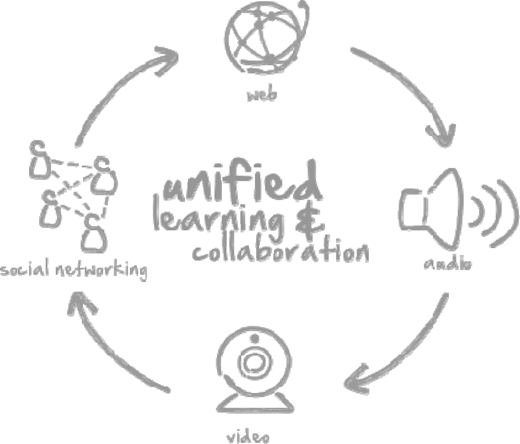
Unifying Content, Instruction, and Expertise
According to the recently released U.S. National Education Technology Plan (NETP) (U.S. Department of Education, 2010), an essential component of what the report calls a twenty-first century model for learning powered by technology is a comprehensive infrastructure for learning that provides every learner, educator, and level of our education system with the resources they need when and where they are needed. The report goes on to describe an infrastructure that includes people, processes, learning resources, policies, and sustainable models for continuous improvement in addition to connectivity, hardware, and applications.
Elluminate concurs. To ensure that learning happens in a better, faster, and more efficient way, we must unify enterprise technologies to provide easy access to resources that include content, instruction, and expertise. Embedded in and surrounding these three core blocks are a wide variety of components, including:
real-time (synchronous) sessions;
non-real-time (asynchronous) sessions;
video-focused sessions;
data-collaboration-focused sessions;
blended focus of location, technology, and learning styles;
large-group interactions;
small-group interactions;
one-to-one interactions;
mobile learning and educational networking;
planned and spontaneous interactions;
multiple moderation modalities from tightly controlled to open;
learning management systems and portal integrations at log-in as well as granular learner and instructor level; and
edges of platform open for third-party development.
Supporting “Connected Teaching”
The NETP introduces the concept of “connected teaching,” in which isolation is replaced with connection that includes 24/7 access to the information, tools, content, resources, systems, and expertise that empower educators to improve their own instructional practices and create engaging and relevant learning experiences for their learners.
The components to support connected teaching are available now. Unified learning and collaboration is about unifying enterprise technologies—infrastructure, applications, and social networking—in a way that’s optimized for education to improve learning and ensure efficient administrative operations. ULC is not just about communication. It’s about the context of that communication and making it instant and accessible, personal and meaningful, active and participative, and connected to relevant content and instructors, and expertise.
Facilitating the Business of Education
Education and training in the twenty-first century is all about keeping existing learners and attracting new ones with universal access, personalized and flexible learning, and a global reach. It’s also about maintaining competitive advantage, reducing costs, and creating a culture of collaboration between departments, campuses, institutions, and organizations.
ULC is not just for the classroom. On an organizational level, this approach can help increase competitive advantage, support strategic planning and decision making, and enhance productivity for faculty and staff. The time has come to blend pedagogy with sound business decision making. With ever-decreasing budgets, academic institutions and training organizations must balance important educational impacts with bottom-line revenue implications, including a rapid return on their investment in technology. A ULC approach can help of all sizes integrate online interaction into all their daily activities, enabling them to communicate, collaborate, and educate more effectively in the global community.
Conclusion
ULC can enable academic and training organizations to realize exceptional outcomes that include:
enhanced learning experiences;
increased learner comprehension, knowledge, and satisfaction;
increased retention and completion rates;
larger educational impact through opened classroom boundaries;
increased adoption of learning technologies;
enhanced teacher effectiveness;
operational efficiency and increased productivity;
leveraged technology infrastructure and rapid return on investment; and
reduced travel and physical infrastructure costs.
At Elluminate, we understand that twenty-first century education requires twenty-first century solutions. As the NETP explains, we don’t have the luxury of time. The time to act is now. Welcome to the age of unified learning and collaboration.
For more information about unified learning and collaboration, download the entire white paper from http://www.elluminate.com/Resources/White_Papers/?id=95/
To view a unified learning and collaboration presentation, visit http://www.youtube.com/user/Elluminated#p/a/u/2/tpJBEyAGkY8
About the author