Brendan Behan said in 1956 that “There’s no such thing as bad publicity except your own obituary.” This quote may be prophetic for the field of distance education given the recent negative publicity about apparent abuses by schools and universities offering online courses.
One of the most critical of the recent articles about online education was by Kevin Carey (2010) in the Chronicle of Higher Education that was titled, “Why Do You Think They’re Called For-Profit Colleges,” where he summarized the concerns of the U.S. Congress about the massive amounts of Pell Grant and guaranteed student loan dollars used by students enrolled in online colleges. Of special concern were the extremely high default rates for repaying guaranteed loans by students in online programs.
Other articles have appeared in the popular media, such as USA Today, where lawsuits by disgruntled online learners have been reported (Marklein, 2010). And, almost every local newspaper has reported on concerns about online education, especially when programs are offered by for-profit colleges; a phenomenon that for many is a new and often misunderstood approach to education.
Certainly, many credible professionals at “for-profit” online colleges work hard to design rigorous courses and offer quality degrees. Just as certainly, the popular press has made many parents, students, and members of the general public question the propriety of distance education. This should be a major concern for those committed to online teaching and learning.
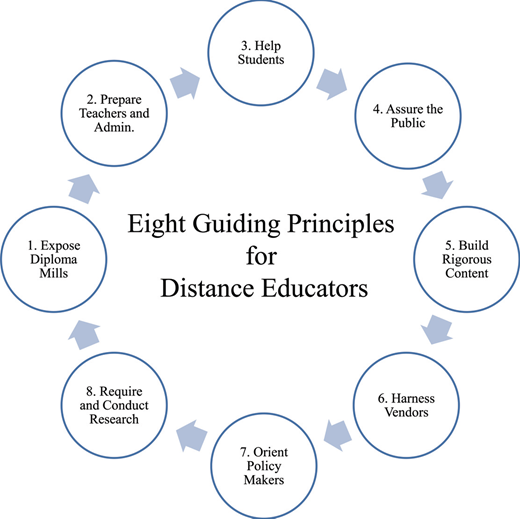
In a recent speech titled, Cautious Optimism (Simonson, 2010), eight guiding principles for those dedicated to high quality distance education were offered. These principles were presented as steps to reduce abuses and promote high quality online learning. The eight were:
Expose diploma mills, especially those “close to home.”
Prepare teachers and administrators so they practice and expect best practices.
Help students understand the requirements for a rigorous online experience.
Assure the public, not with publicity but with research and quality examples of effective instruction.
Build rigorous content that is open to view and easily accessed by anyone who wishes to review it.
Harness vendors who may have excellent products but who are not decision makers in the education process.
Orient policymakers so that members of school boards, legislators, and government agencies know what to demand when online instruction is offered.
Require research, and link research and evaluation to adoption and implementation.
And finally, as of today no distance education obituary has been written, even in draft form. However, distance education is a field that to be accepted must be above reproach. Distance educators must demand openness, quality, and rigor.
About the author