Introduction
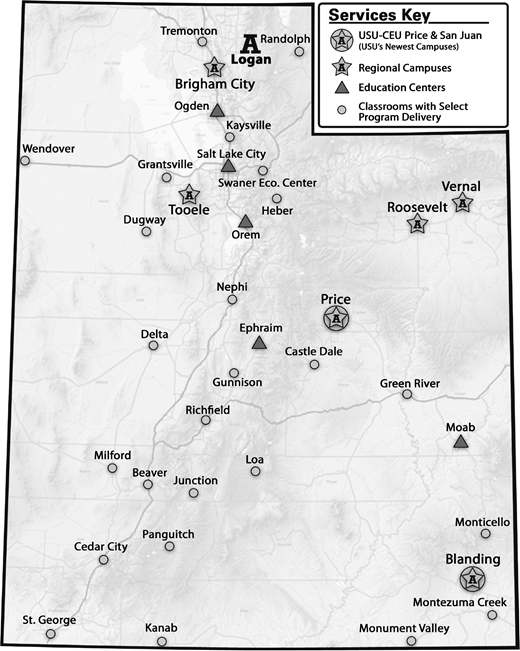
President Stan Albrecht describes Utah State University (USU) as “one university geographically dispersed.” The description could not be more accurate as nearly one half of the 35,000 students attending USU live, work, and study miles from Logan, Utah, where the university began. In addition to the Logan campus there exist a number of additional USU campuses situated throughout Utah and numerous other sites and facilities where students can attend classes and receive advising.
The Regional Campus and Distance Education (RCDE) system of USU is charged with ensuring all students throughout Utah have access to the same quality programs that are offered in Logan. This article describes the context in which we work, the instructional planning that ensues, the new ideas and innovations we employ, and our ongoing evaluating reflections to assess how successful we have been and where changes need to be made.
Utah State University has been serving the people of Utah since its founding in 1888. As a land grant institution it was designated as an institution of higher education in the United States to receive the benefits of the Morrill Acts of 1862 and 1890. The Morrill Acts funded educational institutions by granting federally controlled land to the states for them to develop or sell to raise funds to establish and endow “land grant” colleges (Cohen, 1998). The mission of these institutions as set forth in the 1862 act is to focus on the teaching of agriculture, science, and engineering as a response to the industrial revolution and changing social class rather than higher education’s historic core of classical studies.
USU, like most land grant universities, has greatly expanded its degree offerings. Its School of Teacher Education and Leadership specializes in undergraduate, graduate, and doctoral level teacher education. The College of Education and Human Services of which education is an integral component has received national recognition for its exemplary teaching and research. As USU becomes more geographically dispersed we intend to maintain the same high quality of education to students throughout Utah.
Historically, distance education professors and instructors traveled from the USU campus site in Logan, Utah via car and sometimes plane to provide programs and instruction to students who were unable or unwilling to travel to Logan for their coursework. While the majority of the population of the state lives along the Wasatch Front, in cities such as Ogden, Salt Lake City, and Provo, others live in rural locations where travel to Logan can take hours. Elements of distance education were used in the past; however, the technology was typically basic, sometimes unreliable, and often costly.
Responding to our Responsibility
Several years ago, in response to a growing need and desire to provide better educational services and programs, the USU Regional Campus and Distance Education (RCDE) System was established with substantial financial and leadership support from the State Legislature, Utah Board of Regents, USU administration, USU alumni, and friends throughout the state who saw the potential of such a program.
Technologies used today by RCDE to provide access to preservice and inservice teachers’ education include two-way video and audio such as interactive video conferencing (IVC), live one-way video and two-way audio such as Wimba, and various online course models. One model is WebCT’s current format called Blackboard, which gives student access to teacherdeveloped assessments, files, web links, streamed videos (such as Camtasia), lesson modules, an asynchronous discussion board, and synchronous chats.
A recent RCDE innovation has been the use of a “hybrid” model for class scheduling and implementation where broadcast instruction (IVC) is alternated with online course instruction. This model was implemented in spring semester 2009 as students in the new paraprofessional-to-teacher education program advanced to Level III methods courses. Previously, the class schedule was dictated by one that had been used for years for students on the Logan campus. When we began it became obvious that this traditional schedule created obstacles and provided hardships for many RCDE students. Methods courses taken concurrently in one semester created a heavy credit load in light of the other life demands these students faced. We sought a way to respond to the unique needs of the RCDE student culture.
A solution resulted when we adapted our scheduling and instruction using the technology as it had not previously been used at USU. Offering half of each course online served to increase the amount of flexible “seat time” required for these dayworking students. The IVC sessions are broadcast in the evenings to further facilitate student schedules. During online portions of each class students can choose the time they view and participate in the lesson activities. Their weekly seat-time schedules are economized and consistent with two classes that alternate sharing each time slot. Students complete online sessions on their own schedule and gain the flexibility of meeting other life demands. The RCDE Teacher Education Program has been a win-win situation for all involved. Students take their classes in a more compacted form. This delivery method allows them more time meet the many demands of the family, work, and home lives beyond school. For some it resulted in reduced driving costs, as fewer trips between home community and campus were required. Student safety was increased as they drove fewer miles over hazardous mountain roads, particularly in bad weather. Students can continue their lives as they pursue their dream of education.
Bumps in the Road
The expansion of the use of technology within the RCDE has not come without its challenges. Associate Dean of the School of Teacher Education and Leadership, Martha Dever, likens our expansion to “building the highway as you drive down it.” Nearing the capacity of bandwidth, ensuring sufficient number of rooms to provide the growing number of classes, course scheduling, and maintaining the majority of instruction provided by USU professors are just several of the challenges faced. The RCDE system understands that such challenges are to be expected and are considered opportunities from which to learn and improve.
Evaluating our Progress
While the formats and technologies for delivering teacher preparation courses in USU’s RCDE have evolved and changed dramatically from traditional course delivery in Logan, the evaluation process required by TEAL has not. As is the case in many teacher preparation programs throughout the country, USU employs a basic Student Survey of Instruction to provide student feedback to course instructors. The results of the student evaluations are weighed quite heavily in the eyes of both promotion and tenure committees and course instructors interested in valuable feedback that can improve future instruction. However, with RCDE faculty using instructional strategies combined with new technologies in recent semesters, many questions of how to distinguish student evaluation of instruction versus student evaluation of their interaction with technology persist. These questions include:
Is delivering teacher preparation coursework over a hybrid, distance education model as effective as traditional face-to-face models?
Within the hybrid model (which includes face-to-face, online, and broadcast formats) are there certain assignments or instructional techniques that are more effective for optimizing student learning?
How are RCDE preservice teachers viewing the quality of their distance education courses and overall teacher preparation program?
To evaluate our progress as part of the formative evaluation process for documenting excellence in teaching (Seldon, 2006), faculty asked RCDE preservice teachers about their feelings and experiences regarding USU’s evolving hybrid distance education models. Preservice teachers have described that while having an instructor present for face-to-face teaching is good, there can also be benefits to aspects of online coursework. A common anecdote shared by some preservice teachers is that online work allows a deeper, more thoughtful and reflective inquiry into a class topic than would be afforded in a face-to-face classroom. This perspective appears somewhat common among other universities exploring the hybrid model (Campbell, 2006; Vonderwell & Turner, 2005; Weedman, 1999).
Additionally, preservice teachers have shared some learning benefits specific to the hybrid model. For example, several preservice teachers have enjoyed working on course tasks independently during the online week when it is followed by a face-to-face or broadcast discussion during the next week; they explain that this encourages them to take more individual risks and think deeply about a topic, knowing that their ideas, questions, or misconceptions will be addressed during next week’s open discussion. On a more pragmatic level, when preservice teachers are asked about their preferences regarding online options such as synchronous versus asynchronous online sessions, many of them state that they prefer an asynchronous online format due to the flexibility it affords them to schedule coursework around their jobs and families.
As the field of research investigating issues and quality of distance education models in teacher preparation emerges and grows, we look forward to pursuing research and sharing our findings.
Changing Lives, Creating Opportunities
USU–RCDE student Jennifer Barone dreamt from a young age of being a teacher. Today that dream is a virtual reality. Jennifer is one of a growing number of students in rural communities participating in the Elementary Teacher Education Program. Jennifer has recently completed her Level III coursework where she has learned instructional methods in teaching language arts, mathematics, reading, social studies, and science. She is now developing the skills she learned in managing a classroom and educating young learners in a rural school in Utah.
In many ways, Jennifer does not fit the model of the typical education student in most universities in Utah or across the nation. Jennifer is a “nontraditional” student in that she delayed her education so she could raise a family before she resumed her educational pursuit. She brings with her a wide range of real life skills and experiences and a solid realization of the opportunity and the value of education. Jennifer states, “Being able to earn my teaching degree while living in a rural area has been an unbelievable opportunity. I specifically chose USU because I could earn my degree and stay close to home. I’m always praising USU’s commitment to their distance ed students. This has been an opportunity that will change my life and my family’s lives forever.”
Mentor teacher Mrs. Larsen is proud of the progress she sees in her students as well as Jennifer’s evolution as a teacher. Larsen remarked,
Jennifer Barone’s ability as an elementary educator is evident in her capability to adapt to the instructional needs of students through technological integration, management techniques, and content area knowledge. The students and I feel fortunate to benefit from the blossoming flower USU’s distance education grew. I am impressed with the distance education program and am pleased to see it brought to the forefront.
Jennifer Barone is changing the lives of those she teaches because of her involvement in USU’s distance education program. Associate Dean of the School of Teacher Education and Leadership Martha Dever believes that educational opportunities for teacher candidates in rural communities not only affect the future of elementary children in positive ways, but also are having a dramatic impact on people like Jennifer for whom post secondary education had previously been a distant dream. Dever states,
There are many people throughout Utah who would make excellent teachers; however, for a variety of reasons, are not able to relocate to study on the Logan campus. Under our current system of regional campuses, our students in rural areas have access to a quality educational experience in their communities that parallels that of students on the Logan campus.
Summary and Conclusion
The growth, development, and expansion of the USU Regional Campus have exceeded all expectations. Obviously, there remains a tremendous amount of work to be continued and problems to solve that have not even been considered. What we have discovered is that such change requires dedication, commitment, and innovation. We realize that what has been done successfully in past may only point the general direct of future steps and we must be open to new ideas and opportunities. One administrator summed up his feelings about the RCDE at a recent meeting when he stated, “Years from now we will look back and know that at the outset good things were occurring. What those folks in the early days could never have realized is how truly wonderful it has become.”
About the authors