Introduction
Three-dimensional virtual worlds are no longer uniquely the subject of science fiction or computer games but are becoming embedded in the fabric of the twenty-first century’s social environment. Virtual worlds have the ability to mirror or diverge from reality presenting the opportunity for collaboration, exploration, and role-playing, and for participation in a wide range of experiences in a safe and engaging way (Kelton, 2007). They differ from the structured environment found in a computer game in that there are no rules to determine a winner, nor are driven by competition or the intent of attaining a goal. People enter these users created virtual communities by adopting an avatar and venturing into an environment that is both similar and different from the real world.
Second Life
Developed by Linden Labs, Second Life is perhaps the most popular multiuser virtual environment and it is becoming increasingly prevalent in mainstream society. Second Life is the largest Internet usercreated, 3D virtual world. If Second Life were a country, it would have a population of 12 million inhabitants (New Media Consortium and Educause Learning Initiative, 2007).
This open source virtual community is part of the Web 2.0 social media applications. Similar to other social networking sites such as Facebook and My Space, it allows users to share media, connect with friends, and to experience a feeling of presence and connectedness to a community. Second Life goes beyond the two-dimensional and static nature of other social networking sites in that user-controlled avatars can navigate the environment by walking or flying, teleporting to other regions, and can make use of numerous gestures such as waving, dancing, or sitting down (New Media Consortium and Educause Learning Initiative, 2007).
Second Life at Valencia
The user demographics for Second Life reveal that 26% are between the ages of 18 to 24 years and 38% are between the ages of 25 to 34. The combined user demographics represent two thirds of the Second Life accounts, a target population of great interest for higher education (Kelton, 2007). The student demographics for Valencia Community College reveal a still younger population clustered in the first adult bracket but when combined, they mirror the profile of Second Life users. Fifty-eight percent of students are grouped between the ages of 18 to 24 years and the median age of a Valencia student is 20 years old (Office of Institutional Research, 2008). Sixteen percent of Valencia students are between the ages of 24-34. Nevertheless, the combined demographics of Valencia students between the ages of 18-34 also represent two thirds of the student body (Office of Institutional Research, 2008).
The Horizon Report of 2007 identified virtual worlds as an emerging technology likely to have a large impact in teaching and learning in higher education in 2 to 3 years adoption time. The forecasting of the Horizon Project, a research-oriented initiative conducted by Educause in collaboration with the New Media Consortium seems coming to fruition although still to reach critical mass.
Valencia Community College is among more than 200 universities or academic institutions nationwide having a presence in Second Life. Its virtual campus resides in one of the near 300 virtual islands devoted to educational purposes (Kelton, 2007). Approximately 700 instructors around the world are using immersive environments such as Second Life to provide an engaging context for teaching and learning in fields ranging from the arts, humanities, to the sciences. The faculty at Valencia is part of this growing group of educators (Antonacci & Modress, 2008).
The Making of Virtual Valencia
The initiative to develop a Second Life virtual campus at Valencia was spearheaded by Angelique Smith, director of learning technology and alternative delivery, as an opportunity for faculty to engage with peers through the world in learning new ways to teach and engage students in immersive learning environments. She also envisioned Second Life as a platform for students to learn more twenty-first century skills as computers and technologies continue to evolve (A. Smith, personal communication, December 2, 2009.
The initiative surpassed its initial scope when instructional designer Eddie Howell became involved in the development of a virtual campus for Valencia Community College. Howell has been creating multimedia since 1991, including 3D characters and virtual environments and for the past ten years, and has been advancing his knowledge in virtual technologies and simulations in education. The time was ripe at Valencia to use virtual worlds to reach beyond the institution boundaries and provide students with the opportunity to learn in an immersive environment that could overcome the limitations of time and space.
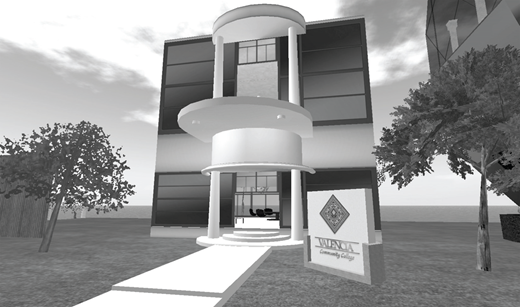
Howell conceived the environment as an open space and drew inspiration from the architectural forms of the brick and mortar campus. He was inspired by the cylindrical and avant garde look of the East Campus library but took it further to create a virtual campus without walls. Furthermore, he built the virtual classrooms setting them up above cloud level freeing the ground level for welcome and student interactive areas (E. Howell, personal communication, November 24, 2009).
After conducting an online survey, Howell designed the Virtual Campus, integrating both the needs of the students and faculty members. The welcome area has a campus directory and shelves with free objects which provide students and prospective students with information about Valencia Community College. In addition, the environment includes a “sandbox” hands-on area where students can build their own items for 6 hours before the virtual items are returned to them (E. Howell, personal communication, November 24, 2009).
The virtual classrooms provide a space for active learning and multimedia interactivity. Howell customized the open classrooms for seating and enabled technologies for audio and video display. Instructors are able to bring objects to personalize the classroom environment and students are encouraged to finish the classroom by contributing themselves objects and sharable media (E. Howell, personal communication, November 24, 2009).
The Virtual Classroom at Valencia: A Case Study
The majority of faculty members at Valencia Community College belong to the generation born before the digital explosion initiated after 1980. The average age of full time faculty is 47 years old (Office of Institutional Research, 2008). Using Prensky’s (2001) term, we see that “digital immigrants” are teaching a generation of “digital natives.” Howell, however, considers the skills needed to teach in a virtual world, such as Second Life, as not inherently different from those needed to navigate the two-dimensional Internet and asserts that most faculty members were able to adapt to websites and course management systems in the first digital wave. The skills needed, in his estimation, are the ability to be organized and self-motivated to be an independent explorer (E. Howell, personal communication, November 24, 2009). Professor Ed Frames, a 70-year-old senior faculty member, fits this profile. He is one of the educators who are taking the adoption of Second Life to what Rogers identified as critical mass. Rogers considers that critical mass in the diffusion of interactive innovation is reached at the point when enough individuals in a system have adopted an innovation so its further rate of adoption becomes self-sustaining (Rogers, 2003, p. 343).
Frames, who teaches a fully synchronous honors world mythology class using Second Life, saw the advantages of teaching through a 3-D learning environment after attending an Honors conference. This learning immersive experience affords him new opportunities that are not available in regular online courses. On the verge of renouncing online teaching, finding insurmountable the transactional distance of the asynchronous online environment, Second Life became the natural extension of the traditional classroom and paradoxically afforded Frames more, not less, teacher control (E. Frames, personal communication, November 20, 2009).
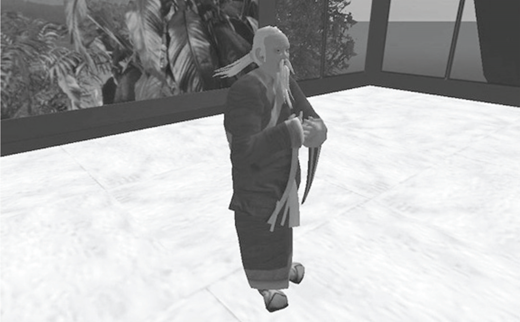
Emulating his most admired teacher, Confucius, who believed that education was the key to success and self-realization, inspired his selection of his avatar. Having an avatar to interact with students restored a sense of connectedness and presence, absent in the disembodied online classroom. The virtual physical embodiment possible in Second Life provides an educational experience that elicits emotional involvement and implies a higher level of engagement (Kelton, 2007). Students are so deeply connected to the master teacher personae they complain when Frames changes his avatar when trying to adopt an identity that would best suit the topic of the session (E. Frames, personal communication, November 20, 2009).
Counterintuitively, what attracted Frames to an immersive environment such as Second Life, was the capability of doing what he knows to do best in his “first life”: lecturing, and it is deeply personal. Most of his PowerPoint presentations, playing on a projection screen in his virtual classroom, are based on his travels around the world. They include visits to historical and archeological sites such as Machu Pichu in Peru and Chichen Itzá in Mexico. As he shows the slides, Frames fields questions from students in the text chat, simultaneously explaining the significance of myth and worldview. The Virtual Valencia classroom in Second Life surpasses the brick and mortar environment, as he is able to use his ideas decorating the classroom so that when students come in, they find a different theme especially suitable to a world mythology class (E. Frames, personal communication, November 20, 2009). Virtual objects pertaining to the myths of the given culture he is analyzing, decorate the classroom without walls. During the Latin American mythology session, a massive Devotional Stone of the Sun sat at the center of his virtual classroom as he deciphered the meaning of a world that gave way to conquest and colonization by the Europeans.
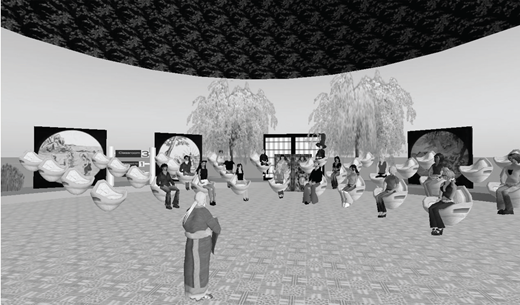
One of the unique features of Second Life is that it is an open world. Different from the brick and mortar classroom, or an online chat room inside a learning system, Second Life is always open. This virtual world is persistently available for exploration and learning. Once in Second Life, this persistence extends learning beyond a defined space since there are other worlds to explore and people to meet (Robbins-Bell, 2008). Furthermore, the immersive nature of the experience as participant in virtual worlds offer learners an opportunity for engagement with other times and places (Jeffery & Collins, 2008). Frames considers that feature enriches a world mythology class since he can combine his lecture with virtual field trips to museums and environments dealing directly with the cultures referenced in his course.
Interestingly enough, Frames is not consciously aware of the strides he is making in this virtual environment which are gradually taking him to a learner-centered level of teaching. He is graciously unaware of the deep sensory shift he is experiencing as he lectures in a multimodal communication learning environment. Frames uses voice chat to deliver his lecture but students are asking questions and making comments in the text chat. Students are also communicating among themselves using the instant messaging channel.
There is a lot of simultaneous communication that is unacceptable in a real life classroom (E. Howell, personal communication, November 24, 2009). His perception is that students are comfortable while he is speaking to type in questions that appear on the screen, knowing they are not disrupting his lecture as he has time to finish his sentence before responding.
Another big step toward learner centered practices is to hold an end of semester virtual get together in which Frames discusses possible ways of improving the world mythology course. As a result, he has relinquished control of selecting the sites to visit during class, thus empowering students to assume responsibility in the learning process. Each week two students are assigned to scout and select beforehand the worlds to be included in the virtual field trips. Furthermore, students serve as guides during class taking the group to the most interesting points. Attendance to the virtual field trips consists on taking snapshots of the visited worlds, a feature enabled in Second Life, to be submitted as screen captures via e-mail to the instructor (E. Frames, personal communication, November 20, 2009).
Underlying apparent seamless lecture sessions is the ability to integrate pedagogical, managerial, social, and technical tasks to create an immersive learning experience (Collins & Jeffery, 2008). Frames opens the session with two general questions related to mythology but tied into the lecture, such as inquiring about the role of concepts of giants, and small people and their origins. At the same time, he creates a friendly and social environment in which learning is promoted and makes students comfortable with the technology to the extent that it is seamless. In addition, he performs the managerial task of setting the agenda of activities and virtual field trips, and he establishes procedural rules and manages the interactions with leadership during the session. Focused on the capability to lecture in this environment, he seems unaware of the level of dexterity and proficiency he exhibits in performing these faculty roles in the context of a complex immersive learning environment.
Learning Results
At the end of this journey into a world mythology class in Second Life at Valencia Virtual campus, the question of rigor arises: does media have an effect on learning or is it the instructional method the independent variable that produces the desired effect of learning? It is understood that one case study cannot confirm a correlation between media employed and learning outcomes. Nevertheless, the retention rate in the Second Life world mythology class is 100%; in the three semesters that Frames have taught the course in the immersive environment of Second Life, there has not been a single dropout. A charting of grade averages based on the virtual class versus the brick and mortar experience revealed a higher grade point average for those enrolled in the three-dimensional immersive version of the world mythology class (E. Frames, personal communication, November 20, 2009). Frames must be doing something right in order to enjoy such success.
Conclusion
In an environment where constructivist theories have a profound impact in the way educators approach online learning, there are unique methods that defy the theoretical framework under which best practices are outlined. It is important to take into account the specific context of teaching and learning. Is lecturing totally outmoded? Is the time of the “sage on the stage” totally over? On the other hand, is it possible for three-dimensional virtual environments to elicit a transformative immersive learning and teaching experience and provide a “second life” for seasoned faculty members who otherwise resist teaching online?
Further inquiry is needed to understand the interplay of life experiences of a master teacher within a three-dimensional immersive learning environment. It is, nonetheless, clear that user created virtual worlds, such as Second Life, provide a platform for faculty and students to interact in an environment flexible enough to accommodate different teaching and learning needs and styles (Schlemmer & Backes, 2008).
About the author