Introduction
The attrition of candidates for advanced graduate degrees represents a perennial problem for many institutions of higher education, due to suggested lack of support, stress, and the solitary nature of thesis writing. Research by the National Center for Education Statistics (2007) indicates that a large number of candidates for advanced degrees finish their coursework, but do not complete their thesis. A master’s degree program at Fresno Pacific University has addressed this dilemma, designing an innovative support system to facilitate the thesis writing experience. The use of an enhanced process for mentoring at a distance was devised, including the creation of an online course, the use of a virtual classroom, and an enhanced communications system. These features addressed the deficit issues, better supporting the candidates in the process of writing their thesis at a distance, and increasing the number of graduates.

Program Director for the Master’s Degree in Curriculum and Teaching, Fresno Pacific University, 1717 S. Chestnut Avenue, Fresno, CA 93702. Telephone: (559) 453-5550.
Program Director for the Master’s Degree in Curriculum and Teaching, Fresno Pacific University, 1717 S. Chestnut Avenue, Fresno, CA 93702. Telephone: (559) 453-5550.
Context/Background
Fresno Pacific University (FPU) is a private, accredited, medium-sized master's university founded in 1944 by the Pacific District Conference of Mennonite Brethren churches as a response to the desire of the denomination to be able to provide quality higher education for their youth. The vision for the institution was that FPU would be “a leading Christian university known for academic excellence, innovative programming and spiritual vitality” (Fresno Pacific University, 2011). FPU currently serves over 3,300 students in their graduate, undergraduate, and degree completion programs at their main campus and three regional centers.
It is located in the heart of the California Central Valley, a region which is largely agricultural, whose residents reflect some of the greatest ethnic diversity in the nation, with at least a hundred different primary languages represented by students entering the public schools, and economically has been referred to as “California’s Appalachia,” with more pockets of deep poverty than any other city in the United States—not an enviable statistic. According to a 2005 analysis by the Brookings Institution, Fresno ranks first in the country among large U.S. cities for concentrated poverty, with 43.5% living in “extreme poverty” neighborhoods (Berube & Katz, 2005). Extreme poverty is defined by having more than 40% of the residents living below the federal poverty threshold. Many of the students at FPU are the first in their families to graduate from high school, and enter college hoping to be the first to graduate with a bachelor’s degree.
Challenge Addressed
The challenge of the attrition of graduate students became evident as new ways of aggregating data in the School of Education began to be utilized. Records illustrated the fact that a significant number of candidates were not graduating; they were finishing the coursework, but were not completing the summative assessment, the thesis. A survey was done of all candidates in the Curriculum and Teaching master’s degree program who had enrolled in the last 5 years. The purpose of this survey was to determine the degree to which the candidates felt supported in the process of completing the thesis, what they saw as stumbling blocks to their completion, what suggestions they could offer to strengthen the process, and to ascertain how many had actually completed. The results indicated that:
between 50 to 60 percent of candidates who enrolled actually completed their master’s degree program,
candidates felt unconnected with the university once coursework was completed,
candidates felt unsure of the procedure and process of completing the thesis, and
candidates were daunted by the scope of the requirement and had difficulty knowing how to focus their research to manageable proportions (Janzen, 2007).
An initial attempt was made to address the low completion rate by assigning mentors to work with each individual candidate. This provided a sense of facilitation for the candidate, but this strategy lost effectiveness in that most mentors were adjuncts who were not clear themselves as to what the requirements were. Support was sporadic and inconsistent. Interviews with the mentors revealed a high sense of frustration in feeling responsible for the candidate’s successful completion, but with very few resources.
Defining a Goal
The objective of defining the goal of how best to meet the identified challenge began with a collaborative process. Faculty and staff, along with the Curriculum and Teaching advisory board acknowledged the deficit and began an ongoing dialogue about how to better support the candidates in the process of writing their thesis. In designing an innovation to address the low completion rate for master’s degree candidates, it was imperative to review the results, weighing the inputs, the processes and the outputs. Kaufman, Watkins, and Leigh (2001) noted that strategic thinkers will “search for their effective and efficient alignment in order to create a successful educational system” (p. 35).
It was also critical to consider pertinent adult learning theory, andragogy, which identifies characteristics of adult learners as well as four critical elements of learning: motivation, reinforcement, retention, and transference (Knowles, Holton, & Swanson, 2005). In order to be effective in designing the innovation, those creating the online course should consider these characteristics and elements in their planning, gearing toward how adults learn best. A basic rule of thumb in planning learning experiences for adults in a graduate school is to enhance the candidate’s reasons for pursuing the advanced degree and to remove the barriers. Addressing the unique needs of adults in the design process facilitates the creation of relevant learning environments for the population being served. In the formation of the components of how to best create an enriched mentoring system these precepts were helpful guides.
Enriching the Mentoring System
The goal recommended by the collaboration between faculty, staff, and the Curriculum and Teaching advisory board was to create a support system that would enrich the mentoring process, lessening the transactional distance (Moore, 2007) between candidate and mentor. This support system was envisioned to have four components which would remove barriers and facilitate communication and a sense of connection. Figure 1 illustrates the components, along with the recommended medium and the potential benefits.
Figure 1 illustrates how an enhanced system of mentoring at a distance could address the problem of low completion rates, as well as candidate and mentor concerns. The system design proposal suggests the following:
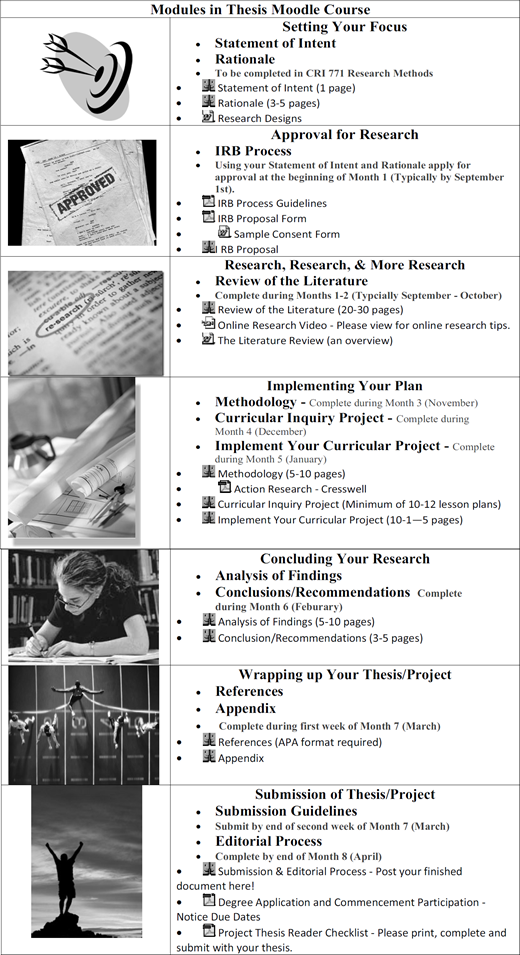
The creation of a Moodle course (see Appendix A) for candidates, facilitated by the program director, which would:
provide direct communication with advisor/program director,
house a timeline and provide organized access to all necessary resources,
allow for easy communication between candidates and mentors, and
facilitate collaboration between candidates and the ability to view each other’s submissions.
The development of a system of increased interaction and communication between mentors and mentees using Elluminate and Skype, along with increased editing capabilities using Word review features, and
The use of DropBox for easy document exchange and access to most recent version of the thesis.
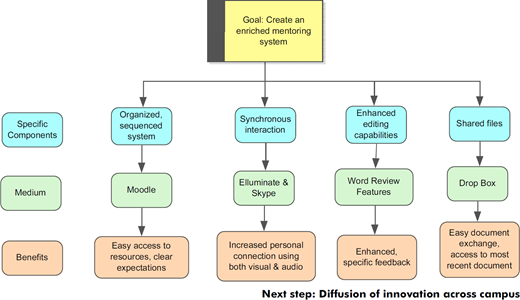
Recommendations from advisory board.
Recommendations from advisory board.
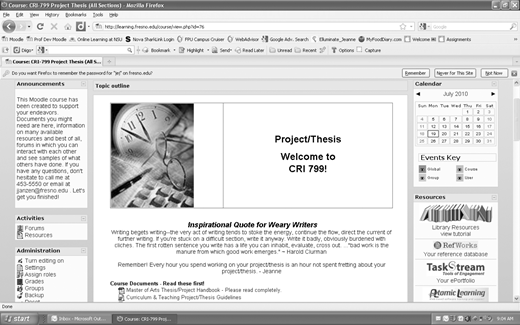
Screen shot of Project/Thesis Moodle Course.
Screen shot of Project/Thesis Moodle Course.
Developing a Vehicle for Support
The first step in creating an enriched mentoring system was to develop a vehicle for support by using Moodle, a course management system. The Moodle course (see Figure 2) was designed to foster increased communication with both the program director/advisor and the candidate’s mentor, keeping in mind the interplay between Moore’s (2007) variables: structure and dialogue. In this case flexibility within structure was the goal along with building in the opportunity for synergistic dialogue.
It was organized using a module for each component of the thesis, making it easier for the candidate to follow. A resource block was provided with direct links to FPU’s online databases, access to RefWorks, an online bibliographic tool, access to TaskStream, which provides the opportunity to create ePortfolio if desired, and Atomic Learning, step-by-step online tutorials for over 130 software applications. This newly created Moodle course would give candidates a greater sense of clarity regarding the process and increase their feeling of connectedness to the university and its resources.
Utilizing Synchronous Interaction
Synchronous interaction was generated by utilizing Elluminate and Skype to facilitate mentoring sessions between candidates and their mentors. Elluminate allowed the mentor to meet either individually with mentees or as a group. Communication could be done verbally using the microphone, visually using the icons, or through text using the textbox. A whiteboard was available for brainstorming or for the recording of ideas generated. The mentor was also able to access the resources in the Moodle course by sharing applications, reviewing the pertinent links at the point they were most needed. Documents could be shared for review and formative feedback.
Skype, voice calls over the Internet, was utilized for one-on-one conversations. Communication was both visual and auditory and provided a very efficient tool for quick responses to questions. International students had easy access to the expertise of the mentor using this tool, as did those nearer in distance.
An engaging method of introducing the use of synchronous interaction to the mentors was used, extending an invitation to an “Elluminate Mentor Party” (see Appendix B). At this first Elluminate session they were given an orientation to Elluminate, to the online thesis course, and to the other required tools. Mentors had the opportunity to interact with each other, ask questions, and become acquainted with the virtual classroom environment. This orientation was followed by a brief questionnaire asking for responses on: a) perceived effectiveness of the tool, b) user’s comfort level with the tool, and c) possible suggestions for further in-service training or support required. Feedback from this session was enthusiastic as mentors became aware of the capabilities of the new tools and the potential benefits.
Utilizing Advanced Editing Feedback
Using Word’s review capabilities to give “comments within text” afforded an excellent avenue for providing feedback. In this process, when comments were given within text, the candidate addressed each comment, but did not remove them. When all comments were addressed, the document was sent back to the mentor, who reviewed all corrections, removing comments when adequately addressed. When a section was finished to the satisfaction of both candidate and mentor, it was posted in the Moodle course, where it could be viewed and interacted with by other candidates.
Utilizing Shared Files
Sharing files made the process of accessing the most recent version of the document easy for both parties. DropBox was a tool that made this possible and also allowed candidates to access their document from anywhere they could log onto the Internet. It also functioned as a backup file for the candidate’s work.
Outcomes
The implementation of the innovation, an enhanced system for mentoring at a distance, has occasioned significant results within the curriculum and teaching master’s degree program. In comparison to the original survey results, the new data showed marked benefits:
candidates were clear about the expectations of the thesis endeavor and were better able to manage their time and efforts,
candidates felt a sense of connection throughout the thesis writing experience, supported by necessary resources, and encouraged by their colleagues, and
over 86% of candidates who enrolled completed their master’s degree program (Janzen, 2010).
With these positive results, the desire to share the innovation more widely within the School of Education became the next objective. A review of Rogers’ (1995) diffusion of innovations theory informed the question of how to approach the task.
Diffusing Innovation
Rogers’ (1995) diffusion of innovation theory defines diffusion as the “process in which an innovation is communicated through certain channels over time among the members of a social system” (p. 5). It suggests that the rate of adoption is increased when: (a) the innovation is seen as better than the previous idea, (b) it is compatible with the values and norms of the social system, (c) it is not too complex to understand and use, (d) it can be experimented with on a trial basis, and (e) it yields positive results rather quickly. These elements are addressed in developing the plan for diffusing the model at FPU.
Diffusing the Model at Fresno Pacific University
In strategically planning the steps for diffusing the model at FPU, the results from the Curriculum and Teaching implementation would be strong testimony. The positive data illustrates the probable result of greater numbers of high quality, academically-pre-pared graduates who contribute effectively to the community and society. It demonstrates the effectiveness of facilitating a greater sense of connection (mentee to mentee, mentor to mentor, and mentor to mentee) and with the university. Candidates would no longer feel that they are “flying solo.” This innovation would also increase the number and quality of alumni who are satisfied with their graduate experience at Fresno Pacific. They are more willing to support its endeavors; an obvious result highly valued by the university. The implementation of an enhanced system for mentoring at a distance would facilitate stronger WASC data in the number of candidates who are mastering the required “desired student outcomes” and meeting the goals and objectives of the university.
The innovation would be “marketed” first at the academic level to garner both the necessary approval and a vetted legitimacy. The academic steps include:
approval by the dean of the School of Education and the provost,
presentation using PowerPoint for discussion to the ad hoc Task Force on Thesis/Summative Assessments,
presentation for approval to the Graduate Academic Committee, and
presentation for dissemination to Graduate Caucus.
A final recommendation would be to assess the implementation of the innovation within the School of Education in a variety of ways, giving an array of differing viewpoints an opportunity to be heard. The Moodle thesis course contained an online course evaluation via Survey Monkey in which both the candidates and the mentors would have the opportunity to give feedback, suggestions, and recommendations. The School of Education would also run the completion rate data and compare it to previous figures to determine the effectiveness of the innovation. This information would be reviewed by program directors and the Graduate Academic Council, chaired by the dean, to evaluate efficiency, possibly suggesting adjustments or additions. The institution of these practices will create a continuous feedback loop designed to inform improvement and enhance the effectiveness of the innovation.
Summary
The implementation of an enhanced system for mentoring at a distance stood candidates in the master’s degree in Curriculum and Teaching program at Fresno Pacific University in good stead. It stands to reason that diffusion of this innovation to other institutions would serve to facilitate candidate progress in the thesis writing experience, enhance communication, and increase the number of graduating candidates. An interesting next step would be to test the innovation at the doctoral level, to facilitate the dissertation writing experience, and increase the number of candidates who graduate with their terminal degree.
In higher education, low completion rates are not to be accepted and should provide impetus to seek out an improved system. Kaufman, Watkins, and Leigh (2001) note that when institutions fail to compare “the cost of potential intervention against the often unconsidered cost to ignore the need (gap in results)” (p. 151), achieving desired outcomes or useful educational results becom.es highly improbable. Educational institutions today cannot afford to tolerate “what is” when a transition to “what should be” can prove to be substantially beneficial to the individuals involved, the institution, and society at large.