Introduction
Look around. The days of an education that solely includes a chalkboard, desk, paper, pencil, and a textbook are slowly disappearing. In their stead, classrooms are coming alive with moving, constantly updating technologies. Look around. The students who walk into your classroom are entering “connected.” Many are arriving with knowledge of how to collaborate, create, and discuss in a variety of online formats. Look around. The definition of literacy no longer simply means the ability to read and write. Educators in the twenty-first century are charged with the responsibility to teach students to read, write, and function responsibly in a digital world. It is the role of the educator to preserve important elements of the past while simultaneously embracing the tools of the future. If this charge sparks an overwhelming sense of anxiety, consider this—the basic tenets of education have not changed. In fact, a quality education has always included the ability for students to make connections and build relationships. The challenge here is simply to draw a stronger correlation between the digital literacy skills that the students already possess and the traditional classroom environment.
A Social Perspective
It is crucial to understand what it means to be connected in the twenty-first century. Being connected refers to one's level of self-directed access to the wealth of knowledge that exists in the world. Today, there are a wide variety of outlets to the greater world to foster this connection. Whether it is with a cellular device, Facebook, Twitter, e-mail, YouTube, LinkedIn, or one of the many other applications that exist to connect people with knowledge, the one thing that is apparent is that being connected is in many ways a social activity. Merriam-Webster defines social as “tending to form cooperative and interdependent relationships with others; living and breeding in a more or less organized community” (“Social,” 2011). Students from the Net Generation, also known as Net Geners, are definitely different from students of past generations. These students see the world from a social perspective. This social perspective does not discriminate between purely social activity for entertainment purposes and social activity for learning. In fact, “Net Geners assume continual, constant access to computers, the Internet and each other, via phone, text or some other still-emerging technology. Those factors have changed how Net Geners act and even how their brains function in some areas” (Tapscott, 2009, p. 6). A consistent access to technology has hardwired many students to learn in a way that connects them with other people and the greatest body of knowledge, the Internet. Students who are born into the Net Generation expect those connections to form interdependent relationships that can be categorized into groups that can be future sources of specific information. The question that educators should ask is whether or not current teaching methodologies align with the social perspective on learning that social media tools are offering.
What Is Social Media?
“Social Media integrates technology, social interaction, and content creation using the ‘wisdom of crowds’ to collaboratively connect online information. Through social media, people or groups can create, organize, edit, comment on, combine, and share content” (Rubin, 2011). According to Mayfield (2008), social media shares most or all of the following characteristics:
Participation—Users of social media are active participants. The format encourages contributions and feedback.
Openness—Most social media encourage sharing of information.
Conversation—Social media is often seen as a two-way conversation.
Community—Social media allows communities to form quickly and communicate effectively based on common and specific interests.
Connectedness—Social media readily makes use of links to other sites, resources, and people.
There are seven key social media outlets that are frequently used. Rubin (2011), a representative of the United States Office of Innovative Technologies, provides some insight on the various types of social media:
Blogs: A blog is an easy-to-update website or webpage where authors write regular entries in a diarylike format. The most effective and interesting blogs allow readers to engage in conversations with the author and other readers.
Social Networks: Social networking sites are websites that connect people. In these online communities, people can join (for free) and, at a minimum, establish a page with their profile. The most popular are MySpace and Facebook, which also have groups, which are feature-rich chat boards for members. A popular professional social networking site, LinkedIn, offers sections for jobs, service provider recommendations, and questions. All allow users to find people they know among the members, or look for other members with similar interests or affiliations. These sites make it easy to establish networks of contacts.
Microblog: As its name suggests, microblogging is writing extremely short blog posts, kind of like text messages. Microblogs often house posts that are about happenings of the moment. Twitter is currently the most popular microblog service and lets users post entries up to 140 characters long.
Wikis: A wiki is a type of collaborative workspace, it is a collection of webpages that encourages users to contribute or modify the content.
Video: Short videos are used to communicate all kinds of information by way of websites and popular online video-sharing services. YouTube is a widely popular tool for video-sharing.
Discussion Forums: Discussion forums are places for online communities to discuss topics of common interest. Posts are organized into related threads around questions and answers, or community discussions.
Photo Sharing: Photo sharing has become a key part of the social media landscape, since photos can now be so easily shared on sites like Flickr.
Edmodo: Social Media for the Classroom
While it is necessary to embrace online tools, it is not feasible and quite naïve to suggest that students should be set free on the Internet and told to learn. The suggestion here is to use the ways that students might prefer to learn, create, and interact as a tool to enhance the content that is being learned. With this approach, perhaps the perception amongst students of tools, such as Facebook, that are primarily used for social entertainment, can be changed and “exploited in formal learning” (Poellhuber & Anderson, 2011). Imagine the potential for learning that exists if a child learns about history by following the President of the United States on Twitter or a science assignment to “friend” a major corporation, such as Intel, on Facebook and enter an idea for the next big innovation. What about English coming alive in real time as students follow Terry McMillan's blog? The possibilities for listening, watching, evaluating, reflecting, thinking, collaborating, connecting, personalizing, planning, and finding a voice seem endless. Everyone knows, however, that there is no technological innovation, especially in the classroom, that is not accompanied by conflict.
There is currently some debate as to whether Facebook and other social networking tools that students use in their personal lives should also be used, without change, for educational purposes—this may be like mixing one's work life too closely with one's personal life. But the ability Facebook provides to connect people with people of particular groups and to see their frequent comments, as well as to reply to those comments, is potentially a very important one for education and should be explored, and thought about, by every teacher. (Prensky, 2010, p. 123)
Edmodo is a tool that marries the benefits of social networking with a safe, controlled environment that educators can allow students to freely operate in. Essentially, it is like Facebook for education.
At the time of its second birthday in May 2011, Edmodo had acquired 2 million users and are continuing to grow. In an interview with EdTech Digest, Edmodo cofounder Nic Borg explains what Edmodo is and why it was created. Borg explains,
We live in a connected world where students and teachers depend on technology and online resources in their day-to-day lives.… Edmodo provides classrooms a safe and easy way to connect and collaborate, offering a real-time platform to exchange ideas, share content, and access homework, grades and school notices. (Rivero, 2011)
Capabilities of Edmodo
So, you might be wondering what Edmodo actually does. It is a platform rich in useful features for education. Benefits for the teacher/student include:
Accounts can be created for teachers, students, and parents and is available for all schools and user friendly enough for all grades.
Mobile Access—Edmodo creates an anytime, anywhere learning environment because it can be accessed from any computer or device with an internet connection and also offers free applications (apps) for Apple and Android devices.
Peer Connections—Educators have the unique opportunity to create professional learning networks with like-minded individuals to collaborate on activities or share content.
Classroom Management—Tools are available to post homework, assign quizzes, organize groups, turn-in and grade assignments, update the calendar, reward students, create a library of uploads, and monitor discussions to name just a few. All of this can be completed at the click of a button.
Cost Savings—It is a free service.
Edmodo in Action
At Manalapan High School in English-town, New Jersey, a handful of teachers are beginning to embrace Edmodo as a social networking tool that gets students interested in learning. Jessica Medler, a Spanish teacher, speaks on the ease of use of the program, “Students were easily able to navigate this program immediately because they recognized the navigation as that of something similar to Facebook.… When I realized this, I knew I had won the attention of my students!” (personal communication, November 29, 2011).
Sharing Information
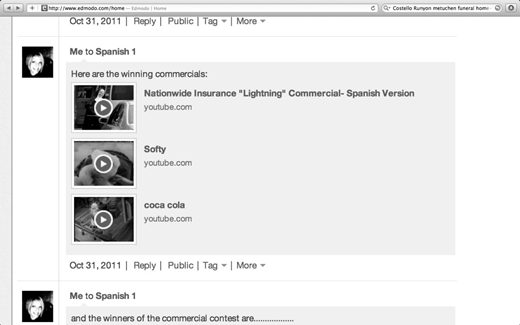
Medler continues to share what a great tool Edmodo can be to create and assign quizzes and share information. On one occasion, Medler required her Spanish I to post videos of popular American commercials that are translated into Spanish (see Figure 1). Students were then able to view each other's postings and listen to and practice understanding the Spanish language being spoken in a recognizable and authentic way.
Engaging students beyond the classroom walls
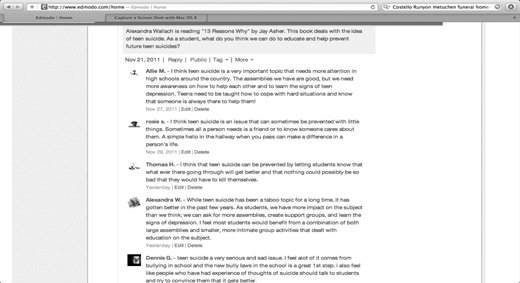
In an English classroom, students were assigned to read an article for homework. Students then were asked to post a response as they read. The result is a real-time discussion (see Figure 2) that helps students see other perspectives and create meaning.

Example of students sharing on Edmodo.
Example of students sharing on Edmodo.
Example of a student discussion occurring in real-time.
Example of a student discussion occurring in real-time.
Example of the quiz creation screen on Edmodo.
Example of the quiz creation screen on Edmodo.
Immediate Feedback
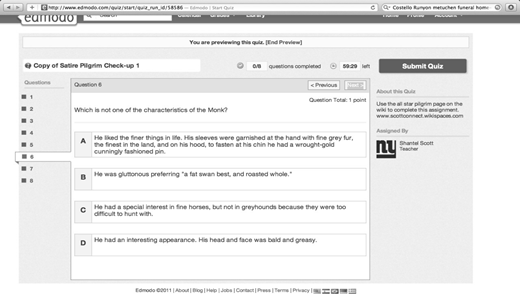
A History teacher assigned a short quiz to be completed online to assess student knowledge of the Middle Ages and Chaucer's The Canterbury Tales. The quiz features (Figure 3) possesses teacher controls that can allow for students to receive immediate feedback after completion of the quiz.
Edmodo in Action
Perhaps the best feature of Edmodo is that the program helps teachers maximize the benefits of an educational social network. The Help Center houses a library of ideas for integrating Edmodo into the classroom environment. The Help Center also offers webinars and other opportunities for professional development.
Conclusion
In a world where students thrive on the amount of time they spend connected each day, a profound shift must occur in the traditional classroom environment. Students in the Net Generation do not want to be lectured to; they want to have their opinions valued, they want to follow their own interests, they want to create, they want to connect with peers to express and share opinions, they want to share control, they want immediate information, and most importantly, want an education that is not just relevant, but real (Prensky, 2010) While some educators might feel tempted to dismiss this list as unrealistic, it would be a huge mistake. In fact, these requests are far from unrealistic. Students can make these requests because they know that the possibility exists. Social media is already providing students the opportunity to learn in this way. The problem is that most students access social media for entertainment purposes only. The mere format and variety of social media provide free opportunities for educators to engage students in a method of interaction and learning for which they are already accustomed. Edmodo is in the business of offering educators the platform to leverage the full potential of the social network for educational purposes. After all, with more than 800 million active users (Facebook, 2011) and 144 million tweets posted to Twitter in a single day (Twitter Blog, 2011), it is clear that social media is not going away. The question is whether or not educators will partner with it to offer the most well rounded education to their students.
About the author