Overview
Online learning in K-12 schools, in community colleges, and in higher education is the choice method of delivery. As traditional K-12 educators move to the role of instructional designers of online curriculum, it is important to recognize that what works in a face-to-face classroom filled with text and textbooks does not always work in a web environment that uses a learning management system. Online learning is not flat, is not text heavy, or a mere replication of the textbook. Good online content invites, motivates, and engages the learner to interact with the online content. The term “engaged” is used here to emphasize that the participants interact with each other around substantive issues (Xin & Feenberg, 2006). In addition, Mitsuhara, Kanenishi, and Yano (2006) coined the phrase “multiperspective thinking” in reference to a learner's need to think about online content from many perspectives beyond their individual interests. All relevant elements need to be explored in efforts to enhance online learning.
The term, “interactive learning” is described as the decisive measure of engagement in an online or in an onground class. As a dynamic relationship between teacher and students, between students and resources, and among students, interactive learning encompasses all content areas and all dimensions of learning. Steinaker and Leavitt (2008) designed the Interactive Learning Taxonomy (ILT) as one of 17 taxonomies educators could employ while engaged in the act of teaching and learning.
The role and function of computer-enhanced learning as well as the level of interactivity for the teacher and learner has long been studied in the literature. “Computer based instruction provides greater potential for truly interactive instruction than any mediated teaching device … excluding the human tutor” (Jonassen, 1988, as cited in Sims, 2003, p. 87). To frame how digital content becomes “interactive,” the ILT and its inquiry needs to include many of the contemporary digital construction tools such as blogs, wikis, learning and content management systems, and other Web 2.0 tools that allow for the easy construction of digital, multimedia-enhanced instruction.
The purpose of this article is to report ongoing action research conducted with K-12 educators in a master's degree program that specializes in educational technology with a focus on teaching online. Action research is defined as the process of “any systematic inquiry conducted by teachers in a teaching learning environment, to gather information about the ways in which their particular school operates, the teachers teach, and the students learn” (Gay, Mills, & Airasian, 2006, p. 595). An action research model has been applied to examine if the ILT could be effectively utilized in an online environment. This study also seeks to exemplify the ways in which each step in the taxonomy is made intrinsic to the online learning process. Following Davies and Dunhill's (2008) model of learning study, lesson preparation is preceded by an attempt to identify variation in ways of understanding a phenomenon that is the focus of the lesson. The intention of this activity is to help students to revise their professional knowledge, their theories of learning and teaching, in the light of their experience of practice.
Through this ongoing research, we continue to collect data on the application of the ILT as a practical tool for the construction and analysis of online content and online instruction. Although this research reports the role of a student-constructed lesson using a blog tool, there are other learning and content management systems that will be studied in future research.
Theoretical Construct of Interactive Learning
The ILT was first published in Steinaker and Leavitt (2008). The five categories of the ILT are: invitation, involvement, investigation, insight, and implementation. At the first stage of the taxonomy, activities in the invitation category are designed to engage students. Students need to become engaged in terms of content and process and then become aware of the short-term content as well as long-term goals and outcomes. Activities in this category involve interactive dialogue as well as developing a sense of readiness to learn. Involvement with the content follows as a second category where it is essential for students (as navigators through the content) to develop new levels of interaction. Involvement is the step when connections are more firmly established with the content. At this phase, the student explores ideas, issues, and materials.
As relationships grow, so does the next category, investigation. In the investigation stage of the ILT process, the learner begins to work at the application and analysis levels of cognition (Bloom, 1956). In this category, discourse and discussion are central to investigation. Group interaction among peers online is critically important. As a key component of the ILT, interrogative interaction with the teacher is pivotal in this investigative stage. It is hypothesized that insight develops when ideas and concepts come together and the process is internalized. Students demonstrate that they have achieved insight through analysis of goals and through expected outcomes. The process of developing insight from an interactive lesson can be both a culmination and a challenge for the student. The challenge becomes how to use what they have learned within the real world of their classroom or at their workplace. Implementation is the fifth and final category. Implementation is the dissemination and sharing of the changes that have taken place during this process of thinking, learning, and teaching. In this category of the ILT, students assume responsibility for what they have learned. They demonstrate their roles as influencer and disseminator. These are the categories of the ILT and the proposed process which students will experience when they go through the taxonomy.
Content and Learning Management Systems (LMS)
In order to examine the concept of “content” in relation to its applications in online education, it is useful to consult current empirical research and advances in pedagogical theory that focuses directly on online education. The logical starting point is an examination of the teaching philosophies and pedagogical theories that lay the foundation for creating a framework of learning. What such studies try to answer are questions that deal with what students need to learn in order to attain knowledge or mastery of a subject and how learning actually takes place. Following this, in order to understand how information is best communicated within learning management systems, we need to look at theories of media design, instructional methodology, and information and communication technologies. The question of how various modalities and media forms affect the transmission of ideas, the presentation of content, its delivery recognition of critical inquiry, evaluation and learning outcomes must be examined and addressed. The cycle of learning is completed when reliable measures of student learning and effective methods of supplying students with critical commentary and expert feedback are in place. These measures are essential in ensuring that the content in question has been successfully conveyed, understood, integrated, and applied.
Figure 1 illustrates the basic plan or framework for addressing the central issues involved with the development of online content. The framework divides the main topic into four independent but interconnected components: design and technology, pedagogy and instruction, student-centered learning, and assessment and evaluation.
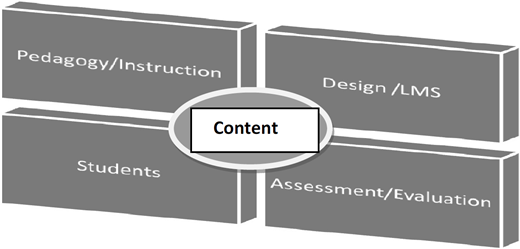
Design and Technology: Course design, comprised of instructional and aesthetic (visual, auditory, etc.) design, and technological instruments such computer hardware and software, learning management systems (LMS), etc., are critical components in the construction of effective learning environments. The design and technological modality of an online course is perhaps the most crucial factor in determining the quality of a learning experience. Instructional design should facilitate the pedagogical model being followed, while technology supports the new teaching paradigms of the information age.
Pedagogy and Instruction: Instructional methodology uses pedagogy and appropriate instructional tools to insure effective learning outcomes. Though there may be some differences across content areas, the role of the instructor as an active participant, mentor, and model with expertise in understanding and meeting the needs of adult learners is key.
Student-Centered Learning: This approach to education that focuses on the personality and needs of students as central in the education process. It has many implications for the design of curricula, course content, and interactivity within the online learning platform. Although student-centered learning requires students to be active, responsible participants in their online learning process, the institution must provide a framework and an effective environment for ensuring excellence in student learning.
Assessment and Evaluation: Assessment is integral to the production of useful, effective feedback and plays an essential role in the achievement of quality learning outcomes. Evaluation, guided by high-level standards and coming from experienced and knowledgeable sources, helps compare student achievement and various instructional methods.
Background of Study
EDT 610 Teaching Online is the second class in obtaining a master of arts degree with a specialization in educational technology. The entire program is delivered online through eCollege, a learning management system. The specialization consists of four focused technology integration classes as a supplement to the MAT offered by the School of Education at National University. This specialization is designed to assist practicing teachers to enhance their teaching skills and to develop knowledge and skills for using technology in an educational setting. EDT 610 is a comprehensive course that covers principles and strategies for conducting online instruction in a variety of online teaching environments including hybrid and blended instruction. In this class, students survey theories and explore the application of online learning and teaching for youth and adults. During this class, students are engaged in both asynchronous and synchronous discussion groups.
As the culminating project for this class, students were asked to create an interactive, online lesson using a blog format. A blog is a “web log,” an online lesson designed by the teacher to teach a concept or concepts in a specific subject and grade level. Blogs are widely used in K-12 education as a format for posting content and for communicating thoughts and ideas. Much of the “blogosphere” outside of education is used for logging personal comments and opinions. For the purpose of this class, students created a blog in EduBlog.
Demographics and Description
In March 2009, the Interactive Learning Taxonomy (ILT) was integrated and applied in the EDT 610 class as a focused assignment for the analysis of an online lesson. Formerly, the class did not contain a model for building and assessing an online lesson. This pilot class included 13 students: 7 males and 6 females. For this initial study, 12 students completed the application and analysis of the ILT. Since March 2009, four additional classes were added to the study, March 2010 (n = 19), July 2010 (n = 21), March 2011 (n = 18), and July 2012 (n = 38).
Process for Analysis and Application of the Taxonomy
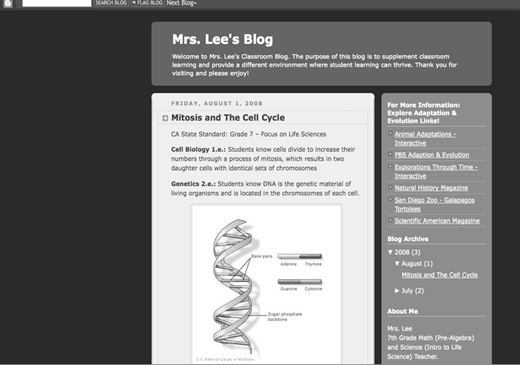
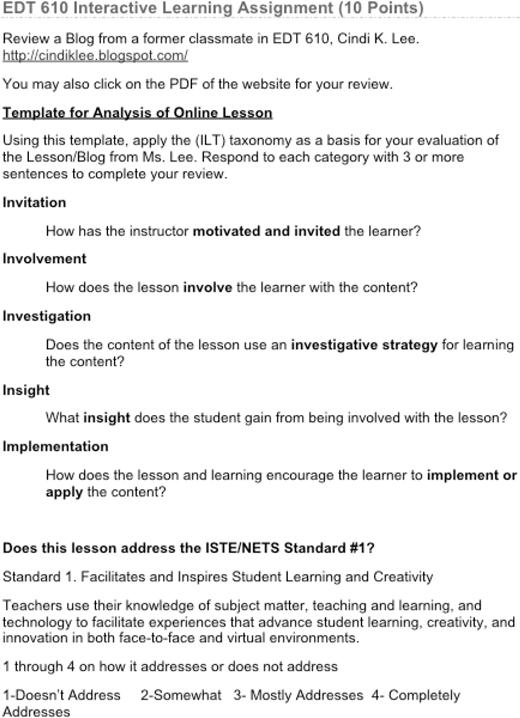
Students in EDT610 were asked to review a blog created by a former student, C. Lee (2009). An ILT template describing each stage was used to evaluate the lesson/blog. Responses had to be three or more sentences in length. In addition, students were asked to rate the lesson according to criteria to determine the extent the blog followed the ILT criteria for interactivity and to rate at which level the National
Educational Technology Standards (NETS) were mastered. These standards were developed by the International Society for Technology in Education (ISTE): Standard #1 – Facilitates and Inspires Student Learning and Creativity (NETS, 2008). The overall evaluation of the lesson/blog was rated using a 4-point Likert scale.
Evaluation of Online Lesson/Blog With Application of the ILT (Sistek-Chandler, Amber, Steinaker, & Tolbert, 2008)
Invitation: How has the instructor motivated and invited the learner?
Involvement: How does the lesson involve the learner with the content?
Investigation: Does the content of the lesson use an investigative strategy for learning the content?
Insight: What insight does the student gain from being involved in the lesson?
Implementation: How does the lesson and learning encourage the learner to implement or apply the content?
Does this lesson address the ISTE/NETS Standard #1? 1 = Doesn't Address; 2 = Somewhat; 3 = Mostly Addresses; 4 = Completely Addresses
Study Results
In the initial pilot study, 12 students completed the review of the lesson/blog and provided feedback that enabled the researchers to gauge their understanding of the taxonomy and consider it for future analysis.
Analysis Questions
How has the instructor motivated and invited the learner?
Responses to the Invitation stage indicate the students perceive the site as meeting this stage of the taxonomy. Students mentioned such elements as “eye-catching and topic appropriate graphics; simple, attractive, well-organized format; page is easy to follow; and material is introduced with examples.”
How does the lesson involve the learner with the content?
Responses to the Involvement stage note that learners using the blog are required to interact with the content. Comments “builds on previous knowledge; good use of a variety of websites; provided California standard; rich print environment; allows students to interact with technology; and requires students to create a flow map and answer questions.”
Does the content of the lesson use an investigative strategy for learning the content?
The action words used by respondents indicate their view that students are involved in investigative activities such as “students explore their surroundings and relate material to previous knowledge; students list adaptation of living organism; applying concepts; responding to posts; choosing an environment; and visually expressing results.” This indicates students are challenged to use higher order thinking skills.
What insight does the student gain from being involved in the lesson?
The Insight stage was seen as a strong element of the class blog. Comments from this area detailed activities that would encourage students to apply the knowledge in practical ways: “Students respond to posts and use critical thinking in their descriptions; students choose an environment and adaptations; students learn to visually express what they've learned; reinforcement occurs through use of external websites and activities; learning by reading other posts; encouraged to apply content; website encouraged real-life application; lesson draws comparisons to stages students will go through; students create a flowchart, and use knowledge to solve crimes; students provide their own examples through blog postings.
How does this lesson and learning encourage the learner to implement or apply the content?
Students documented activities that lead to implementation of the content: “respond to blog postings; answer questions based on observations; students choose an environment and remark on adaptations; students use knowledge to solve crimes; websites encourage interaction and real life application.” Each of these elements encourages learner interaction with the content.
The EDT610 students were also asked to rate how well the instructional blog addressed ISTE/NETS Standard #1: Facilitates and Inspires Student Learning and Creativity (NETS for Teachers, 2008). A 4-point Likert scale was used by the students to evaluate the level at which the lesson complied with or met the ISTE standard: 1 = Doesn't Address; 2 = Somewhat Addresses; 3 = Mostly Addresses; and 4 = Completely Addresses.
In the July 2009 study, the mean of the 12 responses was 3.83. Seventy-five percent of respondents (n = 9) rated the blog as 4; 17% (n = 2) rated the blog 3.5. For the March 2010 section the mean score was 3.66 (n =19), for the July 2010 section, 3.7 (n = 20), and for the July 2012 section, 3.1 (n = 38).
In July 2010, many students readily adopted this analysis of an online lesson and have also applied reflection and analysis to the overall process. In the dissertation research conducted by Ma, Lai, Williams, Prejean, and Ford (2008), teachers who engaged in online journals often lacked articulate and reflective attributes of meaningful learning. Reingold, Rimor, and Kalay (2008) emphasize that learning does not take place without reflection and engagement of metacognitive processes. One student in particular has applied this metacognitive statement in his work, suggesting we add another category to the taxonomy as an aid for his personal construction of the lesson.
Dear Professor, Given the form [template] that I received … I am hesitant to suggest adding another “I” to the list without first consulting you. Given the research that is stamped all over … the course's textbooks, might there be a place for an “Interactivity” category in the taxonomy? Overall, I believe the model [ILT] is a useful checklist, but will include the interactivity in my own evaluations to insure that I create the most powerful learning tools that I can. (Student, EDT 610, July 2010)
Through continuous observation and analysis, we have noticed another theme that students have also engaged in the reflective process of comparing the model (C. Lee's blog) to their own blogs.
Overall it is a great blog. I see many weaknesses in my own [blog that I have created] that I am not sure I will be able to easily fix. A well-thought out lesson will take hours to complete, refine and edit, but once the final product has been produced, it can be replicated year after year with ease. (Student, EDT 610, July 2010)
Overall Findings
The ILT, its structure and categories were generally easy to apply, initiating thoughtful responses to the prompts. All of the five categories were responded to in detail. The
Insight stage was seen as a strong element of the class blog. The principles of the ILT can be used to increase interaction and involvement in an online course. The ILT can assist the teachers in guiding the construction of content to be more interactive. As a tool for analysis and evaluation of an online, interactive lesson, the ILT proved to be extremely positive and useful; students easily embraced the taxonomy. Often students engage in the practice of restating factual information; however, in this case, the ILT fosters higher order thinking through application and analysis. Overall, the results indicate the ILT is a valid tool for analysis of interactivity for practicing teachers.
The July 2009 study is the first application that actively applied and assessed the five elements of the ILT (Sistek-Chandler et al., 2009). Students responded to using the ILT without prompting or hesitation. Although the population for the initial study was small (n = 12), the pilot proved the resounding utility of the ILT and the need to include this application and analysis in future EDT 610 classes. Since the initial pilot, an additional 40 students have been asked to participate in the study of the ILT to analyze a sample blog and reflect upon their understanding of the ILT stages.
Application of the Interactive Learning Taxonomy in Future Studies
In applying the interactive learning process, we believe this approach has the potential to produce a high quality online learning environment that actively and purposefully engages learners (Baldwin & Sabry, 2003). According to Steinaker and Leavitt (2008), the strength of interactive learning is that it encapsulates the overall process of learning and helps to provide a concrete representation of knowledge for the student. Implementation of the ILT theory becomes the springboard to new areas of learning and assists the learner to move toward the replication of the process in a new context. The taxonomy of interactive learning can be utilized for online teaching while the designer applies each step of the ILT to a planned and purposeful pathway for learning.
Online learning environments (OLE) and online content is typically designed for one-way dissemination of information (Hughes, Terveen, Ernst, & Ooms, 2009). Hughes et al. posit that the OLE delivers the instructor's content and structure, without the consideration of students’ needs, perspective, or interests. We refer to this as flat, passive content with a minimum level of interactivity. Our research extends beyond the issue of learning style and emphasizes the need to apply five guiding principles from the ILT to engage the learner with interactive content; content that promotes interactivity between teacher and students, between students and resources, and among students. The Web interface is a bridge between instruction and learning (Cassarino, 2003). It is clear that while presentation of content is clearly one important aspect of any learning encounter, without effective interactivity manifested through communication, involvement, control, and adaptation, the effectiveness of online and flexible learning will be minimized (Sims, 2003).
The next step in the investigation of the use of this taxonomy is to solicit suggestions to refine the ILT categories. As we move forward with new classes of EDT610, we plan to have the students use this taxonomy (ILT) to further analyze not only the work of a peer which serves as a model online lesson/blog but also to apply this same analysis as a reflection on their own instructional, online content (blog).
About the authors