
Interview with Dr Hannelore Vogt by Anna Maria Tammaro
The Cologne Public Library is one of the largest and most important public libraries in Germany. It consists of the Central Library, 11 other branch libraries and a mobile library. The Public Library of Cologne provides local residents (about one million inhabitants in total) with information resources and technological tools, as well as a long list of innovative services. The Cologne Public Library is also internationally renowned for being a “third space” for a multicultural community and makes available a wide range of innovative activities and services to facilitate connections and social networking. As a multicultural meeting place, the Public Library of Cologne opens up many opportunities for language acquisition for immigrants and cooperates with agencies, which run integration courses.
During my visit to the Public Library last October, I was struck by the makerspace and the other digital services the Library offers to accelerate digitisation. The Library (Daniel et al., 2010) provides high-speed access to the internet and licensed databases that can be searched by communities and was one of four pilot libraries for the introduction of the “Onleihe”, a download portal for the temporary use of digital items (e-books, electronic audiobooks and music CDs, e-videos and e-papers). The Library offers various library education programmes on digital literacies and cooperates with schools.
Dr Hannelore Vogt
Overseeing this major public library system is Dr Hannelore Vogt, who became its director in 2008. In 2015 Cologne City Library was elected “Library of the Year” as best library in Germany, and in 2016 Hannelorer Vogt was awarded with the Cologne Cultural Award as “Cultural Manager of the Year”. Dr Vogt is also a member of the IFLA Metropolitan Libraries Standing Committee, a longtime chair of the Advisory Board “Information and Library” of the Goethe Institute and worked as a Strategic Advisor and Reviewer for the Bill and Melinda Gates Foundation (Global Libraries, Global Development).We wanted to learn how the Cologne Public Library is promoting digitisation and building digital skills by interviewing Dr Vogt by email.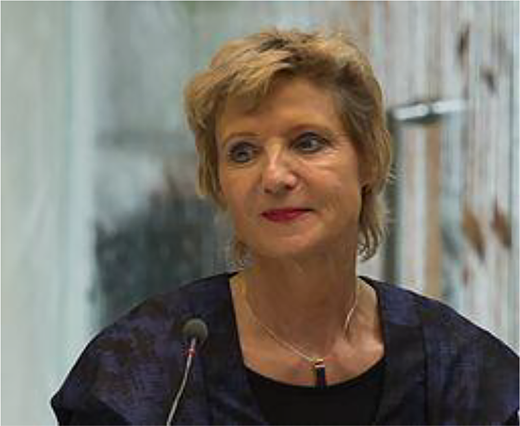
Q1. The Community Library wants to facilitate the improvement of the community and by visiting your library one gets the impression that the focus of all the activities and services is on improving learning. Did you have to adjust the Library’s mission after establishing a new service vision?
The Library has always been a place not only for media but also a place for meeting people, studying and learning. From the very beginning, the Central Library of Cologne was a “participatory” library, made for today’s maker generation and DIY (Do It Yourself) movement: even back in 1979 there was a recording studio and a record bar, as well as a grand piano that was available for everyone to practise on. In the eighties there even was a language laboratory with 20 carrels. But of course, with the developing technologies, we can offer much more of this kind today. Digitalisation is an irreversible process and many parts of society are in flux as a result. Libraries are also facing changes. Although their classic purpose of imparting education and knowledge remains largely unchanged, libraries must find ways to accomplish that mission under the new conditions.
Q2. Your library has been very successful in engaging communities and has even reached out to marginalised communities. What good practices can you recommend? How did you improve community learning?
Both outreach services and an attractive library ambience are important. Staff of the branch libraries visit communities and institutions in their respective neighbourhoods to present the library’s services and plan co-operations. We have a diversity team that especially addresses migrant communities. Also the library space plays an important role – everyone should feel welcome and at home. We have even set up a separate, very attractive room next to the Central Library for refugees and people who want to learn German. The “sprachraum” is an open learning space for people of different origins and a meeting place for intercultural exchange. It opened in October 2015 when many refugees came to Germany and is since then successfully run by volunteers.
Q3. Readers of Digital Library Perspectives are very interested in the best application of technology to improve services and create new ones. How did you collaborate with communities to design services that apply technologies, especially emerging ones?
Libraries combine progress with participation. People want to be more than just passive recipients, they want to actively participate. We worked mainly with the design thinking method and with focus groups in which citizens and representatives of different groups participated.
Q4. In your experience, how did you create the community digital library?
Putting up digital library services is a long process. We offer digital services that can be used locally and digital media that can be used remotely 24/7. For some digital media services we ask library patrons for feedback and suggestions of improvement. If possible we have organised usability studies. For digital tools in the library we offer free workshops where anyone can participate. Like this, people interested in the topic get to know each other and then a network can develop. If there are local initiatives and thus an already existing network for a topic, it is easiest to approach these initiatives to see if they are interested in cooperation and what infrastructure the library can provide (e.g. technology, rooms, advertising, event organisation).
Q5. Among the many innovative services you have launched, the support for peer learning seems very interesting to me. What is the impact this service has had on the community? How did you measure it?
You are addressing our learning circles according to the model of P2PU (Peer 2 Peer University). This concept has been further developed and adapted to the needs of European libraries in the project “Learning Circles in Libraries” (James, 2020) funded by the EU. Obviously there is a great demand for this way of learning together. Participants from previous learning circles often have asked us, which dates are coming next. They definitely want to continue meeting and learning together, no matter what topic is chosen next. The social contact is obviously in the foreground, and at the same time participants can broaden their personal horizons and deal with something new. There have also been participants who would like to offer a learning circle themselves. This alone, and of course the number and enthusiastic feedback from the participants, are already good criteria for success. Many library visitors also took part in the survey on which topics are generally interesting to deal with.


