As a result of the continuous growth of digital movement across the world, libraries in academic institutions continue to adopt digital marketing to enhance user engagement, increase visibility and align their services with institutional goals and objectives (Gamit et al., 2021; Isiaka et al., 2024). However, despite the continuous growth and adoption, there is a limited body of literature that covers digital marketing in libraries, in particular, academic libraries (Joshua and Michael, 2020). This paper aims to systematically identify, evaluate and synthesise the existing body of literature on digital marketing strategies used by academic libraries across the globe. The review process will facilitate understanding of current practices, trends, effectiveness, challenges and gaps in the body of literature published over the past 10 years, starting from 2015.
This study used a systematic literature review, which was guided by the Preferred Reporting Items for Systematic Reviews and Meta-Analyses (PRISMA) on literature about digital marketing in South African academic libraries. The Prisma method is used to ensure consistency and transparency in the reporting process. This systematic review addressed the following research question, RQ1: What are the global trends of digital marketing in academic libraries? Searching within EBSCOhost databases (Academic Search Premier, MasterFile, Library Information Science and Technology Abstracts, Business Source Premier), Web of Science (WoS) and Scopus databases for key terms in the titles and abstracts of articles is important to include in any systematic review. The databases used are multi-disciplinary databases. Three key refiners, period (10 years), English Language and journal articles were used after adding keywords in the search boxes. After removing duplicates, EBSCOhost databases mentioned above retrieved a combined number of 232, Scopus with 13 and 6 from the WoS that matched the criteria. The searches were performed on the chosen topic using Boolean and phrase searching.
Digital marketing has emerged as a crucial element for marketing services and resources in academic libraries. The findings reveal that digital marketing in academic libraries is predominantly trending in regions such as Asia, Europe and North America. Notably, there is limited research published in Africa, indicating a gap in the body of literature in this area. Countries such as India, Pakistan, Indonesia and Jordan are among the leading contributors to this topic. Globally, there has been a significant increase in research outputs on this topic between 2020 and 2023, marking a peak in digital marketing-related publications during this period, further suggesting a growing recognition of the critical role of digital marketing strategies in academic library settings.
Research on digital marketing in academic libraries is still quite limited, and some relevant studies might have been overlooked because of database or language restrictions.
This paper highlights a critical need for academic libraries to integrate and leverage digital marketing to enhance user engagement and the delivery of library services. Adopting digital marketing strategies can help position academic libraries as relevant, proactive and reliable strategic partners that contribute to the university’s goals in a digital era. In addition, this study highlights the need for continuous professional development for academic library staff in digital marketing to provide user-centred services in today’s world.
Adopting digital marketing strategies can help position academic libraries as relevant, proactive and reliable strategic partners that contribute to the university’s goals in a digital era.
This paper fills a gap in the literature regarding comparative efficiencies of major databases for systematic review results on digital marketing in academic libraries. The findings offer insights to information service providers in libraries to embrace digital marketing strategies and channels to enhance services.
1. Introduction and background
In the rapidly evolving digital landscape of higher education, academic libraries are undergoing a significant transformation in how they promote their services, engage users and demonstrate value to their institutions (Okunlaya et al., 2022). As traditional modes of communication become less effective in reaching increasingly tech-savvy and digitally connected user populations, libraries are turning to digital marketing to remain visible, relevant and responsive (Corrall and Jolly, 2019). Digital marketing encompasses a range of practices, including the use of social media platforms, search engine optimisation (SEO), targeted email campaigns, content marketing and data analytics, aimed at enhancing user engagement, increasing service uptake and strengthening institutional branding (Peter and Dalla Vecchia, 2020; Shah et al., 2021; Wani, 2024). As underscored by (Sokolova and Titova, 2019), digital marketing could be interpreted as the strategic integration of activities and practices of using all aspects of the organisation’s traditional marketing, aimed at managing engagements and relationships with library users through digital information and communication technologies and electronic platforms. Although digital marketing is well established in the commercial sector, its use in academic libraries is still a relatively new area of practice (Kumar et al., 2024). Digital marketing plays a crucial role in today’s academic libraries by enhancing their reach with users, fostering user engagement and increasing access to information services via digital platforms (Gamit et al., 2021; Wu and Yang, 2022). Academic libraries face a number of specific challenges in this space, such as limited marketing skills, restricted resources and the need to balance promotional efforts with educational and ethical responsibilities (Wu and Yang, 2022). Despite growing interest in digital marketing within the library sector, there is still a limited understanding of how these strategies are developed, applied and assessed in academic settings.
This systematic literature review aims to address this gap by examining current research on digital marketing strategies used by academic libraries. Using the PRISMA (Preferred Reporting Items for Systematic Reviews and Meta-Analyses) method, the review explores key themes, evaluates the effectiveness of different approaches and identifies areas where further research is needed. The findings will help strengthen the evidence base that supports digital marketing in academic libraries and inform the design of more strategic, user-centred and data-driven outreach activities.
2. Literature review
The literature captured in this section encompasses current trends, challenges, benefits and the general adoption of digital marketing for library services across academic libraries worldwide. In the current digital era, it has become essential for academic libraries to move swiftly towards the implementation of digital strategies, plans and tools to support and meet the needs of today’s users.
2.1 Digital marketing in academic libraries
Previously, academic libraries were treated as mere repositories of knowledge and information, with the marketing of library services depending heavily on traditional methods, including material such as printed pamphlets, physical book loans, pamphlets, notice boards and referrals Winata et al., 2021). Nowadays, digital evolution has drastically impacted libraries to shift towards providing services and resources through digital platforms (Gamit et al., 2021). Munshi et al. (2024) concur that the fast-paced development of the digital world is encouraging libraries to adapt to the current changing needs of library users who are now techno-savvy and are demanding services to be delivered via digital platforms. As a result, libraries now have to move more services and resources to be marketed and accessible via digital platforms to remain relevant to the current user needs and expectations (Temiz and Salelkar, 2020). These technological changes are also allowing academic libraries in higher education systems to maximise the use and access of information services and resources to their users in a manner that is strategic and innovative. It is also noted by Shah et al. (2021) that digital marketing is contributing to low levels of service delivery via traditional methods. Furthermore, the movement is emphasising a need for continuous movement towards digital platforms to achieve better engagement and accessibility, allowing libraries to explore various marketing techniques made possible through the current digital revolution (Waral, 2020). It is through digital marketing that academic libraries are claiming their positions as critical stakeholder in their university communities as they use digital marketing to enhance library services (Isiaka et al., 2024). In closing, Wani (2024) posit that academic libraries can achieve a lot more in a much quicker and easier way by adopting digital marketing to engage and connect with their university community. The study aims to explore how academic libraries are adopting digital marketing tools and strategies to meet current needs and enhance library services.
2.2 Library digital marketing strategies and tools
Due to this extensive and rapid digital revolution, academic libraries are highly impacted by this development, which calls for more libraries to move towards digital libraries and digital content. Such digital content demands that libraries follow certain strategies and guidelines (Baryshev et al., 2020; Martzoukou, 2021). As a result, digital marketing plans, strategies are now becoming part of the literary strategic plans for efficient marketing. Libraries are now using digital platforms more to engage, collect feedback and inform the general library users. Examples of some of the digital platforms and tools used by academic libraries and library staff include social media, targeted email communication, digital screens, digital posters and digital notice boards (Chan, 2012; Mashiyane et al., 2020). In addition, Libraries are now developing and creating marketing and communications portfolios due to the increasing demand for modern services facilitated by the digital revolution, improved internet and the development of Information Communication Technology (Hussain, 2020). For libraries to deliver efficient and reliable services via digital formats and platforms, librarians with relevant experience are required to deliver such services. It is for these reasons that libraries are now employing librarians such as marketing and communication librarians to handle these portfolios.
Chaffey and Bosomworth (2013) suggest that library digital marketing plans enable librarians to develop user engagement platforms that foster stronger relationships between users and the library and enhance users’ understanding and use of library resources and services promoted through digital channels. According to Smith (2011), in (Thaha and Purnamasari, 2021), librarians should make it their business to create effective marketing plans to promote services and resources through various digital platforms, as this can also improve user engagement and understanding of their information and resource needs. Understanding user needs can help librarians develop effective digital marketing plans using relevant tools and channels preferred by users (AlAwadhi and Al-Daihani, 2019). The lack of effective marketing plans and strategies has been identified by Osinulu (2021) and Harlow and Hill (2020) as one of the weaknesses of many libraries. Otobrise and Omagbon (2019) also highlight the need for more comprehensive digital marketing strategies that are tailored to the specific needs and preferences of the library’s target audience.
Globally, several studies (Masizana and Salubi, 2023; Masizana and Salubi, 2022; Mpungose, 2024) confirm that academic libraries use digital marketing tools such as social media, email marketing and search engine optimisation to promote their resources and services. Due to the large number of university libraries embracing digital marketing, marketing plans and strategies must be given the attention they deserve (Fraser-Arnott, 2020). Contrary to this, Kumar et al., (2024) posit that some librarians at university libraries lack confidence and skills to implement current changes as a way of adopting digital marketing. However, studies by Ocholla and Ocholla (2020), and Udochukwu and Agunwamba (2021) disagree with the above findings as they confirms that, due to the Fourth Industrial Revolution (4IR), digital marketing strategies such as social media and customised search engine optimisation have become essential skills adopted by librarians in academic libraries globally. Digital marketing has become one of the new roles for libraries in the digital age (Cox, 2019), and therefore, libraries have to continue to adopt digital marketing tools to attract the current generation of users to pay attention to library services and resources. Studies such as Chaffey and Smith (2022), and Kaur (2009) believe that digital Marketing tools, including social media and online surveys, can be used to track information-seeking behaviour and user experiences of services and resources offered by libraries. Libraries are largely moving towards using digital marketing tools such as social media as effective tools to promote library services and resources for today’s users (Jones and Harvey, 2019). The study contribute to the unpacking of gaps in the literature that focus on digital marketing strategies for academic libraries globally.
3. Research question
This systematic review aims to systematically identify, evaluate and synthesise the existing body of literature on digital marketing strategies used by academic libraries across the globe. This process will help the process of understanding current practices, trends, effectiveness, challenges and gaps in the body of literature. With this in mind, the paper addresses the following research question:
What are the global trends of digital marketing in academic libraries?
4. Methodology
The paper followed PRISMA, described by Mpungose et al. (2025) as a method that ensures transparency, reproducibility and rigour in the systematic review process. The method allows researchers to provide clear criteria for the inclusion and exclusion of literature scanned from various databases. As applied in this paper, the PRISMA method includes conducting a literature search that is aligned with the research question, followed by clarifying the inclusion and exclusion criteria, reporting on the literature profile and information from selected papers, and finally, providing an analysis and discussion on the relevant literature from the final selection (Kostagiolas and Katsani, 2021). The EndNote software was used to complete this process. Strategic keywords were developed to be representative of the topic and to allow the utilised database to retrieve works of literature from a variety of sources, including reliable online resources. The inclusion and exclusion criteria assisted in removing duplicates, irrelevant results and selecting the best results for this paper.
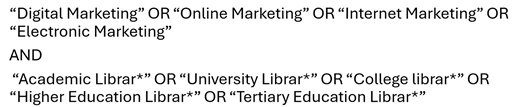
This systematic review was concluded by using publications indexed in major citation databases, namely, the Web of Science (WoS), Scopus, and EBSCOhost databases (MasterFile, Academic Search Premier, Library Information Science and Technology Abstracts, Business Source Premier). EBSCOhost databases were used for this study as reliable multi-disciplinary full-text databases. The keywords and synonyms, as illustrated in Figure 1, were applied across all the mentioned databases:
A truncation (*) was used at the end of the word “Librar” to allow the database to expand search results and to retrieve all possible word endings such as Libraries, Librarians and Library.
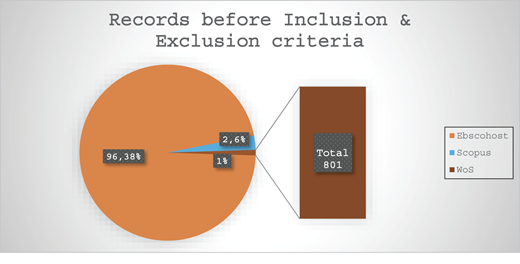
The authors had anticipated that major citation databases such as Scopus and WoS would provide more results compared to EBSCOhost databases. However, contrary to popular belief, the EBSCOhost databases yielded more results compared to the two major citation databases mentioned above. Another contributing factor to EBSCOhost databases yielding more results was also due to several duplicates from the combined EBSCOhost databases. Before the Inclusion and Exclusion criteria were used, the numbers were retrieved as indicated in Figure 2 below:
Records retrieved from the 3 main databases were 801, with EBSCOhost databases contributing a total of 772, about 96%, Scopus yielding 21 records, equivalent to 2.6%, while WoS yielded 8 records, amounting to merely 1% towards the total records. To ensure consistency, the researcher performed deduplication after combining all records, rather than sequentially by database. Therefore, the final proportions reflect the number of unique records retrieved from each database, rather than the order of import. When the Inclusion and Exclusion criteria were applied, the numbers from all databases were lower compared to the first results. Specific criteria included limiting the result to only show records of journal articles published in the past 10 years, starting from 2015 and published in the English language. Figure 3 depicts the number of records retrieved from each database after inclusion and exclusion criteria were applied.
4.1 Inclusion criteria
In this paper, digital marketing, specifically for libraries, is identified as the marketing of library services via digital tools, systems and channels. Alternative words that are normally used intertwined with digital marketing include “Online marketing”, “Internet Marketing” “Electronic Marketing” and “Web Marketing”. As there are various types of libraries, this paper specifically focuses on digital marketing for academic libraries. Academic libraries are identified in this paper as libraries that serve communities such as students, staff members and researchers within institutions of higher learning (Adetayo, 2023). Other words used to describe academic libraries include “University Libraries”, “College Libraries”, “Higher Education Libraries” and “Tertiary Education Libraries”.
The authors followed a systematic retrieval process using a combination of primary and secondary search terms. Primary search terms used include “Digital Marketing”, “Online Marketing”, “Internet Marketing”, “Electronic Marketing” and “Web Marketing”, while secondary search terms included “Academic Libraries”, “University Libraries”, “College Libraries”, “Higher Education Libraries” and “Tertiary Education Libraries”. To limit the scope of the study to a manageable study, results were limited to cover Journal articles, published in the English language, for the past ten years (2015–2024). This research did not include the year 2025 as the year is not yet completed. Future studies may include results of literature published from the year 2025. This entire process was followed as framed by the PRISMA process.
4.2 Exclusion criteria
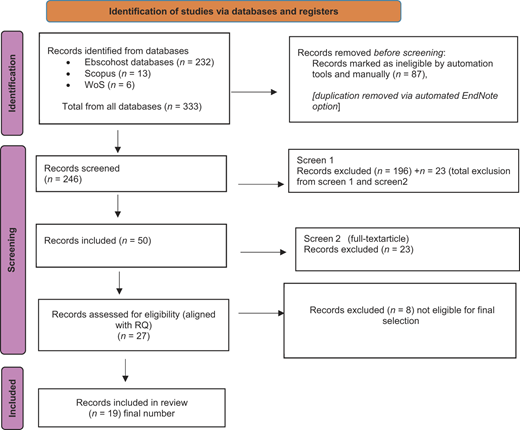
Excluded articles were all articles published in languages other than English, published outside the 2015 and 2024 period, as well as other resources such as books and chapters, e-books, magazines, theses and dissertations and other resources other than journal articles. To keep up with eligibility and to align the study with the research question chosen for this article, titles of records, abstracts and key findings were taken into consideration, which resulted in the exclusion of 219 from screening 1 and screening 2 out of the 333 results. To align eligibility, out of 27 articles selected for final analysis, 3 more records were excluded because they did not align directly with the research question of the study. Finally, an additional record was removed from the final list as the reference was incorrectly referenced as a journal article, while it is a book chapter, leaving a total of 23 records analysed as final for this study.
4.3 PRISMA flow diagram
The above PRISMA flow diagram is provided to illustrate how the records were systematically selected or removed from the main pool from the beginning of the process. This process began with a total of 333 selected records, which were subjected to various screenings. The process included screening stages used via a reference management tool, EndNote software. Records that made it to the screening stages were deemed appropriate after the Inclusion and Exclusion stages were executed. About 87 records were removed from the pool as duplicates using the EndNote software. The EndNote software embedded tools were used to identify duplicates, leaving about 246 records available for screenings.
Screening 1 focused mainly on the topic, year of publication and language. Screen 2 further analysed the abstracts of each record, digging into the findings of each study and the availability of full text. During both screenings, a total of 219 records were removed that did not align with the study, leaving a total of 27 records selected after both screening 1 and screening 2 were completed. However, a further review of the selected records was conducted to validate the eligibility of the records.
This process allowed researchers to further identify about 8 records that were not meant to go through after both screening 1 and screening 2 were completed. Some of the reasons for excluding these records included year of publication and language of records represented in the systems, as well as records not aligned to the study’s research question. As a result, a total of 19 articles made it to the final selected list eligible for discussion.
5. Findings and results
5.1 Selected databases for final inclusion
As highlighted in section 4.2, after the Inclusion and Exclusion criteria were used, minimal records were retrieved compared to the first results before the inclusion and exclusion criteria were used. Table 1 below shows the total number of records retrieved that aligned with the study’s research question and that met all the specifications outlined in 4.1 and 4.2. The results included in Table 1 are records of journal articles that represented digital marketing in academic libraries across the globe. The table has a total of 19 records aligned to the study’s research question.
5.2 Publications by country, continent and year
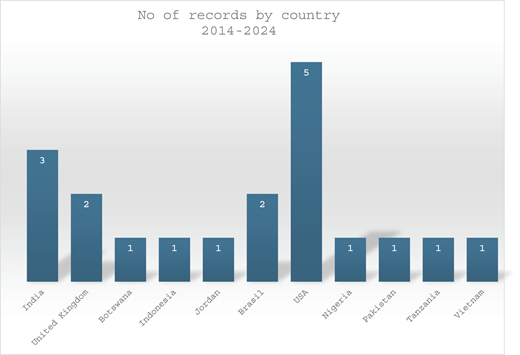
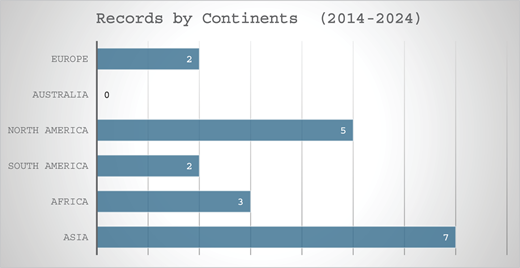
The paper aimed to examine global trends in digital marketing within academic libraries through a literature review. After refining the results as highlighted in sections 4.1 and 4.2, respectively, only 11 countries from 5 continents produced journal articles that focused on digital marketing in academic libraries, illustrating the need for more literature in the field. As shown in Figure 4, journal article publications on digital marketing for academic libraries between 2014 and 2024 were unevenly distributed across countries. The USA accounted for the highest number of publications, with five articles, indicating a stronger research presence in this area. India followed with three publications, while the UK and Brazil each contributed two articles. In contrast, several countries, including Botswana, Indonesia, Jordan, Nigeria, Pakistan, Tanzania and Vietnam, recorded only a single publication each during the period under review, suggesting more limited research output in this domain. However, in terms of continental representation, as illustrated in Figure 5, most records were produced in Asia compared to other continents. Of the 19 final records, Asia contributed the majority, with seven journal articles published during the period under review. North America ranked second with five articles, followed by Africa with three. Europe and South America each produced two records, indicating a gap and a need for further research on this topic. No records were produced in Australia during the period reviewed, highlighting the need for additional research in this region.
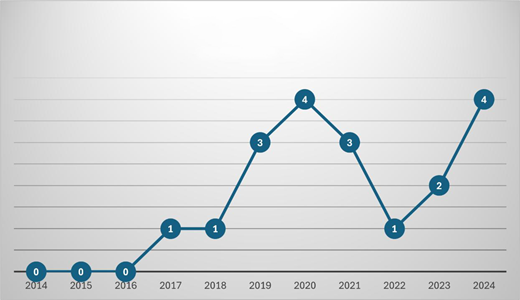
As illustrated in Figure 6, the results further show that, during the period under review, the highest number of articles was published in 2020 and 2024, with four records produced in each year. No records were identified for the period from 2014 to 2016. The years 2019 and 2021 each yielded three records, followed by 2023 with two records. In contrast, only one record was published in each of the years 2017, 2018 and 2022.
6. Discussions
To answer the research question for this systematic review, the authors evaluated the literature to understand global views and trends regarding digital marketing in academic libraries. Marketing in libraries is a critical component that is used to promote and effectively communicate services and resources. As highlighted by SN5 and SN8, libraries use both traditional and digital marketing strategies to advance library services as they continue to serve with the intention of satisfying today’s users’ information needs. However, SN18 argues that academic libraries are finding digital marketing strategies to be more effective compared to the traditional methods of communicating and marketing library services. It is common knowledge that traditional marketing strategies are becoming obsolete in academic libraries, as digital tools are infiltrating systems and processes in academic libraries. A notable contributing factor is the Fourth Industrial Revolution, which continues to force libraries to change how they operate and engage with their users (Hussain, 2020). Academic libraries, as critical stakeholders in universities and college libraries, are equally affected by this shift, as they serve generations of users who are glued to their mobile devices and other digital tools daily (Matumba, 2021). It is a well-known fact that Digital marketing tools have become a quick way for libraries to communicate and engage with users regarding services, spaces and resources.
Within the scanned literature, SN1, SN5 and SN16 confirm that digital marketing strategies are enhancing the engagement, enabling quick dissemination of information and in addition promoting library services and resources in a manner that is inclusive, open and accessible to users in a digital era. SN6 and SN8 concur that digital marketing has become an essential component in keeping libraries relevant in the digital era. As confirmed by SN16, SN1, SN6, SN10, SN18 and SN19, globally, digital marketing in academic libraries is trending in areas such as India, Brazil, USA.
As it is commonly known, as confirmed by several studies (Bag et al., 2022; Jadhav et al., 2023; Onunka et al., 2023; Tsekea and Chigwada, 2021), that universities are populated by users who belong to the digitally savvy generations. In line with this statement, studies by SN10 and SN11 suggest that academic libraries should engage users via digital tools and platforms, as these are preferred by the majority of users in academic environments.
While analysing global trends regarding digital marketing, SN19 and SN18 reiterate that globally, academic libraries are using digital marketing strategies as an effective way of engaging with library users by promoting library services, resources and spaces to their users and most importantly, using digital marketing strategies as critical for rebranding libraries in a digital era.
As a result, social media channels such as Facebook, X, TikTokand YouTube are now playing a critical role in marketing libraries. SN1 highlight the social networking tools and infrastructure such as chatbots, web portals and digital libraries used by academic libraries in India to market library services and resources in digital spaces. The study further portrays the benefits of adopting digital platforms to market library services, resources and spaces. SN15 and SN16 concur that university libraries are receiving feedback that suggests that social media and websites are critical digital marketing tools for academic libraries to remain relevant in serving today’s users. SN15 further suggest that with the implementation of digital marketing tools such as social media and websites, academic libraries can develop a strong brand identity that can align with the current population at universities. Contrary to these developments, SN3 question the effectiveness of these social media tools as key library marketing strategies that can support institutional goals and objectives. This is also supported by SN2, which identified university libraries in Pakistan as struggling to deliver digital marketing strategies. Contrary to popular belief, SN2 also highlight that marketing in public university library websites is done better than at those in private university libraries, even though private universities are well funded compared to the public university libraries. In addition, SN18 concurs with SN3, arguing that a lack of relevant tailor-made frameworks, policies and guidelines aimed at managing and guiding how social media and other digital marketing tools contribute to the challenges experienced by academic libraries when it comes to implementing digital marketing strategies. This study contributes to the much-needed body of literature regarding digital marketing in academic libraries, as it shares global trends of digital marketing in the past 10 years. However, the scanned literature lacks coverage of inclusive digital marketing strategies that cater for people with disabilities. None of the literature covers how digital marketing is currently inclusive of this population, which is hugely marginalised in many spheres of the world.
6.1 Limitations and suggestions for future research
As briefly noted in the methodology section, limitations were applied in this study to help manage its scope and size. Montgomery (2023) argues that researchers may use limitations not only to manage the scope of a study but also to demonstrate transparency and critical reflection. First, the study was limited to journal articles, which may have excluded other important sources such as conference proceedings, reports, theses, ebooks and print books. In terms of language, only publications available in English were included, which may have resulted in the exclusion of relevant studies published in other languages. In addition, the study was limited to three widely used databases in the humanities, social sciences and Library and Information Science fields, namely Scopus, EBSCOhost databases and Web of Science (WoS). This may have led to the exclusion of relevant studies indexed in other databases. Furthermore, the review covered a ten-year period, which may have excluded earlier foundational work on digital marketing in academic libraries. However, these limitations were not intended to undermine the value of the review, but rather to highlight gaps and areas that future research could address and expand upon. Future studies should consider using different limitations, inclusions and exclusions to further explore the topic, especially in the global south. Such studies could use mixed methods research (MMR), given the fact that the topic is interdisciplinary and multidisciplinary nature of the topic.
7. Recommendations in summary
The key findings of this study show that digital marketing is merging as an essential component in promoting and communicating services and resources within academic libraries in the digital era. Consequently, the study suggests the following recommendations:
Digital Marketing Frameworks, Policies and Guidelines: libraries should develop tailor-made digital marketing frameworks, policies and guidelines to guide the use and adoption of digital marketing tools and strategies in alignment with institutional goals and objectives.
Diversify Digital Marketing Tools and Channels: With artificial intelligence taking over in all fields globally, libraries should consider investing in various interactive digital marketing tools that can help engage users from different backgrounds to enhance library services in a manner that is open, inclusive and developmentally appropriate.
Capacity Building: Academic libraries should invest in equipping library staff with digital skills via continuous training and development. The training capacity will allow librarians to best promote resources, spaces and services in a digital era.
User-Experience (UX) marketing Strategies: Libraries should consider leveraging user feedback in evaluating the effectiveness of digital marketing strategies for library services and resources. This process calls for regular user engagement and service evaluation via digital platforms.
Inclusive Digital Marketing Strategies: Academic libraries should consider making available digital marketing tools and systems that are inclusive of people with disabilities. The study findings reveal limited digital marketing strategies implemented by academic libraries to accommodate people with disabilities.
8. Conclusions and implications
This paper fills a gap in the literature regarding digital marketing in academic libraries. Reliable and relevant databases were included for a systematic review that used the EndNote referencing tool to administer various screening processes to select reliable and relevant records for the study. The study used the PRISMA Systematic Review model that allowed records to be systematically analysed and selected based on relevance to the topic and research question of the study. The finding shows that academic libraries are adopting digital marketing through social media platforms such as Facebook, X and YouTube to enhance engagement with users and to promote library services, spaces and resources. However, globally, it is evident that the body of literature that covers digital marketing for academic libraries is limited based on the findings in this study. These tools are significantly enabling academic libraries to widen their chances of reaching more users within a short space of time, compared to the traditional ways of marketing libraries. Key recommendations of the study include the development of tailor-made digital frameworks that could assist as guidelines for the adoption and implementation of digital marketing strategies and plans in a manner that is open and inclusive in this digital era.