

Data economy is a recent phenomenon, raised by digital transformation and platformisation, which has enabled the concentration of data that can be used in economic purposes. However, there is a lack of clear procedures and ethical rules on how data economy ecosystems are governed. As a response to the current situation, there has been criticism and demands for the governance of data use to prevent unethical consequences that have already manifested. Thus, ethical governance of the data economy ecosystems is needed. The purpose of this paper is to introduce a new ethical governance model for data economy ecosystems. The proposed model offers a more balanced solution for the current situation where a few global large-scale enterprises dominate the data market and may use oligopolistic power over other stakeholders.
This is a conceptual article that covers theory-based discourse ethical reflection of data economy ecosystems governance. The study is based on the premise of the discourse ethics where inclusion of all stakeholders is needed for creating a transparent and ethical data economy.
This article offers self-regulation tool for data economy ecosystems by discourse ethical approach which is designed in the governance model. The model aims to balance data “markets” by offering more transparent, democratic and equal system than currently.
By offering a new ethically justified governance model, we may create a trust structure where rules are visible and all stakeholders are treated fairly.
1. Introduction
The “data economy” is a buzzword that has implicated in a new and flourishing area of the economy that changes the world – and simultaneously it is seen paradoxical (Acquier et al., 2017; Sadowski, 2019). Currently, data ecosystems are created and controlled by a few big tech companies (Koskinen et al., 2017; Koskinen et al., 2019). Recently, the practices of companies have gained negative attention because of some dubious episodes, including Cambridge Analytica (Berghel, 2018) and censorship by platform owners (Koskinen et al., 2017; Ververis et al., 2019), to mention a few. Likewise, the questionable adventure of Iceland’s genome information (Järvenpää and Markus, 2018) is an illustrative example where individuals and their rights were bypassed by companies and governmental actors. This kind of phenomena is described as data colonialism, which has normalised the exploitation of humans through personal data (Couldry and Mejias, 2019). Zuboff (2015) calls this kind of economy as surveillance capitalism that is based on the logic of accumulation. The logic of accumulation/surveillance capitalism appears in operation mode where data is collected from a multitude of sources, then extracted, analysed, commodified and finally used to make profit.
Current situation seems to have shaken deeply people’s trust and faith in the data economy, its practices and players (Rantanen, 2019). This mistrust and its consequences – limitation of information sharing and falsification of data – jeopardise data collection and, therefore, the whole basis of data economy (Punj, 2019). Thus, a new, people-centric and transparent approach to the data economy is needed to overcome the lack of trust and risks for ethical society (Koskinen et al., 2019).
While research about data ecosystems has gained popularity in recent years (Gelhaar et al., 2021; Rantanen et al., 2019), it is still in its early stages with clear gaps to be filled (Oliveira et al., 2019). In some fields, governance is an extensively researched area (Oliveira et al., 2019; Helin, 2019). Likewise, opposing views on how ecosystems emerge and what is the theory of it exist (Gelhaarand and Otto, 2020; Shipilov and Gawer, 2020). However, existing studies are fragmented by content and domain, and research about ethical governance of data ecosystems is lacking (Rantanen et al., 2019). Thus, trans-disciplinary, ethical and people-centric research, where people’s values and needs in data economy governance are highlighted, is needed.
Accordingly, the main research question of this paper is the following:
How to govern complex data economy ecosystem in a way where all relevant stakeholders are included ethically?
As argued by Hyrynsalmi and Hyrynsalmi (2019), the central concepts in platform and ecosystems research are becoming muddy and need clarification. As a response to this, our focus in the following section is to provide an overall picture of data economy ecosystems. In Section 3, we look upon the governance research and rising problems to meet up with challenges that data economy ecosystem as a new phenomenon sets for current governance research and approaches in it. In Section 4, we raise the need for an ethical approach for ecosystems and present discourse ethics as a promising ethical approach in this context. In Section 5, we present the ethical people-centric governance model for data economy ecosystems as a promising way to arrange a control mechanism for use of information in ecosystems. Finally, in Section 6, we close the study with conclusions.
2. Data economy ecosystems
During the past two decades, our world along with the economy has turned online, where more and more activities are done by computers and mobile devices. The phenomena, such as big data, artificial intelligence and Internet of Things, have steered local, national and worldwide attention increasingly towards ecosystems around data and data usage (Curry and Sheth, 2018). As an example, big data is a technology and an approach that is seen as a source for value creation for organisations and a possibility to gain benefits through different domains (De Mauro et al., 2016; Günther et al., 2017). However, it brings along a lot of difficulties in practicalities such as, for example, data capture, storage and analysis (Chen and Zhang, 2014; Hu et al., 2014). It also makes processing and analysis difficult through traditional data management techniques and technologies (Siddiqa et al., 2016).
Ecosystem is a word that has been used widely from field to field. Ecosystem research has been done about business (Moore, 1993; Seppänen et al., 2017), software (Jansen et al., 2009), information systems (Brummermann et al., 2012) as well as information technology (IT) (Iansiti and Richards, 2006) and information and communication technology ecosystems (Fransman, 2010), just to mention a few. One key concept for the ecosystem view is value. Iansiti and Levien (2004) define, in their seminal paper, that the keystone organisation, the one being in charge of the well-being of the business ecosystem, is responsible for creating and sharing value in the ecosystem.
Data economy ecosystems are networks where data is created, stored, shared and used by different parties. What is worrying is the lack of transparency even it has noted as an important value for individuals whose information is commonly used as a basis of data economy (Rantanen, 2019; ter Hoeven et al., 2019). Therefore, research – especially ethical (Rantanen et al., 2019) – into data economy ecosystems is needed to achieve the goal of a fair data economy. One problem is that research into data (economy) ecosystems is still in its infancy, even though it has been identified as a field of growing importance (Oliveira et al., 2019; Rantanen et al., 2019; Gelhaarand and Otto, 2020; Shipilov and Gawer, 2020).
When we are talking about data economy ecosystems, there is a need to define what we are meaning with it as there are so many ways to use the terms such as business ecosystem, data economy and data economy ecosystem (Moore, 1996; Holm and Ploug, 2017; Oliveira and Lóscio, 2018; Koskinen et al., 2019). By using the term data economy ecosystem, fragmented concepts referring to the emerging complex socio-technical network of interrelated data producers and consumers (Reggi and Dawes, 2016; Demchenko et al., 2014; Bourne et al., 2015), business ecosystems (Moore, 1996) and platform ecosystems (Cennamo and Santalo, 2013; Hyrynsalmi et al., 2016) can be subsumed to a practical entirety. Further, this enables the formulation of a concrete and definable model for data economy ecosystem(s).
In this paper, we use the definition by Koskinen et al. (2019), which combines data ecosystem and business ecosystem – the areas we are interested here. The definition is:
Data economy ecosystem is a network, that is formed by different actors of ecosystem, that are using data as a main source or instance for business. Different actors and stakeholders are connected directly or indirectly within network and its value chains. Data economy ecosystem also incorporates the rules (official or unofficial), that direct action allowed in network (Koskinen et al., 2019).
The term network is commonly used to describe connections that are based on formal contracts or informal collaboration in (inter)organisational context – whereas ecosystem is used to describe the connections that are not so formal, do not have such hierarchical control and can have loose complementary parties involved (Shipilov and Gawer, 2020). We see that the term ecosystem is preferable as it widens the pool of possible contributing actors regardless of their way to use data, rather than sets the network too narrow and determinative. However, as the data ecosystems are commonly based on personal data, we need to make sure that there are justified rules for data use (official and unofficial) and they are acceptable for all participant actors – including the individuals, although they are commonly subordinate compared with organisations that use the data. Therefore, we emphasise the ecosystem approach to underline the evolutionary nature of data economy. However, some control aspects are needed and they could be incorporated from network research stream into it in a human-centric way.
The definition for data economy ecosystem by Koskinen et al. (2019) gives a suitable abstraction level and viewpoint as it gives specific notion for rules and network’s control over allowed actions and thus incorporates governance aspects into the data economy ecosystem. Next, we will look more closely governance in the context of data ecosystem and its research streams.
3. Governance of data economy ecosystem
Big, successful tech companies such as Google, Facebook, Twitter and Amazon in the west – and Baidu, Alibaba and Tencent in the east – have created ecosystems (Couldry and Mejias, 2019). However, ecosystems, which receive and contribute data from many different sources and networks, are challenging to govern (Lee et al., 2018).
Governance of data ecosystems can be seen as the third step after information technology governance and inter-organisational IT governance. As digital ecosystems and platformisation bring changes to our society by changing economics and creating new business models (Zuboff, 2015; Lammi and Pantzar, 2019; Westermeier, 2020), there is a need to govern ethically the digital world and business (Floridi, 2018). Though, it seems that ecosystems are commonly controlled by few central companies, which can orchestrate the ecosystem by themselves without considering minor actors. This is an ethically problematic issue (Koskinen et al., 2017; Knaapi-Junnila et al., 2022). In this situation, it is highly problematic that we lack the ethical research on ecosystems, platforms and governance of those (Hyrynsalmi et al., 2019; Aasi et al., 2014). Currently, governance is gaining attention, for example, in the research field of software ecosystem (Alves et al., 2017). However, only a handful of papers about ethics of ecosystems and platforms exist. Those few papers show that various ethical issues should be considered as even the wider picture is in infancy (Rantanen, 2019) and the need for an ethical approach is obvious to fill existing research gap.
The challenge for technology ecosystems’ governance is that they need to be both stable and flexible. This problem is called “the paradox of change” (Tilson et al., 2010). Stability is needed to enable new actors, artefacts and processes while flexibility is needed for growth to meet market needs. Therefore, governing ecosystem is a challenging task, even without ethical considerations. Effective use of IT is essential for all companies, which strive to survive in the ever more tightening business environment (Amali et al., 2014). However, ethics has become crucial attribute for data-driven business which sets new kind of demands for management (Baker-Brunnbauer, 2021), business models (Breidbach and Maglio, 2020) and governance of data (Calzada and Almirall, 2020).
Overall, governance has different requirements depending on the focus areas. In technology ecosystem governance, the main requirements lie in homogeneity and stability to ensure joint investments with constant parts while simultaneously heterogeneity and variability are needed to response changes in market demand (Wareham et al., 2014). In digital business ecosystem governance, the focus is to make sure that cooperation is well defined with identified interfaces and resource sharing (Senyo et al., 2019). Likewise, governance of data in ecosystems has its own characteristic and this topic is considered as under-researched (Lis and Otto, 2020; Lis and Otto, 2021). There is a need for conceptual understanding (Lis and Otto, 2021) and new ideas for data governance (Nokkala et al., 2019).
Michelli et al. (2020) examined four emerging data governance models. First model is the data-sharing pools (DSP), where different actors are joined to partnership to use data as a market commodity that provides economic benefits for participating actors. Governance mechanism covers technical architecture but the main component of this model is “the contract, a legal and policy framework, that defines the modalities for data sharing, how data can be handled, and for which purposes” (Michelli et al., 2020, p. 7). In this model, only data holders are involved as participants while data sources such as individuals tend to be excluded and not seen as a key stakeholder. Second model is data cooperatives (DCs), where data is distributed and used by actors of network. The difference compared to DSP is that data subjects are seen as key stakeholders that are involved in democratic manners. This model aims to balance power relation between data subjects, data platforms and third-party data users. Nonetheless, monopolistic big tech companies have advantageous position, mass of users and economical resources compared with small DCs. Third model of data governance is called public data trusts. In this model, public sector establishes the relationship of trust between actors. It aims to better services for citizens and ethical use of data collected from them. Here, various public sector actors are crucial stakeholders; even other stakeholders can be included in the ecosystem/network by invitation of public administration. Citizens, public bodies and the invited actors outside public sector have specific legal obligations to comply with to meet expectations. Fourth model, called personal data sovereignty (PDS), emphasises data subjects’ control over their data and restriction of private companies’ influence and power over individuals’ personal information. There are two main goals in PDS. First is to improve individual’s self-determination and possibilities considering personal information. The other goal is the balanced relationship between digital platforms and users – fostered by development of services focused on user needs (Michelli et al., 2020).
Our approach for ethical data ecosystem governance is a combination of all the above-mentioned models presented by Michelli. The idea is that an ecosystem needs to be constructed so that it will meet ethically justified demands and expectations of all stakeholders and thus creates the trust and balance between stakeholders. As our idea is to provide ethical governance model of data economy ecosystem, we need to describe the ethical basis of our model which we will focus in the following section.
4. Discourse ethics as a road to consensus in data ecosystem
As reasoned above, an ethical approach for governing the data economy is needed (Koskinen et al., 2019; Rantanen et al, 2019; König, 2021; Knaapi-Junnila et al., 2022). As an emerging phenomenon, data economy’s impact on society is still unclear. However, significant ethical issues to be noted and taken care of have already risen (Brey, 2018). As Brey noted, participatory and deliberative approach together with ethical analyses is needed in this kind of emerging phenomenon. Hence, deliberative and participatory discourse between all stakeholders in the data economy ecosystem is an essential cornerstone of our governance model.
Ethical approaches such as deontology, consequentialism and virtue ethics – known as the three big ones – and others are used in the area of information and communication technology to raise understanding about ethical aspects of modern society (Stahl et al., 2014). Computer ethics is a brand of ethics that was presented by Moor’s (1985) observations on how computers will change our world and bring new challenges. First, computer ethics – also called IT ethics – analyses nature and social impact of information technology (here ecosystems and platforms) to identify justified policies for ethical use of information technology. Secondly, Moor notes the importance of general ethics for computer ethics, because it provides categories and procedures of what is ethically relevant. Thirdly, computer ethics provides conceptualisations and policies for using technology, and it also prompts us to rethink our values and the nature of information technology.
We agree with Moor in that we need general ethics as it creates the foundation and thus we cannot bypass the main theories. However, we note that those theories conflict with each other in many cases and the parallel demands of universalism and relativism create challenging problem setting for those theories to be used. Fortunately, there is a consensus amongst normative theorist of cultural pluralist about dialogue as a key for securing just relation between different groups (James, 2003). Discourse ethics offers a promising path towards solution of this problem (Mingers and Walsham, 2010). Discourse ethics is an applicable tool to bring different views under constructive debate in the context of IT/information system (Lyytinen and Hirschheim, 1988; Yetim, 2006; Ross and Chiasson, 2011; Stahl, 2012). It offers a way to reveal the strategic logic behind group conflicts between different stakeholders and thus helps discourse towards a more transparent and rational one.
Discourse ethics (Habermas, 2018) is based on the work of Habermas’ (Habermas, 1984, 1987) theory of communicative action, public sphere and rational discourse. In communicative action, participants should not be primarily motivated by their own individual successes. Instead, they should be ready to negotiate based on common situational definitions to formulate a plan of action. It is a pre-requirement of rational discourse because it aims for reaching understanding between participants. Although Habermas mentioned rational discourse already in his book “Communicative action”, the concept was further developed in his book called “Between facts and norms”, especially from legislative perspective (Habermas, 1996).
Habermasian rational discourse demands that subjects of legislation have a possibility to take part in rational discourse whilst creating laws (Habermas, 1996). This kind of legislative rational discourse is, of course, an ideal but it seems trivial to note that there can be diverse degrees of implementation of it. Government – and certainly no other actors – cannot wield arbitrary power over citizens. Even though Habermas talked about legislative process in Between Norms and Facts (Habermas, 1996), we claim that the same demands apply to data economy ecosystems and should be included in IT field. It seems that platforms and ecosystems have gained such a position (Koskinen et al., 2017) in our society that they may influence on individual’s life in a way that can be compared to legislative use of power or even bypass it (Lessig, 1999). The problem is that individuals do not have truly effective procedures to affect digital business or structures behind it. Furthermore, in many cases, people do not have real access to information nor understand the procedures behind the data economy ecosystems. To ensure transparency, decisions made through the systems should be clear and understandable for individuals – whose information is collected and used in data ecosystems.
Rational discourse is based on the view that all stakeholders can participate in discourse, and discourse itself is rational (Habermas, 1996). All arguments are evaluated in terms of how convincing and plausible they are. Arguments can be based on logic, ethics or another justified basis. A crucial aspect of rational discourse is that no strategic games are allowed but must be rejected. A strategic game is a way of influencing others by trying to end up with an outcome by using some other actions -such as bargaining- instead of giving better arguments and this is not allowed. These strategic actions actualise as bargaining, hidden agendas and use of authority over others (James, 2003).
Thus, discourse ethics – based on rational discourse – is a fruitful basis for data ecosystems because of three reasons. First, it does not take such a rigid standpoint as the big three ethical (deontology, consequentialism and virtue ethics) theories do and thus can integrate different views more resiliently. Although reaching to theoretical universal justifications by discourse ethics is questionable, it seems to be useful when resolving problems, misunderstandings or disagreements (Georg Scherer and Patzer, 2011). Secondly, it is based on the consensus approach where the rules should be commonly agreed as in all four aforementioned data governance models described by Michelli et al. (2020). This consensus approach is not only in line with varied and diverse stakeholder groups that create the data economy ecosystems in a global environment but also within democracy itself. Thirdly, discourse ethical approach offers a tool for analysing the communication action and discourse itself (Yetim, 2006) and sets boundaries for rational decisions – by avoiding strategic games between stakeholders. These are issues that should be seen as a necessary basis for all discourse and decisions about governance of data economy ecosystem.
This kind of deliberative approach – based on rationality and communication – is needed to gain an understanding about values and demands for data ecosystems to ensure that stakeholders’ values are not conflicting. This is important as research by Cazier et al. (2017) shows that value congruence has a significant role when creating trust between consumers and business.
5. Ethical governance model for data economy ecosystem
As noted earlier, data economy is more and more based on personal information. This information collected about people is the core of software business likewise in all digital business areas. Thus, it seems that the governance of data economy ecosystem needs a new – deliberative – model as the research of IT governance has focused on the corporate side (De Haes et al., 2013; Gheorghe, 2010; Turel et al., 2017).
However, data economy is increasingly based on collecting information about individuals. These data ecosystems are mainly controlled by large corporations or other organisations. Thus, individuals’ needs and desires must be acknowledged by involving individual representation in governance to achieve ethical data economy ecosystems. Personal information and its use have gained legal attention lately while general data protection regulation (GDPR) is the most known example of it. The forthcoming ePrivacy Directive by the EU follows the same idea of protection of individual’s privacy and individual rights against corporations and other actors. Scandals such as Cambridge Analytica (Berghel, 2018) and DeCode Genetics (Järvenpää and Markus, 2018) have shown that we need governance over information collected about individuals as the use of information has been questionable or unethical.
Koskinen et al. (2019) state that there is a need for a fair governance model for data economy ecosystem(s), which should be based on people-centredness. When a new business is based on information about individuals, the justification of the data economy ecosystem should be based on creating consensus between all relevant stakeholders – people, companies, third sector and public sector – that are relevant for the governance of the ecosystem at hand.
Adner (2017) noted that structure approach offers a new way to examine relationships in ecosystems and helps to define ecosystem strategy. Structure approach complements views of ecosystem as an affiliation that focuses on relation and position of network actors and formation and government of strategies in general level. Hence, it gives limited insight for specifics of value creation. As a structure, ecosystem helps to seek benefits for whole ecosystem as value creation. It is the key that defines the ecosystem and included members. Overlapping or even conflicting nature of data interests and rights between different actors underlines that there is a need for continuous ethical evaluation and communication. Moreover, in business ecosystems (economic), value creation overrides easily the other aspects. Especially layman’s position in data economy is easily reduced to data objects instead of seeing them as active actors (Knaapi-Junnila et al., 2022). Therefore, we use discourse ethical approach for ecosystem to complement the view of ecosystem as a structure where the inclusion of all relevant stakeholders is a precondition for ethicality.
The backbone of governance model is a governing board [1] as it incorporates the members to the ecosystems and creates forum for decision-making. Like Michelli (2020) have noted, agreements and contracts between key stakeholder groups are needed in all governance models. Especially, when dealing with personal data, clear rules and procedures are essential also to meet legislations, such as GDPR in EU. Therefore, decision-making instance – board – is crucial. As a distinct instance, it is able to serve the ecosystem by creating and changing rules and strategies. Furthermore, it can define and oversee technical boundaries for the ecosystem (see Picture 1). Governance board is the deliberative body of governance model. It should include all stakeholders and the aforementioned discourse ethical approach should be used for decision-making. The rules (rulebook) of boards guide all stakeholders. This model is intended particularly for ecosystems with several stakeholders and different stakeholder groups.
Aiming to fair data economy, human-centric governance model was developed during IHAN-project by Sitra (Sitra, 2019). The project provided tools for building data economy ecosystems with publications called Rulebook (Sitra, 2020b) and IHAN Blueprint (Sitra, 2020a). These tools are integrated into our model. First come the written rules (Rulebook) that participants of the data ecosystem need to follow. Rulebook defines the legal, ethical, business, technical and administrative rules that organisations need to comply with when sharing data in a data ecosystem. The guidelines in Rulebook devote particular attention to ethical principles, in addition to the privacy and data protection requirements. Second is the description of components (Blueprint) that makes data ecosystem operational. Blueprint is a description document that guides how components of the data economy ecosystem should be built according to requirements. This document contains detailed requirements for all functional components in end-user, service provider and data provider levels. Whilst Rulebook and Blueprint are developed in the IHAN project, the incorporating model – ethical governance model (Figure 1) – is developed by the authors. Central part of ethical governance model is the board that creates and controls rules, strategies, technical components and other agreed issues in the ecosystem.
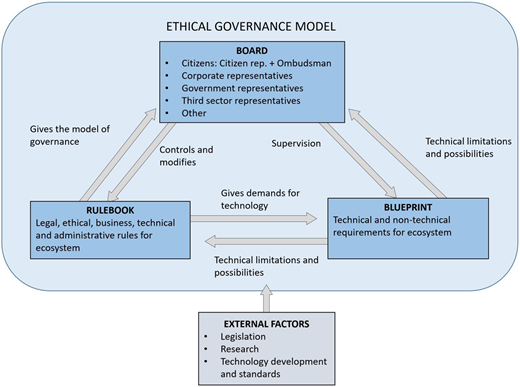
However, also other kind of ecosystems may exist. As an example, an ecosystem that uses only corporate information thus contains only the representation of those corporations. Likewise, the board may have different constructs in different ecosystems. While in small ecosystems all stakeholder organisations may have their own representative, in larger ones, the representation should be defined by a democratic mechanism as that is the base of the discourse ethical approach.
A board with individual representation is needed when an ecosystem uses personal information. However, it is crucial to notice that individuals may lack the needed knowledge of how the data economy works. Therefore, a guardian of interest, who has knowledge and authority to balance the power structure, is included in the board. Such an actor is able to act as a citizen rights/data protection ombudsman. Special attention is needed to include citizens if ecosystems use data about them. Aiming to involve citizens, it is essential to ensure that the environment enables respectful, responsive and supportive collaboration. For creating that, we suggest implementing invitational rhetoric (Foss and Griffin, 1995, 2020; Foss, 2009), which has been presented in the context of data economy ecosystems earlier in more detail (Knaapi-Junnila et al., 2022). Invitational rhetoric could be described as an attitude of genuine willingness to listen, present ideas and collaborate with all stakeholders respectfully (Foss and Griffin, 1995).
To ensure that the board works well and have real power over its ecosystem, clearly defined rules and procedures on how decisions are made are needed. They are written out in the Rulebook. Deliberative approach, especially the aforementioned rational discourse, needs to be emphasised in Rulebook so that board is not a mere playground of strategic games. Thus, rational discourse is an integral part of the model and should be used to justify it. Likewise, it is a permanent part of board’s actions to maintain and develop its structure and power balance.
Discourse ethics may need to be pragmatised so it would be usable in real life, not only in theoretical level (Mingers and Walsham, 2010). However, discourse ethics can be integrated to decision-making in various ways and different levels – keeping in mind that all issues are not ethical ones. House rules can be mentioned as one solution that incorporates Discourse ethics in practice (Knaapi-Junnila et al., 2022). This approach has already been tested in discourse ethical workshops conducted in a Finnish research project, where an ethical, human-centric consent management system was developed for municipalities. The project provided an idea of consent management system where citizens can manage and give permissions for the use of personal information to get better services produced by municipalities, companies and third sector. The concept was generated in discourse ethical workshop series where the main stakeholder groups (citizens, companies, municipalities and third sector) developed consent management systems together with researchers (Koskinen, Knaapi-Junnila and Selkälä). Discourse ethical principles (Knaapi-Junnila et al., 2022) were used by formulating them into following house rules:
Create a safe, respectful and positive environment with your own actions. This is achieved by being open, interested and respectful to each other. The purpose is to promote common good, not winning. If you want to win, someone has to lose – which would not contribute the cooperation.
Speak clearly and understandably, avoid special terms and unnecessary jargon. The purpose is to learn together, not to emphasise one’s own knowledge.
Present your thoughts concisely. Think, how it promotes progress in the case, and access to the goal. Focus on listening to others, even when others’ thoughts differ from yours. This is how you show respect for others, being on time and staying on schedule.
Justify your position, especially if you have strong objections or opinions. Stay open to others’ viewpoints.
Participate in the discussion with open cards, sincerely and honestly, without hidden objectives. This is essential for building mutual trust, using different viewpoints and reaching real common understanding (consensus).
Participants’ diverse backgrounds were beneficial in workshop where a proposal for consent management system was formulated and all participants were able to accept the output.
However, as ecosystem is involved in many issues that need special knowledge, adequate experts of legislation, technology and other (depending on the ecosystem and context) should be employed when necessary. This underlines the rationality of discourse ethics; arguments should be based on rationality, which demands knowledge. Crucial is that the knowledge is shared and discussed so that all can understand the arguments instead of using Jargon where rational communication is replaced with quasi rationality. This set special demands for professionals as their language may be unreachable for other participants. Nevertheless, experiments and test for various kinds of discourse ethical solutions are needed, like studies about discourses (Ulrich, 2001; Yetin, 2006) for evaluating how rationality is achieved.
6. Conclusions
Data economy is an area where a few major players are dominating markets by creating their own data economy ecosystems. However, the demand for more ethical approach has arisen. The current data economy is not in line with values of individuals. It is not ethically justified from the perspective of individuals and neither from the perspective of minor companies. Aiming to more fair use of data, the European Union has taken notable steps – especially by GDPR – towards the protection of people’s privacy by safeguarding their control over personal information and to create more open market. These are remarkable actions and a solid foundation for further development of data economy ecosystems.
Our research question was:
How to govern complex data economy ecosystem such a way that it can include all relevant stakeholders in an ethically acceptable way?
We showed that a new approach with commonly accepted ground rules is urgently needed. For this endeavour, an ethical governance model for data economy ecosystem(s) was presented. It is a solid starting point for fair data economy ecosystems aiming to benefit all stakeholders. Interaction between all stakeholders is in the core of this novel model. Thus, data governance research should go beyond organisational and inter-organisational focus towards ecosystem models where the focus is not in organisations but in the data and strategies that are shared between ecosystem stakeholders. This sets demands for deliberative model where discourse between stakeholders is a permanent requirement and has its own rules. Obviously, the size of the ecosystem sets different demands for governance model and those should be adjusted by constructive communication between stakeholders.
The presented governance model offers a practical approach to govern complex networks and ecosystems by offering a structure where rules and requirements, that steer ecosystem or network, are documented. Likewise, it sets a demand for participatory approach that is incorporated by the board. This kind of model relies on the idea, offered by discourse ethics, that all stakeholders need to be seen and treated as active actors – an approach that has been lacking in the sphere of data ecosystems. All stakeholders together should create and modify the rules of their ecosystem by rational discourse aiming at consensus that all members can accept instead of accepting current situation where some parties have gained too dominant position. Especially, individuals are bypassed in the current data economy, which is strongly based on data collected from them. This kind of self-regulation, that we offered here, is more flexible than legislation and thus is able to facilitate when solving problems that ecosystems may face and legislation cannot solve. Thus, even legislation sets demands what we need to do; this governance model helps to see and aim for what we ought to do within ecosystems. In future, we should examine both current communication practices in the sphere of data economy and evaluate appropriate ways for communication when striven for fair and functional data economy ecosystems. To ensure the viability of the proposed ethical governance model, future research is needed. It is needed to test and develop this concept with both ethical analysis and further empirical studies to examine how such ecosystems could emerge and how could we ensure that all relevant stakeholders are brought together. Especially, deliberative approach and procedures for rational discourse in ecosystems – such as rules for communication, discourse ethics workshops and models for representation of stakeholders– should be developed and tested.
Note
Board is the term we are using here, but it can be called by different names depending on the context. Main issue here is that it represents the decision-making body that has recognised democratic mandate to make decisions on behalf of the ecosystem participants.

