China’s globalizing Internet describes a situation where China is using the Internet as a tool or medium to transmit its voice on the world stage and enhance its influence over the global Internet governance system and the global digitalization process. Several concerns, however, exist regarding China’s globalizing Internet strategies. This paper aims to respond to these concerns and enhance the understanding of China’s globalizing Internet strategies.
This paper will use content analysis to trace the policy development trajectory of China’s globalizing Internet, including policy vision, policy-making agencies and policy tools.
The Chinese government has issued a considerable number of policies to regulate and promote the development of the Internet since 2014. The key trend that emerged from the analysis of China’s globalizing Internet policy is the cooperation among different agencies. Existing policies have comprehensively used the supply-oriented tools, the environment-oriented tools and the demand-oriented tools; and the last two tools have been used more frequently in recent years.
The analysis results contribute to understanding how China uses digital technology to enhance its influence over the global Internet governance system.
1. Introduction
In the context of global digitalization, the Internet has become a basic and essential part of daily life. New information communication technologies (ICTs), including the Internet, have accelerated the diffusion of information at an astounding pace. It took 75 years for the telephone to reach 50 million users, while the Internet reached the same number in just four years (Papagiannidis, Gebka, Gertner, & Stahl, 2015). This fast progress can be explained by the key factors of the Internet, that is, high speed, low cost, convenient connections and free speech. The Internet has increasingly become a leading force in the global digitalization process and has penetrated political, economic, social and cultural fields worldwide. The Internet characterized by openness, globalization, interactivity and speed may exacerbate conflicts between nations. For example, there is a firm and persistent tension between state sovereignty, which is territorially bounded, and the non-territorial Internet space.
Many high-profile events have been held in the global Internet landscape. For example, the Global Internet Governance Alliance held its first general council meeting in Sao Paulo in 2015. The United States government officially handed over supervision of the Domain Name System to the Internet Corporation for Assigned Names and Numbers (ICANN) in 2016. In the same year, the United States officially accused Russia of hacking the Department of Homeland Security and interfering with the 2016 election through the Internet. The first China-US Law Enforcement and Cybersecurity Dialogue was held in 2017, and eight consecutive World Internet Conferences were hosted by the Chinese government from 2014 to 2021.
In 1994, China started to enter a digital society by officially establishing connectivity with the Internet. The Chinese media listed the event as a major piece of science and technology news, and it was one of the major scientific and technological achievements in China’s national statistical bulletin of that year (Yang & Mueller, 2014). In China, before the mid-1990s, most Chinese people had not heard of or accessed the Internet, but now most people participate on the Internet, and a unique digital society has been developed. According to a statistical report by the China Internet Network Information Center (CNNIC), 1,032 million people in China were using the Internet by the end of December 2021. This number accounted for 73% of the whole population and marked an increase of 2.6% points over December 2020 (CINIC, 2022). So far, the Chinese Communist Party (CPC) has adopted a subtle and orderly mechanism for Internet development rather than the explicit and unrefined strategy of the past (Repnikova & Fang, 2018). At the international level, external uncertainty, changing market conditions and the decline of the US’s dominant position in the globalized Internet system are making the global Internet more complex and controversial (Bradshaw, Denardis, Hampson, Jardine, & Raymond, 2015). This complex evolutionary pattern seems to give China more opportunities for developing the Internet. For example, as the country that accounted for 18.3% of the global population of Internet users at the end of 2021 (Internet World Stats, 2021), China is attempting to utilize the Internet as a global medium to intersect with existing global elements and is increasingly integrated with the deepening demands of globalization.
The globalizing Internet can be defined as a situation where one country extends the domestic Internet to the whole world in order to enhance its discourse power in international communications such as political games, economic operations, social interactions and cultural exchanges. China’s globalizing Internet, therefore, describes a situation where the Chinese government is using the Internet as a tool or medium to transmit its voice on the world stage and enhance its influence over the global Internet governance system and the global digitalization process. China’s globalizing Internet envisions the Internet as a composite that consists of supranational organizations, corporate infrastructure, production value chains and the cyber-public as well as a space where ideas and interests of China are intertwined, coordinated, or disconnected from transnational forces (Hong & Harwit, 2020). China’s globalizing Internet is not as insular as many might imagine (Jia, 2018). Instead, it involves multinational companies, capital, infrastructure, technology and talents; it also aims to strengthen the Chinese voice on the global Internet system by participating in the formulation of conventions, joining international alliances and seeking international cooperation. In practice, China’s globalizing Internet strongly relies on the involvement of more Chinese government departments and the continuous release of support policies.
As the instrument and guidance for China’s globalizing Internet, an analysis of policies enables us to trace the policy-making trends and understand China’s globalizing Internet strategies. Considering the lack of theories or models for analyzing policies of the globalizing Internet, this paper will analyze the vision, policy-making agencies and policy tools that can be collected from the data. These three elements have been described in detail in research analyzing Chinese policies in other fields, such as China’s science and technology policies (Huang et al., 2015), energy policy (Kong, Feng, & Yang, 2020) and the policy of the new-energy vehicle industry (Dong & Liu, 2020). The paper is organized as follows. The second section briefly summarizes the existing literature on the globalizing Internet of China. The third section describes the research data and introduces the method of content analysis. The fourth section analyzes the results, including the vision, policy-making agencies and policy tools. The fifth section discusses about the fundamental features or trends of China’s globalizing Internet policies. The final section concludes our research, elaborating on its significance and weaknesses.
2. Literature review
Since the late 1990s, the Chinese government has been trying to reform the global Internet system currently dominated by the US government (Galloway & Baogang, 2014) and advocating sovereign control in cyberspace (Cai, 2018). China has rapidly developed new cybersecurity institutions, laws, guidelines and standards, becoming one of the most active cyberspace players (Segal, 2020). Chinese corporations, government and other private actors are playing increasingly important roles in the global market for Internet infrastructures and mobile devices, as well as in international fora where Internet governance is discussed. New Web-empowered ICT applications, from artificial intelligence to cloud computing to the Internet of Things, are expected to penetrate and change economic and social life further (Hong, 2017). China put forward its cyber power strategy to enable its voice to be heard in the global arena (Zhao & Cao, 2014), marking a milestone in China’s growing willingness to establish norms in the field of the global Internet governance system (Zeng, Stevens, & Chen, 2017). Thus, China aims to play a greater role in the global Internet landscape, cultivate more world-class companies and lead the world in advanced technology through domestic regulations, technological innovation and foreign policy (Segal, 2020). For example, in most of ICANN’s advisory committees and working groups, there are almost always participants from China, including the Cyberspace Administration of China, the Ministry of Industry and Information Technology (MIIT), the CNNIC, the China Organizational Name Administration Center, Internet companies such as Alibaba and Tencent, research institutes, such as the China Academy of Information and Communications Technology, and many members of civil society. Through national strategies like the “Internet Plus,” China seeks to enhance the power of its global discourse and rule-making (Augustin & Shidiq, 2020). In this sense, the eight World Internet Conferences hosted by the Chinese government from 2014 to 2021 set up China’s platform for improving the output of Internet policy claims and agenda-setting. As there is now a consensus that no single entity can govern the Internet, multi-stakeholders are striving to expand their space there to gain more rights and make rules. China regards the Internet as a new competitive advantage in the globalization landscape and the development of digital society.
A similar picture has also been presented in the broader literature about China’s influence on the global Internet governance system. For example, a study analyzed how Chinese academics and civil society were involved in the International Telecommunication Union (ITU) and the ICANN (Negro, 2020). Tang’s research pointed out the role of the Chinese state in how to bridge China’s Internet to transnational capital (2020). Chinese government involvement could improve Chinese Internet companies’ degree of international breadth (Yin & Li, 2020). With the rapid Internet development in China, the Chinese government pays more attention to exploring the influence of China’s Internet on the global landscape. Naturally, China’s Internet is a collection of ownership, policies and interests, and it is evolving into China’s globalizing Internet.
However, there are some skeptical and even critical voices of China’s globalizing Internet strategies. For instance, Mueller points out that many westerners have trouble making sense of China’s global Internet strategies alongside its perseverance in territorial sovereignty (2012). Besides, China’s globalizing Internet has escaped scholarly inquiry in academia (Hong & Harwit, 2020). China’s strategies toward the global Internet are complex and changing (Shen & Segal, 2016), but previous research tends to focus on how Internet development impacts China’s democratization and public diplomacy (Liu, 2012). In order to respond to these concerns, an in-depth examination of China’s globalizing Internet strategies is necessary. China’s globalizing Internet strategies are supported by the massive injection of multinational companies, capital, infrastructure and technology, all of which are driven by the policies of the Chinese government. This paper, therefore, will trace the policy trajectory of China’s globalizing Internet using content analysis.
3. Research methodology
The data in this article come from Beida Fabao (http://en.pkulaw.cn/), which is one of the most professional and comprehensive law databases in China and is well-known for providing rich content, detailed classification and timely information on Chinese policies. Policy retrieval was conducted on July 10, 2022. First, we conducted a pre-retrieval using keywords like “global Internet.” Then, several related keywords, including “network power,” “Internet power” and “cyber power,” were identified to expand the results of the retrieval. This paper focuses on the national policies formulated by the central government rather than the provincial policies as the latter are formulated under the guidance of the former and their content is similar. The “level of authority” in the retrieval strategy was limited to Laws, Administrative Regulations and Departmental Rules, ignoring policies such as Group Provisions, Industry Regulations and Local Regulations. According to the Chinese legal system, these different levels of policies have different legal effects. We did not distinguish the legal effects here as the goal of this paper is to understand China’s global Internet strategies by reviewing the content of related policies rather than that different to them. The final retrieval strategy was as follows:
Keyword = (global OR international) and (internet OR cyber OR network) OR (network OR internet OR cyber) and power. AND Area of Law = All AND Level of authority = Laws, Administrative Regulations, Departmental Rules AND Issuing Authority = All AND Status = Effective AND Date formulated = All Year.
The search results were 409 policies. To ensure the accuracy and representativeness of the data, this article first deleted the duplicate policies in the search results. Then, some weakly related policies were also deleted. In other words, policies that have keywords like “global or international Internet” still can be deleted if they do not describe how China uses the Internet to express its voice or enhance its international influences. For example, the “Guide to the Opening of Government Information of the State Council General Office (Trial)” was retrieved because it contains the “global Internet.” The context of this phrase, however, is “China Government Network is a comprehensive platform for the government to publish government information and provide online services on the global Internet.” This sentence focused on explaining the “China Government Network” rather than how China uses the Internet to enhance its influence on the global Internet governance system. This policy, therefore, is irrelevant and should be deleted. Similarly, “the Opinions of the State Economic and Trade Commission and the Ministry of Information Industry on the Implementation of the “Golden Trade Project” to Promote the Construction and Application of China’s Electronic Trading System” was deleted because the original text of the policy also used “global Internet” to explain “electronic trade”—“E-commerce is the establishment of e-commerce based on the global Internet and the intranet in the field of commodity circulation.” In addition, the original data of the “Notice of the Party Group of the Ministry of Education of the Communist Party of China (CPC) on the Study and Implementation of ‘Several Opinions of the CPC Central Committee on Strengthening and Improving Ideological and Political Work’” includes “The rapid development of modern media such as the global Internet and multimedia have increased the complexity of guiding teachers and students to correctly distinguish right from wrong and choose behavior …” In this policy, “global Internet” is just a background description, and the policy is mainly focused on school education, so this policy needs to be deleted. The focus of the above three examples is not how China uses the Internet to spotlight itself at the stage of global Internet governance. They do not confine the definition of China’s globalizing Internet and are deleted when selecting data.
In the end, a total of 185 policies were obtained. The content analysis method was the primary research method used in this research. The content analysis compresses a large amount of text content into a small number of categories to determine the development pattern and trend of text objects (Erlingsson & Bryslewicz, 2017). Based on the original data, several frequently emergent categories—vision, policy agencies and policy tools—were identified. This article, therefore, will summarize and explain China’s globalizing Internet policies from these three categories. More specifically, the policy vision and the relationship between policy agencies were calculated and visualized using Excel and the contents of these policies were analyzed from the perspective of policy tools. Policy tools are how policy is put into practice and have many categories. This article combines the classification of policy tools from Rothwell and Zegveld (1981) and the characteristics of China’s Internet policy to construct an analysis framework for China’s Internet policy tools (Table 1). The supply-oriented tools comprise the government’s provision of material, spiritual and other resources to Internet companies to push China’s Internet to the whole world. Environment-oriented tools involve the government’s creation of a good social environment for the development of the Internet by setting goals, providing financial tax support and improving the rules. Demand-oriented tools involve the government’s creation of demand to generate relevant subjects through specific measures, such as market formation, international cooperation and platform shaping. The two researchers then used this framework to code policies and discussed them until the coding consistency coefficient was greater than 80%. Finally, the coding results were sent to experts and were modified until the coding results could fully reflect the contents of these policies.
4. Results and findings
4.1 Policy vision
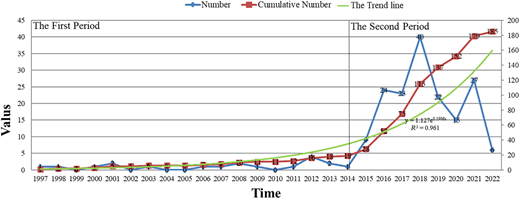
Figure 1 was obtained by counting the time when the policies come into force. China’s globalizing Internet policy may be traced back to the “Notice of the State Science and Technology Commission on the Implementation of Technical Innovation Project Opinions,” formulated in 1997. At that time, China was actively and comprehensively advancing the reform of the scientific and technological system and was beginning to realize the need to establish a national technological innovation subject on the global Internet and promote the exchange of international and domestic technological innovation information. The vision of China’s globalizing Internet policy can be divided into two phases: a gentle start phase (1997–2014) and a rapid development phase (2014–2022).
In the first stage, the Internet began to spread in China; China’s Internet entered the commercial stage, the entrepreneurial Internet wave rose and the netizen group gradually developed. However, China’s Internet development vision was relatively narrow at that time. China’s awareness of interoperability with the international community in the Internet field was relatively weak. Combining the number of policies formulated and their cumulative number, there are very few globalizing Internet policies at this stage (the average annual number of policies was 1.06), and the number of policies is stable at between 0 and 2. The peak number of policies at this stage appeared in 2012. At this time, the Chinese Internet had become an important part of global Internet development, and the Internet industry with international influence had taken shape. The CPC and the State Council have also attached importance to the Internet in relation to the production methods revolution and social development. For example, the MIIT has formulated the “Twelfth Five-Year Plan for the Development of the Internet Industry” to guide the development and management of the Chinese Internet industry in the next five years, with an expectation of significantly improving the international influence of China’s mobile Internet and strengthening China’s influence in the globalizing Internet standards system.
The rapid development of China’s globalizing Internet policy happened in 2014. At the first meeting of the Central Cyber Security and Informatization Leading Group in February 2014, the Chinese government initially raised the vision of building China into a cyber power. One year later, the pursuit of cyber power officially became a national strategy at the Fifth Plenary Session of the 18th Central Committee of the CPC. Overall, this phase has seen multiple surges in the number of policies. For example, the number of policies increased from 1 (2014) to 24 (2016), as well as by 17 from 2017 to 2018. Although the number of policies at that stage was lower than for 2017 and 2019, the number of policies formulated in those two years (23 and 22, respectively) is still higher than the total number of policies in the first stage (18).
The comparison of the cumulative growth curve (the red line) and its trend line (the green line) can effectively reveal the actual and natural growth of China’s globalizing Internet policy and thus help us to understand the changes in its importance. When the cumulative growth curve is above the trend line, China is paying more attention to its globalizing Internet policy than it is supposed to be. In Figure 1, the trend line (y = 1.127e0.1906x, R2 = 0.961) and the cumulative growth curve of globalizing Internet policy are created by Excel. From 1997 to 2009, the two lines had the same pace, and from 2009 to 2015, the cumulative growth curve was slightly lower than the trend line, indicating that the Chinese government has kind of ignored issuing globalizing Internet policies at that time. However, the cumulative growth curve is much higher than its trend line since 2016, which shows that government departments have attached greater importance to globalizing the Internet in recent years.
4.2 Policy-making agencies
Statistics on the policy-making agencies of the globalizing Internet policy are shown in Table 2 (the latest names are shown when the agencies’ names have changed; for example, the National Development Planning Commission has been renamed the National Development and Reform Commission). It can be seen from Table 2 that a total of 42 agencies have participated in the formulation of globalizing Internet policies. These agencies cover finance, education, human resources, science and technology and markets, which shows that China’s globalizing Internet requires the participation of all kinds of social forces. Of these, the MIIT is the main policy-making agency. It has issued 102 policies, accounting for 55.14% of 185 policies (in other words, more than half of globalizing Internet policies were issued by the MIIT). Most of the policies issued by the MIIT are strategically guided plans, such as the “Twelfth Five-Year Plan for the Development of the Internet Industry,” “Notice of the Ministry of Industry and Information Technology on Issuing the Development Plan of the Big Data Industry (2016–2020)” and “Notice of the Ministry of Industry and Information Technology on Issuing the Development Plan of the Software and Information Technology Services Industry (2016–2020).”
The remaining major policy-issuing agencies are the State Council of the People’s Republic of China (GOV) and the Ministry of Finance of the People’s Republic of China (MOF), with 24 and 15 policies, respectively, which indicates that the development of the globalizing Internet is related to the duties of GOV and the MOF. Most of the policies formulated by GOV provide insights and treatment methods for the international development of the Internet. For example, “Notice of the State Council on Printing and Distributing the National Information Plan of the 13th Five-Year Plan,” formulated by GOV in 2016, stated that the development of informatization during China’s 13th Five-Year Plan (2016–2020) needed to maintain a global perspective, making the World Internet Conference one of the most important international platforms for cyberspace cooperation, participating in the formulation of Internet governance rules and technical standards and establishing an international cooperation mechanism to combat cybercrime. The MOF has repeatedly cooperated with the MIIT to stimulate the innovation and development of Chinese Internet companies by holding competitions and establishing pilot projects. For example, in 2019, the MOF and MIIT jointly formulated the “Notice of the Ministry of Industry and Information Technology and the Ministry of Finance on the 2019 “Maker China” Enterprise Innovation and Entrepreneurship Competition,” aiming to improve the professional ability and level of enterprises; promote the collaborative innovation development of large, medium and small enterprises; and help in the construction of cyber power.
As a form of policy formulation, jointly formulated policies reveal the cooperation between agencies quantitatively. Overall, of the 185 policies, 52 policies were formulated in cooperation (28.11%), and 133 were independently formulated (71.89%), which indicates that the globalizing Internet policy is biased toward individual departments for formulation. Among the main issuing agencies, the MIIT and GOV prefer to formulate independently, while the MOF prefers to formulate cooperatively, which shows that the MOF and other agencies have common goals and interests in the globalizing Internet, or it can be said that the development of various aspects of the globalizing Internet cannot be separated from issues of funding. Although the MIIT is biased toward independently formulated policies, it still occupies an important position in the social network of agencies of the globalizing Internet. CAC is mainly responsible for the top-level design, overall layout, overall coordination, overall promotion and implementation of major work in the Internet field. The NDRC is responsible for formulating and organizing the implementation of national economic and social development strategies, mid-and long-term plans and annual plans.
4.3 Policy tools
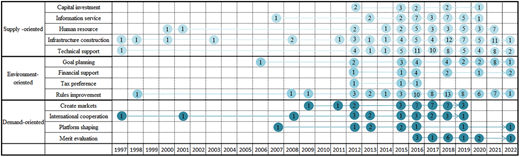
Statistics on the number of various types of policy tools are shown in Table 3. There are more supply-oriented policies and fewer environment-oriented and demand-oriented policies on the globalizing Internet. This also means that although the Chinese government strives to promote the globalization of the Internet in all its aspects by providing all kinds of support, shaping a good development environment and creating demand, it still relies too much on supply-oriented tools. Of the 185 policies, Rules improvement is the most used tool, accounting for 35.14%, while tax support and platform shaping are relatively small, accounting for 1.62% and 4.86%, respectively. Specifically, among the supply-oriented policy tools, the more frequently used are technical support and infrastructure construction, which shows that the Chinese government attaches importance to improving the level of network infrastructure construction, innovative cloud computing, the Internet of Things, artificial intelligence technology and academic research to promote the development of the globalization of the Internet. Environmental policy tools are more inclined to improve the various systems of Internet development and formulate medium- to long-term plans for Internet development rather than using financial incentives and tax support. Among the demand-oriented policy tools, the most used is the creation of market demand for the development of the Internet by encouraging the connection of the Internet with various industries.
Figure 2 shows the types of policy tools based on the year they were formulated. Figures inside the circles represent the number of types of policy tools in the same year. For example, capital investment policies appeared twice and three times, respectively, in 2012 and 2015. It can be seen from Figure 2 that there were too many supply-oriented policies, especially infrastructure construction policies, in 2011 and before. The reason is that this represents the period when the Internet was gradually spreading in China, and China had begun to develop an international Internet awareness, emphasizing the construction of software and hardware systems for Internet access. From 2012, the number of policy types increased significantly, and the comprehensive use of supply-, environment- and demand-oriented policies began. The reason is that in 2012, the Chinese government gained for the first time a clear understanding of the importance of the Internet era, and with the “Twelfth Five-Year Plan for the Development of the Internet Industry,” formulated by the MIIT, China’s Internet industry also had its first thematic five-year plan.
5. Discussions
5.1 The bright vision of policies
The importance of the Internet as a strategic resource has been globally recognized and actions to promote the development of the Internet have increased every day. The analysis of the policy vision displays the increasing regulatory efforts of the Chinese government to increase its voice in the global Internet governance system via the Internet. The key trend emerged from the vision of China’s globalizing Internet policy is that after years of extremely slow growth, China’s globalizing Internet policy has experienced a period of rapid development since 2014.
Unlike the US-centric, market-oriented Internet governance scheme, the development of China’s globalizing Internet policies has been influenced by political factors (Shen & Segal, 2016). The Chinese government has actively promoted “Internet sovereignty” to reshape the discourse and practices of global cyber governance (Zeng et al., 2017). Since 2014, the Chinese government had begun to think about Internet security and governance from an international angle. This consideration is in fact closely related to the Snowden incident in 2013. From the perspective of China, this was new evidence that the United States endangered global cybersecurity. The Chinese government emphasizes that although the Internet is highly globalized, the sovereign rights and interests of each country should not be infringed in cyberspace. In the analysis of policy vision, the number of globalizing Internet policies has rapidly increased, with the intention of pushing for the goals of Internet sovereignty. Becoming one of the “major cyber power” has been a goal for the Chinese leadership, acting as an organizing principle for domestic and foreign policy formulation (Creemers, 2020).
In summary, the analysis of the policy vision shows that the Chinese government plays an important role in regulating its globalizing Internet. This trend is similar to the Internet governance policies of Russia which have advocated more hierarchy and a greater role for governments (Nocetti, 2015). The world is still in the age of power, and China’s globalizing Internet strategy is dependent on the increasingly hard power on the international stage. Realizing the great benefits that the Internet has brought, the Chinese government has issued a considerable number of policies to regulate and promote the development of the Internet with the purpose of enhancing the influence of China in the global Internet governance system.
5.2 The cooperation among policy-making agencies
In terms of policy-making agencies, although the MIIT dominates the promulgation of China’s globalizing Internet policy, the globalization of the Internet requires the participation of more government forces. At present, most of the departments, including finance, education, human resources and technology, are participating in the construction of China’s globalizing Internet with the introduction of related policies that have stimulated the process of globalizing the Internet and cyber power. In addition, social forces represented by enterprises are also more involved in the formulation of China’s globalizing Internet. China encouraged the formation of more next-generation Internet research institutions and key enterprises and encouraged more Internet companies to provide services to the world.
The analysis of policy-making agencies demonstrates that China’s globalizing Internet policy is a result of the cooperation among various agencies, which implies that countries that want to express their voice in the global Internet governance system need several main policy-issuing agencies, along with the participation of other agencies. Since the use and the influence of the Internet cut across almost all sectors of life, including industry, agriculture, health, finance, education, job and travel, cooperation among various agencies is necessary. Meanwhile, these agencies should work with a long-term strategic guided plan and common goals. As an intersectional field, the Internet covers almost everything to some extent. Without the guidance of strategic plans and common goals, these various agencies would be in a mess, developing the globalizing Internet in their own way. Such a fragmented approach would hinder, not promote, the sustainable and sound development of a globalizing Internet.
In summary, the key trend that emerged from the analysis of China’s globalizing Internet policy is the cooperation among different agencies. China’s globalizing Internet focuses on technical issues as well as the expression of national values. It is not only the participation of Chinese academics and civil society in Internet international organizations, but also Chinese Internet technology, capital, and transnational corporation integrate into the Internet. The Internet can bring the influence of a country’s history, culture, policy and economics to the whole world, and, therefore, requires the engagement of agencies in all these different sectors.
5.3 The comprehensive use of policy tools
The comprehensive use of multiple types of policy tools is the development trend of China’s globalizing Internet policy, reflecting how the Chinese government is striving to achieve the goal of globalizing the Internet. The Chinese government has continued to use a supply-oriented policy as the main means to develop the international Internet, including giving play to the role of central financial funds in guiding telecommunications companies, using information technology to promote the construction, cultivating scientific and technological innovation teams, promoting infrastructure construction and strengthening innovation to achieve Internet breakthroughs in key technologies in the field. The Chinese government has also consciously increased the number of the environment- and demand-oriented policies. These policies, among other things, emphasize the promotion of Internet industry standards to provide legal guarantees for the globalizing Internet, guide the behavior of market entities and allocate government public resources through the formulation of target plans. In terms of demand-oriented policy tools, China combines the power of the Internet with major national strategies, such as the “Belt and Road” initiative and promotes the internationalization of the Internet in China by expanding international markets and strengthening international cooperation.
In summary, the key trends that emerged in the analysis of China’s globalizing Internet policy include (1) existing policies have comprehensively used the supply-oriented tools, the environment-oriented tools, and the demand-oriented tools; (2) the supply-oriented tool is the primary mean in current policies; and (3) the environment-oriented tools and the demand-oriented tools have been used more frequently in recent years. Considering the demand of the Chinese government for the global Internet governance system and the long-term practice of emphasizing the responsibility and intervention practices of government in Internet management, the wide usage of all kinds of policy tools will continue in the future. This wide usage is a comprehensive outcome of China’s economic development and social environment. China is a government-led country. In the adoption of policy tools, the Chinese government spares no effort to become a cyber power and increase its influence on the global Internet governance system.
6. Conclusions
The Internet is fully integrated into all areas of social production and life and has led to new changes in social production, creating a new digital space for human life, bringing new challenges to national governance and profoundly changing global industry, the global economy, global interests and global security. The large changes that the Internet has introduced have only just begun, and various sovereign countries are working to develop the global Internet as a tool to develop digital society and promote their values and political systems. China is no exception, and its globalizing Internet is part of its future development. The first email in China, entitled “Across the Great Wall we can reach every corner in the world,” was sent in 1987, marking the beginning of Internet use in the country. After more than 30 years of Internet development, China’s position and influence in the global Internet governance system has gradually increased, undergoing a transition from “Limited” to “Comprehensive” and “Passive” to “Active” and even leading in some areas. This paper examined the policy-making trajectory of China’s globalizing Internet in order to enhance its understanding of China’s globalizing Internet strategies.
It is a political tendency of China to use the Internet as a tool to involve in the global governance system. The Chinese government has implemented various policies to achieve this national goal, and it has also embodied these policies in terms of infrastructure, companies, talent and technology, which constitute the guidelines of China’s globalizing Internet. Due to the novelty and volatility of the technology, the rapid changes in economic and political interests, and the impact of social and intergenerational cognitive changes, there are still many uncertainties in the normative structure of the various problems facing cyberspace in the future (Nye, 2014). In recent years, the crusade against the US’s cyber hegemony has provided the Chinese government with more space to pursue its globalizing Internet, but its nation-centered policy structure is bound to set off a global wave in a transnational context. China has consciously promoted the value of Internet sovereignty, especially regarding resisting the US’ global surveillance after the Snowden leak. Since 2013, more government departments have been involved in the frequent promulgation of Internet policies, and the policy tools involved are more specific than before. In fact, this is also China’s response to the predominant narrative of a single, connected Internet on various Internet-related fora at that time, and China’s emphasis on an Internet community of respect for Internet sovereignty, multilateral governance and multistakeholder participation. China’s globalizing Internet is a “key option” for realizing the “Chinese Dream,” which also can explain more comprehensively why China subsequently decided on more policy-making agencies to formulate Internet policies and the creation, to some extent, of more policy tools.
This study offers several theoretical implications for research. First, this paper provides an important analytical framework in the field of China’s globalizing Internet. Unlike most literature researching the development of, and challenges faced by China’s globalizing Internet, this study uses policy text analysis. The analysis of policy text is useful for understanding strategies in the past and foreseeing activities in the future (Walt et al., 2008). It provides a powerful tool for understanding how China achieves its continuously rising influence over the global Internet and helps clarify the reality of the activities of China’s globalizing Internet contained in the policy. Furthermore, in contrast to studies that discuss China’s globalizing Internet based on specific events, this study pays attention to the whole development of China’s globalizing Internet. By showing the dramatic increase in the frequency of policy formulation and the diversity of policy-making agencies, this research explains why the Chinese government is highly active and provides a background to the involvement of multinational companies, capital, infrastructure, technology and talents. Finally, the analysis of policy tools helps our understanding of China’s approach to the development of the globalizing Internet through public policies. There are many conscious or unconscious actions, such as the investment of capital and the provision of information services, contained in the texts of globalizing Internet policies. Policy tools help us identify and analyze these actions.
There are some limitations to this research. First, as we mentioned before, this paper focuses on the content of China’s globalizing Internet. We did not consider the policy effectiveness of different types/levels of policy, such as Laws and Administrative Regulations, nor examine the effects of these three policy tools. Second, this paper did not examine the relationships among policy vision, policy-making agencies and policy tools. Based on our data, we can preliminarily find that these three elements are closely related to each other. To enhance its discourse power at the global level, the Chinese government is issuing more and more globalizing Internet policies. Meanwhile, various agencies are engaging in the making of policies, and different policy tools are being used. But the deeper relationship among these elements is not clear. For example, which agency prefer using which policy tools? Third, this paper focused on a broad concept – China’s globalizing Internet and did not discuss special regulations for specific topics, such as an expansion of Internet cooperation with Belt and Road countries and China’s advocacy of a community with a shared future in cyberspace. These specific subjects should be examined in future research. Finally, this paper only investigates China’s promotion of its globalizing Internet and does not specifically discuss the conflict between China’s globalizing Internet and the US and other countries who use the “multistakeholder” Internet governance mode; nor does it discuss the alliance issue with Brazil and Russia, who have a similar view of Internet sovereignty. Therefore, the relationship between China and other countries in the process of China’s globalizing Internet is also worth exploring.
This work was supported by the Sichuan University under Grant No. SKSYL201807 and No. SS202102.
Declaration of interest: No competing interests declared.