In recent years, human resource analytics (HRA) has become a key focus area of study and practice within human resource management (HRM). Especially in today's rapidly changing business environment, organizations must increasingly rely on insights from HR data. This study examines the evolution of HRA as a crucial tool for data-driven decision-making in HRM.
A bibliometric review is conducted on research articles related to HRA published in journals listed by the Australian Business Deans Council 2022 and indexed in the Scopus Database. This study uses a systematic approach to evaluate performance metrics, collaboration networks, scientific mapping and thematic developments.
The findings reveal significant growth in HRA research, indicating an increase in academic contributions and a shift in evolving research themes. Key trends include the integration of artificial intelligence, machine learning and advanced analytics of HRA in workforce planning and strategic decision-making.
The study provides valuable insights for both academics and practitioners, illustrating the trajectory of HRA research and its significance to strategic HRM. Organizations can utilize HRA to enhance workforce analytics, optimize talent management and improve HR decision-making through data-driven strategies.
This research expands the existing knowledge of HRA through a comprehensive bibliometric analysis. It establishes a foundation for future research and practical uses, helping researchers and professionals grasp the development and impact of HRA within contemporary HRM.
1. Introduction
In recent years, firms have increasingly incorporated data-driven insights to increase workforce decision-making. The rapid growth of digital technology and the availability of huge datasets have pushed the acceptance of analytics in human resource management, changing traditional HR tasks into strategic, data-informed practices (Chen et al., 2012). As businesses attempt to align HR activities with larger organizational goals, the application of human resource analytics (HRA) has gained great traction in both academic research and industrial implementations (Arora, Prakash, Dixit, Mittal, & Singh, 2023; Boudreau & Cascio, 2017; Marler & Boudreau, 2017; McCartney & Fu, 2024). Human resource analytics (HRA) has gained significant attention from businesses and public organizations (Espegren & Hugosson, 2023). HRA is defined as the process of gathering, analyzing and interpreting human-related data to guide decision-making, leading to better outcomes for both employees and the organization as a whole (Fernandez & Gallardo-Gallardo, 2021).
With the rapid advancements in technology and the increasing availability of data, HR practices have transitioned toward a more analytical and evidence-based approach. This transformation has been facilitated by HRA, which integrates data-driven insights into workforce decision-making processes. Technology is playing a growing role in HR functions across different industries, with many companies adopting HRA to improve workforce management. Intelligent gadgets driven by AI, in particular, are giving an ever-growing amount of performance-related information to boost human influence at work. Studies estimate that AI and machine learning will contribute to a 37% increase in labor productivity by 2025 (Deloitte, 2023). These trends highlight the growing importance of HRA in modern business environments, as organizations strive to enhance their decision-making processes through data-driven insights. Successful companies use data to make better HR decisions, gaining a competitive advantage (Vargas, Yurova, Ruppel, Tworoger, & Greenwood, 2018). As artificial intelligence and digital tools become more common in business, HRA helps companies adapt to new ways of working and develop the necessary skills to meet future challenges (Gurusinghe, Arachchige, & Dayarathna, 2021). This transition is visible in top businesses such as Google and Bank of America, where workforce-related choices are now predominantly guided by analytical frameworks rather than intuition (McCartney & Fu, 2022). HRA expands beyond standard HR measurements by incorporating statistical approaches and advanced analytical tools to evaluate the impact of HR operations on organizational outcomes (Marler & Boudreau, 2017).
In recent years, studies in HRA have explored various dimensions, such as predicting employee attrition, the role of big data in HRM (Dahlbom, Siikanen, Sajasalo, & Jarvenpää, 2019), artificial intelligence applications in HR (Achchab & Temsamani, 2021) and talent acquisition (Ghosh & Basu, 2020). Additionally, research has focused on predicting employee absenteeism (Lawrance, Petrides, & Guerry, 2021) and leveraging analytics to optimize HR strategies. The adoption of HRA has revolutionized traditional HR practices by shifting from heuristic-based decision-making to a more objective, data-driven approach, minimizing biases and improving workforce-related decision-making (Rasmussen & Ulrich, 2015).
The bibliometric analysis uses ABDC-listed journals (2022) and the Scopus database (2014–2024) to ensure research quality, credibility and academic rigor. ABDC-listed journals are considered in this study as they are recognized for their peer-reviewed, high-impact contributions, while Scopus-indexed publications provide comprehensive coverage. Research Questions (RQ) of this study are as follows.
What are the publication trends in HRA literature?
Which geographical regions and research collaborations are the most influential in HRA?
Who are the most prominent journals and authors, and what are the highly cited documents in this field?
How have keywords used in HRA research evolved?
To what extent do scholars collaborate in HRA research?
2. Background of the study
HRA has gained significant traction in recent years (Arora et al., 2023; Pham-Duc, Tran, Huu Hoang, & Bao Do, 2023). Fitz-enz, often regarded as the pioneer of HRA, introduced the concept in his book “How to Measure Human Resources Management” (Fitz-enz & Davison, 1984). Despite this early foundation, academic interest in HRA remained relatively limited for many years (Marler & Boudreau, 2017). The field of HRM has historically concentrated on key functions such as performance evaluation, recruitment and training and their impact on organizational effectiveness. The emergence of HRA in scholarly literature dates back to 2003–2004, and since then, research interest in this domain has significantly expanded, as evidenced by the growing number of publications and citations in this field. HRA remains an evolving discipline that continues to gain momentum. Due to its interdisciplinary nature, scholars have conceptualized it under various terminologies, including “Talent Analytics” (Thomas H. Davenport, 2010), “People Analytics” (Wei, Varshney, & Wagman, 2015), “Human Capital Analytics” (Minbaeva, 2017)and “Workforce Analytics” (Huselid, 2018).
While some researchers have proposed their definitions of HRA, others have referenced existing definitions from prior studies, contributing to the diversity and fragmented nature of the literature. Despite its potential, HRA has received limited attention in management research (Marler & Boudreau, 2017). Despite its growing significance, research on HRA remains limited, leaving many questions surrounding its effective implementation unsolved (Arora, Prakash, Mittal, & Singh, 2024; Fernandez & Gallardo-Gallardo, 2021). Furthermore, various hurdles, including technology integration, data quality problems and skill shortages among HR practitioners, prevent the mainstream use of HRA (Dahlbom et al., 2019). Nonetheless, despite its early-stage acceptance, HRA continues to evolve as organizations see its potential to drive strategic decision-making and optimize human capital management (Falletta & Combs, 2021). While many firms are still exploring HRA implementation, there remains a lack of understanding of the critical resources and competencies required for successful execution (Qamar & Samad, 2022). As HRA matures, further research is required to bridge these gaps and provide a thorough path for integrating data-driven insights into workforce initiatives (Huselid, 2018; Schiemann, Seibert, & Blankenship, 2018). As research in this field continues to develop, a comprehensive literature analysis can further increase the understanding of HRA and its various applications in modern organizations.
Despite the growing interest in bibliometric studies in HRA, prior research (Arora et al., 2023; Qamar & Samad, 2022; Wang, Zhou, Sanders, Marler, & Zou, 2024) has primarily relied on various databases without systematically considering journal quality rankings. A critical gap exists in the literature, as no comprehensive study has exclusively focused on ABDC-ranked journals, which serve as a benchmark for high-impact, peer-reviewed research in business and management disciplines. This study bridges this gap by conducting a bibliometric analysis (2014–2024), incorporating the latest ABDC 2022 Journal Quality List (JQL) to ensure a rigorous and up-to-date assessment of research contributions. By utilizing the Scopus Database and ABDC-ranked Journal Articles, this study provides a refined, credible and structured evaluation of how HRA research has evolved over the past decade.
3. Research framework
3.1 Research methodology
A literature review serves as a systematic approach to mapping the intellectual landscape of a research domain, enabling the identification of research gaps and existing informational constraints. A structured literature review synthesizes a diverse body of scholarly work to provide an in-depth and holistic analysis of a given field. In this study, the bibliometric analysis approach is utilized for the literature review. Bibliometric analysis has gained widespread application in management research, as it systematically evaluates academic literature through citation patterns, publication trends and scholarly influence (Wu, Farrukh, Raza, Meng, & Alam, 2021).
In the context of HRA research, this approach helps map scholarly contributions, identify key trends and assess the impact of influential studies. Bibliometric analysis is a quantitative research methodology that systematically evaluates the expanding body of literature within a given field (Milian, Spinola, & Carvalho, 2019). While traditional systematic reviews offer in-depth insights into research depth, bibliometric analysis excels in capturing a broader range of publications, making it particularly useful for emerging and rapidly growing fields. The bibliographic dataset was processed using R software's “bibliometrix” package and VOSviewer, enabling comprehensive network analysis, co-citation mapping and thematic clustering.
3.2 Data collection (Designing the search query)
To ensure thorough coverage of HRA literature, this study adopted a structured search protocol. Based on prior research (Espegren & Hugosson, 2023; Margherita, 2022), a comprehensive set of keywords was identified. The search query included terms such as “HR analytics,” “Human resource analytics,” “Workforce analytics,” “People analytics,” “Talent analytics,” “Employee Analytics” and “Human capital analytics”. These keywords were carefully selected to encompass a diverse range of terminology used in scholarly discourse and industry practices, ensuring a comprehensive representation of the field.
3.3 Data search and preliminary results
The Scopus database was selected as the main source for bibliographic data collection in this study due to its wide-ranging coverage of high-impact journals and a greater number of publications compared to other databases (Tiwari, Ilavarasan, & Punia, 2021). Many studies have also utilized it for bibliometric analysis due to its extensive indexing of peer-reviewed literature (Arora et al., 2023; Farrukh, Raza, Ansari, & Bhutta, 2022; Qamar & Samad, 2022).
3.4 Refinement of results
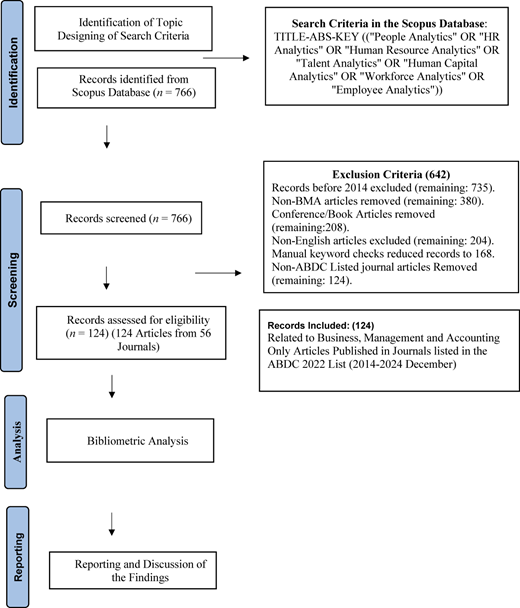
Scientific literature, often regarded as “specialized knowledge” published in peer-reviewed journals serves as the foundation for academic research. Given the emerging nature of HRA, this study incorporates ABDC 2022-listed journal articles to ensure a comprehensive analysis of scholarly contributions. Specifically, 124 peer-reviewed articles from 56 high-quality journals listed in the ABDC 2022 Journal Quality List were selected to maintain academic rigor and credibility. This meticulous selection process ensures that the dataset accurately reflects the most influential contributions in HRA, thereby enhancing the credibility and reliability of this bibliometric study. Initially, 766 articles were retrieved from the Scopus database, as shown in Figure 1 (Prisma Framework by (Page et al., 2021)). A rigorous refinement and filtering process led to a final dataset of 124 high-quality articles published in ABDC 2022-listed journals. The bibliographic data was systematically compiled and stored in CSV format for further analysis.
4. Analysis and findings
4.1 Preliminary analysis
The bibliometric analysis of HRA research from 2014 to 2024, based on Scopus-indexed publications, as per Table 1, reveals a rapidly growing field with a yearly growth rate of 33.51%. The field is relatively young but evolving speedily, with an average document age of 3.56 years. The impact of these studies is evident in an average citation rate of 34.57 per document. The dataset is supported by 7,376 references, indicating deep integration with existing literature. The thematic landscape is broad, with 427 author-defined keywords and 214 Keywords Plus, showcasing the diversity of topics explored. The research community consists of 271 authors, with a strong inclination toward collaborative work. The average co-authorship per document is 2.62. Around 22.58% of publications involve international collaborations, indicating a growing global research network.
4.2 Annual growth of the research
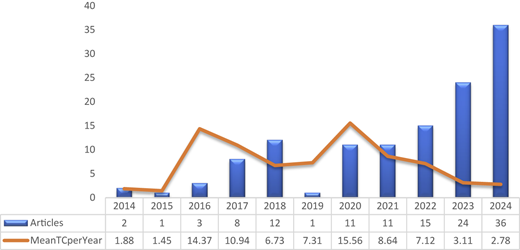
The number of publications in ABDC 2022 listed journals surged to 36 in 2024 from 2 in 2014, indicating an expanding scholarly focus on HRA. Figure 2 states that from 2014 to 2024 (Till December), the annual production of HRA research articles has increased significantly, indicating a growing academic and industry interest in this field.
The citation impact, measured by Mean Total Citations per Year, peaks in 2016 and 2020 respectively. However, it has declined since 2021, with 3.11 in 2023 and 2.78 in 2024. However, as publication volume increased, the average citations per year declined, indicating a lag in citation accumulation for newer studies or a diffusion of citations across a larger number of publications.
4.3 Source analysis (top 10 journals related to the field)
Table 2 reveals that the “Journal of Organizational Effectiveness” is the leading academic source in HRA research, with a high number of publications, an H-index of 9 and 489 total citations. HRM, despite having fewer articles, also holds an A* ranking in ABDC 2022, indicating its prestige and influence. The “International Journal of Human Resource Management” has the highest citation count, indicating a strong research impact. Other prominent sources include the “Human Resource Management Journal” and Personnel Review. However, “Human Resource Management International Digest” and “International Journal of Organizational Analysis” have relatively lower citation counts, indicating a niche focus or limited research influence.
4.4 Author’s influence
The study of the most prominent authors in HRA research is based on key bibliometric indicators, including publications, citations, H-index, G-index and M-index (See Table A1 in the supplementary file). The H-index represents the number of publications with at least h citations each, while the G-index accounts for the cumulative g2 citations. The M-index, calculated as the H-index divided by the number of years since the author's first publication, provides insight into citation consistency over time. McCartney S ranks highest with five publications and 177 total citations, while Fu N follows with four publications and 124 citations. Other authors, including Arora M, Cavanagh J, Di Prima C, Ferraris A, Halvorsen B, Mittal A, Pariona-Cabrera P, Singh S, and Wang L, have contributed three publications each with varying citation impacts.
4.5 Countries scientific production
The study of HRA research by country reveals a significant geographical distribution and level of international collaboration. As per Table 3, the USA leads the field with 23 articles, with 18 being single-country publications and five being multi-country publications. India follows closely with 21 articles, indicating a similar trend. European nations like Germany, Ireland, the Netherlands, and Spain contributed seven articles, with Germany and Ireland showing low international collaboration. Italy and Australia had a higher level of global engagement. Smaller contributors like Belgium, the United Kingdom, Canada, Finland and France showed moderate collaboration, while Greece and South Korea produced articles solely through single-country publications. The data suggests that developed economies dominate HRA research, with countries like China and Austria relying on international co-authorship, while Spain, Israel, Denmark and Greece contribute independently.
4.6 Countries total citation analysis
The study of HRA research citations by country reveals that the USA leads with the highest total citations (TC = 1,400) and an average of 60.9 citations per article, indicating a strong research presence and consistent scholarly influence in the field (See Figure A1 in the supplementary file). The UK, despite having fewer articles, demonstrates the highest citation impact (average = 130.3 citations per article), reflecting the high-quality contributions and significant influence of UK-based research. India, with 368 total citations and an average of 17.5 citations per article, shows a substantial volume of research output but comparatively lower citation impact per study. Denmark, with 206 citations per article, exhibits a strong impact despite a smaller research contribution, suggesting Danish research in HRA is highly cited and influential. Other countries like Australia, the Netherlands, Ireland, Spain and Israel have moderate citation impact, while Italy demonstrates moderate academic influence. Overall, the citation distribution highlights the importance of both volume and influence in shaping HRA research worldwide.
4.7 Keyword analysis
Keyword analysis is a systematic approach used to explore connections between different subfields of HRA research. “HR analytics” had the highest occurrence and strong link strength, emphasizing its prominence in research. Other frequently occurring keywords include “People Analytics, “Human Resource Management” and “Workforce Analytics”. These terms indicate a shift from traditional HR practices toward data-driven decision-making. Additionally, technological advancements such as “Artificial Intelligence”, “Big Data”, and “Machine Learning” highlight the increasing reliance on automation and predictive analytics to enhance HR processes. The emphasis on “Strategic HRM” and “Human Capital Analytics” suggests that HRA is not only being used for operational improvements but also for strategic workforce planning and competitive advantage (Rasmussen & Ulrich, 2015). The occurrence of “Organization” and “Human” suggests that despite the increasing reliance on data, there is still an emphasis on maintaining the human aspect of HRA to foster a balanced and people-centric approach.
4.8 Analysis of the keyword co-occurrence
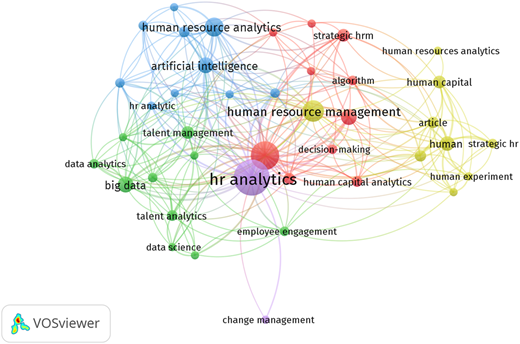
The structure of knowledge and emerging research themes in HRA can be examined through keyword co-occurrence networks. Figure 3 highlights the main areas of focus within the field. Analyzing these patterns in VOSviewer reveals major research clusters.
The first cluster focuses on the technological foundation of HRA, with terms like “HR analytics,” “People Analytics,” “Workforce Analytics,” “Big Data” and “Human Resource Management” indicating a strong focus on building sophisticated systems and frameworks to manage and analyze HR data efficiently.
The second cluster focuses on predictive and data-driven decision-making, with terms like “Artificial Intelligence,” “Machine Learning”, “Talent Analytics” and “Human Resource Analytics” suggesting organizations are leveraging advanced analytics tools to enhance HR functions, optimize talent strategies, and forecast workforce trends more accurately.
The third cluster is more strategic, emphasizing the role of HRA in shaping organizational performance and competitive advantage. Keywords like “Strategic HRM”, “Human Capital Analytics”, “Human Capital”, “Talent Management” and “Organizational Performance” highlight how HRA is being used to measure workforce effectiveness, align HR strategy with business goals, and enhance long-term organizational success.
4.9 Co-citation analysis
Co-citation analysis is a method used to examine the relationships between academic works by identifying how often two different authors are cited together in another research (Farrukh et al., 2022). In the co-citation network, authors who frequently appear together in citations form clusters, reflecting their shared contributions to the field. Co-citation analysis reveals three major clusters of influential authors in HRA research (See Figure A2 in the supplementary file). The strength of co-citation links among these clusters demonstrates how different aspects of HRA research are interconnected. While Cluster 1 focuses on strategic HRM and workforce analytics, Cluster 2 highlights operational and organizational outcomes and Cluster 3 explores the impact of emerging technologies. This co-citation analysis provides valuable insights into the key contributors driving the evolution of HRA.
Cluster 1, which includes Boudreau J., Huselid M.A., Levenson A., Marler J.H. and Ulrich D., represents scholars with a strong focus on workforce planning, talent management and strategic HRM.
Cluster 2, featuring Angrave D., Charlwood A., Kirkpatrick I., Lawrence M. and Stuart M., focuses more on HRA implementation, decision-making processes and its role in organizational performance. The works of these authors are frequently co-cited, highlighting their collective influence on research discussing the practical applications of HRA.
Cluster 3, which includes Di Lauro S., McCartney S., Pagliari C. and Tursunbayeva A., emphasizes the intersection of HRA, digital transformation, and technological advancements in workforce management. This cluster suggests an evolving research trend toward integrating digital tools, artificial intelligence and big data into HR functions.
4.10 Most cited articles
Marler and Boudreau focus on evidence-based HR practices, whereas Angrave et al. discuss the difficulties HR faces in adapting to big data. Newman et al. and Gal et al. address ethical issues related to algorithmic bias and promote fairness in AI-driven HR decisions. Pessach et al. focus on machine learning for recruitment, whereas van den Heuvel and Bondarouk stress the importance of credible human capital analytics. Studies by Hamilton & Sodeman and McIver et al. examine the role of big data in strategic workforce management. Fernandez and Gallardo-Gallardo discuss barriers to HRA adoption and Margherita provides an overview of research trends (See Table A2 in the supplementary file). Overall, HRA has evolved from simple reporting to predictive insights, reinforcing its role in business strategy and competitive advantage.
4.11 Co-authorship analysis
The co-authorship analysis, conducted with VOSviewer, includes 36 items grouped into 17 clusters, offering insights into research collaboration patterns within the field (See Figure A3 in the supplementary file). The visualization of the collaboration network through co-authorship mapping reveals distinct patterns of scholarly interactions (Munjal & Sachdeva, 2024). The analysis suggests that the network is widely distributed, indicating opportunities for expansion in collaborative research efforts. The size of the circles represents the number of publications per author, while different colors denote separate research clusters. However, findings also indicate a limited degree of co-authorship among highly cited researchers, suggesting that many influential scholars tend to work independently rather than in collaborative teams. Effective collaboration leverages various skill sets to enhance research impact. Co-authorship networks help delineate the structure and strength of academic partnership.
5. Discussion
This study advances the literature on HRA by employing bibliometric techniques to map its intellectual structure and development trajectory. The findings identify leading journals, highly cited publications, prominent research regions and influential authors, thereby providing a comprehensive overview of the field between 2014 and 2024. Consistent with prior work that positions HRA as an emerging and fragmented domain (Marler & Boudreau, 2017), the analysis confirms that the field remains relatively nascent, with increasing scholarly collaboration and practice-oriented applications. Leading journals such as “The Journal of Organizational Effectiveness”, “International Journal of Human Resource Management” and “Human Resource Management” have become central platforms for knowledge dissemination, while North America, Europe and East Asia dominate the research landscape as the top contributors, followed by South America, Africa and Oceania. The trend in HRA is characterized by the use of machine learning, AI, data analytics and big data. HR professionals rely on vast datasets from applicant tracking systems, performance reviews and employee surveys to measure human capital, employee engagement and talent management.
By harnessing data and technology, HR professionals can make informed choices, improve efficiency and drive organizational success. It highlights the strategic role of HRA in decision-making, workforce planning, performance management, recruitment, learning and compensation. HRA has become an essential tool for organizations to make better decisions using data. To successfully use HRA, companies need to ensure they have good-quality data, strong analytical skills and a clear plan for applying insights (McCartney & Fu, 2022). The emphasis on collaboration and practice-oriented applications underscores the HRA's potential to transform people management by integrating evidence-based insights into strategic decision-making.
5.1 Theoretical implications
This study advances theoretical understanding of HRA by consolidating fragmented knowledge, refining its conceptual boundaries and linking it with strategic HRM, evidence-based management and digital transformation theories. For policymakers and industry leaders, the research highlights the importance of HRA in shaping future workplace policies and workforce planning strategies (Walter, 2024). Industries can use HRA insights to develop policies on skills development, labor market trends and digital transformation in human resources. The growing use of big data, artificial intelligence, and machine learning in HRA underscores the importance for HR managers to be skilled in using advanced analytical tools (Avrahami, Pessach, Singer, & Chalutz Ben-Gal, 2022). Organizations should invest in training programs and technology to enhance HR teams' ability to interpret and utilize analytics in key areas such as talent acquisition, employee engagement and workforce planning.
5.2 Practical implications
The findings of this research have significant practical and managerial implications for organizations, HR professionals and policymakers aiming to use HRA for strategic decision-making. One important implication is that HR professionals need to develop analytical skills and data-driven decision-making abilities. In his study (Omol, 2024), states that the future of work will involve greater human-machine collaboration, with humans emphasizing creative and analytical tasks, while automation and AI perform routine functions.
Managers should incorporate HRA into corporate decision-making processes, ensuring that data insights support the organization's broader goals. Another important managerial implication is the ethical and responsible use of HRA (Edwards, Charlwood, Guenole, & Marler, 2024; Falletta & Combs, 2021). The growing reliance on predictive analytics and AI-driven decision-making raises concerns about bias, fairness and employee privacy. Despite its strategic potential, HRA also entails risks that may undermine organizational legitimacy and employee trust. Key concerns include privacy and data protection, as extensive data collection can be perceived as intrusive and ethically problematic (Calvard & Jeske, 2018). The use of analytics for surveillance and constant tracking risks creating a culture of control, thereby eroding psychological safety (Leicht-Deobald et al., 2019).
Furthermore, algorithmic biases embedded in predictive models may reinforce inequalities and lead to discriminatory outcomes in recruitment, performance evaluation and promotion (Newman, Fast, & Harmon, 2020). These issues underscore the potential misuse of HRA, where efficiency and prediction are prioritized over fairness and employee dignity (Giermindl, Strich, Christ, Leicht-Deobald, & Redzepi, 2022). Addressing such risks requires responsible governance, transparency and a human-centered approach to analytics. Therefore, organizations must establish clear guidelines and governance frameworks to ensure transparency, adhere to ethical AI practices and comply with data protection laws. This approach will help build trust among employees and stakeholders and maximize the benefits of HRA. By systematically connecting research trends with practical implications, this study not only synthesizes existing knowledge but also provides a foundation for advancing more coherent theoretical perspectives and responsible applications of HRA.
6. Conclusion
This study highlights the growing interaction between HRA and digital transformation in organizations (Kumar, Salmona, Berry, & Grummert, 2024). As digital transformation reshapes business models and workforce dynamics. HRA serves as a critical enabler by leveraging data-driven insights to enhance decision-making, employee engagement and organizational agility. The findings of this research contribute to understanding how analytics-driven HR practices support digital maturity and technological adaptation across organizational processes. The bibliometric study provides a systematic examination of HRA by mapping its research trends, influential contributors, key publication journals and emerging themes. The analysis reveals a substantial expansion of scholarship since 2014, the growing visibility of leading authors and journals and the dominance of thematic areas such as HRA methodologies, technology-driven applications and organizational outcomes. This study concludes that HRA has been used to enhance employee performance and talent management by supporting data-driven decision-making. It also helps organizations connect leadership quality to employee retention, resulting in higher efficiency, fewer workplace problems and better customer satisfaction. (Rasmussen & Ulrich, 2015). By leveraging HRA, organizations can enhance employee experiences, promote innovation, improve operational efficiency and support sustainable business growth. In conclusion, this study offers key insights for HR professionals, managers and policymakers, emphasizing the need for data-driven decision-making, ethical AI use, strategic alignment and interdisciplinary collaboration to maximize the impact of HRA in modern organizations.
6.1 Limitations and future directions
Although this bibliometric analysis offers valuable insights, it has some limitations. One main limitation is that the dataset for this research was solely taken from the Scopus database. While Scopus is a well-known and comprehensive academic database, other sources like Web of Science, IEEE Xplore and Google Scholar also contain relevant literature on HRA. Future research could include multiple databases to give a more complete view of the research landscape. In addition, this study specifically looks at articles published in journals listed in the ABDC Journal Quality List 2022. While this ensures high academic standards, it also excludes many influential articles published in non-ABDC journals, conference proceedings, and industry reports that may offer significant insights into emerging trends in HRA. Expanding the scope to include a wider variety of publications could provide a deeper understanding of both academic and practical progress in the field. Furthermore, the study is limited to the Business, Management and Accounting (BMA) subject area. Since HRA heavily incorporates machine learning, artificial intelligence and data science, including research from computer science, information systems and applied statistics would give a more interdisciplinary view of the field. Future studies should explore cross-disciplinary research to examine the technological advancements that drive HRA and their real-world implications for workforce management. Despite these limitations, this study lays a strong foundation for future research. Future studies can build on these findings by using multiple databases, adopting a broader keyword strategy and exploring interdisciplinary approaches. As HRA continues to develop, broadening the research scope will be essential to fully understanding its potential and overcoming challenges associated with data-driven HR practices.
Data availability
Data will be shared on demand.
Contributions Statement
This work is part of Akshay Rana’s doctoral thesis, carried out under the guidance of Dr. Geeta Sachdeva, an Assistant Professor at NIT Kurukshetra. Akshay Rana handled the study’s conception, data collection, analysis, and drafting of the manuscript. Dr. Sachdeva provided academic supervision, helped refine the research framework, and offered critical feedback during manuscript revisions. Both authors have reviewed and approved the final version and take responsibility for all aspects of the work.
The authors gratefully acknowledge the support and guidance received from the National Institute of Technology Kurukshetra, an Institute of National Importance, in India, for providing the academic resources and conducive research environment essential for the successful completion of this work.
The supplementary material for this article can be found online.