Studies have shown that promoting indigenous housing developers can improve the delivery of sustainable and affordable projects, especially in developing countries such as Nigeria. Thus, the role of indigenous developers is pertinent to sustainable low-cost housing (LCH) projects and, with government support, may help achieve housing-related Sustainable Development Goals, such as sustainable cities and communities (SDG 11). Indigenous housing developers face challenges, and an in-depth study is required. This study examines the barriers faced by indigenous housing developers and proposes measures to enhance their role in delivering sustainable LCH projects and, by extension, advancing SDG 11.
This research employed a qualitative design. It conducted 46 face-to-face semi-structured interviews. The researchers used convenience sampling to select participants in Abuja and Lagos, Nigeria. The study also analysed the data manually using a thematic approach.
The role of indigenous housing developers is critical to enhancing sustainable LCH delivery. The study also identified 18 barriers that indigenous developers face in achieving sustainable LCH projects. Findings indicate that these barriers may threaten sustainable LCH for urban low-income earners in Nigeria if left unchecked. This research proposed measures to enhance indigenous developers' roles and, by extension, improve the achievement of SDG 11.
The study's results will benefit the housing industries of developing countries with similar characteristics by motivating indigenous developers to deliver more sustainable LCH projects. Findings will also contribute to the body of knowledge on how to improve the achievement of SDG 11 through sustainable LCH provision.
1. Introduction
Sustainable low-cost housing delivery is pertinent to reducing extreme poverty and improving families' health and well-being, particularly in developing nations. Ebekozien (2021) opined that increased sustainable housing provision, particularly for low-income earners, would reduce unemployment. It implies a boom across most economic sectors during affordable housing provision (Adabre et al., 2020). For this study, low-cost housing (LCH) is a component of affordable housing. One key stakeholder to achieve this task is the housing developers. Despite housing developers' gains in sustainable housing provision, especially for low-income earners in developing countries, challenges remain in the delivery process (Moghayedi et al., 2021). Sustainable housing is used in this context. It focuses on sustainable development within the construction industry. In this context, Ezennia (2022) described sustainable development in affordable housing as achieving higher quality through resource competence and excellence while safeguarding environmental protection and economic growth. The term sustainable affordable housing describes housing that incorporates sustainability and affordability and meets present needs without endangering future generations' ability to meet theirs (Adabre and Chan, 2019; Ezennia and Hoskara, 2019). Regarding sustainable affordable housing, this study focuses on low-cost housing because the housing demand-supply gap is more pronounced among low-income groups in developing countries (Malik, 2024).
Olanrewaju et al. (2018) affirmed that the concept of sustainable LCH is gaining widespread support and is mitigating the impact of construction activities on the climate and environment. The concept is designed to meet a range of social, environmental, cultural, and economic criteria to provide housing solutions for low- and middle-income earners, especially in developing countries such as Nigeria. This intention agrees with SDG 11 of the United Nations' 2030 Agenda. The focus of SDG 11 is to improve access to adequate, safe, and low-cost housing for low-income groups by 2030. Indigenous housing developers can play a critical role in achieving this goal, but may face challenges. These challenges may be critical for indigenous housing developers, as sustainable LCH involves many factors. Studies (Adabre and Chan, 2019; Ezennia, 2022; Ebekozien et al., 2024) reveal that attributes of sustainable LCH promote good health and well-being, including adequate ventilation and the use of non-toxic construction materials.
Scholars acknowledged the role of housing developers in providing sustainable LCH by reducing construction costs, improving quality, and saving time through the use of local construction materials (Ahn et al., 2013; Ezennia, 2022; Reid, 2023; Malik, 2024). Local use of building materials can enhance building quality, delivery, and cost-efficiency. Indigenous developers are embracing these local materials, such as Lime-pozzolana cement, containment reinforcement for earthquake-resistant masonry structures, compressed stabilised earth blocks, and filler slab roofs. Still, they face challenges (Malik et al., 2025). Ezennia (2022) identified the top ten critical factors from the 43 barriers facing sustainable LCH in Nigeria, but not from the perspective of low-cost housing and achieving SDG 11 using an unexplored approach (qualitative research design). This includes the unorganised nature of the industry, the absence of projects, high population growth, a lack of emphasis in housing policy on sustainable construction practices, lax legislation and enforcement, hesitant use of local building materials, unwillingness to adopt changes, inadequate public awareness, and an underdeveloped mortgage system. The identified barriers were general to LCH developers and not specific to indigenous housing developers, and how they will improve achieving SDG 11 by measures to enhance their role in sustainable low-cost housing projects and, by extension, improve the achievement of SDG 11. This study will fill the theoretical and methodological gaps.
Despite the benefits of indigenous housing developers in promoting sustainable projects through local green construction materials in many developing countries, evidence of intentional motivations and incentives, via government policies, to bridge the sustainable LCH gap and, by extension, improve the achievement of SDG 11 is not available in Nigeria. Studies on key barriers to indigenous housing developers achieving sustainable LCH projects in the developing-country context are also scarce. Also, indigenous housing developers' roles may help address the low-cost housing demand-supply gap (Malik, 2024) if their challenges are curbed to make Goal 11 inclusive, resilient, safe, and sustainable on or before 2030. Hence, this study investigates the barriers facing Nigeria's indigenous housing developers and suggests measures to improve their role in achieving sustainable low-cost housing projects and, by extension, improve the achievement of SDG 11 through the following objectives.
To investigate barriers facing indigenous developers in achieving sustainable low-cost housing projects.
To suggest measures to improve indigenous developers' role in achieving sustainable low-cost housing projects and, by extension, improve the achievement of SDG 11.
2. Review of literature
The Sustainable Development Goals (SDGs) 2015–2030 will be less than a decade from now. Housing provision is a critical agenda, especially for low-income groups in developing countries such as Nigeria, which is a signatory. The housing sector is pertinent to achieving SDG 11 and related SDGs and their targets. Progress has been made by developed and developing countries toward achieving safe, LCH for all. Despite these efforts via policies and programmes, barriers still prevent housing providers, especially indigenous ones, from incorporating sustainability into low-cost housing projects (Ezennia, 2022). For this study, low-cost housing is a component of LCH tailored for low-income groups. Hence, low-cost housing here is discussed in the context of sustainability and the role of indigenous developers as providers (stakeholders). Yang and Yang (2015) and Ezennia (2022) affirmed that many interested parties often have conflicting interests, making the integration of sustainable housing complex. Understanding affordability in the context of sustainable low-cost housing broadens the housing scope to include environmental, social, and economic factors (Ezennia and Hoskara, 2021). Sustainability is the foundation of LCH, which promotes cost-efficiency in energy, transportation, and healthcare (as cited in Ezennia, 2022). Infusing sustainability is critical because it aims to improve and protect the LCH environment (Muazu and Oktay, 2011). Studies such as those by Global Green USA, as cited in Muazu and Oktay (2011), have argued that sustainable, affordable housing fosters a connection between residents' well-being and the well-being of the environment. It shows how LCH can promote economic values, social justice, and environmental sustainability. These are the values of low-cost housing.
Preliminary findings indicate that the provision of sustainable low-cost housing is slow in Nigeria. Yang and Yang (2015) found that in some developed countries, LCH challenges remain more pronounced, as evidenced by election campaigns. Ezennia (2022) found that it is more critical in many African countries. A few studies (Muazu and Oktay, 2011; Ezennia and Hoskara, 2019; Ezennia, 2022) did not address low-cost housing from the perspective of the indigenous developer's role and how it can improve the achievement of SDG 11. It is one of the motivations of this study. Ezennia and Hoskara (2019) focused on sustainable LCH choices in Nigeria. They found that wide-ranging criteria and broader dimensions of sustainable housing affordability were missing in Nigeria's housing delivery processes. Therefore, LCH housing will remain a social issue, especially for most low-income earners in urban Nigeria. This research summarised the possible barriers to sustainable housing identified in Table 1. The researchers found issues such as the unorganised nature of the industry, absence of projects, high population growth, lax emphasis in housing policy on sustainable construction practices, lax legislation and enforcement, hesitant use of local building materials, unwillingness to adopt changes, inadequate public awareness, lax interest and demand, and an underdeveloped mortgage system in related studies. Whether these barriers will influence indigenous developers in delivering sustainable, low-cost housing in a developing economy like Nigeria remains uncertain and warrants investigation. Table 1 also reveals that, besides Ebekozien (2021), who investigated the provision of low-cost housing from the perspective of indigenous housing developers, most studies adopted quantitative, mixed-methods, or review methods. These issues, if not curbed, may threaten SDG 11. The government's role in engaging stakeholders, especially indigenous developers, in delivering sustainable, low-cost housing should be a priority.
3. The study’s theoretical framework
Engagement is an “umbrella” term that describes the actions an organisation takes to ensure that organisations, associations, and people can engage in, or have a stake in, decision-making and development processes that concern them (Aigbavboa et al., 2023). Thus, the notion of stakeholder participation incorporates multiple levels of government (multi-level governance), indigenous developers, local building manufacturers, housing regulators, policymakers, community leaders, civil society and other related constituencies. The researchers adopted the stakeholder theory. It aligns with Kimanzi (2020) and Malik (2024), who adopted the stakeholder theory to support stakeholders' engagement in projects. Sustainable low-cost housing provision is a component of construction projects. Stakeholder management is indispensable for implementing projects (Xia et al., 2018). Rhenman (1964) developed the theory. The essential principle of stakeholder theory is that all interests should be recognised and continually built upon to create greater value (Santos and Carvalho, 2019). The theory reveals the implications of stakeholders in the provision of sustainable, low-cost housing through indigenous developers. It emphasises the need to generate value for various groups within a system. One special thing about this theory is that the interest of the stakeholders, in this context, the indigenous developers, who can influence (or be influenced by) their tasks, should be considered by the government (Rahman et al., 2020) to improve the participation, and by extension, improve sustainable low-cost housing provision in Nigerian cities.
4. Research method
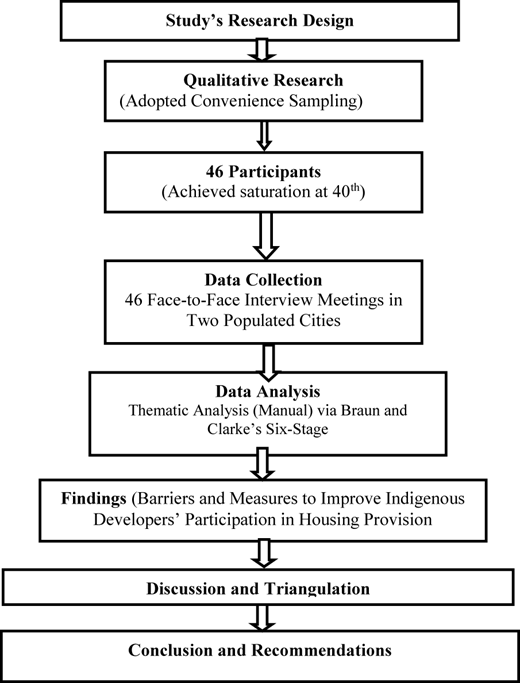
This study utilised qualitative research. It also used face-to-face interviews with semi-structured interview questions. A qualitative research design is a better approach for tackling social perceptions in housing-related studies (Nadal et al., 2018; Ebekozien, 2021), as shown in Figure 1. Aun and Bustami (2025) stated that a face-to-face method enhances interviewees' perceptions and enables an in-depth study of the problem. In this context, this study investigates the interviewees' perceptions of the main barriers to indigenous housing developers achieving sustainable low-cost housing projects. To ensure knowledgeable interviewees, the researchers adopted a convenience sampling method to engage indigenous housing developers, construction consultants involved in LCH provision, mortgage institutions, selected low-income earner house owners, intending house owners, government policymakers, and NGOs in housing provision for the masses in Lagos and Abuja, Nigeria, as detailed in Table 2. To mitigate bias associated with convenience sampling, the researchers ensured fair representation of each group, as shown in Table 2. The researchers selected Lagos and Abuja because they are among the top five Nigerian cities with a high level of housing provision and economic capital with unmatched demand (Edisom, 2025). Convenience sampling is a nonprobability sampling method in which interviewees are selected for inclusion in the research sample (Creswell and Creswell, 2018; Ebekozien et al., 2025a). It allows researchers to engage interviewees who are willing to participate in the study.
Table 2 shows that the names of the firms, participants, and designations were concealed in line with ethical considerations. Forty-six interview sessions were conducted between August 2024 and January 2025, and reached saturation at the 40th interviewee. Ebekozien et al. (2025b) affirmed that data saturation was achieved when there was no evidence of a “new construct or further theoretical perceptions” from the ongoing interview sessions. The researchers utilised their contextual views to analyse and explain the data (Thorne, 2020). The semi-structured interview questions proffered answers to this study's objectives. Each interview session lasted 40 minutes on average. The researchers created 90 codes from the 46 transcripts and re-clustered them based on occurrence, reference, and frequency into nine categories. The researchers generated two themes from the nine categories. The researchers conducted a pilot with six interviewees and slightly adjusted interview questions. The interview's main questions were.
Q1. Can you identify the role of indigenous developers in achieving sustainable low-cost housing projects?
Q2. To what extent do you feel displeased with the role of indigenous developers in achieving sustainable low-cost housing projects in Nigeria?
Q3. Can the lax role of indigenous developers in achieving sustainable low-cost housing projects threaten SDG 11 and other related housing SDGs?
Q4. If yes, how?
If not, why do you think so?
Q5. What are indigenous developers' main barriers to achieving sustainable low-cost housing projects?
Q6. To what extent can these barriers be mitigated?
Q7. How can key stakeholders enhance indigenous developers' roles in delivering sustainable low-cost housing projects and, by extension, advance SDG 11?
This study employed a thematic analysis to analyse the data. Jaafar et al. (2021) and Naeem et al. (2023) affirmed that thematic analysis is used to develop an understanding of the phenomenon being explored by identifying the patterns of interesting views that participants wish to express. The researchers analysed the data manually using the six stages (Braun and Clarke, 2012). First, the study familiarised the data through their separate reading of the 46 transcripts. Second, open coding was generated, and the main constructs/words were identified in the documents (Lune and Berg, 2016). The major constructs include the role of indigenous developers in achieving sustainable low-cost housing projects, the barriers indigenous developers face in achieving them, and measures to improve indigenous developers' role in achieving sustainable low-cost housing projects and, by extension, improve the achievement of SDG 11. Next, this study adopted axial coding. Therefore, translating the earlier constituted open sub-themes into sub-themes. Fourth was selective coding, which documented pertinent text in the 46 documents (Braun and Clarke, 2021). Next, the researchers compared the themes generated with what they had heard throughout the data collection and contacted selected interviewees to check the emerging key results. This study concluded that the perceived barriers facing indigenous developers in achieving sustainable low-cost housing projects pose a threat to achieving SDG 11 and related housing SDGs. Finally, measures to improve indigenous developers' roles in achieving sustainable, low-cost housing projects and, by extension, in achieving SDG 11 are aligned with the United Nations SDGs. This study reviewed 46 documents and identified and analysed the major extant research (Hemmler et al., 2022). This study adopted a quality assessment strategy to strengthen the credibility and reliability of the qualitative data. This study aligns with Yin (2014), as tabulated in Table 3. Table 3 shows that the study employed terms such as generalisability, validity, reliability, transferability, and credibility. In this study, the ‘majority’ criterion is used when more than 75% of participants agree on an item.
5. Findings and discussion
5.1 Theme 1: barriers facing indigenous developers
Indigenous housing developers contribute to the construction of sustainable low-cost housing, including general renovations and periodic maintenance of residential buildings. Despite the role of indigenous developers, especially in supporting sustainable LCH via embracing local building materials and creating direct and indirect employment, they face challenges. The absence of extant literature on the barriers faced by indigenous housing developers may be one of the reasons for the disastrous LCH crisis in most developing countries. These challenges may have contributed to the scarcity of urban low-cost housing and can threaten the social, economic, and well-being of inhabitants, including health and safety (Ezennia, 2022). Thus, this theme provides a concise x-ray of the issues faced by Nigeria's indigenous housing developers and acknowledges that, if left unmitigated, achieving sustainable low-cost housing provision might become an illusion (P16, P20, P30, P34, PP38, P41, and P43-P46) and a threat to achieving SDG 11. Results align with Ebekozien (2021), who found that affordable housing is essential to achieving SDG 11. Findings reveal that indigenous housing developers are likely to embrace local sustainable construction materials more than foreign developers because of the accessibility, affordability, and usage technique (majority). These benefits can only manifest through large-scale production of locally sustainable construction materials, which major indigenous developers cannot afford. Findings identified 18 barriers to indigenous developers achieving sustainable, low-cost housing projects, as presented in Table 4.
From the 18 barriers, inadequate household income, hyperinflation resulting from currency floating and fuel subsidy removal, lack of basic infrastructure in sub-urban or new locations, indigenous developers' inaccessibility to housing finance, indigenous developers', lax legislation to motivate indigenous housing developers to use local sustainable materials, slow bureaucratic procedures involving building plan approval and certificate of occupancy, absence of government's incentive and support to indigenous housing developers, and the issue of urban land inaccessibility by indigenous housing developers were frequent among the participants as the hindrances facing indigenous developers in achieving sustainable low-cost housing projects. Findings reveal that these barriers are threats to achieving SDG 11, especially in most low-income groups in the developing countries (majority). Viewpoint from P22 says, “ …. many indigenous housing developers are local entrepreneurs that venture into housing provision with insufficient capital and stakeholders, including the government, expecting them to provide basic infrastructure before the main residential buildings make the property expensive if possible. I doubt in the first instance … …” Housing provision is capital-investment driven, and a government role is inevitable (P29, P34, P39, P40, and P45). Government investment to ease the burden on indigenous developers is critical (majority). Results align with Ekpo (2020), who stated that the Lagos State Government plans to provide more funds for affordable housing to bridge the demand-supply gap in the state through collaboration with stakeholders. The majority of the identified barriers stem from the inadequate engagement of relevant government agencies with indigenous housing developers in understanding the fundamental issues they face (Ebekozien, 2021; Ezennia, 2022). This is one of the justifications for the adopted theory (Stakeholders Theory). The theory is critical to low-cost housing, focusing on the inclusive, sustainable, and efficient delivery of housing by fostering collaboration with indigenous developers to meet the needs of low-income beneficiaries. Findings agree with Malik (2024), who adopted the stakeholder model and found that strong connections exist between the civil society, market, and state across construction capital, land, finance, policy, and design consultancies. Regarding the conflict within government agencies/departments/ministries, the findings align with The Guardian Editorial Board (2025), which reported a conflict between the Lagos State Government and Real Estate Developers over 176 estates that the government labelled ‘illegal.’ Many of the estates secured building plan approval, yet a new order comes. It corroborates the African Cities Research Consortium's findings, which consistently highlighted that the Lagos real estate and housing sector is caught in a vicious cycle of bureaucratic inefficiency, weak enforcement, informal practices, and desperate demand pressures. These are critical barriers facing low-cost housing provision that could be resolved via a collaborative environment for effective stakeholder engagement.
Regarding fuel subsidy removal and local currency float as barriers facing indigenous housing developers and, by extension, threats to achieving SDG 11, findings reveal that building materials have escalated since the removal of the fuel subsidy and the local currency float (majority). Participant P14 says, “ … …within few months of the declaration by the Nigerian President that ‘fuel subsidy is gone’ and the market forces must determine the local currency, there has been increasing building materials prices, for example, 50 kg of Cement that was sold for within the range of NGN4,500 (USD1/NGN1500) to NGN5,500 in July 2023 is being sold for NGN9,500 to NGN10,500 in February 2025, depending on the location. This is above 100% increase. The same applies to reinforcement, per 20 tons in August 2023 was NGN854,375 and increased to NGN1,808,000 in February 2025 ….”. This is worrisome for the indigenous housing developers (P4, P25, P33, P39, P41, and P46). It has increased building material prices beyond what indigenous housing developers can afford. This threatens SDG 11. Findings align with those of Viewpoint (2024) and Ayeyemi and Osadebamwen (2024), who found that prices of basic building materials increased by more than 100% between mid-2023 and early 2024 due to hyperinflation resulting from the removal of the fuel subsidy and the local currency float. For slow bureaucratic procedures involving building plan approval and certificate of occupancy, findings reveal that bribery and corruption have compounded delays. “ …. why do many public servants not have ethical values? I'm ashamed that bribery has become a norm and accepted procedure for getting a building plan approved, even after doing the right thing and making all the necessary official payments ….” Queried P1. This weighty allegation was rebuffed by Participant P39, who insists that many prospective housing developers expose themselves to extortion to cut corners. This implies that there is an unethical practice in the building plan approval process. This reflects society because the staff working there are part of it. The findings agree with those of Sahara Reporters (2025) and Sulaimon (2025). Sahara Reporters (2025) reported that Nigeria ranked 140th out of 180 countries in the 2024 Corruption Perceptions Index, released by Transparency International. Sulaimon (2025) reported that Nigeria ranked the 36th most corrupt country in the world in 2024, according to Transparency International. Transparency International is a global coalition against corrupt and unethical practices. Regarding construction practitioners' reluctance to change (constructional or technological) and their inaccessibility to housing finance, the findings align with those of Abraham and Gundimeda (2018) and Eze et al. (2023). Abraham and Gundimeda (2018) found that the high cost of capital for investment is one of the issues developers face. Eze et al. (2023) found that building industry stakeholders, particularly housing developers, are reluctant to adopt innovative mechanisms involving new construction techniques and materials.
5.2 Theme 2: measures to improve indigenous developers' participation in housing provision
This theme highlights measures to enhance indigenous developers' roles in delivering sustainable, low-cost housing projects and, by extension, advancing SDG 11. Findings reveal that the indigenous housing developer contributes to sustainable, low-cost urban housing provision, which cannot be overemphasised. Findings also show that if these barriers are not curbed, the sustainable urban low-cost housing demand-supply gap will increase, endangering the economy, society, and inhabitants' well-being, and threatening the achievement of SDG 11 (majority). Findings suggest 13 measures to improve indigenous developers' roles in achieving sustainable, low-cost housing projects and, by extension, advancing SDG 11, as presented in Table 5.
From the 13 measures, upward review of minimum income, fiscal policy to mitigate harsh hyperinflation, provision of basic infrastructure in sub-urban or new locations, access to housing finance is critical for indigenous developers with one-digit interest rate, legislation to motivate indigenous housing developers to use local sustainable materials via land subsidy or tax wavier, mitigate the bureaucratic procedures involving building plan approval and certificate of occupancy, and government should make urban land inaccessible and affordable to the indigenous housing developers were frequent among the participants as the measures to improve indigenous developers' role in achieving sustainable low-cost housing projects and, by extension, improve the achievement of SDG 11. Regarding investing in research for locally sustainable materials, sensitisation regarding the benefits of locally sustainable materials to mitigate resistance to change, and government assistance in upskilling and reskilling personnel in the use of locally sustainable materials, findings reveal that successive governments' absence in tailoring policies and programmes to promote indigenous housing developers in providing sustainable LCH for the urban low-income groups compounded the issues. Participant P46 says, “… … whether we accept it or not, indigenous housing developers' roles in sustainable housing provision are critical and should be encouraged by the relevant authorities to optimise the best from them …..” Urban sustainable low-cost housing provision has gone beyond government-scarce resources (P4, P13, P23, P33, P39, P41, and P44). Government institutions should be revamped to support training and research on locally sustainable building materials (majority). Findings align with those of the Nigerian Building and Road Research Institute. This construction research institution conducts applied research into various engineering and building materials to determine the most sustainable and cost-effective mechanisms for their utilisation.
Regarding sensitisation to the benefits of locally sustainable materials to mitigate resistance to change, and to legislation that motivates indigenous housing developers to use them, the findings align with those of Bodle et al. (2018) and Eze et al. (2023). Bodle et al. (2018) affirmed that the Aboriginal and Torres Strait Islander Heritage Protection Act 1984 exists in Australia. The Act is to protect and sustain indigenous businesses in Australia. Eze et al. (2023) suggested that stakeholders should support innovation, including new sustainable materials and construction methods. Participant P40 says, “ …… collaboration between the industry and academia through ground-breaking research and supported by the government can go a long way to improve indigenous developers' role in providing sustainable urban low-cost housing ……” Findings reveal that research will bring down the prices of sustainable building materials because the whole-life-cycle costs will have been evaluated using empirical data to compare (majority). Results align with those of Tokbolat et al. (2020), who found that sustainable construction reduces whole-life-cycle building costs. Findings also suggest the need for technical personnel to be upskilled and reskilled in the use of sustainable building materials (majority). The government should lead the establishment of training centres and artisan schemes across the six geopolitical zones (P4, P9, P12, P28, P33, P40, P43, and P46). Findings align with Reid (2023), who emphasised the need to train staff to address the shortage of qualified construction workers capable of implementing sustainable construction techniques. An upward review of income is also critical to reflect the reality of hyperinflation and create a market for indigenous housing developers. Only a modest household income can afford sustainable low-cost housing (Gan et al., 2017; Kineber and Hamed, 2022).
6. The study's implications
The research implications from a theoretical perspective contribute to the existing literature by providing empirical evidence of the underlying barriers indigenous developers face in achieving sustainable low-cost housing projects and how these barriers can threaten the achievement of SDG 11. The findings also help identify the underlying barriers to indigenous developers' sustainable, low-cost housing provision, underscoring the need for a collaborative environment to enable effective stakeholder engagement and enhance LCH for all by 2030, especially in a developing economy such as Nigeria. This component of the study's contributions advances the Stakeholder Theory. The Stakeholder Theory suggests that all interests should be recognised and continually built upon to create greater value (Santos and Carvalho, 2019). The theory reveals the implications of stakeholders in the provision of sustainable low-cost housing through indigenous developers. It emphasises the need to generate value for various groups within a system. One special thing about this theory is that the interest of the stakeholders, in this context, the indigenous developers, who can influence (or be influenced by) their tasks, should be considered by the government (Rahman et al., 2020) to improve the participation, and by extension, improve sustainable low-cost housing provision in Nigerian cities. It is one of the study's core values. The model would assist in engaging policymakers, indigenous developers, building materials manufacturers, and housing practitioners through inclusive, collaborative stakeholder engagement and, by extension, improve the achievement of sustainable cities and communities. Also, the investigation, conducted using a qualitative research design, creates a pathway for future methodological expansion and adds to the academic knowledge base.
As part of this study, which focuses on practical contributions and demonstrates how the findings provide concrete evidence policymakers and practitioners can use to design effective, targeted interventions, the paper highlights an often-overlooked barrier facing key stakeholders in low-cost housing research, thereby contributing to sustainable housing delivery in Nigeria. Thus, the main findings also contribute to the ongoing debate regarding sustainable low-cost housing provision and the underlying barriers in Nigeria. This is a threat to LCH for all, including sustainable cities and communities. Regarding the applicability of measures, this study's implications provide insights, as suggested in Section 5.2. As part of the operational pathways for practice and policy, the government should raise the minimum income, improve fiscal policy to mitigate the harsh effects of hyperinflation, and provide basic infrastructure in suburban or new areas. The government should also provide access to housing finance for indigenous developers at a one-digit interest rate, introduce legislation to incentivise indigenous housing developers to use local, sustainable materials via land subsidies or tax waivers, and streamline bureaucratic procedures for building plan approval and certificate of occupancy. Regarding the study's contributions to future research and societal impact, future studies on sustainable low-cost housing provision by indigenous developers can build on investigations of the long-term engagement of all construction housing providers, including foreign contracting firms, thereby strengthening the case for sustainable low-cost housing provision in Nigeria.
7. The research limitation and area for further studies
Despite the significant role of indigenous housing developers, this research identified major barriers to their achieving sustainable low-cost housing projects, especially in developing countries such as Nigeria. Given the limited scope and mono-research design adopted, extending the study to larger populations of relevant stakeholders across the six geopolitical zones, supported by a mixed-methods research design, would help clarify and chart progress in advancing the role of indigenous developers in providing sustainable, low-cost housing in developing countries. It would also be beneficial to the body of knowledge to conduct a comparative study of the roles of indigenous and non-indigenous housing developers in achieving SDG 11 in other developing countries with similar low-cost housing challenges and other variables, such as fiscal policy, low-cost housing policy, and social, cultural, and political factors. An extension of the study to investigate other stakeholders' roles in promoting sustainable LCH delivery for urban low-income groups could also be useful, especially as the UN SDG deadline approaches.
8. Conclusion and recommendations
This research explored the barriers faced by indigenous housing developers and proposed measures to enhance their role in delivering sustainable, low-cost housing projects and, by extension, advancing SDG 11. This research employed semi-structured questions through face-to-face interviews. The researchers used convenience sampling to engage knowledgeable participants on indigenous developers and SDG 11. This research employed a manual, thematic approach to data collection. This study identified 18 barriers facing indigenous housing developers. An inadequate household income, hyperinflation resulting from currency floating and fuel subsidy removal, lack of basic infrastructure in sub-urban or new locations, indigenous developers' inaccessibility to housing finance, lax legislation to motivate indigenous housing developers to use local sustainable materials, slow bureaucratic procedures involving building plan approval and certificate of occupancy, absence of government's incentive and support to indigenous housing developers, and issue of urban land inaccessibility by indigenous housing developers were frequent among the interviewees as the barriers facing indigenous developers in achieving sustainable low-cost housing projects. This study also recommended measures to enhance indigenous developers' roles in delivering sustainable low-cost housing projects and, by extension, advancing SDG 11. Apart from being a sustainable LCH provision, enhancing the role of indigenous developers to achieve SDG 11 would also improve sustainable low-cost housing for urban groups. This approach will enhance urban sustainability and promote shared wealth in cities.
The recommendations are as follows.
The role of government is critical to enhancing indigenous developers' capacity to deliver sustainable low-cost housing for urban low-income earners in Nigeria's cities. This has become pertinent because the government alone, with its scarce resources, cannot provide housing for all, especially for urban low-income households.
Second, an enabling environment ranks high among variables that can attract a local investor. Thus, the government should develop a sustainable low-cost housing framework and policy, supported by sensitisation, regulations, investment in sustainable materials research, and access to housing finance, to attract more local investors to sustainable LCH provision for urban low-income groups. The Central Bank of Nigeria should tailor their policy to ensure that housing finance via mortgage institutions is accessible to indigenous housing developers at one-digit interest rates with feasible requirements.
The government should use basic infrastructure, land subsidies, and incentives, such as tax waivers, to entice indigenous investors to venture into sustainable LCH for urban low-income groups. This will bridge the inequality gap and enhance the household's well-being, a component of the United Nations 2030 Agenda SDGs (good health and well-being).
The authors convey special thanks to the participants for providing scholarly contributions to enhance the findings of this study and also to Dr S. S. Umar (Rector, Auchi Polytechnic) and his team for creating an enabling environment to contribute to this research. The authors appreciate the comments, suggestions and recommendations provided by the anonymous reviewers, which honed and strengthened the quality of this manuscript during the blind peerreview process.