


Despite the importance of opportunity management, academic literature on this subject remains sparse across all sectors. This study aims to fill this gap by identifying project opportunities pertinent to the oil and gas industry and taxonomizing them into categories in an opportunity breakdown structure (OpBS).
A narrative literature review was conducted by searching Scopus and major academic book databases. An OpBS was then developed using open, axial and selective coding.
The literature review identified 150 project opportunities pertinent to the oil and gas industry. These opportunities are categorized into technical, management, commercial and external opportunities as Level 1 categorizations and are further divided into Level 2 subcategories.
The narrative review approach may have introduced bias. The use of specific databases, predefined keywords, and an initial screening based on titles and abstracts could restrict the literature coverage. In addition, cross-sectoral insights may introduce subjectivity into the analysis.
The proposed OpBS can assist practitioners in systematically identifying, classifying, and capturing project opportunities. By highlighting areas in which project opportunities may be hidden, project efficiency and effectiveness can be improved.
This study identifies opportunities for the oil and gas industry that may benefit local communities. These include job creation, improving community relations, encouraging sustainable practices and increasing the social value of projects.
This study develops an original, unified taxonomy of project opportunities in the oil and gas industry. This taxonomy introduces the consideration of opportunities as both uncertain events and choices.
1. Introduction
Although opportunity management is important, academic literature on this topic across various sectors remains limited. This gap results in missed opportunities that hinder project objectives, value, and performance. In the oil and gas industry, several studies have addressed project risks (Mubin and Mannan, 2013; Mubin and Mubin, 2008; Kassem et al., 2021; Sohrabi and Noorzai, 2023; Syzdykov et al., 2020), with a primary focus on threats.
Oil and gas is a project-oriented industry with high uncertainty and complex delivery conditions. Projects often involve large capital investments, numerous stakeholders, the use of advanced technology, and significant environmental and social impacts (Ajibike et al., 2022; Van Thuyet et al., 2007).
Contemporary risk management standards define risk as having two sides: threats, which are risks with negative effects, and opportunities, which are risks with positive effects (Project Management Institute, 2023). Effective project risk management seeks to reduce the negative impacts of threats while exploiting opportunities that may arise.
Oil and gas facility projects are typically conducted in four main phases. The first phase is business planning, which is conducted by the Plant Owner to determine business opportunities. In the second phase, the project moves to the conceptual design (Basic Engineering phase), which is performed by a Process Licensor (if applicable) and an engineering company. The third phase, Front-End Engineering Design (FEED), is executed by an engineering company. It finalizes cost estimates and documentation for the next project phase (usually Engineering, Procurement, and Construction (EPC) or Engineering, Procurement, and Construction Management (EPCm)). If the outcome of each of the aforementioned phases is favorable for the owner, the project moves to a detailed design and construction phase. In this phase, the project specifications are detailed, equipment is purchased from vendors, and construction drawings and specifications are produced. The construction phase is executed by an EPC or EPCm contractor, followed by commissioning and startup. Oil and gas projects are often classified as greenfield, where projects start from scratch with no existing infrastructure, and brownfield, which refers to modifications to existing plants (Baron, 2018).
This study addresses the literature gap by identifying the opportunities for oil and gas industry projects described in various publications (articles, conferences, and books) and taxonomizing them into categories in an OpBS. Specifically, this study aims to answer the following research question:
What are the known project opportunities for oil and gas industry projects?
2. Literature review and research background
In the early days of risk management, the focus was predominantly on threats, and opportunities were often overlooked. Today, leading standards widely agree that risk is a two-sided concept. The Project Management Institute (2023, p. 340), defines risk as “an uncertain event or condition that, if occurs, has a positive or a negative effect on one or more project objectives.” This definition acknowledges the dual nature of risk, encompassing both threats (negative effects) and opportunities (positive effects). Similarly, widely recognized standards such as ISO 31000 and the Association for Project Management (APM) Body of Knowledge align with this perspective (Murray-Webster and Dalcher, 2019; “ISO 31000 Guidance Handbook: Risk Management - Guidelines,” 2018; Project Management Institute, 2023). However, despite the theoretical recognition of opportunities in risk management, actual implementation remains predominantly threat-focused.
Over the last two decades, opportunity management has gradually gained conceptual recognition, although its practical application remains limited. Historically, opportunity as an embedded term in risk was derived from the PMBOK 2000 edition published by PMI, which includes both opportunities and threats in its definition. Hillson (2002a) extends the existing standard risk management process to incorporate opportunity management, recognizing that certain uncertainties faced by a project can be beneficial if they occur. Hillson argued that incorporating both opportunities and threats into a single definition of risk underscores the importance of achieving project success. Despite the simplicity of this integrated approach, several researchers, as reported by Olsson (2007), have argued that the use of a standard risk process tends to focus on threats and is not entirely suitable for managing opportunities.
A further evolution is the shift, proposed by several researchers, from risk management to uncertainty management to address the imbalance between threat and opportunity management (Kolltveit et al., 2004; Ward and Chapman, 2003). “Uncertainty” can be distinguished from “risk” because it encompasses a broader scope than risk. As stated by Iriani et al. (2024), risk can be quantified using available information, whereas uncertainty includes unforeseeable events with outcomes that cannot be confidently predicted. Ward and Chapman (2003) advocated a balanced approach that integrates the management of threats and opportunities, shifting the focus from “risk” to “uncertainty” to enhance project risk management. This shift is significant, offering a broader perspective with heightened emphasis on opportunity management. Kolltveit et al. (2004) reinforced this view and highlighted that opportunities are revealed through an organization's decision to increase uncertainty while controlling the risks (threats) involved with the goal of exploiting them. This early divergence in the approach of integrating opportunities with existing risk frameworks and redefining the entire framework challenges traditional risk definitions and promotes an opportunity-oriented perspective.
Many years later, Krane et al. (2014) and Johansen et al. (2014, 2016) mentioned that although threats and opportunities are handled through the same process, opportunities are identified less frequently than threats. An asymmetric view of threats and opportunities is still present, as confirmed in 2023, when APM conducted a survey to assess perceptions of risk (threat) and opportunity management in projects (Verbraeck et al., 2023). These studies reveal a notable contradiction between theory and practice: opportunities are formally recognized in standards and literature, whereas risk management practice remains a threat focus.
This disconnect between theoretical recognition and practical application is also reflected in academic literature. Lehtiranta (2014) conducted a systematic literature review for the period 2000–2012, revealing that only 15% of the reviewed articles primarily focused on opportunities, whereas the remainder focused on threats. Similarly, through a descriptive literature review of articles published between 2010 and 2019, Denney and Powell (2020) identified a significant literature gap in opportunity management and emphasized it as an area for future research. More recently, Marsov et al. (2022) identified only 27 articles related to opportunity management in their scoping review. This imbalance in opportunity (positive risk) management compared with threat (negative risk) management in publications mirrors a gap in practice and highlights the critical research gap that this study aims to address.
To ensure that all potential sources of risk are considered, minimize the likelihood of omissions or blind spots, and effectively manage risks, including both threats and opportunities, using a structured, hierarchical framework to systematically organize this information is crucial (Project Management Institute, 2019). This can be achieved using the Risk Breakdown Structure (RBS) introduced by Hillson in 2002 as a standard tool for risk management. Following the pattern of the Work Breakdown Structure (WBS) (Hillson, 2002a, b), RBS is “a hierarchical representation of potential sources of risks” (Hillson, 2002a, b; Project Management Institute, 2019, p. 148). A fundamental approach adopted by researchers is to classify risks into external and internal factors. External risks arise from areas outside an organization's control, whereas internal risks arise from areas where an organization's management can directly influence and control them (Kiser and Cantrell, 2006; as cited in Holzmann and Spiegler, 2011).
As several researchers have suggested, project opportunities can be perceived in various ways in the context of a project. Lechler et al. (2012) argued that although project opportunities have different characteristics, they can redefine a project's initial baseline and add value to the project through the implementation of new technologies, adoption of innovative processes, or identification of future projects. Johansen et al. (2014) stated that one perspective considers the project itself as an opportunity, focusing on the desired change or effect for stakeholders. Alternatively, opportunities may arise as factors, variations, or events that enhance a project's objectives beyond the original plan. Opportunities can also arise unexpectedly as positive solutions or occurrences that are sometimes beyond a project's control. Additionally, Kendrick (2015a) identified three main types of opportunities: the first involves choices related to the specifications of project deliverables; the second concerns planning choices, often involving trade-offs in resource allocation or scheduling; and the third involves beneficial uncertainties within project activities. Project opportunities can also align with broader business strategies, as stated by Poli and Shenhar (2003) and Sheykh et al. (2013).
In high-stakes industries, such as oil and gas, opportunity management is especially critical because of volatile market conditions and large capital investments. Researchers agree on the importance of opportunity management but differ in their conceptualization and practical approaches. In this context, Lechler et al. (2012) identified several opportunities that could enhance a project's value and categorized them into distinct categories of uncertainty: contextual turbulence, stakeholder uncertainty, technological uncertainty, organizational uncertainty, project uncertainty, and malpractice. They posit these as the origins of the identified opportunities. Meanwhile, Kendrick's (2015b) focuses on project-level decisions, explaining that the primary motivation behind opportunity management is to enhance a project's business value. In contrast, Rolstadås et al. (2019) challenged the integration of opportunities within traditional risk frameworks and proposed that a separate framework for classifying opportunities in complex projects is needed because opportunities require a different management approach than threats.
Value engineering is an applied technique that enhances project-level opportunity exploitation. Value engineering is a globally accepted systematic method for increasing project value. Value engineering is not only a cost optimization method but also offers several benefits in enhancing project value, such as creating new or improving existing work processes, enhancing performance, improving quality, and reducing lifecycle project costs (SAVE International, 2007). Value analysis and engineering ensure that the required performance is achieved at the lowest cost, as discussed by Pujanova et al. (2023). According to Agca and Cotone (2019), value engineering in oil and gas projects is a structured, collaborative exercise involving both the project owner and contractor to identify areas in which costs can be reduced without compromising the project objectives. However, despite their potential in oil and gas industry projects, Anthreas (2023) and Pillai (2005) highlighted that only a few EPC contractors can perform effective value management.
Overall, opportunity management is underutilized in both theory and practice. Although theoretical frameworks have expanded over the past two decades, their practical implementation has lagged, particularly in high-risk industries. Building on the gaps identified in the literature review, this study contributes to the discourse on opportunity management by moving beyond traditional definitions. Thus, adopting a broader perspective that considers both uncertain events and choices as sources of opportunity may enhance the project value. This approach appears to be closer to general practice in the oil and gas industry.
3. Methodology
3.1 Research strategy – method selection
The academic literature on project opportunities in the oil and gas industry is fragmented and limited. Therefore, a structured narrative literature review was chosen as the most appropriate research method. Snyder (2019) highlighted that literature reviews contribute to knowledge development by identifying what is known and highlighting areas that require further research. Furthermore, Snyder (2019) demonstrated that literature reviews are more effective than single studies, as they allow for a deeper and more extensive exploration of existing knowledge by synthesizing findings of various empirical studies with different perspectives. As a result, literature review papers can have significant academic value, even without collecting new empirical data. Moreover, Bolderston (2008) noted that literature reviews enable researchers to become critically informed about specific topics and draw valuable conclusions.
Systematic literature reviews can be highly efficient in synthesizing findings from the existing literature. However, systematic reviews become less effective when information is fragmented, as noted by Snyder (2019) and Bryman (2012). Therefore, a systematic literature review is not suitable for identifying project opportunities. The selection of a narrative literature review aligns with the study by Taherdoost (2023), who argued that narrative literature reviews have the advantage of broad literature coverage and the ability to synthesize studies that examine different methodologies and perspectives. Similarly, Klein and Müller (2020) demonstrated that narrative reviews are suitable for complex areas, as they view topics from multiple perspectives and provide a foundation for future research, including empirical studies. This approach is consistent with the objectives of this study.
This narrative literature review was conducted in accordance with the guidelines of Green et al. (2006) and Ferrari (2015). The initial step was a preliminary search of existing literature to identify published studies in this area. The search provided information that helped define the scope, objectives, and key search questions for the literature review. Although the rigid, structured approach used in systematic reviews is not necessary, a structured approach to the literature search, as followed in this study, is preferable for narrative reviews. Appropriate search terms and databases were selected to conduct a comprehensive literature search, identify relevant articles, and exclude irrelevant studies. Inclusion and exclusion criteria were established to determine relevant studies on this topic. Once the relevant literature was identified, the selected articles were critically assessed to determine whether they should be included in the study. Following this assessment, the results of the studies were synthesized to summarize the key findings, and based on these, valuable conclusions were drawn. Finally, the limitations of the study were identified, and a roadmap for future research was established.
This study was anchored in the process school of project management, as described by Bredillet (2008a), who identified nine schools of project management. These schools were defined by metaphors that can express their philosophies (e.g. “project as a machine”, “project as a mirror”, etc.) (Bredillet, 2008b). The project management process school considers projects as algorithms that convert vision into reality through the implementation of structured processes. The development of OpBS reflects this approach by providing a structured framework for identifying and categorizing opportunities in oil and gas industry projects.
Information for this literature review was collected from a wide range of sources, including databases, academic journals, books and conference proceedings. This comprehensive search ensured that the review was thorough and up to date, which is key to producing reliable research results (Baumeister and Leary, 1997; as cited in Ebidor and Ikhide, 2024). This study used the Scopus database as the primary source of data collection. Scopus is a highly recognized database that spans various scientific fields and is widely used by researchers to identify existing literature. It is one of the most extensive databases available and offers greater journal coverage than other databases (Bakkalbasi et al., 2006; Guz and Rushchitsky, 2009; Mongeon and Paul-Hus, 2016). To include information from books in the area under investigation, data collection was expanded to include the reputable academic databases of Wiley Online Books Collection, Taylor & Francis Group eBooks, and Springer eBooks. The Wiley Online Books Collection, Taylor & Francis Group, and Springer eBook databases provide access to a vast array of content relevant to project risk management and ensure that the sources therein are reliable and credible. This decision to expand the search beyond a single database aligns with the recommendations of Green et al. (2006), who considered it the best practice to achieve broad coverage and depth in a literature review.
3.2 Data collection
In the first (initial search round), the search in the Scopus database began with the identification of the following keywords: “project opportunity,” “upside risk,” and “positive risk” for the subsequent literature review. The Boolean logic operators “AND” and “OR” were used to combine these keywords with the terms “oil and gas,” “refining,” and “process plant.” Moreover, the search was expanded to use the same Boolean logic operators for the terms “risk management,” “opportunity management,” “uncertainty management,” and “value management,” in which opportunities may be hidden.
According to the initial search round, there were limited publications focusing on project opportunities that were specific to the oil and gas sector. Given that construction industry projects share many common risks (Zou et al., 2016), the search was expanded (expanded search round) to include construction industry projects from other sectors such as infrastructure and transportation (Sohrabi and Noorzai, 2023). The search was further broadened to include mega/large projects because oil and gas projects typically require significant investment. Complex projects were also included, as this is a key characteristic of oil and gas projects. The search also covered EPC, construction, and engineering projects because these are key phases in oil and gas projects. Additionally, a search using the term “project risk management” was conducted for books and book chapters in the Springer, Taylor & Francis, and Wiley databases to identify project opportunities. The details of the search strings for the initial and expanded search rounds are listed in Table 1.
Search strings for the initial and expanded search rounds with relevant number of publications per database
| Database | Search round | Search rule | Number of identified records |
|---|---|---|---|
| Scopus | Initial | ((TITLE-ABS-KEY ( ( project* AND opport* ) OR ( upside* AND risk* ) OR ( positive* AND risk* ))) OR (TITLE-ABS-KEY ( ( project* AND opport* ) OR ( upside* AND risk* ) OR ( positive* AND risk* )))) AND (TITLE-ABS-KEY( ( process* AND plant* ) OR ( oil* OR gas* OR refining))) AND ( LIMIT-TO ( SUBJAREA, “ENGI” ) OR LIMIT-TO ( SUBJAREA, “BUSI” ) OR LIMIT-TO ( SUBJAREA, “ENER” ) OR LIMIT-TO ( SUBJAREA, “MATE” ) OR LIMIT-TO ( SUBJAREA, “MULT” ) OR LIMIT-TO ( SUBJAREA, “CENG” ) OR LIMIT-TO ( SUBJAREA, “COMP” ) ) | 10,122 |
| Scopus | Expanded | ((TITLE ( ( project* AND opport* ) OR ( upside* AND risk* ) OR ( positive* AND risk* ))) OR (KEY ( ( project* AND opport* ) OR ( upside* AND risk* ) OR ( positive* AND risk* )))) AND (TITLE-ABS-KEY((risk* AND management*) OR (opportunity* AND management*) OR ( mega-project* ) OR megaproject* OR ( mega* AND project* ) OR ( large* AND project* ) OR ( uncertainty* AND management* ) OR ( complex* AND project* ) OR ( construction* AND project* ) OR ( value* AND management* ) OR ( process* AND plant* ) OR ( oil* OR gas* OR refining) OR ( engineering* AND project* ) OR ( infrastructure* AND project* ) OR ( transportation* AND project* ) OR ( epc* AND project* ))) AND ( LIMIT-TO ( SUBJAREA, “ENGI” ) OR LIMIT-TO ( SUBJAREA, “BUSI” ) OR LIMIT-TO ( SUBJAREA, “ENER” ) OR LIMIT-TO ( SUBJAREA, “MATE” ) OR LIMIT-TO ( SUBJAREA, “MULT” ) OR LIMIT-TO ( SUBJAREA, “CENG” ) OR LIMIT-TO ( SUBJAREA, “ENVI” ) OR LIMIT-TO ( SUBJAREA, “COMP” ) ) | 2,616 |
| Wiley Online Books Collection | Expanded | Title: “Project Risk Management”, Applied Filters: “Books” | 160 |
| Taylor & Francis Group ebooks | Expanded | Title: “Project Risk Management”, Keyword: ( ( construction AND project ) OR ( engineering AND project ) OR ( infrastructure AND project ) OR ( transportation AND project ) OR ( epc AND project ) OR ( mega-project* ) OR megaproject* OR ( mega AND project ) OR ( large AND project ) OR ( complex AND project ) OR oil OR gas OR refining OR ( process AND plant ) OR ( uncertainty AND management ) OR value* OR ( risk AND management ) ) ), Filters: Subject “Engineering & Technology” | 1,069 |
| Springer eBooks | Expanded | Title: “Project Risk Management” | 152 |
The initial and expanded search rounds were conducted on August 18, 2024. Owing to the nature of the literature review and the aim of capturing as many project opportunities as possible, no timeframe constraints were implemented. The inclusion and exclusion criteria are listed in Table 2.
Inclusion and exclusion criteria
| Inclusion criteria | Exclusion criteria |
|---|---|
| References that are mentioning project opportunities for oil and gas, refining, process plant projects or construction industry projects or mega/large projects or complex projects or EPC, construction and engineering projects | References that do not mention specific project opportunities, providing only general information |
| Articles (Scopus) that their subject area are Engineering or Environmental science or Computer science or Business, Management and Accounting or Energy or Material Science or Multidisciplinary or Chemical engineering | Full-text not available |
| References Included in Scopus or Wiley Online Books Collection or Taylor & Francis Group eBooks or Springer eBooks | Non-primary data (e.g. literature reviews) |
The literature review was supplemented by backward and forward citation searches of the identified articles. According to Haddaway et al. (2022), backward citation chasing involves the use of reference lists or bibliographies from identified materials (journal articles, books, and conference proceedings), whereas forward citation chasing involves using Scopus and Google Scholar to identify sources that cited the identified materials.
Additionally, project opportunities common to various sectors, identified as significant in this study's literature review, were added to the pool of project opportunities. Although previous literature reviews were excluded from the pool of publications included in this review, they were reviewed and used for the citation searches.
Eligibility assessment was performed in two stages (Figure 1). First, publications were screened based on their titles and abstracts to determine whether they met the inclusion criteria for this review. In the initial search, 10,122 references were identified. In the extended search, an additional 3,681 references were identified after removing duplicates. In the first stage, 13,603 (10,097 + 3,506) studies were excluded, and 200 full-text publications were reviewed in the second stage for potential inclusion. Ultimately, nine additional publications were included from citation chasing: two from the literature review section, three from Scopus, and one from another source. A total of 50 publications were included in the literature review, resulting in 150 project opportunities.
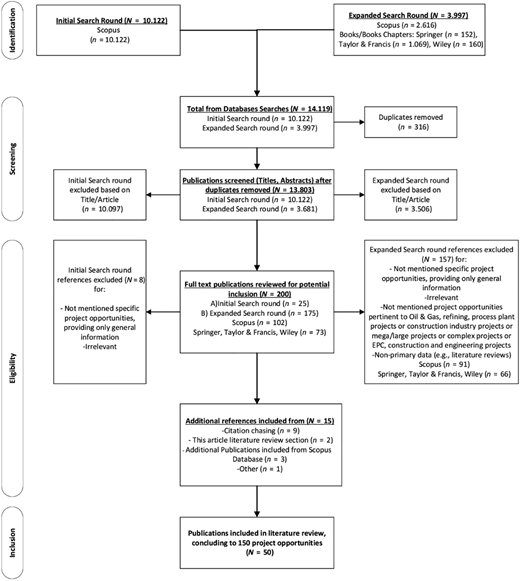
A flowchart (Figure 1) illustrating the selection of publications from the initial and expanded search rounds was developed according to Bente et al. (2024).
3.3 Data analysis
Birks and Mills (2022) stated that grounded theory is suitable for fields in which limited research has been conducted, and new pathways and insights can be identified and developed. As Djamba and Neuman (2002) stated, qualitative coding is an essential part of data analysis, allowing researchers to move from the complexity of raw data to higher-level generalizations. Birks and Mills (2022) also detailed the coding process, which includes at least three steps with different targets: starting with open coding, moving to axial coding, and concluding with selective coding. Bradley et al. (2007) stated that these methods provide researchers with a formal system to organize and analyze qualitative data, thus enabling them to uncover and document links within and between the key concepts and experiences described in the data.
The publications included in the literature review were examined in detail to identify the project opportunities. Using a structured approach of open, axial, and selective coding as an interpretive tool to synthesize and structure dispersed information for literature review, the identified project opportunities were systematically categorized to develop a meaningful taxonomy of project opportunities. As Djamba and Neuman (2002) state, open coding is the first stage of data analysis, in which researchers review the data and locate preliminary analytic categories or codes. Zhou (2023) also highlighted that this process of conceptualization and categorization of raw materials lays the groundwork for subsequent stages of analysis, as it helps researchers identify key concepts and their logical relationships. Axial coding is the second stage, in which researchers begin to organize and relate the codes identified during open coding to discover key analytic categories. Selective coding is the final stage, in which researchers review all data and previous codes to identify and select specific cases that best illustrate the major themes and conceptual categories that have been developed, and make comparisons to solidify core ideas.
Following the grounded theory methodology described by Flick (2018) and Birks and Mills (2022), data analysis was conducted in sequential stages of open, axial and selective coding. Table 3 presents an example of how the original excerpts of the papers examined (open coding column) were combined with meaningful phrases (initial codes) that constituted the identified opportunities. We then discuss how these initial codes were combined through axial coding with higher notions and how the final affinities were derived through selective coding. To match the established practice for general risks, the last part (selective coding) constituted the first-level RBS category proposed by the Project Management Institute (2019). This process of using open, axial, and selective coding, followed by mapping higher-level categories to existing frameworks, is consistent with directed content analysis as described by Hsieh and Shannon (2005) and has also been applied by Al-Eisawi (2022), who mapped the final categories to the established Absorptive Capacity (ACAP) model. Table 3 illustrates how raw textual data were progressively abstracted and structured into a coherent taxonomy through open, axial, and selective coding. The complete taxonomy is presented in Appendix 1, where the levels of the taxonomy correspond to the initial codes (Level 3 – opportunities), axial coding (Level 2 categorization), and selective coding (Level 1 categorization).
Illustration of open, axial, and selective coding in project opportunities classification
| Selective coding | Axial coding | Initial codes | Open coding |
|---|---|---|---|
| Commercial | Contractual approaches | Performing value engineering with cost-saving sharing schemes, especially for projects with low profits | “When value engineering is performed during a contract execution, it is customary to introduce some sharing scheme for the savings obtained.” (Agca and Cotone, 2019, p. 240) |
| “Contractor gives importance to Value Engineering to further his profit, if the profit foreseen at the award of Contract is thin. The extent of credit that Contractor gets for such efforts is usually 50:50.” (Anthreas, 2023, p. 135) | |||
| … … … … … | … … … … … | ||
| Negotiating cost-sharing agreements with other project stakeholders, such as local authorities and private landowners | “The physical structure interacted with different stakeholders, such as the local authority and private landowners. The project team had several negotiations with such stakeholders regarding what costs the project should cover, and what cost others could take. On several occasions, they managed to move costs away from the project budget.” (Johansen, 2019, p. 125) | ||
| … … … … … | … … … … … | … … … … … | |
| Partnerships | Collaborating with low-cost subcontractors who already have established relationships allows companies to mitigate risks while capitalizing on their highly qualified internal staff | “The last option was to choose a low-cost country subcontractor they knew and had a long standing relationship with,” “The established relations between the parties were, however, a good basis for satisfactory control of the element of risk,” “In addition, the Norwegian shipyard had a highly qualified staff of engineers able to deal with uncertainty related to ship design. The yard management considered this to be a precondition for successful application of an outsourcing strategy.” (Kolltveit et al., 2004, p. 138) |
Throughout the process of open, axial, and selective coding, a constant comparative analysis, as described by Birks and Mills (2022), was used to compare new incoming data with existing data to ensure consistency in the labeling and category development processes.
4. Opportunities identification and categorization
A literature review identified 150 project opportunities in 50 publications. Oil and gas industry projects contributed six opportunities from 22 references, whereas other construction industry projects as well as megaprojects/large and complex projects contributed 78 opportunities from 26 references. The remaining 12 opportunities from the two references were common across various sectors.
The opportunities range from “optimizing technical and technological solutions for design and materials” to “use of reliability buffering instead of contingency buffering.” Opportunities have been categorized as Level 1 risk sources, encompassing technical, management, commercial, and external risks, as proposed by the Project Management Institute (2019). Level 2 categories were established using open, axial and selective coding. Using this method, the identified project opportunities were grouped into more detailed subcategories, as depicted in Figure 2 and summarized in Appendix 1. Appendix 2 lists the references included in this literature review.
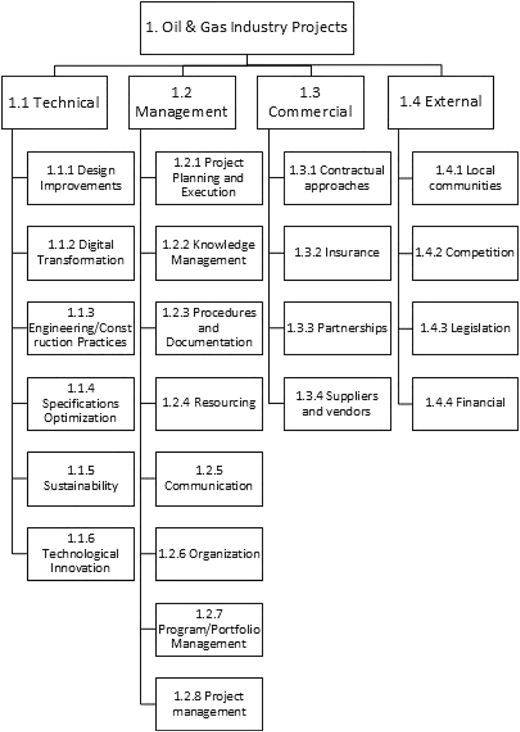
Specifically, 41 Technical opportunities were identified and categorized into six key areas: design improvements, digital transformation, engineering/construction practices, specification optimization, sustainability, and technological innovation. Design improvements focus on design standardization, process consolidation, removal of non-essential project components, constructability analysis, and value engineering, which can streamline processes, reduce costs and improve project outcomes. Digital transformation emphasizes the adoption of advanced technologies, such as building information modeling (BIM), virtual reality (VR), robotic process automation (RPA), digital site material management approaches, and engineering process enhancements, to improve project execution. Engineering/construction practices include prefabrication and modular construction, the use of 3D and 4D models for better planning and risk management, and improved site accessibility. Specifications optimization involves reducing CAPEX by downgrading specifications where feasible, optimizing material use, standardizing project specifications for major topside equipment and bulk materials and reviewing, and adjusting spare parts requirements. Sustainability opportunities focus on improving project lifecycle efficiency and reducing environmental impact, whereas technological innovation encourages the adoption of new technologies and simplified solutions to maintain competitiveness and drive project success.
In addition to technical opportunities, 72 Management opportunities were identified and categorized into eight areas: project planning and execution, knowledge management, procedures and documentation, resourcing, communication, organization, program/portfolio management, and project management. In Project planning and execution, key opportunities include optimizing early-stage activities, such as implementing front-end loading (FEL), shifting from a minimal FEED approach, and early involvement of operations, maintenance personnel, and subcontractors in the design phase. Other opportunities include the initiation of early engineering activities before signing the EPC contract, early engagement of designers and general contractors in preconstruction services, use of two shifts for critical construction activities, and phased execution of commissioning. Moreover, value-improving practices and techniques include Critical Chain Project Management (CCPM). Adopting a carbon-copy project strategy and eliminating unnecessary resources can further optimize project execution and outcomes. Knowledge management emphasizes creating comprehensive lessons learned from reports and implementing reverse mentoring to enhance digital skills and leverage project experience. Procedures and documentation focus on streamlining document creation and reviews by reducing unnecessary documentation, digital automation, workshops, and formal document control processes. Structured handovers and checklists ensure smoother transitions between project phases and reduce errors. For Resourcing, creating a resource databank, utilizing experienced and competent personnel, and ensuring full-time dedication are crucial for improving project planning, execution, and outcomes. Communication highlights the importance of maintaining open and transparent channels to foster trust and collaboration and ensure a clear project scope and responsibilities. Organization opportunities include improving team structures and internal management practices to optimize project execution. Program/portfolio management identifies opportunities to adopt standardized processes and methodologies across projects, concurrent execution of projects, and project fragmentation strategies. Project management emphasizes opportunities arising from accelerated schedules, enhanced quality control, opportunity studies, integrated teams, systematic change management, and comprehensive front-end planning.
Furthermore, 28 Commercial opportunities were identified and categorized into four areas: contractual approaches, insurance, partnerships, suppliers and vendors. Contractual approaches involve alternative contracting methods to traditional EPC models, such as EPCm or risk-optimization contracts. Key strategies include engaging third-party facilitators to optimize contract terms and risk assessments, implementing value engineering with cost-sharing schemes, and negotiating clear risk/reward models to ensure effective cost management and project success. Insurance focuses on optimizing construction-all-risk and erection-all-risk insurance. By allowing contractors to manage these insurance programs, projects can benefit from better pricing based on the contractor's global experience. Strategies such as shortening coverage periods during low-risk phases can further reduce costs. Partnerships emphasize the importance of collaboration, particularly with local contractors and low-cost subcontractors with established relationships. Strategic alliances and joint ventures have been highlighted as ways to leverage innovation, technology transfer, and improve stakeholder management. Suppliers and vendors emphasize the potential for cost savings by expanding their vendor lists and sourcing from low-cost countries. Effective vendor management, including the use of previously successful collaborations, can significantly reduce costs and improve project schedules. Exploiting material discounts for bulk purchases and common procurement practices are recommended to enhance the costs and operational efficiency.
Finally, nine External opportunities were identified and divided into four categories: local communities, competition, legislation, and finance. In the local communities' category, there is an opportunity for both project organizations and local communities to engage in project value co-creation for job opportunities, sustainability, and infrastructure enhancement. Competition emphasizes the opportunities to enter new markets, early market penetration, and value generation through future projects. Regarding legislation, projects can capitalize on favorable regulatory conditions, exemptions from export duties, and extraction taxes. Lastly, favorable financial conditions, such as currency, inflation, and taxation, can reduce project costs.
5. Results and discussion
This literature review aims to identify project opportunities that are usually overlooked in traditional risk management approaches pertinent to the oil and gas industry and taxonomize them into an OpBS to enhance the understanding and management of these opportunities. The project opportunities identified in this study align with the widely accepted standards-based definition of project opportunities, which are perceived as an uncertain event or condition that, if it occurs, will have positive consequences for the project (Murray-Webster and Dalcher, 2019; “ISO 31000 Guidance Handbook: Risk management - Guidelines”, 2018; Hillson, 2019). Illustrative examples include favorable regulatory and financial conditions, leveraging material discounts for bulk purchases, taking advantage of seasonal peaks in the availability of skilled labor, and lower-than-expected bids from new market entrants.
However, these examples represent only part of the opportunity spectrum captured in this review. Most identified project opportunities follow a broader view in which they can be perceived as having the potential to increase project value (Kendrick, 2015a; Lechler and Edington, 2013). Opportunities in this category include optimizing design through standardization, reducing CAPEX by downgrading specifications, implementing digital transformation solutions, and engaging in project value co-creation with local communities. Other project opportunities can be perceived as deliberate project choices (Kendrick, 2015a), such as initiating early engineering activities before signing an EPC contract, engaging subcontractors and operation teams early in the planning and design phases, and implementing modular construction and phased commissioning. Additionally, some project opportunities are aligned with broader business strategies (Poli and Shenhar, 2003; Sheykh et al., 2013), such as entering new markets, promoting sustainability, and forming strategic alliances and partnerships.
Overall, the distribution of the 150 identified project opportunities across Level 1 categories indicates the dominance of Management opportunities (72 opportunities; 48% of the total), along with substantial portions of Technical (41; 27%) and Commercial opportunities (28; 19%), with External opportunities comprising the remaining nine (6%). Within Management, opportunities are concentrated in Level 2 subcategories Project planning and execution followed by Procedures and documentation and Project management, suggesting that opportunities in oil and gas projects are most frequently presented in the literature as managerial practices that can be applied across multiple oil and gas project types and phases. Examples include “Executing front-end loading (FEL) for business opportunity identification and risk mitigation,” “Initiating early engineering activities prior to EPC contract signing,” “Early involvement of operations and maintenance personnel in the design review process,” and “Promoting Inspection and Test Plans (ITPs) as primary project roadmaps.”
The sizeable share of Technical opportunities is similarly shaped and concentrated mainly in Design improvements and Engineering/construction practices, with additional contributions from Digital transformation and Specifications optimization, as opportunities such as “Standardization of conceptual design,” “Removing non-essential project components,” and “Use of modularization” can improve cost, schedule, and project performance. Commercial opportunities cluster mainly in Contractual approaches, Partnerships, and Suppliers and vendors, with examples such as “Using risk optimization contracts such as reimbursable with incentive scheme and Converted LSTK (Lump Sum Turnkey),” and “Leveraging suppliers from low-cost countries” highlighting the importance of contracting strategy and supply-chain choices. In contrast, there are fewer External opportunities, which plausibly reflects their lower controllability and greater context dependence.
The project opportunities identified in this literature review were collected from a wide range of literature sources without applying regional or segment-specific distinctions. However, the studies included were diverse in terms of their geographical and sectional dimensions. This review covers projects from the Gulf region, as discussed by Al Hammadi and Saud (2014), Projects from Eastern Europe are represented in the study by Pujanova et al. (2023), upstream projects were examined by Butsaev et al. (2016) and Michel et al. (2016), FPSO projects in Latin America by Affonso et al. (2020), Pinto et al. (2017), and Nunes et al. (2016), projects from East Asia by Gao et al. (2023) and Jin et al. (2019), brownfield projects by Ramana (2006), and process plant projects by Agca and Cotone (2019) and Bastianelli et al. (2013). The review also incorporates projects from the Oceania region presented by Martin and Benson (2021), European projects by Kolltveit et al. (2004), Chapman and Ward (2004), Johansen (2019), and Johansen et al. (2012), and projects in the North America region by Austin et al. (2016) and Pishdad-Bozorgi et al. (2016).
This study of opportunity management in the oil and gas industry offers several notable contributions to the existing literature, distinguishing it from previous literature reviews and studies. Although previous studies, such as Marsov et al. (2022), Lehtiranta (2014), and Denney and Powell (2020), explored opportunity management across various industries and identified conceptual gaps and research trends in this field, they adopted a broad, generalized approach. In contrast, this study offers a detailed and sector-specific exploration of opportunity management by identifying and categorizing 150 project opportunities into a structured OpBS. Moreover, although narrative reviews are sometimes viewed as less rigorous than systematic reviews, such as that of Marsov et al. (2025), this study ensures both flexibility and rigor by employing a structured narrative review approach. By systematically synthesizing insights from multiple databases, this methodology enables a comprehensive and reliable analysis of the themes and opportunities that are particularly relevant to the oil and gas industry. Overall, the main contribution of this study lies in organizing and structuring existing knowledge on project opportunities in the oil and gas industry, rather than developing a new theory.
The methodological contributions of this study extend the established theoretical perspectives found in widely recognized standards by considering opportunities not only as uncertain events but also as deliberate project choices that can enhance value. This broader interpretation aligns with the industry's best practices and provides a practitioner-oriented framework that bridges the gap between theoretical research and its practical implementation.
To minimize bias and enhance the robustness of the proposed taxonomy, data were collected from a broad range of academic databases, journals, books and conference proceedings. The search strings, use of backward and forward citations, and inclusion and exclusion criteria are described in detail to ensure the traceability of the literature included in this study. The analysis process followed the grounded theory methodology, employing open, axial, and selective coding, along with constant comparative analysis to ensure consistency in category development. However, Bradley et al. (2007) stated that the coding process is an interpretive method. Thus, researchers who use the same data may obtain different results.
In addition to its academic contributions, this study has significant practical implications. The identified opportunities and proposed taxonomy offer a structured roadmap for oil and gas practitioners to systematically identify, classify, and capture project opportunities at various project stages. Unlike traditional risk management frameworks, which predominantly focus on mitigating threats, this study emphasizes the integration of opportunity identification and exploitation into project decision-making. Furthermore, this study introduces a comparative cross-sectoral perspective by integrating insights from related industries, such as construction, infrastructure and mega/large projects. This approach identifies transferable opportunity management practices that can be used in oil and gas projects.
To analyze the effectiveness of the proposed OpBS, it is essential to compare it with existing opportunity classification frameworks. Tepeli (2021) presented an RBS for complex infrastructure projects that incorporate both threats and opportunities by categorizing them based on external and internal environmental factors. Although this approach recognizes opportunities, it does so within a broader risk management framework in which opportunities are evaluated alongside threats using a multi-criteria Likert scale. Tepeli focused on the early (pre-contract) phase at the strategic level, whereas OpBS offers a comprehensive opportunity-focused framework that spans the entire project lifecycle.
A further distinction arises when the proposed OpBS is compared with the opportunity classification framework of Lechler et al. (2012), which is applied to various sectors. Lechler et al.’s (2012) framework traces the origins of opportunities to six types of uncertainty (contextual turbulence, stakeholder uncertainty, technological uncertainty, organizational uncertainty, project uncertainty, and malpractice). Lechler et al. (2012) highlighted how uncertainties can serve as a basis for opportunity identification. However, the proposed OpBS adopts a more structured and managerial approach and categorizes opportunities based on their project-related sources rather than their uncertainty-driven nature. This distinction reinforces OpBS as a practical tool for project practitioners, enabling them to identify and leverage opportunities without relying solely on uncertainty. Similarly, Rolstadås et al. (2019) proposed an opportunity classification framework for complex projects that focused on quantifiable project benefits and grouped opportunities based on their impact on cost, time, and quality. Although OpBS recognizes these factors as important project outcomes, it primarily structures opportunities based on technical, managerial, commercial, and external factors. This approach provides a more comprehensive view of opportunity management beyond direct financial or schedule-related benefits.
Several studies have described the risks of oil and gas projects, primarily focusing on threats. To ensure the comprehensiveness and relevance of the proposed OpBS, this study compared its categories and subcategories with established RBS frameworks in the oil and gas industry. This comparative analysis serves two objectives: (1) to assess whether the OpBS categories align with existing RBS classifications and (2) to identify any critical areas that may require further refinement.
Existing frameworks provide detailed classifications of the risks associated with project functions and internal processes. For Instance, Mubin and Mannan (2013) offered a comprehensive RBS for EPC projects in the oil and gas sector, identifying 162 risks across the engineering, project management, procurement, contractual, quality, health and safety, human resources, and financial domains. Similarly, Sohrabi and Noorzai (2023) classified 36 risk factors based on internal sources (owner, designer and contractor) and external sources (political, social, economic, and natural). Syzdykov et al. (2020) adopted a more execution-oriented approach, identifying risks such as equipment failure, labor productivity, and supply chain disruptions, which were ranked using probability-impact matrices. Although these models provide strong operational and process-based insights, they generally maintain a threat-centric perspective. The proposed OpBS incorporates similar functional and lifecycle categories but extends them to include opportunity areas, such as digital transformation, early collaboration, sustainability, and program-level integration. Moreover, the proposed OpBS reframes project risk as a set of problems to be managed and as a domain of strategic levers that can enhance project value.
Other studies have adopted a broader contextual view, highlighting the significance of external and environmental risks in politically or economically unstable regions. For example, Mubin and Mubin (2008) identified 34 risks related to political, socioeconomic, organizational, technological, security, natural disasters, and environmental factors in the Pakistani gas sector, emphasizing the geopolitical and environmental challenges. Working in the conflict-affected context of Yemen, Kassem et al. (2021) grouped 51 risk factors into internal and external categories, focusing on security, force majeure, and local socio-political dynamics. The proposed OpBS includes external categories and expands on them through opportunity framing, for example, by aligning with evolving policy trends and engaging with local communities.
Methodologically, several frameworks employ structured approaches to prioritize risks. Dey (2010) proposed a hierarchical risk management framework for oil pipeline projects in India, categorizing risks into three levels: project, work package, and activity. Although OpBS aligns with these classifications and integrates many of their sub-factors, it does not incorporate these specific analytic tools, but it creates space for integrating them in future iterations.
A comparative analysis of the proposed OpBS and existing RBS frameworks in the oil and gas sector reveals a fundamental difference in their focus. Although existing RBS models emphasize risk mitigation, OpBS provides a more comprehensive framework by integrating strategic dimensions such as technological advancements, sustainability, and efficiency improvements. Although OpBS aligns well with most established RBS classifications, several areas, including security risks, force majeure events, legal disputes, natural disasters, and worksite safety, are more comprehensively addressed in the aforementioned frameworks. This highlights areas where OpBS may be further refined and contextually adapted.
This study introduces a comprehensive taxonomy that addresses critical gaps in the opportunity management literature. In doing so, it lays the foundation for future empirical validation and encourages practitioners to adopt and refine the proposed framework to enhance project efficiency, sustainability, and decision-making in the oil and gas sector. Specifically, the proposed OpBS can be used by practitioners, such as contractors and project owners, throughout all project phases. For example, during the pre-award phases, “Use of project fragmentation strategy, where large capital development projects are broken down into smaller lots and managed by engaging multiple contractors” and/or “Implementing a risk (pain)/ reward (gain) model with upside/downside caps for both cost and non-cost project targets” can be applied. During the design phase, opportunities at both technical and managerial levels, such as “Integrating constructability into the design phase,” “Standardization of conceptual design,” and/or “Removing non-essential project components” can be utilized. The OpBS can also support early planning and execution considerations with opportunities such as “Initiating early engineering activities prior to EPC contract signing” and “Applying value-improving practices in the early stages of a project”. In procurement, the OpBS can support supply-chain opportunities such as “Leveraging suppliers from low-cost countries” as well as specification choices such as “Standardization of project specifications for major topside equipment and bulk materials.” Similarly, during construction, delivery and execution opportunities can be identified based on “Use of modularization,” “Construction joint ventures between local and foreign contractors,” and “Conducting construction/operation readiness planning.” Moreover, external opportunities such as “Engaging in project value co-creation for both project organizations and local communities,” “Temporary employment of local unskilled personnel in various labor tasks,” and “Favorable financial conditions such as currency, inflation, and taxation” can be considered for various gate decisions.
The implementation of the proposed OpBS offers social benefits, particularly in sensitive environments. Specific project opportunities, such as “Engaging in project value co-creation for both project organizations and local communities,” “Temporary employment of local unskilled personnel in various labor tasks,” “Triggering additional energy-efficiency measures,” and “Integrate sustainability into value management through reduction, reuse, and recycling of construction and demolition waste” can deliver tangible positive social outcomes. Policymakers play a crucial role in enhancing social benefits by establishing supportive regulations and incentives. Furthermore, opportunities such as the “Use of modularization” and “Employ constructability analysis early in the project phases” enhance safety by reducing on-site threats.
The findings of this study were interpreted based on three organizational frameworks: the real options theory (ROT), dynamic capabilities theory, and resilience theory. The ROT, pioneered by Myers and further developed by Trigeorgis, extends the logic of financial options to strategic business decisions, treating them as rights rather than as obligations. It provides organizations with the flexibility to defer, grow, expand, switch, or abandon in response to uncertainty (Myers, 1977; Trigeorgis, 2004; Trigeorgis and Reuer, 2017). Opportunities from the proposed OpBS are related to the ROT, for example, “Transition from site-cast production to prefabrication construction methods,” and “Leveraging suppliers from low-cost countries” represent switching options, while “Entering new markets,” and “Developing pilot projects” correspond to growth and expansion options.
In contrast, Dynamic Capabilities Theory (Teece, 2007) addresses how organizations can adapt to rapidly changing environments by sensing (identifying) opportunities, seizing (mobilizing resources to capture value), rapidly capitalizing on them, and reconfiguring their organizational structures (transforming organizational assets and routines) to maintain competitiveness. The proposed OpBS can serve as a mechanism for implementing the dynamic capabilities theory in oil and gas projects. Opportunities such as “Involving subcontractors early in planning and design phases” and “Initiating early engineering activities prior to EPC contract signing” reflect deliberate resource mobilization to capture value (seize). Meanwhile, “Adopting standardized processes and methodologies across projects,” “Implementing structured procedures for proposal-project team handover,” and “Simplifying approval processes” reflect organizational reconfiguration to enhance efficiency. Resilience theory was first observed in ecological systems and can be extended to the organizational context. Additionally, the various identified opportunities align with the principles of resilience theory, as described by Duchek (2020), who outlined how organizations can prepare for, cope with, and recover from unexpected events. For example, opportunities such as “Use of reliability buffering instead of contingency buffering,” “Focusing procurement decisions on construction needs and priorities,” “Planning of procurement of long-lead items,” and “Reviewing redundancy and spare parts requirements” can enhance project robustness while “Use of modularization,” “Robust designs that align with the other solutions selected by the company,” “A solution to a threat was identified as opportunity by another department within the organization,” and digital transformation opportunities support coping and demonstrate flexible response to disruptions. Organizational learning (adaptation) can be enriched with opportunities such as “Creating comprehensive lessons learned reports,” and “Disseminating experience and knowledge at both organizational and individual levels” which ensures organizational knowledge, strengthening and increasing the organization's resilience to future events.
6. Conclusions
This study highlights the bright side of risk, demonstrating that risk management should not only focus on threats but also on exploiting opportunities to maximize project value. This perspective challenges the traditional threat-centric approach, which prevails in risk management practices, and advocates a more balanced strategy that includes opportunity management as a critical component of risk management.
A comprehensive narrative literature review identified 150 project opportunities from 50 publications. These opportunities were categorized using OpBS, which was developed through open, axial and selective coding. Level 1 categorization included four categories: Technical, Management, Commercial, and External opportunities, whereas 22 subcategories were identified at Level 2. The proposed OpBS provides a structured and valuable framework for both academics and oil and gas industry practitioners to effectively identify, categorize, and exploit project opportunities, ultimately enhancing project outcomes through a balanced approach to risk management. This is particularly crucial in the oil and gas industry, where projects are characterized by high complexity and substantial capital investment, making the effective management of both threats and opportunities vital for achieving project success. Overall, the study's findings provide an explicit connection between the literature review and the proposed OpBS. Specifically, the proposed OpBS accommodates the standard risk process view by capturing opportunities as uncertain events or conditions with positive consequences. It also reflects uncertainty and value management perspectives by incorporating project opportunities with the potential to increase project value and those arising from deliberate project choices or broader business strategies.
Although this study provides valuable insights into opportunity management in the oil and gas industry, it has several limitations. First, the literature review used a narrative approach instead of a systematic method, such as the Preferred Reporting Items for Systematic Reviews and Meta-Analyses (PRISMA), because of the limited and dispersed literature on project opportunities in publications on projects across different sectors. This study followed a structured narrative approach to ensure the thoroughness and reliability of the results. Given the qualitative nature of this study, subjective bias might have influenced the findings. This is a common and anticipated limitation of qualitative studies, as data interpretation often reflects the researchers' perspectives. Although every effort was made to minimize bias through a rigorous methodology, it is difficult to achieve complete objectivity.
Second, data collection from the selected databases and the use of predefined keywords may have led to the exclusion of relevant studies. Additionally, the initial screening was based on titles and abstracts, which may have further excluded relevant studies from the review. Citation chasing was used to identify the studies that might have been missed.
Finally, this study incorporated project opportunities from other sectors based on the common characteristics of oil and gas industry projects. However, the cross-sectional approach introduces subjectivity into this research. These limitations highlight areas for potential improvement and suggest that future research could benefit from a more systematic review approach and full-text screening to ensure comprehensive coverage of relevant literature. Moreover, surveys can be conducted with professionals in oil and gas industry projects to evaluate the value of the identified project opportunities and the proposed OpBS, thereby refining the findings to meet the needs of oil and gas industry practitioners.
The next step is to empirically validate the proposed OpBS through industry surveys and interviews to identify the most significant opportunities and assess its practical relevance. Testing OpBS in active projects would further evaluate its effectiveness in decision-making, resource allocation, and balancing threats and opportunities across key project phases, including FEED, EPC, commissioning and start-up.
Future research should refine the OpBS by identifying high-impact opportunities in each phase and investigating the prevalence of particular opportunities across different geographical regions and upstream, midstream, and downstream projects. Comparative studies can enhance sector-specific applicability and investigate cross-industry potential in infrastructure, construction, and renewable energy projects, which would help validate scalability and flexibility. Additionally, while this review focused on project-level opportunity management, further contributions from broader organizational theories, such as ROT, dynamic capabilities theory, and resilience theory, should be considered in future research to anchor opportunity taxonomy.
Prior research, such as Marsov et al. (2022), Lehtiranta (2014), and Denney and Powell (2020), has examined opportunity management across diverse industries and outlined conceptual gaps and research trends. However, these studies adopted a broad and generalized approach. In contrast, this study advances the discourse and contributes to the body of knowledge in the field of opportunity management, addressing a critical gap in the literature by identifying and categorizing project opportunities pertinent to oil and gas projects, a topic that remains underexplored compared to traditional threat-focused risk management theory and practice. By identifying 150 project opportunities through a literature review and developing the OpBS, a strong theoretical foundation was established through synthesizing dispersed knowledge, thereby offering a framework for further exploration. The proposed taxonomy extends existing risk management frameworks by considering opportunities as both uncertain events and choices that may enhance project value. Addressing this critical gap in the literature offers practical insights for industry professionals to enhance the value and performance of their projects. Furthermore, this study lays the foundation for future research, particularly for validating and refining the proposed taxonomy through empirical studies and surveys involving industry professionals.
Appendix 1
Project opportunities categorization
| Level 1 categorization (selective coding) | Level 2 categorization (axial coding) | Level 3 opportunities (initial codes) | References |
|---|---|---|---|
| Technical | Design improvements | Optimizing technical and technological solutions for design and materials | Butsaev et al. (2016) |
| Concept design improvements by consolidating processes | Anthreas (2023) | ||
| Employing value engineering process to reduce work volume and costs by elevating the finished floor level in challenging subsoil conditions | Anthreas (2023) | ||
| Employ constructability analysis early in the project phases | Pillai (2005) | ||
| Introducing smarter technical solutions | Agca and Cotone (2019) | ||
| Removing non-essential project components | Agca and Cotone (2019) | ||
| Standardization of conceptual design | Nunes et al. (2016) | ||
| Implementing simplified designs | Johansen et al. (2018) | ||
| Integrating constructability into the design phase | Ajam (2020) | ||
| Considering fabrication and construction speed when selecting design alternatives | Austin et al. (2016), Pishdad-Bozorgi et al. (2016) | ||
| Robust designs that align with the other solutions selected by the company | Johansen (2019), Johansen et al. (2012) | ||
| Use of standardized design elements | Johansen (2019) | ||
| Digital transformation | Automating valve selection through P&ID data extraction and analysis | Affonso et al. (2020) | |
| Implementation of robotic process automation (RPA) systems for data-centric commissioning | Affonso et al. (2020) | ||
| Developing a Business Intelligence Dashboard for automated cargo handling checks | Affonso et al. (2020) | ||
| Utilizing natural language processing (NLP) and artificial intelligence (AI) for semantic search in data-centric engineering processes | Affonso et al. (2020) | ||
| Implementing digital approaches for site materials management (barcode-GPS tracking systems, structured Work Breakdown Structures that integrate geographical and functional dimensions, centralized material data management) | Tamat and Baharudin (2022) | ||
| Harnessing technologies (building information modeling (BIM), 3D printing, virtual reality (VR), cloud computing, and augmented reality (AR)) | Musarat et al. (2024) | ||
| Leveraging blockchain technology in construction management | Gao et al. (2023) | ||
| Use of augmented reality (AR) and virtual reality (VR) in construction management | Ahmed (2019) | ||
| Engineering/construction practices | Development of a 3D model-centered weight management system | Affonso et al. (2020) | |
| Extending the use of 3D models for detailed construction studies and planning | Affonso et al. (2020) | ||
| Transition from site-cast production to prefabrication construction methods | Johansen et al. (2018), Schaufelberger and Holm (2024) | ||
| Improving accessibility to the construction site | Hietajärvi et al. (2017) | ||
| Implementing 4D modeling to develop diverse construction scenarios based on schedule alternatives | Pujanova et al. (2023) | ||
| Conducting Constructability reviews based on advanced work packaging (AWP) and critical chain methodologies | Pujanova et al. (2023) | ||
| Use of modularization | Ajam (2020), Pujanova et al. (2023), Schaufelberger and Holm (2024) | ||
| Selection of appropriate construction methods | Austin et al. (2016), Pishdad-Bozorgi et al. (2016) | ||
| Adoption of an industrial offsite production mode, as opposed to traditional on-site execution | Gao et al. (2019) | ||
| Utilizing 4D BIM from early project phases | Jin et al. (2019) | ||
| Promoting technology reuse | Hillson (2019) | ||
| Specifications optimization | Standardization of project specifications for major topside equipment and bulk materials | Lee and Chakala (2019) | |
| Optimizing project specifications of equipment and materials | Anthreas (2023) | ||
| Downgrading general specifications and waiving stringent conditions by using manufacturer's standards | Agca and Cotone (2019) | ||
| Reviewing redundancy and spare parts requirements | Agca and Cotone (2019) | ||
| Adjusting spare parts management approaches | Agca and Cotone (2019) | ||
| Changing materials and reducing finish quality | Johansen et al. (2018) | ||
| Sustainability | Triggering additional energy-efficiency measures | Johansen et al. (2018) | |
| Achieving project lifecycle operational efficiency through specific technical decisions | Johansen (2019) | ||
| Technological innovation | Experiencing simplified technical solutions from new market entrants | Johansen (2019), Johansen et al. (2012) | |
| Applying technical innovation or alternative technologies | Lechler et al. (2012), Johansen (2019), Johansen et al. (2012), Hietajärvi et al. (2017) | ||
| Management | Project planning and execution | Improving the accuracy of construction cost estimation | Butsaev et al. (2016) |
| Projects should be ready to advance other activities when such opportunities arise | Chapman and Ward (2004) | ||
| Postponing infrastructure construction until production needs are confirmed | Butsaev et al. (2016) | ||
| Developing pilot projects | Butsaev et al. (2016) | ||
| Executing commissioning in phases | Butsaev et al. (2016) | ||
| Involving subcontractors early in planning and design phases | Martin and Benson (2021) | ||
| Enhancing subcontractors' engagement in innovative projects to contribute their own ideas and technologies | Martin and Benson (2021) | ||
| Using the Critical Chain Project Management (CCPM) method instead of the traditional Critical Path Method (CPM) | Jo et al. (2018) | ||
| Executing front-end loading (FEL) for business opportunity identification and risk mitigation | Bastianelli et al. (2013) | ||
| Implementing a carbon-copy project strategy | Pinto et al. (2017) | ||
| Applying Critical Issues Analysis to identify project optimization opportunities in the HSSE field | Green and Woolson (2016) | ||
| Shifting from a ‘FEED as a minimum' mindset enables design optimization | Haider et al. (2016) | ||
| Recording additional engineering man-hours incurred from the Owner's delayed approval of critical engineering deliverables | Anthreas (2023) | ||
| Initiating early engineering activities prior to EPC contract signing | Agca and Cotone (2019) | ||
| Applying value-improving practices in the early stages of a project | Pujanova et al. (2023) | ||
| Conducting construction/operation readiness planning | Pujanova et al. (2023) | ||
| Using two shifts during construction for critical activities | Eldosouky et al. (2014) | ||
| Early involvement of operations and maintenance personnel in the design review process | Egbelakin et al. (2021) | ||
| Involving contractors and subcontractors from the conceptual design phase to address constructability issues | Egbelakin et al. (2021) | ||
| Early engagement of designers and general contractors in preconstruction services | Schaufelberger and Holm (2024) | ||
| Coordination planning during the design phase | Austin et al. (2016), Pishdad-Bozorgi et al. (2016) | ||
| Planning of procurement of long-lead items | Austin et al. (2016), Pishdad-Bozorgi et al. (2016) | ||
| Allocation of sufficient resources for critical path items | Austin et al. (2016), Pishdad-Bozorgi et al. (2016) | ||
| Identification and management of additional fast-track risks | Austin et al. (2016), Pishdad-Bozorgi et al. (2016) | ||
| Timely selection and awarding of contracts to subcontractors | Austin et al. (2016), Pishdad-Bozorgi et al. (2016) | ||
| Focusing procurement decisions on construction needs and priorities | Austin et al. (2016), Pishdad-Bozorgi et al. (2016) | ||
| Eliminating unnecessary resources that do not add value to the client | Leszczyński and Wodzisławska (2017) | ||
| Good planning and execution contribute to increased and better resource availability and level of resources' competence | Johansen (2019), Johansen et al. (2012) | ||
| Reducing construction duration and coordination interfaces streamlines project execution | Johansen (2019) | ||
| Use of reliability buffering instead of contingency buffering | Park and Peña-Mora (2004), Lee et al. (2006) | ||
| Knowledge management | Disseminating experience and knowledge at both organizational and individual levels | Mancini and Derakhshanalavijeh (2017) | |
| Implementing “Reverse Mentoring” | Affonso et al. (2020) | ||
| Creating comprehensive lessons learned reports | Agca and Cotone (2019) | ||
| Procedures and documentation | Identifying alternative resources by the owner to review and approve contractor's engineering documents | Al Hammadi and Saud (2014) | |
| Collaboration of multidisciplinary teams to rewrite corporate engineering guidelines into machine-verifiable requirements | Affonso et al. (2020) | ||
| Establishing documents to be reviewed and approved by the owner | Cohen and Obi (2017) | ||
| Presenting technical procedures in task or checklist formats | Cohen and Obi (2017) | ||
| Conducting document reviews through presentations and workshops | Cohen and Obi (2017) | ||
| Promoting Inspection and Test Plans (ITPs) as primary project roadmaps | Cohen and Obi (2017) | ||
| Focusing on capturing project-specific parameters and essential documentation | Cohen and Obi (2017) | ||
| Implementing structured procedures for proposal-project team handover | Agca and Cotone (2019) | ||
| Implementing a formal document and change control process to manage modifications | Egbelakin et al. (2021) | ||
| Simplifying approval processes | Austin et al. (2016), Pishdad-Bozorgi et al. (2016) | ||
| Resourcing | Creating a resource databank | Al Hammadi and Saud (2014) | |
| Selecting team members based on leadership skills and previous relevant experience | Austin et al. (2016), Pishdad-Bozorgi et al. (2016) | ||
| Dedicating full-time personnel to projects | Austin et al. (2016), Pishdad-Bozorgi et al. (2016) | ||
| Access to more competent resources, such as skilled personnel and experienced workforce from retired staff members | Johansen (2019), Johansen et al. (2012) | ||
| Use of more experienced resources for early delivery | Hillson (2019) | ||
| Seasonal peaks of availability of skilled labor | Hillson (2019) | ||
| Utilization of skilled staff from other endeavors executed simultaneously | Hillson (2019) | ||
| Communication | Establishing trust-based relationships between owner and contractor | Zaghloul and Hartman (2003), Wong et al. (2008) | |
| Provision of sufficient information to project team members to clearly define project scope, outline owner/contractor responsibilities, and address the owner's risks and needs | Egbelakin et al. (2021) | ||
| Establish clear communication channels between the design team, client, and other project members | Egbelakin et al. (2021) | ||
| Open communication and full transparency | Austin et al. (2016), Pishdad-Bozorgi et al. (2016) | ||
| Organization | Improved work practices can enhance maintenance possibilities and provide benefits to society | Hietajärvi et al. (2017) | |
| Well-organized team structure that is essential for success | Ajam (2020) | ||
| Improving management performance | Johansen (2019), Johansen et al. (2012) | ||
| Creating an efficient team | Johansen (2019), Johansen et al. (2012) | ||
| Improving work methods | Johansen (2019), Johansen et al. (2012) | ||
| Program/portfolio management | Use of project fragmentation strategy, where large capital development projects are broken down into smaller lots and managed by engaging multiple contractors | Ogbeifun et al. (2018) | |
| Coordinating with other projects to reduce investment costs | Johansen (2019) | ||
| Adopting standardized processes and methodologies across projects | Lechler et al. (2012) | ||
| Concurrent execution of projects | Hillson (2019) | ||
| Project management | A solution to a threat was identified as opportunity by another department within the organization | Chapman and Ward (2004) | |
| Introducing opportunity studies at both the project and contract levels | Johansen et al. (2018) | ||
| Investigating external cost optimization | Johansen et al. (2018) | ||
| Systematic change management to control project scope changes | Ajam (2020) | ||
| utilizing the Project Definition Rating Index (PDRI) to assess the completeness of front-end planning | Ajam (2020) | ||
| Establishing a fully integrated team throughout all project phases (design, construction, commissioning, etc.) | Austin et al. (2016), Pishdad-Bozorgi et al. (2016) | ||
| Maximizing authority at the project level | Austin et al. (2016), Pishdad-Bozorgi et al. (2016) | ||
| Capturing opportunities arising from accelerated schedules | Johansen (2019), Johansen et al. (2012) | ||
| Enhancing quality control through fewer mistakes and change orders than anticipated | Johansen (2019), Johansen et al. (2012) | ||
| Commercial | Contractual approaches | Adopting alternative contractual approaches (EPCm, EPC with procurement on a reimbursable basis and construction on an actual man-hours basis, E&P by the owner with separate engagement of a construction contractor) vs traditional EPC methods | Ramana (2006) |
| Involving the owner more extensively in various aspects of project execution | Ramana (2006) | ||
| Reducing risk and price disparities during tender negotiations with subcontractors | Martin and Benson (2021) | ||
| Engaging a third-party facilitator for optimizing contract terms and risk assessments | Bastianelli et al. (2013) | ||
| Performing value engineering with cost-saving sharing schemes, especially for projects with low profits | Anthreas (2023), Agca and Cotone (2019) | ||
| Using risk optimization contracts such as “reimbursable with incentive scheme” and “Converted LSTK” (Lump Sum Turnkey) | Agca and Cotone (2019) | ||
| Setting clear and specific contractual requirements | Austin et al. (2016), Pishdad-Bozorgi et al. (2016) | ||
| Establishing clear change management procedures | Austin et al. (2016), Pishdad-Bozorgi et al. (2016) | ||
| Early funding allocation for critical efforts | Austin et al. (2016), Pishdad-Bozorgi et al. (2016) | ||
| Negotiating cost-sharing agreements with other project stakeholders, such as local authorities and private landowners | Johansen (2019) | ||
| Implementing a risk (pain)/ reward (gain) model with upside/downside caps for both cost and non-cost project targets | Love et al. (2011) | ||
| Insurance | Optimizing erection-all-risk (EAR) insurance premiums, by adopting strategies such as shortening the coverage period during low-risk early works and replacing it with an alternate EAR policy | Anthreas (2023) | |
| Management of construction-all-risk and erection-all-risk (EAR) insurance by the contractor, rather than the owner | Agca and Cotone (2019) | ||
| Partnerships | Fostering cooperation and partnerships with external organizations | Butsaev et al. (2016) | |
| Collaborating with local contractors when entering new markets | Agca and Cotone (2019) | ||
| Collaborating with low-cost subcontractors who already have established relationships allows companies to mitigate risks while capitalizing on their highly qualified internal staff | Kolltveit et al. (2004) | ||
| Implementing projects in partnership | Pujanova et al. (2023) | ||
| Fostering collaborative relationships through partnering initiatives | Ajam (2020) | ||
| Construction joint ventures between local and foreign contractors | Zhang and Zou (2007) | ||
| Forming strategic alliances for innovation | Johansen (2019), Johansen et al. (2012) | ||
| Cooperation with new projects in the nearby area | Johansen (2019), Johansen et al. (2012) | ||
| Suppliers and vendors | Leveraging suppliers from low-cost countries | Charron and Gérard (2009) | |
| Expanding the project vendor list to include more competitive vendors | Agca and Cotone (2019) | ||
| Exploiting material discounts for bulk purchases | Eldosouky et al. (2014) | ||
| Experiencing lower-than-expected bids from new market entrants | Johansen (2019), Johansen et al. (2012) | ||
| Implementing common procurement practices | Johansen (2019), Johansen et al. (2012) | ||
| Utilizing outsourcing | Hillson (2019) | ||
| Use of previous successful collaborations in supply chain | Hillson (2019) | ||
| External | Local communities | Engaging in project value co-creation for both project organizations and local communities | Mancini and Derakhshanalavijeh (2017) |
| Temporary employment of local unskilled personnel in various labor tasks | Michel et al. (2016) | ||
| Integrate sustainability into value management through reduction, reuse, and recycling of construction and demolition waste | Yu et al. (2018) | ||
| Competition | Entering new markets | Butsaev et al. (2016) | |
| Adherence of construction firms to social procurement policies | Loosemore et al. (2022) | ||
| Early market penetration | Lechler et al. (2012) | ||
| Future project business opportunities have the potential to generate value beyond the current project | Lechler et al. (2012) | ||
| Legislation | Obtaining additional benefits according to legislation (exceptions in export custom duties and extraction taxes, favorable regulatory conditions, etc.) | Butsaev et al. (2016) | |
| Financial | Favorable financial conditions such as currency, inflation, and taxation | Johansen et al. (2012) |
Appendix 2
List of references included in this literature review
| SN | Authors (year) | Reference type | Project type |
|---|---|---|---|
| 1 | Affonso et al. (2020) | Conference paper | Oil and gas industry |
| 2 | Agca and Cotone (2019) | Book | Oil and gas industry |
| 3 | Ahmed (2019) | Review | Construction project |
| 4 | Ajam (2020) | Book | Construction project |
| 5 | Al Hammadi and Saud (2014) | Conference paper | Oil and gas industry |
| 6 | Anthreas (2023) | Book | Oil and gas industry |
| 7 | Austin et al. (2016) | Article | Construction project |
| 8 | Bastianelli et al. (2013) | Conference paper | Oil and gas industry |
| 9 | Butsaev et al. (2016) | Review | Oil and gas industry |
| 10 | Chapman and Ward (2004) | Article | Oil and gas industry |
| 11 | Charron and Gérard (2009) | Conference paper | Oil and gas industry |
| 12 | Cohen and Obi (2017) | Conference paper | Oil and gas industry |
| 13 | Egbelakin et al. (2021) | Article | Construction project |
| 14 | Eldosouky et al. (2014) | Article | Construction project |
| 15 | Gao et al. (2023) | Article | Construction project |
| 16 | Gao et al. (2019) | Article | Construction project |
| 17 | Green and Woolson (2016) | Conference paper | Oil and gas industry |
| 18 | Haider et al. (2016) | Conference paper | Oil and gas industry |
| 19 | Hietajärvi et al. (2017) | Article | Megaproject/large project |
| 20 | Hillson (2019) | Book | Various |
| 21 | Jin et al. (2019) | Article | Construction project |
| 22 | Jo et al. (2018) | Article | Oil and gas industry |
| 23 | Johansen (2019) | Book | Infrastructure project |
| 24 | Johansen et al. (2018) | Conference paper | Megaproject/large project |
| 25 | Johansen et al. (2012) | Conference paper | Infrastructure project |
| 26 | Kolltveit et al. (2004) | Article | Megaproject/large project |
| 27 | Lechler et al. (2012) | Article | Various |
| 28 | Lee and Chakala (2019) | Conference paper | Oil and gas industry |
| 29 | Lee et al. (2006) | Article | Infrastructure project |
| 30 | Leszczyński and Wodzisławska (2017) | Article | Construction project |
| 31 | Loosemore et al. (2022) | Article | Construction project |
| 32 | Love et al. (2011) | Article | Infrastructure project |
| 33 | Mancini and Derakhshanalavijeh (2017) | Conference paper | Oil and gas industry |
| 34 | Martin and Benson (2021) | Article | Construction project |
| 35 | Michel et al. (2016) | Conference paper | Oil and gas industry |
| 36 | Musarat et al. (2024) | Article | Construction project |
| 37 | Nunes et al. (2016) | Conference paper | Oil and gas industry |
| 38 | Ogbeifun et al. (2018) | Conference paper | Megaproject/large project |
| 39 | Park and Peña-Mora (2004) | Article | Infrastructure project |
| 40 | Pillai (2005) | Conference paper | Oil and gas industry |
| 41 | Pinto et al. (2017) | Conference paper | Oil and gas industry |
| 42 | Pishdad-Bozorgi et al. (2016) | Article | Construction project |
| 43 | Pujanova et al. (2023) | Book chapter | Megaproject/Large project |
| 44 | Ramana (2006) | Conference paper | Oil and gas industry |
| 45 | Schaufelberger and Holm (2024) | Book | Construction project |
| 46 | Tamat and Baharudin (2022) | Conference paper | Oil and gas industry |
| 47 | Wong et al. (2008) | Article | Oil and gas industry |
| 48 | Yu et al. (2018) | Article | Construction project |
| 49 | Zaghloul and Hartman (2003) | Article | Oil and gas industry |
| 50 | Zhang and Zou (2007) | Article | Construction project |

