This study aims to examine the impact of fiscal deficit, exchange rate and trade openness on current account deficit (CAD). The study tried to empirically investigate the ‘twin deficits hypothesis’ and ‘compensation hypothesis’ in the Indian context.
Autoregressive distributed lagARDL) bound test approach was used by taking annual time series data from 1978 to 2021. The estimates confirm a significant long-run and short-run relationship between dependent variables, i.e. CAD and independent variables such as the fiscal deficit, exchange rate and trade openness.
The results show that positive shocks of all explanatory variables significantly affect the CAD. CAD and fiscal deficit are significantly associated, as the coefficient of fiscal deficit is positive and significant. The study also found that exchange rate and trade openness significantly affect the CAD. The coefficients of exchange rate and trade openness are positive and significant. The findings show that an increase in CADs results from liberal trade policies that help domestic industries grow their trade and expansionary fiscal policy, leading to a higher fiscal deficit. The negative and significant error correction term suggests that short-run disequilibrium converges to long-run equilibrium at a speed of 19.2%. The findings validate the ‘twin deficits hypothesis’ and ‘compensation hypothesis’ in the Indian context.
It can be inferred from the study that liberal policy to promote economic growth and trade openness should be designed and promoted judiciously. An excessive liberalised approach may impact other macroeconomic variables such as current account balances. Integrating the domestic market with global markets poses a big challenge for countries like India that aspire to penetrate global markets. Furthermore, the Indian policy makers should rigorously work and promote the policies such as Fiscal Responsibility and Budget Management (FRBM) as reduction in fiscal deficits, trade imbalances will also be reduced.
This study contributes to the existing literature on ‘twin deficit’ and trade openness by giving new evidence on the trilemma between designing sustainable fiscal policy by spending wisely without imperilling the country's global presence and CAD.
1. Introduction
The trade and budget deficits in the USA exhibited twin-like behaviour in the 1980s, with changes in the budgetary deficit causing changes in the trade deficit. It is crucial to examine the relationship between trade and budget deficits because, if one deficit propagates to another, the fiscal expansion may result in an imbalance in the current account, and vice versa (Ahmed, 1986, 1987; Darrat & Suliman, 1991; Evans, 1988; Monadjemi & Kearney, 1991; Obstfeld & Rogoff, 1995; Winner, 1993). Keynesian and Ricardian schools of thought have opposing viewpoints on the phenomenon of two deficits acting as twins. According to Keynesian theory, increased government spending would lead to increased private sector spending on both domestic and foreign goods, with the former lowering exports and the latter increasing imports. Furthermore, the government's spending exceeds its revenue, resulting in fiscal deficits (Keynes, 1936; Perez-Montiel & Manera, 2021). Contrary to the Keynesian view, the Barro (1974) research explains the necessary criteria for maintaining the Ricardian equivalence hypothesis (also known as ‘Barro-Ricardian Equivalence’ by (Buchanan, 1976) in his paper ‘Barro on the Ricardian Equivalence Theorem’) which explains that the two deficits are not connected because individuals are indifferent about the changes in the fiscal imbalance and how it is funded (tax versus debt) (Abel, 1991; Leachman & Francis, 2002; Miller & Russek, 1989; Normandin, 1999).
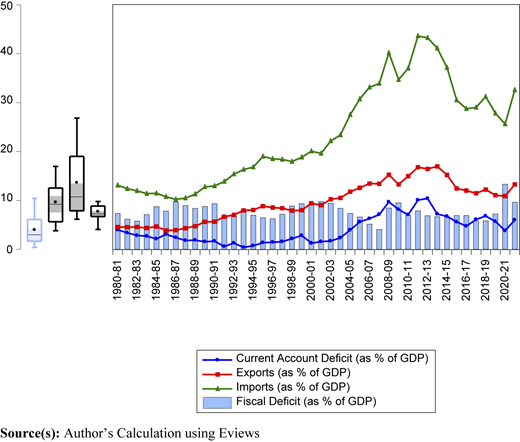
Since the 2007–08 financial crisis, substantial current account imbalances and fiscal deficits in many countries have dominated debates on international macroeconomic policy. The consequences of fiscal imbalance and adjustments for current account movements piqued attention even more in resuming robust, sustained and balanced global growth (Bose & Jha, 2011). It is imperative to investigate the relationship between fiscal and current account deficits (CADs) in countries like India, where reforms (of globalisation and privatisation) and expansionary fiscal policies have resulted in an exponential rise in both deficits. The Indian economy has continuously faced budgetary deficits for decades; all the budgets presented in parliament have been deficit budgets (Mehta, 2018). Figure 1 shows an increase in the budget deficit as a proportion of GDP. The fiscal deficit (measured as a percentage of GDP) was 7.33% in 1980–81 and increased to 8.7% in 1988–89. Government expenditure was relatively high in 1990–1991 to support market reforms, which increased the fiscal deficit to 9.3% (as percent of GDP). Due to the global economic recession that began in 2008, the rising trend in government spending and the budget deficit (9.5% of GDP) persisted in 2009–10. As a percentage of GDP, the budget deficit was 9.6% in 2020–21 due to the government's fiscal relief initiatives to revive the domestic economy after COVID–19. The foreign trade policy (FTP) of 2015–20 and 2021–26 provides a clear policy intention of the government for increasing the trade of goods and services by providing a stable and sustainable policy environment conducive to foreign trade. Liberal trade policy includes procedures and incentives for exports and imports with other initiatives such as “Make in India”, “Digital India” and “Skills India”. It will help India to gain global competitiveness, and create an architecture for India's global trade engagement with a view to expanding its markets and better integration (Government of India, 2021; Panagariya & Sundaram, 2013). Due to India's trade development strategy and policy, both Indian exports and imports have exhibited positive trends from 2004–2005; yet, the CAD has also widened (see, Figure 1). Following reforms in 1990, the CAD decreased from 3.9% of GDP to 2.84% (as a percentage of GDP). However, with the global economic crisis of 2008, the current trend soon showed a rising tendency, as shown in the fiscal deficit in 2009–2010 (the CAD was 9.6% of GDP). 2020–21 was having 6.0% (as a percentage of GDP) CAD, with imports accounting for 19.3% of GDP and exports for 13% (see, Figure 1). As Indian policymakers seek to strike a balance between designing sustainable fiscal policy (by spending wisely) and maintaining current account balance without compromising on the country's trade openness, it is important to empirically measure the relationship between fiscal deficit, CAD and trade openness.
2. Literature review
The literature offers conflicting evidence for the causal link between the current account and the budget deficit. Several studies regressed the current account balance and exchange rate on the fiscal balance to investigate the relationship between the two deficits (Ahmed, 1986; Beck, 1994; Feldstein, 1982; Mohammadi, 2004; Monadjemi & Kearney, 1991; Obstfeld & Rogoff, 1995; Winner, 1993). Studies like (Anoruo & Ramchander, 1998; Darrat, 1988; Enders & Lee, 1990; McMillin & Koray, 1990; Normandin, 1999; Rosensweig & Tallman, 1993; Vamvoukas, 1999) applied the Granger causality test utilising VAR and VECM model on time series data for assessing twin deficit. Vamvoukas (1999) tested long-term and short-term associations between two deficits using a single equation error correction model (ECM) and Granger causality. Akbostanci and Tunç (2001) also tried to examine short-run relationships between two deficits using a single ECM equation.
Darrat (1988) used the Granger causality test on quarterly data of the USA from 1960 to 1984, and the findings revealed a causality between CAD and fiscal deficit. Melvin, Schlagenhauf, and Talu (1989) used US monthly data from 1974 to 1987 to re-examine (Feldstein, 1982) showing that the exchange rate of the dollar is affected (appreciation) due to a rise in the projected budget deficit. There are few studies on twin deficits in developing countries, and the results are ambiguous. The studies like Ahmed (1986), Banday and Aneja (2019), Bernheim and Bagwell (1988), Bhat and Sharma (2018), Helmy (2018), Rosensweig and Tallman (1993), Saleh and Harvie (2005), Mdanat and Shotar (2009) and Melesse (2020) found a causal link between fiscal and CADs in developing countries. Some studies supporting the Keynesian paradigm in Asian countries like India, Thailand and Sri Lanka are Kulkarni and Ericsson (2001), Ratha (2012), Saleh, Nair and Agalewatte (2005), Baharumshah and Lau (2007), amongst others.
Using co-integration analysis, Ghatak and Ghatak (1996) found no support for the equivalence hypothesis by David Ricardo, implying that there is no connection between India's fiscal and trade deficits. Anoruo and Ramchander (1998) checked the twin deficit phenomenon in India from 1965 to 1993 and observed a causal relationship between fiscal and trade deficits in India. Kulkarni and Erickson (2011), used post-reform data and found that fiscal deficits cause CADs in India. The studies like Kouassi, Mougou, and Kymn (2004) found no causal link between two deficits but advised adding more macro-variables to the model. Mohanty (2019) and Shastri (2019) investigate the link between two deficits in Indian data from 1970 to 2014. The study observed short-run and long-run bi-directional associations using the autoregressive distributed lag (ARDL) bounds testing technique. Furceri and Zdzienicka (2020) used quarterly data from 1997 to 2012 to examine the domestic macro and foreign variables that affect India's current account. The findings support the hypothesis of twin deficits and rule out Ricardian equivalence.
Nevertheless, contradicting the previous studies, Kundu and Goyal (2020) studied Indian data from 1990 to 2018 and found no causal relationship between current accounts and fiscal deficits. Munir and Mumtaz (2021) studied south Asian countries and found no causal relationship between fiscal and CADs in India and Pakistan, supporting the Ricardian equivalence hypothesis. In contrast, Mallick, Behera, and Murthy (2021) found non-linear and asymmetric relations between fiscal and CADs in India by using the non-linear ARDL model. Furthermore, the finding asserts that any volatility in the fiscal deficit leads to a change in the CAD. Nautiyal, Belwal, and Belwal (2022) also found an association between current account and fiscal deficit using the ARDL model; the study supports the Keynesian proposition of the twin deficit hypothesis and fails to support the Ricardian proposition in the Indian context.
Based on a brief literature review, there is no clear evidence to validate the twin deficits phenomenon in India. Most of the empirical research attempted to analyse has produced mixed results, possibly due to the sample size, study period and methodology. Furthermore, very evident gaps from the review are that the studies have not incorporated the impact of liberal trade policy on twin deficits as explained in the “compensation hypothesis” (Rodrik, 1998). The “compensation hypothesis,” related to trade openness, states that government spending is higher in open economies to mitigate against the jeopardy of being exposed to global markets and economic shocks. Some studies conducted in the Indian context to empirically examine the impact of trade openness have also yielded mixed results (Benarroch & Pandey, 2008, 2012; Chatterji, Mohan, & Dastidar, 2014; Dixit, 2014; Hye & Lau, 2014; Jani, Joshi, & Mehta, 2019; Joshi, Jani, & Mehta, 2022; Karras, 2003; Kumari et al., 2021; Mallick, 2008). However, the relationship between liberal trade policy and deficits cannot be understood in isolation because, on the one hand, the government must spend heavily (creating fiscal deficits) to maintain its trade competitiveness, and, on the other hand, the liberal policy can result in a current account imbalance and change the exchange rate. Using the ARDL approach, this study examines the relationships between current accounts and fiscal deficits in India from 1978 to 2021. The aim of including trade openness and the exchange rate is to explore the policy implication of opening the economy and maintaining fiscal discipline.
3. Methodology
The saving-investment identity and national income identity link the two deficits as solicited by Keynesian school of thought for an open economy (Dornbusch, Fisher, & Startz, 2011; Feldstein, 1982; Kormendi, 1983).
Where, Y represents income (national income), C is consumption, I is investment, G is government expenditures and (NX = X − M) is net exports (goods and services); Eq. (1) can be rewritten by taking disposable income (post-tax):
Further Eq. (2) can be rearranged as follow:
Eq. (3) is rearranged to link between capital flows, consumption, savings and investment [see, Eq. (4)].
From Eq. (5) it is evident that the difference between national saving and domestic investment (S – I) equals net exports (NX = X – M). This difference between exports and imports (positive or negative) must be met by the economy's capital flows (inflow or outflow). Eq. (5) shows that the capital flow between two economies is related to net exports (NX), also referred to as trade balance (BOT). When national savings are greater than domestic investment (S > I), it will lead to positive net exports (NX) and capital outflow [2]. Suppose there is a fiscal deficit (T < G). In that case, the national savings (private savings (Y – T – C) and government savings (T – G)) will be less than domestic investments (S < I), which will cause negative net exports and a net inflow of capital [3]. By adding transfer payments and net factor income to BOT, we get the current account balance (CA); Eq. (6) shows that CA equals national savings and domestic investment.
It is clear from the aforementioned equation [see Eq. (6)] that the current account balance affects private and public savings (T- G) and vice versa. According to the Keynesian approach, a rise in the fiscal deficit because of higher government spending causes a trade imbalance. The relationship between the current account balance and fiscal balance of Eqs. (3) and (6) are presented in Eq. (7) as causal relation between both balances. Eq. (7) represents current the CAD as a function of fiscal deficit (FD) and national income (Y) (Ahmed, 1986; Bhat & Sharma, 2018; Darrat, 1988; Mallick et al., 2021; Mohanty, 2019; Nautiyal et al., 2022; Padhi, 2019; Sahoo & Sethi, 2018; Shastri, 2019).
Where, CAD denotes current account deficit at time t; FD is net fiscal deficit at time t, and Y is real GDP at time t.
3.1 Exchange rate and twin deficits
The Mundell–Fleming model also explains how the fiscal and trade deficits are connected. The model describes how budget deficits drive domestic interest rates to increase, which leads to capital inflows and exchange rate appreciation (Fleming, 1962; Mundell, 1963; Bilgili, Ünlü, Gençoğlu, & Kuşkaya, 2021). As a result, it will have an impact on the balance of payments by making imports cheaper and exports more expensive. Under a flexible exchange rate regime, the trade imbalance will decrease (Feldstein, 1982). Alternatively, under a fixed exchange rate system, a fiscal deficit (owing to expansionary fiscal policy) generates higher real income and raises prices, worsening the current account balance and increasing the CAD. The exchange rate variable is added in Eq. (4) to incorporate the impact of change in exchange rate on twin deficit phenomena [see Eq. (8)] (Ahmed, 1986; Arora & Rakhyani, 2020; Bhat & Sharma, 2018; Darrat, 1988; Feldstein, 1982; Missio & Gabriel, 2016; Mohanty, 2019; Padhi, 2019; Saleh & Harvie, 2005; Taneja & Ansari, 2016; Vieira & MacDonald, 2020).
Where, EXR is real effective exchange rate (REER) at time t.
3.2 Trade openness and twin deficits
The fiscal and CADs are also influenced by the trade openness; according to the “compensation hypothesis” proposed by (Rodrik, 1998), open economies spend more to protect domestic sectors from the disruption posed by trade openness and foreign markets. (see, Benarroch & Pandey, 2012; Dixit, 2014; Islam, 2004; Liberati, 2007; Molana, Montagna, & Violato, 2011; Nguea, 2020). On one hand, the liberal trade policy will leads to increase in the government spending which in turn increased the fiscal deficit. Whereas, on other hand liberal trade policy will also result in current account balances (Al-Yousif, 1997; Glasure & Lee, 1999; Okur & Soylu, 2015; Wani & Mir, 2021). By adding the trade openness in Eq. (8), we get Eq. (9)
Where, TO is trade openness at time t.
3.3 Econometric model
The objective of the study is to check the relationship between CAD, fiscal deficit and trade openness. For the study, we employed the ARDL bounds testing (Pesaran, Shin, & Smith, 2001). Hence, Eq. (10) represents the ARDL long-run equation of CAD as a function of all the explanatory variables under study.
Where, represent coefficients and shows “the time period and error term”.
Utilising the ARDL approach has several benefits over other cointegration methods. In contrast to VAR and VECM models, ARDL is a single equation model and can have multiple variable lag orders (Pesaran et al., 2001; Sims, 1980). The robustness of the estimates of the VAR and VECM approaches relies on higher sample sizes, but the ARDL approach can also be utilised with small samples (Patel & Patel, 2022; Pesaran et al., 2001). Given the strength and testing of the long-term relationship, one advantage of the ARDL model is that it can be used regardless of the integration order. Finally, this ARDL model also helps to represent structural breaks in the equation since economic, political and international environmental changes typically lead to structural breakdowns in economic time series (Patel & Patel, 2022). To investigate the cointegration amongst the variables provided in Eq. (10), we estimate the ARDL limits to test for CAD as follows in Eq. (11);
Here Δ represents the first difference operator; and represent coefficients of the ARDL model in the short-run and long run coefficients, respectively, i, n represents optimal and threshold lag respectively; represents the white noise terms.
The computed long-run coefficients in Eq. (11) are used to test the existence of cointegration. To test the hypothesis, the null hypothesis is that the variables have no long-term relationship , whereas the alternate hypothesis is that the variables are co-integrated . The F statistics, as well as upper and lower bound critical values, are obtained. If the F statistic found is above the upper bound critical values, the null hypothesis is rejected; if the F statistic is below the lower bound critical values, the null hypothesis is not rejected. The existence of a long-term relationship is regarded as inconclusive if the F-statistics is between the upper and lower bound values. Once the cointegration has been established, error correction model must be used to represent the rate of adjustment to the long-run equilibrium, as shown below:
3.4 Data
Table 1 presents the description, measure and source of the variables in the study to measure the impact of fiscal deficit and trade openness on CAD of India. The data is time series from 1981 to 2021 (see, Bhat & Sharma, 2018; Kulkarni & Erickson, 2011; Mohanty, 2019). The nominal variables are deflated into real ones by the GDP deflator (2004–05 constant price).
4. Results and discussions
The average CAD (percentage of GDP) from 1980 to 2021 is 1.67%, the average FD (percentage of GDP) 4.25% from 1981 to 2021 (see Table 2). The Jarque-Bera statistics suggest that CAD is normally distributed (see Table 2). In order to investigate the magnitude and direction of the relationship between two deficits ARDL model is used.
To avoid spurious ARDL estimates the data series should have I (0), I (1), or both (Acquah, 2010) order of integration. ADF and PP tests are used to check the unit root considering intercept and trend as well as only intercept in the model. Both the tests confirm the order of integration at 1% significance level. Unit root test estimates are presented in Table 3.
The unit root test estimates are measured at a level and first difference series. The results of ADF and PP confirm the stationary at I (1). We have established the order of integration only when both the unit root tests confirm the results at a 1% level of significance. Further, the results of unit root tests confirm that none of the series is I (2), which satisfies the first condition of ARDL.
ARDL bounds test estimates are presented in Table 4. The estimated F-Statistics for ARDL surpasses 99% upper bound rejecting null of no co-integrational, which indicates long-run that the linear cointegration co-integration between the CAD, fiscal deficit (FD), exchange rate (EXR), trade openness (TO) and income (Y). Table 5 presents the estimates of long-run and short-run coefficients of ARDL co-integrating equations Eq. (10), Eq. (11) & Eq. (12).
According to the long-run estimates, the CAD is significantly affected by a fiscal deficit (FD), an exchange rate (EXR), trade openness (TO) and income (Y). The fiscal deficit (FD) is positive and significant, implying that a 1% increase in fiscal deficit corresponds to a 1.83% increase in the CAD. It can be inferred that any reduction in government savings (T < G) will lead negative current account balance (CA) [see Eqs. (5) and (6)]. Estimates confirm the twin deficit hypothesis, which asserts that the change in fiscal deficit leads to a change in CADs (estimates are in line with the trend between fiscal deficit and CAD presented in Figure 1). This relationship is consistent with previous studies on twin deficits (see, Ahmed, 1986; Bhat & Sharma, 2018; Darrat, 1988; Mallick et al., 2021; Mohanty, 2019; Nautiyal et al., 2022). Furthermore, the positive and significant coefficient of income (Y) shows that a 1% increase in income will lead to a 0.003% increase in the CAD. Though the magnitude of the impact of income (Y) on the CAD is small, it propounds the Keynesian approach that the CAD increases because of increased demand caused by the income increase. The exchange rate coefficient (EXR) is positive and significant, implying that for every percentage rise in the exchange rate, the CAD will rise by 0.03 %. It can be inferred from the estimates that an increase in the exchange rate will impact the current account balance by making imports cheaper and exports more expensive. This relationship supports Mundell–Fleming model (Bilgili et al., 2021; Fleming, 1962; Mundell, 1963; Taneja & Ansari, 2016; Vieira & MacDonald, 2020).
The trade openness coefficient is positive and significant, implying that a 1% increase in trade openness corresponds to a 0.22% increase in the CAD (estimate are in line with the trend between trade and CAD presented in Figure 1). The estimates confirm the ‘Compensation Hypothesis’ (Rodrik, 1998), which asserts that government expenditure is high in open economies to hedge against the danger of high exposure to the global markets. The increase in government spending, in turn, increases the fiscal deficit and will also change the current account balance. This relationship is consistent with previous studies on trade openness (see, Bernaure & Achini, 2000; Hicks & Swank, 1992; Rodrik, 1998; Ruggie, 1982; Shelton, 2007; Swank, 2001). The error correction model is estimated to check the short-run relationship amongst the variables. Estimates of the short-run model are presented in Table 5. In the short run, fiscal deficit, exchange rate and trade openness significantly impact the CAD. Short-run estimates show that changes in CADt−1 lagged values have a 0.78% positive impact on the CAD (see, (Mohanty, 2019; Shastri, 2019). Similarly, changing the lagged values of FDt−1 increases CADt by 2.83% (estimates are in line with the trend between fiscal deficit and CAD presented in Figure 1), whereas changing the lagged values of EXRt−1 and TOt−1 increases CADt by 0.028% and 0.07%, respectively. The error correction term in the dynamic model represents the rate of adjustment that restores the equilibrium relationship. The ECM term is negative and statistically significant at 1%, implying a stable long-run relationship between variables (Banerjee, Dolado, & Mestre, 1998; Pesaran et al., 2001). It demonstrates that short-run disequilibrium converges to long-run equilibrium at a speed of 19.2% in the ARDL model.
The estimates indicate that a budget deficit spurred on by rising public spending will have a greater short-term impact than long-term impact on the current account balance (by 2.83%). Current account balance changes as a result of changes in exchange rates in both the short-run and long-run (short-run: 0.028%; long-run: 0.029%). An increase in the exchange rate will lead to negative trade balance, and a decrease in the exchange rate will lead to higher exports and positive trade balance. The government of India moved from a controlled exchange rate regime to a floating exchange rate system in 1993, intending to integrate the domestic market with international markets (Kohli, 2000). The switchover to a flexible exchange rate in 1993 did not result in high exchange rate volatility in the short-run and long-run compared to the other countries worldwide; as India was not strictly a fixed-rate arrangement but more of an adjustable peg (Bhat & Sharma, 2018; Kohli, 2000; Singh, 2004). The estimates also show that trade openness in the long and short run causes the CAD to rise (by 0.21% in the long run; 0.07% in the short run) as India has been a net importer over the years (see Figure 1). India's trade balance has been import heavy due to its high energy demand and reliance on foreign technology and capital goods to complement its industrial progress (Singh, 2004). Exports promotion and import substitution initiatives (to reduce CADs) taken by the Indian government in the Foreign Trade Policy (FTP) of 2015–20 and 2021–26, the harvesting of its benefits will take some time. Therefore, an open trade policy will initially lead to more significant imports than exports, but over time, export markets will catch up and lower the current account balance.
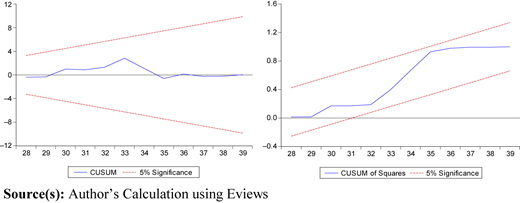
The diagnostics of the model are also reported in Table 5. According to the model diagnostics estimations, the model is consistent. The ARDL model fits with an R-Square of 0.95 and an adjusted R-Square of 0.86. The results of the Jarque-Bera and LM tests confirm the normally distributed residuals and no serial correlation, respectively. The model is well-fitting in Ramsey functional form and free from heteroscedasticity. The model's stability using the CUSUM and CUSUMSQ tests is present in Figure 2 for the model. It is apparent that the model is stable during structural break and confirms the stability of long-run estimates.
4.1 Discussion
The analysis confirms the ‘Twin Deficit’ in the Indian economy; our linear estimates show CAD elasticity concerning fiscal deficit, exchange rate, trade openness and domestic income.
4.1.1 Current account and fiscal deficits (twin deficits)
The significant and positive impact of fiscal deficit and domestic income supports the ‘Twin Deficits Hypothesis’ and rejects the Ricardian Equivalence hypothesis. The findings indicate that the fiscal deficit will increase because of higher government spending, increasing domestic income. Higher income will stimulate the domestic demand for domestic as well as foreign goods, causing a trade imbalance. The estimates fail to support the Ricardian claim of no association between the two deficits. It seems that Indian households are not indifferent to the fiscal measures and mode of deficit financing (see, Ahmed, 1986; Bhat & Sharma, 2018; Darrat, 1988; Mallick et al., 2021; Mohanty, 2019; Nautiyal et al., 2022; Shastri, 2019).
4.1.2 Exchange rate and twin deficits
The significant and positive impact of the exchange rate on the CAD supports the Mundell–Fleming model, which explains how the fiscal and trade deficits are connected. It can be inferred from the estimates that appreciation of the exchange rate will increase the CAD in India. Indian CAD leads to the appreciation of the currency, making exports more expensive and less competitively priced in international markets (Bilgili et al., 2021; Fleming, 1962; Missio & Gabriel, 2016; Mundell, 1963; Taneja & Ansari, 2016; Vieira & MacDonald, 2020) resulting in the reduction of the exports and an increase in imports. This gap between exports and imports will result in a higher CAD because developing countries like India are net importers (see, Ahmed, 1986; Bhat & Sharma, 2018; Darrat, 1988; Feldstein, 1982; Mohanty, 2019).
4.1.3 Trade openness and twin deficits
Trade openness influences the CAD in India; as an open economy, India has to spend more to protect domestic sectors from the disruption posed by trade openness and foreign markets (see, Benarroch & Pandey, 2012; Dixit, 2014; Islam, 2004; Liberati, 2007; Molana et al., 2011; Nguea, 2020). It indicates that while India's liberal trade policies would result in increased government spending to safeguard domestic industries from external risk, the countries' fiscal and CADs will likely widen (Dixit, 2014; Rodrik, 1998).
5. Conclusion
The present study explores the long-run and short-run relationship using the ARDL bound test on annual time series data of CAD, fiscal deficit, exchange rate and trade openness. We observed that all the series are stationary at I(1) order of integration. The ARDL bound test confirms a long-run relationship amongst the variables.
The study validated twin deficit in the Indian context; the long-run and short-run estimates demonstrate a significant impact of positive shocks in all explanatory variables on the CAD. The fiscal deficit coefficients indicate a direct relationship between fiscal and CADs. The increase in fiscal deficit leads to a rise in CAD and vice versa (see, (Darrat, 1988; Mallick et al., 2021; Mohanty, 2019; Nautiyal et al., 2022; Shastri, 2019). The study also found that change in the exchange rate also leads to change in CAD, supporting the Mundell–Fleming model; the estimates show that appreciation of the exchange rate will increase the CAD in India. The positive relationship between trade openness and CAD supports the compensation hypothesis in the Indian context. The findings indicate that the liberal trade policies to assist trade openness leads to an increase in fiscal deficit (due to an increase in government expenditure) and CAD. Furthermore, India struggles with fiscal sustainability as its liberal and progressive policies lead to fiscal and current account imbalance. The estimates show a direct and positive relationship between trade openness (TO) and the CAD. The negative and significant error correction term suggests that short-run disequilibrium converges to long-run equilibrium at a speed of 19.2%. The ARDL bound test estimates are robust and confirm the twin deficit phenomenon in the Indian economy as fiscal deficit positively impacts the CAD in the long and short run.
It can be inferred from the study that liberal policy to promote economic growth and trade openness should be designed and promoted judiciously, as an excessive liberalised approach may impact another macroeconomic variable such as current account balances. This finding backs the Keynesian theory that a fiscal deficit boosts domestic demand, which leads to higher imports and a worsening trade balance. A fiscal deficit implies increased spending on domestic and foreign goods, with the former pushing down exports and the latter pushing up imports. Moreover, fiscal deficits cause trade deficits due to exchange rate appreciation since Ricardian equivalence does not hold. As a result, if the government reduces fiscal deficits, trade imbalances will also be reduced. If the government intends to increase taxes, this will be considered a counter-deficit policy. In other words, a tax rise will lower CADs by reducing imports due to a decline in individual disposable income. Furthermore, if the government wants to boost spending, both deficits will increase. The exchange rate also shows a significant relationship with the current account balance and concurs with the Mundell–Fleming model. This study contributes to the existing literature on ‘twin deficit’ and trade openness by giving new evidence on the trilemma between designing sustainable fiscal policy by spending wisely without imperilling the country's global presence and CAD. This study also opens the scope for further investigation on the relationship between fiscal deficit, CAD and trade openness. This trilemma can be further explored by first; the worldwide analysis may be more informative than a country-specific analysis; hence this can be extended by considering the panel of comparable economies. Second, the relationship between two deficits and trade openness can be investigated in the presence of more macroeconomic variables, which demands more empirical research.
Notes
National Savings (S) = private savings (Y – T – C) and government savings (T – G). Therefore Y – T – C + T – G = Y –C – G (see (Dornbusch et al., 2011)).
If countries domestic savings (S = Private Savings + government savings (when T > G)) exceeds NX will lead to residents of the country invest or lend money abroad (see (Dornbusch et al., 2011)).
Net capital inflow implies that country will borrow from foreign or receive foreign investment to make up for (S < I) and negative NX (see (Dornbusch et al., 2011))