Is monetary policy neutral to Ibovespa index returns and volatility? To approximate neutrality, the Brazilian Government has implemented a system in which the financial sector’s economic agents contribute to their daily predictions about future expected monetary policy changes. The full implications of this policy innovation for the economy have yet to be assessed. Therefore, the purpose of this study is to investigate the effect of monetary changes on the mean returns and volatility of the Ibovespa Index. Here, monetary policy is proxied by market interest rate predictions uploaded to the Brazilian Central Bank database by the economic agents.
In the research design, multiple econometric model specifications were used, including Autoregressive Moving Average with Exogenous variables and Generalized Autoregressive Conditional Heteroskedasticity with Exogenous variables (ARMAX-GARCHX), Standard Generalized Autoregressive Conditional Heteroskedasticity with Exogenous variables (S-GARCHX), Exponential Generalized Autoregressive Conditional Heteroskedasticity with Exogenous variables (E-GARCHX), and Glosten-Jagannathan-Runkle Generalized Autoregressive Conditional Heteroskedasticity with Exogenous variables (GJR-GARCHX), with the best model selected based on the Akaike Information Criterion (AIC).
Our findings demonstrate that monetary policy is not yet entirely neutral because it influences the mean daily returns. The good news is that this system does not influence daily volatility. In summary, the evidence confirms that the government’s method of implementing monetary policy is in the right direction to neutrality in Ibovespa volatility. The results seem to support innovation and offer a model for other countries.
This study innovates by incorporating exogenous variables and enhancing the GARCHX model with optimized parameters and a distribution suited to the Brazilian context.
1. Introduction
In this study, the definition of expected monetary policy changes is based on predictions made by financial market economic agents [1]. These predictions guide investments, for instance, by economic agents in investment banks and the public in general. Market players’ decisions influence the overall portfolio of the economy at any point in time. Therefore, high expected interest rates tend to move investments towards fixed income and low-indebted companies and low interest rates towards shares and assets negotiated in the exchange Ibovespa. By extension, government bonds and assets, such as stocks and their indices (e.g. B3’s Ibovespa index), should be greatly influenced by the investment decisions of economic agents that participate in monetary policy predictions.
To understand the importance of B3 index volatility in Brazil, Angelico and Oliveira (2016) used ARMA-GARCH models to estimate the volatility of the Ibovespa Index and the Dow Jones Industrial Average Index. Their study aimed to analyze the statistical volatility and explore the temporal precedence between these indices. They found that the Brazilian market displayed higher heteroscedasticity than the American market and identified a temporal precedence for the American index, despite the absence of a long-term equilibrium between the series. This suggests that movements in developed markets, such as Dow Jones, could precede changes in the Ibovespa Index, providing insights into the direction of daily Ibovespa return predictions.
Regarding the volatility of the Ibovespa Index between 2001 and 2016, Nogueira and Kobunda (2019) utilized symmetric and asymmetric GARCH models, including GARCH (1,1), EGARCH (1,1), and TARCH (1,1). Their findings confirmed the persistence effect and the presence of asymmetry, with negative shocks having a more significant impact on volatility, indicating a “leverage effect.”
Additionally, Silva (2017) examined the volatility of Ibovespa returns from January 2, 2006, to December 29, 2015, employing heteroscedastic models such as EGARCH (1, 1), TARCH (1, 1), and APARCH (1, 1). This study highlights the persistence and asymmetry in volatility using the TARCH (1, 1) model, which stands out for its ability to capture the differentiated impacts of positive and negative shocks on volatility.
Our study differs from the existing literature in several important respects. First, we use an exogenous variable to explain B3 index returns and volatility. In the literature, only one GARCH model has been estimated for each specification. In this study, we expand the GARCHX model to a total of 96 models and select the best models for each group. Moreover, in our case, it is not sufficient for the model to have statistical significance; it must be the best one under our criteria, after a grid search for the parameters (p,q) in the ARMA(p,q) and GARCHX(p,q) specifications under the exogenous variable. The optimal distribution was also tested. More specifically, the test chooses among the best of the two distributions: normal and student. In our results, not shown here, Pearson´s goodness-of-fit test recommended the use of the student distribution [2].
Another innovation was the use of expected monetary policy, or more specifically, the expected interest rate, which is predicted by economic agents in the financial market. Economic agents build statistical models to predict future interest rates and upload them to the Central Bank database every month on a daily basis. This dataset can be used for research on monetary policy assertiveness, similar to what we are doing.
The key objective here is to test the Brazilian government technique to avoid monetary “surprise.” The literature is rich in the effect of surprised monetary policies, as discussed below. The major conclusion is that asset volatility is likely to respond to the unanticipated policies that the Brazilian Central Bank wants to avoid.
2. Monetary policy and stock market
The literature underscores that unexpected shocks in monetary policy decisions tend to provoke significant reactions in financial markets, thereby increasing asset price volatility. Studies such as those by Konrad [3] (2009) for Germany and Hussain, Omarne, and Al-Yahyaee (2020) for Latin America demonstrate that these surprises directly affect return volatility, particularly in emerging markets, such as Brazil and Mexico.
Therefore, to better understand the connections between monetary policy projections and asset price returns with the incorporation of such news, studies such as that by Gardner, Scotti, and Vega (2021) provide a relevant contribution by examining how sentiment in FOMC statements influences stock prices in the U.S. market. They observe that this impact is more pronounced during times of economic difficulty and less relevant in favorable scenarios, being one of the main predictors of interest rate changes.
To complement this analysis, Banerjee, Pooter, Grishchenko, Strum, and Walsh (2019) applied natural language processing techniques to create a sentiment index based on FOMC communication. Variations in this index explain the movements of financial assets, especially before the implementation of the zero lower bound on interest rates. In the same context, Elyasiani and Mansur (1998) explore the effects of interest rate levels and volatility on bank stock returns, highlighting their direct impact on return distributions and risk premiums. Guerello (2016) investigates the relationship between monetary policy and investor confidence and finds significant correlations between confidence, monetary growth, and economic growth. Patelis (1997) suggested that monetary variables are relevant predictors of future returns, although they do not fully explain their predictability.
Extending this discussion beyond the United States, Gertler and Horvath (2018) show that communications from members of the European Central Bank significantly influence financial markets with a greater impact on interest rates and stocks, particularly from the statements of the most influential members. Using a GARCHX model, Hsing (2013) analyzes the Polish stock market and concludes that stock index mean returns are negatively affected by the market interest rate.
In the Brazilian context, Val, Klotzle, Pinto, and Barbedo (2017) and Santos, Garcia, and Medeiros (2014) found evidence that monetary policy decisions have effects on the stock and futures markets, with a more pronounced impact on the financial sector assets. Hussain et al. (2020) confirmed the sensitivity of Brazilian and Mexican markets to surprises in FOMC decisions, especially during periods of economic expansion, reinforcing the importance of U.S. monetary policy news in emerging markets.
In summary, central bank statements and their respective policies are important predictors of market movements, especially during times of uncertainty or significant changes in economic policies. Based on these fundamentals, the next section details the methodology used, where we apply ARMAX-GARCHX models to capture the influence of monetary policy expectations on the volatility and return of Brazilian financial asset prices in the context of an emerging market.
3. Methodology
This study delves into the models proposed by Engle (1982) and Bollerslev (1986), incorporating ARMA components in the conditional mean and exogenous variables, thus adapting to the ARMAX-GARCHX model, as well as according to Suhartono (2015), Apergis and Rezitis (2011), and Han and Kristensen (2014). This approach allows for a more detailed analysis of the effects of monetary policy on the Ibovespa index, considering both conditional volatility and external influences. The index returns along the period are modeled as:
where the the series of Ibovespa returns during specific period, is the error term, represents the exogenous variables (such as interest rate expectations, for example), and is the conditional volatility, modeled by the equation:
Equations (2-4) present the variants of the GARCH model that incorporate exogenous variables to capture the influence of external factors on the volatility of Ibovespa returns, each adapting the basic structure of the GARCH model to reflect different aspects of market volatility. The S-GARCHX (Equation (2)) extends the traditional conditional volatility of GARCH to include the impact of exogenous variables, in addition to considering past returns and previous volatility. Equation (3) (E-GARCHX) adjusts the volatility equation to explicitly model asymmetries in how positive and negative information affects market volatility. GJR-GARCHX (Equation (4)) expands the analysis to explicitly consider the presence of asymmetric effects on volatility, through the term , which distinguishes between positive and negative returns.
The lags, (p, q) (for both conditional mean and conditional volatility), are defined to capture temporal dependence and the impact of exogenous variables, with the selection of lags based on information criteria such as AIC or BIC, aiming to optimize the model fit. The model estimates are presented in groups, with the first group excluding exogenous variables serving as a reference and subsequent groups progressively incorporating the exogenous variables according to the equations previously presented.
3.1 Data analysis
The Ibovespa Index is the main performance indicator of stocks traded on B3, which was created in 1968 and functions as a signal of the performance of the national capital market, according to B3 (2023). Our study uses daily closing data from API Yahoo!Finance (2023) for the period from January 3, 2014, to January 31, 2023, to calculate the log return.
The use of returns instead of prices for the model estimation is due to the statistical properties of stationarity. The condition of stationarity is important to ensure that the mean, variance, and autocovariance do not vary over time, leading to the mean reversion process, which is nothing more than the variable returning to the series mean.
Interest rate expectations [4] were obtained from the Central Bank’s Market Expectations System [5], which calculates daily statistics based on the market expectations of approximately 130 financial agents (such as banks, brokers, and managers). The survey began in 1999 and monitors expectations to facilitate monetary policy decisions. Based on this information, an indicator variable for expectations is constructed and used as an exogenous variable in the estimated models. It should be noted that interest is the annual rate determined on a daily basis. To this end, the expectation changes are simple, and the market prediction is the actual less lagged one [6].
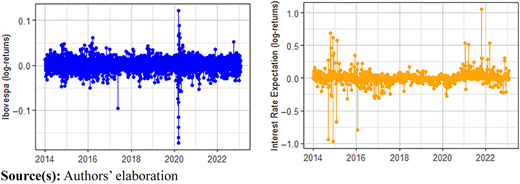
Table 1 reveals important details about the behavior of Ibovespa and the interest rate expectation with both sets of data derived from logarithmic returns. With 2,239 observations for each variable, the descriptive analysis showed that Ibovespa had an almost nil average logarithmic return of 0.00019, suggesting that, on average, the index did not show significant daily variations during the analyzed period.
On the other hand, interest rate expectation has an average logarithmic return of 0.00094, accompanied by significantly higher volatility (observable values at maximum and minimum points, for example), reflecting greater uncertainty or variation in market expectations regarding monetary policy.
ADF (Augmented Dickey-Fuller) [7] test for both series has values of −11.45 for Ibovespa and −10.491 for interest rate expectation, and a p-value of 0.0001 for both, strongly indicating rejection of the null hypothesis of a unit root. In simple terms, this means that both series are stationary, a prerequisite for many economic and financial analyses, as it suggests that the series have a constant mean and variance over time.
The charts in Figure 1, which illustrate the behavior of the logarithmic returns of Ibovespa and the interest rate expectation, visually complement the statistical analysis by providing a graphical representation of the fluctuations over time. Thus, one can observe how the logarithmic returns of both variables behave in relation to each other throughout the study period.
Together, the table of descriptive statistics and graph offer a comprehensive view of the behavior of the Brazilian financial market, highlighting both the quantitative characteristics of the data and their temporal evolution in an intuitive manner. Therefore, the next section of this paper presents the results and discussion.
4. Effects of monetary policy on volatility: ARMAX-GARCHX
It is worth noting that, to understand the relationship of the variables in more detail, the model estimates were divided into four groups: (1) group with only Ibovespa returns (univariate version for comparison with other groups); (2) Group with Ibovespa return plus the mean and variance of interest rate expectations as exogenous; (3) group with only the variance of interest rate expectations as exogenous; and (4) group with only the mean of interest rate expectations as exogenous. The results were obtained from the estimation of 96 models, whose details are presented in the appendices of this study [8]. Appendix A presents the results of the GARCH model without an exogenous variable, while Appendix B displays the results of the GARCH model with an exogenous variable in both the mean and variance. Appendix C contains the results of the GARCH model with an exogenous variable only in the variance, and Appendix D presents the GARCH model with an exogenous variable only in the mean.
Table 2 presents the best models for each group using the AIC value as the selection criterion. In the presented models, mu values represent the average return for the period given by the conditional mean equation. The omega parameter represents the part of volatility that is independent of the other variables, showing statistical significance in all four cases. The autoregressive (AR) and (MA) components detail the temporal dynamics of Ibovespa returns, whereas mxreg and vxreg incorporate interest rate expectations through the mean and variance, respectively. Here, alpha, beta, and gamma are crucial parameters in the conditional volatility equation that reflect the market’s reaction to past movements and new information.
The E-GARCHX and GJR-GARCHX models stand out as the best in their respective settings. The E-GARCHX model was selected as the best model in groups with and without the inclusion of the mean and variance of interest rate expectations, highlighting its ability to effectively capture the asymmetry and leverage effects (where negative shocks have a greater impact on volatility) in Ibovespa returns. On the other hand, the GJR-GARCHX model, selected in the group with only the exogenous variance of interest rate expectations, proved to be particularly effective in modeling conditional volatilities, adjusting well to changes in the variability of returns.
In group (1), the E-GARCHX model was identified as the best model using only Ibovespa returns as the endogenous variable. In the last three groups (2, 3, and 4), all parameters are significant (except for the exogenous variable in the conditional volatility equation), implying asymmetry and volatility clustering in Ibovespa’s returns. The first indicates that negative returns increase the conditional variance; that is, a negative shock increases the index’s risk. In the E-GARCHX, the same shock is represented by alpha1 and gamma1, where the former indicates the direction of the shock and the latter indicates its size. In the GJR-GARCHX model, the shock impact value is given by the sum of the alpha1 and gamma1 parameters. Although the determination of asymmetry was different in the two methods, the estimated value was very close in all three cases.
A high value of beta1 captures the effect of volatility clustering, indicating that volatility generates more volatility. These effects are characteristic of the Brazilian financial system, which is marked by high uncertainty and shock propagation according to Perlin, Mastella, Vancin, and Ramos (2021).
Comparing the normal average return of Ibovespa (0.00019) with the averages (mu) of the best models for each group (0.00539, group 2 model, for example), it is observed that all the averages of the selected models surpass the statistical sample average return of Ibovespa. The average sample of Ibovespa returns gives us an annual real rate of 4.9%, while the conditional mean estimated produces an annual real rate of 14.5% [9].
This indicates an improvement in the accuracy of the models by incorporating interest rate expectations, whether in their mean, variance, or both. These results suggest that interest rate expectations are a relevant factor in modeling Ibovespa returns, providing insights into Brazilian (Latin American and emerging) financial markets.
Analyzing the effects of the exogenous variable, we conclude that (interest rate expectation) has statistical significance in the equation of the conditional mean of returns. The parameter that captures this effect is mxreg1, which is significant at the 5% level, implying that in the period in question, monetary policy negatively affected the average real return of the Ibovespa Index. In other words, monetary policy is not neutral with respect to Ibovespa’s average returns.
The negative relationship between the expected monetary policy and Ibovespa returns is explained by the behavior of financial market agents. By predicting the expected changes in the interest rate on a daily basis, economic agents bring portfolio changes to the market according to those expectations. In other words, the expected monetary policy changes capture the government monetary policy changes in advance.
Parameter vxreg1, considered in the estimates of Models 2 and 3, represents the impact of monetary policy on volatility, and in both cases, it was not statistically significant. Here, the economic agent’s anticipation is good for the market by not inflating the volatility of the shares market, which would affect Ibovespa index behavior. In simple words, the financial market seems to reasonably predict monetary policy changes over time by reallocating their portfolio, which affects Ibovespa returns in advance.
5. Conclusion
This study empirically analyzes the relationship between innovative monetary policy and the Brazilian stock market to identify whether policy neutrality exists. Here, we emphasize that we tested monetary policy predictions using financial market economic agents. In doing so, we analyze the government’s proposed idea of monetary policy neutrality in the financial market.
Our algorithm estimates 98 models under two distributions and selects the best model, ARMAX-GARCHX, with extensions GJR-GARCHX and E-GARCHX, according to the parameter specifications for ARMA(p,q) and GARCH(p,q). The algorithm results showed that the expected monetary policy on the Ibovespa index returns is in accordance with the international literature. However, monetary policy has no effect on Ibovespa volatility, which is a clear indication of neutrality. Another aspect is that market prediction and advance lead to a positive increase in the mean returns of the Ibovespa Index. Thus, we have confirmed that the Brazilian way of making monetary policy that involves financial economic agents’ predictions seems to be in the right direction of not affecting volatility and reducing its impact on mean returns. Is it a good policy model for other countries? Yes and no, as we have tested it more thoroughly.
The article also underscores its practical impact, showing that the results are aligned with the view that clear and predictable communication mechanisms, such as the “Boletim Focus” of economic agent predictions can help mitigate the effects of unexpected monetary policies. This approach may serve as a recommendation for other countries to adopt similar strategies to promote greater stability in financial markets.
The second and third authors gratefully acknowledge the financial support from the Coordenação de Aperfeiçoamento de Pessoal de Nível Superior – Brasil (CAPES).
Notes
In Brazil, the financial economic agents predict the SELIC which is the daily interest rate on government bonds, according BACEN (2023).
According Pearson (1900).
Konrad (2009) analyzed the effects of U.S. monetary policy shocks on stock return volatility in Germany, concluding that these shocks significantly impact stock return volatility, with a greater effect during bear markets.
Was used the real variable, that is, less daily inflation.
According BACEN (2023).
Equation for interest rate expectation changes is: - , where MS represents the average of the Selic rate expectations on days t and t−1 and Interest Rate Expectation is the exogenous variable indicating the change in daily interest rate expectations.
According Dickey and Fuller (1979).
Variations of order (p, q) from 1 to 2 to find the model with the lowest AIC.
4.9% = (((1.00019)252–1)*100) and 14.9% = (((1.000539)252–1)*100). The 252 represents average number of daily negotiations of the Ibovespa returns.
References
The supplementary material for this article can be found online.