


This article aims to investigate whether the effect of public investment on private investment differs in regimes of relatively high and low-income inequality in Brazil from 1996 to 2022.
The linear vector autoregressive (VAR) model was applied to estimate the effect of public investment on private investment. To investigate the role of income distribution in this result, we employed a threshold vector autoregressive (TVAR) model.
The results reveal that the crowding-in effect only occurs in the relatively low-income inequality regime: a 10% increase in public investment results in a 0.8% and 3.4% increase in private investment after one and four quarters, respectively. Conversely, the response is not statistically different from zero in the relatively high-inequality scenario. Thus, from a macroeconomic standpoint, diminishing inequality can enhance the responsiveness of private investment to public investment.
Our results underscore the substantial macroeconomic potential of policies designed to mitigate inequalities. These policies play a pivotal role in advancing social equity and propelling more inclusive economic growth.
1. Introduction
Investment is one of the main components of aggregate demand and is especially relevant to long-term growth. Nevertheless, there is still controversy about the role of the state both as a direct investor and as an inducer of private investment. To fill this gap, many studies have carried out empirical estimates to capture whether public investment crowds in or crowds out private investment. Recent studies on the Brazilian economy (Alves & Luporini, 2008; Sanches & Rocha, 2010; Tadeu & Silva, 2013; Dos Santos et al., 2016; Reis, Araújo, & Gonzales, 2019; Bredow, Cunha, & Lélis, 2022; Fraga & Ferreira-Filho, 2023; Iasco-Pereira & Duregger, 2023) found a crowding-in effect of public investment on private investment. However, the literature has shown that the magnitude of the effect depends, for example, on the target of the investment, such as strategic infrastructure sectors (Aschauer, 1989a, b; Greene & Villanueva, 1991; Calderón & Servén, 2004; Perrotti & Sánchez, 2011), economic conditions, such as periods of economic expansion and recession, and low and high credit liquidity (Conte Filho, 2013; Alves & Luporini, 2008; Soave, 2016).
Inspired by these studies and motivated by recent political changes in Brazil that have the potential to affect income distribution and public investment - including the announcement of a new public investment program aiming at enabling macro-sectoral conditions for economic growth and development (Taioka, Sanches, Brenck, & Oliveira, 2023) and a recent expansion of Programa Bolsa Família (Bergamin, Serra, Sanches, Gomes, & Nassif-Pires, 2022) - we noticed a gap in the empirical literature for Brazil on the relationship between public and private investment in different income inequality. Understanding that the levels of income inequality generate different stimuli in the dynamism of the economy (Carvalho & Rezai, 2016), our hypothesis posits that the inequality regime may influence the magnitude of the ultimate impact of public investment on private investment. Thus, this article aims to investigate whether the effect of public investment on private investment differs in regimes of relatively high and low-income inequality.
Keynes (1964) argues for the importance of fiscal intervention in controlling the volume of investment to avoid expressive fluctuations in employment [1]. Moreover, Keynes also discusses the positive relationship between the marginal efficiency of capital (as a determinant of private investment) and the propensity to consume. Additionally, Kalecki (1945), when discussing ways of achieving full employment, argues that public investment does not exclude the need to stimulate mass consumption. In this sense, our working hypothesis is that a relatively equal income distribution enhances the public investment multiplier, leading to a stronger crowding-in effect on private investment compared to an economic scenario with relatively higher income inequality.
Using a linear Vector Autoregressive Model (VAR) for Brazil in 1996–2022, we find a crowding-in effect, in line with the more recent literature: a 10% rise in public investment leads to a 2.5% increase in private investment after four quarters. However, using a Threshold Vector Autoregressive model (TVAR), we find that the crowding-in effect only occurs in the relatively low-inequality regime: a 10% rise in public investment leads to a 3.4% increase in private investments after four quarters. In contrast, the response in high-inequality scenarios is not statistically different from zero. Our findings underscore the significant macroeconomic implications of reducing income inequality: it has the potential to enhance the responsiveness of private investment to public investment.
The remainder of this paper is organized as follows: Sections 2 and 3 review the literature, focusing on the empirical literature about the relationship between private and public investments in the Brazilian economy. In Section 4, we elaborate on the econometric methodology and the data employed in this study. Section 5 presents the results, while Section 6 offers a discussion of them. Section 7 presents some robustness tests. Finally, in Section 8, we draw our conclusions.
2. Related literature
There is no consensus in economic theory on the relationship between government spending and private investment, with a more evident disagreement when comparing different schools of thought. Regarding public investment more specifically, some authors argue that its expansion crowds out private investment, as both types of investment might compete for physical and financial resources. In this case, the increase in public investment could raise production costs, for instance, through elevating interest rates or affecting expectations on taxation (if the public expenditure results in a higher government deficit), leading to a reduction in private investment (Jacinto & Ribeiro, 1998; Cruz & Teixeira, 1999; Sonaglio, Braga, & Campos, 2010; Reis et al., 2019).
On the other hand, the crowding-in effect occurs when private investment responds positively to public investment. The empirical literature typically presents two channels through which public investment boosts private sector investment (Bredow et al., 2022; Iasco-Pereira & Duregger, 2023; Cruz & Teixeira, 1999; Sonaglio et al., 2010; Reis et al., 2019; Jacinto & Ribeiro, 1998): (1) public investment stimulates aggregate demand through its income multiplier effect, encouraging production and investment by the private sector (the so-called “accelerator effect”); (2) Public investment provides better supply conditions to the private sector (for example, through investments in infrastructure and human capital formation), contributing to increasing labor productivity and reducing production and transaction costs.
Although not exclusively, such a positive relationship between public and private investment appears mainly in demand-led growth models. Tavani and Zamparelli (2017), for instance, emphasize that the provision of public infrastructure positively affects labor productivity by providing better economic conditions for innovation. Inspired by Mazzucato (2013), the authors highlight the role of public investment in the innovative process and the productivity of the economy. In this sense, Ciaffi, Deleidi, and Mazzucato (2024) empirically show for a group of OECD countries that an expansion in public investment related to research and development (R&D) generates a positive impact on business R&D investment.
Dutt (2013), in turn, despite constructing a demand-led growth model, considers supply constraints such as the possibility of financial crowding-out effects in a scenario where the government accumulates a public deficit. Even with such effects, however, it is possible to verify a crowding-in outcome due to the direct and indirect effects of public investment on economic activity. This positive effect may persist in the long term if productivity also responds to public investment. The author emphasizes that even when accounting for negative expectations regarding an increase in the public deficit, crowding out is not a rule – and, in fact, it is logically plausible that public spending, especially in the form of investment, generates positive short-term and long-term effects.
The empirical literature verifies that the relationship between public and private investment differs for developed and developing economies. For instance, Soave, Gomes, and Sakurai (2016) studied the relationship between public investment growth and aggregate demand for 48 countries between 1975 and 2009. The sample was divided into two subsamples: 24 developed countries and 24 developing countries, following the World Bank classification. The results indicate a crowding-in effect in the long term. This effect is more significant for developing countries, a result that is confirmed by Izquierdo et al. (2019), who point out that the efficiency of an increase in public investment tends to be lower (higher) in countries where capital scarcity is less (more) pronounced. Moreover, when public investment is applied in strategic areas, such as infrastructure, it can enhance the positive effect on economic growth and increase the stimulus for private investment (Greene & Villanueva, 1991; Calderón & Servén, 2004).
Table 1A, in Appendix A [2], summarizes the main findings of the empirical literature analyzing the impact of public investment on private investment in the Brazilian context. In general, studies that investigated that relationship for years up to the 1990s report the existence of a negative relationship between public and private investment, such as Melo and Rodrigues Júnior (1998), Jacinto and Ribeiro (1998), and Cruz and Teixeira (1999) - although the latter reports a complementarity in the long term. Some other studies use data from the 1990s to the mid-2000s and have found a complementary relationship between the two types of investment (Alves & Luporini, 2008; Sanches & Rocha, 2010). An exception is Sonaglio et al. (2010), who find evidence of a crowding-out effect for the same period.
However, studies that use recent data and updated methodologies tend to find a complementary effect between public and private investments, in contrast to the evidence from previous literature (Tadeu & Silva, 2013; Dos Santos et al., 2016; Reis et al., 2019; Bredow et al., 2022; Fraga & Ferreira-Filho, 2023; Iasco-Pereira & Duregger, 2023). In particular, these more recent studies incorporate the period related to the Programa de Aceleração do Crescimento (PAC) - a Federal government infrastructure investment program - into the database. Furthermore, some more recent studies use, as private investment, the variable of investment in machinery and equipment (Bredow et al., 2022; Iasco-Pereira & Duregger, 2023; Alves & Luporini, 2008; Dos Santos et al., 2016) as it is the most relevant category for productivity gains and income growth (Bredow et al., 2022), and thus considered more accurate. However, Sanches and Rocha (2010) use investment (both public and private) in construction, primarily due to data availability. Finally, studies like Tadeu and Silva (2013) and Fraga and Ferreira-Filho (2023) emphasize that the crowding-in effect is mainly attributed to public investment in infrastructure.
Besides the econometric literature on the relationship between private and public investments, our study is related to the empirical evidence about social benefits multipliers. The empirical literature has shown that social benefits in Brazil contribute to a substantial fiscal multiplier (Sanches & Carvalho, 2022; Resende & Pires, 2021; Orair, Siqueira, & Gobetti, 2016) and exert positive effects on household consumption and private investment (Sanches & Carvalho, 2023), as well as to reduce income inequality (Hoffmann, 2013). In particular, Sanches and Carvalho (2023) estimate that one unit spent on social benefits generates 2.3 units in consumption and 1.58 units in private investment after two years. In this sense, our results underline that literature, as redistributive policies, for instance, by reducing income inequality, create economic conditions wherein one would expect private investment to respond more to public investment.
3. Empirical evidence using non-linear approaches
Additionally, economic cycles are another important factor impacting the magnitude of the crowding-in effect. For instance, using an STVAR (Smooth Transition Vector Autoregressive model) for the period from 1947 to 2008, Auerbach and Gorodnichenko (2012) found significant evidence that government spending in the US has a greater impact on output in times of recession. Following a similar STVAR model, Orair et al. (2016) found comparable results for Brazil between 2002 and 2016. According to the author’s findings, during economic expansions, the response of output to fiscal impulses tends to be subdued, resulting in multipliers lower than unity, with a maximum of 0.8. Conversely, in periods of economic downturns, these multipliers rise to nearly 2, signifying a more substantial impact on output during contractions in the economy.
Regarding the effect of government transfers in times of expansion and recession, using the TVAR approach (Threshold Vector Autoregressive model) for data from 2008 to 2022, Almeida, Ribeiro, and Schommer (2023) also verified a higher income transfer multiplier during recessions (0.51 in the short term and 0.99 in the long term), although lower than unit, in comparison to the expansion regime (0.11 and 0.31, respectively). As for the importance of credit liquidity on fiscal multipliers, Soave (2016) analyzes Brazil from 1995 to 2014 using the TVAR method, showing that, although output and income respond positively to fiscal shocks, both in times of high and low liquidity, the multipliers are higher and the responsiveness to shocks are more persistent in the liquidity-constrained regime. This indicates that in periods of low liquidity in the financial market, a fiscal shock is more effective since consumption and investment would be more tied to income and realized profit than to expected future values.
Carvalho and Rezai (2016) analyzed how low and high-income inequality regimes affect the demand regime. The authors estimated a TVAR for the US between 1967 and 2010, showing that inequality has a negative effect on output and can lead to a change in the demand regime in favor of profits. Therefore, more equitable income distributions would positively affect output. Hence, building upon the literature on crowding-in/out effects and economic cycles, in the subsequent sections we empirically address the following question: to what extent can low- and high-income inequality regimes influence the magnitude of the impact of public investment on private investment?
4. Data and methodology
4.1 Data
We employed quarterly time series from 1996 to 2022 for the following variables:
Public Investment: general government investment (comprising federal, state, and municipal governments), excluding state-owned companies. We obtained the quarterly series from the National Treasury of Brazil (STN), which provides public investment data in quarterly frequency from 2010 onward. For periods before 2010, we extracted the public investment series from the study conducted by Dos Santos et al. (2012), who estimated the series in monthly frequency. By combining both series, following the approach of Bredow et al. (2022), we achieved a comprehensive quarterly dataset. The public investment series is presented in millions of Reais, adjusted for inflation using the National Construction Cost Index (INCC-DI), from the Getulio Vargas Foundation (FGV) since public investments focus on infrastructure (Miguez, 2016), following Bredow et al. (2022). The series is also seasonally adjusted by the X-13 Arima Method [3].
Private Investment: it is an index (1995 = 100), given in real terms, and also seasonally adjusted, calculated by the Institute of Applied Economic Research (IPEA). As it is a monthly index, we transformed it into a quarterly frequency by taking the average of three months (as in Bredow et al., 2022). It refers to gross fixed capital formation in machinery and equipment. Similar to Bredow et al. (2022) and Iasco-Pereira and Duregger (2023), the assumption adopted here is that investments in machinery and equipment are primarily carried out by the private sector (see Dos Santos et al., 2016). The variable for investment in machinery and equipment is used by the recent literature (Bredow et al., 2022; Iasco-Pereira & Duregger, 2023; Alves & Luporini, 2008; Dos Santos et al., 2016), since it is considered the most relevant category for productivity gains and income growth (Bredow et al., 2022).
Gini index for disposable income: this annual series was obtained from the Standardized World Income Inequality Database (SWIID) (Solt, 2020). It was transformed into quarterly frequency using cubic interpolation [4], following Carvalho and Rezai (2016). The Gini coefficient refers to post-tax and post-transfer income (disposable income).
Installed capacity utilization of the manufacturing industry: The data were obtained from the Time Series Management System of the Central Bank of Brazil (BCB) and made available at a quarterly frequency by FGV, from their Conjunctural Survey of Manufacturing Industry.
Real exchange rate index (US Dollar to Brazilian Real): calculated by the Department of Statistics of the BCB (BCB-DSTAT) using the Extended National Consumer Price Index (IPCA) of the Brazilian Institute of Geography and Statistics (IBGE). We use the quarterly average of the monthly data available.
Real interest rate: we use the monthly Brazilian federal funds rate (Selic rate) accumulated in annual terms (basis of 252 days) from the Open Market Operations Department of the BCB (BCB/Demab) and the 12-month percentage change in the IPCA. The data used in the estimation comprises the average of the monthly data for each quarter.
Primary Commodity Price Index: monthly data from the International Monetary Fund (IMF). We use the average for the quarter. The time series available starts in January 2003.
4.2 Methodology
Following the recent literature investigating the relationship between private and public investment in Brazil, we employ a vector autoregressive model to analyze the dynamic impulse-response functions derived from the empirical model (Dos Santos et al., 2016; Reis et al., 2019; Bredow et al., 2022). Before analyzing the hypothesis of this article, that is, how the level of income inequality influences the public and private investment relationship, we employ an estimation of simultaneous dynamic equations in a standard linear VAR model, as shown in Sims (1980) (see Dos Santos et al., 2016; Bredow et al., 2022), using public investment and private investment as our endogenous variables vector. Both variables were log-transformed and differenced in the first order since the Augmented Dickey-Fuller test showed they are integrated of order one. Based on the information criteria, we selected 4 lags [5].
Next, to consider a possible non-linearity in the relationship between the two endogenous variables when considering income inequality levels, we employ a Threshold Vector Autoregressive model (TVAR), as in Carvalho and Rezai (2016), Almeida et al. (2023), and Soave (2016). Following Carvalho and Rezai (2016), we utilize the Gini index as our threshold variable, enabling us to derive model results for relatively low- and high-income inequality levels.
The two-dimensional TVAR aims to estimate the non-linearity of the dynamic relationship between the endogenous variables. The threshold, or value among the possible values of the transition variable, is thus defined so that the sum of the squared residuals can be minimized, and the estimated coefficients will differ in the regimes. Tsay (1998) proposed an extension of the regime shift autoregressive model (threshold) to the multivariate context, giving rise to the TVAR.
The TVAR model can be represented as follows (Almeida et al., 2023):
Where (Yt) is a vector of endogenous variables and (St) is the threshold variable and the threshold. (βj,i) is the matrix of lagged coefficients associated with period (i) and regime (j), where: j = 1 and j = 2 stand for the relatively low- and high-inequality regimes, respectively. (I) is an indicator that can be set to (1) if the condition in brackets is true or (0) if the condition is false. (vi,j) is a vector of random errors, and (αj) is a vector of constant terms for the regime (j). It should be noted that non-linearity is a property of the TVAR model, but within each regime, the model will be linear.
We performed an estimation for a two-dimensional TVAR [6] for the period 1996–2022, with public investment and private investment as endogenous variables. Again, both variables were log-transformed and differenced in the first order. We adopted one lag for the vector autoregressive model, following two of the three information criteria (BIQ and HQ) [7]. The Gini index for disposable income was utilized as the threshold variable, lagged by one period and differenced in the first order. The threshold value was automatically determined through a grid search, minimizing the sum of squared residuals [8]. We obtained linear accumulated impulse-response functions to Cholesky standard deviation innovations for each TVAR regime.
We also conduct tests for the robustness of the VAR model by including the following exogenous control variables (see Section 7): installed capacity utilization, real exchange rate, real interest rate, and primary commodity price index. All variables used were log-transformed and first-order differentiated, as the Augmented Dickey-Fuller test showed they are first-order integrated. Following three information criteria (AIC, HQ, FPE), we adopted four lags for the vector autoregressive model.
Furthermore, we used the local projections model based on Jordà (2005) to perform the robustness test of the model. The non-linear version of this methodology uses a smooth transition function as in Auerbach and Gorodnichenko (2012) to separate the data into two regimes. Unlike the TVAR model, the local projections package in R allows us to estimate the confidence interval for the two inequality regimes [9]. The local projections model can be represented as follows (Auerbach & Gorodnichenko, 2012):
where (zt) is standardized so that γ (>0) is scale-invariant, the observations for the two regimes are the product of the transition function and the endogenous variables:
Regime 1:
Regime 2:
Public investment is ordered first, as it is considered the most exogenous [10] (Dos Santos et al., 2016; Bredow et al., 2022). As highlighted in the fiscal multiplier literature, when using high-frequency data, there is little or no fiscal policy response to unexpected shocks in aggregate demand (or components, such as private investment) within the same quarter since policymakers take more than a quarter to react to the macroeconomic conditions and decide the next steps of fiscal policy (Blanchard & Perotti, 2002).
A common criticism of VAR models is that they require a predefined ordering of variables, often addressed through the Cholesky decomposition. The ordering usually depends on economic theory or institutional knowledge for identification (Stock & Watson, 2001; Jalles, 2017). For instance, Blanchard and Perotti (2002) argue that government expenditure should be ordered first when estimating fiscal multipliers with high-frequency data, as governments do not immediately respond to GDP changes. Another major limitation of VAR models is their sensitivity to misspecification - such as omitted variables, incorrect lag selection, or incorrect orthogonalization of innovations - which distorts impulse response functions (Hendry, 1995; Ericsson, Hendry, & Mizon, 1997). Since impulse responses rely on increasingly long-horizon forecasts, specification errors accumulate over time (Braun & Mittnik, 1993). To mitigate these issues, we include control variables and test different specifications of the model.
Additionally, VAR models face identification and size-related challenges, as estimating too many parameters leads to imprecise results (Lütkepohl, 2005), which is why recent literature has shifted towards Local Projections for impulse response estimation (Gupta, Talles, Mullas-Granados, & Schena, 2017; Heimberger, 2020). Given these advantages, we apply Local Projections in our nonlinear model as a robustness test. Finally, since linear VAR models fail to capture nonlinear responses to shocks, we also employ Threshold VAR (TVAR) models to address potential asymmetries (Donayre & Wilmot, 2016).
5. Results
5.1 Linear VAR
Employing a standard linear bi-dimensional VAR, we estimate that an increase of 10% in public investment generates a 2.5% increase in private investment after four quarters. The immediate response is 1.48%. It is noteworthy that these results are close to the ones found by Bredow et al. (2022) (see Table 1A, in Appendix A). The response is statistically significant at the 10% level for all periods (Figure 1). Tests on the residuals of this model [11] are available in Appendix B and show that the estimation is stable and free of problems such as heteroscedasticity and residual autocorrelation.
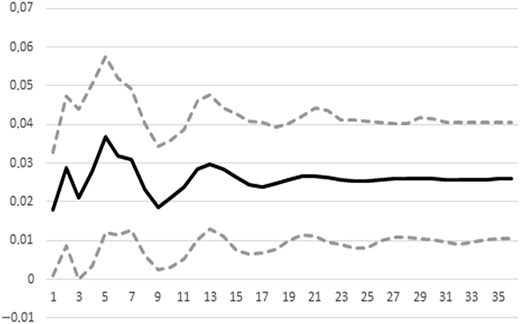
Accumulated response of private investment to a standard deviation shock in public investment in the linear VAR. Note: The dashed lines correspond to confidence intervals of 90%. Source: Authors’ elaboration
Accumulated response of private investment to a standard deviation shock in public investment in the linear VAR. Note: The dashed lines correspond to confidence intervals of 90%. Source: Authors’ elaboration
5.2 TVAR
The coefficients from the TVAR estimations are presented in Table 1. Both equations for private and public investments are provided, but our analysis will primarily concentrate on the private investment equation. This focus aligns with our investigation into the crowding-in effect across two inequality regimes. The threshold parameter estimated by the method for the Gini coefficient was 0.4656, with 21.7% of the observations lower than this value (“low-inequality regime”) and 78.3% of the observations higher than the threshold value (“high-inequality regime”).
Results of the two-dimensional TVAR estimation for Brazil (1996–2022) using the Gini index for disposable income as a threshold
| Private investment equation | Public investment equation | |||
|---|---|---|---|---|
| Low inequality | High inequality | Low inequality | High inequality | |
| Private investment (−1) | 0.0281 | −0.0731 | −0.4822** | 0.4349*** |
| Public investment (−1) | 0.2477** | −0.0480 | 0.2041 | 0.0345 |
| Intercept | −0.0294 | 0.0160 | −0.0258 | 0.0026 |
Note(s): Significance: ***1%, **5%, *10%
Source(s): Authors’ elaboration
As indicated by the private investment equation, we observed a crowding-in effect in the relatively low-inequality regime: private investment responds positively to a shock in public investment. This impact is statistically significant at a 5% significance level, as detailed in Table 1. In contrast, within the relatively high-inequality regime, public investment does not significantly impact private investment.
Figure 2 illustrates the cumulative impulse-response function of private investment to a one-standard-deviation shock in the public investment variable for both relatively low- and high-inequality regimes. The graph underscores a notably positive response of private investment to a shock in public investment within the relatively low-inequality regime, showcasing a significant disparity between the two regimes over time, despite similar short-run responses. In other words, our findings suggest the presence of a crowding-in effect when income inequality is lower.
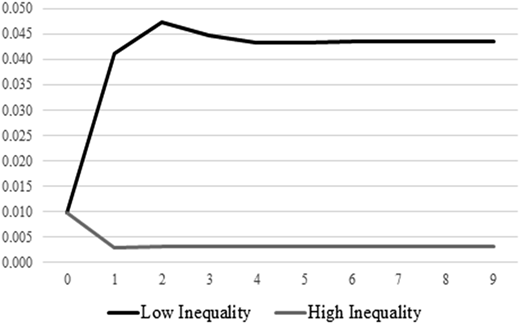
Accumulated response of private investment to a standard deviation shock in public investment in relatively low- and high-inequality regimes. Source: Authors’ elaboration
Accumulated response of private investment to a standard deviation shock in public investment in relatively low- and high-inequality regimes. Source: Authors’ elaboration
More precisely, the cumulative response depicted in Figure 2 reveals that a 10% increase in public investment results in a 3.4% surge in private investments after four quarters in the relatively low-inequality regime. In contrast, the corresponding response is not statistically significant in the relatively high-inequality scenario. In the short run, however, both regimes display a comparable reaction, with a 10% increase in public investment leading to an approximately 0.8% increase in private investment. Even so, as we notice in Table 1, only the immediate response of private to public investment in the relatively low-inequality regime is statistically significant.
Although it is not our focus in this article, Table 1 shows a positive response of public investment to private investment for the relatively high-inequality regime and a negative in the case of relatively low-inequality. Appendix C shows the impulse response functions for this exercise.
6. Discussion
Our findings are consistent with recent literature on the Brazilian economy, revealing a crowding-in effect. Importantly, our results parallel those of Bredow et al. (2022), who employed a linear VAR model for Brazil using similar time series data from 1996 to 2018. While their study found that a 10% expansion in public investment leads to a 2.04% increase in private investment over time (after four quarters), our analysis reveals a 2.5% increase for the same period. Moreover, Bredow et al. (2022) find an immediate effect (in the first quarter) of 1.64%. Our results for the linear VAR indicate a similar impact (1.48%).
When allowing for different regimes using the TVAR approach, we find that the crowding-in result only appears in the relatively low-inequality regime: a 10% expansion in public investment leads to a 0.8% and 3.43% increase in private investment after one and four quarters, respectively. Conversely, the response is not statistically different from zero in the relatively high-inequality scenario.
It should also be noted that the most recent literature, which includes in the sample the sharp decline in the Gini index period in the mid-2000s, has found positive effects of public investment on private investment (see Table A1 in Appendix A). Therefore, our result of the crowding-in effect being more pronounced in the relatively low-inequality regime aligns with and reinforces the findings in that literature, underscoring a positive relationship between reduced inequality and investment.
In the relatively low inequality scenario, lower-income brackets, exhibiting a higher inclination to consume (as observed in Palomo, Carvalho, & Toneto, 2022, for Brazil), contribute to a more dynamic economy since there is a redistribution from the class with a higher propensity to save to the class with a higher propensity to consume (Carvalho & Rezai, 2016). This dynamic setting not only stimulates household consumption but also drives private investment, which responds positively to increased aggregate demand, commonly referred to as the accelerator effect (Hein & Vogel, 2008).
Since the lower-income groups exhibit a higher marginal propensity to consume (Palomo et al., 2022; Kalecki, 1952) and a higher average propensity to consume (Serra & Sanches, 2025), a lower-inequality scenario enhances the stimulus effect of public investment - known for its high multiplier impact on the economy (Sanches & Carvalho, 2022; Orair et al., 2016) - on private investment. This occurs because the overall dynamic effects on economic activity are stronger. Moreover, social benefits - expenditures that potentially reduce inequality - also have a significant multiplier effect (as estimated for various countries by Cardoso et al., 2025), as they further stimulate both consumption and investment dynamics (Sanches & Carvalho, 2023). These findings suggest that in a lower-inequality regime, the economy operates with greater dynamism, as income redistribution fuels economic activity. Consequently, the crowding-in effect of public investment on private investment becomes even more pronounced in this context.
7. Robustness check
7.1 Alternative methodology: non-linear local projections
Figure 3 shows that our main conclusions still hold when we use an alternative non-linear methodology. The local projections method produces results that are similar to the TVAR’s ones. The impact was positive and significant for both regimes in the first period. After the second period, the impulse-response function for the low inequality regime was significant at 10% throughout the entire period after the shock, until period 8, while it was not significant for the high inequality regime [12].
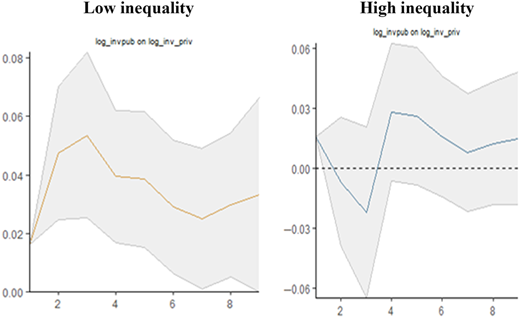
Responses of private investment to a standard deviation shock in public investment - low and high inequality, respectively. Note: The gray lines correspond to confidence intervals of 90%. Source: Authors’ elaboration
Responses of private investment to a standard deviation shock in public investment - low and high inequality, respectively. Note: The gray lines correspond to confidence intervals of 90%. Source: Authors’ elaboration
7.2 Control variables
We check the influence of control variables to account for possible omitted variable bias, based on relevant literature: degree of capacity utilization, real exchange rate, commodity price index, and interest rate. We observe that the findings from Section 5 remain robust even after including control variables: the response of private investment to a shock in public investment continues to be statistically significant at 10% across most periods. The results can be found in Appendix D [13].
8. Concluding remarks
This paper has analyzed how relatively high- and low-inequality regimes impact the magnitude of the response of private investment to public investment. Our findings support the conclusions drawn from recent literature, indicating that public investment has a crowding-in effect on private investment—that is, the latter responds positively to the former.
More specifically, our linear VAR baseline estimation concludes that an increase of 10% in public investment generates a 2.5% rise in private investment after four quarters. Using a TVAR model, we have demonstrated that this crowding-in effect only occurs in the relatively low-inequality regime: a 10% increase in public investment results in a 3.4% increase in private investment after four quarters. On the other hand, in the relatively high-inequality regime, this response is not statistically different from zero.
A surge in public investment, for example, produces a significant multiplier effect, typically higher than one, as evidenced in Brazil (refer to Sanches & Carvalho, 2022; Orair et al., 2016; Pires, 2014; Resende & Pires, 2021). According to our findings, this economic stimulus positively impacts private investment, particularly in scenarios where inequality is lower, fostering a more dynamic aggregate demand environment. In such circumstances, the impetus for investment is heightened, driven by the increased dynamism in consumption stemming from a more equitably distributed income.
Our results indicate that the crowding-in effect only appears in the relatively low-inequality regime, which indicates the importance of redistributive policies to mitigate income inequality and enhance the responsiveness of private to public investment. This aligns with empirical findings in the literature highlighting the relevance of the social benefits multiplier effect. Since social benefits are targeted toward individuals in lower-income groups, who exhibit a higher propensity to consume, their multiplier effect is relevant, making the economy more dynamic (Cardoso et al., 2025; Sanches & Carvalho, 2023; Resende & Pires, 2021; Orair et al., 2016). This evidence may contribute to elucidating our finding that private investment responds significantly to the stimulus in public investment (crowding-in effect) when income inequality is lower.
Furthermore, our study suggests that the state has a key role as a driver of investment and that its role is crucial in implementing and coordinating investment programs. Programs aimed at greater income distribution are crucial to improving the welfare of low-income populations and boosting the effects of macroeconomic stimuli, as public investment is more effective at stimulating private investment in a less unequal economy.
In alignment with the literature on fiscal multipliers of social benefits, our results underscore the substantial macroeconomic potential of policies designed to mitigate inequalities. In this context, these policies play a pivotal role in advancing social equity and propelling more inclusive economic growth.
The authors express their gratitude to Rodrigo Orair for making available the monthly series of public investment. The authors also thank Gilberto Tadeu Lima, Pedro Romero Marques, Rafael Ribeiro and an anonymous referee for helpful comments in earlier drafts of this paper.
Funding: This research was supported by the Research Center on Macroeconomics of Inequalities (Made), University of São Paulo (FEA/USP).
Disclosure statement: The authors report there are no competing interests to declare.
Erratum: It has come to the attention of the publisher that the article, da Silva Sanches, M., Taioka, T., Zanon Brenck, C. and Pereira Serra, G. (2025), “How does income distribution affect the impact of public investment on private investment? Empirical evidence from Brazil”, EconomiA, Vol. 26 No. 2. https://doi.org/10.1108/ECON-02-2025-0043 was published with an incomplete version of the condensed review process statement. The statement should read “This article is part of the special issue Selecta 2024, featuring the best papers from the 52nd Brazilian Economic Meeting. It was nominated by the conference’s scientific committee. Following an invitation to submit, the paper underwent a condensed review process, with a single referee recommending minor revisions.” The error was introduced in the editorial process and has now been corrected in the online version. The publisher sincerely apologises for this error and for any inconvenience caused.
Notes
See Seccareccia (2012) for an analysis of Keynes’ proposal for the socialization of investment.
All appendices are available in the supplementary materials section.
Available in Eviews 12.
Available in Eviews 12 (“Cubic Match Last”).
The criteria AIC, HQ and FPE indicated 4 lags. SC criteria indicated 1 lag. However, the estimation using 1 lag showed heteroscedasticity problems.
We performed the TVAR estimation using the “tsDyn” package in R.
Following the parsimony principle, we chose 1 lag for the estimation, according to the criteria mentioned. The AIC criteria indicated 6 lags. Given that our sample is not very large, we opted to include one lag in order to have a higher degree of freedom. However, when we estimate the model using 6 lags, the substantial difference between the low and high inequality regimes persisted.
We adjusted the trimming parameter indicating the minimal percentage of observations in each regime according to the LR Test, proposed by Lo and Zivot (2001) (which is based on Hansen (1999), but for the multivariate case), and to increase the number of observations for the low-inequality regime (which has lower observations). Setting the parameter to 0.2 (Carvalho & Rezai (2016) used 0.25), the LR test reveals non-linearity, leading to the rejection of the null hypothesis of a linear model at a 5% significance level. We tested other parameter values, such as 0.15 and 0.10, for which the LR test also detects non-linearity. Our results barely changed with this variation.
The package used was “pirfs” in R.
We also conducted estimations using an alternative specification, ordering the private investment variable first. The results remained robust to this change, with the difference between the two regimes persisting.
Since the residual tests are not available in the tsDyn package in R for the TVAR model, we performed these tests only for the linear VAR models.
The switching function is similar to the work by Auerbach and Gorodnichenko (2012). We used gamma as 2, but our conclusions are robust to other values. We used the lags for the model chosen by the AIC criteria. We obtained similar results when using the BIC criteria.
Since the possibility of including control variables is not available in the tsDyn package in R for the TVAR model, we have included controls only for the linear model.
References
Further reading
The supplementary material for this article can be found online.

