
Skip to article sections
Purpose

Racialized disabled job seekers and workers continue to face disadvantages in the labour market. This gap in labour market outcomes suggests there is a need to investigate the range of employment supports, also known as vocational rehabilitation (VR) services, available to this population. By examining the entire employment journey, we can thoroughly assess how these supports and services impact their employment outcomes. The purpose of this scoping review is to examine and synthesize the existing evidence about VR and identify gaps in practice with racialized disabled job seekers and workers using supports and services to help them gain employment.

Design/methodology/approach

An extensive literature search was carried out, encompassing the search of four electronic databases and a review of grey literature. From this search, 73 studies and 6 grey literature documents met the inclusion criteria.

Findings

The results of the analysis are focused on the intersectional impact of racial and (dis)ability identities on VR experiences and outcomes. The analysis suggests that current VR systems are not structured to address the complex needs of racialized disabled job seekers and workers. Service providers and employers should address this gap and design services that can be tailored for individual needs and strengths.

Originality/value

The study provides a crucial step towards establishing a clearer and more comprehensive understanding of how the intersection of race and disability affects outcomes and experiences within VR services.

Employment is a recognized social determinant of health (Raphael et al., 2020) and can provide benefits to both personal and societal health such as contributing to establishing social status and developing a sense of belonging (Armenti et al., 2023). Programs and initiatives focused on delivering employment supports for racialized disabled job seekers and workers have emerged to help individuals obtain and maintain employment. Employment-focused support services can improve the employability of an individual by providing job readiness training, job development supports, onboarding supports and retention/promotion services (Canadian Association for Supported Employment, 2024). However, issues of ableism and racism are inherently prevalent in organizational structures of employment services (Yin et al., 2022), which can contribute to ongoing barriers to employment faced by racialized disabled individuals.

Experiences and challenges of disabled individuals seeking and maintaining employment have been well documented in the literature (Vornholt et al., 2013), and yet disabled individuals remain among the most disadvantaged in the labour market (Saleh and Bruyère, 2018). Disabled individuals also continue to report consistently lower employment quality and are nearly twice as likely to report low-quality employment, either as being stuck in secure yet unfulfilling jobs or in in insecure and unrewarding positions (Shahidi et al., 2023). Following labour market trends, the labour force participation of disabled individuals is in decline in recent years despite ongoing efforts across many Canadian jurisdictions to implement innovative policies and legislation to improve their employment opportunities (Pettinicchio and Maroto, 2017). Disabled workers who are employed often contend with ableist attitudes at workplaces, leading to deeply rooted workplace discrimination, exclusion and oppression (Dirth and Branscombe, 2019; Fuentes et al., 2023). Similarly, racialized individuals also face disparities in the workforce and labour market due to racist beliefs and behaviours (Lippens et al., 2022).

Despite the expansive literature focused on employment supports for disabled individuals, there has been little attention paid to how intersecting identities of race, and disability can impact employment related experiences, amongst racialized disabled workers (Berghs and Dyson (2022). A lack of consistent standards for collecting racial data across various disciplines, and a historical tendency to neglect the combined impact of race and disability contribute to this gap (James and Wu, 2006). This gap persists within the rehabilitation sector, as does a lack of awareness about how one’s identity can impact their experiences and the challenges they face (Saia et al., 2023).

Vocational rehabilitation (VR) is a service in the United States (US) which helps disabled persons to overcome barriers to accessing, retaining, or returning to employment through supportive services (US Department of Labor, 2024). In this review we explore the intersection of disability and race within employment supports broadly, with a specific focus within our analysis on VR services in the US. Similarly, in Canada we often refer to the same suite of services as employment supports; these include services to find and keep jobs, however, these services are provincially/territorially funded (Canadian Association for Supported Employment, 2024). Due to the similar nature of VR and employments supports, both terms can be used interchangeably but differ in light of geographical contexts [1]. Traditionally, VR and employment supports have targeted individuals and their skills, competencies and behaviours to improve their fit in existing workplace contexts (Yin et al., 2022). However, such individual-level approaches rarely address structural and social barriers embedded in workplace organizations that can limit employment opportunities for racialized disabled job seekers and workers.

An intersectional approach can guide an examination of the experiences of those who identify with multiple marginalized identities, creating overlapping disadvantage (Kelly et al., 2021). Originally introduced by Crenshaw (1991) and later described by the Ontario Human Rights Commission (2024), intersectionality captures the idea that individuals who have multiple marginalized identities can face a myriad of individual and systemic forces that can reproduce and reinforce inequities (Ontario Human Rights Commission, 2024). Intersectionality offers researchers a methodological framework to explore how privilege and disadvantage interact, examining whether a study adopts an intersectional approach, the appropriate framing for the research context, and the focus on systemic processes or individual identities. It emphasizes critically analysing how dominant groups construct notions of “normal”, which perpetuate structural inequities by marginalizing underrepresented voices. By analysing the interplay of socially constructed identities, intersectionality highlights how these categories operate within systems of power, revealing both privilege and oppression. This approach shifts the focus from solely individual identities to broader organizational and societal processes, enabling more nuanced and equitable analyses (Mooney, 2016; Hancock, 2007). To address such inequities in the context of employment, service providers and employers should be aware and understand how complex forms of oppression may impact both the process and nature of employment supports received by racialized disabled job seekers and workers.

The purpose of this scoping review is to synthesize existing knowledge about employment support systems currently in place for racialized disabled workers and to explore strategies and guidelines to address the employment needs of this population. While significant research exists on employment supports for disabled persons, to our knowledge, no review has specifically examined the issue of race within this body of literature, making this an important and novel contribution to the field. Insights into the impact of race are crucial for understanding how racial identity uniquely intersects with disability to compound barriers in employment and how addressing these barriers can improve outcomes for this population (Fuentes et al., 2023). In Canada, available estimates from Statistics Canada (2020) indicate that among racialized disabled individuals between the ages of 25–64 years, 49.9% have the potential to work but are currently unemployed, highlighting an urgent need to better understand the intersectionality of race and disability in the context of employment supports. Despite this gap, historically, Canada has not collected race-based data regarding employment services (Wilkerson and Penn, 1938). Although other marginalized identities can also intersect with disability, this review prioritizes race to address a critical gap in the literature and to illuminate how racial inequities shape the experiences of disabled workers. By focusing on race, this review acknowledges the unique challenges faced by racialized disabled workers, such as discrimination, underemployment, and lack of culturally responsive support systems. This contextualization is particularly important for Canadian service providers and employers, as it highlights the systemic barriers that racialized disabled workers face in accessing equitable employment opportunities. This focus not only sheds light on the specific barriers experienced by this population but also provides insights into the impact of race, contributing to a deeper understanding of how to address intersectional complexity and heterogeneity within this group, ensuring that employment support systems are more inclusive and effective.

To assess existing knowledge and identify research priorities, we conducted a scoping review of the literature on employment support processes and practices concerning racialized disabled job seekers and workers. This method is particularly suited for complex research topics that have not been systematically examined. Scoping review approaches can be used to: (1) summarize the extent, range, and nature of the existing literature; (2) determine the value of undertaking a full systematic review on the topic; (3) disseminate existing evidence; and (4) identify research gaps and set research priorities (Arksey and O’Malley, 2005; Levac et al., 2010). Drawing on the scoping review framework developed by Arksey and O’Malley (2005) and advanced by Levac and colleagues (2010), we sought to identify the current state of the employment support systems as documented in the literature for racialized job seekers and workers.

We began by asking the broad question: “What is written about the experiences of racialized disabled workers receiving employment support services?” This question guided us to address the following research objectives to:

  1. Identify and synthesize what is written about practices and processes for providing employment supports to racialized disabled job seekers and workers while specifying gaps in the existing literature;

  2. Explore intersectional perspectives and experiences of racialized disabled job seekers and workers;

  3. Suggest potential next steps to enhance current employment supports systems for racialized disabled job seekers and workers in a broader context.

The initial phase of this scoping review included a search of electronic databases. In the consultation with a university librarian having expertise in health and social care research, we identified four databases as relevant to our topics: Cumulative Index to Nursing and Allied Health, Web of Science, Applied Social Sciences Index and Abstracts, and Business Source Premier. The database search strategy combined terms related to the population of focus (racialized disabled job seekers and workers), concept (employment supports) and concept (intersectionality). The search was not limited in terms of language of the literature or publishing date so that we could capture international trends and practices and examine how the literature has changed over time. A grey literature search was conducted through a Google search and the top ten pages of the results of this search were reviewed.

The inclusion and exclusion criteria were initially stated broadly. However, we engaged in an iterative process to further refine our inclusion and exclusion criteria as we examined the available literature. Our finalized inclusion criteria were that papers: (1) focused on racialized disabled workers over the age of 16; (2) focused on employment supports, and; (3) address race as a contributing factor to the employment experience as opposed to race being merely a demographic variable. Quantitative and qualitative studies, descriptive, theoretical, case reports, dissertations, and conceptual papers, as well as scoping and systematic reviews were included. Articles were excluded if all or most participants were under the age of 16 years since our target population was adult job seekers and workers. We also excluded opinion pieces, editorials, and conference abstracts and proceedings.

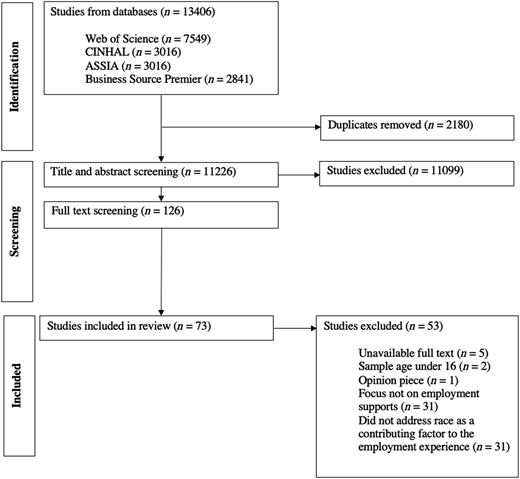
Covidence software was used throughout all stages of the review to organize papers and assist with the collaborative review and data extraction process. A total of 73 articles were included in the review (see Figure 1 for an outline of the study selection process and supplementary material for information regarding each included study). Additionally, a total of six grey literature documents were identified and included in the final analysis. The grey literature search was performed independently, and the results of the grey literature search were not included in Figure 1, which exclusively depicts the study selection process for articles identified through database searches.

The data extraction process was conducted by the same two members of the research team. We extracted data from each article focusing on the purpose, methods and any information related to employment supports in the context to race and disability. The data extracted from the literature were thematically analysed through a process of identifying and synthesizing recurrent or emerging themes by examining points of agreement and disagreement as described by Braun and Clarke (2006). Through an iterative process of reviewing papers, comparing, and contrasting the data, a summary of key themes was created to capture the experiences of racialized disabled job seekers and workers.

Our review included 73 studies conducted in three countries over a span of a 25-year period (1998–2023). Most of these studies (n = 71) were conducted in the US, one was conducted in the United Kingdom and one in Sweden. Prominent racial groups included in the articles consisted of Black/African American, Latino/Hispanic, Asian, Native Hawaiian/Pacific Islander, American Indian, and White/Caucasian/European American. There was a range of types of disabilities discussed in the included articles. Some articles used broad categories like mental, physical, intellectual, sensory, neurodivergent, psychiatric, developmental and neuropsychiatric to describe the type of disability studied. Some articles focused on specific chronic health conditions such as depression, diabetes, and HIV/AIDS. Sixty-four studies had a quantitative design, and the authors analysed VR outcomes amongst different racialized disabled groups; four of the studies had a qualitative design and involved interviewing individuals with lived experience; and five studies were review articles. Through our broad search for this scoping review with the intent to capture international literature, we saw that all the included articles focused on race and disability in the context of VR in the US. Moving forward, the rest of this scoping review will use the term VR when discussing the results of the analysis. Importantly, we recognize differences in preferred terminology across cultures, within individual groups and over time regarding disability, race, and ethnicity. Thus, throughout our presentation of our results, we use the original terms used by the authors in the included studies.

We identified three key themes in our analysis: (1) the impact of race and disability; (2) VR services that promote employment success; and (3) action needed and recommendations in shaping employment supports and subsequently, labour market experiences and outcomes. See supplementary material for a summary of assigned themes for each included study.

Poor VR outcomes

Authors of six USA-based studies identified that certain racialized disabled groups had significantly poorer VR outcomes than White disabled participants. On average, African American, American Indian, and Latino disabled clients were more likely than White disabled clients to receive unsuccessful case closures from their VR program (Dunham, 1998; Goodwin, 1998; Elmore-Williams, 2008; Lukyanova et al., 2014; Ware, 2005; Wehman et al., 2007). For example, African Americans were more likely to have their cases closed due to reasons of “failure to cooperate”, “unable to locate or contact”, and “refused further services” (Dunham, 1998; Elmore-Williams, 2008).

Disparity in VR services

The authors of four studies suggested that the combined effects of race and disability can lead to reduced rates of acceptance into VR programs. There was a consensus amongst authors of these four studies in which African American, Asian American, Hispanic, and Pacific Islander clients with varying disabilities were identified as less likely to be referred and/or accepted for VR services than White clients with varying disabilities (Kim-Rupnow et al., 2005; Ni, 2008; Park et al., 2005; Rosenthal et al., 2005).

Authors of five studies reported differences in the type of services that were provided to certain racial groups whereby certain individuals were not provided the required foundational and supportive services to succeed. In two studies, it was noted that African Americans and Hispanic clients with specific learning disabilities or traumatic brain injuries (TBI) or spinal cord injuries were less likely than European (White) Americans to be accepted for specific services including rehabilitation planning, college training, and on-the-job training (Elmore-Williams, 2008; Garcia-Iriarte et al., 2007). Instead, racialized individuals living with disability primarily received workplace support, food, shelter, and transportation services (Arango-Lasprilla et al., 2011; Elmore-Williams, 2008; Romero-Ramirez, 2009). Arango-Lasprilla and colleagues (2011) and Mwachofi and colleagues (2009) also identified significant statistical differences in access to services in which White clients were receiving VR interventions for longer periods and case expenditures were significantly higher for White clients.

Authors of three studies revealed significant gaps between racialized and White groups in terms of access and use of VR services and delivery of VR services. At a national level, disabled job seekers and those who identify as African American, American Indian/Alaska Native, and Hispanic apply for VR services at a higher rate than their White counterparts but have lower eligibility, receival of services, and employment rates (Yin et al., 2022). For example, Crudden and colleagues (2020) reported that White applicants on average, waited 6 days less than applicants of all other races from application to a signed individualized plan for employment services. This delay in services is also prevalent amongst women with HIV/AIDS in which 51% of racialized women with HIV/AIDS reported that race limited their use of employment services (Conyers and Datti, 2008).

Authors of three studies highlighted the impact of same client-counsellor race relationships. Matrone and Leahy (2005) examined the relationship of having a counsellor and client when both are of the same race. Additionally, Matrone and Leahy (2005) identified that most of the significant explanatory variables are located at the client level, not at the counsellor level. For example, non-White clients working with a counsellor of any race have a lower probability for successful closure in comparison with same race counsellors (Matrone and Leahy, 2005). In terms of successful VR outcomes, evidence suggests that client-counsellor matches based on race resulted in a 7.3% higher VR rate than did client-counsellor race mismatches (Whitfield et al., 2010). Lastly, another study examined racial perceptions and identified that White rehabilitation counsellors were more eager to jump to conclusions about African American clients in early stages of the rehabilitation processes, creating inequitable treatment and assumptions (Rosenthal et al., 2005).

Poor employment outcomes

A common trend that was identified in three studies was poor employment outcomes for racialized disabled job seekers and workers. Among transition-age youth, three studies explicitly highlighted the experiences of African American and Hispanic/Latino participants with intellectual/learning disabilities and depressive disorders and identified significantly lower odds of such individuals securing employment in comparison to their White peers with the same conditions (Akinola and Doabler, 2022; Ji et al., 2015; Kaya, 2018). Issues that may have contributed to this finding include cultural mistrust and lack of agreement on the type of employment services needed for successful employment of racialized disabled transition-age youth (Akinola and Doabler, 2022; Ji et al., 2015; Kaya, 2018).

Authors of three studies reported on income differences as well along the intersection between race and disability among VR clients. Race was a significant predictor for earnings and success in employment, with White disabled clients being more likely to escape the cycle of poverty through employment despite working fewer hours than their African American, American Indian, and Hispanic counterparts (Glynn and Schaller, 2017; Goodwin, 1998; Mwachofi et al., 2009).

Other intersecting identities

The authors of nine US studies reported gender differences amongst racialized disabled job seekers and workers. Six of the included articles in the review identified that racialized disabled men were more likely to successfully rehabilitate and become employed than their female counterparts (Cimera et al., 2015; Homa, 2004; Johnstone et al., 2003; Martz and Xu, 2008; Ni, 2008; Oswald et al., 2016). Three additional studies reported that the mean earnings of males were significantly higher than females (Akinola et al., 2021; Glynn and Schaller, 2017; Ji et al., 2015).

Authors of four studies reported how education can influence VR success. Specifically, higher education (i.e. an associate/undergraduate degree/diploma or higher) contributed towards successful case closure among racialized disabled job seekers (Kaya et al., 2021; Muesser et al., 2014; Rogers et a., 2005; Vaughn, 2009).

VR supports

The authors of twenty-five studies discussed what VR supports were predictive of successful employment. In particular, VR counselling, assistive technology, diagnostic/treatment services, job placement services, on-the-job services, and job search assistance were predictive of positive employment outcomes for racialized disabled individuals (Akinola et al., 2021; Bromet, 2005; Chun et al., 2018; Crudden et al., 2018; Fagundo, 2020; Ji et al., 2015; Kaya, 2018; Lee et al., 2020; Lukyanova et al., 2014; Martz and Xu, 2008; Miller et al., 2016; Moore et al., 2002a, b; Ni, 2008; Rogers et al., 2005; Rumrill et al., 2022; Schronburn, 2005; Spence, 2000; Ware, 2005). For example, job placement and on-the-job services have been identified to play a central role in predicting successful employment, however, are significantly underutilized (Ahonle et al., 2020; Chan et al., 2006; Johnson et al., 2020; Vaughn, 2009). A study conducted through the perspectives of VR counsellors saw that VR counselling was the most frequently offered service because it helps counsellors to identify their clients’ strengths and weaknesses to inform their VR plan (Johnstone et al., 2003). A similar finding was identified in a qualitative study, which revealed that young Black adults primarily focused on the characteristics, qualities, and skills of their vocational counsellor in achieving their financial goals. They favoured counsellors who were nonjudgemental, understanding, relatable, and willing to provide several engagement options for their ongoing work together (Delman and Adams, 2022).

Amongst racialized transition-age disabled youth, completion of college/university was significantly regarded as a predictor for successful employment in four studies. Both uptake of services and services aimed at upward mobility such as college/university training are associated with positive employment outcomes and higher reported linear incomes (Cimera et al., 2015). However, fewer than 12% of successful VR clients received college/university training (Berry and Caplan, 2010; Cimera et al., 2015; Glynn and Schaller, 2017; O’Neil et al., 2015).

Authors of five studies considered the benefits of wrap-around supports such as transportation, food, shelter, and clothing. For example, the authors of a study including Black/African American disabled clients who received transportation support or supported employment were 19 and 38% more likely to be employed than White disabled clients who received similar services (Ahonle et al., 2020). The authors of four other studies reported that a combination of wrap-around supports and job-oriented VR services were strong predicators of successful employment outcomes when offered to racialized disabled clients (Austin et al., 2019; Catalano et al., 2006; da Silva Cardoso et al., 2007; Wang and Ethridge, 2022).

Revisit of VR policies and services

Significantly, authors from seven studies suggest that many individuals who might benefit from VR services do not receive them. For example, nearly three-fourths of clients with TBI in the study by Johnstone and colleagues (2003) discontinued services before they could be offered or completed. Specifically, 60% of the sample had disabilities that would adversely impact their ability to work, but they dropped out before services could be initiated or completed, while 13% dropped out before their eligibility could be determined (Johnstone et al., 2003). Similarly, Conyers and Datti (2008) reported that 75% of the respondents had never received any VR services. In terms of specific supports, the results reported by O’Neil and colleagues (2015) identified that college/university training as a VR intervention is a viable method of improving earning potential of disabled persons, demonstrating the benefits for groups where college/university training is appropriate but is severely underutilized. Authors of other studies acknowledged the need to create employment training opportunities by ensuring that racialized disabled youth receive relevant school services and workshops to foster community participation, independence and develop transferable skills (Akinola et al., 2021; Cimera et al., 2015; Garcia-Iriarte et al., 2007; Ni, 2008).

In the grey literature, authors of six studies, reports, and government documents detailed key policy gaps and needed reforms to create better VR systems for racialized disabled job seekers and workers. Key reforms include delinking VR services from income support programs (Torjman and Makoul, 2016), developing guidelines regarding workplace accommodations (Ives-Rublee et al., 2022), strengthening employee rights (Ives-Rublee et al., 2022), and improving access to unionized employment (Maroto and Pettinicchio, 2022). Regarding upskilling VR staff, strategies include compulsory intersectional disability anti-bias training for service providers (Rajan, 2021), revising social assistance programs to create person-centeredness (Torjman and Makoul, 2016), hiring more diverse and culturally competent workforce system staff (Goodman et al., 2019), and developing the cultural competency of existing workforce system staff (Gurney et al., 2022).

Counsellor training and skills

Authors of nine studies also reported the need to provide better training to VR counsellors to better capture the needs of racialized disabled job seekers and rectify their concerns. Fagundo (2020) recommended that teaching medical and psychosocial aspects of disability should include a cultural and lifespan perspective. Authors of eight studies noted there is a need to assess VR needs and services within the context of client characteristics and create more culturally diverse services for the rapidly growing diverse population being served (Delman and Adams, 2022; Greene, 2006; Kaya, 2018; Kim-Rupnow et al., 2005; Hasnain and Balcazar, 2009; Homa, 2004; Miller et al., 2016; Owalla et al., 2021; Ware, 2005).

Motivating racialized disabled clients was highlighted as a key skill among VR counsellors in six studies. Daniels (2007) and Matrone and Leahy (2005) noted that if counsellors encourage their clients to increase their social network, the client will become more aware of employment opportunities and sets goals for themselves. Authors of five other studies also pointed out the need of counsellors to have a positive, empowered and forward-oriented perspective to create motivation, transparency, and commitment to better experiences for their clients (Balcazar and Taylor-Ritzler, 2009; Elmore-Williams, 2008; Glynn and Schaller, 2017; Ji et al., 2015; Martz and Xu, 2008).

Outreach

Authors of three studies identified outreach as a key factor in motivating and raising awareness of the services and programs communities offer for job seekers and workers with multiple intersecting identities including disability and race. For example, these authors reported that there is a need to provide better information to potential clients about the eligibility criteria for services and to implement outreach and information campaigns that help potential consumers make informed decisions about applying for VR services (Anderson et al., 2021; Lukyanova et al., 2014; Park et al., 2005). These authors also suggested that service providers need to do outreach with business communities and employers to reduce Eurocentric biases that might still exist within the labour market.

In this scoping review we mapped out existing evidence about the intersection of race and disability in the VR system. As noted by Berghs and Dyson (2022), previous studies have explored the impacts of race and disability discrimination as separate entities but in this review, we aimed to explore if and how the intersection of race and disability has been explored in existing literature and what has been written about the unique hurdles faced by racialized disabled job seekers and workers while accessing VR services. Understanding this intersection is important since racialized disabled job seekers and workers face many complex challenges in preparing for, finding, and maintaining, employment. The multiple intersecting forms of racism and ableism that has been reported in the literature suggest there is a need for tailored and specialized employment/vocational supports and services (Elmore-Williams, 2008).

Most of the authors of the studies included in this review compared VR case closure rates, service utilization rates, and employment rates after exiting VR programs across various racial groups. Our analysis of the existing literature suggests that racialized disabled workers face poorer VR outcomes in comparison to their White disabled counterparts. VR outcomes include lower probabilities of success of exiting VR programs, disparities in accessing services and service delivery, and lower earnings once entering the workforce.

In the 25-year period covered in the reviewed literature, it is evident that the focus on race has increased, especially in the US, through the Black Lives Matter Movement (Okoroji et al., 2023). This finding is in alignment with Dunbar’s (2022) work in which they identified an emphasis on promoting equity, diversity, and inclusion. However, research examining the impact of race and disability within the African American population is lacking (Berghs and Dyson (2022). Through our grey literature search, a factsheet by the US Department of Civil Rights (Johnson, 2024) suggested that approximately 40% of disabled African Americans are living in poverty compared to 22% of African Americans without disabilities. Some studies within our sample also highlight a distrust grounded in historical patterns of systemic racism that requires efforts to dismantle (Wingfield and Chavez, 2020).

VR counsellors play an important role in recognizing cultural differences that can shape employment. However, these counsellors are often not equipped with necessary resources, training, or capacity to build the trust and respect amongst their clients (Delman and Adams, 2022; Rosenthal et al., 2005). A study by Fernando and colleagues (2022) explored experiences of disabled Black, Indigenous and People of Colour as they navigated their employment journey with assistance from a supported employment program. Service providers listed language and cultural barriers as their top two challenges for supporting racialized disabled job seekers. These challenges can further prompt more unsuccessful case closures due to the counsellor’s perception of the client being difficult or uncooperative (Dunham, 1998; Elmore-Williams, 2008). In the past, researchers have drawn on theories such as the critical race theory (Crenshaw et al., 1995) or critical disability theory (Meekosha and Shuttleworth, 2009) to contend with the idea of race and disability as by-products of socially and historically constructed ideas (Artiles, 2013) to inform counselling interventions for racialized disabled clients through a multidimensional approach (Mpofu and Harley, 2006). The theory of social capital (Machalek and Martin, 2015) can also be applied within the VR systems to examine how social relationships are resources that can lead to the development and accumulation of human capital. Consistent with the results of our analysis presented here, stable counsellor-client relationships can support employment attainment, and support the development of highly rewarded skills and knowledge (Daniels, 2007; Matrone and Leahy, 2005). In alignment with the theory of social capital (Machalek and Martin, 2015), racialized disabled job seekers and workers benefit from stable counsellor-client relationships to further advance in their careers and increase their networks.

Our analysis suggests racialized disabled job seekers and workers have experienced layered forms of discrimination and bias within rehabilitation and employment systems. These results support an intersectional approach (Crenshaw, 1991), highlighting the complex and nuanced experiences of individuals as they pursue employment. Individuals with multiple intersecting marginalized identities face overlapping experiences of oppression, domination, and discrimination, despite formal legislative and policy reform intended to reduce such inequity (Yin et al., 2022). The analysis presented in this review suggests that policy change, while important, is an insufficient to counteract the legacy of structural disadvantage, bias, and discrimination.

The analysis also indicates that while many workers already contend with ableism and racism, other intersecting identities can alter their employment trajectories and career opportunities. Consistent with existing research (Fuentes et al., 2023; Lindsay et al., 2018), we identified that individual and systemic inequalities shape labour market outcomes and daily lived experiences. For example, our results of the analysis suggest that gender can influence employment outcomes, with disabled men being more likely to report higher earnings and more VR success than disabled women (Akinola et al., 2021). These results suggest how intersecting forms of discrimination impact employment services and outcomes and the importance of addressing workplace discrimination broadly to create more inclusive and just workplaces.

In our review, we identified several VR services that are critical in finding and maintaining employment. However, it was noted in our results that many services predictive of successful employment are underutilized among racialized disabled VR clients, including college/university training, job search, finding and placement. Our analysis demonstrated the importance of removing barriers to accessing services among underrepresented populations, further encouraging counsellors to start building profiles of services that have been successful in the past to better allocate their attention and resources, and to create supports that are customizable to the needs of each job seeker and worker (Chan et al., 2006; Chun et al., 2018; Vaughn, 2009).

Focusing on the intersection between race and disability is crucial in addressing the challenges faced by marginalized workers in the context of employment supports. In Canada, racialized disabled people in 2023 consistently had lower employment rates than their counterparts without disabilities (Vergara and Hardy, 2024). This disparity highlights the compounded barriers that racialized disabled individuals face in accessing quality job opportunities and career advancement. At the same time, as our analysis suggests, addressing these inequities can create significant economic benefits. It was estimated that moving toward a fully accessible and inclusive society could generate a value of $337.7 billion for Canadian society, which represents 17.6% of the country’s gross domestic product (Tompa et al., 2022). This demonstrates not only the moral imperative to support racialized disabled workers but also the tangible economic benefits that come with fostering a more inclusive workforce. Business leaders and society at large can play a key role in breaking down these barriers. Additionally, fostering an environment of inclusivity through targeted reform can contribute to both economic growth and social equity. Briefs by the National Network of the Americans with Disabilities Act (Gould et al., 2021) and the Harvard Business Review (Alemany and Vermeulen, 2023) noted the missed opportunity of hiring racialized disabled persons, as many companies seek to develop a more inclusive organizational culture and an improved reputation for equity and diversity.

There are several noteworthy limitations to this review. First, most of the included studies were conducted in the US, which is why some of the terminology used and analysis are specific to that country. Second, most of the studies were quantitative and presented analyses of national/state data or VR programs. As a result, through this scoping review we cannot report about aspects of lived experiences of racialized disabled job seekers and workers that could have been captured through qualitative studies. Most of the studies reviewed here predominantly focused on outcomes rather than on the underlying mechanisms. While valuable insights have been gained from quantitative analyses of national/state data or VR programs, the emphasis on outcomes often limits a deeper understanding of the processes and mechanisms that influence the experiences of racialized disabled job seekers and workers. This approach has implications for the comprehensiveness of our understanding, as it may overlook critical factors that shape employment outcomes and the effectiveness of support interventions within diverse racial and disability contexts. This paper represents a step forward in conceptualizing the underlying mechanisms by incorporating frameworks such as intersectionality and theory of social capital. These frameworks allow for a more nuanced understanding of how multiple, interconnected identities such as race and disability can shape an individual’s employment journey. We recognize that the employment experience is far more complex than merely evaluating outcomes, which is why we identified this as a limitation in our study. Moving forward, it is essential that future research not only examines the outcomes of employment interventions but also delves deeper into the processes and systemic factors that influence these outcomes. By exploring the inherent mechanisms at play, particularly those that impact racialized disabled workers, we can better understand the challenges they face and develop more effective, tailored support strategies that address the unique barriers posed by their intersectional identities. Further, other demographic variables beyond race and disability (such as gender, age, education, and socioeconomic background) were often included in the studies. Although this demographic information was pertinent to understanding the broader message, it can be difficult to examine distinct aspects of race and disability and how these intersect in VR. Furthermore, most studies did not directly examine and compare the intersection of race and disability, rather these were often listed as individual variables. This limitation was addressed during the study selection process, and studies were excluded if they reported disability and race as independent without consideration for their intersection. Lastly, amongst the included studies and grey literature, there were a lot of inconsistencies in terminology used to describe different racial groups. This oftentimes made it difficult to synthesize information with coherent and consistent terms. However, to remain true to the literature, we used terms as described directly from the sources to avoid being misconstrued.

Future research should be aimed at better analysing lived experiences of intersectionality (Crenshaw, 1991) and VR through more qualitative studies to gain more insight on how race and disability can culminate and affect various employment outcomes and experiences. By capturing the nuanced realities of individuals with multiple intersecting identities, policy development and workplace inclusivity can be driven to create impact on job accessibility, inclusive hiring practices and retention by formulating supportive measures that address compounded disadvantages. There is an urgent need to conduct research across jurisdictions, different regions and countries since many have varying legal frameworks, cultural attitudes, and resources concerning employment and disability (Heymann et al., 2022). Comparative studies can highlight best practices and areas needing improvement, providing a more comprehensive understanding of how intersectionality plays out globally. Additionally, while race and disability are critical, it is important to consider how social identities such as gender, sexual orientation and socioeconomic status can affect experiences of employment services through an intersectional lens. This approach would broaden the intersectional analysis, offering a fuller picture of how diverse identities influence employment experiences and outcomes.

An additional important future research direction is the need for greater specificity in identifying and evaluating targeted strategies for racialized disabled workers. While this study incorporates literature focused on racialized disabled individuals, a key limitation is the lack of contextualized examples demonstrating how strategies are applied in practice. This level of specificity is often best captured through qualitative research, which can provide deeper insights into how employment interventions function within the lived experiences of racialized disabled workers. Future studies should aim to bridge this gap, ensuring that policy recommendations and workplace strategies are explicitly informed by the unique challenges faced by this population. While this paper outlines necessary actions and provides broad recommendations, a crucial next step is to refine these strategies with concrete, context-specific examples. Greater specificity will enhance their effectiveness, ensuring they directly address the structural and systemic barriers that racialized disabled workers face in employment settings.

This scoping review raises the need for comprehensive research and policy interventions that address the intersecting challenges faced by racialized disabled individuals in accessing VR services and achieving equitable employment outcomes. By embracing an intersectional lens and promoting inclusive and personalized VR service practices, stakeholders can work towards dismantling systemic barriers and fostering workplaces that are truly diverse, equitable, and inclusive.

1.

Regarding the use of terms, “employment supports” was searched for as part of the database search strategy, but only VR consistently appeared in the relevant studies, as Canadian studies on this topic are not readily available. To ensure clarity and avoid alienating the Canadian context, “employment supports” was chosen as the preferred term when contextualizing for Canada. This approach allows for a clearer connection to the Canadian system.

The supplementary material for this article can be found online.
Ahonle
,
Z.J.
,
Barnes
,
M.
,
Romero
,
S.
,
Sorrells
,
A.M.
and
Brooks
,
G.I.
(
2020
), “
State-federal vocational rehabilitation in traumatic brain injury: what predictors are associated with employment outcomes?
”,
Rehabilitation Counseling Bulletin
, Vol. 
63
No. 
3
, pp. 
143
-
155
, doi: .
Akinola
,
O.A.
and
Doabler
,
C.T.
(
2022
), “
Determinants of employment outcomes of transition-age youth with depressive disorders
”,
Journal of Vocational Rehabilitation
, Vol. 
56
No. 
1
, pp. 
55
-
68
, doi: .
Akinola
,
O.A.
,
Horsman
,
E.N.
and
Dunkley
,
L.
(
2021
), “
Correlates of vocational outcomes of youth with co-occurring mental illness and substance use disorders: evidence from a vocational rehabilitation program
”,
The Australian Journal of Rehabilitation Counselling
, Vol. 
27
No. 
2
, pp. 
110
-
121
, doi: .
Alemany
,
L.
and
Vermeulen
,
F.
(
2023
), “
Disability as a source of competitive advantage
”,
available at:
 https://hbr.org/2023/07/disability-as-a-source-of-competitive-advantage
Anderson
,
C.A.
,
Hergenrather
,
K.
and
Jones
,
W.D.
(
2021
), “
Empowering community voices: the influences of consumer race, disability, and poverty on public vocational rehabilitation service engagement
”,
Journal of Rehabilitation
, Vol. 
87
No. 
1
, pp. 
40
-
47
.
Arango-Lasprilla
,
J.C.
,
da Silva Cardoso
,
E.
,
Wilson
,
L.M.
,
Romero
,
M.G.
,
Fong
,
C.
and
Sung
,
C.
(
2011
), “
Vocational rehabilitation service patterns and employment outcomes for Hispanics with spinal cord injuries
”,
Rehabilitation Research, Policy and Education
, Vol. 
25
Nos
3/4
, pp. 
149
-
162
, doi: .
Arksey
,
H.
and
O’Malley
,
L.
(
2005
), “
Scoping studies: towards a methodological framework
”,
International Journal of Social Research Methodology
, Vol. 
8
No. 
1
, pp. 
19
-
32
, doi: .
Armenti
,
K.
,
Sweeney
,
M.H.
,
Lingwall
,
C.
and
Yang
,
L.
(
2023
), “
Work: a social determinant of health worth capturing
”,
International Journal of Environmental Research and Public Health
, Vol. 
20
No. 
2
, p.
1199
, doi: .
Artiles
,
A.J.
(
2013
), “
Untangling the racialization of diisabilities: an intersectionality critique across disability models
”,
Du Bois Review
, Vol. 
10
No. 
2
, pp. 
329
-
347
, doi: .
Austin
,
B.S.
,
Lee
,
C.L.
,
Fleming
,
A.
and
Pi
,
S.
(
2019
), “
Vocational rehabilitation outcomes for individuals with intellectual disabilities and co-occurring psychiatric disorders
”,
Journal of Rehabilitation
, Vol. 
85
No. 
4
, pp. 
14
-
23
.
Balcazar
,
F.E.
and
Taylor-Ritzler
,
T.
(
2009
), “
Perspectives of vocational rehabilitation counselors on the factors related to employment outcomes of racial and ethnic minorities with disabilities
”,
Journal of Social Work in Disability and Rehabilitation
, Vol. 
8
Nos
3/4
, pp. 
102
-
116
, doi: .
Berghs
,
M.
and
Dyson
,
S.M.
(
2022
), “
Intersectionality and employment in the United Kingdom: where are all the Black disabled people?
”,
Disability and Society
, Vol. 
37
No. 
4
, pp. 
543
-
566
, doi: .
Berry
,
H.G.
and
Caplan
,
L.J.
(
2010
), “
Employment and earnings growth among transition-age supplemental security income program participants
”,
Journal of Disability Policy Studies
, Vol. 
21
No. 
3
, pp. 
152
-
159
, doi: .
Braun
,
V.
and
Clarke
,
V.
(
2006
), “
Using thematic analysis in psychology
”,
Qualitative Research in Psychology
, Vol. 
3
No. 
2
, pp. 
77
-
101
, doi: .
Bromet
,
E.S.
(
2005
),
The Relationship between Vocational Rehabilitation Services, Demographic Variables and Outcomes Among Individuals with Psychiatric Disabilities
,
Ohio State University
.
Canadian Association for Supported Employment
(
2024
), “
What is supported employment?
”,
available at:
 https://www.supportedemployment.ca/
Catalano
,
D.
,
Pereira
,
A.P.
,
Wu
,
M.Y.
,
Ho
,
H.
and
Chan
,
F.
(
2006
), “
Service patterns related to successful employment outcomes of persons with traumatic brain injury in vocational rehabilitation
”,
NeuroRehabilitation
, Vol. 
21
No. 
4
, pp. 
279
-
293
, doi: .
Chan
,
F.
,
Cheing
,
G.
,
Chan
,
J.Y.C.
,
Rosenthal
,
D.A.
and
Chronister
,
J.
(
2006
), “
Predicting employment outcomes of rehabilitation clients with orthopedic disabilities: a CHAID analysis
”,
Disability and Rehabilitation
, Vol. 
28
No. 
5
, pp. 
257
-
270
, doi: .
Chun
,
J.
,
Pi
,
S.
,
Lee
,
E.-J.
and
Park
,
J.
(
2018
), “
An exploration of Asian Americans in the state vocational rehabilitation system by disability type
”,
Work
, Vol. 
60
No. 
2
, pp. 
281
-
294
, doi: .
Cimera
,
R.E.
,
Rumrill
,
P.D.
,
Fong
,
C.
,
Kaya
,
C.
and
Bezyak
,
J.
(
2015
), “
Vocational rehabilitation services and outcomes for transition-age youth with visual impairments and blindness
”,
Journal of Vocational Rehabilitation
, Vol. 
43
No. 
2
, pp. 
103
-
111
, doi: .
Conyers
,
L.
and
Datti
,
P.
(
2008
), “
The unmet vocational rehabilitation needs of women with HIV/AIDS
”,
Journal of Prevention Assessment and Rehabilitation
, Vol. 
31
No. 
3
, pp. 
277
-
290
, doi: .
Crenshaw
,
K.
(
1991
), “
Mapping the margins: intersectionality, identity politics, and violence against women of color
”,
Stanford Law Review
, Vol. 
43
No. 
6
, pp. 
1241
-
1299
, doi: .
Crenshaw
,
K.
,
Gotanda
,
N.
,
Peller
,
G.
and
Thomas
,
K.
(
1995
),
Critical Race Theory: The Key Writings that Formed the Movement
,
The New Press
.
Crudden
,
A.
,
Giesen
,
J.M.
and
Sui
,
Z.
(
2018
), “
Contrasting competitively employed and unemployed VR applicants with visual disabilities: characteristics and VR service delivery patterns
”,
Journal of Vocational Rehabilitation
, Vol. 
49
No. 
1
, pp. 
117
-
126
, doi: .
Crudden
,
A.
,
Sui
,
Z.
and
Lund
,
E.
(
2020
), “
Employed vocational rehabilitation applicants with visual disabilities: factors associated with timely service delivery
”,
Journal of Visual Impairment and Blindness
, Vol. 
114
No. 
1
, pp. 
31
-
42
, doi: .
da Silva Cardoso
,
E.
,
Romero
,
M.G.
,
Chan
,
F.
,
Dutta
,
A.
and
Rahimi
,
M.
(
2007
), “
Disparities in vocational rehabilitation services and outcomes for Hispanic clients with traumatic brain injury: do they exist?
”,
The Journal of Head Trauma Rehabilitation
, Vol. 
22
No. 
2
, pp. 
85
-
94
, doi: .
Daniels
,
T.M.
(
2007
),
Determinants of Employment Outcomes Among Persons with Disabilities in Public Vocational Rehabilitation
,
George Washington University
.
Delman
,
J.
and
Adams
,
L.B.
(
2022
), “
Barriers to and facilitators of vocational development for Black young adults with serious mental illnesses
”,
Psychiatric Rehabilitation Journal
, Vol. 
45
No. 
1
, pp. 
1
-
10
, doi: .
Dirth
,
T.P.
and
Branscombe
,
N.R.
(
2019
), “
Recognizing ableism: a social identity analysis of disabled people perceiving discrimination as illegitimate
”,
Journal of Social Issues
, Vol. 
75
No. 
3
, pp. 
786
-
813
, doi: .
Dunbar
,
A.S.
(
2022
), “
Black lives and Black research matter: how our collective emotions continue to drive a movement
”,
Journal of Adolescent Research
, Vol. 
32
No. 
1
, pp. 
307
-
313
, doi: .
Dunham
,
M.D.
(
1998
), “
Vocational rehabilitation outcomes of African American adults with specific learning disabilities
”,
Journal of Rehabilitation
, Vol. 
64
No. 
3
, pp. 
36
-
41
.
Elmore-Williams
,
P.D.
(
2008
), “
Differences in the vocational rehabilitation process between African Americans and European Americans with specific learning disabilities on acceptance, services, and reasons for closure
”,
University of Texas at Austin
.
Fagundo
,
E.
(
2020
), “
Older vocational rehabilitation consumers with gainful employment outcomes: correlation of VR services, demographics, and disability characteristics
”,
ProQuest Dissertations and Theses
.
Fernando
,
K.
,
Veeravel
,
M.
,
Wong
,
V.
and
Wilson
,
R.
(
2022
), “
An exploration of the employment journeys of black, Indigenous, and people of colour who experience disability
”,
available at:
 https://supportedemployment.ca/wp-content/uploads/2023/06/DW-Research-Report_v02.pdf
Fuentes
,
K.
,
Hsu
,
S.
,
Patel
,
S.
and
Lindsay
,
S.
(
2023
), “
More than just double discrimination: a scoping review of the experiences and impact of ableism and racism in employment
”,
Disability and Rehabilitation
, Vol. 
46
No. 
4
, pp. 
1
-
22
, doi: .
Garcia-Iriarte
,
E.
,
Balcazar
,
F.
and
Taylor-Ritzler
,
T.
(
2007
), “
Analysis of case managers’ support of youth with disabilities transitioning from school to work
”,
Journal of Vocational Rehabilitation
, Vol. 
26
No. 
3
, pp. 
129
-
140
, doi: .
Glynn
,
K.
and
Schaller
,
J.
(
2017
), “
Predictors of employment outcomes for transition-age state-federal vocational rehabilitation consumers with attention-deficit/hyperactivity disorder
”,
Journal of Vocational Rehabilitation
, Vol. 
47
No. 
2
, pp. 
159
-
174
, doi: .
Goodman
,
N.
,
Morris
,
M.
and
Boston
,
K.
(
2019
), “
Financial inequality: disability, race and poverty in America
”,
available at:
 https://www.nationaldisabilityinstitute.org/wp-content/uploads/2019/02/disability-race-poverty-in-america.pdf
Goodwin
,
G.L.
(
1998
),
Success-Rate Probabilities of Persons with Disabilities in the Nebraska Department of Vocational Rehabilitation
,
University of Nebraska
.
Gould
,
R.
,
Mullin
,
C.
and
Harris
,
S.P.
(
2021
), “
Race, disability, and employment: an ADA knowledge translation center research brief
”,
available at:
 https://adata.org/research_brief/research-brief-race-disability-and-employment
Greene
,
S.B.
(
2006
),
An Investigation of Relationships between Customer Demographics, Case Service Variables, and Successful Vocational Rehabilitation Outcomes for Transition-Age Adults with Autism
,
University of Texas at Austin
.
Gurney
,
E.
,
Klimkina
,
D.
and
Karhan
,
A.
(
2022
), “
Addressing the needs of youth with disabilities and other intersecting identities: state strategies for program implementation
”,
available at:
 https://capeyouth.org/wp-content/uploads/sites/9/2022/02/Addressing-the-Needs-of-Youth-with-Disabilities-and-Other-Intersecting-Identities-State-Strategies-for-Program-Implementation.pdf
Hancock
,
A.M.
(
2007
), “
Intersectionality as a normative and empirical paradigm
”,
Politics and Genderand
, Vol. 
3
No. 
2
, pp. 
248
-
254
, doi: .
Hasnain
,
R.
and
Balcazar
,
F.
(
2009
), “
Predicting community- versus facility-based employment for transition-aged young adults with disabilities: the role of race, ethnicity, and support systems
”,
Journal of Vocational Rehabilitation
, Vol. 
31
No. 
3
, pp. 
175
-
188
, doi: .
Heymann
,
J.
,
Wong
,
E.
and
Waisath
,
W.
(
2022
), “
A comparative overview of disability-related employment laws and policies in 193 countries
”,
Journal of Disability Policy Studies
, Vol. 
33
No. 
1
, pp. 
25
-
34
, doi: .
Homa
,
D.B.
(
2004
), “
The impact of vocational evaluation on outcomes in the vocational rehabilitation services program
”,
Illinois Institute of Technology
.
Ives-Rublee
,
M.
,
Khattar
,
R.
and
Roberts
,
L.
(
2022
), “
Removing obstacles for disabled workers would strengthen the U.S. labor market
”,
available at:
 https://www.americanprogress.org/article/removing-obstacles-for-disabled-workers-would-strengthen-the-u-s-labor-market/
James
,
J.C.
and
Wu
,
C.
(
2006
), “
Editors’ introduction: race, ethnicity, disability, and literature: intersections and interventions
”,
Melus
, Vol. 
31
No. 
3
, pp. 
3
-
13
,
188
, doi: .
Ji
,
E.
,
Schaller
,
J.
,
Pazey
,
B.
and
Glynn
,
K.
(
2015
), “
Education and employment outcomes from the RSA data file for transition-age African American, White, and Hispanic youth with learning disabilities
”,
Journal of Applied Rehabilitation Counseling
, Vol. 
46
No. 
3
, pp. 
15
-
24
, doi: .
Johnson
,
C.
(
2024
), “
The intersectionality of race and disability
”,
available at:
 https://www.michigan.gov/mdcr/newsletter/the-intersectionality-of-race-and-disability
Johnson
,
J.E.
,
Aref
,
F.
,
Ward-Sutton
,
C.
,
Moore
,
C.L.
,
Washington
,
A.L.
and
Webb
,
K.
(
2020
), “
National study of American Indian vocational rehabilitation program and veterans affairs interagency collaborations: an emerging conceptual framework for co-serving native American and Alaskan native veterans with disabilities
”,
Journal of Rehabilitation
, Vol. 
86
No. 
4
, pp. 
48
-
57
.
Johnstone
,
B.
,
Vessell
,
R.
,
Bounds
,
T.
,
Hoskins
,
S.
and
Sherman
,
A.
(
2003
), “
Predictors of success for state vocational rehabilitation clients with traumatic brain injury
”,
Archives of Physical Medicine and Rehabilitation
, Vol. 
84
No. 
2
, pp. 
161
-
167
, doi: .
Kaya
,
C.
(
2018
), “
Demographic variables, vocational rehabilitation services, and employment outcomes for transition-age youth with intellectual disabilities
”,
Journal of Policy and Practice in Intellectual Disabilities
, Vol. 
15
No. 
3
, pp. 
226
-
236
, doi: .
Kaya
,
C.
,
Hsu
,
S.
,
Rumrille
,
P.D.
,
Hanley-Maxwell
,
C.
and
Chan
,
F.
(
2021
), “
Differential vocational rehabilitation service patterns and outcomes for transition-age youth with specific learning disabilities: implications in the COVID-19 era
”,
Journal of Vocational Rehabilitation
, Vol. 
54
No. 
1
, pp. 
59
-
70
, doi: .
Kelly
,
C.
,
Kasperavicius
,
D.
,
Duncan
,
D.
,
Etherington
,
C.
,
Giangregorio
,
L.
,
Presseau
,
J.
,
Sibley
,
K.M.
and
Straus
,
S.
(
2021
), “
‘Doing’ or ‘using’ intersectionality? Opportunities and challenges in incorporating intersectionality into knowledge translation theory and practice
”,
International Journal for Equity in Health
, Vol. 
20
No. 
1
, p.
187
, doi: .
Kim-Rupnow
,
W.S.
,
Park
,
H.C.
and
Starbuck
,
D.E.
(
2005
), “
Status overview of vocational rehabilitation services for Asian Americans and Pacific Islanders with disabilities
”,
Journal of Vocational Rehabilitation
, Vol. 
23
No. 
1
, pp. 
21
-
32
, doi: .
Lee
,
E.-J.
,
Park
,
J.
,
Chun
,
J.
and
Pi
,
S.
(
2020
), “
State vocational rehabilitation services and employment outcomes for Asian Americans with psychiatric disabilities
”,
Community Mental Health Journal
, Vol. 
56
No. 
5
, pp. 
854
-
866
, doi: .
Levac
,
D.
,
Colquhoun
,
H.
and
O’Brien
,
K.K.
(
2010
), “
Scoping studies: advancing the methodology
”,
Implementation Science
, Vol. 
5
No. 
1
, p.
69
, doi: .
Lindsay
,
S.
,
Cagliostro
,
E.
,
Albarico
,
M.
,
Srikanthan
,
D.
and
Mortaji
,
N.
(
2018
), “
A systematic review of the role of gender in securing and maintaining employment among youth and young adults with disabilities
”,
Journal of Occupational Rehabilitation
, Vol. 
28
No. 
2
, pp. 
232
-
251
, doi: .
Lippens
,
L.
,
Baert
,
S.
,
Ghekiere
,
A.
,
Verhaeghe
,
P.-P.
and
Derous
,
E.
(
2022
), “
Is labour market discrimination against ethnic minorities better explained by taste or statistics? A systematic review of the empirical evidence
”,
Journal of Ethnic and Migration Studies
, Vol. 
48
No. 
17
, pp. 
4243
-
4276
, doi: .
Lukyanova
,
V.V.
,
Balcazar
,
F.E.
,
Oberoi
,
A.K.
and
Suarez-Balcazar
,
Y.
(
2014
), “
Employment outcomes among African Americans and Whites with mental illness
”,
Journal of Prevention Assessment and Rehabilitation
, Vol. 
48
No. 
3
, pp. 
319
-
328
, doi: .
Machalek
,
R.
and
Martin
,
M.W.
(
2015
), “Sociobiology and sociology: a new synthesis”, in
Wright
,
J.D.
(Ed.),
International Encyclopedia of the Social & Behavioral Sciences
, (2nd ed.) ,
Elsevier
,
Oxford
, pp. 
892
-
898
.
Maroto
,
M.L.
and
Pettinicchio
,
D.
(
2022
), “
Disability and economic precarity
”,
available at:
 https://genderpolicyreport.umn.edu/disability-and-economic-precarity/
Martz
,
E.
and
Xu
,
Y.J.
(
2008
), “
Person-related and service-related factors predicting employment of individuals with disabilities
”,
Journal of Vocational Rehabilitation
, Vol. 
28
No. 
2
, pp. 
97
-
104
, doi: .
Matrone
,
K.F.
and
Leahy
,
M.J.
(
2005
), “
The relationship between vocational rehabilitation client outcomes and rehabilitation counselor multicultural counseling competencies
”,
Rehabilitation Counseling Bulletin
, Vol. 
48
No. 
4
, pp. 
233
-
244
, doi: .
Meekosha
,
H.
and
Shuttleworth
,
R.
(
2009
), “
What’s so ‘critical’ about critical disability studies?
”,
Australian Journal of Human Rights
, Vol. 
15
No. 
1
, pp. 
47
-
75
, doi: .
Miller
,
E.
,
Gonzalez
,
R.
and
Jeong Han
,
K.
(
2016
), “
Vocational rehabilitation outcomes among older adults with diabetes
”,
Journal of Vocational Rehabilitation
, Vol. 
44
No. 
1
, pp. 
109
-
121
, doi: .
Mooney
,
S.
(
2016
), “
‘Nimble’ intersectionality in employment research: a way to resolve methodological dilemmas
”,
Work, Employment and Society
, Vol. 
30
No. 
4
, pp. 
708
-
718
, doi: .
Moore
,
C.L.
,
Feist-Price
,
S.
and
Alston
,
R.J.
(
2002a
), “
Competitive employment and mental retardation: interplay among gender, race, secondary psychiatric disability, and rehabilitation services
”,
Journal of Rehabilitation
, Vol. 
68
No. 
1
, pp. 
14
-
19
.
Moore
,
C.L.
,
Feist-Price
,
S.
and
Alston
,
R.J.
(
2002b
), “
VR services for persons with severe/profound mental retardation: does race matter?
”,
Rehabilitation Counseling Bulletin
, Vol. 
45
No. 
3
, pp. 
162
-
192
, doi: .
Mpofu
,
E.
and
Harley
,
D.A.
(
2006
), “
Racial and disability identity: implications for the career counseling of African Americans with disabilities
”,
Rehabilitation Counseling Bulletin
, Vol. 
50
No. 
1
, pp. 
14
-
23
, doi: .
Mueser
,
K.T.
,
Bond
,
G.R.
,
Essock
,
S.M.
,
Clark
,
R.E.
,
Carpenter-Song
,
E.
,
Drake
,
R.E.
and
Wolfe
,
R.
(
2014
), “
The effects of supported employment in Latino consumers with severe mental illness
”,
Psychiatric Rehabilitation Journal
, Vol. 
37
No. 
2
, pp. 
113
-
122
, doi: .
Mwachofi
,
A.K.
,
Broyles
,
R.
and
Khaliq
,
A.
(
2009
), “
Factors affecting vocational rehabilitation intervention outcomes: the case for minorities with disabilities
”,
Journal of Disability Policy Studies
, Vol. 
20
No. 
3
, pp. 
170
-
177
, doi: .
Ni
,
C.
(
2008
),
Transition Success: What Factors Relate to VR Acceptance and Employment Outcomes?
,
University of Connecticut
.
Okoroji
,
C.
,
Ibison
,
Y.
and
Robotham
,
D.
(
2023
), “
Employment support for Black people with long-term health conditions: a systematic narrative review of UK studies
”,
Journal of Mental Health
.
O’Neill
,
J.
,
Hyun-Ju
,
K.
,
Sánchez
,
J.
,
Muller
,
V.
,
Aldrich
,
H.
,
Pfaller
,
J.
and
Fong
,
C.
(
2015
), “
Effect of college or university training on earnings of people with disabilities: a case control study
”,
Journal of Vocational Rehabilitation
, Vol. 
43
No. 
2
, pp. 
93
-
102
, doi: .
Ontario Human Rights Commission
(
2024
), “
An introduction to the intersectional approach
”,
available at:
 https://www.ohrc.on.ca/en/intersectional-approach-discrimination-addressing-multiple-grounds-human-rights-claims/introduction-intersectional-approach
Oswald
,
G.
,
Flexer
,
R.
,
Alderman
,
L.A.
and
Huber
,
M.
(
2016
), “
Predictive value of personal characteristics and the employment of transition-aged youth in vocational rehabilitation
”,
Journal of Rehabilitation
, Vol. 
82
No. 
4
, pp. 
60
-
66
.
Owalla
,
B.
,
Vorley
,
T.
,
Coogan
,
T.
,
Smith
,
H.L.
and
Wing
,
K.
(
2021
), “
Absent or overlooked? Promoting diversity among entrepreneurs with public support needs
”,
International Journal of Entrepreneurial Venturing
, Vol. 
13
No. 
3
, pp. 
231
-
261
, doi: .
Park
,
H.C.
,
Kim-Rupnow
,
W.S.
,
Stodden
,
R.
and
Starbuck
,
D.E.
(
2005
), “
Disparity of closure types in vocational rehabilitation services
”,
Journal of Vocational Rehabilitation
, Vol. 
23
No. 
1
, pp. 
33
-
38
, doi: .
Pettinicchio
,
D.
and
Maroto
,
M.
(
2017
), “Employment outcomes among men and women with disabilities: how the intersection of gender and disability status shapes labor market inequality”, in
Factors in Studying Employment for Persons with Disability
,
Emerald Publishing
, pp. 
3
-
33
.
Rajan
,
D.
(
2021
), “
Serious problems experienced by diverse people with disabilities: western Canada a qualitative study
”,
available at:
 https://www.justice.gc.ca/eng/rp-pr/jr/pwdwc-phcw/docs/RSD_RR2021_Persons_with_Disabilities_Western_Canada_EN.pdf
Raphael
,
D.
,
Bryant
,
T.
,
Mikkonen
,
J.
and
Raphael
,
A.
(
2020
),
Social Determinants of Health: The Canadian Facts
,
Ontario Tech University Faculty of Health Sciences and York University School of Health Policy and Management
.
Rogers
,
J.B.
,
Bishop
,
M.
and
Crystal
,
R.M.
(
2005
), “
Predicting rehabilitation outcome for supplemental security income and social security disability income recipients: implications for consideration with the ticket to work program
”,
Journal of Rehabilitation
, Vol. 
71
No. 
3
, pp. 
5
-
10
.
Romero-Ramirez
,
M.
(
2009
),
Service Patterns and Employment Outcomes of People with Traumatic Brain Injury in Vocational Rehabilitation: The Contribution of Race and Ethnicity
,
University of Wisconsin
.
Rosenthal
,
D.A.
,
Ferrin
,
J.M.
,
Wilson
,
K.
and
Frain
,
M.
(
2005
), “
Acceptance rates of African-American versus white consumers of vocational rehabilitation services: a meta-analysis
”,
Journal of Rehabilitation
, Vol. 
71
No. 
3
, pp. 
36
-
44
.
Rumrill
,
P.D.
,
Lee
,
B.
,
Minton
,
D.
,
Bishop
,
M.L.
,
Koch
,
L.C.
and
Pittman
,
C.
(
2022
), “
Emerging vocational rehabilitation strategies for people with diabetes mellitus
”,
Journal of Prevention Assessment and Rehabilitation
, Vol. 
73
No. 
3
, pp. 
753
-
759
, doi: .
Saia
,
T.
,
Yaghmaian
,
R.
,
Cuesta
,
R.
,
Mueller
,
C.
and
Pebdani
,
R.N.
(
2023
), “
A call to action for disability and rehabilitation research using a DisCrit and disability justice framework
”,
Disability and Rehabilitation
, Vol. 
46
No. 
14
, pp. 
1
-
7
, doi: .
Saleh
,
M.C.
and
Bruyère
,
S.M.
(
2018
), “
Leveraging employer practices in global regulatory frameworks to improve employment outcomes for people with disabilities
”,
Social Inclusion
, Vol. 
6
No. 
1
, pp. 
11
-
28
, doi: .
Schonbrun
,
S.L.
(
2005
),
Vocational Rehabilitation Outcome in Clients with Traumatic Brain Injury
,
University of Arizona
.
Shahidi
,
F.V.
,
Jetha
,
A.
,
Kristman
,
V.
,
Smith
,
P.M.
and
Gignac
,
M.A.
(
2023
), “
The employment quality of persons with disabilities: findings from a national survey
”,
Journal of Occupational Rehabilitation
, Vol. 
33
No. 
4
, pp. 
785
-
795
, doi: .
Spence
,
M.A.S.
(
2000
),
Successful Vocational Rehabilitation for Persons with Significant Mental Disabilities: A Logistic Regression Analysis
,
Ohio State University
.
Statistics Canada
(
2020
), “
The visible minority population with a disability in Canada: employment and education
”,
available at:
 https://www150.statcan.gc.ca/n1/pub/11-627-m/11-627-m2020086-eng.htm
Torjman
,
S.
and
Makhoul
,
A.
(
2016
), “
Disability supports and employment policy
”,
available at:
 https://www.crwdp.ca/sites/default/files/Research%20and%20Publications/1105eng.pdf
Tompa
,
E.
,
Mofidi
,
A.
,
Jetha
,
A.
,
Lahey
,
P.
and
Buettgen
,
A.
(
2022
), “
Development and implementation of a framework for estimating the economic benefits of an accessible and inclusive society
”,
Equality, Diversity and Inclusion: An International Journal
, Vol. 
41
No. 
3
, pp. 
318
-
339
, doi: .
U.S. Department of Labor
(
2024
), “
Vocational rehabilitation FAQs
”,
available at:
 https://www.dol.gov/agencies/owcp/dlhwc/FAQ/RehabFAQs#1
Vaughn
,
S.
(
2009
),
Predicting Employment Outcomes Among Women of Color with Psychiatric Disabilities in the State-Federal Vocational Rehabilitation Program
,
Michigan State University
.
Vergara
,
D.
and
Hardy
,
V.
(
2024
), “
Labour market characteristics of persons with and without disabilities, 2023
”,
Statistics Canada
.
Vornholt
,
K.
,
Uitdewilligen
,
S.
and
Nijhuis
,
F.J.N.
(
2013
), “
Factors affecting the acceptance of people with disabilities at work: a literature review
”,
Journal of Occupational Rehabilitation
, Vol. 
23
No. 
4
, pp. 
463
-
475
, doi: .
Wang
,
Y.D.C.
and
Ethridge
,
G.
(
2022
), “
Identifying factors that promote successful vocational rehabilitation case closure: comparison of individual characteristics, VR experiences and state economic conditions
”,
Journal of Vocational Rehabilitation
, Vol. 
56
No. 
2
, pp. 
139
-
147
, doi: .
Ware
,
S.M.
(
2005
),
Exploring Vocational Rehabilitation Outcomes of African Americans with Emotional and Behavioral Disabilities: A National Investigation
,
Ohio State University
.
Wehman
,
P.
,
Targett
,
P.
,
Yasuda
,
S.
,
McManus
,
S.
and
Briel
,
L.
(
2007
), “
Helping persons with traumatic brain injury of minority origin: improve career and employment outcomes
”,
The Journal of Head Trauma Rehabilitation
, Vol. 
22
No. 
2
, pp. 
95
-
104
, doi: .
Whitfield
,
H.W.
,
Venable
,
R.
and
Broussard
,
S.
(
2010
), “
Are client-counselor ethnic/racial matches associated with successful rehabilitation outcomes?
”,
Rehabilitation Counseling Bulletin
, Vol. 
53
No. 
2
, pp. 
96
-
105
, doi: .
Wilkerson
,
D.A.
and
Penn
,
L.A.
(
1938
), “
The participation of Negroes in the federally-aided program of civilian vocational rehabilitation
”,
The Journal of Negro Education
, Vol. 
7
No. 
3
, pp. 
319
-
330
, doi: .
Wingfield
,
A.H.
and
Chavez
,
K.
(
2020
), “
Getting in, getting hired, getting sideways looks: organizational hierarchy and perceptions of racial discrimination
”,
American Sociological Review
, Vol. 
85
No. 
1
, pp. 
31
-
57
, doi: .
Yin
,
M.
,
Pathak
,
A.
,
Lin
,
D.J.
and
Dizdari
,
N.
(
2022
), “
Identifying racial differences in vocational rehabilitation services
”,
Rehabilitation Counseling Bulletin
, Vol. 
66
No. 
1
, pp. 
13
-
24
, doi: .
Published by Emerald Publishing Limited. This article is published under the Creative Commons Attribution (CC BY 4.0) licence. Anyone may reproduce, distribute, translate and create derivative works of this article (for both commercial and non-commercial purposes), subject to full attribution to the original publication and authors. The full terms of this licence may be seen at Link to the terms of the CC BY 4.0 licence.

Supplementary data

Data & Figures

Figure 1
A PRISMA flow diagram details the process of study identification, screening, and inclusion for a literature review.The flowchart is organized vertically into three main phases: “Identification,” “Screening,” and “Included.” The steps illustrate the reduction in the number of studies (n) at each stage. Identification Phase: The process begins with “Studies from databases (n equals 13406): Web of Science (n equals 7549), C I N A H L (n equals 3016), A S S I A (n equals 3016), and Business Source Premier (n equals 2841).” An arrow from this initial pool leads to “Duplicates removed (n equals 2180).” Screening Phase: The remaining studies move to “Title and abstract screening (n equals 11226).” From this stage, “Studies excluded (n equals 11099)” are removed. The flow continues to “Full-text screening (n equals 126).” Included Phase: The final included set is “Studies included in review (n equals 73).” An arrow from the full-text screening box leads to “Studies excluded (n equals 53): Unavailable full text (n equals 5), Sample age under 16 (n equals 2), Opinion piece (n equals 1), Focus not on employment supports (n equals 31), and Did not address race as a contributing factor to the employment experience (n equals 31).” Each phase contains text boxes displaying the respective information.

Study selection process. Source: Authors’ own work

Figure 1
A PRISMA flow diagram details the process of study identification, screening, and inclusion for a literature review.The flowchart is organized vertically into three main phases: “Identification,” “Screening,” and “Included.” The steps illustrate the reduction in the number of studies (n) at each stage. Identification Phase: The process begins with “Studies from databases (n equals 13406): Web of Science (n equals 7549), C I N A H L (n equals 3016), A S S I A (n equals 3016), and Business Source Premier (n equals 2841).” An arrow from this initial pool leads to “Duplicates removed (n equals 2180).” Screening Phase: The remaining studies move to “Title and abstract screening (n equals 11226).” From this stage, “Studies excluded (n equals 11099)” are removed. The flow continues to “Full-text screening (n equals 126).” Included Phase: The final included set is “Studies included in review (n equals 73).” An arrow from the full-text screening box leads to “Studies excluded (n equals 53): Unavailable full text (n equals 5), Sample age under 16 (n equals 2), Opinion piece (n equals 1), Focus not on employment supports (n equals 31), and Did not address race as a contributing factor to the employment experience (n equals 31).” Each phase contains text boxes displaying the respective information.

Study selection process. Source: Authors’ own work

Close modal

Supplements

Supplementary data

References

Ahonle
,
Z.J.
,
Barnes
,
M.
,
Romero
,
S.
,
Sorrells
,
A.M.
and
Brooks
,
G.I.
(
2020
), “
State-federal vocational rehabilitation in traumatic brain injury: what predictors are associated with employment outcomes?
”,
Rehabilitation Counseling Bulletin
, Vol. 
63
No. 
3
, pp. 
143
-
155
, doi: .
Akinola
,
O.A.
and
Doabler
,
C.T.
(
2022
), “
Determinants of employment outcomes of transition-age youth with depressive disorders
”,
Journal of Vocational Rehabilitation
, Vol. 
56
No. 
1
, pp. 
55
-
68
, doi: .
Akinola
,
O.A.
,
Horsman
,
E.N.
and
Dunkley
,
L.
(
2021
), “
Correlates of vocational outcomes of youth with co-occurring mental illness and substance use disorders: evidence from a vocational rehabilitation program
”,
The Australian Journal of Rehabilitation Counselling
, Vol. 
27
No. 
2
, pp. 
110
-
121
, doi: .
Alemany
,
L.
and
Vermeulen
,
F.
(
2023
), “
Disability as a source of competitive advantage
”,
available at:
 https://hbr.org/2023/07/disability-as-a-source-of-competitive-advantage
Anderson
,
C.A.
,
Hergenrather
,
K.
and
Jones
,
W.D.
(
2021
), “
Empowering community voices: the influences of consumer race, disability, and poverty on public vocational rehabilitation service engagement
”,
Journal of Rehabilitation
, Vol. 
87
No. 
1
, pp. 
40
-
47
.
Arango-Lasprilla
,
J.C.
,
da Silva Cardoso
,
E.
,
Wilson
,
L.M.
,
Romero
,
M.G.
,
Fong
,
C.
and
Sung
,
C.
(
2011
), “
Vocational rehabilitation service patterns and employment outcomes for Hispanics with spinal cord injuries
”,
Rehabilitation Research, Policy and Education
, Vol. 
25
Nos
3/4
, pp. 
149
-
162
, doi: .
Arksey
,
H.
and
O’Malley
,
L.
(
2005
), “
Scoping studies: towards a methodological framework
”,
International Journal of Social Research Methodology
, Vol. 
8
No. 
1
, pp. 
19
-
32
, doi: .
Armenti
,
K.
,
Sweeney
,
M.H.
,
Lingwall
,
C.
and
Yang
,
L.
(
2023
), “
Work: a social determinant of health worth capturing
”,
International Journal of Environmental Research and Public Health
, Vol. 
20
No. 
2
, p.
1199
, doi: .
Artiles
,
A.J.
(
2013
), “
Untangling the racialization of diisabilities: an intersectionality critique across disability models
”,
Du Bois Review
, Vol. 
10
No. 
2
, pp. 
329
-
347
, doi: .
Austin
,
B.S.
,
Lee
,
C.L.
,
Fleming
,
A.
and
Pi
,
S.
(
2019
), “
Vocational rehabilitation outcomes for individuals with intellectual disabilities and co-occurring psychiatric disorders
”,
Journal of Rehabilitation
, Vol. 
85
No. 
4
, pp. 
14
-
23
.
Balcazar
,
F.E.
and
Taylor-Ritzler
,
T.
(
2009
), “
Perspectives of vocational rehabilitation counselors on the factors related to employment outcomes of racial and ethnic minorities with disabilities
”,
Journal of Social Work in Disability and Rehabilitation
, Vol. 
8
Nos
3/4
, pp. 
102
-
116
, doi: .
Berghs
,
M.
and
Dyson
,
S.M.
(
2022
), “
Intersectionality and employment in the United Kingdom: where are all the Black disabled people?
”,
Disability and Society
, Vol. 
37
No. 
4
, pp. 
543
-
566
, doi: .
Berry
,
H.G.
and
Caplan
,
L.J.
(
2010
), “
Employment and earnings growth among transition-age supplemental security income program participants
”,
Journal of Disability Policy Studies
, Vol. 
21
No. 
3
, pp. 
152
-
159
, doi: .
Braun
,
V.
and
Clarke
,
V.
(
2006
), “
Using thematic analysis in psychology
”,
Qualitative Research in Psychology
, Vol. 
3
No. 
2
, pp. 
77
-
101
, doi: .
Bromet
,
E.S.
(
2005
),
The Relationship between Vocational Rehabilitation Services, Demographic Variables and Outcomes Among Individuals with Psychiatric Disabilities
,
Ohio State University
.
Canadian Association for Supported Employment
(
2024
), “
What is supported employment?
”,
available at:
 https://www.supportedemployment.ca/
Catalano
,
D.
,
Pereira
,
A.P.
,
Wu
,
M.Y.
,
Ho
,
H.
and
Chan
,
F.
(
2006
), “
Service patterns related to successful employment outcomes of persons with traumatic brain injury in vocational rehabilitation
”,
NeuroRehabilitation
, Vol. 
21
No. 
4
, pp. 
279
-
293
, doi: .
Chan
,
F.
,
Cheing
,
G.
,
Chan
,
J.Y.C.
,
Rosenthal
,
D.A.
and
Chronister
,
J.
(
2006
), “
Predicting employment outcomes of rehabilitation clients with orthopedic disabilities: a CHAID analysis
”,
Disability and Rehabilitation
, Vol. 
28
No. 
5
, pp. 
257
-
270
, doi: .
Chun
,
J.
,
Pi
,
S.
,
Lee
,
E.-J.
and
Park
,
J.
(
2018
), “
An exploration of Asian Americans in the state vocational rehabilitation system by disability type
”,
Work
, Vol. 
60
No. 
2
, pp. 
281
-
294
, doi: .
Cimera
,
R.E.
,
Rumrill
,
P.D.
,
Fong
,
C.
,
Kaya
,
C.
and
Bezyak
,
J.
(
2015
), “
Vocational rehabilitation services and outcomes for transition-age youth with visual impairments and blindness
”,
Journal of Vocational Rehabilitation
, Vol. 
43
No. 
2
, pp. 
103
-
111
, doi: .
Conyers
,
L.
and
Datti
,
P.
(
2008
), “
The unmet vocational rehabilitation needs of women with HIV/AIDS
”,
Journal of Prevention Assessment and Rehabilitation
, Vol. 
31
No. 
3
, pp. 
277
-
290
, doi: .
Crenshaw
,
K.
(
1991
), “
Mapping the margins: intersectionality, identity politics, and violence against women of color
”,
Stanford Law Review
, Vol. 
43
No. 
6
, pp. 
1241
-
1299
, doi: .
Crenshaw
,
K.
,
Gotanda
,
N.
,
Peller
,
G.
and
Thomas
,
K.
(
1995
),
Critical Race Theory: The Key Writings that Formed the Movement
,
The New Press
.
Crudden
,
A.
,
Giesen
,
J.M.
and
Sui
,
Z.
(
2018
), “
Contrasting competitively employed and unemployed VR applicants with visual disabilities: characteristics and VR service delivery patterns
”,
Journal of Vocational Rehabilitation
, Vol. 
49
No. 
1
, pp. 
117
-
126
, doi: .
Crudden
,
A.
,
Sui
,
Z.
and
Lund
,
E.
(
2020
), “
Employed vocational rehabilitation applicants with visual disabilities: factors associated with timely service delivery
”,
Journal of Visual Impairment and Blindness
, Vol. 
114
No. 
1
, pp. 
31
-
42
, doi: .
da Silva Cardoso
,
E.
,
Romero
,
M.G.
,
Chan
,
F.
,
Dutta
,
A.
and
Rahimi
,
M.
(
2007
), “
Disparities in vocational rehabilitation services and outcomes for Hispanic clients with traumatic brain injury: do they exist?
”,
The Journal of Head Trauma Rehabilitation
, Vol. 
22
No. 
2
, pp. 
85
-
94
, doi: .
Daniels
,
T.M.
(
2007
),
Determinants of Employment Outcomes Among Persons with Disabilities in Public Vocational Rehabilitation
,
George Washington University
.
Delman
,
J.
and
Adams
,
L.B.
(
2022
), “
Barriers to and facilitators of vocational development for Black young adults with serious mental illnesses
”,
Psychiatric Rehabilitation Journal
, Vol. 
45
No. 
1
, pp. 
1
-
10
, doi: .
Dirth
,
T.P.
and
Branscombe
,
N.R.
(
2019
), “
Recognizing ableism: a social identity analysis of disabled people perceiving discrimination as illegitimate
”,
Journal of Social Issues
, Vol. 
75
No. 
3
, pp. 
786
-
813
, doi: .
Dunbar
,
A.S.
(
2022
), “
Black lives and Black research matter: how our collective emotions continue to drive a movement
”,
Journal of Adolescent Research
, Vol. 
32
No. 
1
, pp. 
307
-
313
, doi: .
Dunham
,
M.D.
(
1998
), “
Vocational rehabilitation outcomes of African American adults with specific learning disabilities
”,
Journal of Rehabilitation
, Vol. 
64
No. 
3
, pp. 
36
-
41
.
Elmore-Williams
,
P.D.
(
2008
), “
Differences in the vocational rehabilitation process between African Americans and European Americans with specific learning disabilities on acceptance, services, and reasons for closure
”,
University of Texas at Austin
.
Fagundo
,
E.
(
2020
), “
Older vocational rehabilitation consumers with gainful employment outcomes: correlation of VR services, demographics, and disability characteristics
”,
ProQuest Dissertations and Theses
.
Fernando
,
K.
,
Veeravel
,
M.
,
Wong
,
V.
and
Wilson
,
R.
(
2022
), “
An exploration of the employment journeys of black, Indigenous, and people of colour who experience disability
”,
available at:
 https://supportedemployment.ca/wp-content/uploads/2023/06/DW-Research-Report_v02.pdf
Fuentes
,
K.
,
Hsu
,
S.
,
Patel
,
S.
and
Lindsay
,
S.
(
2023
), “
More than just double discrimination: a scoping review of the experiences and impact of ableism and racism in employment
”,
Disability and Rehabilitation
, Vol. 
46
No. 
4
, pp. 
1
-
22
, doi: .
Garcia-Iriarte
,
E.
,
Balcazar
,
F.
and
Taylor-Ritzler
,
T.
(
2007
), “
Analysis of case managers’ support of youth with disabilities transitioning from school to work
”,
Journal of Vocational Rehabilitation
, Vol. 
26
No. 
3
, pp. 
129
-
140
, doi: .
Glynn
,
K.
and
Schaller
,
J.
(
2017
), “
Predictors of employment outcomes for transition-age state-federal vocational rehabilitation consumers with attention-deficit/hyperactivity disorder
”,
Journal of Vocational Rehabilitation
, Vol. 
47
No. 
2
, pp. 
159
-
174
, doi: .
Goodman
,
N.
,
Morris
,
M.
and
Boston
,
K.
(
2019
), “
Financial inequality: disability, race and poverty in America
”,
available at:
 https://www.nationaldisabilityinstitute.org/wp-content/uploads/2019/02/disability-race-poverty-in-america.pdf
Goodwin
,
G.L.
(
1998
),
Success-Rate Probabilities of Persons with Disabilities in the Nebraska Department of Vocational Rehabilitation
,
University of Nebraska
.
Gould
,
R.
,
Mullin
,
C.
and
Harris
,
S.P.
(
2021
), “
Race, disability, and employment: an ADA knowledge translation center research brief
”,
available at:
 https://adata.org/research_brief/research-brief-race-disability-and-employment
Greene
,
S.B.
(
2006
),
An Investigation of Relationships between Customer Demographics, Case Service Variables, and Successful Vocational Rehabilitation Outcomes for Transition-Age Adults with Autism
,
University of Texas at Austin
.
Gurney
,
E.
,
Klimkina
,
D.
and
Karhan
,
A.
(
2022
), “
Addressing the needs of youth with disabilities and other intersecting identities: state strategies for program implementation
”,
available at:
 https://capeyouth.org/wp-content/uploads/sites/9/2022/02/Addressing-the-Needs-of-Youth-with-Disabilities-and-Other-Intersecting-Identities-State-Strategies-for-Program-Implementation.pdf
Hancock
,
A.M.
(
2007
), “
Intersectionality as a normative and empirical paradigm
”,
Politics and Genderand
, Vol. 
3
No. 
2
, pp. 
248
-
254
, doi: .
Hasnain
,
R.
and
Balcazar
,
F.
(
2009
), “
Predicting community- versus facility-based employment for transition-aged young adults with disabilities: the role of race, ethnicity, and support systems
”,
Journal of Vocational Rehabilitation
, Vol. 
31
No. 
3
, pp. 
175
-
188
, doi: .
Heymann
,
J.
,
Wong
,
E.
and
Waisath
,
W.
(
2022
), “
A comparative overview of disability-related employment laws and policies in 193 countries
”,
Journal of Disability Policy Studies
, Vol. 
33
No. 
1
, pp. 
25
-
34
, doi: .
Homa
,
D.B.
(
2004
), “
The impact of vocational evaluation on outcomes in the vocational rehabilitation services program
”,
Illinois Institute of Technology
.
Ives-Rublee
,
M.
,
Khattar
,
R.
and
Roberts
,
L.
(
2022
), “
Removing obstacles for disabled workers would strengthen the U.S. labor market
”,
available at:
 https://www.americanprogress.org/article/removing-obstacles-for-disabled-workers-would-strengthen-the-u-s-labor-market/
James
,
J.C.
and
Wu
,
C.
(
2006
), “
Editors’ introduction: race, ethnicity, disability, and literature: intersections and interventions
”,
Melus
, Vol. 
31
No. 
3
, pp. 
3
-
13
,
188
, doi: .
Ji
,
E.
,
Schaller
,
J.
,
Pazey
,
B.
and
Glynn
,
K.
(
2015
), “
Education and employment outcomes from the RSA data file for transition-age African American, White, and Hispanic youth with learning disabilities
”,
Journal of Applied Rehabilitation Counseling
, Vol. 
46
No. 
3
, pp. 
15
-
24
, doi: .
Johnson
,
C.
(
2024
), “
The intersectionality of race and disability
”,
available at:
 https://www.michigan.gov/mdcr/newsletter/the-intersectionality-of-race-and-disability
Johnson
,
J.E.
,
Aref
,
F.
,
Ward-Sutton
,
C.
,
Moore
,
C.L.
,
Washington
,
A.L.
and
Webb
,
K.
(
2020
), “
National study of American Indian vocational rehabilitation program and veterans affairs interagency collaborations: an emerging conceptual framework for co-serving native American and Alaskan native veterans with disabilities
”,
Journal of Rehabilitation
, Vol. 
86
No. 
4
, pp. 
48
-
57
.
Johnstone
,
B.
,
Vessell
,
R.
,
Bounds
,
T.
,
Hoskins
,
S.
and
Sherman
,
A.
(
2003
), “
Predictors of success for state vocational rehabilitation clients with traumatic brain injury
”,
Archives of Physical Medicine and Rehabilitation
, Vol. 
84
No. 
2
, pp. 
161
-
167
, doi: .
Kaya
,
C.
(
2018
), “
Demographic variables, vocational rehabilitation services, and employment outcomes for transition-age youth with intellectual disabilities
”,
Journal of Policy and Practice in Intellectual Disabilities
, Vol. 
15
No. 
3
, pp. 
226
-
236
, doi: .
Kaya
,
C.
,
Hsu
,
S.
,
Rumrille
,
P.D.
,
Hanley-Maxwell
,
C.
and
Chan
,
F.
(
2021
), “
Differential vocational rehabilitation service patterns and outcomes for transition-age youth with specific learning disabilities: implications in the COVID-19 era
”,
Journal of Vocational Rehabilitation
, Vol. 
54
No. 
1
, pp. 
59
-
70
, doi: .
Kelly
,
C.
,
Kasperavicius
,
D.
,
Duncan
,
D.
,
Etherington
,
C.
,
Giangregorio
,
L.
,
Presseau
,
J.
,
Sibley
,
K.M.
and
Straus
,
S.
(
2021
), “
‘Doing’ or ‘using’ intersectionality? Opportunities and challenges in incorporating intersectionality into knowledge translation theory and practice
”,
International Journal for Equity in Health
, Vol. 
20
No. 
1
, p.
187
, doi: .
Kim-Rupnow
,
W.S.
,
Park
,
H.C.
and
Starbuck
,
D.E.
(
2005
), “
Status overview of vocational rehabilitation services for Asian Americans and Pacific Islanders with disabilities
”,
Journal of Vocational Rehabilitation
, Vol. 
23
No. 
1
, pp. 
21
-
32
, doi: .
Lee
,
E.-J.
,
Park
,
J.
,
Chun
,
J.
and
Pi
,
S.
(
2020
), “
State vocational rehabilitation services and employment outcomes for Asian Americans with psychiatric disabilities
”,
Community Mental Health Journal
, Vol. 
56
No. 
5
, pp. 
854
-
866
, doi: .
Levac
,
D.
,
Colquhoun
,
H.
and
O’Brien
,
K.K.
(
2010
), “
Scoping studies: advancing the methodology
”,
Implementation Science
, Vol. 
5
No. 
1
, p.
69
, doi: .
Lindsay
,
S.
,
Cagliostro
,
E.
,
Albarico
,
M.
,
Srikanthan
,
D.
and
Mortaji
,
N.
(
2018
), “
A systematic review of the role of gender in securing and maintaining employment among youth and young adults with disabilities
”,
Journal of Occupational Rehabilitation
, Vol. 
28
No. 
2
, pp. 
232
-
251
, doi: .
Lippens
,
L.
,
Baert
,
S.
,
Ghekiere
,
A.
,
Verhaeghe
,
P.-P.
and
Derous
,
E.
(
2022
), “
Is labour market discrimination against ethnic minorities better explained by taste or statistics? A systematic review of the empirical evidence
”,
Journal of Ethnic and Migration Studies
, Vol. 
48
No. 
17
, pp. 
4243
-
4276
, doi: .
Lukyanova
,
V.V.
,
Balcazar
,
F.E.
,
Oberoi
,
A.K.
and
Suarez-Balcazar
,
Y.
(
2014
), “
Employment outcomes among African Americans and Whites with mental illness
”,
Journal of Prevention Assessment and Rehabilitation
, Vol. 
48
No. 
3
, pp. 
319
-
328
, doi: .
Machalek
,
R.
and
Martin
,
M.W.
(
2015
), “Sociobiology and sociology: a new synthesis”, in
Wright
,
J.D.
(Ed.),
International Encyclopedia of the Social & Behavioral Sciences
, (2nd ed.) ,
Elsevier
,
Oxford
, pp. 
892
-
898
.
Maroto
,
M.L.
and
Pettinicchio
,
D.
(
2022
), “
Disability and economic precarity
”,
available at:
 https://genderpolicyreport.umn.edu/disability-and-economic-precarity/
Martz
,
E.
and
Xu
,
Y.J.
(
2008
), “
Person-related and service-related factors predicting employment of individuals with disabilities
”,
Journal of Vocational Rehabilitation
, Vol. 
28
No. 
2
, pp. 
97
-
104
, doi: .
Matrone
,
K.F.
and
Leahy
,
M.J.
(
2005
), “
The relationship between vocational rehabilitation client outcomes and rehabilitation counselor multicultural counseling competencies
”,
Rehabilitation Counseling Bulletin
, Vol. 
48
No. 
4
, pp. 
233
-
244
, doi: .
Meekosha
,
H.
and
Shuttleworth
,
R.
(
2009
), “
What’s so ‘critical’ about critical disability studies?
”,
Australian Journal of Human Rights
, Vol. 
15
No. 
1
, pp. 
47
-
75
, doi: .
Miller
,
E.
,
Gonzalez
,
R.
and
Jeong Han
,
K.
(
2016
), “
Vocational rehabilitation outcomes among older adults with diabetes
”,
Journal of Vocational Rehabilitation
, Vol. 
44
No. 
1
, pp. 
109
-
121
, doi: .
Mooney
,
S.
(
2016
), “
‘Nimble’ intersectionality in employment research: a way to resolve methodological dilemmas
”,
Work, Employment and Society
, Vol. 
30
No. 
4
, pp. 
708
-
718
, doi: .
Moore
,
C.L.
,
Feist-Price
,
S.
and
Alston
,
R.J.
(
2002a
), “
Competitive employment and mental retardation: interplay among gender, race, secondary psychiatric disability, and rehabilitation services
”,
Journal of Rehabilitation
, Vol. 
68
No. 
1
, pp. 
14
-
19
.
Moore
,
C.L.
,
Feist-Price
,
S.
and
Alston
,
R.J.
(
2002b
), “
VR services for persons with severe/profound mental retardation: does race matter?
”,
Rehabilitation Counseling Bulletin
, Vol. 
45
No. 
3
, pp. 
162
-
192
, doi: .
Mpofu
,
E.
and
Harley
,
D.A.
(
2006
), “
Racial and disability identity: implications for the career counseling of African Americans with disabilities
”,
Rehabilitation Counseling Bulletin
, Vol. 
50
No. 
1
, pp. 
14
-
23
, doi: .
Mueser
,
K.T.
,
Bond
,
G.R.
,
Essock
,
S.M.
,
Clark
,
R.E.
,
Carpenter-Song
,
E.
,
Drake
,
R.E.
and
Wolfe
,
R.
(
2014
), “
The effects of supported employment in Latino consumers with severe mental illness
”,
Psychiatric Rehabilitation Journal
, Vol. 
37
No. 
2
, pp. 
113
-
122
, doi: .
Mwachofi
,
A.K.
,
Broyles
,
R.
and
Khaliq
,
A.
(
2009
), “
Factors affecting vocational rehabilitation intervention outcomes: the case for minorities with disabilities
”,
Journal of Disability Policy Studies
, Vol. 
20
No. 
3
, pp. 
170
-
177
, doi: .
Ni
,
C.
(
2008
),
Transition Success: What Factors Relate to VR Acceptance and Employment Outcomes?
,
University of Connecticut
.
Okoroji
,
C.
,
Ibison
,
Y.
and
Robotham
,
D.
(
2023
), “
Employment support for Black people with long-term health conditions: a systematic narrative review of UK studies
”,
Journal of Mental Health
.
O’Neill
,
J.
,
Hyun-Ju
,
K.
,
Sánchez
,
J.
,
Muller
,
V.
,
Aldrich
,
H.
,
Pfaller
,
J.
and
Fong
,
C.
(
2015
), “
Effect of college or university training on earnings of people with disabilities: a case control study
”,
Journal of Vocational Rehabilitation
, Vol. 
43
No. 
2
, pp. 
93
-
102
, doi: .
Ontario Human Rights Commission
(
2024
), “
An introduction to the intersectional approach
”,
available at:
 https://www.ohrc.on.ca/en/intersectional-approach-discrimination-addressing-multiple-grounds-human-rights-claims/introduction-intersectional-approach
Oswald
,
G.
,
Flexer
,
R.
,
Alderman
,
L.A.
and
Huber
,
M.
(
2016
), “
Predictive value of personal characteristics and the employment of transition-aged youth in vocational rehabilitation
”,
Journal of Rehabilitation
, Vol. 
82
No. 
4
, pp. 
60
-
66
.
Owalla
,
B.
,
Vorley
,
T.
,
Coogan
,
T.
,
Smith
,
H.L.
and
Wing
,
K.
(
2021
), “
Absent or overlooked? Promoting diversity among entrepreneurs with public support needs
”,
International Journal of Entrepreneurial Venturing
, Vol. 
13
No. 
3
, pp. 
231
-
261
, doi: .
Park
,
H.C.
,
Kim-Rupnow
,
W.S.
,
Stodden
,
R.
and
Starbuck
,
D.E.
(
2005
), “
Disparity of closure types in vocational rehabilitation services
”,
Journal of Vocational Rehabilitation
, Vol. 
23
No. 
1
, pp. 
33
-
38
, doi: .
Pettinicchio
,
D.
and
Maroto
,
M.
(
2017
), “Employment outcomes among men and women with disabilities: how the intersection of gender and disability status shapes labor market inequality”, in
Factors in Studying Employment for Persons with Disability
,
Emerald Publishing
, pp. 
3
-
33
.
Rajan
,
D.
(
2021
), “
Serious problems experienced by diverse people with disabilities: western Canada a qualitative study
”,
available at:
 https://www.justice.gc.ca/eng/rp-pr/jr/pwdwc-phcw/docs/RSD_RR2021_Persons_with_Disabilities_Western_Canada_EN.pdf
Raphael
,
D.
,
Bryant
,
T.
,
Mikkonen
,
J.
and
Raphael
,
A.
(
2020
),
Social Determinants of Health: The Canadian Facts
,
Ontario Tech University Faculty of Health Sciences and York University School of Health Policy and Management
.
Rogers
,
J.B.
,
Bishop
,
M.
and
Crystal
,
R.M.
(
2005
), “
Predicting rehabilitation outcome for supplemental security income and social security disability income recipients: implications for consideration with the ticket to work program
”,
Journal of Rehabilitation
, Vol. 
71
No. 
3
, pp. 
5
-
10
.
Romero-Ramirez
,
M.
(
2009
),
Service Patterns and Employment Outcomes of People with Traumatic Brain Injury in Vocational Rehabilitation: The Contribution of Race and Ethnicity
,
University of Wisconsin
.
Rosenthal
,
D.A.
,
Ferrin
,
J.M.
,
Wilson
,
K.
and
Frain
,
M.
(
2005
), “
Acceptance rates of African-American versus white consumers of vocational rehabilitation services: a meta-analysis
”,
Journal of Rehabilitation
, Vol. 
71
No. 
3
, pp. 
36
-
44
.
Rumrill
,
P.D.
,
Lee
,
B.
,
Minton
,
D.
,
Bishop
,
M.L.
,
Koch
,
L.C.
and
Pittman
,
C.
(
2022
), “
Emerging vocational rehabilitation strategies for people with diabetes mellitus
”,
Journal of Prevention Assessment and Rehabilitation
, Vol. 
73
No. 
3
, pp. 
753
-
759
, doi: .
Saia
,
T.
,
Yaghmaian
,
R.
,
Cuesta
,
R.
,
Mueller
,
C.
and
Pebdani
,
R.N.
(
2023
), “
A call to action for disability and rehabilitation research using a DisCrit and disability justice framework
”,
Disability and Rehabilitation
, Vol. 
46
No. 
14
, pp. 
1
-
7
, doi: .
Saleh
,
M.C.
and
Bruyère
,
S.M.
(
2018
), “
Leveraging employer practices in global regulatory frameworks to improve employment outcomes for people with disabilities
”,
Social Inclusion
, Vol. 
6
No. 
1
, pp. 
11
-
28
, doi: .
Schonbrun
,
S.L.
(
2005
),
Vocational Rehabilitation Outcome in Clients with Traumatic Brain Injury
,
University of Arizona
.
Shahidi
,
F.V.
,
Jetha
,
A.
,
Kristman
,
V.
,
Smith
,
P.M.
and
Gignac
,
M.A.
(
2023
), “
The employment quality of persons with disabilities: findings from a national survey
”,
Journal of Occupational Rehabilitation
, Vol. 
33
No. 
4
, pp. 
785
-
795
, doi: .
Spence
,
M.A.S.
(
2000
),
Successful Vocational Rehabilitation for Persons with Significant Mental Disabilities: A Logistic Regression Analysis
,
Ohio State University
.
Statistics Canada
(
2020
), “
The visible minority population with a disability in Canada: employment and education
”,
available at:
 https://www150.statcan.gc.ca/n1/pub/11-627-m/11-627-m2020086-eng.htm
Torjman
,
S.
and
Makhoul
,
A.
(
2016
), “
Disability supports and employment policy
”,
available at:
 https://www.crwdp.ca/sites/default/files/Research%20and%20Publications/1105eng.pdf
Tompa
,
E.
,
Mofidi
,
A.
,
Jetha
,
A.
,
Lahey
,
P.
and
Buettgen
,
A.
(
2022
), “
Development and implementation of a framework for estimating the economic benefits of an accessible and inclusive society
”,
Equality, Diversity and Inclusion: An International Journal
, Vol. 
41
No. 
3
, pp. 
318
-
339
, doi: .
U.S. Department of Labor
(
2024
), “
Vocational rehabilitation FAQs
”,
available at:
 https://www.dol.gov/agencies/owcp/dlhwc/FAQ/RehabFAQs#1
Vaughn
,
S.
(
2009
),
Predicting Employment Outcomes Among Women of Color with Psychiatric Disabilities in the State-Federal Vocational Rehabilitation Program
,
Michigan State University
.
Vergara
,
D.
and
Hardy
,
V.
(
2024
), “
Labour market characteristics of persons with and without disabilities, 2023
”,
Statistics Canada
.
Vornholt
,
K.
,
Uitdewilligen
,
S.
and
Nijhuis
,
F.J.N.
(
2013
), “
Factors affecting the acceptance of people with disabilities at work: a literature review
”,
Journal of Occupational Rehabilitation
, Vol. 
23
No. 
4
, pp. 
463
-
475
, doi: .
Wang
,
Y.D.C.
and
Ethridge
,
G.
(
2022
), “
Identifying factors that promote successful vocational rehabilitation case closure: comparison of individual characteristics, VR experiences and state economic conditions
”,
Journal of Vocational Rehabilitation
, Vol. 
56
No. 
2
, pp. 
139
-
147
, doi: .
Ware
,
S.M.
(
2005
),
Exploring Vocational Rehabilitation Outcomes of African Americans with Emotional and Behavioral Disabilities: A National Investigation
,
Ohio State University
.
Wehman
,
P.
,
Targett
,
P.
,
Yasuda
,
S.
,
McManus
,
S.
and
Briel
,
L.
(
2007
), “
Helping persons with traumatic brain injury of minority origin: improve career and employment outcomes
”,
The Journal of Head Trauma Rehabilitation
, Vol. 
22
No. 
2
, pp. 
95
-
104
, doi: .
Whitfield
,
H.W.
,
Venable
,
R.
and
Broussard
,
S.
(
2010
), “
Are client-counselor ethnic/racial matches associated with successful rehabilitation outcomes?
”,
Rehabilitation Counseling Bulletin
, Vol. 
53
No. 
2
, pp. 
96
-
105
, doi: .
Wilkerson
,
D.A.
and
Penn
,
L.A.
(
1938
), “
The participation of Negroes in the federally-aided program of civilian vocational rehabilitation
”,
The Journal of Negro Education
, Vol. 
7
No. 
3
, pp. 
319
-
330
, doi: .
Wingfield
,
A.H.
and
Chavez
,
K.
(
2020
), “
Getting in, getting hired, getting sideways looks: organizational hierarchy and perceptions of racial discrimination
”,
American Sociological Review
, Vol. 
85
No. 
1
, pp. 
31
-
57
, doi: .
Yin
,
M.
,
Pathak
,
A.
,
Lin
,
D.J.
and
Dizdari
,
N.
(
2022
), “
Identifying racial differences in vocational rehabilitation services
”,
Rehabilitation Counseling Bulletin
, Vol. 
66
No. 
1
, pp. 
13
-
24
, doi: .

Languages

or Create an Account

Close Modal
Close Modal
