Skip to Main Content
Purpose

This paper aims to explore how witnessed ageism influences observer responses, focusing on the development of age group allegiance. Using social cognitive and social identity theories, we position negative affect as the link between witnessed ageism and age-group allegiance, moderated by age diversity climate. This model explains how discrimination spreads through social observation in organizations.

Design/methodology/approach

We conducted a narrative literature review synthesizing 63 peer-reviewed studies on workplace ageism, bystander responses and identity processes. This approach enables conceptual model development for an emerging research area where heterogeneous methodologies preclude systematic review protocols.

Findings

Our conceptual model proposes that witnessed ageism relates positively to age group allegiance, mediated by negative affect and moderated by age diversity climate. Different forms of ageism – competence-, adaptability-, socio-emotional- and resource-based – trigger distinct social categorization processes.

Research limitations/implications

The model primarily examines younger employees observing ageism against older workers. Future research should examine bidirectional ageism, additional mediators and cross-cultural differences. The study supports further research on the social transmission of workplace discrimination.

Originality/value

To the best of the authors' knowledge, this is one of the first conceptual papers to introduce a witness-centered perspective that moves beyond traditional victim–perpetrator models. By integrating cognitive, emotional, and identity-based perspectives through an uncertainty-reduction lens, it offers novel insights into how observed ageism reinforces organizational age divisions through in-group belonging rather than out-group hostility (Brewer, 1999) – explaining why discrimination persists even among empathetic observers.

The global phenomenon of population aging continues due to rising life expectancy, falling fertility rates, and improved mortality conditions. According to the United Nations, there are now 962 million people in the world who are 60 or older. By 2030, the number of people who are 50 or older is expected to rise from 37% to 45% (OECD, 2019). These changes in demographics have a direct effect on labor markets (OECD, 2017), leading to workplaces with people of all ages where diversity is becoming more important as technology changes and the makeup of the workforce changes.

In the past, organizations operated in linear hierarchies, with senior staff members mentoring junior employees (Lyons et al., 2012). These traditional structures are changing, though, as younger professionals take on leadership roles earlier due to increased educational opportunities and technological advancement (Cappelli and Novelli, 2010). Intergenerational conflict is frequently sparked by the significant differences in work approaches, communication styles, and competence perceptions brought about by this evolution (Dencker et al., 2007; Urick et al., 2017). While empirical evidence for generational differences is inconsistent (Costanza et al., 2012; Twenge et al., 2010), this age diversity creates important contexts for analyzing age-related dynamics.

This challenge of managing age-based divisions represents a pivotal turning point where organizational responses determine whether age diversity becomes an asset or liability. When effectively leveraged, multigenerational workforces provide substantial advantages through knowledge exchange and diverse thinking (Burmeister et al., 2020; Zacher et al., 2018). Organizations successfully integrating generational expertise demonstrate enhanced problem-solving capabilities, creativity, and market adaptability (Ellwart et al., 2013; Joshi et al., 2011). Conversely, research indicates that unmanaged age-based categorization damages workplace climate and performance outcomes (Kunze et al., 2011), while homogeneous teams forfeit the productivity and financial benefits diversity offers (Richard and Shelor, 2002). Age segregation creates barriers to knowledge transfer and collaboration, ultimately undermining the competitive advantages age diversity could otherwise provide (Burmeister et al., 2021; North and Fiske, 2015). OECD findings confirm that age-diverse teams outperform homogeneous groups through complementary skills and knowledge exchange (OECD, 2020).

Addressing age bias in the workplace is crucial, as evidenced by some of the Sustainable Development Goals (SDGs) set forth by the UN. Consider SDG 8, which focuses on ensuring that everyone has access to respectable employment, equitable compensation, and secure working conditions. The next goal is SDG 10, which is to reduce inequality and make the world more inclusive for people of all ages (United Nations, 2015). Accepting people of all ages at work is not only the right thing to do, but it's also a smart move, especially as our population ages and the workforce evolves. It's also a powerful way to promote economic growth and build a community where everyone is valued and included.

Ashforth and Anand (2003) highlight how organizations may unintentionally reinforce societal prejudice. Diversity training and formal policies are essential, yet frequently inadequate in preventing discrimination (Paluck, 2006; Roberson et al., 2003). Recent research underscores the social-cognitive mechanisms—especially observation and modeling—that perpetuate bias within organizations (Bandura, 1999; Ferguson et al., 2019). Social cognitive theory emphasizes the process through which individuals acquire knowledge by observing others, highlighting the pivotal role of witnesses in either perpetuating or contesting discriminatory norms (Bandura, 1986; Brown et al., 2005). Organizational psychology has transitioned from an emphasis on victims and perpetrators to an acknowledgment of the impact of bystanders on workplace norms (Ashburn-Nardo et al., 2008; Dickter et al., 2012). Research indicates that witnesses can both reinforce and disrupt bias (Chaudoir and Quinn, 2010; O'Reilly and Aquino, 2011). This paper investigates the impact of witnessing ageism on observers, especially regarding age group allegiance, and advocates for a more profound analysis of the psychological mechanisms influencing bystander interventions (Good et al., 2012; Moisuc et al., 2018). Cortina et al. (2018) further promote a social-ecological perspective, contending that discrimination functions within intricate systems influenced by observer.

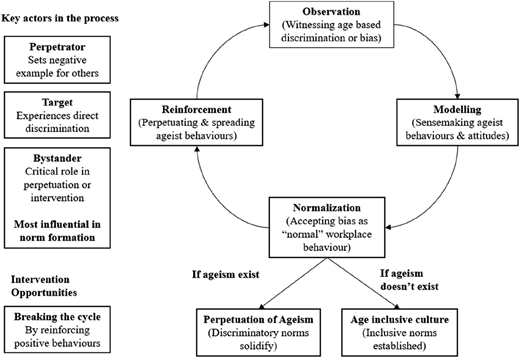
Figure 1 shows how ageism spreads in a self-reinforcing cycle through social learning in groups. The model has four main steps: witnessing age-based discrimination, modeling what you observe, rendering the bias normal and acting on it, and finally observing the conduct again and accepting it as normal. Bystanders often play a bigger role than victims or offenders when it comes to either reinforcing or challenging discriminatory norms in workplace culture. Depending on how people respond, these moments can either fuel the spread of ageism or help build a more inclusive environment for people of all ages. This framework goes beyond the typical focus on just victims and offenders by highlighting how witnesses shape what is deemed acceptable at work.

Although age-diverse workplaces are becoming more common, little is known about the effects on bystander employees of witnessing age discrimination. By investigating the psychological processes that connect observed ageism to age group allegiance, with an emphasis on the moderating influence of age diversity climate, this study seeks to close this gap. In particular, we pose the following question: (1) How does witnessing ageism influence age group allegiance among employees? (2) What is the role of negative affect in mediating this relationship? (3) How does age diversity climate moderate the impact of witnessed ageism on age group allegiance?

This study uses a narrative literature review approach to investigate how social learning fuels ageism and inform practical solutions (Green et al., 2006). A narrative literature review facilitates conceptual development and allows for objective synthesis (Onwuegbuzie and Frels, 2016).

Literature on workplace ageism and social cognitive theory was reviewed by searching databases such as Scopus, Web of Science, and Google Scholar using terms like “bystander effect,” “age discrimination,” “intergenerational conflict,” and “diversity climate” in Scopus, Web of Science, and Google Scholar, with a focus on management and psychology disciplines.

Given the relatively early stage of research in this area, studies were included regardless of methodology or publication date, provided they offered insights relevant to the proposed relationship. The following sections present key findings from this review. Using a social cognitive lens, our model clarifies how witnessed discrimination fuels age-based divides—and how organizations might disrupt this cycle.

In order to compile the body of knowledge and create a conceptual framework for investigating observed ageism in age-diverse workplaces, this study used a narrative literature review. According to Green et al. (2006) and Onwuegbuzie and Frels (2016), narrative reviews are especially well-suited for new research fields where the objective is theory development and proposition generation rather than hypothesis testing or effect size estimation. This method supported the creation of testable hypotheses for further empirical research while allowing for flexible integration across various theoretical and empirical literature, which was necessary given the paucity of direct research on observer responses to age discrimination.

We performed systematic searches in three major databases: Web of Science, Scopus, and Google Scholar. The following terms and Boolean combinations were used in the search strategy: “age discrimination,” “ageism,” “bystander effects,” “witnessed discrimination,” “social identity,” “age diversity climate,” “intergenerational workplace conflict,” “organizational age bias,” and “ageism.” Since research on witnessed ageism is still in its infancy, there were no date restrictions. Forward citation searching of seminal works and backward citation tracking from important papers were used to find additional studies.

Search terms unique to a database:

  1. Google Scholar: “age discrimination” workplace; “ageism” organizational behavior; “bystander effect” discrimination

  2. Scopus: TITLE-ABS-KEY((“age discrimination” OR “ageism”) AND (“workplace” OR “organization*”))

  3. Web of Science: TS=((“witnessed discrimination” OR “bystander*”) AND (“age*” OR “intergenerational”))

Inclusion criteria. Studies were included if they: (1) examined age-related bias, discrimination, or stereotyping in workplace contexts; (2) investigated bystander/witness responses to any form of workplace discrimination; (3) provided theoretical frameworks addressing social identity, group processes, or organizational climate relevant to age categorization; (4) were published in English in peer-reviewed outlets; (5) offered insights relevant to understanding how witnessed ageism influences observer responses.

Exclusion criteria: Studies were excluded if they: (1) focused exclusively on hiring/recruitment without ongoing workplace dynamics; (2) were conducted in non-organizational settings; (3) examined age demographics without discrimination or bias components; (4) were non-peer-reviewed sources (note: a small number of policy reports and methodological references are cited for practical contextualization but were not included in the theoretical synthesis count).

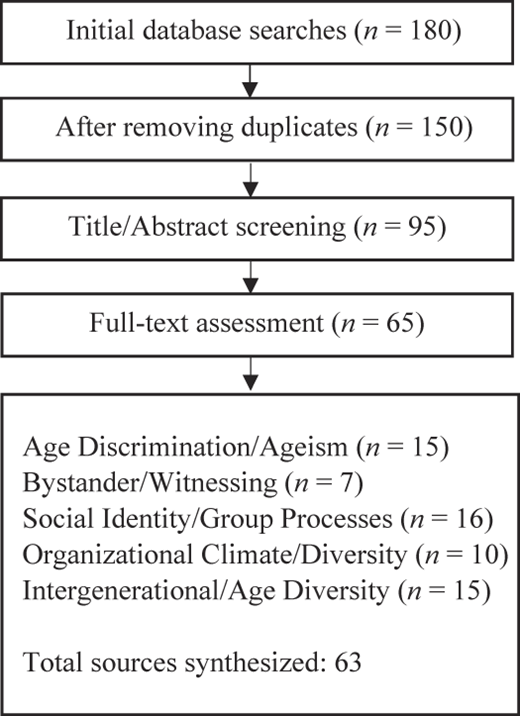
Initial database searches yielded approximately 180 sources. After removing duplicates (n = 85) and conducting title/abstract screening against inclusion criteria, 95 sources remained for full-text evaluation. 32 sources were eliminated after a thorough evaluation: 12 only addressed hiring and recruitment without considering ongoing workplace dynamics; 8 looked at age demographics without considering bias or discrimination; 6 were conducted outside of organizations; 4 were not peer-reviewed and lacked theoretical foundations; and 2 looked at general discrimination without considering age. As a result, the theoretical model is directly informed by 63 peer-reviewed studies. When choosing and classifying sources, both authors independently reviewed them; disagreements were settled and consistency was ensured through frequent discussion. Based on their main theoretical contribution, the 63 peer-reviewed studies were systematically divided into five research domains (see Appendix A for the detailed study characteristics): (1) ageism/discrimination (n = 15), (2) bystander/witnessing behavior (n = 7), (3) social identity/group processes (n = 16), (4) organizational climate/diversity (n = 10), and (5) intergenerational/age diversity (n = 15). The synthesis by domain is shown in Table 1, and the selection procedure is depicted in Figure 2.

Note: Literature categorization was conducted through iterative discussion between both authors to ensure consistency. While formal inter-rater reliability statistics were not calculated, both authors reviewed all studies and resolved any categorization disagreements through consensus.

Several factors led to the selection of the narrative review methodology: Because witnessed ageism has received little direct empirical attention, it has been necessary to integrate it across related but distinct literature; (2) our goal was to develop conceptual models with testable propositions rather than to aggregate meta-analytic findings; (3) the topic's interdisciplinary nature necessitated synthesis across the domains of social psychology, organizational psychology, and management; and (4) the field's emerging state made traditional systematic review protocols less appropriate due to heterogeneous methodologies and the need for flexible theoretical integration to identify novel mechanisms and relationships not previously explored. Furthermore, our objective was to create a theoretically integrated model that identifies an uncertainty-based psychological mechanism—the uncertainty-driven allegiance pathway—not previously identified in the literature on age discrimination, rather than to compile effect sizes or map all available evidence in a methodical manner. Instead of systematically aggregating evidence, this conceptual contribution necessitated interpretive synthesis across disparate literature. Our synthesis count of 63 peer-reviewed studies that inform the theoretical model does not include the policy reports (e.g. OECD workforce statistics) and methodological texts that we cite to contextualize practical relevance and justify our approach (n = 6).

This study integrates social information processing theory (Salancik and Pfeffer, 1978), social identity theory (Tajfel and Turner, 1979), and uncertainty-identity theory (Hogg, 2007) to examine how witnessing subtle ageism affects employees' affective responses and behavioral shifts toward same-age interactions.

According to the social information processing theory, workers rely on their surroundings, particularly when things are ambiguous (Salancik and Pfeffer, 1978). Employees use peer behavior as a primary referent when management gives them unclear signals regarding age diversity (Zohar and Luria, 2010). Peer-generated cues are more salient when organizational norms are unclear (Salancik and Pfeffer, 1978).

Social identity theory posits that individuals uphold favorable ingroup identities and delineate themselves through their associations with specific groups (Tajfel and Turner, 1979). Brewer (1999) demonstrates that ingroup favoritism primarily signifies a yearning for inclusion and belonging rather than outgroup animosity, characterizing this phenomenon as “ingroup love” in contrast to “outgroup hate.” People demonstrate ingroup alignment when age boundaries are salient, as evidenced by their preferences for collaboration and the formation of friendships. This preference is driven more by the desire for comfort and the reduction of uncertainty than by animosity towards colleagues of varying ages (Brewer, 1999). This distinction is essential for comprehending observed ageism: observers may empathize with older workers facing discrimination while concurrently seeking psychological safety from peers of the same age, thus perpetuating age-based divisions without overt bias.

Uncertainty-identity theory (Hogg, 2007) links these perspectives by positing that ambiguous contexts heighten dependence on group affiliation for cognitive clarity. Employees favor interactions with peers of similar age due to the greater predictability of social norms and reduced ambiguity in the absence of explicit frameworks for interpreting subtle ageism (Hogg and Mullin, 1999). Rather than being a deliberate exclusion, this preference is a coping mechanism.

Using the affective events theory (Weiss and Cropanzano, 1996), we combine these theories and propose that negative affect resulting from observing subtle ageism is a sign of environmental ambiguity. These emotions cause workers to gravitate toward coworkers of the same age in an effort to engage with interactions with more explicit age-based norms (Hogg, 2007). The primary mechanism that connects observed ageism to behavioral reactions is emotion.

Our model proposes that (1) witnessing subtle ageism relates to stronger age-based interaction preferences, mediated by negative affect, and (2) an uncertain age diversity climate amplifies this relationship by intensifying the affective reaction. By centering uncertainty reduction and affective mechanisms, this framework illuminates how and when observed subtle ageism spreads through emotional pathways, eliciting same-age alignment.

Because they experience more normative ambiguity and may be protected from uncertainty by age-based cohesion, we concentrate on younger employees who witness ageism against their older coworkers (Hogg and Mullin, 1999). A subtle behavioral shift toward same-age interactions that sustains age-based silos without being overtly discriminatory is what witnessing does as a contagion mechanism. Finding this complex route provides opportunities for managerial action.

In this section, we examine the proposed relationships and mechanisms linking witnessed ageism to age group allegiance, with negative affective reactions as a mediator and age diversity climate as a moderator. Witnessed ageism, defined as the observation of age-discriminatory behaviors, is posited to influence age group allegiance, which refers to the preferential treatment and support towards one's own age group. Negative affective reactions, characterized by unpleasant emotional responses to witnessed ageism, are proposed to mediate this relationship. Age diversity climate, reflecting the clarity and consistency of management's age-inclusive practices, is suggested to moderate the impact of witnessed ageism on age group allegiance through its influence on negative affective reactions.

Age group allegiance emerges through social identity processes (Tajfel and Turner, 1986; Hogg et al., 2017) and can persist even when individuals empathize with discriminated outgroups. This apparent paradox—simultaneous empathy and allegiance—reflects what Brewer (1999) identifies as the fundamental distinction between ingroup favoritism and outgroup derogation. Ingroup favoritism operates through positive attachment seeking rather than negative outgroup attitudes. Young workers may witness ageism and feel empathy yet still identify with their cohort—a phenomenon Brewer (1999) explains through the independence of ingroup attachment from outgroup evaluation. Because age group allegiance operates through belonging needs and uncertainty reduction rather than outgroup hostility, individuals can simultaneously (1) recognize discrimination as unjust, (2) feel empathy for victims, and (3) increase same-age clustering without experiencing cognitive dissonance (Brewer, 1999). This makes the contagion of ageism particularly insidious: it spreads through seemingly benign comfort-seeking rather than overt prejudice, rendering it invisible to perpetrators. Ageism manifests through behaviors, attitudes, and stereotypes that deepen workplace divides (Finkelstein et al., 2015), while perceptions of resource competition may sustain younger workers' group loyalty despite empathy (North and Fiske, 2012). Further research is needed to clarify how witnessing discrimination shapes age group allegiance in organizations. In the context of witnessed ageism, age group allegiance may manifest as younger employees increasingly gravitating towards their same-age peers for collaboration, advice-seeking, and social support. To understand how witnessed ageism contributes to age group allegiance, we examine four prominent forms of ageism—each shaping observer responses in unique ways.

Competence-Based Ageism. Competence-based ageism portrays older workers as resistant to change, slow learners, or lacking technical skills (Posthuma and Campion, 2009), leading to reduced idea sharing and increased withdrawal (Finkelstein et al., 2019; von Hippel et al., 2019). Witnessing such bias activates age as a key social category for younger employees, prompting stronger allegiance with their age group over the organization (Abrams et al., 2016; Turner et al., 1987). It reinforces perceived competence gaps and promotes sorting by age, not ability (Kooij et al., 2013; Homan et al., 2007). This strengthens age group allegiance, as individuals seek self-worth through favorable ingroup comparisons (Hornsey, 2008; Hogg, 2016).

Adaptability-Based Ageism. Age-based stereotypes portray older workers as resistant to change, technology-averse, and inflexible (Ng and Feldman, 2012), reinforcing assumptions about their inability to adapt. When younger employees witness such ageism, it strengthens age group allegiance by emphasizing generational differences in adaptability and innovation (North and Fiske, 2016; McGuire et al., 2007). These stereotypes often invoke generational narratives over individual traits (Lyons and Kuron, 2014), prompting younger workers to view workplace interactions through a generational lens (Joshi et al., 2011). Fearing similar treatment as they age, they experience identity threat and respond by aligning more closely with their age peers while distancing from older colleagues (Finkelstein et al., 2019; Weiss and Lang, 2012; Garstka et al., 2004).

Socio-Emotional Ageism. Ageism often involves socio-emotional stereotypes portraying older workers as difficult, overly sensitive, or uncooperative, emphasizing personality over ability (Posthuma and Campion, 2009). These stereotypes create perceived communication and value mismatches, prompting younger employees to favor interactions with peers. Witnessing older colleagues as unapproachable or sensitive leads to expectations of communication difficulties (McCann and Giles, 2006), while perceived value differences reinforce psychological distance (Burke et al., 2015; Lyons et al., 2012). Such stereotyping fosters exclusionary behaviors, where younger workers observe and replicate age-segregated interaction norms through social learning (Bandura, 1977).

Resource-Based Ageism. Resource-based ageism involves beliefs that older employees contribute less while consuming more organizational resources (North and Fiske, 2013). This includes assumptions that they block advancement, monopolize opportunities, and are overcompensated (North and Fiske, 2016). Witnessing such bias highlights intergenerational competition for limited resources like promotions and training, making age group membership more salient. In response, younger workers show defensive ingroup favoritism, aligning with peers to safeguard their interests and reinforcing age as a key workplace category.

According to social identity theory (Tajfel and Turner, 1986) and self-categorization theory (Turner et al., 1987), individuals develop a sense of self based on their group affiliations, particularly when group boundaries are highlighted by instances of unequal or biased treatment. These theories suggest that witnessing differential treatment based on a social category (like age) heightens that category's salience as a meaningful social distinction. This increased salience leads individuals to define themselves more strongly through their category membership and engage in social comparison that emphasizes intergroup differences. Age group allegiance results from these processes, strengthening ingroup allegiance while establishing psychological distance from outgroups (Brewer, 1999; Hogg, 2016). We suggest that observed age discrimination fosters age group allegiance through the effects of various forms of ageism on observer categorization processes, leading to our first proposition:

Proposition 1.

Witnessing ageism positively relates to age group allegiance.

Understanding how witnessed ageism triggers emotional responses and strengthens age group allegiance is essential. Social Information Processing Theory (Salancik and Pfeffer, 1978) explains that people interpret workplace events through cognitive and affective cues, with affect playing a key role in shaping intergroup behavior (Mackie et al., 2000; van den Bos, 2003). Witnessed discrimination often leads to negative emotions (Chaudoir and Quinn, 2010), which reflect psychological discomfort from norm violations (Cooper, 2007). Factors like intent ambiguity and organizational climate affect the intensity of these reactions (O'Reilly and Aquino, 2011). For younger employees, this discomfort arises in several ways: witnessing ageism creates uncertainty between organizational and age-group norms (Ashforth and Anand, 2003), threatens moral identity when the perpetrator is an ingroup member (Bandura, 1999), and fosters moral disengagement, which increases age group allegiance (Leidner et al., 2010). It also triggers status insecurity (North and Fiske, 2015), encouraging peer alignment as a coping mechanism. Uncertainty-identity theory (Hogg, 2007) supports this, suggesting that uncertainty drives stronger identification with salient social groups (Reid and Hogg, 2005). As no prior work has examined this link, we propose negative affect mediates the relationship between witnessed ageism and age group allegiance.

Proposition 2a.

The relationship between witnessed ageism and age group allegiance is mediated by negative affective reaction.

Organizational context strongly shapes how employees respond to witnessed ageism. We propose that age diversity climate—employees’ perceptions of how much leadership values age differences (Boehm et al., 2014; Kunze et al., 2011)—moderates the link between observed ageism, negative affect, and age group allegiance. When management is unclear or dismissive about age inclusivity, it creates normative ambiguity, heightening discomfort and leading employees to rely more on peer cues (Zohar, 2000; Salancik and Pfeffer, 1978). This amplifies the emotional impact of witnessed discrimination and strengthens age group allegiance (Robinson and O'Leary-Kelly, 1998). In contrast, clear signals that leaders support inclusivity help employees view ageism as deviant, prompting more constructive responses (McKay et al., 2008). Uncertainty management theory suggests unclear norms increase identity-driven coping, reinforcing age group allegiance (Hogg and Mullin, 1999). Moreover, organizational tolerance for age bias legitimizes ingroup favoritism via moral credentialing (Monin and Miller, 2001), allowing negative affect to fuel allegiance with age peers (Kouchaki, 2011). Thus, drawing on social information processing and uncertainty management theories, we argue that age diversity climate moderates how witnessed ageism influences age group allegiance through negative affect.

Proposition 2b.

Age diversity climate moderates the relationship between witnessed ageism and age group allegiance via negative affect, such that an uncertain age diversity climate strengthens the positive relationship between witnessed ageism and age group allegiance through intensified negative affective reaction.

Knowing how ageism spreads socially has become essential to resolving intergenerational conflicts amid the historic demographic changes transforming today's workplaces and the serious difficulties presented by growing age diversity. Facilitating the ability of employees to navigate age-diverse environments and sustain fruitful cross-generational relationships is a critical role of organizational behavior and human resource management. In this paper, we propose a model that investigates the effects of observing age-based discrimination on the reactions of observers. We emphasized how, rather than inspiring anti-discrimination action, observed ageism can elicit negative affective responses that paradoxically increase age group allegiance. The age diversity climate of the organization also affects this relationship and has the potential to either increase or decrease these effects. The theoretical and practical implications of our model are discussed in the sections that follow, with an emphasis on how it might help promote age-inclusive cultures and recede the spread of discriminatory norms through social observation.

This paper advances organizational discrimination research by adopting an interdisciplinary perspective and spotlighting how observed ageism influences observers through distinct psychological pathways. Even though there is a growing interest in bias at work, we don't know much about how witnessing age discrimination affects the attitudes and actions of third parties. This is problematic because it renders it more challenging to understand how bias spreads through social structures. To fill this gap, our conceptual model introduces witness-centered mechanisms that explain age-based division. It does this by using theories from social information processing, social identity, and uncertainty management. This integrated model builds on other models by looking at how discrimination spreads beyond its direct targets from cognitive, emotional, and identity-based points of view. One important theoretical advance is to think about age group allegiance in terms of Brewer's (1999) ingroup love framework instead of outgroup hostility models. This difference shows why age-based divisions still exist, even among employees who care about their coworkers who are being discriminated against: the mechanism works through belonging needs that are based on uncertainty rather than prejudice. So, traditional discrimination interventions that focus on changing hostile attitudes may not work when the underlying dynamic is based on needs for comfort and mental clarity. This novel way to conceptualize has significant implications on how to design interventions. It suggests that making elements less ambiguous by having clear organizational norms may be better than traditional ways of reducing prejudice.

The paper proposes significant advances in the theories of uncertainty-identity (Hogg, 2007) and social information processing (Salancik and Pfeffer, 1978). The latter explains how people use social cues to figure out how to respond, which supports our claim that discrimination affects how people perceive age-related norms. Clear normative expectations set by inclusive leaders are necessary for effective management of age diversity. In this theoretical path, negative affect becomes a key mediator, which is in line with uncertainty-identity theory to explain how people respond to ageism when they witness it.

Integrating these theories clarifies how observation can prompt identity-protective rather than corrective reactions. We propose that examining links between witnessed ageism, negative affect, age group allegiance, and the moderating role of age diversity climate can enhance understanding of how discrimination spreads and persists within organizations.

Organizations often overlook the influence of social dynamics on discriminatory norms by focusing solely on formal policies. According to a witness-centered view, witnesses are very important in either supporting or opposing discrimination. This shows how bias spreads through observation. The prevalence of peer-based ageism and the clarity of age diversity norms differ across workplaces. Some people don't have inclusive norms even though their peers don't show bias, while others face subtle discrimination when leadership signals are unclear. The most favorable environments have strong support for including people of all ages and minimal discrimination.

Diversity training that is focused can help with these differences. Strong organizational norms help bystander interventions work better by making it easier for people to get over their feelings (Good et al., 2012; Moisuc et al., 2018). Controlling negative emotions is crucial, as they can exacerbate anxiety, perpetuate stereotypes, and diminish interest (Chaudoir and Quinn, 2010; Weiss and Cropanzano, 1996). Role modeling and inclusive leadership, both of which are based on social learning, can help people give constructive witness responses. As the age gap widens, intergenerational relationships become increasingly vital for knowledge dissemination and collaboration. They may cause adverse outcomes if not handled well. Organizations should look at how their peers interact with each other and how diverse their workplace is to come up with focused strategies that don't rely on age-based fault lines. As the younger generation joins the workforce and Boomers stay in it, the differences between the two generations in how they expect things to be, use technology, and communicate grow. When norms are not clear, they can cause people to split up and form silos. When norms are clear, people can use them to their advantage.

Such contexts can lead to defensive age-based identities over shared organizational goals (Kunze and Boehm, 2013; North and Fiske, 2016). Addressing how witnessed ageism fuels these divides—and the mechanisms sustaining them—can reduce fragmentation and promote collaboration across age groups.

The study's findings have significant implications for achieving the Sustainable Development Goals of the UN, particularly SDGs 8 (Decent Work and Economic Growth) and 10 (Reduced Inequalities). By understanding how observed ageism perpetuates age-based divisions, organizations can better align their practices with these global commitments. The proposed framework offers helpful guidance on creating safe and equitable work environments for all employees, regardless of age. Everyone gains from this, and it helps society grow in a constructive way.

This study offers a witness-centered framework to understand and address age-based discrimination, paving the way for additional research and subsequent diversity program initiatives. Discrimination is shaped by coworker interactions and the organizational context; further research should investigate factors such as moral disengagement, observer characteristics (including moral identity and empathy), team climate, and the evolution of work structures (such as remote versus co-located environments). Our model incorporates personal factors, including negative emotions and loyalty to a particular age group, alongside organizational factors, such as a age diversity climate, that affect witness behavior. Future research might investigate the influence of hierarchy and power dynamics on responses to ageism and expand the model to include reverse ageism, especially the reactions of older employees to discrimination against younger workers. Furthermore, alternative mediators such as empathy and perceived similarity, along with moderators including job security, ethical leadership, and organizational identification, may augment the model's complexity. Finally, as the proposed set of relationship is based on Western literature, cross-cultural research is needed to capture variations in age-related norms across global contexts.

Testing the uncertainty-driven allegiance model requires specific research designs:

Experimental studies should manipulate normative clarity (clear vs. ambiguous management signals) and measure uncertainty-specific emotions (confusion, ambiguity discomfort) alongside general negative affect to isolate the uncertainty mechanism from alternative affective pathways (moral outrage, empathy, threat).

Experience sampling methods could capture real-time affective responses to witnessed discrimination in natural settings, testing whether uncertainty emotions predict subsequent same-age interaction patterns more strongly than other negative emotions.

Longitudinal field studies tracking employees across climate changes would test whether clarity interventions reduce the witnessed ageism–allegiance relationship by providing interpretive frameworks, as our model predicts.

Cross-cultural comparative studies should examine whether uncertainty-driven allegiance operates differently in high vs. low uncertainty avoidance cultures, testing boundary conditions of the proposed mechanism.

While we propose uncertainty-driven allegiance as the explanatory mechanism, we acknowledge that negative affect may reflect various appraisals: interpretive discomfort from normative ambiguity, moral unease, threat perception, or empathic distress. Our conceptual model prioritizes the uncertainty interpretation because it best explains why (1) age diversity climate moderates the relationship, and (2) affect channels toward age group allegiance rather than intervention. However, empirical validation requires distinguishing uncertainty-specific emotions from general negative affect—a measurement precision our narrative synthesis cannot provide but which experimental studies should address.

While our model focuses on younger workers witnessing ageism against older colleagues, future research could explore boundary conditions and alternative pathways. For instance, the model may operate differently when older workers witness ageism against younger colleagues. Additionally, in some cases, witnessed ageism may evoke moral outrage that leads to cross-age solidarity rather than increased age group allegiance. Examining these boundary conditions and alternative pathways would provide a more comprehensive understanding of the complex dynamics of witnessed ageism in the workplace.

Organizations and HR stakeholders need not view age diversity as an inevitable source of conflict but as an opportunity to foster inclusive environments where intergenerational collaboration can flourish. The proposed model integrates overlooked connections and connects research on discrimination—typically centered on targets and perpetrators—with wider organizational factors that influence the development of discriminatory norms. By describing how observed discrimination contributes to the establishment and maintenance of age-based divisions, we outline a practical remedy for several undesirable and preventable outcomes. Through various theories, we support the moderating role of age diversity climate and the mediating role of negative affect in understanding the social propagation of ageism. The conceptual model presented in this paper encourages further research, especially on developing successful interventions to stop the social transmission of discriminatory norms and promote workplaces that are truly inclusive of all ages. This study gives us useful information on how to deal with one of the most common but least talked about forms of workplace discrimination. Organizations all over the world are working hard to meet the UN Sustainable Development Goals, especially those that have to do with decent work and less inequality.

The supplementary material for this article can be found online.
Abrams
,
D.
,
Swift
,
H.J.
and
Drury
,
L.
(
2016
), “
Old and unemployable? How age-based stereotypes affect willingness to hire job candidates
”,
Journal of Social Issues
, Vol. 
72
No. 
1
, pp. 
105
-
121
, doi: .
Ashburn-Nardo
,
L.
,
Morris
,
K.A.
and
Goodwin
,
S.A.
(
2008
), “
The confronting prejudiced responses (CPR) model: applying CPR in organizations
”,
The Academy of Management Learning and Education
, Vol. 
7
No. 
3
, pp. 
332
-
342
, doi: .
Ashforth
,
B.E.
and
Anand
,
V.
(
2003
), “
The normalization of corruption in organizations
”,
Research in Organizational Behavior
, Vol. 
25
, pp. 
1
-
52
, doi: .
Bandura
,
A.
(
1977
),
Social Learning Theory
,
Prentice-Hall
,
Englewood Cliffs, NJ
.
Bandura
,
A.
(
1986
),
Social Foundations of Thought and Action: A Social Cognitive Theory
,
Prentice-Hall
,
Englewood Cliffs, NJ
.
Bandura
,
A.
(
1999
), “
Moral disengagement in the perpetration of inhumanities
”,
Personality and Social Psychology Review
, Vol. 
3
No. 
3
, pp. 
193
-
209
, doi: .
Boehm
,
S.A.
,
Kunze
,
F.
and
Bruch
,
H.
(
2014
), “
Spotlight on age-diversity climate: the impact of age-inclusive HR practices on firm-level outcomes
”,
Personnel Psychology
, Vol. 
67
No. 
3
, pp. 
667
-
704
, doi: .
Brewer
,
M.B.
(
1999
), “
The psychology of prejudice: ingroup love or outgroup hate?
”,
Journal of Social Issues
, Vol. 
55
No. 
3
, pp. 
429
-
444
, doi: .
Brown
,
M.E.
,
Treviño
,
L.K.
and
Harrison
,
D.A.
(
2005
), “
Ethical leadership: a social learning perspective for construct development and testing
”,
Organizational Behavior and Human Decision Processes
, Vol. 
97
No. 
2
, pp. 
117
-
134
, doi: .
Burke
,
R.J.
,
Cooper
,
C.L.
and
Antoniou
,
A.S.G.
(
2015
),
The Multi-Generational and Aging Workforce: Challenges and Opportunities
,
Edward Elgar Publishing
,
Cheltenham
.
Burmeister
,
A.
,
Fasbender
,
U.
and
Deller
,
J.
(
2018
), “
Being perceived as a knowledge sender or knowledge receiver: a multistudy investigation of the effect of age on knowledge transfer
”,
Journal of Occupational and Organizational Psychology
, Vol. 
91
No. 
3
, pp. 
518
-
545
, doi: .
Burmeister
,
A.
,
van der Heijden
,
B.
,
Yang
,
J.
and
Deller
,
J.
(
2020
), “
Knowledge transfer in age-diverse coworker dyads in China and Germany: how and when do age-inclusive human resource practices have an effect?
”,
Human Resource Management Journal
, Vol. 
30
No. 
4
, pp. 
448
-
464
, doi: .
Burmeister
,
A.
,
Wang
,
M.
and
Hirschi
,
A.
(
2021
), “
Understanding the motivational benefits of knowledge transfer for older and younger workers in age-diverse coworker dyads: an actor-partner interdependence model
”,
Journal of Applied Psychology
, Vol. 
106
No. 
1
, pp. 
88
-
105
, doi: .
Cappelli
,
P.
and
Novelli
,
B.
(
2010
),
Managing the Older Worker: How to Prepare for the New Organizational Order
,
Harvard Business Press
,
Boston, MA
.
Chaudoir
,
S.R.
and
Quinn
,
D.M.
(
2010
), “
Bystander sexism in the intergroup context: the impact of cat-calls on women's reactions towards men
”,
Sex Roles
, Vol. 
62
Nos
9-10
, pp. 
623
-
634
, doi: .
Cooper
,
J.
(
2007
),
Cognitive Dissonance: 50 Years of a Classic Theory
,
Sage
,
London
.
Cortina
,
L.M.
,
Rabelo
,
V.C.
and
Holland
,
K.J.
(
2018
), “
Beyond blaming the victim: toward a more progressive understanding of workplace mistreatment
”,
Industrial and Organizational Psychology
, Vol. 
11
No. 
1
, pp. 
81
-
100
, doi: .
Costanza
,
D.P.
,
Badger
,
J.M.
,
Fraser
,
R.L.
,
Severt
,
J.B.
and
Gade
,
P.A.
(
2012
), “
Generational differences in work-related attitudes: a meta-analysis
”,
Journal of Business and Psychology
, Vol. 
27
, doi: .
Dencker
,
J.C.
,
Joshi
,
A.
and
Martocchio
,
J.J.
(
2007
), “
Employee benefits as context for intergenerational conflict
”,
Human Resource Management Review
, Vol. 
17
No. 
2
, pp. 
208
-
220
, doi: .
Dickter
,
C.L.
,
Kittel
,
J.A.
and
Gyurovski
,
I.I.
(
2012
), “
Perceptions of non-target confronters in response to racist and heterosexist remarks
”,
European Journal of Social Psychology
, Vol. 
42
No. 
1
, pp. 
112
-
119
, doi: .
Ellwart
,
T.
,
Bündgens
,
S.
and
Rack
,
O.
(
2013
), “
Managing knowledge exchange and identification in age diverse teams
”,
Journal of Managerial Psychology
, Vol. 
28
Nos
7/8
, pp. 
950
-
972
, doi: .
Ferguson
,
M.A.
,
Branscombe
,
N.R.
and
Reynolds
,
K.J.
(
2019
), “
Social psychological research on prejudice as collective action supporting emergent ingroup members
”,
British Journal of Social Psychology
, Vol. 
58
No. 
1
, pp. 
1
-
32
, doi: .
Finkelstein
,
L.M.
,
King
,
E.B.
and
Voyles
,
E.C.
(
2015
), “
Age metastereotyping and cross-age workplace interactions: a meta view of age stereotypes at work
”,
Work, Aging and Retirement
, Vol. 
1
No. 
1
, pp. 
26
-
40
, doi: .
Finkelstein
,
L.M.
,
Truxillo
,
D.M.
,
Fraccaroli
,
F.
and
Kanfer
,
R.
(
2019
), “Age discrimination at work: a review of the research and recommendations for the future”, in
Shultz
,
K.S.
and
Adams
,
G.A.
(Eds),
Aging and Work in the 21st Century
, (2nd ed.) ,
Routledge
,
New York
, pp. 
274
-
302
.
Garstka
,
T.A.
,
Schmitt
,
M.T.
,
Branscombe
,
N.R.
and
Hummert
,
M.L.
(
2004
), “
How young and older adults differ in their responses to perceived age discrimination
”,
Psychology and Aging
, Vol. 
19
No. 
2
, pp. 
326
-
335
, doi: .
Good
,
J.J.
,
Moss-Racusin
,
C.A.
and
Sanchez
,
D.T.
(
2012
), “
When do we confront? Perceptions of costs and benefits predict confronting discrimination on behalf of the self and others
”,
Psychology of Women Quarterly
, Vol. 
36
No. 
2
, pp. 
210
-
226
, doi: .
Green
,
B.N.
,
Johnson
,
C.D.
and
Adams
,
A.
(
2006
), “
Writing narrative literature reviews for peer-reviewed journals: secrets of the trade
”,
Journal of Chiropractic Medicine
, Vol. 
5
No. 
3
, pp. 
101
-
117
, doi: .
Hogg
,
M.A.
(
2007
), “
Uncertainty-identity theory
”,
Advances in Experimental Social Psychology
, Vol. 
39
, pp. 
69
-
126
, doi: .
Hogg
,
M.A.
(
2016
), “Social identity theory”, in
McKeown
,
S.
,
Haji
,
R.
and
Ferguson
,
N.
(Eds),
Understanding Peace and Conflict through Social Identity Theory
,
Springer
,
Cham
, pp. 
3
-
17
.
Hogg
,
M.A.
and
Mullin
,
B.A.
(
1999
), “Joining groups to reduce uncertainty: subjective uncertainty reduction and group identification”, in
Abrams
,
D.
and
Hogg
,
M.A.
(Eds),
Social Identity and Social Cognition
,
Blackwell Publishing
,
Oxford
, pp. 
249
-
279
.
Hogg
,
M.A.
,
Abrams
,
D.
and
Brewer
,
M.B.
(
2017
), “
Social identity: the role of self in group processes and intergroup relations
”,
Group Processes and Intergroup Relations
, Vol. 
20
No. 
5
, pp. 
570
-
581
, doi: .
Homan
,
A.C.
,
van Knippenberg
,
D.
,
Van Kleef
,
G.A.
and
De Dreu
,
C.K.
(
2007
), “
Bridging faultlines by valuing diversity: diversity beliefs, information elaboration, and performance in diverse work groups
”,
Journal of Applied Psychology
, Vol. 
92
No. 
5
, pp. 
1189
-
1199
, doi: .
Hornsey
,
M.J.
(
2008
), “
Social identity theory and self‐categorization theory: a historical review
”,
Social and Personality Psychology Compass
, Vol. 
2
No. 
1
, pp. 
204
-
222
, doi: .
Joshi
,
A.
,
Dencker
,
J.C.
and
Franz
,
G.
(
2011
), “
Generations in organizations
”,
Research in Organizational Behavior
, Vol. 
31
, pp. 
177
-
205
, doi: .
Kooij
,
D.T.
,
Guest
,
D.E.
,
Clinton
,
M.
,
Knight
,
T.
,
Jansen
,
P.G.
and
Dikkers
,
J.S.
(
2013
), “
How the impact of HR practices on employee well‐being and performance changes with age
”,
Human Resource Management Journal
, Vol. 
23
No. 
1
, pp. 
18
-
35
, doi: .
Kouchaki
,
M.
(
2011
), “
Vicarious moral licensing: the influence of others' past moral actions on moral behavior
”,
Journal of Personality and Social Psychology
, Vol. 
101
No. 
4
, pp. 
702
-
715
, doi: .
Kunze
,
F.
and
Boehm
,
S.A.
(
2013
), “Research on age diversity in the workforce: current trends and future research directions”, in
Field
,
J.
,
Burke
,
R.J.
and
Cooper
,
C.L.
(Eds),
The SAGE Handbook of Aging, Work and Society
,
SAGE Publications
,
London
, pp. 
41
-
58
.
Kunze
,
F.
,
Boehm
,
S.
and
Bruch
,
H.
(
2011
), “
Age diversity, age discrimination, and performance consequences—a cross organizational study
”,
Journal of Organizational Behavior
, Vol. 
32
No. 
2
, pp. 
264
-
290
, doi: .
Kunze
,
F.
,
Boehm
,
S.A.
and
Bruch
,
H.
(
2013
), “
Age, resistance to change, and job performance
”,
Journal of Managerial Psychology
, Vol. 
28
Nos
7/8
, pp. 
741
-
760
, doi: .
Kunze
,
F.
,
Boehm
,
S.
and
Bruch
,
H.
(
2021
), “
Does it matter how old you feel? A missing piece for understanding intergenerational tensions
”,
Journal of Organizational Behavior
, Vol. 
42
No. 
2
, pp. 
205
-
219
.
Leidner
,
B.
,
Castano
,
E.
,
Zaiser
,
E.
and
Giner-Sorolla
,
R.
(
2010
), “
Ingroup glorification, moral disengagement, and justice in the context of collective violence
”,
Personality and Social Psychology Bulletin
, Vol. 
36
No. 
8
, pp. 
1115
-
1129
, doi: .
Lyons
,
S.
and
Kuron
,
L.
(
2014
), “
Generational differences in the workplace: a review of the evidence and directions for future research
”,
Journal of Organizational Behavior
, Vol. 
35
No. 
S1
, pp. 
S139
-
S157
, doi: .
Lyons
,
S.T.
,
Schweitzer
,
L.
,
Ng
,
E.S.
and
Kuron
,
L.K.
(
2012
), “
Comparing apples to apples: a qualitative investigation of career mobility patterns across four generations
”,
Career Development International
, Vol. 
17
No. 
4
, pp. 
333
-
357
, doi: .
Mackie
,
D.M.
,
Devos
,
T.
and
Smith
,
E.R.
(
2000
), “
Intergroup emotions: explaining offensive action tendencies in an intergroup context
”,
Journal of Personality and Social Psychology
, Vol. 
79
No. 
4
, pp. 
602
-
616
, doi: .
McCann
,
R.M.
and
Giles
,
H.
(
2006
), “
Communication with people of different ages in the workplace: Thai and American data
”,
Human Communication Research
, Vol. 
32
No. 
1
, pp. 
74
-
108
, doi: .
McGuire
,
D.
,
By
,
R.T.
and
Hutchings
,
K.
(
2007
), “
Towards a model of human resource solutions for achieving intergenerational interaction in organisations
”,
Journal of European Industrial Training
, Vol. 
31
No. 
8
, pp. 
592
-
608
, doi: .
McKay
,
P.F.
,
Avery
,
D.R.
and
Morris
,
M.A.
(
2008
), “
Mean racial‐ethnic differences in employee sales performance: the moderating role of diversity climate
”,
Personnel Psychology
, Vol. 
61
No. 
2
, pp. 
349
-
374
, doi: .
Moisuc
,
A.
,
Brauer
,
M.
,
Fonseca
,
A.
,
Chaurand
,
N.
and
Greitemeyer
,
T.
(
2018
), “
Individual differences in social control: who 'speaks up' when witnessing uncivil, discriminatory, and immoral behaviours?
”,
British Journal of Social Psychology
, Vol. 
57
No. 
3
, pp. 
524
-
546
, doi: .
Monin
,
B.
and
Miller
,
D.T.
(
2001
), “
Moral credentials and the expression of prejudice
”,
Journal of Personality and Social Psychology
, Vol. 
81
No. 
1
, pp. 
33
-
43
, doi: .
Ng
,
T.W.
and
Feldman
,
D.C.
(
2012
), “
Evaluating six common stereotypes about older workers with meta‐analytical data
”,
Personnel Psychology
, Vol. 
65
No. 
4
, pp. 
821
-
858
, doi: .
North
,
M.S.
and
Fiske
,
S.T.
(
2012
), “
An inconvenienced youth? Ageism and its potential intergenerational roots
”,
Psychological Bulletin
, Vol. 
138
No. 
5
, pp. 
982
-
997
, doi: .
North
,
M.S.
and
Fiske
,
S.T.
(
2013
), “
Act your (old) age: prescriptive, ageist biases over succession, consumption, and identity
”,
Personality and Social Psychology Bulletin
, Vol. 
39
No. 
6
, pp. 
720
-
734
, doi: .
North
,
M.S.
and
Fiske
,
S.T.
(
2015
), “
Modern attitudes toward older adults in the aging world: a cross-cultural meta-analysis
”,
Psychological Bulletin
, Vol. 
141
No. 
5
, pp. 
993
-
1021
, doi: .
North
,
M.S.
and
Fiske
,
S.T.
(
2016
), “
Resource scarcity and prescriptive attitudes generate subtle, intergenerational older‐worker exclusion
”,
Journal of Social Issues
, Vol. 
72
No. 
1
, pp. 
122
-
145
, doi: .
O'Reilly
,
J.
and
Aquino
,
K.
(
2011
), “
A model of third parties' morally motivated responses to mistreatment in organizations
”,
Academy of Management Review
, Vol. 
36
No. 
3
, pp. 
526
-
543
, doi: .
OECD
(
2017
),
Better Use of Skills in the Workplace: Why it Matters for Productivity and Local Jobs
,
OECD Publishing
,
Paris
.
OECD
(
2019
),
An OECD Learning Framework 2030
,
Springer International Publishing
,
Cham
.
OECD
(
2020
),
Promoting an Age-Inclusive Workforce: Living, Learning and Earning Longer
,
OECD Publishing
,
Paris
,
available at:
 https://www.oecd-ilibrary.org/sites/59752153-en/1/3/2/index.html
Onwuegbuzie
,
A.J.
and
Frels
,
R.
(
2016
),
Seven Steps to a Comprehensive Literature Review: A Multimodal and Cultural Approach
,
Sage Publications
,
London
.
Paluck
,
E.L.
(
2006
), “
Diversity training and intergroup contact: a call to action research
”,
Journal of Social Issues
, Vol. 
62
No. 
3
, pp. 
577
-
595
, doi: .
Posthuma
,
R.A.
and
Campion
,
M.A.
(
2009
), “
Age stereotypes in the workplace: common stereotypes, moderators, and future research directions
”,
Journal of Management
, Vol. 
35
No. 
1
, pp. 
158
-
188
, doi: .
Reid
,
S.A.
and
Hogg
,
M.A.
(
2005
), “
Uncertainty reduction, self-enhancement, and ingroup identification
”,
Personality and Social Psychology Bulletin
, Vol. 
31
No. 
6
, pp. 
804
-
817
, doi: .
Richard
,
O.C.
and
Shelor
,
R.M.
(
2002
), “
Linking top management team age heterogeneity to firm performance: juxtaposing two mid-range theories
”,
International Journal of Human Resource Management
, Vol. 
13
No. 
6
, pp. 
958
-
974
, doi: .
Roberson
,
L.
,
Kulik
,
C.T.
and
Pepper
,
M.B.
(
2003
), “
Using needs assessment to resolve controversies in diversity training design
”,
Group and Organization Management
, Vol. 
28
No. 
1
, pp. 
148
-
174
, doi: .
Robinson
,
S.L.
and
O'Leary-Kelly
,
A.M.
(
1998
), “
Monkey see, monkey do: the influence of work groups on the antisocial behavior of employees
”,
Academy of Management Journal
, Vol. 
41
No. 
6
, pp. 
658
-
672
, doi: .
Salancik
,
G.R.
and
Pfeffer
,
J.
(
1978
), “
A social information processing approach to job attitudes and task design
”,
Administrative Science Quarterly
, Vol. 
23
No. 
2
, pp. 
224
-
253
, doi: .
Tajfel
,
H.
and
Turner
,
J.C.
(
1979
), “An integrative theory of intergroup conflict”, in
Austin
,
W.G.
and
Worchel
,
S.
(Eds),
The Social Psychology of Intergroup Relations
,
Brooks/Cole
,
Monterey, CA
, pp. 
33
-
47
.
Tajfel
,
H.
and
Turner
,
J.C.
(
1986
), “The social identity theory of intergroup behavior”, in
Worchel
,
S.
and
Austin
,
W.G.
(Eds),
Psychology of Intergroup Relations
, (2nd ed.) ,
Nelson-Hall
,
Chicago
, pp. 
7
-
24
.
Turner
,
J.C.
,
Hogg
,
M.A.
,
Oakes
,
P.J.
,
Reicher
,
S.D.
and
Wetherell
,
M.S.
(
1987
),
Rediscovering the Social Group: A Self-Categorization Theory
,
Basil Blackwell
,
Oxford
.
Twenge
,
J.M.
,
Campbell
,
S.M.
,
Hoffman
,
B.J.
and
Lance
,
C.E.
(
2010
), “
Generational differences in work values: leisure and extrinsic values increasing, social and intrinsic values decreasing
”,
Journal of Management
, Vol. 
36
, doi: .
United Nations
(
2015
),
Transforming Our World: The 2030 Agenda for Sustainable Development
,
United Nations
,
New York, NY
,
available at:
 https://sdgs.un.org/2030agenda
Urick
,
M.J.
,
Hollensbe
,
E.C.
,
Masterson
,
S.S.
and
Lyons
,
S.T.
(
2017
), “
Understanding and managing intergenerational conflict: an examination of influences and strategies
”,
Work, Aging and Retirement
, Vol. 
3
No. 
2
, pp. 
166
-
185
, doi: .
van den Bos
,
K.
(
2003
), “
On the subjective quality of social justice: the role of affect as information in the psychology of justice judgments
”,
Journal of Personality and Social Psychology
, Vol. 
85
No. 
3
.
von Hippel
,
C.
,
Kalokerinos
,
E.K.
,
Haanterä
,
K.
and
Zacher
,
H.
(
2019
), “
Age-based stereotype threat and work outcomes: stress appraisals and rumination as mediators
”,
Psychology and Aging
, Vol. 
34
No. 
1
, pp. 
68
-
84
, doi: .
Weiss
,
H.M.
and
Cropanzano
,
R.
(
1996
), “
Affective events theory: a theoretical discussion of the structure, causes and consequences of affective experiences at work
”,
Research in Organizational Behavior
, Vol. 
18
, pp. 
1
-
74
.
Weiss
,
D.
and
Lang
,
F.R.
(
2012
), “
'They' are old but 'I' feel younger: age-group dissociation as a self-protective strategy in old age
”,
Psychology and Aging
, Vol. 
27
No. 
1
, pp. 
153
-
163
, doi: .
Zacher
,
H.
,
Kooij
,
D.T.
and
Beier
,
M.E.
(
2018
), “
Active aging at work: contributing factors and implications for organizations
”,
Organizational Dynamics
, Vol. 
47
No. 
1
, pp. 
37
-
45
, doi: .
Zohar
,
D.
(
2000
), “
A group-level model of safety climate: testing the effect of group climate on microaccidents in manufacturing jobs
”,
Journal of Applied Psychology
, Vol. 
85
No. 
4
, pp. 
587
-
596
, doi: .
Zohar
,
D.
and
Luria
,
G.
(
2010
), “
Group leaders as gatekeepers: testing safety climate variations across levels of analysis
”,
Applied Psychology
, doi: .
Ashforth
,
B.E.
,
Harrison
,
S.H.
and
Corley
,
K.G.
(
2008
), “
Identification in organizations: an examination of four fundamental questions
”,
Journal of Management
, Vol. 
34
No. 
3
, pp. 
325
-
374
, doi: .
Branscombe
,
N.R.
,
Ellemers
,
N.
,
Spears
,
R.
and
Doosje
,
B.
(
1999
), “The context and content of social identity threat”, in
Ellemers
,
N.
,
Spears
,
R.
and
Doosje
,
B.
(Eds),
Social Identity: Context, Commitment, Content
,
Blackwell Science
,
Oxford
, pp. 
35
-
58
.
Perry
,
E.L.
,
Golom
,
F.D.
,
Catenacci
,
L.
,
Ingraham
,
M.E.
,
Covais
,
E.M.
and
Molina
,
J.J.
(
2017
), “
Talkin’‘bout your generation: the impact of applicant age and generation on hiring-related perceptions and outcomes
”,
Work, Aging and Retirement
, Vol. 
3
No. 
2
, pp. 
186
-
199
, doi: .
Licensed re-use rights only

Supplementary data

Data & Figures

Figure 1
A model illustrates ageism through observation, modelling, normalization, and reinforcement with key actors and outcomes.The model shows multiple rectangular text boxes connected by curved and straight arrows. On the left side, a heading reads “Key actors in the process”, below which three vertically arranged text boxes appear: the top box is labeled “Perpetrator” and contains the text “Sets negative example for others”, the middle box is labeled “Target” and contains the text “Experiences direct discrimination”, and the bottom box is labeled “Bystander” and contains the text “Critical role in perpetuation or intervention” followed by the text “Most influential in norm formation”. At the bottom left, a heading reads “Intervention Opportunities”, below which a text box labeled “Breaking the cycle” contains the text “By reinforcing positive behaviours”. To the right, a circular process is depicted with four text boxes arranged in a loop: at the top, a box labeled “Observation” contains the text “(Witnessing age based discrimination or bias)” and connects by a curved clockwise direction arrow to a box on the right labeled “Modelling” containing the text “(Sensemaking ageist behaviours and attitudes)”, which connects by a curved clockwise direction arrow to a box at the bottom labeled “Normalization” containing the text “(Accepting bias as ‘normal’ workplace behaviour)”, which connects by a curved clockwise direction arrow to a box on the left labeled “Reinforcement” containing the text “(Perpetuating and spreading ageist behaviours)”, and a curved clockwise direction arrow connects “Reinforcement” back to “Observation”. Below the circular process, two diagonal arrows emerge from “Normalization”, with the left arrow labeled “If ageism exist” pointing to a box labeled “Perpetuation of Ageism” containing the text “(Discriminatory norms solidify)”, and the right arrow labeled “If ageism doesn’t exist” pointing to a box labeled “Age inclusive culture” containing the text “(Inclusive norms established)”.

Social cognitive mechanisms: How Social Learning Perpetuates Ageism, Source: Authors' own work

Figure 1
A model illustrates ageism through observation, modelling, normalization, and reinforcement with key actors and outcomes.The model shows multiple rectangular text boxes connected by curved and straight arrows. On the left side, a heading reads “Key actors in the process”, below which three vertically arranged text boxes appear: the top box is labeled “Perpetrator” and contains the text “Sets negative example for others”, the middle box is labeled “Target” and contains the text “Experiences direct discrimination”, and the bottom box is labeled “Bystander” and contains the text “Critical role in perpetuation or intervention” followed by the text “Most influential in norm formation”. At the bottom left, a heading reads “Intervention Opportunities”, below which a text box labeled “Breaking the cycle” contains the text “By reinforcing positive behaviours”. To the right, a circular process is depicted with four text boxes arranged in a loop: at the top, a box labeled “Observation” contains the text “(Witnessing age based discrimination or bias)” and connects by a curved clockwise direction arrow to a box on the right labeled “Modelling” containing the text “(Sensemaking ageist behaviours and attitudes)”, which connects by a curved clockwise direction arrow to a box at the bottom labeled “Normalization” containing the text “(Accepting bias as ‘normal’ workplace behaviour)”, which connects by a curved clockwise direction arrow to a box on the left labeled “Reinforcement” containing the text “(Perpetuating and spreading ageist behaviours)”, and a curved clockwise direction arrow connects “Reinforcement” back to “Observation”. Below the circular process, two diagonal arrows emerge from “Normalization”, with the left arrow labeled “If ageism exist” pointing to a box labeled “Perpetuation of Ageism” containing the text “(Discriminatory norms solidify)”, and the right arrow labeled “If ageism doesn’t exist” pointing to a box labeled “Age inclusive culture” containing the text “(Inclusive norms established)”.

Social cognitive mechanisms: How Social Learning Perpetuates Ageism, Source: Authors' own work

Close modal
Figure 2
A flow diagram shows the database search screening steps and final thematic sources synthesized.The flow diagram shows a vertical sequence of rectangular text boxes connected by downward arrows. The top box is labeled “Initial database searches (n equals 180)”, followed by a box labeled “After removing duplicates (n equals 150)”. Below it, a box is labeled “Title or Abstract screening (n equals 95)”, followed by a box labeled “Full-text assessment (n equals 65)”. The final large box at the bottom contains multiple lines of text reading “Age Discrimination or Ageism (n equals 15)”, “Bystander or Witnessing (n equals 7)”, “Social Identity or Group Processes (n equals 16)”, “Organizational Climate or Diversity (n equals 10)”, and “Intergenerational or Age Diversity (n equals 15)”, followed by the text “Total sources synthesized: 63”.

Literature selection process. Source: Authors' own work

Figure 2
A flow diagram shows the database search screening steps and final thematic sources synthesized.The flow diagram shows a vertical sequence of rectangular text boxes connected by downward arrows. The top box is labeled “Initial database searches (n equals 180)”, followed by a box labeled “After removing duplicates (n equals 150)”. Below it, a box is labeled “Title or Abstract screening (n equals 95)”, followed by a box labeled “Full-text assessment (n equals 65)”. The final large box at the bottom contains multiple lines of text reading “Age Discrimination or Ageism (n equals 15)”, “Bystander or Witnessing (n equals 7)”, “Social Identity or Group Processes (n equals 16)”, “Organizational Climate or Diversity (n equals 10)”, and “Intergenerational or Age Diversity (n equals 15)”, followed by the text “Total sources synthesized: 63”.

Literature selection process. Source: Authors' own work

Close modal
Table 1

Literature synthesis by research domain

Research domainStudies (n)Representative studiesPrimary constructs examinedModel contribution
Age Discrimination15North and Fiske (2012, 2015, 2016); Posthuma and Campion (2009) Finkelstein et al. (2015, 2019) Ng and Feldman (2012) Age stereotypes (competence, adaptability, socio-emotional, resource-based); discrimination experiences; stereotype threatWitnessed ageism operationalization; four-form ageism taxonomy and categorization processes
Bystander Behavior7O'Reilly and Aquino (2011) Good et al. (2012) Ashburn-Nardo et al. (2008) Moisuc et al. (2018) Chaudoir and Quinn (2010) Third-party moral reactions; confrontation costs/benefits; intervention likelihood; observer emotionsWitness-centered framework; bystander reinforcement vs. disruption mechanisms
Social Identity/Group Processes16Tajfel and Turner (1979, 1986) Hogg (2007, 2016) Brewer (1999) Bandura (1977, 1986, 1999) Turner et al. (1987) Social categorization; uncertainty-identity dynamics; ingroup identification; social learning; moral disengagementCore theory: explains witnessing-categorization link, uncertainty-identity amplification, allegiance despite empathy
Organizational Climate/Diversity10Boehm et al. (2014) Kunze et al. (2011) Salancik and Pfeffer (1978) McKay et al. (2008) Zohar (2000) Robinson and O'Leary-Kelly (1998) Age diversity climate; social information processing under ambiguity; normative cues; peer influenceModerating mechanism: normative clarity determines whether witnessing amplifies or disrupts allegiance
Intergenerational/Age Diversity15Burmeister et al. (2018, 2020, 2021) Kunze et al. (2013, 2021) Joshi et al. (2011) Lyons and Kuron (2014) Urick et al. (2017) Knowledge transfer; intergenerational conflict; team dynamics; communication patternsWorkplace context and practical implications of age-based divisions

Note(s): N = 63 peer-reviewed studies categorized by primary theoretical contribution via iterative author discussion

Source(s): Authors’ own work

Supplements

Supplementary data

References

Abrams
,
D.
,
Swift
,
H.J.
and
Drury
,
L.
(
2016
), “
Old and unemployable? How age-based stereotypes affect willingness to hire job candidates
”,
Journal of Social Issues
, Vol. 
72
No. 
1
, pp. 
105
-
121
, doi: .
Ashburn-Nardo
,
L.
,
Morris
,
K.A.
and
Goodwin
,
S.A.
(
2008
), “
The confronting prejudiced responses (CPR) model: applying CPR in organizations
”,
The Academy of Management Learning and Education
, Vol. 
7
No. 
3
, pp. 
332
-
342
, doi: .
Ashforth
,
B.E.
and
Anand
,
V.
(
2003
), “
The normalization of corruption in organizations
”,
Research in Organizational Behavior
, Vol. 
25
, pp. 
1
-
52
, doi: .
Bandura
,
A.
(
1977
),
Social Learning Theory
,
Prentice-Hall
,
Englewood Cliffs, NJ
.
Bandura
,
A.
(
1986
),
Social Foundations of Thought and Action: A Social Cognitive Theory
,
Prentice-Hall
,
Englewood Cliffs, NJ
.
Bandura
,
A.
(
1999
), “
Moral disengagement in the perpetration of inhumanities
”,
Personality and Social Psychology Review
, Vol. 
3
No. 
3
, pp. 
193
-
209
, doi: .
Boehm
,
S.A.
,
Kunze
,
F.
and
Bruch
,
H.
(
2014
), “
Spotlight on age-diversity climate: the impact of age-inclusive HR practices on firm-level outcomes
”,
Personnel Psychology
, Vol. 
67
No. 
3
, pp. 
667
-
704
, doi: .
Brewer
,
M.B.
(
1999
), “
The psychology of prejudice: ingroup love or outgroup hate?
”,
Journal of Social Issues
, Vol. 
55
No. 
3
, pp. 
429
-
444
, doi: .
Brown
,
M.E.
,
Treviño
,
L.K.
and
Harrison
,
D.A.
(
2005
), “
Ethical leadership: a social learning perspective for construct development and testing
”,
Organizational Behavior and Human Decision Processes
, Vol. 
97
No. 
2
, pp. 
117
-
134
, doi: .
Burke
,
R.J.
,
Cooper
,
C.L.
and
Antoniou
,
A.S.G.
(
2015
),
The Multi-Generational and Aging Workforce: Challenges and Opportunities
,
Edward Elgar Publishing
,
Cheltenham
.
Burmeister
,
A.
,
Fasbender
,
U.
and
Deller
,
J.
(
2018
), “
Being perceived as a knowledge sender or knowledge receiver: a multistudy investigation of the effect of age on knowledge transfer
”,
Journal of Occupational and Organizational Psychology
, Vol. 
91
No. 
3
, pp. 
518
-
545
, doi: .
Burmeister
,
A.
,
van der Heijden
,
B.
,
Yang
,
J.
and
Deller
,
J.
(
2020
), “
Knowledge transfer in age-diverse coworker dyads in China and Germany: how and when do age-inclusive human resource practices have an effect?
”,
Human Resource Management Journal
, Vol. 
30
No. 
4
, pp. 
448
-
464
, doi: .
Burmeister
,
A.
,
Wang
,
M.
and
Hirschi
,
A.
(
2021
), “
Understanding the motivational benefits of knowledge transfer for older and younger workers in age-diverse coworker dyads: an actor-partner interdependence model
”,
Journal of Applied Psychology
, Vol. 
106
No. 
1
, pp. 
88
-
105
, doi: .
Cappelli
,
P.
and
Novelli
,
B.
(
2010
),
Managing the Older Worker: How to Prepare for the New Organizational Order
,
Harvard Business Press
,
Boston, MA
.
Chaudoir
,
S.R.
and
Quinn
,
D.M.
(
2010
), “
Bystander sexism in the intergroup context: the impact of cat-calls on women's reactions towards men
”,
Sex Roles
, Vol. 
62
Nos
9-10
, pp. 
623
-
634
, doi: .
Cooper
,
J.
(
2007
),
Cognitive Dissonance: 50 Years of a Classic Theory
,
Sage
,
London
.
Cortina
,
L.M.
,
Rabelo
,
V.C.
and
Holland
,
K.J.
(
2018
), “
Beyond blaming the victim: toward a more progressive understanding of workplace mistreatment
”,
Industrial and Organizational Psychology
, Vol. 
11
No. 
1
, pp. 
81
-
100
, doi: .
Costanza
,
D.P.
,
Badger
,
J.M.
,
Fraser
,
R.L.
,
Severt
,
J.B.
and
Gade
,
P.A.
(
2012
), “
Generational differences in work-related attitudes: a meta-analysis
”,
Journal of Business and Psychology
, Vol. 
27
, doi: .
Dencker
,
J.C.
,
Joshi
,
A.
and
Martocchio
,
J.J.
(
2007
), “
Employee benefits as context for intergenerational conflict
”,
Human Resource Management Review
, Vol. 
17
No. 
2
, pp. 
208
-
220
, doi: .
Dickter
,
C.L.
,
Kittel
,
J.A.
and
Gyurovski
,
I.I.
(
2012
), “
Perceptions of non-target confronters in response to racist and heterosexist remarks
”,
European Journal of Social Psychology
, Vol. 
42
No. 
1
, pp. 
112
-
119
, doi: .
Ellwart
,
T.
,
Bündgens
,
S.
and
Rack
,
O.
(
2013
), “
Managing knowledge exchange and identification in age diverse teams
”,
Journal of Managerial Psychology
, Vol. 
28
Nos
7/8
, pp. 
950
-
972
, doi: .
Ferguson
,
M.A.
,
Branscombe
,
N.R.
and
Reynolds
,
K.J.
(
2019
), “
Social psychological research on prejudice as collective action supporting emergent ingroup members
”,
British Journal of Social Psychology
, Vol. 
58
No. 
1
, pp. 
1
-
32
, doi: .
Finkelstein
,
L.M.
,
King
,
E.B.
and
Voyles
,
E.C.
(
2015
), “
Age metastereotyping and cross-age workplace interactions: a meta view of age stereotypes at work
”,
Work, Aging and Retirement
, Vol. 
1
No. 
1
, pp. 
26
-
40
, doi: .
Finkelstein
,
L.M.
,
Truxillo
,
D.M.
,
Fraccaroli
,
F.
and
Kanfer
,
R.
(
2019
), “Age discrimination at work: a review of the research and recommendations for the future”, in
Shultz
,
K.S.
and
Adams
,
G.A.
(Eds),
Aging and Work in the 21st Century
, (2nd ed.) ,
Routledge
,
New York
, pp. 
274
-
302
.
Garstka
,
T.A.
,
Schmitt
,
M.T.
,
Branscombe
,
N.R.
and
Hummert
,
M.L.
(
2004
), “
How young and older adults differ in their responses to perceived age discrimination
”,
Psychology and Aging
, Vol. 
19
No. 
2
, pp. 
326
-
335
, doi: .
Good
,
J.J.
,
Moss-Racusin
,
C.A.
and
Sanchez
,
D.T.
(
2012
), “
When do we confront? Perceptions of costs and benefits predict confronting discrimination on behalf of the self and others
”,
Psychology of Women Quarterly
, Vol. 
36
No. 
2
, pp. 
210
-
226
, doi: .
Green
,
B.N.
,
Johnson
,
C.D.
and
Adams
,
A.
(
2006
), “
Writing narrative literature reviews for peer-reviewed journals: secrets of the trade
”,
Journal of Chiropractic Medicine
, Vol. 
5
No. 
3
, pp. 
101
-
117
, doi: .
Hogg
,
M.A.
(
2007
), “
Uncertainty-identity theory
”,
Advances in Experimental Social Psychology
, Vol. 
39
, pp. 
69
-
126
, doi: .
Hogg
,
M.A.
(
2016
), “Social identity theory”, in
McKeown
,
S.
,
Haji
,
R.
and
Ferguson
,
N.
(Eds),
Understanding Peace and Conflict through Social Identity Theory
,
Springer
,
Cham
, pp. 
3
-
17
.
Hogg
,
M.A.
and
Mullin
,
B.A.
(
1999
), “Joining groups to reduce uncertainty: subjective uncertainty reduction and group identification”, in
Abrams
,
D.
and
Hogg
,
M.A.
(Eds),
Social Identity and Social Cognition
,
Blackwell Publishing
,
Oxford
, pp. 
249
-
279
.
Hogg
,
M.A.
,
Abrams
,
D.
and
Brewer
,
M.B.
(
2017
), “
Social identity: the role of self in group processes and intergroup relations
”,
Group Processes and Intergroup Relations
, Vol. 
20
No. 
5
, pp. 
570
-
581
, doi: .
Homan
,
A.C.
,
van Knippenberg
,
D.
,
Van Kleef
,
G.A.
and
De Dreu
,
C.K.
(
2007
), “
Bridging faultlines by valuing diversity: diversity beliefs, information elaboration, and performance in diverse work groups
”,
Journal of Applied Psychology
, Vol. 
92
No. 
5
, pp. 
1189
-
1199
, doi: .
Hornsey
,
M.J.
(
2008
), “
Social identity theory and self‐categorization theory: a historical review
”,
Social and Personality Psychology Compass
, Vol. 
2
No. 
1
, pp. 
204
-
222
, doi: .
Joshi
,
A.
,
Dencker
,
J.C.
and
Franz
,
G.
(
2011
), “
Generations in organizations
”,
Research in Organizational Behavior
, Vol. 
31
, pp. 
177
-
205
, doi: .
Kooij
,
D.T.
,
Guest
,
D.E.
,
Clinton
,
M.
,
Knight
,
T.
,
Jansen
,
P.G.
and
Dikkers
,
J.S.
(
2013
), “
How the impact of HR practices on employee well‐being and performance changes with age
”,
Human Resource Management Journal
, Vol. 
23
No. 
1
, pp. 
18
-
35
, doi: .
Kouchaki
,
M.
(
2011
), “
Vicarious moral licensing: the influence of others' past moral actions on moral behavior
”,
Journal of Personality and Social Psychology
, Vol. 
101
No. 
4
, pp. 
702
-
715
, doi: .
Kunze
,
F.
and
Boehm
,
S.A.
(
2013
), “Research on age diversity in the workforce: current trends and future research directions”, in
Field
,
J.
,
Burke
,
R.J.
and
Cooper
,
C.L.
(Eds),
The SAGE Handbook of Aging, Work and Society
,
SAGE Publications
,
London
, pp. 
41
-
58
.
Kunze
,
F.
,
Boehm
,
S.
and
Bruch
,
H.
(
2011
), “
Age diversity, age discrimination, and performance consequences—a cross organizational study
”,
Journal of Organizational Behavior
, Vol. 
32
No. 
2
, pp. 
264
-
290
, doi: .
Kunze
,
F.
,
Boehm
,
S.A.
and
Bruch
,
H.
(
2013
), “
Age, resistance to change, and job performance
”,
Journal of Managerial Psychology
, Vol. 
28
Nos
7/8
, pp. 
741
-
760
, doi: .
Kunze
,
F.
,
Boehm
,
S.
and
Bruch
,
H.
(
2021
), “
Does it matter how old you feel? A missing piece for understanding intergenerational tensions
”,
Journal of Organizational Behavior
, Vol. 
42
No. 
2
, pp. 
205
-
219
.
Leidner
,
B.
,
Castano
,
E.
,
Zaiser
,
E.
and
Giner-Sorolla
,
R.
(
2010
), “
Ingroup glorification, moral disengagement, and justice in the context of collective violence
”,
Personality and Social Psychology Bulletin
, Vol. 
36
No. 
8
, pp. 
1115
-
1129
, doi: .
Lyons
,
S.
and
Kuron
,
L.
(
2014
), “
Generational differences in the workplace: a review of the evidence and directions for future research
”,
Journal of Organizational Behavior
, Vol. 
35
No. 
S1
, pp. 
S139
-
S157
, doi: .
Lyons
,
S.T.
,
Schweitzer
,
L.
,
Ng
,
E.S.
and
Kuron
,
L.K.
(
2012
), “
Comparing apples to apples: a qualitative investigation of career mobility patterns across four generations
”,
Career Development International
, Vol. 
17
No. 
4
, pp. 
333
-
357
, doi: .
Mackie
,
D.M.
,
Devos
,
T.
and
Smith
,
E.R.
(
2000
), “
Intergroup emotions: explaining offensive action tendencies in an intergroup context
”,
Journal of Personality and Social Psychology
, Vol. 
79
No. 
4
, pp. 
602
-
616
, doi: .
McCann
,
R.M.
and
Giles
,
H.
(
2006
), “
Communication with people of different ages in the workplace: Thai and American data
”,
Human Communication Research
, Vol. 
32
No. 
1
, pp. 
74
-
108
, doi: .
McGuire
,
D.
,
By
,
R.T.
and
Hutchings
,
K.
(
2007
), “
Towards a model of human resource solutions for achieving intergenerational interaction in organisations
”,
Journal of European Industrial Training
, Vol. 
31
No. 
8
, pp. 
592
-
608
, doi: .
McKay
,
P.F.
,
Avery
,
D.R.
and
Morris
,
M.A.
(
2008
), “
Mean racial‐ethnic differences in employee sales performance: the moderating role of diversity climate
”,
Personnel Psychology
, Vol. 
61
No. 
2
, pp. 
349
-
374
, doi: .
Moisuc
,
A.
,
Brauer
,
M.
,
Fonseca
,
A.
,
Chaurand
,
N.
and
Greitemeyer
,
T.
(
2018
), “
Individual differences in social control: who 'speaks up' when witnessing uncivil, discriminatory, and immoral behaviours?
”,
British Journal of Social Psychology
, Vol. 
57
No. 
3
, pp. 
524
-
546
, doi: .
Monin
,
B.
and
Miller
,
D.T.
(
2001
), “
Moral credentials and the expression of prejudice
”,
Journal of Personality and Social Psychology
, Vol. 
81
No. 
1
, pp. 
33
-
43
, doi: .
Ng
,
T.W.
and
Feldman
,
D.C.
(
2012
), “
Evaluating six common stereotypes about older workers with meta‐analytical data
”,
Personnel Psychology
, Vol. 
65
No. 
4
, pp. 
821
-
858
, doi: .
North
,
M.S.
and
Fiske
,
S.T.
(
2012
), “
An inconvenienced youth? Ageism and its potential intergenerational roots
”,
Psychological Bulletin
, Vol. 
138
No. 
5
, pp. 
982
-
997
, doi: .
North
,
M.S.
and
Fiske
,
S.T.
(
2013
), “
Act your (old) age: prescriptive, ageist biases over succession, consumption, and identity
”,
Personality and Social Psychology Bulletin
, Vol. 
39
No. 
6
, pp. 
720
-
734
, doi: .
North
,
M.S.
and
Fiske
,
S.T.
(
2015
), “
Modern attitudes toward older adults in the aging world: a cross-cultural meta-analysis
”,
Psychological Bulletin
, Vol. 
141
No. 
5
, pp. 
993
-
1021
, doi: .
North
,
M.S.
and
Fiske
,
S.T.
(
2016
), “
Resource scarcity and prescriptive attitudes generate subtle, intergenerational older‐worker exclusion
”,
Journal of Social Issues
, Vol. 
72
No. 
1
, pp. 
122
-
145
, doi: .
O'Reilly
,
J.
and
Aquino
,
K.
(
2011
), “
A model of third parties' morally motivated responses to mistreatment in organizations
”,
Academy of Management Review
, Vol. 
36
No. 
3
, pp. 
526
-
543
, doi: .
OECD
(
2017
),
Better Use of Skills in the Workplace: Why it Matters for Productivity and Local Jobs
,
OECD Publishing
,
Paris
.
OECD
(
2019
),
An OECD Learning Framework 2030
,
Springer International Publishing
,
Cham
.
OECD
(
2020
),
Promoting an Age-Inclusive Workforce: Living, Learning and Earning Longer
,
OECD Publishing
,
Paris
,
available at:
 https://www.oecd-ilibrary.org/sites/59752153-en/1/3/2/index.html
Onwuegbuzie
,
A.J.
and
Frels
,
R.
(
2016
),
Seven Steps to a Comprehensive Literature Review: A Multimodal and Cultural Approach
,
Sage Publications
,
London
.
Paluck
,
E.L.
(
2006
), “
Diversity training and intergroup contact: a call to action research
”,
Journal of Social Issues
, Vol. 
62
No. 
3
, pp. 
577
-
595
, doi: .
Posthuma
,
R.A.
and
Campion
,
M.A.
(
2009
), “
Age stereotypes in the workplace: common stereotypes, moderators, and future research directions
”,
Journal of Management
, Vol. 
35
No. 
1
, pp. 
158
-
188
, doi: .
Reid
,
S.A.
and
Hogg
,
M.A.
(
2005
), “
Uncertainty reduction, self-enhancement, and ingroup identification
”,
Personality and Social Psychology Bulletin
, Vol. 
31
No. 
6
, pp. 
804
-
817
, doi: .
Richard
,
O.C.
and
Shelor
,
R.M.
(
2002
), “
Linking top management team age heterogeneity to firm performance: juxtaposing two mid-range theories
”,
International Journal of Human Resource Management
, Vol. 
13
No. 
6
, pp. 
958
-
974
, doi: .
Roberson
,
L.
,
Kulik
,
C.T.
and
Pepper
,
M.B.
(
2003
), “
Using needs assessment to resolve controversies in diversity training design
”,
Group and Organization Management
, Vol. 
28
No. 
1
, pp. 
148
-
174
, doi: .
Robinson
,
S.L.
and
O'Leary-Kelly
,
A.M.
(
1998
), “
Monkey see, monkey do: the influence of work groups on the antisocial behavior of employees
”,
Academy of Management Journal
, Vol. 
41
No. 
6
, pp. 
658
-
672
, doi: .
Salancik
,
G.R.
and
Pfeffer
,
J.
(
1978
), “
A social information processing approach to job attitudes and task design
”,
Administrative Science Quarterly
, Vol. 
23
No. 
2
, pp. 
224
-
253
, doi: .
Tajfel
,
H.
and
Turner
,
J.C.
(
1979
), “An integrative theory of intergroup conflict”, in
Austin
,
W.G.
and
Worchel
,
S.
(Eds),
The Social Psychology of Intergroup Relations
,
Brooks/Cole
,
Monterey, CA
, pp. 
33
-
47
.
Tajfel
,
H.
and
Turner
,
J.C.
(
1986
), “The social identity theory of intergroup behavior”, in
Worchel
,
S.
and
Austin
,
W.G.
(Eds),
Psychology of Intergroup Relations
, (2nd ed.) ,
Nelson-Hall
,
Chicago
, pp. 
7
-
24
.
Turner
,
J.C.
,
Hogg
,
M.A.
,
Oakes
,
P.J.
,
Reicher
,
S.D.
and
Wetherell
,
M.S.
(
1987
),
Rediscovering the Social Group: A Self-Categorization Theory
,
Basil Blackwell
,
Oxford
.
Twenge
,
J.M.
,
Campbell
,
S.M.
,
Hoffman
,
B.J.
and
Lance
,
C.E.
(
2010
), “
Generational differences in work values: leisure and extrinsic values increasing, social and intrinsic values decreasing
”,
Journal of Management
, Vol. 
36
, doi: .
United Nations
(
2015
),
Transforming Our World: The 2030 Agenda for Sustainable Development
,
United Nations
,
New York, NY
,
available at:
 https://sdgs.un.org/2030agenda
Urick
,
M.J.
,
Hollensbe
,
E.C.
,
Masterson
,
S.S.
and
Lyons
,
S.T.
(
2017
), “
Understanding and managing intergenerational conflict: an examination of influences and strategies
”,
Work, Aging and Retirement
, Vol. 
3
No. 
2
, pp. 
166
-
185
, doi: .
van den Bos
,
K.
(
2003
), “
On the subjective quality of social justice: the role of affect as information in the psychology of justice judgments
”,
Journal of Personality and Social Psychology
, Vol. 
85
No. 
3
.
von Hippel
,
C.
,
Kalokerinos
,
E.K.
,
Haanterä
,
K.
and
Zacher
,
H.
(
2019
), “
Age-based stereotype threat and work outcomes: stress appraisals and rumination as mediators
”,
Psychology and Aging
, Vol. 
34
No. 
1
, pp. 
68
-
84
, doi: .
Weiss
,
H.M.
and
Cropanzano
,
R.
(
1996
), “
Affective events theory: a theoretical discussion of the structure, causes and consequences of affective experiences at work
”,
Research in Organizational Behavior
, Vol. 
18
, pp. 
1
-
74
.
Weiss
,
D.
and
Lang
,
F.R.
(
2012
), “
'They' are old but 'I' feel younger: age-group dissociation as a self-protective strategy in old age
”,
Psychology and Aging
, Vol. 
27
No. 
1
, pp. 
153
-
163
, doi: .
Zacher
,
H.
,
Kooij
,
D.T.
and
Beier
,
M.E.
(
2018
), “
Active aging at work: contributing factors and implications for organizations
”,
Organizational Dynamics
, Vol. 
47
No. 
1
, pp. 
37
-
45
, doi: .
Zohar
,
D.
(
2000
), “
A group-level model of safety climate: testing the effect of group climate on microaccidents in manufacturing jobs
”,
Journal of Applied Psychology
, Vol. 
85
No. 
4
, pp. 
587
-
596
, doi: .
Zohar
,
D.
and
Luria
,
G.
(
2010
), “
Group leaders as gatekeepers: testing safety climate variations across levels of analysis
”,
Applied Psychology
, doi: .
Ashforth
,
B.E.
,
Harrison
,
S.H.
and
Corley
,
K.G.
(
2008
), “
Identification in organizations: an examination of four fundamental questions
”,
Journal of Management
, Vol. 
34
No. 
3
, pp. 
325
-
374
, doi: .
Branscombe
,
N.R.
,
Ellemers
,
N.
,
Spears
,
R.
and
Doosje
,
B.
(
1999
), “The context and content of social identity threat”, in
Ellemers
,
N.
,
Spears
,
R.
and
Doosje
,
B.
(Eds),
Social Identity: Context, Commitment, Content
,
Blackwell Science
,
Oxford
, pp. 
35
-
58
.
Perry
,
E.L.
,
Golom
,
F.D.
,
Catenacci
,
L.
,
Ingraham
,
M.E.
,
Covais
,
E.M.
and
Molina
,
J.J.
(
2017
), “
Talkin’‘bout your generation: the impact of applicant age and generation on hiring-related perceptions and outcomes
”,
Work, Aging and Retirement
, Vol. 
3
No. 
2
, pp. 
186
-
199
, doi: .

Languages

or Create an Account

Close Modal
Close Modal