


This article presents a scoping review addressing two key questions: What do management and organisational studies reveal about barriers and strategies for intersectional gender equality in universities and research organisations? And how can we organise to sustain such change? It aims to identify knowledge gaps and propose a framework for sustainable transformation.
The review follows a structured scoping approach, guided by four criteria: (1) the discipline, Management and Organisation Studies; (2) the context, such as universities and other research organisations; (3) the topic, intersectional gender equality and (4) knowledge about organisational change. From 189 articles sourced since 2017, 95 were analysed for theoretical and empirical insights.
Neoliberalism emerges as a systemic barrier, where competition and market-driven meritocracy promote homogeneity. To address this, we propose the concept of Communities of Change – a framework grounded in feminist principles such as solidarity, reciprocity, care, belonging and anti-racist and decolonial perspectives. These communities foster diverse members to drive interventions and share the socio-political responsibilities of equality work.
The study is limited to English-language articles from 2017 onward, potentially excluding earlier or non-English written perspectives.
The Communities of Change are a strategy for policymakers, administrators and practitioners to sustain organisational change for equality inside organisations through collective action based on shared values.
This study supports efforts to foster intersectional gender equality by integrating feminist and anti-racist values, collective action and decolonial frameworks.
Communities of Change offer an innovative, integrative approach to advancing sustainable intersectional gender equality in organisations affected strongly by neoliberal practices.
The struggle for intersectional gender equality
We are currently in the sixth decade of efforts by academics and practitioners to address gender inequalities in universities and research organisations. Since the 1970s, numerous approaches, perspectives and terms (such as emancipation, affirmative action, equal opportunity policies, gender equality plans (GEPs) and diversity management) have been introduced in organisations to spur this change (Clarke et al., 2024; O’Connor, 2020). The scope has expanded to include gender in intersection with race, ethnicity, class, sexuality, dis/ability and other categories of difference, although integrative approaches to transform universities into gender-equitable, anti-racist, decolonial, anti-ableist and LGBTQI+-friendly inclusive workplaces remain scarce. There is a growing body of research dedicated to the challenges related to sustaining change and integrating equality goals into the strategic agendas of organisations. However, inequality regimes remain persistently entrenched (Acker, 2006). Progress is slow at best, the effects of interventions are limited, and results are inconclusive (Clarke et al., 2024; O’Connor, 2020). Therefore, we require knowledge on how to improve organising for equality, which entails ensuring equal visibility, power and participation for all in universities and research organisations (Benschop and Verloo, 2006). While a few related literature reviews on policies and measures exist (Mour, 2022; Zimmermann et al., 2023), so far, none synthesise how to create and sustain change for intersectional gender equality. This research addresses this gap by carrying out a scoping review that identifies current ways of knowledge production, analyses the knowledge landscape and examines how to sustain and deepen change. The two central research questions are: What does the current knowledge landscape in management and organisational studies reveal about barriers and strategies for achieving intersectional gender equality within universities and research organisations? and How do we need to organise ourselves to produce and sustain intersectional gender equality in these settings?
The results of the literature review allowed us to develop the contours of a theory of change for intersectional equality in universities and research organisations. We draw inspiration from feminist organisation theories to conceptualise intersectional equality as an aspirational ideal for organisations willing to address multiple dimensions of inequality and issues of power and combine reflection and action in their equality work through community building and capability development (Woods et al., 2022). The call for intersectional equality is supported by the European Union policy framework that requires organisations in this sector to work on inclusive gender equality (IGE), which considers discrimination based on the intersections between gender and other social characteristics like ethnicity, disability, class and sexual orientation (European Commission, 2023). In this context, one pressing issue is the way to do justice to the complexity of intersecting inequalities without privileging gender over other social categories and dealing with complex patterns of privilege and marginalisation.
Management and organisation studies and intersectional gender equality
This scoping review involves four levels of knowledge. First, the field or discipline, Management and Organization Studies (MOS), which analyses people in organisational structures, their practices and processes and how these elements create social relations and organisational culture. As organisations have fluid and flexible external and internal boundaries, MOS also analyses the relationship between organisations and their socio-political context and relationships among organisations (Schneider and Somers, 2006). The second level is the context, universities and research organisations. In this context, exclusion and discrimination have particular forms based on narrow perspectives of meritocracy and scientific excellence (Clarke et al., 2024; O’Connor and White, 2021) and the assumption of neutrality and universality of knowledge production (Ramirez, 2021).
The next two levels refer to conceptual levels, intersectional gender equality and the specific knowledge domain of organisational change (see Figure 1). Gender equality in universities and research organisations relates to three core areas: gender equality in scientific careers (presence); gender balance in decision-making (voice) and integration of gender dimension into the content of research and innovation (process) (Palmén and Müller, 2022). Intersectional gender equality expands the focus on gender equality by promoting an approach that carefully considers the intersections of gender with other social characteristics, such as ethnicity, disability, class, age and sexual orientation.
 A figure shows a nested model with four concentric circles. Each circle represents a different level of research for a scoping review. The first circle at the top is labeled “Management and Organisational Studies.” Moving inward, the second circle is labeled “Universities and research organisations.” The third circle is labeled “(Intersectional) Gender Equality.” The fourth circle, present inside, is labeled “Organisational change.”
Research levels for the scoping review. Source: Authors’ own work
A figure shows a nested model with four concentric circles. Each circle represents a different level of research for a scoping review. The first circle at the top is labeled “Management and Organisational Studies.” Moving inward, the second circle is labeled “Universities and research organisations.” The third circle is labeled “(Intersectional) Gender Equality.” The fourth circle, present inside, is labeled “Organisational change.”Research levels for the scoping review. Source: Authors’ own work
Change for intersectional gender equality in universities and research organisations should encompass three dimensions: representation, institutions and knowledge (Schiebinger and Schraudner, 2011). According to Schiebinger and Schraudner (2011), representation implies “fixing the numbers”, by increasing the number of people from marginalised groups; institutions refer to “fixing structures” by removing practices, policies and cultural norms that perpetuate gender inequality and integrating gender equality into the very architecture of organisational processes. Finally, issues of knowledge production denote recognising that science is not value-neutral and demanding the inclusion of a gender dimension in research design, for instance, by specifying whether and in what sense, issues of intersectionality and gender are relevant to the goals and methodologies of the research.
The four levels of knowledge (see Figure 1) serve as the framework for structuring the literature review, helping to identify relevant keywords and search terms. Moreover, adherence to these levels acts as inclusion criteria; therefore, any document under consideration must address all the levels to be included in the research. However, since intersectional gender equality is not a widely recognised term, we include articles on change for gender equality, even if they do not explicitly frame it as intersectional.
Search and selection strategy
This research is limited to scientific articles and uses four databases with strict processes of quality control: Web of Science, APA PsycInfo (OVID platform), Business Source Complete (EBSCO host) and Women Studies International (EBSCO host). The keywords used were based on the four levels of knowledge previously identified. Keyword combinations, proximity operators and other details of the searches were slightly adapted according to the database, but the main keywords were the same for all the databases (Table 1).
Keywords and search terms
| Level | Keywords |
|---|---|
| Discipline | organisation* or organization* |
| Phenomena | (gender* or sex) and (equality or inequality or parity or imparity or gap or role* or attitude* or issue* or segregation or behavio* or assumption* or neutral or privilege* or stereotype* or bias* or discriminat* or inclusiv* or exclusiv* or intersectionalit* or IGE or “inequality regime*” or “egalitarian goal*” or “equitable distribution*” or “diversity program*” or “pay equit*”) |
| Context | (Research or innovation) and (organization* or organisation* or institute* or center* or centre* or academy or academies or academia or universit* or science*) |
| Topic | (chang* or challeng* or barrier* or resistan* or limitation* or facilitat* or transition* or structur* or transform*) |
The two authors then selected articles independently and compared their results afterward. As the selection criteria were clear, there were very few disagreements between the authors, which were then resolved rigorously using the selection criteria. The results included 189 documents from 2017 onwards. This period gave us a general landscape of the scientific knowledge available and a feasible and representative sample of articles. From the final sample, 95 articles were selected for critical analysis due to their theoretical or empirical contribution to knowledge about change for (intersectional) gender equality. All the articles were initially coded according to the year of publication, the country of knowledge production or study location, identified barriers to change, proposed solutions for change and key concepts or main contributions to change.
The country of knowledge production or study location refers to the place in which the case study/research was located or, when it is not specified, where the authors are affiliated. From a decolonial perspective, we assume that knowledge is always produced in a specific context, and this has ontological and epistemological implications. The sample included articles produced in a total of 43 countries worldwide, with most of the articles produced in European countries and the United States, but also articles from Asia, Oceania, Africa, Latin America and the Middle East. Table 2 summarises the identification and selection process via databases and registers.
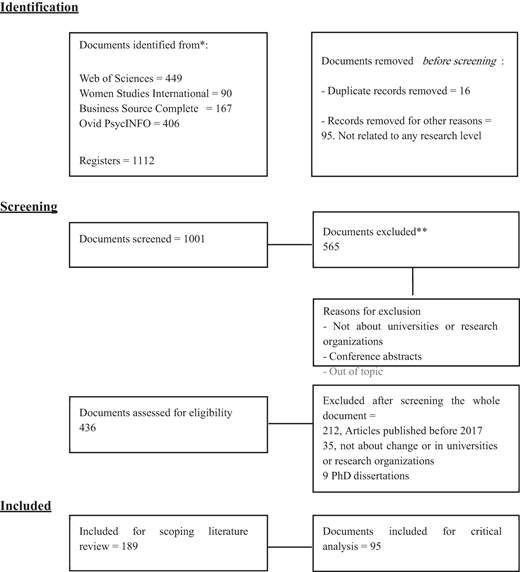
Mapping barriers to change
Neoliberal system
The neoliberal university system as a main barrier to change was mentioned in 27 articles from different geographical locations. The main argument is that market principles and discourses of individualisation promoted by neoliberal structures render asymmetric gender relations invisible and privilege masculine epistemologies (Crimmins, 2022). A neoliberal university system hides exclusion and discrimination in specific discourses, specifically in concepts such as excellence and meritocracy and explicitly presents the current status quo as suitable, rational and justifiable, hindering attempts to promote gender equality (Booi et al., 2017; O’Connor and White, 2021). A study in Iceland argues that private-sector managerial techniques in academia reinforce structural gender inequality (Steinþórsdóttir et al., 2017). Framed as “excellence” under a supposedly objective standard of merit, these techniques rely exclusively on quantitative metrics – such as publication rates, journal rankings, citation indexes and funding success – that tend to favour male-dominated fields (Steinþórsdóttir et al., 2017). In a study on STEM faculties across four European universities (Bulgaria, Denmark, Ireland and Turkey), O’Hagan et al. (2019) identified practices that academics use to build academic capital, concluding that individualism is key to internalising academic capitalism. In conclusion, these studies demonstrate that neoliberal environments encourage individualism, competition and homogeneity. In this context, diversity is rendered superficially “tolerable” within a meritocratic framework.
Racism, misogyny and discrimination
Other major barriers to change are racism, misogyny and discrimination. A study in the United States, the United Kingdom and South Africa based on experiences of women of colour shows that barriers to recruitment and retention of women of colour in research and innovation organisations include lack of belonging, marginalisation, social exclusion and tokenism (Settles et al., 2022). Women of colour experience microaggression in the tenure process, prejudice stemming from affirmative action and higher levels of scrutiny than their colleagues (Heaggans and Frierson, 2019). For instance, their capabilities, achievements and career progression get questioned very often. These exclusion practices have often become subtle and invisible; microaggressions and microinvalidations are frequent (Carroll, 2017) and difficult to perceive, and yet they create de-professionalisation and dehumanisation, resulting in racial battle fatigue, feelings of isolation and disillusionment towards academia (Rollock, 2021). In general, these subtle practices of exclusion and discrimination create a negative climate for women of colour, pushing them to leave academic institutions. Studies also show that women of colour and other racialised workers often engage in identity work to minimise their “difference” (Thomson, 2020), conform to norms and accept their prescribed roles to be granted opportunities for career advancement.
Crenshaw (1991) identified three dimensions of exclusion of women of colour: structural, political and representational intersectionality. At the structural level, exclusion refers not only to career development but also to epistemic exclusion. Epistemic exclusion refers to the devaluation of certain scholars and their work, particularly when their research topics, methodologies or perspectives deviate from mainstream disciplinary norms (Settles et al., 2022). Such devaluation can lead to these scholars being perceived as less legitimate or credible within academic settings. According to Settles et al. (2022), epistemic exclusion occurs first through formal hierarchies that regulate how knowledge is valued and which metrics assess quality and, second, through informal processes that further signal to women of colour that they and their knowledge are irrelevant. The political dimension of intersectionality refers to access to leadership and decision-making and the representational dimension refers to the diversity of the staff (Haynes et al., 2020). Addressing the political and representational dimensions without addressing the structural ones hinders change. Epistemic exclusion, hence, is the way to maintain the status quo in the sector.
Care is considered as a burden
Some studies show that neoliberal discourses and practices affect issues of parenting in academia (Amsler and Motta, 2019; Ashencaen Crabtree and Shiel, 2019; França et al., 2023; Villar-Aguiles and Obiol-Frances, 2022). Family formation and child-rearing often lead to women experiencing truncated, fragmented or non-linear career trajectories, which significantly impede their career progression within academic contexts (Maxwell et al., 2019; Ní Laoire et al., 2021). Hence, Amsler and Motta (2019) explain that the discussion about parenthood (namely, motherhood) in academia constructs care as a professional deficit and overlooks the complexities of life. A study in Ireland shows that maternity leave is seen as “burden” for some organisations and constitutes an institutional practice that actively shapes and reinforces gender dynamics within academic organisations (Maxwell et al., 2019). Another study in Portugal shows that during the COVID-19 crisis, parents in universities had to deal with the institutional pressure to uphold their working routines despite having their children at home (França et al., 2023). In conclusion, neoliberal values in universities intrinsically discriminate against women (as potential mothers and caregivers) and any person who either requires or provides care (Amsler and Motta, 2019; Ashencaen Crabtree and Shiel, 2019; França et al., 2023; Villar-Aguiles and Obiol-Frances, 2022).
Hierarchical values attached to different activities in academia
Some studies point out the difference between teaching, management, services and research activities, showing women often undertake a larger share of administrative and teaching responsibilities, yet receive fewer opportunities for promotion (Ashencaen Crabtree and Shiel, 2019; Haas, 2017; Van Den Brink and Benschop, 2014). A study in German-speaking countries explained that this issue is connected to gendered roles where women academics are often assigned key “mothering” duties and “housekeeping” academic tasks; despite their importance, however, these gendered roles and responsibilities are not adequately acknowledged and rewarded within bureaucratic processes and promotion (Ashencaen Crabtree and Shiel, 2019). Still, values attached to different activities might have different consequences in different contexts. For instance, in China, women already account for half of all academic staff as lecturers (Tang and Horta, 2021). The country is investing more resources in research and, therefore, universities are encouraging female lecturers to develop their careers further, for instance, by doing PhDs (Dai et al., 2021). This case is interesting because it shows that having a majority of women in universities does not necessarily translate into power and decision-making positions.
This body of research suggests that efforts in policies and interventions on IGE should place greater value on activities such as management, services, leadership and teaching, to which women are often assigned. In conclusion, tenure and promotion criteria should be broadened, made more flexible and equalised to better align with the diverse realities of academic work.
Institutional resistance
Scholars have defined institutional resistance as a phenomenon that arises during processes of change for equality; it aims to maintain the status quo (Lombardo and Mergaert, 2013, p. 299) and happens when gender norms are challenged (Benschop and Verloo, 2011). Hence, during gender interventions, individuals seek to protect their privilege in response to threatened gendered organisational norms, beliefs and values (Bleijenbergh, 2018). A very common type of resistance is called “non-performative commitment” or “performative resistance strategy”, in which equality is discursively supported, but no clear actions are taken (Smidt et al., 2021; Stierncreutz and Tienari, 2023). Hence, equality discourses and practices are hijacked and perpetuate an illusion of gender equality, where institutional policies are wrongly perceived as a reflection of reality and gender equality becomes a mere “brand” to maintain a particular image (Smidt et al., 2021).
Beddoes and Schimpf (2018) identified three main discourses that work as resistance mechanisms for equality change used by leaders. First is the discourse of fairness, which encourages an unproblematised adoption of fairness as a core criterion, ignoring how some groups have an advantage over others. Second, the discourse of collective good encourages department heads to make decisions that maximise the “good” for the department and its constituents, even if decisions perpetuate inequality. Third, the training imperative discourse emphasises training, regardless of whether training is or is not an effective means to address gender inequalities (Beddoes and Schimpf, 2018). The focus on individual merit and training implicitly suggests that people who are “less successful” in academia need to invest more in their professional career. These discourses sustain a landscape of academic environments perpetuating inequalities.
In this section, we identified the most significant barriers to change, categorising them into different groups. Together, these barriers both stem from and reinforce individualism, competition and homogeneity within universities and research organisations, perpetuating inequalities (see Figure 2).
 A Venn diagram shows five circles overlapping. The center space, where all five circles overlap, is labeled “Inequality.” The top circle is labeled “Neoliberalism: metrics that promote individualism, competition, homogeneity.” Moving clockwise, the top right circle is labeled “Racism, misogyny and discrimination.” The bottom right circle is labeled “Care as a burden.” The bottom left circle is labeled “Hierarchical values attached to different activities in academia.” The top left circle is labeled “Institutional resistance.”
Key barriers for intersectional gender equality in universities and research organisations. Source: Authors’ own work
A Venn diagram shows five circles overlapping. The center space, where all five circles overlap, is labeled “Inequality.” The top circle is labeled “Neoliberalism: metrics that promote individualism, competition, homogeneity.” Moving clockwise, the top right circle is labeled “Racism, misogyny and discrimination.” The bottom right circle is labeled “Care as a burden.” The bottom left circle is labeled “Hierarchical values attached to different activities in academia.” The top left circle is labeled “Institutional resistance.”Key barriers for intersectional gender equality in universities and research organisations. Source: Authors’ own work
Mapping strategies for change
Changing values and epistemologies
Knowledge production organisations subtly exclude through unexamined epistemological and ontological assumptions, resulting in “bodies out of place”, as if knowledge is context-free (Ramirez, 2021). This epistemic exclusion perpetuates inequality by reinforcing certain values. To counter this, researchers suggest “epistemic disobedience”, encouraging the recognition and valuation of embodied knowledge, especially for people of colour (Ramirez, 2021). Others advocate for care as a vital value in designing policies and interventions to prevent penalising academics during moments of need (Villar-Aguiles and Obiol-Frances, 2022). Solidarity is proposed as a counter value to neoliberal regimes, fostering collaboration through different stages of academic careers (Breeze and Taylor, 2020). Autonomy, mainly for researchers from diverse backgrounds, can increase scientific ambition, collaboration and the pursuit of multidisciplinary and discovery-driven agendas (Santos et al., 2021). A pedagogical philosophy based on two principles, love of self and placing disciplines within a cultural-historical context, can also help. This philosophy can neutralise symbolic violence and empower scholars of colour to re-narrate their fields (Fraser-Burgess et al., 2021). A theory of growth rooted in love and solidarity as praxis is also suggested (Van Katwyk et al., 2020), along with feminist pedagogies as a pathway (Crimmins, 2022; Heijstra and Petursdottir, 2022).
Studies suggest that to reduce epistemic exclusion, universities and research organisations should focus on three areas: (1) raising awareness by discussing disciplinary norms and making implicit values explicit, allowing critique of unstated beliefs; (2) aligning policies with shifts in disciplinary values by recognizing and supporting scholars on the margins and using holistic performance evaluations; (3) monitoring progress by tracking faculty diversity (hiring, retention and advancement) and assessing perceptions of the institutional climate (Settles et al., 2022). Moreover, the concept of inclusive learning organisations (ILOs), as a strategy to combine the concept of learning organisation with feminist perspectives, promoting policies that challenge neoliberal views, valuing learning broadly and supporting research and caregiving responsibilities (Gouthro et al., 2018). In conclusion, this strand of the literature notes how sustaining change requires replacing neoliberal values and systemic structures with feminist values such as solidarity, care and epistemic inclusion. This strand showcases several examples of mostly independent groups within universities advocating for these changes, emphasising the importance of collective action.
Policy approaches to change
The literature on policies stresses that effective policy design and implementation are both crucial. In general, it was found that policies should increase the representation of marginalised groups to destabilise inequality regimes (Thomson, 2020). Additionally, policies must promote dialogue and community building across social locations and organisational levels (Woods et al., 2022). Smidt et al. (2021) emphasised clear actions, responsibilities and accountability measures, along with clear consequences if these actions are not carried out. Scholars found that gender budgeting (GB) is also a useful tool in policy design. It integrates gender mainstreaming into the budgetary process, restructuring revenues and expenditures to promote gender equality (Addabbo et al., 2020; Steinthorsdottir et al., 2019). GB could address unequal budgeting policies and enhance transparency, facilitating resource redistribution and gender equality goals (Steinþórsdóttir et al., 2017). Integrating GB in policy design ensures efficacy by acknowledging gender inequality in organisational budget cycles (Addabbo et al., 2020). These studies highlight how responsibility, transparency, monitoring, evaluating and accountability are key aspects of the implementation of any policy design. Current diversity policies often lack these principles, resulting in vague goals, vague responsibilities and unclear implementation paths.
GEPs are the key policy tool promoted by the European Commission and there is much interest in analysing the reach and achievements of this tool. GEPs involve organisational self-assessment and actions to promote change (EIGE, 2016). They incorporate measures on career development, working conditions, workplace cultures and research content (Palmen and Caprile, 2018). Since 2022, GEPs are required for funding by the Horizon Europe Framework Programme (Thomson et al., 2022b). However, research shows that GEPs face organisational challenges like resistance, coordination failures, lack of expertise, unclear visions and limited resources.
Lack of gender equality knowledge leads to resistance against GEPs as a study in Portugal finds (Jordão et al., 2020). Another study using Bourdieu’s theory of capital highlights that GEPs fail to achieve sustained change due to insufficient attention to gender power structures (Clavero and Galligan, 2021). They suggest treating gender inequality as a justice and power issue rather than an efficiency issue. Ní Laoire et al. (2021) emphasise the importance of context-specific policies tailored to specific disciplines, fields and locations. They propose addressing local dynamics and stakeholder interests to foster transformational change. Finally, understanding the local complexities of gendered structures in academic institutions is essential for effective policy interventions.
Essanhaji and Reekum (2023) found that diversity policy documents in Dutch universities frame diversity as a future issue and often privilege actions for white women while sidelining immediate action for people of colour. This analysis helps to understand why progress for intersectional perspectives is slow and which aspects of policies require improvement. An example of intersectional intervention is the USA ADVANCE Program, which promotes equitable environments for women in STEM by increasing research opportunities, improving work-life integration and addressing psychological needs like relatedness, autonomy and competence (Smith et al., 2018). Although it encourages cultural attunement – risking assimilation – research shows the program benefits all participating faculty (Smith et al., 2018). Effective implementation of these policies, however, requires strong organisational support. A study on Communities of Practice (CoPs) shows that CoPs support change agents and promote gender equality by providing tools, participatory approaches and gender expertise networks (Thomson et al., 2022b). CoPs present a strategy that can help to get support for change at the organisational level (Sekuła et al., 2022). However, the diversity of contexts within transnational CoPs seems to pose challenges (Thomson et al., 2022b).
This body of research indicates that effective policies need contextual understanding, and key stakeholders’ support to achieve deep and lasting change. GEPs could be an important tool for change if they are linked with broader organisational processes, involving both formal and informal arrangements. Moreover, GEPs need support from national, institutional and community efforts, clear budgets and need to incorporate insights from recent research on intersectional gender equality.
Interventions
Another strand of the literature discusses various types of interventions that are put forward to make changes for intersectional gender equality.
Mentorship programs are seen as common strategies to enhance women’s participation and leadership in academia, with successful cases in India, South Africa, Kazakhstan and Vietnam (Gandhi and Sen, 2021; Kuzhabekova and Almukhambetova, 2021; Maheshwari and Nayak, 2022; Mankayi and Cheteni, 2021; Yelibay, 2021). However, they are often criticised for their individualistic approach and overemphasis on “fixing women” (Breeze and Taylor, 2020; de Vries and van den Brink, 2016). Studies suggest that mentorship programmes should be identity-informed and foster long-term relationships and networking groups (Hsieh and Nguyen, 2020; Saffie-Robertson, 2020). A Dutch case study suggests mentorship can produce transformational change when it questions gender norms, revises narratives and experiments with new practices, which requires political commitment and pressure from change agents (Leenders et al., 2020). An autoethnographic study in Scotland highlights feminist collaboration as a type of mentorship that focuses on horizontal support networks, buffering “old boys networks” and supporting alternative career strategies (Breeze and Taylor, 2020). This approach helps navigate early career insecurities but needs to address structural conditions producing these insecurities.
Gender bias interventions target subtle, often unintentional biases that contribute to gender disparities in the workplace. The WAGES-Academic intervention in the United States is an example that shows promising results, as it increases knowledge about the accumulative effects of multiple gendered opportunities and disadvantages through nonthreatening game experiments (Cundiff et al., 2018). These low-cost type of interventions can help detect and address unconscious bias in academic settings. The study also shows that monitoring and analysing GEPs’ implementation of bias awareness is crucial for effectiveness. There are arts-based interventions, such as the ones used by Feminist Educators Against Sexism (#FEAS) in Australia, who challenge sexism in academic spaces (Gray et al., 2018). These interventions utilize collective action, irony and subverting everyday practices and spaces to expose and address sexism, allowing participants to articulate and confront gender discrimination.
A review of studies on Black women in higher education highlights four strategies for an intersectional approach: centring women of colour, using a critical lens on power dynamics, examining how power shapes research and recognising complex identities (Haynes et al., 2020). This politicised approach challenges traditions that perpetuate whiteness and single-axis analyses, focusing on researcher reflexivity, positionality and proximity. Intersectional interventions, for instance, “sista-circles”, or groups specifically designed for women of colour can provide institutional support to help them navigate and heal from the trauma stemming from daily experiences of gendered racism (Szymanski and Lewis, 2016, cited by Haynes et al., 2020). Other illustrations of intersectional interventions are collaborative research efforts and inclusive learning environments that establish “counter-spaces” for women and women of colour. These spaces not only prioritise the lived experiences of women of colour but also foster conditions that enable them to serve as valuable sources and producers of knowledge.
Some studies use a complexity approach, highlighting the non-linear relationship between policy inputs and outcomes, where impacts rely on shifting contextual factors (Schmidt and Cacace, 2019; Vinkenburg, 2017). This approach underscores that gender equality policies must address multiple, intertwined drivers of inequality and adapt over time and contexts. For instance, a Danish study applied this model to interventions by promoting women-inclusive environments, women’s leadership and countering gender stereotypes in science (Schmidt and Cacace, 2019). Implementation involved gender experts and key university figures using both top-down and bottom-up strategies, with ongoing negotiation processes essential to sustaining a supportive environment for change (Schmidt and Cacace, 2019). A Dutch study suggests that engaging gatekeepers, mitigating bias and optimising decision-making related to selection and promotion are key steps for transformative changes (Vinkenburg, 2017).
To sum up, there are various interventions for (intersectional) gender equality in academia that show varying levels of effectiveness. The studies show that successful interventions must address structural inequalities, foster collective support and promote inclusive practices while maintaining a critical perspective on existing power dynamics.
Change agents
This strand of research highlights the importance of change agents and their work; the individuals who facilitate, promote and implement organisational changes towards gender equality (Dahmen-Adkins and Peterson, 2021). This group includes diversity professionals, role models in male-dominated disciplines (Van Camp et al., 2019), equity leaders with formal or informal power (Li et al., 2023) and mentors who champion gender equality (Leenders et al., 2020).
Key practices for change agents include communicating, community building, trust building, resource use, knowledge transfer and personal motivation (Dahmen-Adkins and Peterson, 2021). Effective change agents understand gendering processes and demonstrate sensitivity to inequalities, often through firsthand marginalisation experiences (Dahmen-Adkins and Peterson, 2021). Researchers point to the importance of change agents’ systemic gender knowledge: they need to understand the interaction of gender inequality processes in organisational structure and culture (Lansu et al., 2019). The argument is that when people understand how their practices contribute to gender inequality, these practices can be targeted for experimentation and change (Lansu et al., 2019).
A study in Scotland found four categories of gender awareness among leaders in universities: denial, stereotypical awareness, awareness of inequality and gender competence (O’Connor, 2020). The study found that gender competence, despite being the least common, is crucial for driving changes in gender diversity. Meanwhile, a study in Australia found that senior leaders, men and women, are more likely to perceive gender equality as present and existing initiatives as sufficient, indicating that privilege and rank had a stronger influence than gender (Cortis et al., 2022). Therefore, as women ascend the hierarchy, they may assimilate into the existing culture, becoming less inclined to challenge the status quo. This aligns with findings from the Netherlands, emphasising the importance of gender awareness and knowledge in managerial roles (Lansu et al., 2019). Women are positioned as change agents, for instance, in a US study that suggests that integrating women into upper administrative positions can reduce sexual harassment by enhancing awareness and strengthening anti-harassment policies (Glass et al., 2020). However, collaboration among senior women is essential for them to act as effective change agents. Without such collaboration, women leaders may face limitations and be perceived as token representatives.
Studies from Indonesia highlight the role of religion in shaping leadership values, emphasising balance, tolerance and justice (Wijaya Mulya and Sakhiyya, 2021). Concepts like Amanah (trust), which frames leadership as a moral responsibility, offer alternatives to neoliberal meritocracy by fostering trust and relationality (Arquisola et al., 2020). Another group of actors who can be change agents are marginalised scholars who often engage in identity work to minimise differences and advance their careers. This type of assimilation or mimicry, while facilitating entry, can disrupt power structures by forcing encounters between marginalised and privileged actors (Thomson, 2020). Some marginalised scholars could gain resources and positions to challenge discriminatory structures effectively (Thomson, 2020).
Support networks play a key role in supporting change agents. For instance, configurational support during the vulnerable postdoctoral phase is crucial, especially for female researchers. This includes career networks and supportive promoters (Fusulier et al., 2017). Overall, many female researchers often face inadequate support, feeling trapped between professional and personal roles (Fusulier et al., 2017). Although feminist change agents are valuable, their work often comes at a high emotional and socio-political cost for them (Heijstra and Pétursdóttir, 2022). Thus, organisational support and networks for feminist activists are also essential. Therefore, support networks and collectives are essential to promote life-work balance, mitigate stress and sense of guilt and, in the end, drive institutional changes (Li et al., 2023; Thomson et al., 2022b).
In summary, multiple change agents play a crucial role in promoting gender equality in organisations through varied strategies and support systems. The research highlights how effective change agents draw on specialised gender knowledge in their work with interventions, provide configurational support systems and foster transformational change. Organisations should promote the participation of marginalised groups in contextualised interventions and provide leadership support for change agents.
Towards a theory of change: the importance of communities of change
Our scoping literature review has provided an overview of the knowledge landscape with the main systemic and institutional barriers to change, and the strategies, change agents and interventions for change. Remarkably, the results are dominated by barriers and resistance to change. Neoliberalism is depicted as the primary systemic obstacle to intersectional gender equality, as universities’ increasing demands for excellence depend on narrower definitions of which types of scholarship are deemed meritorious. This results in the production of knowledge becoming increasingly homogenous over time. Hence, neoliberalism promotes competition and market-driven, individualistic and narrow approaches to meritocracy and scientific excellence and, therefore, demands and produces homogeneity. The studies show how homogeneity results in discrimination against women of colour and people who either require or provide care, and exclusion of the epistemologies from marginalised groups. An important challenge identified is the institutionalisation of policies, governance frameworks and practices that ensure intersectional gender equality within institutions. The studies that do address change, address it at multiple levels (system, organisation and individuals), highlight different strategies (values, policies and interventions) and emphasise the key role of multiple change agents, their knowledge and (lack of) power. The literature shows that some progress has been made, especially with interventions and gender equality policies, such as the mandatory GEPs in the EU. However, we do note that the literature review reflects a particular moment in time. In the years 2023/2024, far-right politics have gained power in different countries of Europe, providing an existential challenge to intersectional gender equality efforts (Gusmeroli, 2024; Pichel-Vázquez and Enguix Grau, 2021; Svatoňová and Doerr, 2024). The progress that was made is now at risk once again.
The literature review shows that various strategies for change appear to tackle different barriers (Figure 3). The strategies centred on values and epistemologies are the most radical, suggesting that in opposition to neoliberal values, individuals ought to organise around principles such as solidarity, care and epistemic inclusion. Policies and interventions focus on changing procedures at the organisational level; however, most interventions are directed at individual change. The literature foregrounds change agents targeting the barriers, whether by organising themselves around feminist values, advocating for policies, or creating, promoting, supporting or engaging in interventions. In summary, most articles highlight in one way or another the necessity of individuals or collectives coming up with the intervention, policy or any strategy to drive change.
 The figure shows a Venn diagram with five overlapping circles. The top circle is labeled “Neoliberalism: individualism, competition, homogeneity.” Moving clockwise, the top right circle is labeled “Racism, misogyny and discrimination.” The bottom right circle is labeled “Care as a burden.” The bottom left circle is labeled “Hierarchical values attached to different activities in academia.” The top left circle is labeled “Institutional resistance.” At the top, a green rectangle reads “Changing values and opening to diverse epistemologies,” with three downward pointing arrows. One arrow points to the circle labeled “Neoliberalism: individualism, competition, homogeneity,” another arrow points to the circle labeled “Racism, misogyny and discrimination,” and the third arrow points to the space where these two circles intersect in the middle. On the right, a text box reads “Policy approaches to change.” Three arrows extend left. One arrow points to the circle labeled “Racism, misogyny and discrimination,” another arrow points to the circle labeled “Care as a burden,” and the third arrow points to the space where these two circles intersect in the middle. Below this text box, another text box is labeled “Interventions.” Three arrows extend left. One arrow points to the circle labeled “Racism, misogyny and discrimination,” another arrow points to the circle labeled “Care as a burden,” and the third arrow points to the space where the circles labeled “Care as a burden” and “Hierarchical values attached to different activities in academia” intersect. At the bottom, a text box labeled “Change agents” is present with four arrows. Three upward pointing arrows connect to the circles labeled “Hierarchical values attached to different activities in academia,” “Care as a burden,” and “Institutional resistance.” The fourth arrow points to the central space where all five circles intersect in the middle.
Barriers and strategies for change in universities and research organisations. Source: Authors’ own work
The figure shows a Venn diagram with five overlapping circles. The top circle is labeled “Neoliberalism: individualism, competition, homogeneity.” Moving clockwise, the top right circle is labeled “Racism, misogyny and discrimination.” The bottom right circle is labeled “Care as a burden.” The bottom left circle is labeled “Hierarchical values attached to different activities in academia.” The top left circle is labeled “Institutional resistance.” At the top, a green rectangle reads “Changing values and opening to diverse epistemologies,” with three downward pointing arrows. One arrow points to the circle labeled “Neoliberalism: individualism, competition, homogeneity,” another arrow points to the circle labeled “Racism, misogyny and discrimination,” and the third arrow points to the space where these two circles intersect in the middle. On the right, a text box reads “Policy approaches to change.” Three arrows extend left. One arrow points to the circle labeled “Racism, misogyny and discrimination,” another arrow points to the circle labeled “Care as a burden,” and the third arrow points to the space where these two circles intersect in the middle. Below this text box, another text box is labeled “Interventions.” Three arrows extend left. One arrow points to the circle labeled “Racism, misogyny and discrimination,” another arrow points to the circle labeled “Care as a burden,” and the third arrow points to the space where the circles labeled “Care as a burden” and “Hierarchical values attached to different activities in academia” intersect. At the bottom, a text box labeled “Change agents” is present with four arrows. Three upward pointing arrows connect to the circles labeled “Hierarchical values attached to different activities in academia,” “Care as a burden,” and “Institutional resistance.” The fourth arrow points to the central space where all five circles intersect in the middle.Barriers and strategies for change in universities and research organisations. Source: Authors’ own work
The literature review provides key elements needed for sustaining change, as shown in Figure 3; however, the elements are scattered. The call for replacing neoliberal values of individualism and competition with feminist values is key. Another element is that change requires interventions and policies that are supported by different actors in key positions, institutional networks and collective action. Besides, policies need to consider multiple intertwined factors, be adapted to changing contexts and be integrated with organisational strategies. Moreover, change agents need to understand gender processes within organisational structures and need support from top management and feminist collaboration in the form of horizontal networks. Finally, this brings us to the second research question on How do we need to organise ourselves to produce and sustain intersectional gender equality in these settings?
We propose the contours of a theory of change that puts all the different elements together. We start with the actors who make change happen and emphasise that it is not individual change agents who will be able to make the necessary changes. We coin the concept of Communities of Change as a theoretical and practical umbrella to promote sustainable change. We define Communities of Change for intersectional gender equality as a group of diverse people within the same organisation who share the same values and principles and whose goal is to encourage inclusion and equality in their organisations. A Community of Change uses collective action to foster cohesion and coalitions and commits to transformative change, and the diversity of the members helps to avoid group thinking. The Communities of Change could come from bottom-up initiatives or as a network of change agents who work directly or indirectly on issues related to intersectional gender equality, such as gender, decolonial, race and EDI issues. Typically, the literature identifies change agents as intrinsically motivated, but they are scattered, hold different positions within the organisation, while working on their own projects and fighting their own struggles. In the Communities of Change, change agents carry the responsibility together and share the emotional and socio-political costs of the equality work, collectively muster energy and resources and make change sustainable over time. Ideally, members of a Community of Change should be located in different parts of the organisations: leaders with systemic gender knowledge are crucial in making the Community powerful, diversity professionals with knowledge about intersectional equality are key to working with complex systems and marginalised scholars bring standpoint knowledge and experiences.
Inspired by the scoping review, we emphasise that the Communities of Change need to be value-driven, organised around values such as solidarity, reciprocity, care, trust, belonging, epistemic disobedience, epistemic inclusion, justice, democracy and anti-racist decolonial perspectives. These values are crucial for fostering intersectional gender equality. All the member’s sharing values give the organising process a strong and long-lasting sense of direction, and it helps for resilience during changes in leadership, national policies and other uncertain situations or periods. These values in combination with knowledge of intersectional equality ensure that the community is well-positioned to delve deep and target power processes. This value-driven concept of Communities of Change is also inspired by inter/transdisciplinary research on social movements (Mountz et al., 2015; Oliver et al., 2003; Ostrom, 1999), Indigenous knowledge about organisations (Ali et al., 2022; Chaves et al., 2020) and people organising themselves for social justice and equality change.
While we take inspiration for change from activists who typically organise bottom-up activities, we argue that equality work in organisations cannot be done by volunteers alone. Organisations continue to provide support and resources, and the pursuit of intersectional equality should remain the social responsibility of the organisation (Heijstra and Pétursdottir, 2022), while the Communities of Change bring the motivation, knowledge, energy and organisational network necessary for successful implementation and optimal results. It is important that formal structures, such as EDI committees, councils, task forces or working groups, are established to develop GEPs and EDI strategies, and that members of the Communities of Change actively participate in these structures. This overlap means that the Communities support these structures, yet create awareness on initiatives that reproduce neoliberal agendas and promote initiatives that address structural inequalities. By creating a space of solidarity and mutual support, these communities help ensure that change agents are not left to act in isolation – a common challenge in institutional change efforts. Instead, these Communities offer both emotional and epistemic support, allowing individuals to share burdens, sustain momentum and strengthen their capacity to effect meaningful and lasting change. In addition, Communities of Change offer an approach that can operate within neoliberal academic environments to counter individualism, competition and homogeneity by promoting alternative values: collectivism, collaboration and epistemic inclusion. In summary, the concept of Communities of Change focuses on the core issues behind the barriers for change: the need to change neoliberal values; the shift from individual change agents to communities of change; the implementation of practices at the organisational level; and the need to focus on the complex power dynamics within organisations (see Figure 4).
 The figure shows a central circle labeled “Communities of Change.” On the top of the circle, an oval is embedded and labeled “Values: solidarity, care, belonging, epistemic inclusion, and justice.” On the left of the circle, another oval is attached and labeled “Collective action: collaboration, coordinated actions, mutual support.” On the bottom of the circle, another oval is attached and labeled “Practices: policy advocacy, participation in policy design, interventions, training, mentorship programs, etcetera.” On the left, another oval is attached and labeled “Power: leadership roles, alliances, checks and balances, ensuring the organization remains accountable.”
Key components of the communities of change. Source: Authors’ own work
The figure shows a central circle labeled “Communities of Change.” On the top of the circle, an oval is embedded and labeled “Values: solidarity, care, belonging, epistemic inclusion, and justice.” On the left of the circle, another oval is attached and labeled “Collective action: collaboration, coordinated actions, mutual support.” On the bottom of the circle, another oval is attached and labeled “Practices: policy advocacy, participation in policy design, interventions, training, mentorship programs, etcetera.” On the left, another oval is attached and labeled “Power: leadership roles, alliances, checks and balances, ensuring the organization remains accountable.”Key components of the communities of change. Source: Authors’ own work
We did not find examples of Communities of Change in the literature exactly as conceptualised here. The concept is proposed as an aspirational form of community that may not yet be fully fledged in practice within academic organisations, but it draws from the results of the literature review and feminist modes of organising (Gray et al., 2018; Haynes et al., 2020; Heijstra and Petursdottir, 2022; Neal-Barnett et al., 2011; Szymanski and Lewis, 2016). Likewise, it provides a useful imaginary for guiding transformative efforts in academic and research environments. We propose it in response to the urgent need to answer the question: How must we organise ourselves to produce and sustain intersectional gender equality in academic environments, particularly in the current state of the world, where progress on gender equality in organisations is at significant risk. This implies that the concept of Communities of Change functions as a critical and constructive aspiration that is driven by a collective wish to work in organizations that reflect values of care, equity and collaboration. By naming this ideal explicitly, we aim to provide a vocabulary and conceptual anchor that can guide those engaged in organizational change.
Communities of change and communities of practice
The concept of CoPs moves in the same direction as the Communities of Change, emphasising the need for collaborative work to produce change. The concept of CoPs is defined as a social learning system: “group of people who share a concern, a set of problems or a passion about a topic, and who deepen their knowledge and expertise in this area by interacting on an on-going basis” (Wenger et al., 2002, p. 4). In practice, CoPs are organised between members of different organisations that help each other to engage with others to share information, insights and advice, solve problems and discuss their situations, aspirations and needs (Palmén and Müller, 2022). These interactions are crucial as they allow the community to develop a unique perspective on their topic, as well as common knowledge, practices and approaches (Wenger et al., 2002). However, some examples suggest that CoPs do not ensure institutional commitment, and their ability to foster tangible institutional change relies on a favourable structural context (Mihajović Trbovc, 2022). Furthermore, the capacity of CoPs to produce change and navigate power dynamics within specific organisations is called into question (Sekuła et al., 2022; Thomson et al., 2022b). Some authors argue that Communities of Practice could evolve into Communities of Political Practice (CoPPs): counter-hegemonic collectives of institutionally affiliated actors who, across organisations, come together around gender equality, enact alternative practices, build collective identity, and co-create knowledge to drive institutional change (Thomson et al., 2022a, p. 26). We agree with this perspective, as these CoPPs could directly address the political power that resists change, which is why we argue that Communities of Change are necessary at institutional level.
We argue that the CoPs produce knowledge that can only blossom in organisations when there is a Community of Change that can apply this knowledge in that particular context. Communities of Change are uniquely positioned to trouble internal power dynamics and counter-resistance against change within their organisations. Conceptually, the Communities of Change emphasise the local complexities of change. Moreover, the core driver of the Communities of Change is the systemic change of values. Rather than attempting to manage and control change, the Communities of Change approach assumes that people organise themselves to bring about desired changes, even if the outcomes cannot be precisely predicted. Communities of Change act as a form of resistance against hegemonic, homogenising and individualistic values prevalent in research institutions and neoliberal societies by focusing on value driven collective action. To sum up, CoPs may play a crucial role in supporting Communities of Change across universities and research organisations by providing new knowledge, enhancing the capacity and agency of organisational change agents and connecting various initiatives across organisations (Thomson et al., 2022b). Meanwhile, the Communities of Change drive transformation within the organisation by participating in interventions, designing policies and implementing programmes for intersectional gender equality while holding organisational leaders accountable. In this way, the Communities of Change are explicitly about change agents using their positions inside organisations to confront and reshape power structures and dynamics through collective action.
Conclusions
From our scoping literature review on intersectional gender equality change in universities and research organisations, we have developed the contours of a theory of change. The literature review provided an overview of the knowledge landscape, presenting the neoliberal university system as a formidable multilevel barrier, and mapping the strategies, policies and key actors for change. The main theoretical contribution of the article is the presentation of the concept of Communities of Change as a pathway to organise for sustainable intersectional equality change. Communities of Change empower change agents to organise within their own institutions and gain influence to advocate for a more inclusive organisation. A theory of change based on Communities of Change recognises the importance of values such as belonging, support, solidarity, epistemic inclusion and care. The concept also emphasises communal work, indicating that participation is voluntary and based on shared values. It can deal with the complexity of intersectional inequalities without expecting a linear change process, as Communities can flexibly adapt to changing socio-political environments. Most importantly, it highlights the value and sustainability of collective work for change over individual change agents. With these communities at the heart of the theory of change and the support of strong and well-established CoPs, we can create more inclusive, supportive and equitable environments that challenge existing power structures and drive systemic change in universities and research organisations. The way these communities organise and operate in practice can vary significantly across organisations, depending on contextual needs, the political climate and other structural and cultural factors. This also pertains to the strategies that Communities can use to remain true to their purpose, avoid being co-opted or diluted by institutional pressures and ensure that their members remain aligned with the core principles of change. We want to stress that there are no definite formulas to establish Communities of Change; they should not become yet another standardised recipe for organisations that eventually turns into a bureaucratic tool. Rather, the concept works as an umbrella that change agents can use to organise their communities in their organisations to address their particular challenges. A future research agenda is to identify possible Communities of Change in practice and analyse the various ways in which they address challenges and sustain change in their organisations.
We thank the Inspire Consortium members for the discussions on the methodology, the participants and organizers of the EGOS Sub-theme 2: Radical Dialogues on Inequalities, Privilege, and Marginalization in Organizations in 2024 and the members of the Radboud Hotspot Gender and Power in Politics and Management for their comments and suggestions on the earlier versions.
Note
Adapted from: Page MJ, McKenzie JE, Bossuyt PM, Boutron I, Hoffmann TC, Mulrow CD, et al. The PRISMA 2020 statement: an updated guideline for reporting systematic reviews. BMJ 2021; 372:n71. doi: 10.1136/bmj.n7

