


This paper is a scoping review that aims to explore the scientific evidence in relation to employment discrimination suffered by LGTBIQ+ migrants.
Following a search in the electronic databases PsycINFO, SCOPUS and WOS, 89 studies were obtained. It has been conducted using PRISMA protocol and applied to an initial corpus of 89 academic texts. Having implemented the suitability, screening and inclusion criteria, this corpus was refined to a sample of four articles. These were evaluated using the Joanna Briggs Institute tools.
Despite the scarce scientific evidence on the subject, we can affirm that power dynamics place migrant LGTBIQ+ people in a clearly disadvantaged position with regard to labour integration. The simultaneous ascription to the multiple groups analysed entails the experience of facing double or triple discrimination.
The review highlights the need for more research on LGTBIQ+ migrant issues across various contexts and sectors. It suggests detailed analysis of homophobia and homophilia in different areas, visibility of good practices and exploration of coping strategies like de-transitioning. The sample of people investigated could be extended to other acronyms of the collective. Scaling up research would also be useful to compensate for the methodological limitations of the studies. For example, the hypothesis that the cultural sector is more inclusive with real job offers could be taken up.
The review highlights the need for comprehensive policy interventions to prevent stigmatisation, ensure healthcare access and recognize the rights of marginalized populations. It calls for intersectional approaches in employment and migration policies to address multiple oppressions faced by LGTBIQ+ migrants. The review also recommends revising foreigner regulations to reduce barriers for refugees, ensuring cultural and gender diversity in transit spaces and reinforcing anti-discrimination legislation to guarantee rights and reduce social exclusion. In addition, it would be advisable to reduce waiting times for the resolution of applications and ensure that spaces they are forced to transit are favourable to gender diversity.
The review emphasizes the importance of awareness-raising strategies to counteract exclusionary narratives and promote empathy towards LGTBIQ+ migrants. It advocates for training resources for healthcare, legal professionals and civil servants and inclusion programmes in workplaces. It suggests following principles of new narratives to foster inclusive perceptions and safe spaces and calls for institutional commitments to diversity and inclusion to challenge discrimination and hierarchical exclusion structures.
It is necessary to approach this phenomenon through the prism of intersectionality in order to understand it and to develop appropriate intervention strategies and policy formulation leading to the eradication of discrimination and the reduction of inequalities in the work environment.
1. Introduction
The current study of migration has adopted diverse approaches to enhance its analysis, enabling a deeper examination of the power dynamics that influence individuals and groups in various contexts (Baraño and Marchetti, 2016; Sadiq and Tsourapas, 2024). They highlight issues such as unequal access to resources, situations of exclusion in integration processes, the multiple influences of political, social and economic norms, and the implications for transnational families’ care connections and roles (Pedone and Gil Araujo, 2016; Rodríguez-Lobato and Millán-Franco, 2023). The literature linking migration and work highlights that employment is one of the main motives for migrating. In general, research on employment discrimination of migrant groups has focused on sectors that are not covered by the local population (Alexis et al., 2007; Bell et al., 2010; Coşkun, 2018; Negi et al., 2020). Segmentation theory explains how these people occupy the least stable and skilled jobs, which affects their wellbeing (Fernandez-Molina and Tsourapas, 2024).
On the other hand, there is a call for greater attention to the intersectionality of ethnicity, gender and occupation (Midtbøen, 2016). Research such as Bell et al. (2014) shows that the labour market is no stranger to stereotypes and discrimination. In culturally diverse US companies, there is evidence of differential treatment in promotion, pay and dismissal processes between ethnoracialised groups (Bell et al., 2014). Scientific evidence indicates that the structuring of the labour market according to traditional gender roles influences and conditions life trajectories, differentially affecting biopsychosocial health (He and Wong, 2013; Koseoglu Ornek et al., 2022). More research is needed to understand how gender orientation and identity impact the nature of migrant gender-diverse employment (Waite and Denier, 2016).
Finally, the European Strategy for LGBTIQ [1] Equality 2020–2025 states that there is a lack of research on LGBTIQ experiences when they intersect with other systems of oppression. Incorporating an intersectional approach makes it possible to analyse privilege in the juxtaposition of different social positions and to make visible the discrimination experienced by people with multiple oppressed identities (Combahee River Collective, 2014; Crenshaw, 1989; Haraway, 2016). The result of such discrimination and its most undesirable expression is violence in its different manifestations. Sex-gender dissidents in heteropatriarchal societies are often confronted with this violence. We can identify, therefore, how the research developed in each of our themes converges in the need to include these themes in the same research.
The European Union Special Eurobarometer 493 (2019), which measures perceptions and experiences of discrimination in member countries with a specific focus on LGBTI people, collected data on LGBTI people’s perceived and experienced discrimination in different areas, including employment. Despite progress in legislation and awareness-raising, it found that discrimination persists in areas such as employment, education, health care and housing. In addition, there is a gap between public perception and the reality experienced by LGBT people, as well as significant inequalities between countries. Research on LGTBIQ+ groups and work reveals that, especially in unfavourable work environments, stereotypes and stigma influence their occupational possibilities, and they tend to seek solutions through self-employment (Waite and Denier, 2016). However, the state of research from psychology on these migrant groups is unknown, and data from other disciplines has been timidly compiled (Abreu et al., 2023). Various factors, such as legal, social and health factors, impact differently on the subgroups of the migrant LGBTQ community, which highlights the segmentation of their experiences (García Rodríguez, 2023).
In particular, studies in the health field highlight issues related to stress, depression and HIV, linked to the living conditions and experiences of discrimination, violence and even trafficking that they face in their countries of origin, transit and migration destinations. In addition, the role that legal status and social and family support play in their overall wellbeing has been explored (Chaudhry et al., 2024; Di Feliciantonio, 2018; Santiago-Rodríguez et al., 2021).
In the Spanish context, there are recent reports from the grey literature on labour discrimination against LGTBIQ+ migrants (BBVA et al., 2023; Muñoz, 2018), although there is only one Report on discrimination based on sexual orientation and gender identity suffered by LGTBIQ+ migrants in the workplace. The Report prepared by the Spanish Commission for Refugee Aid CEAR (2021, 2020) denounces the complicated situation of this group and supports the campaign “La cola del pero” (The tail of the but) with the aim of making this situation visible and committing Spanish employers to put an end to these discriminatory practices. The Report on the evolution of hate crimes in Spain in 2022 (Ministerio del Interior, 2022) shows that the main motives for these crimes are racism and xenophobia, followed by those perpetrated based on sexual orientation and gender identity. These findings underline the need for additional measures to address discrimination and promote equal rights.
The study of the LGTBIQ+ migrant population in paid employment is of great relevance in the framework of the SDGs, specifically for the fulfilment of goals five and eight (gender equality and decent work and economic growth, respectively). Currently, the Global Compact for Safe, Orderly and Regular Migration (GCM), promoted by the United Nations (UN) and approved in 2018 for the comprehensive management of international migration from a rights-based approach, describes among its guiding principles the governance of migration with a gender perspective, making reference to:
how laws, policies and programmes recognise and address the different realities faced by migrants based on their gender, including the intersection of gender and migration. factors such as sex, age, sexual orientation, gender identity or race, at all stages of migration, ensuring that their human rights are respected, promoting their empowerment and fostering gender equality (The United Nations Network on Migration, 2023, p. 40).
In order to comply with this principle, it is urgent that the scientific community assumes the responsibility to know, update and, especially, facilitate the knowledge and understanding of the causes of discrimination and inequality, in order to eradicate them. Considering the topics of this research and their intersection, this review responds to the question: what is the current state of knowledge on labour discrimination against LGTBIQ+ migrants?
The article is divided into four main sections. Firstly, in the Design and Method section, we explain what a scoping review is and why it is appropriate for our object of study. We developed our search and the selection criteria we applied in the data treatment. In the second results section, we reflect on the main findings and describe the most important aspects of the selected studies. The third section describes the main implications of the studies for intervention and research, and the existing limitations detected in the analysis. We close with a fourth section of conclusions about political, social, and legal levels.
2. Design and Method
This first section argues and details the approach and procedure for the scoping review of employment discrimination against LGTBIQ+ migrants.
2.1 Why this scoping review
This paper is a scoping review that aims to explore the scientific evidence in relation to employment discrimination faced by LGTBIQ+ migrants. According to Munn et al. (2018, p. 4), a scoping review is proposed for:
Identifying the types of evidence available in a given field.
Clarify key concepts and definitions from the literature.
Examining how research is conducted on a given topic or field.
Identifying the key characteristics or factors related to a concept.
As a preliminary step to a systematic review.
Identify and analyse knowledge gaps.
While the systematic review is narrower research, the scoping review can identify “gaps” in the literature (Arksey and O’Malley, 2005). We use this procedure to examine the theoretical paradigms of the research, the underlying methodology, and the results it yields. In addition, attention is paid to the conclusions drawn and recommendations derived from these studies, with a particular focus on those that contribute to the design of effective strategies to address the elimination of discrimination in the workplace affecting this segment of the population.
This analysis, accompanied by the intersectionality approach (Collins and Bilge, 2016), aims to provide a comprehensive and rigorous overview that not only informs the current state of the art on this issue but also provides a solid foundation to guide future research and policies in pursuit of labour equity and social justice. In order to carry out this review, the formulation of the research question was structured according to the PICO format (Table 1) to find scientific evidence on the research object. Similarly, the guidelines of the Preferred Reporting Items for Systematic Reviews and Meta-Analyses (PRISMA, 2024) were used for studies related to labour discrimination in LGTBIQ+ migrants.
PICO format
| Population | LGTBIQ+ migrants |
| Intervention | Identify labour discrimination |
| Comparator | Variables related to labour discrimination |
| Results | Employment access, job promotion, gender and ethnic-racial identity, labor segregation |
| Research question | What has been investigated about labour discrimination in this group? |
Source(s): Authors’ own work
2.2 Search strategy
The search was carried out in three electronic databases (PsycINFO, SCOPUS and WOS) using migrants, LGTBIQ+ and labour discrimination. In order to give a broader scope to this exploration, synonyms were used for each of the following terms with the booleans “AND” and “OR” as appropriate to join them: (employment discrimination OR discrimination in employment OR labour discrimination OR job discrimination OR job discrimination) AND (migrant* OR immigrant OR foreign OR refugee) AND (gay OR lgtbi OR sexual diversity OR sogi OR homosexual OR lesbian OR queer OR non-binary OR transgender). Table 2 shows the search strategy used for the three databases on 31 January 2024.
Search strategy used depending on the database
| Database | Topics | Results | Selected | Duplicates | Eliminated |
|---|---|---|---|---|---|
| Psycinfo | (employment discrimination OR discrimination in employment OR labour discrimination or job discrimination) AND (migrant* OR immigrant OR foreign OR refugee) AND (gay OR lgtbi OR sexual diversity OR sogi OR homosexual OR lesbian OR queer OR non-binary OR transgender) | 20 | 6 | 5 | 14 |
| Scopus | employment discrimination or discrimination in employment or labour discrimination or job discrimination AND migrant* OR immigrant OR foreign OR refugee AND gay OR lgtbi OR sexual AND diversity OR sogi OR homosexual OR lesbian OR queer OR non-binary OR transgender | 16 | 9 | 6 | 7 |
| WOS | employment discrimination OR discrimination in employment OR labour discrimination OR job discrimination AND migrant* OR immigrant OR foreign OR refugee AND gay OR lgtbi OR sexual diversity OR sogi OR homosexual OR lesbian OR queer OR non-binary OR transgender | 53 | 36 | 10 | 14 |
| Total | 89 | 51 | 39 (After deleting duplicates) | ||
| |||||
| Search date 31/01/2024 | |||||
Source(s): Authors’ own work
2.3 Selection criteria
The selection of the studies has taken into account the following criteria (see Table 3):
Inclusion criteria:
Articles published to: 31.01.2024.
Articles that have been.
Qualitative, quantitative, mixed methods articles and systematic reviews.
Exclusion criteria:
Non-peer-reviewed articles, books and other academic papers.
Articles that do not answer the research question.
Inclusion and exclusion criteria
| Criterion | Inclusion | Exclusion |
|---|---|---|
| Period | _ | until 31.01.2024 |
| Population | LGTBIQ+ Migrants | Non-migrants, non-LGTBIQ+ |
| Phenomenon of interest | Employment discrimination, sexual orientation and gender identity, migration | Do not address all three topics simultaneously |
| Type of study | Qualitative, quantitative, mixed methods and systematic reviews | Dissertations, gray literature, books and book chapters, reviews, editorials |
Source(s): Authors’ own work
The three researchers independently carried out the review process, applying the predefined search criteria and selecting the relevant articles. Subsequently, we reached a consensus to resolve the discrepancies regarding the suitability of the research concerning the defined object of study and the approach to the results obtained.
3. Results
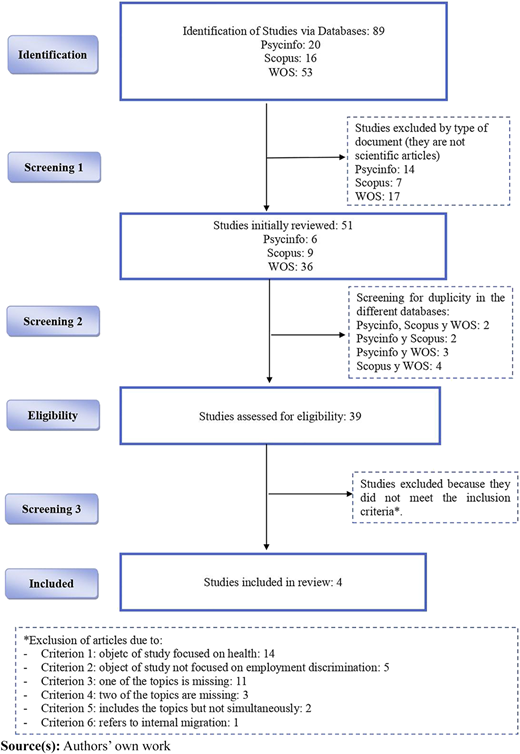
A total of 89 documents were identified in the three databases according to the topics of this review. In the first phase, we excluded 38 documents that were not scientific articles. Out of 51 studies, mostly qualitative in nature, duplicates were eliminated, and 39 research studies remained to be assessed. The final screening ruled out articles that did not directly include any of our three topics and their intersection: LGTBIQ+ membership, long-term international mobility and employment discrimination. Some of those excluded deal with migration and sex-gender dissidence separately (Lee, 2019; Marsicano et al., 2014). In others, the object of study is health (Di Feliciantonio, 2018; Palazzolo et al., 2019) and/or employment discrimination appears tangentially (Logie et al., 2016).
This process can be observed in Figure 1. In the following, we detail the findings of the review of the articles that meet our search criteria. We highlight the formal aspects of the journals of publication and the results found.
3.1 Characteristics of the studies included
The screening resulted in four articles that directly addressed our object of study. The characteristics of these articles are detailed in the following sections:
3.1.1 Demographic information about the publication
Demographic data on the studies include the year of publication, language and geographical location of the first author.
Three articles are written in English, one published in 2023 and two in 2020. The last article is in Spanish and corresponds to the year 2008. Regarding the geographical location of the first author, Abreu and Asessi are located in the United States (Florida and New Jersey, respectively), Gerhards in Berlin and Hernández-Rosete in Mexico.
3.1.2 Information on the quality of publications
The journals of the selected publications and their impact index in the Journal Citation Report (JCR) are listed below:
Journal of Career Development (2023):
Impact index: 4.06.
Categories:
Education (Q1),
Psychology (miscellaneous) Q1),
Applied Psychology (Q2),
Organisational Behaviour and Human Resource Management (Q2)
Sexuality Research and Social Policy (2020):
Impact index: 2.53
Categories:
Gender Studies (Q1),
Health (social sciences) Q1),
Sociology and Political Science (Q1)
Journal of Ethnic and Migration Studies (2020):
Impact index: 2.75.
Categories:
Ethnic Studies (Q1),
Demographics (Q1),
Arts and Humanities (miscellaneous) Q1).
Mental Health (2008):
Impact index: 0.207.
Categories:
Clinical Psychology (Q4),
Psychiatry and Mental Health (Q4).
3.1.3 Participating population
Regarding the participating population, two studies focus on transgender and transsexual people (Abreu et al., 2023; Hernández-Rosete, 2008), one on affective-sexual dissidence in general (Alessi et al., 2020) and the last one on male homosexuality and female transsexuality (Gerhards et al., 2020). The countries of origin of the LGTBIQ+ migrant groups were Cuba, Syria, Iran, Iraq, Mexico, Lebanon, Egypt, Pakistan, Jordan, Nicaragua, Salvador, Puerto Rico, Peru, Colombia, Uruguay, Chechnya, Palestine, Somalia and Tajikistan.
The sample of the set of articles totals 70 people. Of these, ten in-depth interviews were conducted with staff of non-governmental organisations (NGOs), four life histories of Mexican trans people living in California, 18 self-identified Latinx [2] transgender immigrants contacted in South Florida and 38 LGBTQ refugees who migrated to Austria and the Netherlands. In the pilot study, 427 job application letters were sent from profiles that combined origin and gender identity.
Across the studies as a whole, the sample totals 28 transgender people (including five women and one man), 24 gay, three lesbian, three bisexual and two queer people. In addition, of the LGTBIQ+ organisations interviewed, two identified themselves as gay, two lesbian and one queer (Alessi et al., 2020). The study by Hernández-Rosete (2008) does not explicitly identify the five people from the participating organisations.
3.1.4 Theoretical and methodological approaches
Of the articles included in this review, two are based on an intersectional perspective, another refers to the phenomenological, and a fourth can be placed in a positivist framework. The first approach is used by Abreu et al. (2023) and Alessi et al. (2020) to understand the unique situations of discrimination of LGTBIQ+ migrants. This discrimination results from a complex identity categorisation of systems of oppression that determine the possession or not of privileges according to a position in the social structure. These positions are manifested in the contexts of origin, transit and destination, where homophobia, racism, transphobia and xenophobia operate and intersect.
Hernández-Rosete’s (2008) study is framed within a phenomenological approach that examines the meanings and senses constructed from informants’ accounts. This approach makes it possible to understand individual experiences of violence hidden in power relations, based on multidiscrimination and expressed through everyday practices, norms and beliefs that shape their barriers to accessing rights.
Gerhards et al. (2020) conducted a positivist experimental study that situates the conceptual background in research on the statistical and preferential discrimination of migrants and minorities in accessing the labour market. Their experiment consisted of sending out a series of fictitious CVs reflecting different backgrounds and identities of the “persons” offering themselves for employment in Berlin theatres. These identities have several features in common: the same age and the same studies (at level, school and sector). What did vary were the male names, which were combined with German, French and Turkish surnames. On the other hand, transvestism or transsexuality was hinted at by adding a female name in brackets after the male name, as well as the word transgender in the gender field.
Accordingly, the dominant methodology is qualitative, and the techniques used are life histories, and semi-structured and in-depth interviews, and one experimental study.
3.1.5 Methodological quality
To determine the methodological quality of the included studies, the critical appraisal tools of the Joanna Briggs Institute (2024) were used. These instruments provide insight into the rigorousness of the studies, providing a structured framework for the assessment of key aspects of the research such as design, sample selection, data collection, data analysis and interpretation of results. The 10-item and 9-item qualitative and quasi-experimental versions were used. In qualitative studies, this tool examines the consistency and robustness of the methods used for data collection and analysis, as well as the justification and clarity in the interpretation of the results. With regard to the quasi-experimental study, it assesses the internal and external validity, group assignment, control of extraneous variables and generalisability of results.
The qualitative research scored at a high level of methodological quality (Table 4) and the quasi-experimental study scored medium (Table 5). Table 6 presents the characteristics of the four studies addressed in this review, based on the Iberoamerican Cochrane Centre Handbook (Higgins and Green, 2011). It presents, in alphabetical order of the authors, year of publication, study objectives, methodology, tools and results. The score obtained using the JBI critical appraisal tool has also been added.
JBI critical appraisal chesklist for qualitative research
| Research | Is there con-gruity between the stated philosophical perspective and the research methodology? | Is there congruity between the research methodology and the research question or objectives? | Is there congruity between the research methodology and the methods used to collect data? | Is there congruity between the research methodology and the representation and analysis of data? | Is there congruity between the research methodology and the interprettation of results? | Is there a statement locating the researcher culturally or theoretically? | Is the influence of the researcher on the research, and vice- versa, addressed? | Are participants, and their voices, adequately represented? | Is the research ethical according to current criteria or, for recent studies, and is there evidence of ethical approval by an appropriate body? | Do the conclusions draws in the research report flow from the analysis, or interpretation, of the data? | Score |
|---|---|---|---|---|---|---|---|---|---|---|---|
| Hernández-Rosete, 2008 | Y | Y | Y | Y | Y | Y | Y | Y | X | Y | 9/10 |
| Alessi et al. (2020) | Y | Y | Y | Y | Y | Y | X | Y | Y | Y | 9/10 |
| Abreu et al. (2023) | Y | Y | Y | Y | Y | Y | Y | Y | Y | X | 9/10 |
Note(s): Yes: Y; No: N; Is not clear or is not applicable: X
Source(s): Authors’ own work
JBI critical appraisal checklist for quasi-experimental studies
| Research | Is it clear in the study what is the “cause” and what is the “effect” (i.e. there is no confusion about which variable comes first)? | Were the participants included in any comparisons similar? | Were the participants included in any comparisons receiving similar treatment/care, other than the exposure or intervention of interest? | Was there a control group? | Were there multiple measurements of the outcome both pre and post the intervention/exposure? | Was follow up complete and if not, were differences between groups in terms of their follow up adequately described and analysed? | Were the outcomes of participants included in any comparisons measured in the same way? | Were outcomes measured in a reliable way? | Was appropriate statistical analysis used? | Score |
|---|---|---|---|---|---|---|---|---|---|---|
| Gerhards et al. (2020) | Y | Y | N | N | N | N | Y | Y | Y | 5/9 |
Note(s): Yes: Y; No: N; Is not clear or is not applicable: X
Source(s): Authors’ own work
Characteristics of the selected research
| Research | Objectives | Methodology | Methods | Results | Research quality |
|---|---|---|---|---|---|
| Abreu et al. (2023) | To learn about the experiences of transgender Latino immigrants seeking employment in the United States | Qualitative | In-depth semi-structured interviews | Regardless of educational level, the Latino transgender population faces employment discrimination. The intersection of cissexism, racism and xenophobia means that, despite having qualifications, employment opportunities are restricted. Sex work appears as an alternative to so many failed attempts to find employment. They claim to be the only study that addresses positive aspects, including successful job search experiences and useful strategies, such as momentary de-transitioning | 9/10 |
| Alessi et al. (2020) | To examine the integration experiences of LGBTQ refugees who migrated from Islamic societies to Austria and the Netherlands | Qualitative | Interviews. Thematic analysis | LGBTQ people from predominantly Muslim countries face Islamophobia from the host societies in Austria and the Netherlands, as well as homophobia and transphobia from their own migrant communities that hinder, among other things, access to employment | 9/10 |
| Gerhards et al. (2020) | To determine the influence of a person’s migration background and gender identity on the likelihood of being discriminated against in the field of art and theatre | Qualitative | Experiment. Manipulation of variables | It analyses the responses given to a series of fictitious CVs of people with different migration backgrounds and gender identities. The results show that people with a migrant background and transgender identity are not discriminated against in the field of theatre. People with a migrant background even have a slight advantage. The results support the idea that we should differentiate between different social subfields of society and the labour market in future studies on discrimination | 5/9 |
| Hernández-Rosete, 2008 | To analyse sexual violence and discrimination as triggers of an emerging migratory phenomenon among homosexual population groups | Qualitative | In-depth interviews | The discrimination and sexual violence described by the informants has to do with triple stigmatization (for being mobile populations, for being transgender and also for living with HIV). It is a system of stigmatization that not only affects their quality of life by excluding them from employment and legal status, but also prevents them from being recognized as subjects of the right to health, especially in terms of access to antiretroviral drugs and medical care related to the control of HIV/AIDS. | 9/10 |
Source(s): Authors’ own work
3.2 The main results of the publications
The main results of the studies analysed have been structured in three dimensions: individual, community and political-economic framework from an intersectional approach. The set of elements in each of these dimensions is crossed by discrimination–homophobic, sexist, racist and xenophobic–shaping the life trajectory of LGTBIQ+ migrants in general and in the labour sphere in particular, expanding the results reflected in previous sections.
3.2.1 Personal experiences
The articles analysed reveal that the experiences of LGTBIQ+ migrants are deeply marked by discrimination and violence at the individual level. Participants in the studies described facing physical and emotional abuse, police harassment and social rejection because of their gender identity, sexual orientation and ethnicity. In many cases, migration was perceived as a necessary measure to safeguard their lives and access to medical care, especially for those facing serious threats in their home countries.
In Hernández-Rosete (2008) we can see how some people experience different types of discrimination in Mexico for this reason. Firstly, there are cases of verbal violence in the family. Secondly, there is street violence and generalised insecurity. Finally, police violence and impunity allow all these abuses to continue without consequences. Police forces detain individuals under the pretext of disturbing the moral order and then proceed to abuse them. The possibility of reprisals in case of denunciation acts as a disincentive to report these abuses. This situation leaves many LGTBIQ people unprotected and without legal protection. The lack of legal recognition is used to accuse people of misrepresentation, especially when a person registered as one gender claims to be another. All this contributes to the intention to migrate.
Once at the destination, experiences of discrimination are amplified by including them in the migrant category (Alessi et al., 2020; Hernández-Rosete, 2008). Despite the recognition of asylum in US FOR TRANSGENDER PEOPLE. In the case of transgender people in the USA, the granting of this permit often takes a long time and, with it, the fear of deportation. The problem is exacerbated in cases where there is a lack of knowledge of the language of the receiving country and where the legal-administrative situation is not regularised. The lengthy time taken to resolve applications for work, residence, asylum and refugee status is a determining factor in living conditions and access to the labour market. Research has confirmed detrimental effects on their personal circumstances, affecting both the coverage of their needs and their health understood as bio-psycho-social wellbeing (Abreu et al., 2023; Alessi et al., 2020; Hernández-Rosete, 2008). People who decide to apply for asylum must prove that their lives are at risk because of their sexual orientation and/or gender identity, requiring them to meet a series of requirements in which they must expose their privacy in order to demonstrate such persecution.
Discrimination stemming from transphobia, xenophobia and racism in host contexts generates further marginalisation, as these multiple identities intersect in various systems of oppression. These forms of discrimination act as barriers to accessing employment, health, education and housing. In terms of employment, several people recount how they have been selected for an interview but, when seen in person, are rejected, usually due to the intersection of being Latinx and transgender (Abreu et al., 2023). Although they may be highly qualified, they often have access to temporary, precarious jobs and in some cases, the obligation to engage in prostitution as a livelihood mechanism (Abreu et al., 2023; Alessi et al., 2020; Hernández-Rosete, 2008). Certain contexts are less favourable to sexual and gender diversity, which generates feelings of isolation, fear and despair that severely impact the psychological health of LGTBIQ+ migrants.
Resilience strategies include the ability to persist in the face of continual rejection of job applications and momentary disengagement. Despite the possible impact on their wellbeing, they are forced to display a different gender expression than the one they choose in order to improve their job opportunities (Abreu et al., 2023). There are no known studies that have delved into the long-term consequences of these strategies (MacKinnon et al., 2022).
3.2.2 Organisational and community experiences
Three key aspects of community experiences stand out in the different publications. Firstly, non-governmental organisations (NGOs) play a fundamental role in supporting and accompanying LGTBIQ+ migrants. This support takes the form of the provision of resources to meet their basic, health, emotional and relational needs; guidance to facilitate their insertion into the labour market; and assistance in dealing with discrimination (Abreu et al., 2023; Alessi et al., 2020; Hernández-Rosete, 2008).
Another important aspect is the work environment, where the labour market is characterised by traditional role divisions, stereotypes and prejudices. These factors influence significantly on employment opportunities, particularly affecting transgender people. Hernández-Rosete (2008) also highlights the stigma attached to transgender migrants with HIV. A particular barrier for transgender migrants is the denial of asylum for having contracted the infection in the context of origin.
In the pilot study by Gerhards et al. (2020), candidates with a French or Turkish migration background had a slightly higher invitation rate than candidates without a migration background, a possible “positive discrimination” in the theatre sector towards cultural diversity. Transgender people did not face negative discrimination, with invitation rates similar to those of cisgender men. However, the combination of Turkish ethnicity and a transgender identity resulted in the lowest rate of invitations. This profile was 15% less likely to receive an invitation than cisgender Turkish men and an even lower percentage compared to trans people of other backgrounds. This suggests that, although individual characteristics (migrant background or trans identity) did not generate significant rejection in the theatre setting, the intersection of the two characteristics was perceived differently.
The third element is constituted by the host and migrant communities, which are fundamental in their role as a source of formal and informal social support. Homophobic, racist and xenophobic attitudes based on ethno-racial and religious affiliation are evident in both. These attitudes in the receiving context were barriers to accessing housing, especially for phenotypically racialised people. This profile also finds it more difficult to enjoy leisure activities, with situations of sexual exploitation occurring. Within migrant communities, some results pointed to hostile experiences towards sexual and gender diversity. These hostilities constitute barriers to accessing resources that interfere with the socio-cultural and labour market insertion of migrant LGTBIQ+ groups (Alessi et al., 2020). In the studies, we observed the dual nature of social norms and acceptance within host and diaspora communities, which can offer both support and discrimination. The situation becomes particularly sensitive for those who face Islamophobia on the part of the host population, as well as lgtbiphobia on the part of migrant communities.
3.2.3 Political and legislative framework
There are barriers that invisibility and restrict the rights of migrants and, in many cases, violate fundamental rights, especially for those who identify with multiple oppressed identities. Both subtle and direct discrimination and stigma associated with sexual and gender diversity and migration exacerbate the vulnerability of migrants, making it imperative to adopt an intersectional approach in policies and intervention strategies.
In the context of asylum and refugee status, strict requirements and long processing times further complicate the situation. In particular, the Dublin Regulation has obliged them to apply and wait for an asylum response in the country through which they entered the European Economic Area. On other occasions, they have been assigned asylum in countries unfriendly to sexual and gender diversity, adding instability and uncertainty to their journey. According to the receiving contexts, they found that discrimination was more subtle in the Netherlands, while in the German case, it was more direct (Alessi et al., 2020).
The imperative need for intersectionality as an approach is also seen in the existence of narrative frameworks such as homonationalism. By this, we refer to an agenda that “positions Western” “gayfriendly” countries, like the United States, against “oppressive” and “backwards” countries where homophobia and transphobia, as part of the ongoing legacy of colonialism, threaten the livelihood of “LGBTQ + individuals” (Alessi et al., 2020, p. 979; Jungar and Peltonen, 2017; Puar, 2007). In the same vein, we find another discourse that encourages the multiplication of the violence suffered, the global social construction of the transgender population as a propitiatory victim of HIV (Hernández-Rosete, 2008). Although it is not always the group with the highest number of diagnoses of infection [3], it is the one that suffers most from the stigma associated with it. In addition, there are the stigmas associated with migration irregular. All these discourses overlap, affecting our target population simultaneously.
4. Discussion
This section highlights two issues that emerge from the findings. First, the implications are related to different domains: research, society at large, and policy. The second issue addresses the limitations of the theoretical and methodological frameworks and the scope of the results, as reported in the literature and evidenced in our analysis.
4.1 Implications
The implications of this review at the research level underline the need to increase the corpus of studies that address the issue, broadening the contexts, levels of analysis and employment sectors. With regard to this last point, we propose to analyse in greater detail the areas where LGTBIQ+ migrant homophobia or homophilia is evident. The aim is to make visible, denounce or, where appropriate, promote and disseminate existing good practices. In addition, it would be advisable to cover different acronyms of the LGTBIQ+ collective, in order to delve deeper into the ways in which oppression manifests itself. It has also been identified as desirable to explore in more detail the various coping strategies, such as momentary de-transitioning, and their long-term impact on psychological well-being.
In the European context, research could be directed at countries other than Central Europe, such as those in the South or East. The South is characterised by the fact that it includes some of the countries of entry to the EU for many migrant populations. Moreover, the difference in legal matters contrasts between Spain, which has recently approved Ley 4/2023 (2023) of 28 February for the real and effective equality of trans people and for the guarantee of LGTBI people’s rights4 and Italy, whose government is carrying out measures against equal rights of the homoparental families. On the other side, those countries of the East, traditionally more senders than receivers of migrants and with fewer recognised rights for sexual diversity. In Bulgaria, for example, a law against LGTBI “propaganda” has recently been passed.
Research underlines the role of cultural and symbolic violence in perpetuating stigmatisation and discrimination, including by health and security personnel (Hernández-Rosete, 2008). Therefore, at the societal level, there is a need to promote awareness-raising strategies that counteract the different narratives that foster exclusion. These narratives are important because they shape the frameworks through which receiving societies perceive migrants. In order to change these frameworks to ones that foster empathy and the construction of safe spaces, we consider it useful to follow the principles developed by the NGO PorCausa to build what they call New narratives or narratives of love (Carvajal et al., 2019). Among them, they highlight the importance of avoiding both reactive messages and a discourse focused on the us/them distinction. The campaigns developed may follow different strategies depending on the populations they are aimed at. Within these, it is important to provide training resources for the healthcare population, legal professionals and civil servants. It is also essential to implement awareness-raising and training programmes on diversity and inclusion in the workplace, both for employers and host communities.
On a practical level, this review suggests that employment and migration policies must include intersectional approaches that recognise the multiple forms of oppression faced by LGTBIQ+ migrants. Risks of exploitation, barriers to integration and systematic persecution by authorities underline the continued need for targeted interventions and policies to foster more inclusive and supportive environments for LGTBIQ+ migrants (Alessi et al., 2020). In addition, the administrative status of migrants represents a significant barrier to accessing employment and other rights, aggravating their social exclusion.
In the legislative sphere, it is suggested that the regulations on foreigners be reviewed, seeking to reduce the difficulties faced by refugees during the processing and recognition of their status. In addition, it would be advisable to reduce waiting times for the resolution of applications and to ensure that the spaces through which they are forced to transit are favourable to cultural, sexual and gender diversity.
Council Directive 2000/78/EC (2000), which regulates equal treatment in employment and occupation, mentions sexual orientation but not identity. Furthermore, it clarifies explicitly that it “does not cover differences of treatment based on nationality and is without prejudice to provisions governing the entry and residence of third-country nationals and their access to employment and occupation”. While this may make sense within the legal system, it implies that the guarantee of rights will always be conditioned by migration laws. More recently, the LGBTIQ Equality Strategy 2020–2025 mentions that for 40% of LGBTI people, having an ethnic origin or immigrant background is an additional ground for discrimination. Furthermore, it promises to ensure support for LGBTIQ equality in action under the Asylum and Migration Fund. This can be interpreted as a step forward, as well as the explicit mention of hitherto less recognised realities, such as intersex and trans people. However, European migration policy is still based more on militarised defence against an enemy than on a human rights approach. Moreover, within the EU framework, the implementation and effectiveness of these measures vary considerably between different countries. This disparity also applies in the case of the USA, with an Equality Act which seeks to incorporate protections against LGBT discrimination into the federal Civil Rights Act of 1964. Even so, we find states with different legislation in this regard. Therefore, it is suggested that the existing anti-discrimination legislation be complied with and reinforced, considering the different realities together. In order to guarantee effectiveness, it is suggested that complaint and communication mechanisms be set up for non-compliance with existing regulations.
Institutional commitments to diversity and inclusion, especially in specific areas such as theatre, demonstrate the potential for positive change (Gerhards et al., 2020). Without However, in this study, the authors conclude that while theatre can, in some cases, reverse pervasive discrimination in other sectors, it does not completely eliminate hierarchical structures of exclusion. The intersection of characteristics (in this case, ethnicity and gender identity) can face barriers that even an inclusive environment such as theatre does not fully overcome.
Overall, these findings point to the need for comprehensive policy interventions to prevent stigmatisation, ensure access to health care and recognise the rights of historically marginalised populations.
4.2 Limitations
Finally, we mention a number of limitations that can be synthesised into two broad areas; the first relates to methodological aspects, and the second has to do with the difficulty of answering the research question comprehensively.
At the methodological level, possible biases derived from the context are described, such as the fact that Miami has a high proportion of Spanish speakers. This also highlights the importance of studying, in line with the intersectional approach, how each axis of oppression operates in different contexts. Similarly, not all states have the same culture of tolerance of the collective. Finally, for future research, it is recommended to conduct semi-structured interviews with open-ended questions that allow for a deeper exploration of the experiences of resistance to oppression.
It would be interesting to replicate the experiment of Gerhards et al. (2020) to corroborate the results on the greater acceptance of certain profiles in the field of performing arts. In their study, they focus on unpaid positions with the aim that the economic situation of the theatre would not influence as a variable. However, this may make it unavailable for offers of real employment opportunities. In addition, they focus on theatres with their own plays and permanent venues, and most German-speaking theatres officially declare themselves in favour of promoting gender equality and opposing discrimination against minorities.
Due to the requirements regarding the sources for the quality of the publications, grey literature was not taken into account. However, there are documents from institutions or organisations that highlight the problems of highly vulnerable individuals and groups. The inclusion of only four research studies in this review restricts the possibilities of comprehensively understanding the phenomenon of labour discrimination experienced by the LGTBIQ+ collective. The limitations expressed in the articles were related to the aforementioned representativeness of the sample, possible biases in communicating the object of study that could negatively condition the responses of informants and the need for greater comparison between European contexts through standardised measures (Alessi et al., 2020). This lack of research means that we cannot talk in-depth about the different ways in which discrimination manifests itself in the workplace. Similarities are recognised in the discrimination and rejection of the LGTBIQ+ migrant collective, but it is not known how the selection, promotion and employment stabilisation processes operate, among other issues. These are all issues that need to be investigated if we intend to promote equal opportunities.
5. Conclusions
The scoping review shows that labour discrimination against the LGTBIQ+ migrant population is a complex and multifaceted phenomenon, influenced by power dynamics that intersect gender identity, sexual orientation, ethnicity and migration status. The studies analysed show that these people face significant barriers to accessing stable and well-paid employment, often being forced to accept precarious jobs or even resort to sex work as a means of subsistence. The multiple discrimination they face affects not only their economic wellbeing but also their the lack of social support and the prolonged uncertainty in the resolution of their legal situations exacerbated their physical and mental health.
In addition, it highlights the urgent need for public policies and intervention strategies that adopt an intersectional approach to address the various forms of oppression that affect this group. It is essential that employment and migration policies recognise and respond to the specific experiences of LGTBIQ+ migrants, promoting inclusive and safe working environments. It is also recommended that diversity awareness and training programmes for employers and host communities be implemented to reduce prejudice and promote equal opportunities. Future research should broaden its scope to include a greater diversity of contexts and subgroups within the LGTBIQ+ community, providing a more holistic understanding of their experiences and needs in order to eradicate discrimination and reduce inequalities in the workplace.
Notes
Although asexual people are now beginning to be included, identifying them with the letter A, in this article, we will refer to the collective with the denomination used in the source we are talking about. In all other cases, we will use the acronym LGTBIQ+. In any case, we maintain the + sign to indicate the need to include the greatest diversity of realities.
Thus, in the original.
For example, in Castilla et al. (2006), we see that 20–30% of infected people acquired it through risky heterosexual practices and 15–25% through homosexual practices. This study uses data from the Canary Islands, Ceuta, La Rioja, Navarra and the Basque Country in the late 1990s and early 21st century.
This law, despite the progress it represents, has been criticised for leaving out migrants (as well as non-binary people).

