


Over the past decades, female workforce participation has substantially increased; also, more men go on parental leave and participate in domestic and care work. While many women and men progressively try to combine traditionally communal and agentic roles, men are still stereotypically associated with agentic (i.e. assertiveness, competence) and women with communal traits (i.e. warmth, morality). Individuals who do not comply with stereotypical gender roles are likely to receive negative feedback (i.e. backlash effect), particularly in the work environment. We investigated whether the gender stereotypes described above (still) matter for parents during the application process.
In two vignette-based 2×2 between subjects-survey experiments (N1 = 150; N2 = 289; both conducted in Germany), we examined whether the duration of parental leave (2 months vs 12 months) influenced the assessment of qualified female and male job applicants regarding their agentic and communal attributes as well as perceived job demand-ability-fit.
Across studies, we found no differences regarding agency and job fit. Regarding communion, we found a small backlash effect for mothers (Study 1), and a small communality-bonus effect for fathers (Study 2), suggesting that taking shorter parental leave may be perceived negatively for mothers but not fathers (Study 1), whereas taking longer parental leave may be perceived positively for fathers but not mothers (Study 2).
In sum, this suggests that mothers and fathers may be evaluated differently in the hiring context, depending on the amount of parental leave they take.
This research contributes to broader discussions on gender equality and work–life balance.
In many countries, both mothers and fathers have the right to parental leave after the birth of a child. However, there is a difference between women and men in the amount of parental leave taken: Although the proportion of fathers taking parental leave has been slowly increasing since the early 2000s, the average length of parental leave is still much longer for mothers (Hyland and Shen, 2022; Olsson et al., 2023). Gender gaps in parental leave are only partially explained by national parental-leave policies (Olsson et al., 2023).
Germany – where this research was conducted – tried to encourage more fathers to take parental leave by introducing a new law in 2007, which granted couples two extra months of paid leave in addition to the twelve regular months, if the second parent also stays home. Thus, parents are free to distribute 14 months among each other, as long as one parent takes at least two months. Over the past 15 years, the proportion of fathers in Germany taking at least two months of parental leave is steadily increasing, yet 87% of mothers still report providing more than half of childcare. Simultaneously, many men in Germany still choose not to take parental leave due to financial and professional reasons, for example, because they are afraid of professional disadvantages (IFD, 2021). Across countries, including Germany, the decision (not) to go on parental leave is also influenced by individual gender attitudes (Olsson et al., 2023). This may be due to the reason that men are still stereotypically associated with agency (i.e. assertiveness, competence) and women are stereotypically associated with communion (i.e. warmth, morality), which restricts them to certain gender roles (Abele and Wojciszke, 2014). At the same time, however, female and male workforce participation underwent considerable change in many countries, including Germany, in the sense that the number of women in the workforce has substantially increased over the past decades (Ortiz-Ospina and Tzvetkova, 2017).
Against this background, we examined in two vignette-based 2×2 between subjects-survey experiments how mothers and fathers who apply for a job may be judged differently based on the amount of parental leave they have taken with regard to the dependent variables agency, communion and job fit. We expected that the ascription of agentic and communal attributes as well as perceived job demand-ability-fit vary as a function of the two manipulated factors applicant gender (male vs female) and duration of parental leave (short: 2 months vs long: 12 months). Please note that the present article focuses on traditional gender roles, and thus, only includes the binary gender categorization male and female as part of the experimental manipulation.
Gender roles in the work context: agency and communion
According to social role theory (Eagly, 1987), gender roles are the sum of expectations, stereotypes and behavior expected of people in different contexts because of their gender. In most Western societies, women have traditionally been expected to take on the role of primary caregivers in the family. Men, on the other hand, have been assigned the role of primary breadwinners (cf. Eagly, 1987; see also Dulin, 2007). Thus, women are traditionally associated with more communal traits such as being empathetic, nurturing and sensitive, while men are often described to possess more agentic traits such as being dominant, competitive and independent (Abele and Wojciszke, 2014). Biosocial construction theory (Wood and Eagly, 2012) extends this framework by emphasizing how biological, ecological and social factors jointly shape gendered divisions of labor, which in turn guide gender socialization. In societies where labor and power are strongly divided along gender lines, girls and boys are socialized more rigidly into communal and agentic roles, respectively. These socialization processes contribute to gendered self-views and expectations.
It has been shown that gender-based prescriptions (i.e. agency for men, communion for women) vary across countries, whereas gender-based proscriptions (i.e. behavior that women or men should not show, such as weakness for men, dominance for women) seem to be universal (Bosson et al., 2022). This also applies to Germany: men are usually expected to be less communal and more agentic than women (Asbrock, 2010). According to the 2024 Global Gender Gap Index data (GGGI; World Population Review, 2024), Germany has an overall score of 0.810 (on a 0–1 scale, where 1 = full gender parity), which means that it has closed 81% of its gender gap. Regarding the four different dimensions, Germany performs strongly in educational attainment as well as health and survival yet struggles with economic participation and political empowerment. It places just below the top tier of Western European countries, which dominate the global top 10, and above other large Western countries such as Canada (0.761) and the USA (0.747). The differences in gender equality map to the self-views and gendered expectations of people in the respective countries. Cross-cultural research has shown that in more egalitarian countries, the difference between women and men in self-perceived agency is smaller, while it is larger in self-perceived communality (Kosakowska-Berezecka et al., 2022).
A related distinction concerns vertical and horizontal segregation. Vertical segregation refers to the underrepresentation of women in high-status, powerful positions, whereas horizontal segregation describes the clustering of women and men into different types of occupations of similar status, but differing skill demands (Charles, 1992; Wong and Charles, 2020). Both forms of segregation reinforce gendered expectations: vertical segregation sustains the association of men with agency, while horizontal segregation maintains the association of women with communal and caregiving roles. Importantly, vertical segregation is more directly captured by country-level gender equality indicators such as the GGGI (World Economic Forum, 2020), indicating that Germany has rather low vertical segregation.
Although social roles have been shown to be dynamic and have become more flexible over time, as longitudinal studies show, gender stereotypes still persist to some extent (e.g. Diekman and Eagly, 2000; Eagly et al., 2020; Hsu et al., 2021; Rudman et al., 2012b; Twenge, 2001). Research shows that women are progressively described with agentic terms similar to men, and women also view themselves increasingly more agentic than in the past (e.g. Lopez-Zafra and Garcia-Retamero, 2012; Twenge, 2001), especially in the work context (Duehr and Bono, 2006). In contrast, the integration of communal traits into the male stereotype remains difficult (Sendén et al., 2019). Integrating the stereotypical picture of a father into the general male stereotype may be a solution, as fathers are described to possess more communal traits (Banchefsky and Park, 2018) – yet gender stereotypes related to communion show substantial inertia and seem to remain relatively stable over time.
In work and hiring contexts, the perceptions of candidates' agency and communion are crucial due to their impact on candidate fit with job expectations, particularly since gendered divisions of labor are associated with gender stereotypes (Froehlich et al., 2020). The perceived fit that hiring managers attribute to candidates is often a product of simplified heuristics shaped by stereotypes (Dutz et al., 2021; Lee et al., 2015). Therefore, perceptions of agentic and communal attributes along with perceived job fit may be antecedents for (discriminatory) job recruitment decisions. This has been shown for women in STEM fields (Diekman et al., 2010) and in leadership (Koenig et al., 2011). Job-demand-ability fit reflects how well an individual's abilities align with job demands, and research indicates that higher congruence leads to better occupational outcomes (Kristof-Brown et al., 2005; Tims et al., 2016). A mismatch in perceived agency or communion between a candidate and role expectations can negatively impact an applicant's perceived fit for a position, influencing hiring decisions (Rudman and Glick, 2001). Additionally, implications of agency and communion stereotypes and job fit influence not only the hiring process but also long-term employee satisfaction and retention (Kristof-Brown et al., 2005; Tims et al., 2016).
Backlash effects due to parental leave
Women and men who act according to gender stereotypes and take on the expected social roles generally receive more positive feedback and have more positive experiences. The opposite occurs when people do not act as expected: a phenomenon called the backlash effect (Rudman et al., 2012a; Williams and Tiedens, 2016). Individuals are likely to receive negative feedback, if their behavior does not meet gender-stereotypic expectations, because such norm violations are perceived as a threat to the existing social order in society (Rudman et al., 2012a). However, evidence for backlash effects, regarding both women and men, is mixed; while there is still ample evidence for gender-based discrimination in the workplace, some authors theorize that backlash effects against women might be declining in Western societies due to people becoming more acquainted with female leadership (cf. Lee, 2023), indicating less vertical segregation. Therefore, the strength and direction of reactions to such perceived social norm violations likely depend on the context and may be different now compared to findings that were obtained 25 years ago (e.g. Rudman, 1998; Rudman and Fairchild, 2004). The current research focusses on potential backlash effects for mothers and fathers in the hiring context.
Backlash effects have been shown for both genders, that is, among women who show agentic behavior, leading to decreased likability in the work context, and among men who show communal behavior, leading to a decrease in expected success (e.g. Bark et al., 2021; Rudman et al., 2012b). In particular, fathers who take time for their children were perceived as insecure and weak, less motivated on the job and less competent due to the norm violation of the male stereotype (Prentice and Carranza, 2002; Rudman and Mescher, 2013). Research has shown that describing men in more communal roles may lead to a decrease in agentic, but not an increase in communal traits (e.g. Sendén et al., 2019).
However, there is some evidence that the picture is less clear than one might initially assume: For instance, there are studies finding positive effects on the careers of men, but not women, who take parental leave and are involved in raising children. They may be rated more communal and more likable, yet equally agentic and competent compared to men who do not take parental leave (Fleischmann and Sieverding, 2015), leading to perceptions of better hireability and leadership effectiveness (Krstic and Hideg, 2019). This speaks for a communality-bonus effect for men in the work context (Hentschel et al., 2018).
Women who show agentic behavior were judged as less likable and less hirable (Rudman et al., 2012b). Additionally supporting the assumption of a so-called motherhood penalty (Fleischmann and Sieverding, 2015), women, but not men, who have children were perceived as less competent and committed to work, and thus, may experience discrimination in the hiring process (e.g. Hipp, 2020; King, 2008). There is evidence that mothers experience more discrimination than fathers during the hiring process (e.g. Correll et al., 2007; Morgan et al., 2013). Therefore, more attention should be paid to the reasons why this happens, and exploring factors that contribute to such discrimination, for instance, the duration of parental leave taken. This is an important question, given changing formal rules (e.g. new laws of parental leave for mothers and fathers) and shifting gender roles in many countries.
The fact that fathers generally take less, and mothers more parental leave, matches their social gender role expectations. Accordingly, men who take only a short period of parental leave fit the agentic behavior pattern expected of them, while women who take long parental leave live up to the expectations regarding communal behavior. However, when men take a long or women take a short period of parental leave, they violate social expectations. Focusing on backlash effects, we would expect that mothers taking a short parental leave (vs longer leave) could damage communion perceptions (backlash effect); for fathers, taking longer parental leave (vs shorter leave) would damage agency perceptions (backlash effect). With respect to other possible effects, mothers might also be perceived as less agentic (motherhood penalty), and fathers might be perceived as more communal (communality-bonus effect).
The present research
The focus of this research was on parents who apply for a job, as we expected that mothers and fathers will be evaluated differently based on the duration of their parental leave. We examined how applicant gender and the duration of parental leave may affect people's perception of applicants' agency, communion and job fit, with the latter being a more explorative dependent variable. This extends the work of Fleischmann and Sieverding (2015), who investigated whether the duration of parental leave would lead to backlash effects regarding the perception of male (but not female) applicants. In their research, they examined how two or twelve months of parental leave (vs a baseline of no parental leave) may affect ratings of agency, communion and hiring probability. The results of their studies indicate that for men taking parental leave (no matter if 2 or 12 months) leads to higher communion ratings than taking no parental leave but did not affect agency or hiring probability ratings (i.e. communality bonus effect but no backlash effects). Building on their studies, we intended to take the research question a step further, as we were interested in how parents (i.e. mothers and fathers) who apply for a job after taking parental leave may be judged differently based on their gender and associated role expectations. Therefore, we decided against including a control group without parental leave, as the focus of this research was not on comparing non-parents and parents. Note also that the decision to use a between-subjects design was based on the assumption that presenting participants with more than one vignette might trigger unwanted comparisons between the different vignettes (e.g. based on social desirability) that could undermine the effect of the experimental manipulation.
We conducted two experiments to examine this research question. While Study 1 served as an initial test of our hypothesis, Study 2 served as a conceptual replication and extension. In particular, Study 2 was based on a larger sample with more work experience and tested the generalizability of the results by using a different occupational area (for details, see below). Importantly, however, the key hypotheses and research questions remained the same across studies. Based on the theoretical and empirical background outlined above, we expected perceived agency (H1) and perceived communion (H2) to vary as a function of the two factors applicant gender and duration of parental leave. More specifically, we expected perceived agency to be higher for male compared to female applicants (H1a), and perceived communion to be higher for female compared to male applicants (H2a), matching traditional gender stereotypes. Further, we expected perceived agency to be higher for a short duration of parental leave compared to a long duration (H1b). The difference between the short and long duration was expected to be more pronounced among male applicants (planned contrasts, see Statistical analyses; H1c). Yet, we left it as an open research question, whether there would be a significant interaction between the two factors gender and duration of parental leave. In turn, perceived communion was expected to be higher for a long duration of parental leave compared to a short duration (H2b). The difference between the short and long duration was expected to be more pronounced among female applicants (planned contrasts; H2c). Again, the interaction was subject of an open research question. Last, we expected perceived job fit to be higher for the short compared to the long duration of parental leave (H3). Additionally, we exploratively examined whether there was a main effect of applicant gender regarding job fit, and the interaction between the two factors applicant gender and duration of parental leave.
Materials and methods
Transparency and openness
Hypotheses and research questions as well as study design, statistical analyses, sample size and exclusion criteria were preregistered before data collection (Study 1: https://osf.io/pmhs4/?view_only=19b0df7b8de94bed8fb084d9806424be; Study 2; https://osf.io/evwmg/?view_only=b31ec4ef66e0450384c2f2aa207b9429). All data, analysis code, questionnaires and research materials are available in the OSF repository (https://osf.io/p6w8k/?view_only=94bed35e0af9427495c65d6267598c01). We report all studies, conditions and variables.
Participants
Both studies were conducted in Germany and followed the ethical guidelines and data protection policies of the APA and the national psychological society. Informed consent was acquired prior to the experiment.
Study 1. To have enough power (0.80, alpha = 0.05) to detect a medium-sized effect (f = 0.25 – based on Fleischmann and Sieverding, 2015, who also found medium effect sizes) in a 2×2 between person-design, a sample size of 128 participants was calculated (G*Power Version 3.1.9.7, Faul et al., 2007). To account for potential exclusions, we aimed at collecting data from 150 participants. Participants were recruited via social media (convenience sample). As an incentive, participants could participate in a lottery to win one of five 10€ vouchers. A total of N = 163 volunteers completed the study. Participants were excluded from the final sample as preregistered, if they had less than two years of work experience (n = 2), did not complete the survey conscientiously (n = 3 with a score of 4 and lower on the self-report item: “I completed the study attentively and conscientiously”; scale from 1 = do not agree to 7 = fully agree), severe technical problems occurred (n = 2), and/or did not answer the attention check-items correctly (n = 7). The final sample (age range: 18–71 years, M = 29.57, SD = 11.26) consisted of n = 150 participants (n = 91 female, n = 59 male). Work experience ranged from 2 to 57 years (M = 8.23, SD = 11.07). 80.7% (n = 121) reported not having any children; n = 13 had one child, n = 15 had two children, and n = 1 had three children. A total of n = 15 reported that they had taken parental leave.
Study 2. As already stated above, Study 2 was meant as a replication and extension of Study 1. With respect to the sample, we made two crucial adjustments. First, and as usually recommended for replication studies, we intended to recruit a substantially larger sample than in Study 1 (twice the original calculated sample size, i.e. 256 participants). To account for potential exclusions, we planned to collect data from 300 participants. Second, we aimed at recruiting participants with at least two years of work experience, and additionally, who were ideally at least 35 years of age, to increase the chance that people were acquainted with the subject of parental leave. Participants were recruited via the online panel Clickworker and received 1.40€ as compensation. In total, n = 300 people completed the study. Participants were excluded as preregistered, if they had less than two years of work experience (n = 1), did not complete the survey conscientiously (n = 2), and/or did not answer the attention check-items correctly (n = 9). The final sample (age range: 22–74 years, M = 47.27, SD = 9.62) consisted of n = 289 participants (n = 98 female, n = 188 male, n = 3 diverse). Work experience ranged from 3 to 50 years (M = 22.48, SD = 10.42). 48.8% (n = 141) reported having no children, n = 52 had one child, n = 78 had two children and n = 18 had three or more children. A total of n = 72 reported that they had taken parental leave.
Independent variables: applicant gender and duration of parental leave
For each study, we created a fictious job advertisement which was designed gender neutral. In Study 1, the job ad was for a business data analyst in the field of sales and marketing. In Study 2, the job ad was for a wholesaler. In both areas, women and men have been shown to be equally represented (Hausmann and Kleinert, 2014). Hence, the main reason for changing the occupational area between Study 1 and Study 2 was to test the generalizability of the findings across similar, albeit different occupations. Additionally, we generated a fictious résumé of a qualified person applying for the job. As the experimental manipulation, we varied the applicant's gender (female vs male) by adapting the name on the résumé (Anna Müller vs Lukas Müller), as well as the duration of parental leave that was stated on the résumé (short: 2 months vs long: 12 months). In Germany, it is still very common to include personal information on the CV such as marital status, number of children and duration of parental leave taken. This is often done to explain gaps or transitions in the career trajectory. The information was embedded in a short “About me” statement on the résumé.
Study 1: “As a graduate in business administration (B.Sc., M.Sc.) with six years of professional experience, I have extensive knowledge in finance, accounting, controlling, as well as management and marketing. After my parental leave (2 months: Jan 2021–Feb 2021 vs 12 months: Feb 2020–Feb 2021), I would now like to return to work and reorient myself professionally.”
Study 2: “As a trained wholesale management assistant with six years of professional experience, I have extensive knowledge in purchasing and sales, order processing, goods control, and accounting. After my parental leave (2 months: Jan 2023–Feb 2023 vs 12 months: Feb 2022–Feb 2023), I would now like to reorient myself professionally and develop further.”
Measures
Participants were asked to rate the dependent variables based on the following instruction: “We would now like to ask you to evaluate the applicant based on the résumé you saw earlier. Please indicate to what extent you think the following statements apply to the applicant.”
Agency. Perceived agency was measured using the ten agency items from the Agency-Communion-Inventory (AC-IN; Abele et al., 2016), which are answered on a 7-point bipolar Likert scale, e.g. 1 = gives up easily to 7 = does not give up easily (αStudy 1 = 0.90, αStudy 2 = 0.90). The scale contains two subfactors (competence, assertiveness). Wording and item scores are presented in Table A1 in the appendix.
Communion. Perceived communion was measured using the ten communion items from the Agency-Communion-Inventory (AC-IN; Abele et al., 2016), which are answered on a 7-point bipolar Likert scale, e.g. 1 = very cold in relationships to others to 7 = very warm in relationships to others (αStudy 1 = 0.92, αStudy 2 = 0.93). The scale contains two subfactors (warmth, morality). Again, wording and item scores are presented in Table A1 in the appendix.
Job fit. Demands-abilities fit (i.e. the match between the requirements of the job and the skills of a person) was measured using an adapted version of three items used by Cable and DeRue (2002), e.g. “The applicant's abilities and training are a good fit with the requirements of the job” (αStudy 1 = 0.79, αStudy 2 = 0.90).
Demographic variables. We further assessed participants' age, gender, work experience, number of children and whether participants had been on parental leave themselves and, if so, for how long. These variables were included as potential covariates. Results are reported with and without covariates, if applicable.
Procedure
All instructions and measures were presented in German. After being presented with the job advertisement, participants were randomly assigned to see a one-page résumé, which was manipulated based on two factors, namely applicant's gender (female vs male) and duration of parental leave (short vs long). We additionally presented five items as a manipulation check, two of which ensured that all participants correctly stated the applicant's gender and duration of parental leave (i.e. “The applicant was … (a) male (b) female”; “The applicant was on parental leave for … (a) 2 months (b) 12 months”). They were then asked to evaluate the applicant regarding the three dependent variables (agency, communion, job fit). Next, participants provided their demographic information. Last, they reported whether they had experienced technical problems and were provided with an open text field for comments, before being thanked and debriefed.
Results
Statistical analyses
For agency and communion, we conducted two MANOVAs with applicant gender (female vs male) and duration of parental leave (short vs long) as the independent variables, and the two subfactors of agency (competence/assertiveness) and communion (warmth/morality) as the respective dependent variables [1]. Correspondingly, we conducted an ANOVA with job fit as the dependent variable. As preregistered, we also conducted planned contrasts to examine the expected differences among mothers (and fathers respectively) who take a long vs a short period of parental leave and explored whether any of the demographic variables (participants' age, gender, number of children and work experience) systematically varied with the data. Descriptive statistics can be found in Table 1; correlations between the dependent variables are presented in Table 2. As we ran MANOVAs instead of the preregistered ANOVAs for the DVs agency and communion, we based our sensitivity power analyses on the actual statistical tests we performed. Using G*Power (MANOVA: Special effects and interactions, sensitivity power analysis; Faul et al., 2007), the sample size in Study 1 (n = 150) provided 80% power to detect an effect size of Pillai V = 0.078 or greater with a 5% false-positive rate. Study 2 (n = 289) with alpha = 0.05 provided 80% power to detect an effect size of Pillai V = 0.041 or greater.
Descriptive statistics of the dependent variables
| Applicant gender | Duration of parental leave | |||||
|---|---|---|---|---|---|---|
| Short (2 months) | Long (12 months) | |||||
| N | M (SD) | N | M (SD) | |||
| Agency | Male | Study 1 | 32 | 4.91 (0.75) | 38 | 5.09 (0.79) |
| Study 2 | 73 | 4.92 (0.74) | 75 | 5.05 (0.73) | ||
| Female | Study 1 | 36 | 5.14 (0.88) | 44 | 5.15 (0.94) | |
| Study 2 | 71 | 5.09 (0.72) | 70 | 5.02 (0.89) | ||
| Agency: Competence | Male | Study 1 | 5.09 (0.78) | 5.26 (0.88) | ||
| Study 2 | 5.13 (0.80) | 5.29 (0.76) | ||||
| Female | Study 1 | 5.37 (1.01) | 5.40 (1.11) | |||
| Study 2 | 5.36 (0.82) | 5.23 (0.94) | ||||
| Agency: Assertiveness | Male | Study 1 | 4.73 (0.79) | 4.92 (0.81) | ||
| Study 2 | 4.70 (0.76) | 4.80 (0.78) | ||||
| Female | Study 1 | 4.91 (0.87) | 4.90 (0.87) | |||
| Study 2 | 4.82 (0.74) | 4.80 (0.91) | ||||
| Communion | Male | Study 1 | 4.77 (0.70) | 4.98 (0.73) | ||
| Study 2 | 5.05 (0.78) | 5.36 (0.79) | ||||
| Female | Study 1 | 4.70 (0.95) | 5.39 (0.96) | |||
| Study 2 | 5.09 (0.87) | 5.08 (0.87) | ||||
| Communion: Warmth | Male | Study 1 | 4.83 (0.85) | 5.04 (0.82) | ||
| Study 2 | 5.04 (0.81) | 5.37 (0.83) | ||||
| Female | Study 1 | 4.56 (1.02) | 5.43 (1.02) | |||
| Study 2 | 4.99 (0.96) | 5.03 (0.94) | ||||
| Communion: Morality | Male | Study 1 | 4.71 (0.70) | 4.93 (0.75) | ||
| Study 2 | 5.06 (0.83) | 5.34 (0.83) | ||||
| Female | Study 1 | 4.84 (0.99) | 5.35 (0.99) | |||
| Study 2 | 5.19 (0.85) | 5.12 (0.87) | ||||
| Job Fit | Male | Study 1 | 3.53 (0.69) | 3.63 (0.80) | ||
| Study 2 | 4.21 (0.63) | 4.23 (0.59) | ||||
| Female | Study 1 | 3.59 (0.80) | 3.59 (0.70) | |||
| Study 2 | 4.27 (0.71) | 4.11 (0.69) | ||||
Bivariate Pearson correlations of the DVs, i.e. the subdimension of communion and agency, and job fit
| 1 | 2 | 3 | 4 | ||
|---|---|---|---|---|---|
| 1: Communion: Warmth | Study 1 | – | |||
| Study 2 | – | ||||
| 2: Communion: Morality | Study 1 | 0.764*** | – | ||
| Study 2 | 0.836*** | – | |||
| 3: Agency: Competence | Study 1 | 0.579*** | 0.680*** | – | |
| Study 2 | 0.606*** | 0.757*** | – | ||
| 4: Agency: Assertiveness | Study 1 | 0.494*** | 0.584*** | 0.777*** | – |
| Study 2 | 0.575*** | 0.679*** | 0.791*** | – | |
| 5: Job Fit | Study 1 | 0.240** | 0.281*** | 0.395*** | 0.374*** |
| Study 2 | 0.189** | 0.245*** | 0.413*** | 0.288*** |
Note(s): ***p < 0.001; **p < 0.01
For a better interpretation of the results, we additionally conducted Bayesian ANOVAs with JASP Version 0.18. Note that these analyses were not preregistered and conducted for exploratory purposes. To increase readability, however, the analyses are not reported in a separate section but integrated with the preregistered main analyses. We took the Bayesian model averaging (BMA) approach (Hinne et al., 2020) and report the inclusion Bayes factor (BFincl), which indicates how much more likely the observations are under models that include the predictor compared with models that exclude the predictor (see Table 3).
Bayesian ANOVAs for the DVs agency, communion and job fit, including the factors applicant gender, duration of parental leave (PL) and their interaction
| Bayes factor: BFincl | |||
|---|---|---|---|
| Study 1 | Study 2 | ||
| Agency | Gender | 0.188 | 0.122 |
| PL | 0.148 | 0.094 | |
| Gender * PL | 0.039 | 0.023 | |
| Communion | Gender | 0.503 | 0.211 |
| PL | 21.718 | 0.309 | |
| Gender * PL | 1.021 | 0.154 | |
| Job fit | Gender | 0.121 | 0.097 |
| PL | 0.130 | 0.133 | |
| Gender * PL | 0.025 | 0.025 | |
Note(s): BFincl = comparison of effects across all models; IV1 = Applicant Gender; IV2 = Duration of Parental Leave (PL). For BF < 1, evidence favors the H0 (in detail: BF < 0.01 extreme; <0.03 very strong; <0.1 strong; <0.33 moderate; <1.0 anecdotal), for BF > 1, evidence favors the alternative hypothesis (in detail: BF > 100 extreme; >30 very strong; >10 strong; <3 moderate; <1 anecdotal)
Agency
Study 1. There was no multivariate main effect of applicant gender, F(2,145) = 1.01, p = 0.368, η2 = 0.014, no multivariate main effect of duration of parental leave, F(2,145) = 0.22, p = 0.804, η2 = 0.003 and no significant interaction, F(2,145) = 0.26, p = 0.769, η2 = 0.004, on the two subscales of agency, namely competence and assertiveness. Including the covariates did not change the results. Hypotheses 1a, 1b and 1c were not supported. The additionally exploratively calculated Bayes factors provide moderate support in favor of the null hypothesis.
Study 2. There was no multivariate main effect of applicant gender, F(2,284) = 0.41, p = 0.665, η2 = 0.003, no multivariate main effect of duration of parental leave, F(2,284) = 0.14, p = 0.866, η2 = 0.001, and no significant interaction, F(2,284) = 1.47, p = 0.231, η2 = 0.010, on the two subscales of agency, namely competence and assertiveness. Including the covariates did not change the results. Hypotheses 1a, 1b and 1c were not supported. The additionally exploratively calculated Bayes factors provide strong to moderate support in favor of the null hypothesis.
Communion
Study 1. There was a multivariate main effect of applicant gender, F(2,145) = 3.19, p = 0.044, η2 = 0.042, a multivariate main effect of parental leave, F(2,145) = 6.05, p = 0.003, η2 = 0.077, but no significant interaction, F(2,145) = 2.78, p = 0.065, η2 = 0.037, on the two subscales of communion, namely warmth and morality. Planned contrasts showed that the female applicant with a long parental leave was judged significantly more communal than the female applicant with a short parental leave, warmth: d = 0.92, 95% CI [0.51; 1.33], p < 0.001; morality: d = 0.55, 95% CI [0.17; 0.94], p = 0.005; no such difference emerged for the male applicant, warmth: d = 0.17, 95% CI [−0.27; 0.61], p = 0.446; morality: d = 0.19, 95% CI [−0.22; 0.60], p = 0.360. Results are displayed in Figure 1. When including participants' gender as a covariate, the results became more pronounced, with participants' gender being a significant predictor of perceived communion, F(2,144) = 3.52, p = 0.032, η2 = 0.047, indicating that female participants gave higher communion ratings than male participants. The analysis including gender as a covariate resulted in a multivariate main effect of applicant gender, F(2,144) = 3.23, p = 0.043, η2 = 0.043, a multivariate main effect of parental leave, F(2,144) = 6.36, p = 0.002, η2 = 0.081, and a significant interaction, F(2,144) = 3.30, p = 0.040, η2 = 0.044, on the two subscales of communion. The univariate results (including the covariate) revealed that applicant gender was a predictor for the subfactor morality, F(1,145) = 3.97, p = 0.048, η2 = 0.027, but not for the subfactor warmth, F(1,145) = 0.18, p = 0.674, η2 = 0.001. With regard to the main effect of parental leave, there were more pronounced effects for the subfactor warmth, F(1,145) = 12.81, p < 0.001, η2 = 0.081, than for the subfactor morality, F(1,145) = 6.92, p = 0.009, η2 = 0.046. The interaction was significant for the subfactor warmth, F(1,145) = 5.98, p = 0.016, η2 = 0.040, but not for the subfactor morality, F(1,145) = 1.64, p = 0.203, η2 = 0.011. The results support Hypotheses 2a, 2b and 2c, with small effect sizes (Steyn and Ellis, 2009). The additionally exploratively calculated Bayes factors provide anecdotal to strong support in favor of the alternative hypothesis.
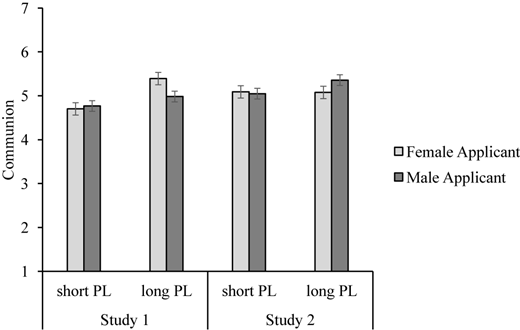
Communion ratings (M, SE) based on applicant gender (female vs male applicant) and duration of parental leave (PL) indicated on CV (short: 2 months vs long: 12 months)
Communion ratings (M, SE) based on applicant gender (female vs male applicant) and duration of parental leave (PL) indicated on CV (short: 2 months vs long: 12 months)
Study 2. There was a multivariate main effect of applicant gender, F(2,284) = 3.43, p = 0.034, η2 = 0.024, but no multivariate main effect of duration of parental leave, F(2,284) = 1.85, p = 0.160, η2 = 0.013, and no significant interaction, F(2,284) = 1.50, p = 0.225, η2 = 0.010, on the two subscales of communion, namely warmth and morality. Interestingly, the male applicant was overall judged as more communal than the female applicant, which is not in line with the expected gender stereotypes. This effect was driven by the high ratings of the father who took long parental leave. Planned contrasts revealed that the male applicant with a long parental leave was judged significantly more communal than the male applicant with a short parental leave, warmth: d = 0.34, 95% CI [0.05; 0.62], p = 0.022; morality: d = 0.28, 95% CI [0.01; 0.55], p = 0.044; no such difference emerged for the female applicant, warmth: d = 0.04, 95% CI [−0.26; 0.33], p = 0.804; morality: d = 0.06, 95% CI [−0.34; 0.22], p = 0.657. Results are displayed in Figure 1. Including the covariates did not change the results. Hypotheses 2a, 2b and 2c were not supported, as the results pointed in the opposite direction with small effect sizes (Steyn and Ellis, 2009). The additionally exploratively calculated Bayes factors provide moderate support in favor of the null hypothesis.
Job fit
Study 1. There was no main effect of applicant gender, F(1,146) = 0.01, p = 0.933, η2 < 0.001, no main effect of duration of parental leave, F(1,146) = 0.16, p = 0.689, η2 = 0.001, and no significant interaction, F(1,146) = 0.17, p = 0.679, η2 = 0.001, on job demand-ability-fit. Including the covariates did not change the results. Hypothesis 3 was not supported. The additionally exploratively calculated Bayes factors provide moderate support in favor of the null hypothesis.
Study 2. There was no main effect of applicant gender, F(1,285) = 0.17, p = 0.679, η2 = 0.001, no main effect of duration of parental leave, F(1,285) = 0.89, p = 0.346, η2 = 0.003, and no significant interaction, F(1,285) = 1.21, p = 0.272, η2 = 0.004, on job demand-ability-fit. Including the covariates did not change the results. Hypothesis 3 was not supported. The additionally exploratively calculated Bayes factors provide strong to moderate support in favor of the null hypothesis.
Discussion
Gender roles and associated social expectations exert a strong influence on the perception of women and men in both the family and work context. As role expectations (and to some extent gender stereotypes) are changing, the perception of working mothers and fathers may also undergo a transformation (Eagly et al., 2020). Against this background, we investigated whether typical gender stereotypes (still) matter during the hiring process. More specifically, we examined whether the duration of parental leave influenced the assessment of female and male job applicants regarding the ascription of agentic and communal attributes as well as perceived job demand-ability-fit as an additional more explorative dependent variable. Overall, our findings suggest that some aspects of gender-related role expectations – particularly those related to agency – may be shifting, whereas others – especially those related to communion – remain more resistant to change.
Agency and job fit
Across studies, we did not find any significant effects for agency and perceived job demand-ability fit. Our additional exploratory analyses using Bayes factors even provide moderate to strong evidence for the null hypothesis, suggesting that there may not be any backlash effects regarding agency and perceived job demand-ability fit. This suggests that, at least in the hiring contexts we examined, mothers and fathers were evaluated as similarly competent and assertive regardless of how long they took parental leave. These results align with the idea that in more gender-equal societies such as Germany, where vertical segregation has decreased, agentic stereotypes are also weakened as a result (Eagly et al., 2020). When women and men increasingly share access to high-status, agentic roles, stereotypes about their competence and assertiveness should converge (Kosakowska-Berezecka et al., 2022). Germany scores relatively high on gender gap indices such as the GGGI; therefore, agentic stereotypes may have weakened because both genders are seen as capable of occupying high-status, agentic roles. Our null effects on agency and job fit suggest that evaluators may no longer assume that mothers are less agentic or less capable.
Communion
In contrast, our findings show gendered expectations around communion, but in asymmetric ways: Mothers taking short leave were rated as less communal than mothers taking long leave (Study 1), while fathers taking long leave were rated as more communal than fathers taking short leave (Study 2). The observation in Study 1 that mothers received lower communion ratings when taking shorter vs longer parental leave (which may be interpreted as agentic behavior) could be either a backlash effect for short leave or a bonus effect for long leave. As previous studies have shown, women are usually rated higher in communion than men (e.g. Asbrock, 2010). Due to the fact that we did not find a difference between mothers and fathers for short parental leave, it seems plausible to interpret our findings as evidence for a backlash effect rather than evidence for a bonus effect. This interpretation is consistent with the notion that horizontal segregation – women's continued overrepresentation in caregiving roles – sustains strong communal expectations for women even in highly gender-equal societies (Charmes, 2019).
Study 2 revealed a complementary pattern: fathers who took long parental leave received a communality bonus, being rated as more communal than fathers who took short leave. The means in Study 1 point in the same direction, yet the difference is not statistically significant, potentially due to the smaller sample size. This indicates that men can get more credit for communal behavior in the work context than women. This matches prior research showing that men are often rewarded for communal behavior because it is seen as “above and beyond” their expected role, whereas women are penalized for the same behavior because it contradicts their prescribed role. Therefore, women are more likely to experience a motherhood penalty in the work context than men to experience a fatherhood penalty; on the contrary, male careers may even benefit from having children (cf. Fleischmann and Sieverding, 2015).
In sum, mothers who behave in ways that signal agency (short leave) violate communal expectations, which may result in a backlash effect. Instead, fathers who behave communally (long leave) violate agentic expectations in a positive direction, which may result in a bonus effect. This asymmetry is in line with biosocial construction theory (Wood and Eagly, 2012), which argues that gendered divisions of labor create stronger and more rigid communal expectations for women than for men, making women more likely to be penalized for agentic deviations while men are more likely to be rewarded for communal ones.
The malleability of gender stereotypes
We would like to point out that the effects on communality ratings were rather small (comparable in size with similar studies such as Fleischmann and Sieverding, 2015) and stress that there were no effects regarding agentic traits or job fit. Taken together, these findings illustrate an important theoretical distinction: agentic stereotypes appear to be changing more rapidly than communal stereotypes. This is in line with previous research demonstrating that gender stereotypes and associated consequences are (at least slightly) shifting in our present-day societies (e.g. Fleischmann and Sieverding, 2015; Krstic and Hideg, 2019). As social role theory predicts, reductions in vertical segregation may lead to more equal perceptions of agency between women and men. However, because horizontal segregation in caregiving roles persists even in highly gender-equal societies, communal expectations remain gendered. Consequently, women may still be penalized for non-communal behavior, whereas men may be rewarded for communal behavior. Regarding agentic attributes, women and men were evaluated similarly in this research; in other words, they were judged equally competent and assertive, no matter how long they went on parental leave. However, communion ratings varied for mothers and fathers, suggesting that women still pay a price for showing role-incongruent behavior, as they become less likeable, whereas men become more likeable when they show communal behavior. While the former is bad news for the possibility to change the traditional female gender stereotype, the latter is good news for the possibility to change the traditional male gender stereotype by integrating the picture of a caring father (cf. Banchefsky and Park, 2018).
Limitations and future research directions
While this research has several strengths (e.g. replication with an independent sample, diverse participants in terms of age and work experience, use of validated measures), we still caution against an overinterpretation of our results. We found evidence for two different effects. The effect sizes were rather small, and the majority of the findings were null effects. Thus, more research (potentially with larger sample sizes to detect small effects) is needed to further examine the research questions.
We specifically focused on the job application process, namely written applications in form of a CV. Even if backlash effects (or other effects that may lead to discrimination) might play a (minor) role in the hiring context we examined, this does not imply that they do not occur at different career stages (e.g. promotions and salary increases). In fact, there is ample evidence demonstrating such effects (e.g. Bark et al., 2021; Prentice and Carranza, 2002; Rudman et al., 2012a). Further, our investigation was limited to two professional fields in which women and men have been shown to be equally represented. It is possible that the results would be different for other work environments, particularly in strongly male or female dominated occupations, as gender job segregation has increased rather than decreased over the last decades (cf. Seguino and Braunstein, 2019). Also, the two job descriptions differed in terms of the required level of qualification (graduate vs assistant), which might have influenced the results.
The two studies were based on fictious job advertisements and résumés, and the samples consisted of people who were not specifically working in the HR context. It may be that lay people differ in their judgments of applicants compared to HR experts. A field study with people working in HR and real job advertisements and applications may examine these effects in an applied context. Also, only some of the participants in both studies had children themselves (Study 1: 19.3%, Study 2: 51.2%). Having children might change people's point of view toward agentic and communal attributes of women and men, and thus, their evaluation of people in the work context. This remains subject of future research.
As this research was conducted in Germany, results may vary across countries and cultural contexts. Both studies were based on convenience samples (Study 1: social media snowball recruitment; Study 2: online participant panel), which were younger and higher educated than the general population. Note, however, that we recruited a slightly older sample with more work experience for Study 2 and that the results of the study are by and large compatible, indicating at least a certain degree of robustness. Nevertheless, we strongly encourage additional studies with more diverse samples in different cultural contexts to increase the generalizability of the results.
Unfortunately, we cannot rule out social desirability effects. As gender stereotypes concerning agency have become less pronounced over time (at least in Germany and comparable countries regarding vertical segregation), participants might perceive it as not socially acceptable to report attitudes that may lead to backlash effects (e.g. rating women lower on agency or as less hirable when they take longer parental leave). However, we tried to minimize the risk of social desirability, by choosing a between subjects-design and using a cover story that did not take reference to gender or parental leave. Therefore, participants were unaware of the dimensions of interest. Nevertheless, contemporary norms may reduce people's willingness to express blatant stereotyping even if implicit evaluations persist (Dovidio et al., 2016).
Finally, the focus of this research was not on comparing non-parents and parents, but on how mothers and fathers who apply for a new job after taking parental leave may be evaluated differently during the hiring process based on their gender and associated role expectations. Nevertheless, future research may want to include an additional control group to gain deeper insight into the perception of agency and communion of different status groups (e.g. men and women who are not parents and therefore took no parental leave or even non-parent vs parent with no parental leave).
Conclusion and practical implications
These limitations notwithstanding, the present research highlights the importance of examining social psychological phenomena in work and organizational contexts, especially regarding implications of gender stereotypes. Our findings provide evidence of differential trait attributions for mothers and fathers, which might have potential downstream implications. In sum, our results suggest that gender stereotypes are evolving asymmetrically. Evaluations of competence and agency appear increasingly gender-neutral, at least in Germany, reflecting broader societal changes in labor force participation and leadership representation. Yet expectations surrounding communion remain more resistant to change, continuing to shape perceptions of mothers and fathers in subtle but meaningful ways. This pattern highlights both progress and remaining challenges in the pursuit of gender equality in the workplace, the scope of which likely depends on various context factors. Hope remains that the influence of gender stereotypes and social role expectations on the evaluation of women and men in the work context may further decrease over time and generations, to increase the chance that hiring decisions are the result of nothing but professional qualification.
The authors would like to thank Jacqueline-Eve Mülhaupt for her assistance in preparing and conducting Study 1. Special thanks to Dr. Christoph Mengelkamp for his advice on the Bayes Analyses.
Appendix
As recommended by the developers of the scale (Abele et al., 2016), agency was computed as the mean of ten items, including assertiveness (AA) and competence (AC), while communion was computed as the mean of the ten items including morality (CM) and warmth (CW). Further, item-level scores were averaged within each subdimension, calculating the mean of the five items per subscale. Higher values indicated greater perceived agency or communion respectively.
Subdimensions of the agency-communion-inventory (AC-IN; Abele et al., 2016) in German and English with item-level scores of Study 1 and Study 2
| Subdimension | German item wording | English item wording | Item-level score study 1 | Item-level score study 2 |
|---|---|---|---|---|
| Bitte geben Sie an, wie sehr die folgenden Eigenschaften Ihrer Meinung nach auf den Bewerber/die Bewerberin zutreffen. Die Person ist … | Please indicate to what extent you think the following characteristics apply to the applicant. The person is … | M (SD) | M (SD) | |
| CW | wenig fürsorglich – sehr fürsorglich | little caring – very caring | 5.10 (1.35) | 5.28 (1.11) |
| CW | wenig liebevoll – sehr liebevoll | little affectionate - very affectionate | 4.90 (1.27) | 5.04 (1.11) |
| CW | sehr kühl in Beziehungen zu anderen – sehr herzlich in Beziehungen zu anderen | very cold in relations with others – very warm in relations with others | 4.86 (1.17) | 4.88 (1.06) |
| CW | wenig einfühlsam – sehr einfühlsam | little empathetic – very empathetic | 4.86 (1.17) | 4.96 (1.04) |
| CW | sehr unfreundlich – ehr freundlich | not at all friendly – very friendly | 5.25 (1.09) | 5.41 (1.00) |
| CM | ungerecht – gerecht | unjust – just | 4.83 (1.13) | 5.02 (1.01) |
| CM | wenig fair – sehr fair | little fair - very fair | 4.81 (1.03) | 5.03 (1.03) |
| CM | sehr rücksichtslos – sehr rücksichtsvoll | very inconsiderate - very considerate | 4.87 (1.16) | 5.00 (1.08) |
| CM | wenig zuverlässig gegenüber anderen – sehr zuverlässig gegenüber anderen | not very reliable - very reliable | 5.14 (1.12) | 5.34 (1.04) |
| CM | nicht vertrauenswürdig – sehr vertrauenswürdig | not trustworthy – very trustworthy | 5.29 (1.14) | 5.51 (1.05) |
| AC | wenig intelligent – sehr intelligent | little intelligent - very intelligent | 5.46 (1.10) | 5.08 (1.01) |
| AC | wenig kompetent – sehr kompetent | little competent - very competent | 5.42 (1.21) | 5.60 (0.95) |
| AC | wenig effizient – sehr effizient | little efficient - very efficient | 5.17 (1.15) | 5.29 (1.01) |
| AC | wenig clever – sehr clever | little clever – very clever | 5.09 (1.14) | 5.00 (0.98) |
| AC | wenig leistungsfähig – sehr leistungsfähig | little capable - very capable | 5.31 (1.19) | 5.30 (1.09) |
| AA | fühlt sich unterlegen – fühlt sich überlegen | feel very inferior – feel very superior | 4.35 (0.98) | 4.29 (0.92) |
| AA | gibt leicht auf – gibt nie leicht auf | give up very easily – never give up easily | 5.09 (1.12) | 4.96 (1.16) |
| AA | nicht selbstsicher – sehr selbstsicher | not at all self-confident – very self-confident | 5.30 (1.17) | 5.26 (1.05) |
| AA | ist kein Führungstyp – hat Führungs-eigenschaften | have no leadership abilities at all - have leadership qualities | 4.53 (1.32) | 4.35 (1.22) |
| AA | kann Druck nicht standhalten – kann Druck gut standhalten | go to pieces under pressure – stand up well under pressure | 5.09 (1.20) | 5.06 (1.11) |
Note(s): All items were answered on a 7-point bipolar Likert scale
Note
This deviates from the preregistration, in which we planned to conduct ANOVAs for all DVs. However, including the two subfactors of agency and communion allows to draw more differentiated conclusions. Thus, we decided to run MANOVAs instead and to report the multivariate as well as the univariate effects.

