Users in the household sector innovate regularly, but lack incentives to spread their innovations. A recent insight is that diffusion effort can be intrinsically motivated: to confirm an aspired social identity. Yet, previous studies have likely overlooked some identity concepts relevant for diffusion, and users' diffusion effort seems more intricate than the main pathways of sharing and commercialization.
We studied users' aspired identities and diffusion behaviors in more detail. Our empirical context was the community of K-pop fans, where users innovate and disseminate innovations for a variety of reasons. Seventeen in-depth interviews were done and analyzed with the Gioia methodology.
Four identity concepts were found: handyman, buddy, contributor and professional. These are associated with different diffusion efforts. Free sharing is unraveled into passive showcasing, active assistance and proactive dissemination. Commercial diffusion starts with informal attempts to sell, while venture creation or licensing innovations to producer firms are rare and considered only later.
Our findings should be replicated in other contexts and validated with quantitative data. Yet, our study informs continued theorizing about the antecedents of various forms of diffusion effort and the associated identities of user innovators.
Practitioners should account for the intrinsic diffusion motives of users. This will stimulate users to collaborate with commercial firms for product development, and their general willingness to spread innovations for everyone's benefit.
We unravel known diffusion pathways into subtypes that are more meaningful for users' diffusion effort. Previously undetected user identities (handyman, buddy) are associated with less pronounced diffusion efforts.
1. Introduction
Individuals in the household sector regularly innovate for themselves. So-called user innovations are developed by individuals to fix personal problems or needs. Users innovate a lot: estimates range from 4% to 6% of all citizens, which is millions of people (de Jong and von Hippel, 2023). In contrast, producer innovations are developed by commercial firms to generate income (von Hippel, 2005). User and producer innovation are complementary paradigms explaining why and how innovations emerge (von Hippel, 2017). Importantly, user innovations are often valuable to others, and this implies that their diffusion is merited (von Hippel, 2005). Diffusion can be accomplished by sharing (users freely reveal innovations to other people without immediate compensation) or commercialization (users start businesses, or license their innovations to existing producers for general sale) (de Jong et al., 2015; Hyysalo et al., 2017; Yu, 2022).
Unfortunately, users do not spread their innovations as much as would be optimal for societal welfare (von Hippel, 2017). As users innovate for themselves, or occasionally, for the enjoyment derived from the innovation process (Raasch and von Hippel, 2013), adoption by other people is an externality to them (de Jong et al., 2015). Lacking incentives causes a diffusion shortfall that, for example, deprives rare disease patients from adopting new user-developed treatments (Oliveira et al., 2015) or sustainability enthusiasts from getting their hands on clean energy technologies (Hyysalo et al., 2017).
In the past decade, researchers started investigating what diminishes the diffusion problem (de Jong et al., 2021). Initially, they applied economic reasoning, arguing that users require compensation (e.g. money) before they will diffuse (de Jong et al., 2015; von Hippel, 2017). This explains users' commercialization behavior, but not other alleviating factors such as community involvement (e.g. Franke and Shah, 2003; Ogawa and Pongtanalert, 2013) or advancement of a common cause (e.g. Jeppesen, 2021; Ornetzeder and Rohracher, 2006), which make users freely reveal innovations. More recently, scholars proposed a unifying framework that captures all known alleviating factors, based on social identity theory (Yu and de Jong, 2024). The framework suggests that spreading innovations enables users to signal part of themselves, such that sharing or commercialization confirms their aspired identity. Applying this perspective Yu and de Jong (2024) found that users striving for a professional identity are more likely to commercialize, while community-oriented and societal identities are associated with free revealing.
Despite these advancements, questions remain. First, it is uncertain if previous studies covered the full spectrum of social identities relevant for diffusion. Aforementioned alleviating factors and their corresponding identities are probably easiest to observe, as they result in new businesses (e.g. Shah and Tripsas, 2007), thriving community innovations (e.g. Franke and Shah, 2003) and accelerated common causes (Jeppesen, 2021). An identity perspective, however, leaves space for concepts associated with potentially less observable diffusion behaviors – Yu and de Jong (2024) already acknowledged this, speculating about do-it-yourself hobbyists who showcase their solutions but refrain from more active diffusion behaviors.
Second, the pathways of sharing and commercialization are probably more intricate behaviors. Theoretically, it has been proposed that diffusion requires users to inform other people, develop clear documentation and improve their designs to ease adoption (von Hippel, 2017). In a recent case study of medical nurses, various of these behaviors were found to stimulate diffusion: demonstrations, improving prototypes, building copies for other users and negotiations with producers and entrepreneurs (de Jong et al., 2023). These observations suggest that diffusion effort may be unraveled more, with potential implications for adoption and differentially related to users' aspired identities.
In this article, we report an initial and explorative study to address these challenges. To unravel users' social identities and diffusion behaviors, we applied Gioia et al.’s (2013) method, which enables in-depth exploration of phenomena for the sake of theory building and future measurement. Our research question was: What social identities are associated with how users disseminate their innovations? This question enabled us to inductively explore the social identities of user innovators and the associated variety in diffusion behaviors.
We conducted our theory building exercise by developing a single case study – a common practice in user innovation research to initially explore phenomena (e.g. Franke and Shah, 2003; Shah and Tripsas, 2007; Dahlander and Frederiksen, 2012). Our empirical context was the community of Korean pop music (K-pop) fans who support bands like BTS and Blackpink. As in most hobbyist communities, K-pop fans frequently develop user innovations like personalized outfits, banners, hats, online content like remixes and choreographies, and lifestyle principles related to food preferences and home decoration. Fans also regularly reveal or commercialize their innovations for miscellaneous reasons, including personal advantage, community advancement and broader societal influence (i.e. growing the influence of K-pop beyond community borders) (Kang et al., 2022). Frequent user innovation and diffusion via both pathways made this setting highly relevant for our purposes.
Drawing on in-depth interviews with K-pop user innovators, we found four identities associated with diffusion effort: handyman, buddy, contributor and professional. Users aspiring to a handyman identity strived for an image of a technically competent person. Buddy identity refers to users who want to maintain and deepen relationships with their close ties by offering authentic contributions. Contributor identity implied that users strived to develop the broader community and relationships with previously unknown fans. Professional identity was pursued by users cultivating a professional image by offering valuable items that meet commercial market standards. Next, we observed more refined diffusion efforts associated with different identity concepts. Free sharing was sometimes only passive showcasing (handyman), but it could also be active assistance to copy innovations (buddy), or offering proactive instructions to facilitate adoption (contributor). Also, we found that commercialization started informally: users who strived for a professional identity initially replicated innovations for a fee, or sold these online. Starting a business was only considered for later. While informal selling has been recognized previously (Hamdi-Kidar and Vellera, 2018), our findings confirm that it is an important step in the process from user innovation to commercial product offering. Finally, we did not find a societal identity concept that earlier work has shown to exist (e.g. Jeppesen, 2021). Obviously, our tight empirical context put limits on external validity (Eisenhardt and Graebner, 2007; Yin, 2018). We recommend replication in other contexts (e.g. communities that advance a common cause) and quantitative follow-up studies to continue investigating how aspired social identities influence the extent to which the benefits of user innovations are fully reached.
2. Literature review
In this section, we discuss existing insights on user innovation, diffusion effort by user innovators and their related social identities. In general, the Gioia method counsels being semi-ignorant about previous literature to avoid overlooking new insights (Gioia et al., 2013; Magnani and Gioia, 2023). Hence, our purpose with this section is to clarify our frame of reference when we started our exploration.
2.1 User innovation
Dominant perspectives on innovation have traditionally focused on producers. By definition, producer innovators require adoption by others in order to benefit from their innovative efforts (von Hippel, 2005). Examples are early Schumpeter (1934), who emphasized radical innovations by entrepreneurs and start-ups, and later Schumpeter (1942), who highlighted R&D in large firms. Both views situate innovation within producers, who supply products to markets. Subsequent models, from the linear model (Bush, 1945) and demand-pull approaches (Rothwell, 1992) to the chain-link (Kline, 1985) and doing-using-interaction model (Jensen et al., 2007), similarly placed producers at the center.
User innovation is an alternative perspective on how innovations emerge: practiced by individuals or firms who seek to benefit primarily from use rather than sale (von Hippel, 2005). User innovation differs from producer innovation in terms of the aforementioned purposes: primarily developed to satisfy a personal or internal need, not to sell. They can exist because heterogeneous user needs often go unserved by standardized producer offerings, so that some users at the edge of markets feel urged to develop solutions themselves (von Hippel, 2005). Alternatively, some user needs remain completely uncovered, and initial user innovation activity may result in new industries (e.g. Shah and Tripsas, 2007).
Another difference is that user innovations tend to embody a different kind of knowledge. Users possess superior “need information” and context-specific experience, which are often difficult to transfer (von Hippel, 1994). This positions users to develop functionally novel innovations, as seen in mountain biking equipment (von Hippel, 2005). Producers, in contrast, hold stronger “solution information”—technical, engineering and marketing capabilities – leading more often to incremental improvements (Riggs and von Hippel, 1994). The difficulty of transferring their need information and lack of solution information amplifies the diffusion problem that users lack incentives to spread their innovations (de Jong et al., 2023).
Moreover, not all user innovations are as valuable to other people and worth dissemination (de Jong et al., 2015). Particularly so-called lead users, defined as users who have strong needs and are ahead of other people or organizations, are associated with the emergence of new industries and breakthrough products (von Hippel, 2005; de Jong et al., 2024).
Especially for user innovations in the household sector, producers are one of the key actors to overcome the diffusion problem, and benefit from the innovation potential of users simultaneously (Franke and Lüthje, 2020). For this purpose producers may deploy various methods, including the lead user method to actively search for users with strong needs who are ahead of a trend (Lilien et al., 2002), innovation toolkits to outsource design tasks to users (von Hippel and Katz, 2002), crowdsourcing challenges to an appropriate crowd of external problem solvers (Poetz and Schreier, 2012), and building knowledge sharing platforms for users develop and share innovations (Ma et al., 2019).
2.2 The varied nature of users' diffusion effort
In practice producers' ability to absorb user innovations is limited (von Hippel, 2005, 2017), and overcoming the diffusion problem requires that users put effort into spreading their innovations. The literature considers sharing and commercialization as the two main diffusion pathways (von Hippel, 2017). Sharing implies that users openly reveal their creations for others to inspect and replicate, without asking for any compensation. Although this may seem irrational, sharing can make sense for multiple reasons, including reciprocation to those who helped develop the innovation (Ogawa and Pongtanalert, 2013) or anticipated improvements that adopters will develop and share in return (Harhoff et al., 2003). Users may also be intrinsically motivated to share, following their aspired identity (see hereafter). Likewise, commercialization implies that users try to generate income or obtain other personal benefits from diffusion. They may do so by starting businesses to sell their innovations (Shah and Tripsas, 2007) or license innovations to producers, who then take care of further commercialization (e.g. Nishikawa et al., 2013).
Several observations from past studies suggest that the distinction between sharing and commercialization can be unraveled further. In the aforementioned study of nurses, free sharing included a range of behaviors (de Jong et al., 2023). For example, an initial step was that nurses demonstrated their innovations so that adopters could observe their potential benefits, but some innovations were also improved to ease replication, or free copies were handed out to other nurses to try. Next, studies have proposed multiple definitions of what free sharing entails. In their early analysis of industrial user innovations, Harhoff et al. (2003) defined free revealing as giving access to all interested parties of innovation-related information, e.g. “placement of non-patented information in a publicly-accessible site such as a journal or public website” (p. 1754), so that the innovation effectively becomes a public good. In later studies of user innovators in the household sector, the definition of what constitutes free revealing became more lenient, i.e. publicly using innovations without a detailed documentation requirement (de Jong et al., 2015). In general, previous studies looked in detail at the type of assistance that users receive freely from other people (e.g. Franke and Shah, 2003; Lüthje et al., 2005) but did not zoom in on different sharing behaviors.
Likewise, commercialization seems to include a variety of behaviors as well. For example, it requires a continued development effort, as the solutions that users develop for themselves are not yet professionally designed (von Hippel, 1994; Riggs and von Hippel, 1994). Broad commercialization also requires improved and more reliable versions of an initial prototype. Next, some users engage in commercialization in parallel with satisfying their personal needs (de Jong et al., 2015), while others recognize commercial opportunities only after interacting with people in their environment (Shah and Tripsas, 2007). Finally, commercialization requires that regulatory requirements are met, e.g. related to safety, liability and sustainability, which is an extra challenge to commercialize (Torrance and von Hippel, 2015).
In all, sharing and commercialization may include a range of behaviors, which are important to identify as various behaviors may have different effects on diffusion outcomes (de Jong et al., 2023). A refined overview based on inductive research is missing, and our study of K-pop users sought to address this omission.
2.3 Social identity and behavior
Originating from social psychology, identity studies link individual behavior to aspired social identity, i.e. people's subjective understanding of who they are and want to be, and how they perceive their place in society (Brown, 2015). Central to identity perspectives is eudaimonic motivation, which is a specific kind of intrinsic motivation (Waterman, 2004). Eudaimonic motivation implies that people act in line with their “daimon” or aspired true self (Ryan and Deci, 2001). It differs from hedonic intrinsic motivation, which is associated with behaviors that provide immediate satisfaction, like partying or traveling, but that do not define the aspired self (Waterman, 2004). In past research hedonic motivation has been associated with user innovation emergence, as users sometimes highly enjoy the process of innovation (Raasch and von Hippel, 2013; Stanko and Allen, 2022). Yet, hedonic motivation is not related to users' diffusion effort (von Hippel, 2017). In contrast, eudaimonic motivation provides (some) users with a reason to diffuse, as it helps them to signal their true self and reach self-actualization (Yu and de Jong, 2024).
The social identities that individuals aspire to can be described along three dimensions: 1. Basic social motivation, 2. Basis of self-evaluation, and 3. Frame of reference (Brewer and Gardner, 1996). Basic social motivation refers to the needs and desires that lead people to create and retain specific identities in a social context, in line with their eudaimonic motivation. Basis of self-evaluation is the criteria that people apply to measure their own value and assess their self-worth in a social context. The frame of reference is the benchmark by which individuals determine if they are successful in reaching their identity-related purposes.
Moreover, identity perspectives recognize that individuals may pursue identities at various levels of social inclusiveness, including the (a) personal, (b) relational and (c) collective level (Turner and Oakes, 1986; Brewer and Gardner, 1996). The personal level represents the part of the self that distinguishes individuals from others. It is the narrowest level of social inclusiveness, where individuals regard themselves as a unique entity, and act in terms of individual goals and ambitions. Next, the relational level is about the part of the self that is derived from relationships in a social network. It is the intermediate level where individuals regard themselves as group members and behave in line with group norms and values. Finally, the collective level is the part of a self-concept formed by partaking in larger, impersonal groups. It is the broadest level where individuals think of themselves as part of society and act with concern for impersonal others.
The pursuit of different identities explains why people's behavior may strongly vary with the circumstances. An example is a physician in an academic hospital who at work publicly advocates and publishes about healthy behaviors (collective level), but violates these behaviors in his leisure time while hanging out with good old friends (relational level).
2.4 Identities associated with the diffusion of user innovation
In previous research, three types of aspired identity have been associated with diffusion behavior (Table 1). These identities correspond with the alleviating factors of the diffusion problem that user innovation scholars have identified until now: economic benefits (de Jong et al., 2015), reciprocity and willingness to contribute to user communities (e.g. Ogawa and Pongtanalert, 2013), and common cause motivation (Jeppesen, 2021).
Users striving for a professional identity are eager to demonstrate that their innovations meet competitive standards. Obtaining private benefits like sales revenues or developing an expert reputation helps them to be the person they want to be – it signals their aspired professionalism. Hence, they are more likely to put effort into commercialization. Community-oriented identity implies that users want to maintain relationships with an ingroup of like-minded others. They want to make authentic and useful contributions to obtain recognition from their social ties, and are more likely to freely share their innovations. Finally, societal identity implies that users want to be known as someone who contributes to a common cause, like energy saving or alleviating poverty. These users find it important to demonstrate responsible behavior and do good. They prioritize the impact of their innovation on society and are likely to share as well (Yu and de Jong, 2024).
Although these identities nicely capture the insights from previous studies, we are not sure if they cover the full spectrum of identity concepts relevant for users' diffusion behavior. The contents of Table 1 were based on their analogy with previous work, but basically only summarize factors that were already known (i.e. commercial motivation, community involvement and common cause advancement), while other identity concepts may be present with a different relationship with diffusion effort. In our study of K-pop fans, we conducted bottom-up research to explore this matter.
3. Methods
3.1 Empirical context
For our exploration of diffusion behaviors and related identities, we conducted a case study in the community of Korean pop music (K-pop) fans. These are known for their severe loyalty and active participation in supporting bands like BTS, Exo, Twice and Blackpink. They stream music and videos, attend concerts, buy merchandise and engage in online discussions. Many of them are enrolled in fan clubs like Army (BTS), Exo-L (Exo), Once (Twice) and Blink (Blackpink). Fans also organize themselves into geographically bounded groups and participate in projects and charity initiatives to support their idols (Kang et al., 2022). For example, they undertake collective action to ensure their idols top the charts or win awards (Blake, 2018; Ming, 2017).
The empirical context of K-pop was a good match with our theory-building purposes. In general, single case studies well capture the richness of phenomena and are powerful to explore new constructs, categories and relationships – also because confounding variables that would occur in cross-context settings are avoided (Eisenhardt and Graebner, 2007; Yin, 2018). K-pop was particularly suitable because fans frequently develop user innovations and regularly diffuse these by freely sharing and/or commercializing them. Having a strong desire to stand out (Alberto and Guerra, 2020), they develop personalized objects (e.g. outfits, banners, hats, artwork) and behavioral innovations (von Hippel and Cann, 2021) like remixes, dance moves and even lifestyle principles. Vice versa, from an adopter perspective, fans like to collect memorabilia to create and cherish personal memories and stay connected with like-minded others. They regard collected objects (like apparel and other items) and behaviors (like the ability to perform new dance moves) as emotionally meaningful (Jenol and Pazil, 2020). In effect K-pop fans are part of a unique participatory culture where the creation and dissemination of user innovations is common: “K-pop fandom activities play substantial roles in the perception of their members, e.g. sense of belonging as a community or passion for the band” (Kang et al., 2022: p. 1486). Moreover, being severely loyal and active fans, interviewees were willing and eager to discuss their innovations, and their considerations to diffuse – we could anticipate lots of user innovations disseminated for identity-related reasons.
Obviously, while a tight empirical context offers the advantages of detailed exploration and high internal validity, it is at the expense of immediate generalization (Eisenhardt and Graebner, 2007; Yin, 2018). Hence, our study offers a theory-developing contribution that opens the door for later cross-context testing, as we will elaborate in our discussion (section 5).
3.2 Participants
We conducted in-depth interviews with user innovators. Our interviewees were fans of BTS and Blackpink, two of the most famous K-pop groups. Our aim was not to capture a representative sample of all user innovators, but to focus on those who had somehow disseminated their user innovations. Hence, we applied a purposive/theoretical sampling logic (Patton, 2002), identifying interviewees who had clear signals of dissemination activity (e.g. providing tutorials, sharing copies, selling innovations online). In this subset, identity aspirations were likely more salient, making them particularly suited for theory development (Eisenhardt, 1989).
As a rule of thumb, interviewees should be sought from various sources to maximize data variance (Patton, 2002). Hence, we ensured that the full spectrum of potential diffusion activities was covered (Goffin et al., 2019). We searched for K-pop fans who had either shared or commercialized their innovations, so that both diffusion channels were covered. First, we conducted an online search on dedicated fan sites (e.g. usbtsarmy.com), knowledge-sharing platforms (e.g. Printables, Thingiverse) and online sales platforms (e.g. Etsy) for original K-pop items that individuals had shared or offered for sale. It was helpful that the first author of this article was a seasoned K-pop fan and very knowledgeable. Second, the first author visited local club events and searched online communities where fans presented, shared or discussed innovations (e.g. Reddit, TikTok). Here, we also piloted our interviewing questions with a few K-pop fans to check if useful data could be obtained (Goffin et al., 2019). Altogether, our initial search resulted in a database of 80 interview prospects, which included descriptions and links to the items that had been disseminated.
Before we started interviewing, we contacted our prospects by e-mail or in an online call to verify if they were user innovators. In line with previous studies we applied various screening criteria (de Jong and von Hippel, 2023): if the individual had truly created the item and not copied it from other fans or bought it from the shelf; if the individual had developed the item primarily for personal use; and if the item was not created on behalf of an employer or business, but truly in their leisure time (to avoid producer innovations). Table 2 provides details of 17 K-pop user innovators that we interviewed eventually.
Interviewees had diverse backgrounds, with many being community members for some time already. Most of their innovations were related to physical objects, but some had developed behavioral innovations. Their demographics resonated with the general characteristics of K-pop fans, i.e. mostly young female adults (Blake, 2018; Ming, 2017).
3.3 Procedures
Interviews were done remotely with videoconferencing. The average interview time was around 45 min. After each interview, a full transcript was created based on the audio recording.
First, we established rapport by assuring confidentiality and asking for details about the interviewee's user innovation. Next, in line with our research purposes, we elaborated on how interviewees had diffused their innovation, and asked questions to identify any aspired identity. Our script included five main topics: (1) K-pop involvement and the user innovation that had been developed (to establish rapport), (2) diffusion effort (how precisely users had disseminated their innovation, what kind of behaviors and activities), (3) basic social motivation (why users disseminated their innovation, what made them share and/or sell), (4) basis of self-evaluation (what made users feel their dissemination effort was successful, the kind of impression they would like to leave on adopters) and (5) frame of reference (outcomes that would make users feel successful in reaching their preferred impression, criteria by which they evaluated their effort).
As prescribed by Gioia et al. (2013), we slightly modified our interview questions while the data collection process evolved, in line with our emerging discoveries. For example, from the initial interviews, we learned that users' sharing effort was diverse, ranging from passive revealing to personally building copies for other fans. It made us expand our follow-up questions on this topic.
3.4 Analysis
We analyzed the interview data using Gioia's method, in which novel theoretical insights are based on an inferential process that starts with inductive reasoning and continues with systematically combining emerging field data with existing theory (Magnani and Gioia, 2023). We followed this process by carefully distinguishing between first- and second-order coding (Gioia et al., 2013).
The first-order coding resembled open coding in grounded theory research (Strauss and Corbin, 1998) and was fully interviewee-centric. We assigned codes respecting the interviewees' vocabulary, and made sure to avoid imposing existing theoretical concepts. Initial codes were cross-checked. When half of the interviews were done, both authors sat together to do an initial round of second-order coding (axial coding in grounded theory). Based on extensive back-and-forth discussion, first-order codes were combined into second-order themes, for which more researcher-centric and theoretical concepts were introduced (Gioia et al., 2013). Specifically, common themes were identified in how users had tried to disseminate their innovations, and in the identity dimensions of basic social motivation, basis of self-evaluation, and frame of reference. Existing literature helped us identify relevant themes, but we made sure not to overly impose existing theory on our data. For example, in the context of K-pop, we found no users who were primarily driven by societal considerations, as observed by Jeppesen (2021). Rather, all interviewees developed and spread innovations for more personal and community-oriented reasons. Also, when it came to diffusion effort, we found a few users who commercially diffused innovations by starting new businesses, and none had tried to transfer their innovation to existing producer firms. Instead, informal selling attempts were more common (see section 4). Likewise, we identified different types of sharing behavior, ranging from passive revealing to very proactive and elaborative forms of dissemination. Together, the first- and second-order coding helped us understand interviewees' lived experiences, and simultaneously, enabled a higher-level perspective required for informed theorizing about aspired identity and diffusion effort.
Emerging with the second-order analysis, we identified aggregate dimensions that helped us to explain and describe the identities that users aspire to when diffusing their innovations. Specifically, we found four types of identity: handyman, buddy, contributor and professional. Finally, we cross-checked our data structure by adding a few more interviews. While we searched for confirming and disconfirming evidence, we also had another researcher (not involved in our article, but knowledgeable of user innovation) review our evidence (Goffin et al., 2019). By that time, our insights became saturated. Our data structure is shown in Table 3.
4. Findings
4.1 Four types of identity
We identified four identities that users pursued when diffusing their innovations. Each was associated with a different kind of diffusion behavior. Table 4 provides a summary.
4.1.1 Handyman
The handyman type of identity refers to users who want to appear as competent do-it-yourselfers (DIYers). They were motivated to show their technical skills: “I wanted to showcase my skills in designing and producing innovations with the help of my 3days printer.” (#16).
Users who aspired to this identity based their self-evaluation on the level of technical sophistication of their innovations. They wanted to create astute items and be recognized for their handiness. Hence, they revealed their innovations for others to observe and admire. Amongst our interviewees, handyman users preferred a reputation of a knowledgeable DIYer, standing out with their innovations: “I want to be a competent DIYer who is providing more and higher-quality fan content.” (#7); “I want to be seen by others as a good developer, as I have been doing this for a while now, and I believe I have more than enough skills to be seen as one” (#17).
As a frame of reference, these users would compare their innovations with those of other fans. They found themselves successful when their creations were better designed: “I went to a concert, and looked at other fan-made banners, but none of them were as well-designed as mine, or had the same quality.” (#15); “I believe that my content is better than what is currently made available by other fans in the community.” (#7).
4.1.2 Buddy
The buddy type of identity was found with users who preferred to share innovations with friends in the K-pop community, to stand out and create value for them. Their motivation to diffuse emerged from their desire to maintain and deepen relationships: “I decided to share my creation with my friends and family because they are fellow K-pop fans and that way, I can foster a stronger relationship with them on something we all love.”(#4); “I shared it so that my friends could pursue new activities, but also to enhance our current relationships.” (#1).
As a basis of self-evaluation, buddy users preferred to make authentic and meaningful contributions to their friends. Being helpful and supportive was an important part of the impression they wanted to leave. They took pride in their social circle's perception of being resourceful: “I shared it because I wanted to provide something useful to my friends in the BTS community.” (#5); “I wanted to show my friends that we were doing something unique since no-one did anything like that at the time.” (#9).
Their frame of reference was the appreciation received from offering benefits provided to peers. Knowing that their innovations had been valuable made them feel good about themselves: “If people around me like my work I find myself successful. People close to me are the most important to me.” (#17).
4.1.3 Contributor
Contributor identity was pursued by users who wanted to align with and expand the broader community of K-pop fans. They tried to reach out to (formerly) unknown others. Contributors had a strong desire to associate and possibly collaborate with fans they did not know before. Diffusion, they believed, helped to promote the community and even K-pop music as such: “I decided to share it because I wanted to produce something that was not very common. It was an option that could reach more people all over the world and make them happy.” (#12).
Concerning self-evaluation, contributor-users wanted to deliver unique value to many others. Unlike the buddy type, they did not limit their efforts to friends but rather sought to cultivate an image of someone who has a positive influence and advances the whole community. For instance: “I want the community to see me as an authentic provider, who is changing the way the group is being viewed by others.” (#2); “I want to be seen as a good community member, as I make efforts to enhance the reputation of K-pop idols and their groups to other people.” (#5).
Not surprisingly, users with an aspired contributor identity were particularly sensitive to getting recognition. Support and encouragement from other fans beyond their close ties mattered a lot to them: “I thought my innovation was successful because other fans showed interest in it.” (#5); “I mostly pay attention to the comment section to see what other K-pop fans think of my work. I pay more attention when people make positive comments, than to any other variable.” (#2); “I find myself successful when people who use it give me positive feedback and tell me that they are happy.” (#12).
4.1.4 Professional
Professional identity applied to users who wanted their innovations to meet professional standards. Beyond technical sophistication, they improved their innovations to a level required to sell or obtain other personal benefits. Sales revenues were considered evidence of their professional capability. Professional users were also interested in finding future adopters, or obtaining followers from whom they could take advantage indirectly (e.g. as an online influencer): “I started spreading to profit from the [continued] development of this product and to build my 3D model portfolio.” (#14).
As for self-evaluation, professional users sought to match regular market standards. Their aspired identity revolved around their ability to design and offer competitive products. Hence, they put more effort into ensuring that other fans regarded their innovations as legitimate and worth payment: “I always pack my orders with stickers and a card with my professional information to be seen as a serious businesswoman.” (#12); I want to be seen as someone who choreographs and dances as well as a K-pop idol. (#9).
Looking at their frame of reference, professionals wanted to avoid looking amateurish but rather operate at the same level as commercial suppliers of K-pop items. They interpreted their performance based on customer validation, i.e. received orders, positive recommendations, and feedback that signaled professionalism: “I always believed that my product was as good as a professional one, and the statistics prove it.” (#14).
4.2 Relationship with diffusion effort
We observed dissimilar diffusion efforts by K-pop user innovators. Especially, free sharing could be unraveled more: it included showcasing, assisting, and instructing. Some users only showcased their innovations, which implied that they restricted themselves to using their innovations in public and/or posting online footage. Others put effort into replicating innovations for K-pop fans or provided active help when friends were interested but lacked the skills to build a copy themselves. Yet other users developed detailed instructions to address broader audiences, for example, by posting videos in which they explained step-by-step how to build their innovation.
The various sharing behaviors were associated with different identities. The handyman type was inclined to showcase innovations, but did not share further details or put effort into making adoption easy. Users with an aspired handyman identity proudly talked about their innovations in personal encounters or online, in their social media posts. Although handyman-users were not against adoption, it was not their primary purpose. Showcasing was enough for them: “I revealed this product to my fellow K-pop fans because I think I did a really good job at creating it from scratch. I couldn't find it online, and did it with materials everyone has at home.” (#4).
Buddy users were more active disseminators. They cared about actual adoption by their close ties, as this would signal that their contribution was meaningful and appreciated. These users not only showcased innovations but also shared details about how to replicate and offered assistance in doing so. Some even built copies for their friends: “If my friends want my creation, I feel like it is a success. If I can make them happy, then the time and skills that I spent are not wasted at all.”(#13).
Contributor users were sharing the most actively. Although personal assistance was less mentioned (which made sense to us, given the large number of potential adopters that contributors aimed for), they developed detailed instructions, posted design files on knowledge sharing platforms or recorded tutorials on how to replicate their innovation: “I want to be viewed by the community as someone who is ready to help create content which is readily available and that can be useful.”(#2).
If there was any commercialization behavior, we found that users initially tried to sell their innovations informally, and that many never passed beyond this phase. Few user innovators were running businesses, and none had contacted commercial suppliers to license their innovations. Instead, they were using informal and low-threshold channels such as online sales platforms (e.g. Etsy) or offering replication services to interested community members in exchange for a fee. This informal selling behavior was associated with users who aspired to a professional identity. Clearly, their diffusion effort had been highest, as prior to sales continued development was required to meet market and legal requirements, e.g. “I put in hard work to make it the best, to make my creation a real commercial product.” (#13). What was also interesting was that professionals were still very intrinsically motivated, and did not seek to maximize profits: “I also had a purpose to sell to turn my passion into a living.” (#13).
4.3 Grounded model
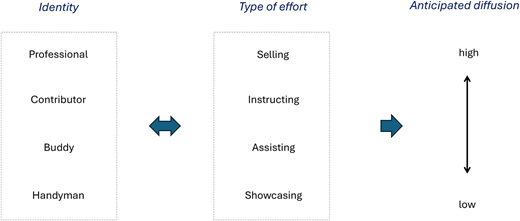
From our empirical findings, we inferred a grounded model of identity pursuit and related diffusion effort (Figure 1). This model visualizes the relationships between our second-order themes (Gioia et al., 2013; Magnani and Gioia, 2023). The identities that user innovators aspire to are associated with different kinds of diffusion effort.
We point out that user innovators in K-pop could aspire to multiple identities in parallel. For example, the combination of handyman and buddy was common amongst our interviewees. Some aspired to be a handy person but also cultivated a buddy image by assisting K-pop friends to copy their innovations (e.g. #4, #17). We also observed that contributors were inclined to personally replicate innovations for close friends - again, a buddy identity was pursued in parallel (e.g. #5).
Professional identity pursuit regularly appeared in combination with the contributor or buddy type. Professionals did not think of their innovations as rocket science that should be fully appropriated. Rather, they were happy to talk about their innovations and share details with interested community members (e.g. #12), or even provided detailed instructions or built copies for close K-pop friends (e.g. #9, #13). They still wanted to align with their close circle (buddy) or the broader community (contributor). Mixed identity types were associated with broader and more intense diffusion efforts.
We anticipate that the different types of identity and associated diffusion efforts will have implications for the extent to which actual diffusion will occur, as visualized at the right-hand side of Figure 1. Moreover, for users who do not aspire to any identity – the classical case of users who are innovating solely to address a personal need – we expect no diffusion effort at all (von Hippel, 2017). In our discussion, we will offer propositions to guide further research on these matters.
5. Discussion
Our explorative study of K-pop innovators showed that users' aspired identity concepts are more intricate than what has been identified before, and are associated with diffusion behaviors that can range from passive to very proactive. Hereafter, we first draw conclusions and offer propositions for continued research, then proceed with discussing our study's implications for theory and practice. Finally, we recognize our empirical setting was narrow, so that relevant identity concepts at the societal level of social inclusiveness may have been missed – we therefore end the article with suggestions about replication and validation.
5.1 Conclusions
Our study of K-pop fans uncovered four types of social identity: handyman, buddy, contributor and professional. These concepts are related to identity theory's personal and relational levels of social inclusiveness (Brewer and Gardner, 1996), as we indicated in the bottom row of Table 4. In addition, the four types provide a more fine-grained view of how aspired identities are related to users' diffusion effort, as we will explain hereafter.
We found two types of identity that users could pursue at the personal level. Professional identity was fully consistent with the past study by Yu and de Jong (2024). Some users made substantial efforts to spread their innovations in order to demonstrate that they could meet professional standards, signaled by adopters who found their innovations worth paying for. These were user innovators who pursued entrepreneurial opportunities, being motivated by the perspective of generating income (von Hippel, 2017). Yet, other users aspired to be a “handyman,” which is an alternative and previously undescribed type of identity at the personal level. Handyman-users only did a modest diffusion effort. To signal their handiness, public revealing or social media posts were sufficient. Although they wanted other people to know about their innovations, compared to professional users, their effort was less instrumental in accomplishing actual dissemination.
At the relational level of inclusiveness, we encountered another two types of aspired identity that we labeled as “buddy” and “contributor”. The buddy type derived self-worth from relationships with close others, to whom they would make authentic and meaningful contributions, while the contributor type was more cosmopolitan. These users wanted to reach out to the broad community (i.e. a broader relational level), deriving self-worth from standing out as a group member who added value to the community, which they believed would help to foster collective feelings of progress and togetherness. Particularly, the buddy type is a new insight compared to previous studies. Whereas Yu and de Jong (2024) hypothesized a single identity concept at this level, the buddy type in our study only assisted close ties to replicate innovations. Former studies were more in line with the contributor type, for example, when extreme sports practitioners reveal innovations to their peers (Franke and Shah, 2003), or when user innovators start to actively promote collective grassroots projects (Ornetzeder and Rohracher, 2006). We only found one previous mention of user innovators in the household sector that resembled with the buddy type: in a nonpublished study of citizens in Finland, some users indicated they only wanted to share innovations with close friends, but not beyond (Kuusisto et al., 2013).
Bearing in mind that our study was explorative, replication studies are recommended to validate our findings (Gioia et al., 2013). For continued research, we suggest that distinguishing between various types of identity is important to understand what intrinsically motivates users to diffuse innovations. Our first proposition is:
Users may aspire to different social identities when diffusing their innovations, including a handyman, buddy, contributor and professional type. These identity types may occur solo or in combination, and (going from handyman to professional) are associated with increasingly proactive and intensive diffusion efforts.
As a second major finding, we found a diversity of diffusion behaviors, and we expect these to have implications for actual dissemination. When it came to free sharing, we identified three relevant behaviors: showcasing, assisting and instructing. Handyman users mainly showcased innovations for others to observe, but refrained from activities that would make adoption easy. In this case, the burden of replication and the challenge of obtaining the required design skills rests entirely on potential adopters – which is unfavorable for actual diffusion (von Hippel, 2017). In contrast, buddy-users assisted their close ties with replication and sometimes even built copies for them. This assured at least some initial diffusion in their local environment. Contributors were sharing more proactively by providing documentation and instructions, and with such behaviors, we would expect broader dissemination to occur – in line with earlier studies of sharing within communities (e.g. Franke and Shah, 2003; Dahlander and Frederiksen, 2012).
When K-pop fans commercialized their innovations, their attempts were initially very informal. Users who aspired to a professional identity reproduced innovations on request and for a fee, or they sold small batches of their innovations online. Most of them had not (yet) started businesses. Hence, whereas previous studies identified formal commercialization behaviors like venture creation and producer licensing (de Jong et al., 2015; de Jong and von Hippel, 2023), informal selling seems an important complementary behavior that comes first.
In any follow-up study, we suggest validating the existence of various sharing and commercialization behaviors. Our second proposition is:
Sharing and commercializing user innovations can be unraveled into more detailed behaviors, with different levels of proactivity and intensity. Specifically, sharing may include passive showcasing, active assistance and proactive instruction, while commercialization captures informal (replication for a fee, selling small-scale batches, online sales) and formal selling behaviors (venture creation, licensing to producers).
Lastly, although the relationship that we assumed at the right-hand side of Figure 1 – that various identities and diffusion behaviors are related to actual diffusion – seems valid, we did not collect data to empirically back up this claim. For a validation study, we recommend starting with the following proposition:
When diffusion behaviors become more proactive and intensive, that is, going from showcasing to commercialization, the actual diffusion of user innovations increases.
5.2 Implications for theory
We expect that our findings about the more fine-grained identity types and diffusion effort will generalize beyond the context of K-pop – and this has implications for subsequent theory building and testing.
When it comes to users who freely share innovations, our study paves the way for refined hypotheses about how sharing is done. Previous studies have been silent about this, that is, it has been reported that users may share (e.g. Franke and Shah, 2003; Ogawa and Pongtanalert, 2013; de Jong and von Hippel, 2023), but not if these were passive or active behaviors. For user innovations to reach their full societal impact, more proactive sharing behaviors are merited, and researchers may theorize on the antecedents of different types (showcasing, assistance and instructing). The social identity approach helped us identify possible new antecedents (e.g. handyman and buddy identities were not explicitly described before). Linking our findings to previous studies, we anticipate that more proactive and intensive forms of sharing require a motivation to become a central person in a user community (Dahlander and Frederiksen, 2012) or to develop a reputation as an expert (de Jong et al., 2023). Likely, the social network characteristics of a community may be influential (Kratzer et al., 2016), and the capabilities of potential adopters, like their design and engineering skills (de Jong et al., 2021), to mention only a few directions for continued theorizing and testing.
Our finding that commercialization is initially informal is not entirely new; previous studies have mentioned similar behaviors (Shah and Tripsas, 2007) or reported that some users only pursue informal pathways like online sales (Hamdi-Kidar and Vellera, 2018). Our study confirms that informal sales are an important intermediary step in the commercialization process, before users consider starting a venture or negotiating licenses with producers. Interestingly, users who pursued a professional identity were not solely commercially oriented. Rather, they seemed mostly intrinsically motivated. Although professional users welcomed the additional income obtained from sales, which triggered their diffusion effort (von Hippel, 2017), these revenues were also considered proof of their professionalism, and they were still inclined to freely share their innovations with close ties or even the community at large. For theory building, an obvious next step is to bring extrinsic motivators more explicitly back to this discussion. We recommend developing hypotheses about the complementarity of intrinsic (eudaimonic) and extrinsic reasons to diffuse. One could delineate the influence of “aspired professionalism” and “income generation” in a follow-up study, by combining a social identity perspective with von Hippel's (2017) hypothesis about diffusion failure due to users' lack of financial incentives. For now, we speculate that over time, extrinsic motives become more important, especially when users disseminate innovations beyond community borders. In our study, professional users had modest financial objectives, but in later phases of business development, their extrinsic motivation may become more important. This pattern would be consistent with observations of user-founded businesses that achieve above-average survival and growth rates in the longer run (Shah et al., 2012).
Last but not least, we suggest that when it comes to the measurement of diffusion of user innovations in the household sector, survey questions should be expanded. Existing survey scripts typically ask if user innovations are revealed, licensed to producers or sold in new ventures (von Hippel, 2017; de Jong and von Hippel, 2023). To facilitate future research, it would be merited to delineate sharing into showcasing, assistance and instructing, and to separately ask about informal selling attempts, versus formal licensing and venture creation.
5.3 Implications for practitioners
Assuming that our findings hold across different contexts, our study has implications for practitioners, including businesses and policy makers.
First, businesses that wish to absorb user innovations for commercial benefit (von Hippel, 2017) can improve their effectiveness by accounting for users' aspired identities. As we discussed in section 2.1, users may become involved in producers' product development via lead user studies (Lilien et al., 2002), innovation toolkits (von Hippel and Katz, 2002), crowdsourcing (Poetz and Schreier, 2012) and knowledge sharing platforms (Ma et al., 2019). When firms seek to leverage the innovations developed by handyman users, the challenge to producer is to secure commitment, as the handyman's interest does not go beyond showing his handiness. We expect that these users are less eager to actively partake in firms' product development projects, so that lead user and crowdsourcing studies are less of a match. Based on our findings, we suggest that firms create low-threshold facilities where handyman users can reveal their innovations – particularly knowledge sharing platforms, which may be tweaked to this purpose. For example, handyman-users may post their creations in social media groups that enable notifications to close ties and unknown others on a platform. Firms can then promote such groups to all platform community members, and count how many innovations are liked to get a sense of potential adopter interest. Alternatively, firms may deploy modern search techniques like Internet scraping to trace innovations that handyman users have already revealed (von Hippel and Kaulartz, 2021).
Likewise, firms are less likely to detect innovations developed by buddy users, who seek to help their close ties but refrain from broader sharing. We suspect that crowdsourcing platforms are a better match with this type of identity, especially when people are invited to nominate any innovations that they observed in their environment. This would leverage the fact that many innovations by buddy users already disseminated locally.
When users aspire to a contributor or professional identity, they are probably more willing to actively collaborate with commercial firms, for example, by providing detailed contributions to crowdsourcing projects (Poetz and Schreier, 2012), posting designs on firm-hosted user platforms (Ma et al., 2019) or participating in lead user studies (Lilien et al., 2002). Effectiveness can be increased by accounting for users' identity-related preferences. Contributor-users are expected to prefer product development projects that serve their community's interests and help advance it. They will have a preference to meet and interact with other users, and to ensure their knowledge remains freely available. Professionals will more likely prefer interventions that focus on developing a next generation of successful commercial products, and be interested in a stake, royalty or some kind of professional recognition (like an award).
Our study also has implications for policymakers interested in diffusing user innovations across society. A new insight is that users' sharing effort can be very modest (showcasing without assistance or instructions). Here, policymakers may wish to facilitate third actors who pick up the diffusion task. Other users are sometimes interested in making their peers' innovations broadly available, in particular when users aspire to a contributor identity. These users may even create new diffusion facilities, like online knowledge-sharing platforms or Makerspaces (de Jong et al., 2023). Alternatively, as many user innovations are first sold informally, policies can be tailored to this phenomenon. For example, the aforementioned knowledge-sharing platforms could include buttons where people can order copies of an innovation or contact the innovator for a copy. Likewise, publicly funded maker spaces may add incubation services for user innovators who pursue a professional identity.
5.4 Limitations and suggestions
As we already indicated, this study should be thought of as a first step to explore the variety of diffusion behaviors and associated social identities, to inform continued theorizing and empirical testing. We fully acknowledge that our narrow context had two important limitations that directly inform our final suggestions.
First, we found no users who aspired to a societally-oriented identity that we know to exist (Yu and de Jong, 2024). Societal identity implies that users are primarily concerned with the collective level of social inclusiveness, sharing innovations with everyone to advance a common cause (Jeppesen, 2021). As the K-pop community is not concerned with a grand societal challenge, our ability to identify users' identity concepts at the collective level was limited. A recommended follow-up is to replicate our interview study in communities where user innovations are related to a common cause. Examples of communities where we expect societal identity concepts to be more salient include with energy saving (e.g. Ornetzeder and Rohracher, 2006; Grosse, 2018), veganism (e.g. Jeppesen, 2021; Sirieix et al., 2023), rare diseases (e.g. Oliveira et al., 2015), or disabled and assistive technologies (e.g. Holloway and Dawes, 2016). We speculate that at the broadest level of social inclusiveness, multiple identities may be found as well. For example, some users may be motivated to globally promote common cause innovations without reservation (Jeppesen, 2021), while others may aspire to a business-related identity and become social entrepreneurs (Fauchart and Gruber, 2011). Uncovering users' aspired identities at the collective level will also help to expand the implications for theory and practice that we discussed in sections 5.2 and 5.3.
Second, the relationships that we uncovered in Figure 1 require validation with quantitative data. In general, Gioia et al.’s (2013) method provides a basis for empirical measurement. Although our findings have face validity, the next step is to develop and validate measures to analyze which identities appear simultaneously, and how they are related with various diffusion behaviors. For this purpose, the measurement approach by Yu and de Jong (2024), which was based on Sieger et al. (2016), could be tailored to measure the more intricate identities that we identified. Moreover, a quantitative follow-up should also investigate the diffusion outcomes that we anticipate improving when diffusion efforts become more proactive and intensive (as stated in our third proposition). In such studies, hypotheses can be developed about the presence and co-occurrence of identity concepts, and their implications for the types of diffusion effort that users do, and the number of people who adopt their innovations over time.