In times that challenge businesses, requiring them to make strategic and operational changes due to downturns in the economy or environmental requirements, governments may initiate business renewal nets (BRNs) to foster development among firms. Knowledge is central to such initiatives. Drawing on a knowledge perspective, this paper aims to explain how the knowledge created and exchanged in BRNs is used and developed by the involved firms beyond the nets’ temporal and spatial boundaries.
A multiple case study approach of two BRNs in Sweden was adopted, drawing on interviews, observations, documents and informal meetings with net participants and governmental bodies.
The paper finds that knowledge use and development beyond the net are conditional on the (1) within-net knowledge arrangement; (2) relative knowledge distance between the nets’ participating parties; (3) parties’ engagement in the cause; and (4) involvement of these parties in within-net knowledge exchange and creation.
The paper helps explain the characteristics of knowledge exchange and creation that contribute to knowledge use and development beyond nets. It theorises four dimensions to explain whether knowledge is used or developed beyond the net. These are knowledge arrangement, knowledge distance, knowledge engagement and knowledge contingency.
The paper provides strategic advice for those establishing BRNs to ensure that aims are met.
Adopting a knowledge perspective in the interorganisational context, the paper contributes to past research on net initiatives by linking beyond-net knowledge use and development with the within-net circumstances, offering propositions for BRN success.
1. Introduction
International, national and regional governmental bodies increasingly create initiatives to improve firms’ processes regarding regional disparities, financial difficulties and environmental concerns (Johnstone, 2019; Öberg and Lundberg, 2022), among others. These initiatives often take the form of business renewal nets (BRNs), which are established to help firms understand and respond to various strategic-related business challenges and regulatory demands (e.g. the European Union Regional Policy and Green Deal). BRNs are temporarily formed nets that are designed to foster the development of participating firms (Möller and Halinen, 2017; Möller and Rajala, 2007). The idea behind BRNs is to extend the knowledge bases of those involved by creating and exchanging ideas (Möller and Svahn, 2006). BRNs are, therefore, important for the participating firms to improve their performance in relation to distinct strategic concerns (Möller and Svahn, 2006), as well as regional or national development and growth.
BRNs are found in regions where industry sectors are facing decline or where large firms as the main employers are disbanded (Agostini and Nosella, 2019; Möller and Halinen, 2017). We also see examples of BRNs with digitalisation and sustainability as strategic objectives (Valkokari, 2015; Johnstone, 2019), as well as for different types of value creation purposes (Murray et al., 2022; Perks et al., 2017). In this sense, BRNs are established for business renewal purposes, whereby the involved firms are required to change or develop their approaches and offerings (Mattila et al., 2016). Importantly, this means that BRNs bring together firm representatives that do not naturally conduct business together for predefined aims such as regional development, digitalisation and sustainability. This makes BRNs distinct from more traditional, organically evolving, business networks (Munksgaard and Frandsen, 2019).
Knowledge, which is here defined as the ability to learn, practice and adjust information and know-how (Kogut and Zander, 1992; Kohtamäki et al., 2018), is central in BRNs (see Möller and Svahn, 2006). Despite the strategic focus in BRNs on the knowledge to be used and developed by the firms in their business conduct beyond the net, past research on BRNs and other types of net initiatives nevertheless focuses on net management (e.g. Hurmelinna-Laukkanen et al., 2022; Kohtamäki et al., 2018; Möller and Halinen, 2017; Murray et al., 2022) and rarely connects this to knowledge use or development beyond the net. Given the aim of BRNs is to improve firm performance, understanding how knowledge is used beyond the net is vital. This is where this paper sets out to fill a gap.
Connecting the knowledge exchanged and created in a BRN with the knowledge used and developed beyond it necessitates a focus on the participating firms’ abilities to use and develop knowledge after the BRN’s termination (temporal boundary dimension) and with business partners that were not part of the BRN (spatial boundary dimension). Meanwhile, past research on nets has mainly focused on the nets themselves (e.g. Agostini and Nosella, 2019; Eklinder-Frick et al., 2011). Keränen et al. (2021) and Mason et al. (2017) suggest a research gap regarding how the nets link to changes in firms and markets beyond the net. With this gap in mind, we explicate the link between the knowledge activities in the net and how knowledge is used and developed beyond the net’s temporal and spatial boundaries.
The purpose of this paper is to explain how the knowledge created and exchanged in BRNs is used and developed by firms beyond the net’s temporal and spatial boundaries. The following research question is asked: What characteristics of knowledge creation and exchange within a BRN determine why, and how, knowledge is used and developed in the business conduct of participating firms beyond the net? “Beyond net,” therefore, incorporates the following two boundary dimensions:
after the net is terminated (temporal boundary); and
in the participating net parties’ business conduct with parties that were never part of the net (spatial boundary).
By adopting a multiple case study design of two BRNs and drawing on a knowledge perspective as the theoretical lens to capture knowledge creation, exchange, use and development, the paper’s main contribution is to explain the conditions under which knowledge from nets transcends into beyond net activities; and, thus, the ability of BRNs to meet their strategic aims. The knowledge perspective that we put forward in this paper is central for understanding how firms adapt and produce value by concentrating on the processes through which knowledge is shared, applied and developed in BRNs. The importance of knowledge thereby rests on its transferable and dynamic nature (Felin and Hesterly, 2007; Lundberg and Öberg, 2025). Our findings show that the use and development of knowledge beyond the BRN are conditional on:
the knowledge arrangement within the BRN;
the knowledge distance among the BRN’s participating parties;
knowledge contingency, which expresses the need for firm representatives to be actively involved in knowledge creation within the BRN to continue to develop knowledge with parties beyond the net; and,
knowledge engagement, which refers to the respective firms’ drive for the BRN’s cause.
These analytical insights move beyond the extant research focus on nets as conceptual (e.g. Möller and Halinen, 2017; Möller and Svahn, 2003; Möller and Rajala, 2007) or on within-net management practices (e.g. Heidenreich et al., 2016; Klijn et al., 2010; Möller et al., 2005; Pereira and Bamel, 2021; Persson et al., 2011). By theorising knowledge as temporally and spatially transcending the net and its parties, the paper extends this prior research on nets (Möller et al., 2005; Möller and Rajala, 2007) and the likelihood of business relationships emerging among their constituents (Eklinder-Frick et al., 2011). Practically, the paper provides important insights for those planning to strategically construct, organise and manage BRNs to facilitate knowledge use and development beyond the net as their ultimate aim. These insights are important given the growing number of net initiatives in today’s society, which are increasingly established for firms to develop their knowledge and, thus, their performance, for a variety of strategic concerns.
The paper begins by looking further into past research on net initiatives, then introducing knowledge as the theoretical lens to capture knowledge creation, exchange, use and development. The case study research design then follows, which explains the methodological selection of two different cases and the longitudinal approach to data collection. Thereafter, the findings from the two BRN cases are presented and analysed. The paper ends with conclusions that include theoretical contributions, practical implications and ideas for further research.
2. Theoretical background and framing
2.1 Business renewal nets
In the industrial marketing literature, the term “net” was popularised by Möller and colleagues in the early 2000s to distinguish “purposefully designed network organizations [i.e. nets] ontologically from the emergent (and borderless) view of business networks” (Möller and Halinen, 2017, p. 6). In their conceptual paper on strategic nets as modes of value creation, Möller and Rajala (2007) elaborate on three types of strategic nets, which are: current business nets, emerging business nets and BRNs. In their view, these three types of nets outline the levels of newness in terms of offerings and the parties involved as now described.
While current business nets include well-known actors and stable value systems, Möller and Rajala (2007) propose that emerging business nets contain a combination of old and new actors, as well as incorporate radical changes to value systems. Meanwhile, BRNs rest between these two extremes. BRNs are strategically designed to work on efficiency improvements or offerings of established firms. As such, BRNs “have explicit goals and timetables and are organized as multiparty [temporary] projects” (Möller and Svahn, 2006, p. 994). Therefore, the uniqueness of BRNs resides in their time-limited, multiparty approach to make improvements in processes or offerings for the involved firms through the knowledge gained from the net (Möller and Rajala, 2007). Even if BRNs include versatile aims and ways of organising (e.g. Andresen, 2020; Johnstone, 2019; Murray et al., 2022; Valkokari, 2015), the macro level of regulatory and societal demands (e.g. to foster regional development or governmental initiatives on environmental sustainability) condition within-net knowledge creation and exchange. The nets, therefore, become the means to provide expert knowledge on specific focal themes (Cova et al., 2021; Keränen et al., 2021; Lundberg and Öberg, 2021).
BRNs have appeared in prior research as orchestrated nets, with the orchestrators either being an administrative hub that contacts parties to participate in the net or by forming an intermediating function for the parties within the net by organising activities to promote collaboration (e.g. Andresen, 2020; Johnstone, 2019). In this sense, the orchestration in BRNs comes down to a facilitating or administering role, rather than one that requires the net orchestrators to be responsible for knowledge mobility, as others describe (e.g. Dhanaraj and Parkhe, 2006). The responsibilities in BRNs are related to the strategic development of the involved firms, often for the wider good of society, whereby all participating parties are responsible. Thereby, the knowledge creation and exchange within BRNs implies horizontal collaborations between parties (e.g. Möller and Halinen, 2017; Möller and Rajala, 2007).
Past research on nets has either focused on the net itself or addressed questions such as why the participating net parties do not form business relationships with one another outside the net (e.g. Agostini and Nosella, 2019; Eklinder-Frick et al., 2011). Eklinder-Frick et al. (2011) suggest that while net initiatives can lead to socialising among firm representatives, they do not appear to lead to business transactions between those involved. Similarly, others suggest a low commitment to the strategic aims of net initiatives if the nets consist of firms that would not naturally do business together (Andrésen et al., 2012). While the failure to create business relationships among the participating parties extends the analysis beyond the net activities themselves, it nevertheless concerns only those firms that were part of the net (Eklinder-Frick, 2016). This means that we still know little about how the knowledge from such nets transcends into business conduct and interactions with customers and suppliers that were not part of the net; that is, we know little about whether and how the very goals of BRNs are achieved in practice [1].
2.2 Knowledge perspective and business renewal nets
Based on knowledge being central to our study, both within the BRNs and in terms of how knowledge is integrated into firms’ business conduct beyond the net, we focus on knowledge as a theorised perspective. This is necessary to understand knowledge as the outcome of processes, or what shapes and develops those very processes as now described.
Once we move from the firm (Grant, 1996) to the net as the analytical unit, knowledge can be understood as embedded into connections among individuals or firms (Adams and Graham, 2017; Kodama, 2005). For Möller and colleagues, knowledge has predominantly been understood as new ideas (e.g. Keränen et al., 2021) and thereby the outcome of net initiatives. Möller and Svahn (2006) describe how emerging business nets (as one strategic net type) embrace new ideas whereby knowledge from diverse fields is used to explore and create opportunities. They describe knowledge in current business nets (as another strategic net type) as being specialised or “functional” in relation to, for example, the technical competences of involved parties. Meanwhile, for BRNs (as a third strategic net type), knowledge is connected to the incremental process improvements made by knowledge exchanges from diverse sources (see Rubach et al., 2017). In this sense, it can be seen as important for learning and developing capabilities.
While knowledge is central to nets, Möller and Halinen (2017) importantly remark that knowledge has nevertheless been overlooked in net studies, even if it is necessary to understand net outcomes (cf. Kohtamäki et al., 2018). Notwithstanding, they still focus on knowledge as part of the net: the “[k]nowledge perspective addresses the role of various kinds of knowledge in the value creation in networks, and how actors – individuals and organizations – learn in a network context” (Möller and Halinen, 2017, p. 8 [emphases added]). As we research how knowledge is transferred from one setting to a new one, we also start to realise how knowledge may be adjusted to the new setting.
To explain how the knowledge created and exchanged in BRNs is used and developed by firms beyond the net’s temporal and spatial boundaries, this paper draws on prior understandings regarding how knowledge can be understood but relates those to our research setting. Felin and Hesterly (2007), for example, suggest that firms must effectively manage the creation, transfer and use of knowledge as a resource. Nevertheless, the within-net knowledge exchange and creation, and the beyond-net knowledge use and development in our research setting capture different characteristics of knowledge. The creation and development of knowledge are linked to the capabilities held or obtained (e.g. Kogut and Zander, 1992), while the exchange and use of knowledge emphasise how knowledge transcends as new ideas or insights; yet is not changed in its form. Table 1 provides definitions of knowledge creation, exchange, use, development and transfer for our research setting.
The definitions in Table 1 help connect the within-net knowledge actions (i.e. knowledge exchange and creation) with how such knowledge is treated beyond the BRN (i.e. knowledge use and development) (e.g. Felin and Hesterly, 2007; Kohtamäki et al., 2018) in our following empirical analysis by asking: What characteristics of knowledge creation and exchange within a BRN determine why, and how, knowledge is used and developed in the business conduct of participating firms beyond the net?
3. Research design
This paper builds on limited past research about how knowledge is used and developed beyond nets (Keränen et al., 2021; Mason et al., 2017) and aims to link within-net and beyond-net knowledge creation, exchange, use and development through a case study methodology (e.g. Halinen and Törnroos, 2005; Tsang, 2022; Woodside and Wilson, 2003). Like previous longitudinal net studies, which aim at gaining a deeper understanding of net dynamics and outcomes (e.g. Munksgaard et al., 2024; Valkokari, 2015), a multiple (two) case study approach was selected. Multiple case studies that include at least two cases are common in business network studies (Piekkari et al., 2010) and are useful for providing broader insights into knowledge in and beyond nets. What is furthermore important, and related to the multiple case study approach, is how our unit of analysis is knowledge, with each case presenting variations in knowledge exchange and creation across its sets of actors and activities, thereby allowing us to theorise across a multitude of knowledge circumstances within and across the cases.
The cases were purposefully selected based on the following criteria: the BRNs needed to follow from governmental initiatives, be based on voluntary participation and have a pre-set start and termination date to enable our data capturing. Nevertheless, the termination date needed to be recent enough so that the beyond-net knowledge could be linked to the net by informants. As contrasting features (Eisenhardt and Graebner, 2007; Eisenhardt, 2021), the BRNs were to represent different types of governmental initiatives and thereby goals, including different types of firms (cf. Murray et al., 2022; Valkokari, 2015). This allowed the cases to vary in relation to their purposes, actors, durations and locations, as well as in terms of different types of organisational activities as contrasting features to ensure the richness and relevance of data (Eisenhardt and Graebner, 2007; Eisenhardt, 2021; Valkokari, 2015), while the overall findings of both cases would be transferable into other net studies and settings (Guba and Lincoln, 1989).
These criteria resulted in the two (anonymised) cases: the Environmental Net and the Revitalisation Net. Both nets were linked to wider European Union policies in terms of environmental sustainability and regional development, respectively. Given the importance of context to understand a case in-depth (e.g. Yin, 2018), both BRNs were in Sweden, focusing on European-level and municipality-level goals, respectively. Drawing on two BRNs is considered useful given the general lack of empirical evidence on BRNs in general, and the processes of explaining how knowledge created and exchanged in BRNs is used and developed by firms beyond the net’s temporal and spatial boundaries specifically (see Eisenhardt, 2021).
The first case (“the Environmental Net”) was in the capital Stockholm, although it included firms that operated throughout the country. It lasted for one year (2016–2017) and was established as a national initiative for firm representatives to share best practices on the operational implementation of Sweden’s 16 Environmental Quality Objectives [2]. Over its existence, it attracted 36 firm representatives. However, most of them did not participate in every BRN activity.
The second case (“the Revitalisation Net”) was in a small city in a regionally dispersed area. This initiative lasted for three years (2014–2017) and had the aim of revitalising a town centre through sharing resources and experiences among the represented firms. With changes over time, a total of 165 representatives participated in the net. Meetings were not mandatory, and there were neither rewards nor punishments for non-participation.
3.1 Data collection
For triangulation purposes (Ridder, 2017; Yin, 2018), data in the form of interviews, participatory observations, documents and informal meetings with BRN participants and governmental bodies were collected during and after the nets’ existence to minimise retrospective biases (Huber and Power, 1985), as well as increase credibility and trustworthiness (see Table 2 for data collection details, such as time of the interview, length of interview, participants, observational data and secondary data). Interviewees were selected among those participating in each case to represent the possible administrative hub (i.e. those facilitating the net), as well as various types of organisations based on their size, net contributions and previous experience related to the aim of the net.
For the first case, 10 interviews were conducted, while for the second case, 36 interviews were performed. The average time per interview was 68 min. While interviews constitute only one approach to data gathering, the difference in interview numbers reflects the different sizes and durations of the nets. The interviewee categories for the Environmental Net were firms, government representatives and a consultant. For the Revitalisation Net, interviewees were municipality representatives, property owners and retailers. These categories provided purposeful representations for the BRN representatives in each net. In both cases, the governmental actors were strongly interested in net outcomes. Most participants (i.e. the government/municipality actors and firms) were driven by the financial and process developments intended by the respective nets. Nevertheless, consultants were involved in the Environmental Net to help the government representative coordinate the BRN’s structure and member interactions.
The within-net interview questions focused on the:
net’s function and ambitions, including understandings of its aims;
organisation and connections between parties; and
knowledge created and exchanged.
These questions were inspired by prior net research and the specific interlinking focus of this study. The beyond-net questions focused on:
how the firms possibly used or developed knowledge from the net in their business conducts;
the status of firms represented in the nets; and
post hoc descriptions of the net.
This secondary round of interviews occurred during 2020 and 2021 for both BRNs.
The participatory observations (Reason and Bradbury, 2001) included one author as an expert within the Revitalisation Net, leading an educational workshop and discussing retailing at two council meetings. Other observations of net meetings were conducted for both nets during their existence, as well as afterwards for the Revitalisation Net, in terms of a national webinar that presented the results of the BRN. The informal meetings (e.g. lunch discussions, walks to and from meetings) provided relaxed accounts of the nets and (more) opinionated views on their respective developments. These observations and informal meetings provided the means to verify opinions across data sources (such as between formal interviews and informal discussions), while also offering an opportunity to further grasp different experiences of the net (Ridder, 2017).
The secondary data included post-meeting memos, email correspondence, meeting minutes, corporate websites and reports, newspaper articles and municipality consultancy reports. These provided real-time documentation to reduce retrospective biases and chronologically arrange the case (Huber and Power, 1985; Welch, 2000). Secondary data also provided verification for the development of the participating firms upon the termination of the BRNs.
While interviews, encompassing 12 (Environmental Net) and 40 h (Revitalisation Net) of recorded (and later transcribed) material, were the main data form, other primary (e.g. observations and meetings) and secondary data (e.g. media or governmental reports) provided the means to nuance the understanding of why and how knowledge use and development took place beyond the nets, in addition to the beyond-net interviews. Together, all data sources (i.e. interviews, observations, documents and meetings) helped provide credibility and trustworthiness by achieving triangulation and reducing bias from obtaining multiple perspectives. In addition, having a third researcher not directly involved in collecting data but responsible for designing the data collection methods helped ensure comprehensive representation across different data types. Table 2 provides an overview of the data sources.
3.2 Data analysis
The data were used to inform the respective within-case patterns and cross-case analysis of emerging constructs (Ridder, 2017) between each BRN, as well as the narrative description of each case as presented in the findings section. Presenting narratives is a typical “best practice” when conducting case studies according to Piekkari et al. (2010) because it allows for the context and relations of variables to be better understood by the reader.
Based on the aim of the paper, the analysis intended to capture:
the within-net knowledge creation and exchange;
the beyond-net knowledge use and development from a temporal (i.e. after net termination) and spatial point of view (i.e. with business partners that were not part of the BRN); and
the linkages between these.
While knowledge verbs, which were loosely built upon Felin and Hesterly’s (2007) prior work but extended to our research setting as defined in Table 1, were the means to theoretically capture the knowledge activities within and beyond the net, the linkages between the net and beyond-net practices, as well as associated explanatory dimensions and their characteristics, required empirical coding.
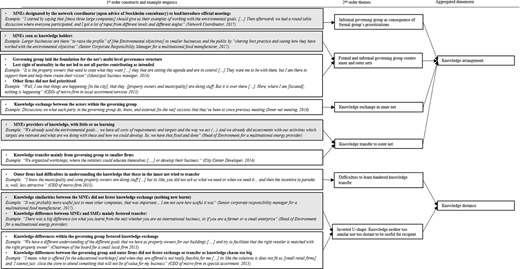
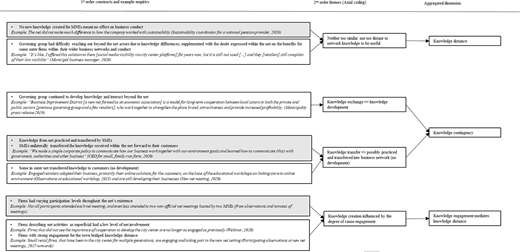
Initial coding departed from the various data sources as emergent and open codes (Gioia et al., 2013, see Figure 1 for the steps of the coding following the Gioia methodology), which were reduced in several steps; keeping the within- and beyond-net practices separate, as well as initially, the cases. This was done on an individual level by two of the researchers that were conducting the participant observations and then revised throughout the analysis process by all authors to ensure research quality. The participant observations and secondary data informed the analysis by providing insights into what business conducts the parties were engaged in, how activities were organised in the nets and the level of engagement among parties. The author who was not part of the data collection and initial coding proved particularly useful for critically addressing questions towards the codes based on the case drafts. The first-order coding provided empirical codes on knowledge activities as part of the BRNs, as well as in beyond-net business conduct. While these codes were mainly the result of interview transcripts and meeting minutes, a degree of background information (e.g. from informal meetings and observations) informed each case.
Next, the findings on the knowledge activities within the net and the beyond-net conducts described above were overlaid with the knowledge concepts presented in Table 1 (creation, exchange, use and development) to provide axial codes (Gioia et al., 2013). While using these concepts to understand the within-net and beyond-net knowledge, the theorising focused on the linkages between – and, hence, the explanations of – the net itself and beyond-net knowledge use and development. To accomplish this, beyond-net knowledge use and development (as well as lacking knowledge transfers from the net) were traced towards knowledge creation and exchange as part of the nets (cf. Jessop, 2005). In this sense, the empirically coding and propositions were inductively derived although matched to the knowledge verbs from the front end of the paper.
Differences were traced between:
knowledge creation and exchange in the net;
the parties and their characteristics as part of each net; and
the beyond-net settings and business connections of parties.
Continuous empirical back-tracking highlighted variations and consistency between the cases, as well as allowed for conclusions to be drawn across the cases regarding the interlinkages of within-net and beyond-net knowledge. This resulted in aggregated dimensions that helped explain why and how knowledge was used and developed beyond the BRNs’ temporal and spatial boundaries. These were theorised as knowledge arrangement, distance, engagement and contingency. To ensure the proposed theoretical contributions, the last step of the analysis regarded an iteration of the findings with the previous research related to these dimensions to provide theoretical anchorage, as well as research on nets and knowledge to ensure the theoretical gap that the paper addresses. Figures 1–2 depict the first- and second-order coding, as well as the aggregate dimensions (c.f. Gioia et al., 2013), with examples from different data sources.
4. Case 1: the environmental net
The Environmental Net was established in 2016. The Swedish Minister of Finance had stated a need for dialogue among industry players on the implementation of Sweden’s 16 Environmental Quality Objectives. The BRN’s participants were multinational enterprises (MNEs) with core operations in Sweden, and Swedish small and medium-sized enterprises (SMEs). The net was non-exclusionary, which meant that its participating firms could come and go. It was led by a coordinator (also a government representative) and positioned as a platform for knowledge exchange. Four official network meetings took place in the nation’s capital and centre of government, Stockholm. In addition, a Stockholm consultancy guided the net coordinator in the planning and structure of meetings. The coordinator initially invited representatives from firms (mainly MNEs) with whom she had had past professional contact, and that she assumed had positive attitudes towards working with the environmental-sustainability objectives. Others were told about the BRN by the existing participants or Stockholm consultancy. These firm representatives generally felt some sort of personal obligation to be part of the BRN.
4.1 Within-net knowledge creation and exchange
Within the BRN, the focus lay on knowledge exchange to develop the firms’ practices in relation to the national environmental objectives. Although described in slightly different ways by those business representatives spoken to, the main reasons for participation can best be described as relating to communication, benchmarking and networking purposes. The senior corporate responsibility manager of a multinational food manufacturer described the main reason for joining as “for getting in contact with other companies and to get inspired”. Meanwhile, the head of environment for a multinational energy provider stated:
I joined it as a way to meet other companies […] to see how they work with the environmental objectives. This helps us get a view of how we use the same terms and vocabulary and have a common way of communicating with each other […] but not only amongst each other but also to the wider public and so on.
At the first meeting, three of the MNEs that had worked with the national environmental objectives for some time were asked by the coordinator to provide examples of their work. This was followed by roundtable discussions in small groups during the net meetings to build upon how the other firms worked with the objectives.
The subsequent official meetings did not deviate much from this initial question, although they addressed it through various formats, including panel sessions with representatives from government ministries and subsequent question-and-answer sessions. This format attached importance to key MNEs and the government representatives as core parties, which was further stressed by the MNEs’ status as Swedish leaders on the environmental sustainability issue. Notwithstanding, the MNEs generally felt that they learnt nothing new from such meetings that could be taken into their business practices, knowledge creation was limited and there was lost potential with the BRN:
All we had in the first meeting was a talk about the general level of things and that is no news for me in the business. […] We do our job anyway regarding the UN and national targets (Senior Corporate Responsibility Manager, Multinational Food Manufacturer B).
As a response to such sentiments, two non-official net meetings were hosted by two of the MNEs as attempts to influence the beyond-net implementation of developed environmental performance indicators. These non-official meetings were both described by the coordinator and during an interview with a participant that hosted a meeting. These MNEs’ roles became more active in terms of the net’s goal, but never reached momentum:
Unfortunately, it ended up in the same situation […] we tried to specify discussions a bit more by having some bilateral work before and between some of the companies, but we did not really succeed. There was a lot of talk and little outcome (Head of Environment Operations, Multinational Energy Provider).
The MNEs’ knowledge and best practices were presented in the net as the best course of action to “push companies […] that didn’t strategically work with the objectives before the net […] to clarify how their activities related to the goals” (Head of Environment, Multinational Energy Provider). The focus on the MNEs’ practices of the national objectives and international sustainable development goals (SDGs), as well as the attempts by various MNEs to influence the BRN’s outcomes by hosting additional non-official meetings, meant that the within-net knowledge was unilaterally transferred from the largest MNEs to SMEs. Meanwhile, the SMEs were expected to contribute to discussions on the environmental question but remained quite passive. This was, for instance, noted in terms of their silence during observations of formal network meetings.
Although the intended goal was to help develop operational practices, much of the meetings remained engaged in general discussions regarding the utility of Sweden’s national environmental goals within the broader context of the SDGs. This was stated both by the firms spoken to and observed in meetings. Furthermore, most MNE representatives described their role, either informally to the researcher or in formal interviews, in the net as one of support for the net coordinator simply by being present. For them, the net served foremost as an opportunity to meet across firms. Meanwhile, the SME representatives generally reported more positive opinions on the role of the BRN for obtaining knowledge through learning about best practice from the MNEs, and on Sweden’s national environmental objectives to improve operational performance and communication:
The conversations between participating companies lead to knowledge: sharing ideas, working methods, ways to fulfil the [environmental] goals, ways to convince the rest of the company of how important these goals are since most of the participants were sustainability managers. I also got knowledge on how to report my own fulfilment of the goals and communicate them (CEO, Family-run Swedish farm).
Similar sentiments were conveyed by other SME representatives during informal conversations at the third net meeting. This describes how the SMEs did not partake in knowledge creation, and how knowledge was transferred rather than exchanged with the SMEs based on how the MNEs, not part of the original administering hub, were assigned as central actors in the BRN.
4.2 Beyond-net knowledge use and development
The Environmental Net terminated in the summer of 2017. By then, it had included 36 firms across industrial sectors (not all at the same time), the Swedish government (with the net coordinator as the primary government representative) and the Stockholm consultancy which served an advisory role. Given that the number of firms varied throughout its existence due to the BRN’s non-exclusionary design, not every “ending” firm had participated in all official (or non-official) net meetings.
When the BRN terminated, the coordinator concluded that the Swedish national environmental objectives offered a “checklist of best practice” in the Swedish context. A report was produced in 2017 [titled “The Presentation of the Assignment: A national environmental target coordinator for business” (Redovisning av uppdraget: En nationell miljömålssamordnare för näringslivet)] to summarise the net’s outcomes. However, the report proposed “further work to engage the business community in the environmental objectives’ work”. Yet, there was the indication from various MNE representatives that there was no need to continue the BRN which can be attributed to the fact that no new knowledge was gained by them as described in the quotations below.
The MNEs generally had issues in terms of how to reach out about the national environmental goals, that is, beyond their sustainability departments. Furthermore, their involvement in the BRN had a limited impact on their business conduct and connections with firms beyond the net. As stated by one MNE representative: “this type of gathering did not help sustainability performance, which is mostly about internal intentions and leadership, not loose interaction outside the organisation”. Nevertheless, being able to communicate more easily with, or strengthen prior social ties between, sustainability specialists across industries were considered by some MNEs representatives as beneficial outcomes of the BRN:
I think it had huge potential. But, I also think that some companies that were more active than others. But, what I really liked about the net was that there were companies from different sectors. For me, to meet the sustainability managers [in my industry] […] you know, we meet the same people all the time and we have maybe the same understandings. So, I think it was quite special to have a net like this, where people from all sorts of different businesses come together (Environmental Manager, Multinational Food Manufacturer)
Rather than knowledge creation within the BRN, and the subsequent use or development of knowledge in beyond-net conduct, knowledge was primarily unilaterally transferred in this BRN from the MNEs to SMEs. The quotations above indicate that the MNEs did not extensively extend their knowledge. Meanwhile, the SMEs as recipients of knowledge obtained knowledge on how to operate and implement practices in relation to the environmental objectives as now described.
For the SMEs, the BRN helped outline the contextual importance of working with the Swedish national environmental objectives for both symbolic (i.e. corporate image) and substantive (i.e. operational design improvements and process efficiencies) performance effects. This knowledge did not remain with those involved in the BRN but was transferred to others in the SMEs, as well as into customer interactions and the SMEs’ wider business networks. However, it remained unilaterally transferred into these by the BRN–SMEs, rather than integrated with customers’ and other business partners’ knowledge on the subject. For SMEs, knowledge about how to “communicate with the government, authorities and other businesses” (CEO, local family farm) was taken forward into further business interactions as an unintended outcome. In addition, both examples suggest that knowledge was not developed.
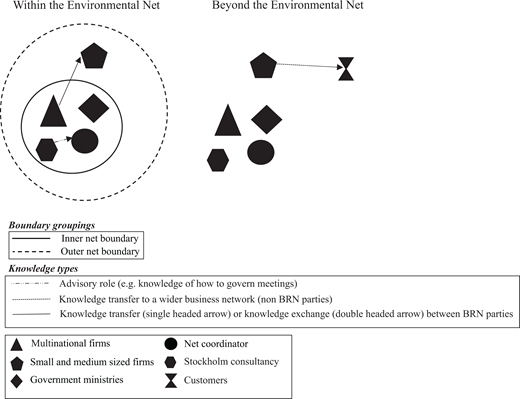
Figure 3 illustrates the different types of participants and groupings, as well as the knowledge exchanges and transfers within and beyond the Environmental Net. Within the net, it shows that while the government representatives, net coordinator, MNEs and the Stockholm consultancy formed an informal type of “inner net”, the SMEs remained outside and were the recipients of knowledge transfer from this inner net. Beyond the net, it shows that it was only the SMEs that continued to transfer knowledge to their customers and other business partners regarding how they work with the environmental objectives, rather than develop knowledge related to them or in interactions with business parties.
5. Case 2: the revitalisation net
The Revitalisation Net was established in 2014. While being open to all retailers and service providers located in the town, a formal governing group was created. This group consisted of one municipality business manager and four local property owners that benefitted from its outcomes. The BRN offered a discussion space with the aim of improving business performance and the prosperity of the town. Retailers, being the prioritised parties, were contacted via the town centre organisation or the municipal business manager to participate. Property owners were invited by the municipal business manager. While the interviews and observations indicated that the municipality representatives embraced the possibility of increased trade and visitors to the town centre through the BRN, the property owners saw the benefits of increased rental value and the other participating firms (mainly local retailers) focused on improving their business.
5.1 Within-net knowledge creation and exchange
Even though the Revitalisation Net was set up as non-exclusionary and open to potentially 165 organisations, its main activities were determined by the governing group. The BRN was driven by the notion that collaboration and involvement would enable pooled knowledge from the BRN to be dispersed or used by the individual firms to enable retail revitalisation. To achieve this aim, the governing group facilitated monthly meetings and knowledge exchange activities within the BRN to help develop business strategies. Throughout formal meetings, a net design emerged that emphasised the governing group as the engine of the BRN.
In interviews, the property owners referred to the BRN as being based on knowledge creation, with all parties contributing to this. However, due to their involvement in the governing group, observations suggested that the property owners lost sight of the actual extent of mutual exchange between allBRN parties, and criticisms of the BRN’s activities were even published in local newspapers. Intense interaction and knowledge exchange did occur, as noted both from interviews and observations, but only between those in the governing group in which knowledge about organisational structures and future developments was exchanged. This led to different, directed operational activities and financial investments by the municipality and property owners which did not extensively extend beyond this inner group. This too raised questions in newspapers wherein retailers commented negatively on the investments and zoning suggestions.
During the net meetings, best business practices, market knowledge and information were presented, much with the intention of inviting firms into the discussion and getting all parties involved. These arrangements, which were intended to facilitate knowledge creation, sometimes included researchers and business system organisations to provide external perspectives on revitalisation. The workshops and seminars (that were observed) did, however, not always include all parties, and sometimes only the governing group. While most parties that were not part of the governing group (i.e. small- and micro-sized retailers and property developers) considered these workshops beneficial, many had difficulty applying the knowledge from them due to their limited business sizes and resource restraints:
They [municipality and city centre developers] do not know what I need – do they really think this digitalisation education will help me when I can hardly pay the rent? (Retailer, CEO of Micro-firm).
Based on various conversations, these small firms found it particularly difficult to understand how the BRN could develop their businesses and how the suggested solutions were suited to their operations. Rather, they primarily perceived the governing group’s ambitions as empty rhetoric and were viewed as psychologically external to the net:
I think the biggest challenge is to get the existing retailers to understand their contribution in the big picture. […] They do not understand their part in it all (Municipality Business Manager).
5.2 Beyond-net knowledge use and development
The Revitalisation Net was terminated in the autumn of 2017. The parties that had foremost thrived in the BRN, those in the governing group, had at this point, moved forward in the municipality to their own advantage, with property owners who were part of the governing group becoming the largest in the town. The governing group furthermore increased social – and potential business – interactions among themselves, as well as changed their strategic and operational work. They felt increasingly optimistic about the town, expanding rather than selling properties by working “more proactively together [to make] operational processes smoother” (Regional Manager, Medium-sized Property Owner, part of the governing group).
Knowledge use beyond the Revitalisation Net was, however, uneven among the participating parties. Most firms’ operations and business network interactions remained unchanged, as evident from both interviews and observations. Firms permanently closed or were forced to relocate away from the town centre, which defeated the BRN’s ambition for city centre rejuvenation. These firms did not have the capacity to operationalise the net knowledge in their firms or interactions with business partners. One town centre developer attributed this to timing, by emphasising how these firms would have benefited from a livelier town centre, but continued to struggle:
[The BRN] maybe started a little late […] I would probably have started it much earlier […] You think that it [town centre revitalisation] solves itself, but it does not. You have to actively work together to see something positive (City Centre Developer/Municipal Business Manager).
A shared denominator among these firms, which did not experience any benefits or developments beyond the net, was that they were external to the governing group and ascribed their lack of involvement to what they felt was the superficial nature of net meetings that did not address their business specifics nor were within their current knowledge reach. A division between the governing group and the other parties was evident during the BRN’s existence and continued even beyond its termination. For these firms, the use and development of knowledge in business activities beyond the net were limited. Nevertheless, among the retailers in the town, a small group stood out that contradicted this lack of engagement, a group that had been active in the municipality for several generations:
We’ve been here for over 80 years [with franchise agreements enforced in the 1990s]. We do what we can to stay here […] We contribute to the survival […] but it is hard to get the consumers here [to the city centre] compared to the stores located at big shopping areas in the outskirts of the town (Retailer, Local Franchise Owner).
These firms were aligned with the BRN’s revitalisation goal of keeping the town centre as a marketplace. While not being invited into the governing group, they continued to reshape their operational practices with a clear focus on revitalising the town in line with the BRN’s goals. These firms changed their interactions with customers towards having closer relationships and smoother business transactions, via online availability, in-store technology and city centre activities such as hosting fairs or offering gift cards, thereby acting in a similar way beyond the net as those part of the governing group. This followed from what they had learned from the BRN in terms of how to operate and interact.
After the BRN’s termination, the governing group took a leading position in a new net established in 2018, with many of the same parties as the revitalisation net. This new net was intended as a non-temporal [3] platform for collaboration among more parties than the Revitalisation Net. It was formed as an economic association for, primarily, commercial firms and property owners, but where the municipality had a funding responsibility. As explained at a webinar and during the new net’s meetings, this new initiative was based on a more structured, contractual process of resource sharing between involved parties. Yet, it also entailed a less democratic approach to revitalisation:
They [other parties] can choose to get onboard, or they just must accept the strategy that we [the economic association] determine to be feasible […] We no longer have time to get everyone onboard (Municipality Manager at webinar).
Parties from the governing group stressed that the knowledge retained from the Revitalisation Net led to a more nuanced understanding of the differences between municipality and private firm representatives, and this affected who would collaborate in the future. However, the governing group organised the new net in a way that hampered knowledge creation and exchange among all participating parties.
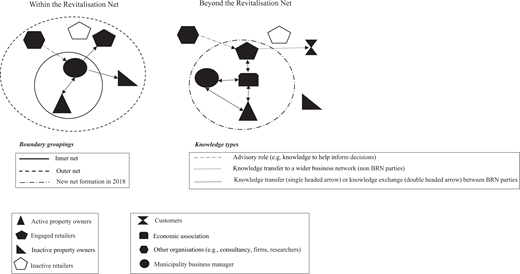
Figure 4 illustrates the different types of participants and groupings, as well as the knowledge exchanges and transfers within and beyond the Revitalisation Net. Within the net space, it shows the municipality business manager and active property owners as part of a formal inner net within which knowledge creation occurred. Meanwhile, the knowledge was only unilaterally transferred to the retailers and inactive property owners in the outer net. Like the first case, it was only those part of the inner net that potentially developed knowledge beyond the net. In addition, so did the group of engaged firms, while the remaining small firms only potentially transferred knowledge to others and never engaged in any knowledge development with business partners beyond the net.
Table 3 summarises the case findings from both cases, which are then elaborated on in the following analysis section.
6. Analysis
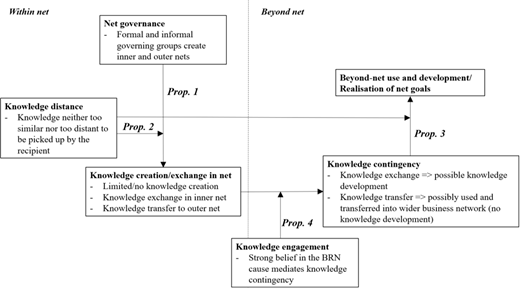
Returning to the coding in Figures 1–2, four dimensions emerged as theorised concepts from the cases. These dimensions (i.e. knowledge arrangement, knowledge distance, knowledge engagement and knowledge contingency) relate to the knowledge perspective as our theoretical lens and help explain how the knowledge created and exchanged in BRNs is used and developed by firms beyond the net’s temporal and spatial boundaries. The analysis below is structured around these four dimensions, which leads to four propositions being put forward that help explain what characteristics lead to knowledge use and development beyond nets as our key contribution.
6.1 Knowledge arrangement
While the organising differed somewhat between the cases, an inner net was formally or informally created as part of the BRNs. For both cases, these inner nets included actors not part of the original administrating hub.
In the Environmental Net, this inner net centred around the government ministries, particularly the coordinator who was advised by the Stockholm consultancy, and the MNEs who were assigned roles in the inner net. In the Revitalisation Net, high-profile retailers and real estate owners (that did not establish the BRN) created such an inner net. This means that when we analyse knowledge exchange and creation within the net, we also need to deal with two structures: an inner net and an outer net which together formed the BRNs. These structures led to divergences in the beyond-net knowledge use and development. We refer to these double structures and their relationships as knowledge arrangements (cf. Puente-Rodríguez et al., 2016), thereby targeting net organising as matters of inclusion in a prioritised sphere (see Figures 3 and 4).
As the result of the within-net knowledge arrangements in both cases, knowledge was mutually exchanged and potentially created among parties in the inner net, while only unilaterally transferred from the inner to the outer net. In the Environmental Net, for example, knowledge transfer occurred from the MNEs to the SMEs in terms of the former explaining how they worked with the national environmental objectives in daily operations. In the Revitalisation Net, it was the governing group of certain retailers and real estate owners who formed the inner net, with knowledge exchange and creation as a primary activity between those actors. Meanwhile, other retailers and real estate owners outside this inner net became the one-way recipients of knowledge from this.
While not formed by contracts (Wang et al., 2023), the hierarchy of inner and outer nets, and thereby within-net boundaries, constrained knowledge creation and exchange for all involved parties. More precisely, the inner net parties did not become the recipients of knowledge from the outer net, nor involved themselves in knowledge creation with those in the outer net. Meanwhile, the outer net parties only received knowledge from the inner net, while not interacting amongst themselves or with the inner net in such ways which meant that knowledge was exchanged or created. Furthermore, the exchange and transfer as differences in how knowledge was treated also affected the beyond-net knowledge use and development as is elaborated on below, related to knowledge contingency.
Related to past research on nets, Möller et al. (2005) address questions on the coordination of nets and the management of relationships within nets. In their view, a BRN would need openness and trust, echoed in how relations are emphasised in alliance research (Bai et al., 2021). However, these studies focus on the shared output of the net itself, rather than on the participating firms’ knowledge use and development beyond the net.
Our findings thereby move beyond the prior analytical focus of net management and outcomes (e.g. Heidenreich et al., 2016; Möller et al., 2005; Pereira and Bamel, 2021; Persson et al., 2011) by connecting how knowledge arrangements affect the knowledge creation and exchange within BRNs, and importantly, how the parties use and develop this knowledge beyond the net. The findings from the Environmental Net and the Revitalisation Net indicate that (1) informal within-net separations (i.e. of inner and outer nets) may follow from the knowledge positions that parties have when entering the net, and (2) formal and informal knowledge arrangements may have implications not only for knowledge creation and exchange within the net, but also for beyond-net practices. The aggregated dimension of knowledge arrangement from the findings (see Figures 1–2), therefore, leads to the first proposition:
Within-net knowledge arrangements that create separations among net parties into sub-structures delimit knowledge in the net.
This is broken down into two sub-propositions:
Knowledge is created or exchanged among the parties that form an informal or formal prioritised group.
Knowledge is unilaterally transferred, but not created or exchanged, for parties beyond the within-net prioritised group.
6.2 Knowledge distance
In addition to how the within-net knowledge arrangements affected whether knowledge was exchanged or unidirectional, the case of the Environmental Net indicates that the inner net did not advance knowledge (create knowledge), despite its position and potential for mutual exchange. This had to do with the fact that the knowledge of MNEs in the inner net was too similar. Meanwhile, in the Revitalisation Net, firm representatives in the outer net had some difficulties in understanding the knowledge that those in the inner net had tried to transfer to them. Here, the outer-net representatives found the knowledge too abstract and distant from what they already knew. This assumes a second dimension and characteristic of within-net knowledge that is important for knowledge to be used or developed beyond the net, described as knowledge distance.
Knowledge distance reflects how knowledge can neither be too similar nor too different to what the involved net parties had before participation in the BRN for it to be applied beyond the net. While the previous proposition regarding knowledge arrangements decides whether knowledge is transferred or exchanged within the net, the knowledge distance dimension applies regardless of their relative position in the net (as inner or outer net parties).
Knowledge as neither being too similar nor too different suggests what could be referred to as an inverted u-shape (e.g. Ifie, 2023; Öberg, 2013) of knowledge distance. This helps explain the varying degrees of knowledge assimilation (Kohtamäki et al., 2018) between parties in BRNs. The inverted u-shape means that knowledge will be picked up through exchange or transfer from the point that it is not too similar to the firm’s past knowledge until the point it becomes too different from this past knowledge, thus, with a decreasing ability to be received. The inverted u-shape of knowledge similarity and difference also applies to the firms’ business conduct beyond the net in these cases. It did so in terms of how the relative knowledge similarity and difference had a similar shape if transferred to customers or other business parties, as seen in, for instance, the Revitalisation Net where business partners with overlapping knowledge and those with far less knowledge than the party from the net, were not able to obtain the knowledge from the BRN party.
While knowledge proximity is widely described in past research (e.g. Christensen and Pedersen, 2018), we add to this by suggesting that knowledge should neither be too similar nor too different to be effectively used and developed beyond the net. Relatedly, Andrésen et al. (2012) describe how nets should contain parties that complement each other (rather than compete or overlap) in terms of the businesses’ role, with the complementarity denoting knowledge that is “not too similar”. However, their study focused on forming business relationships within the net rather than knowledge exchange, creation, use or development within and beyond nets.
Our findings related to the aggregated dimension of knowledge distance and the inverted u-shape of having neither too similar nor too different knowledge are formulated as a second proposition:
For knowledge to be received, the knowledge needs to complement the recipient’s past knowledge.
This is broken down into two sub-propositions:
Having knowledge that is too similar does not allow for within or beyond net knowledge exchange, creation, use or development.
Having knowledge that is too different disables the within or beyond net knowledge exchange, creation, use or development.
6.3 Knowledge contingency
Both BRNs had goals that the participating firms should incorporate knowledge from the nets into their wider business conduct. This raised expectations that the knowledge from the nets would be used and developed beyond the respective nets’ termination (temporal dimension) and related to parties not part of the original net (spatial dimension). While such expectations are central in relation to the aim of nets, past research focuses on the analytical level of the net (Andrésen et al., 2012; Möller and Rajala, 2007) or the interactions between participating parties (e.g. Eklinder-Frick, 2016). Moreover, when Crespin-Mazet et al. (2021) describe the diffusion of knowledge in a setting different to nets (construction industry projects), the focus is on the temporal rather than spatial dimension.
According to the two cases, whether knowledge was used or developed beyond the BRNs was contingent on if the firms had been part of the within-net knowledge exchange, that is, the result of the within-net knowledge arrangement. More precisely, the firms involved in creating knowledge then developed it beyond the BRN (temporal dimension) and in their interactions with customers and other firms in their business networks (spatial dimension). Meanwhile, the parties that received knowledge in the BRN, via a unidirectional knowledge transfer, only used or transferred it into their business networks, but did not develop the knowledge further. For example, the SMEs in the Environmental Net, which had unilaterally received knowledge from the MNEs, acted in a similar way in their interactions with business parties. Meanwhile, the firms in the governing group in the Revitalisation Net continued to practice mutual knowledge exchanges with firms in their business networks and even developed knowledge with these parties. These findings thereby connect unilaterality with continuous unilateral knowledge transfer, and mutuality with mutual knowledge use and development beyond the net.
Descriptions of contingencies are recurrent in the literature (Zeithaml et al., 1988) and related to knowledge, though often with knowledge types as explanations for organising rather than its outcome (e.g. Birkinshaw et al., 2002), and especially not dealing with how knowledge transcends space or time. Furthermore, knowledge is described as a condition for other activities. This thereby does not focus on knowledge as something “developable” which we find here, and the net literature mostly concerns knowledge as an outcome. Notwithstanding, the knowledge contingency from our cases leads to the following proposition:
Knowledge use and development beyond the net is contingent on knowledge transfer, exchange and creation within the net.
This is broken down into two sub-propositions:
For knowledge to be developed beyond the net, the net party needs to have been involved in knowledge creation within the net.
Knowledge received through unidirectional knowledge transfer in the net only leads to possible knowledge transfer to parties beyond the net.
6.4 Knowledge engagement
The Revitalisation Net points to engagement in the cause (hereafter referred to as knowledge engagement) as being a mediating factor linked to knowledge contingency, and which positively affects the beyond net knowledge use and development. More specifically, those firms in the outer net of the Revitalisation Net, which had been in the town for generations, had strong ties to the town and felt deeply about its development. Despite being part of the outer net and thereby only having knowledge transferred to them from the inner net, these outer net firm representatives adopted goals and reshaped their operations with a focus on revitalising the town centre. This was because they had historical ties to the town centre that supported an engagement with the cause (i.e. the goal of the Revitalisation Net). More importantly, this engagement expanded beyond the net and allowed for these parties to partake in knowledge development beyond it.
Past research denotes how engagement can positively affect knowledge sharing (e.g. Auh and Menguc, 2013). This suggests that those parties that are more engaged would use and develop knowledge with others. However, such studies do not imply any “bridging” by the more engaged parties (in a cause) that are, in this case, partly excluded from knowledge exchange (e.g. not prioritised in or by the formal or informal within-net knowledge arrangements). Meanwhile, research also describes how engagement helps explain participation in voluntary-based communities (e.g. Chen et al., 2018). Knowledge engagement in this study, however, did not move the engaged firms into the inner net. Rather, it only made these parties act as if they were part of the inner net in terms of knowledge use beyond the net, by, for example, engaging customers in the revitalisation of the city.
While the reverse has been denoted in past research on nets [i.e. that the lack of engagement or commitment prevents parties from being active in the net (Eklinder-Frick, 2016)], our findings suggest that issues following from knowledge arrangements within the net (see Proposition 1) can be overcome if a party is engaged in the net’s cause. The key message here is that engagement leads parties to act as if they had been part of knowledge exchange and creation within the net and, thus, a fourth proposition is put forward:
Knowledge contingency is mediated by knowledge engagement for beyond-net knowledge use and development.
In Section 2.2, we described how knowledge may be about capabilities held or obtained or more tangible knowledge (e.g. Kogut and Zander, 1992). The separation between transferred knowledge potentially being moved forward and knowledge creation enabling knowledge development beyond the net indicates how the studied BRNs deal with these two types of knowledge. It appears that it would only be when knowledge is a capability that knowledge can be further developed beyond the net, while knowledge transfer may be more instrumentally transferred beyond the net. This again stresses the need for inclusion in knowledge exchange and creation for BRNs’ goals to be fulfilled. Figure 5 summarises the relations among the four main propositions outlined above.
7. Conclusions
This paper explains how the knowledge created and exchanged in BRNs is used and developed by firms beyond the nets’ temporal and spatial boundaries. The introduction raised the following question:
What characteristics of knowledge creation and exchange within a BRN determine why, and how, knowledge is used and developed in the business conduct of participating firms beyond the net?
Adopting a knowledge perspective, the paper has theorised four knowledge dimensions and their respective characteristics to explain why and how knowledge is used or developed beyond the net. These are: knowledge arrangement, knowledge distance, knowledge contingency and knowledge engagement. Combined, these knowledge concepts suggest that the BRN should be based on mutual knowledge exchange among the parties engaged in the cause of the BRN, with a balanced (not too different, not to similar) knowledge distance between them. Under such circumstances, the chance of knowledge use and development beyond the net (i.e. upon its termination and with parties external to the net) is enabled.
7.1 Research contributions
The main theoretical contributions of this paper are formulated in terms of four propositions (with explaining sub-propositions to capture the various nuances of these propositions) related to knowledge arrangement, knowledge distance, knowledge contingency and knowledge engagement. These add to past research on nets by:
focusing on knowledge, which Möller and Halinen (2017) have highlighted as an important but overlooked dimension of studies on nets (and networks); and
linking what happens in the net with its goal, that is, the developments beyond the net.
This latter aspect is surprisingly rare in past net research. Few examples relate to the temporal dimension (e.g. Andrésen et al., 2012; Eklinder-Frick, 2016), but do not focus on how firms incorporate learnings from the net in their business conduct with parties beyond those of the net. Our perspective thereby responds to the gap defined by Keränen et al. (2021) and Mason et al. (2017) on beyond-net practices, while moving beyond descriptions and into explanations of such practices through interlinking them with the net.
While the focus of this study is not to determine success or failure of nets, research that focuses implicitly or explicitly on the high rate of failures of such initiatives (e.g. Andrésen et al., 2012; Eklinder-Frick, 2016) is informed by this paper. By explaining why beyond-net knowledge use and development takes place (or does not take place), this expands on prior research by showing the knowledge characteristics conducive to knowledge development and use beyond the nets. As such, the knowledge perspective as the theoretical lens used here offers insights to help understand what goes on within the net and, importantly, beyond it. Notably, the knowledge contingency dimension follows from the within-net knowledge arrangement and distance as these set the antecedents to the use and development of knowledge, while being mediated by knowledge engagement. This provides testable explanations beyond past research’s descriptive conclusions on net failures or successes. While past net studies reside in the marketing domain (e.g. Andresen, 2020; Eklinder-Frick et al., 2011; Möller and Rajala, 2007), our theorising on knowledge arrangement, distance, contingency and engagement link nets with conceptualisations as part of, but also beyond, the marketing literature.
7.2 Practical implications
The practical implications of this paper are founded on our four propositions and dimensions that help guide how BRNs should be organised for knowledge to be used and even developed beyond the net. These propositions create important insights, as net initiatives continue to be a popular way to meet various societal issues and increase the participating firms’ likelihood of survival and growth. Based on how the researched BRNs created inner and outer nets, which limited knowledge creation to a transfer state, we suggest that the formation of a BRN should avoid hierarchical arrangements, formally or informally, and the favouring of specific parties. The inner net of the Revitalisation Net may stand as a model for how nets should ideally be organised, but between all those involved rather than between selected parties. Furthermore, a net would need to carefully invite parties with complementary, not too divergent, knowledge or would need to work on enhancing the knowledge of certain parties to bring them up to speed. Creative processes and engagement should be fostered in the BRN if goals are not only about parties adopting practices from the net in their beyond-net business conduct, but about knowledge development beyond this.
Some key questions directly related to knowledge are important to consider for those initiating BRNs such as: Is there enough distance between the knowledge of the intended parties for each of them to learn something from the net? If, and how, can each party’s knowledge be used in the net? How do we accomplish knowledge creation rather than a unilateral knowledge transfer? How can shared knowledge be used (and potentially developed) in the business networks of participating firms? How does the BRN initiative lead to the fulfilment of societal goals through knowledge exchange, creation, use and development?
7.3 Limitations and future research
Given that this paper is based on two cases, additional empirical research is prompted to verify and extend the findings, as well as to test the propositions put forward. Complementary or comparative studies could include other types of nets such as current or emerging business nets (e.g. Möller and Rajala, 2007), as well as nets with different types of organisational structures and goals. This is of particular interest since firms nowadays often concurrently exist in multiple nets, in an increasingly complex knowledge-driven society.
In addition, because the BRNs in this paper were based in Sweden with its disposition to collaborative and discursive arrangements for knowledge development (e.g. Strand and Freeman, 2015), complementary studies could be set in different institutional and geographical contexts (cf. Yin, 2018 on context dependency). Contingencies in the network-level spread would also be interesting to further explore to see how capabilities and new ideas travel forward within and between business network relations. It would also be of interest to further elaborate on the characteristics that could ensure knowledge creation within nets and knowledge development beyond them. This could lead to the further fine-tuning of our propositions, thus, extending the knowledge conditions that implicate the success likelihood of various strategic net forms (Möller and Svahn, 2006). The summarisation of our findings as propositions additionally invites studies to test these quantitatively or be used in mixed-method study designs to further their analytical conception.
Acknowledgements
The authors are very thankful for the editor and reviewers’ constructive and helpful comments during the revision process of this paper.
Note that this research did not receive any specific grant from funding agencies in the public, commercial or not-for-profit sectors.
Notes
Indeed, Crespin-Mazet et al. (2021) discuss how firms in the construction industry may create semi-stable organisations to bridge between projects and firms. This, however, is between various temporal nets rather than beyond nets.
Note that Sweden’s national environmental goals [Miljömålen] were established by Parliament in 1999 – long before the international sustainable development goals (SDGs) in 2016.
This new net was strategically designed, but had no temporal boundary, making it conceptually distinct from the originally BRN.