This study examines the relationships between behavioral leadership, time management skills (as a mediator) and job satisfaction in the chemical industry in Istanbul, Türkiye.
The research adopted a quantitative approach using structural equation modeling (SEM) to analyze data collected from 608 middle and senior managers in 86 companies. A survey was designed to measure the constructs of behavioral leadership, time management skills and job satisfaction, and Jamovi (v2.3) was used for analysis.
The results indicate that behavioral leadership has direct positive effects on both time management skills and job satisfaction, and time management skills partially mediate the relationship between behavioral leadership and job satisfaction.
The study is based on cross-sectional, single-source survey data from chemical industry firms in Istanbul, which limits causal inference and may constrain generalizability to other sectors and regions.
The findings point to how firms can improve job satisfaction by developing managers’ behavioral leadership behaviors (clear priorities, role clarity, coordination and timely feedback) and strengthening time management as a core managerial competency through training, coaching, and performance appraisal.
The study advances theory on behavioral leadership by showing that its relationship with job satisfaction operates through both direct and indirect pathways, with time management skills functioning as a key mediating mechanism. The findings underscore a competency-based explanation of leadership effects and highlight that, in hazardous, process-intensive production contexts, employee satisfaction depends not only on supportive leadership climates but also on leaders’ capacity to strengthen employees’ self-regulation and time control under sustained operational pressure.
Using SEM, this study identifies time management as a competency-based mechanism linking behavioral leadership to job satisfaction in a high-risk, time-sensitive industry context.
1. Introduction
In the volatile global economic environment of the 21st century, the chemical industry remains a cornerstone of industrial development, yet it is also one of the most operationally challenging sectors. Characterized by high-risk environments, stringent regulatory frameworks, and persistent hazards, the chemical sector demands more than just technical precision. It requires a sophisticated integration of human capital management and operational efficiency (Bass and Riggio, 2006). These conditions make leadership behaviors especially consequential, because they shape how employees prioritize tasks, manage time pressure, and maintain satisfaction in demanding operational settings.
As the leadership literarure matured, the initial influence of the trait approach gradually diminished, researchers increasingly began examining the behaviors of effective leaders who achieved success, including those who led organizations through difficult conditions and improved performance (Bass and Bass, 2009). This shift contributed to the view that leadership can be developed through training and that leaders’ actions can be identified and shaped (Chemers, 2014). In other words, whereas the trait approach focuses on who leaders are, behavioral approaches emphasize what leaders do and how they act in specific situations, suggesting that leadership can be learned through experience and effective decision-making (Northouse, 2021). Situated in this context, the current study examines behavioral leadership as an independent variable and tests its relationship with employees’ time management skills and job satisfaction in the chemical industry.
Effective time management influences job performance and satisfaction by allowing individuals to prioritize tasks, allocate resources efficiently, and maintain work-life balance (Mackenzie et al., 2018). As competition increases and the volume of information people must absorb expands, individuals’ responses to time pressure may differ. From a managerial perspective, time is a resource that cannot be expanded at will and cannot be replaced (Southerton, 2020). For this reason, time is a concept that must be used carefully. Time is a unique resource that is distributed equally to all people and puts pressure on all people (Giurge et al., 2020). The importance of time management lies not only in controlling time, but in using time more intentionally to enhance the quality and value of work and life (Whipp et al., 2002). Accordingly, the current study models time management skills as a mediating mechanism that translates behavioral leadership into higher job satisfaction by strengthening employees’ self-regulation under time pressure.
In this context, job satisfaction represents a central employee outcome that reflects broader well-being and organizational health. It refers to employees’ overall evaluative judgment of their job and work context (Judge et al., 2021). It encompasses multiple dimensions, including satisfaction with the work itself, working conditions, and interpersonal relationships, all of which are influenced by leadership behaviors and individual skills (Camelie et al., 2023; Judge et al., 2021).
In today's organizational life, employees are exposed to many distractions that can reduce concentration and weaken interest in their work while carrying out their responsibilities. Managing these attention-related challenges is therefore a key concern for organizational leaders. In this context, job satisfaction becomes especially important as an outcome that warrants attention. Job satisfaction reflects positive emotions toward work and the resulting work-related attitude that emerges from these emotions (Lee and Jang, 2020).
While previous research has considered the direct relationship between behavioral leadership and job satisfaction from a broad perspective, this study extends the literature by shifting attention from primarily affective explanations to a cognitive, evaluative, and competency-based mechanism. Whereas much of the existing literature emphasizes emotional pathways such as trust and commitment, this study addresses an empirical gap by examining how leaders foster employees’ self-management skills, specifically time management, and how these skills, in turn, translate into job satisfaction. This competency-based perspective is particularly relevant in operational settings where time pressure is persistent and performance consequences are high.
Building on this competency-based perspective, we conduct a test of the conceptual model in the chemical industry, where stringent quality and safety requirements leave little tolerance for error, and time pressure affects not only productivity but also operational risk. In doing so, this study specifically aims to address a gap in literature by examining leadership as more than a motivational influence, positioning it as a facilitator of effective resource management under high-stakes conditions. Despite extensive research on leadership, there is limited empirical evidence on whether leaders’ behavioral orientations strengthen employees’ self-regulation through time management. Evidence is also limited on whether stronger time management, in turn, reduces stress and improves job satisfaction. Accordingly, this study focuses on everyday leadership behaviors, specifically how leaders delegate, communicate, and structure tasks, because these behaviors are likely to shape how employees allocate and control their scarcest resource, time. We therefore conceptualize time management as the missing link that translates leaders’ direction into employees’ daily sense of accomplishment and satisfaction.
In sum, the primary objective of this study is to test a comprehensive structural model that examines:
The association between behavioral leadership and job satisfaction;
The role of leadership in developing employees’ time management competencies;
Time management as an indicator of employee well-being; and
The mediating role of time management in the relationship between behavioral leadership and job satisfaction.
From an analytical standpoint, the research uses structural equation modeling (SEM), a robust statistical technique suitable for analyzing complex relationships between multiple variables (Hair et al., 2019). SEM enables the simultaneous estimation of direct and indirect (mediated) effects within a single framework, providing a comprehensive test of the proposed model (Hair et al., 2019).
1.1 The role of study context
In terms of study context, the chemical industry faces distinctive challenges, including handling hazardous materials, managing complex manufacturing processes, meeting stringent quality standards, and operating under intensive regulatory oversight. These conditions create a high-risk environment in which operational failures can have serious consequences. As a result, the dynamics of leadership and time management differ meaningfully from those in typical office settings because the operational stakes are higher and employees may experience greater psychological strain. Accordingly, testing the research model in this context is not only a question of generalizability, but also an opportunity to examine how these critical variables operate under sustained time pressure and elevated risk.
The chemical industry in Turkiye is the focus of this study not only because of its economic and export capacity, but also because it combines high job stress with substantial operational complexity. Although prior research has frequently examined the relationship between leadership behaviors and job satisfaction in general service or manufacturing settings, high-risk contexts such as the chemical sector, where hazardous materials management and strict safety standards prevail, remain underrepresented.
Against this backdrop, the study addresses an important gap by examining how behavioral leadership and time management skills jointly shape employee outcomes in an environment where job security concerns and high-performance expectations often coexist. Moreover, cultural dynamics associated with Türkiye, such as higher power distance and collectivism (Hofstede, 1984), provide a relevant setting for re-examining leadership theories that are largely developed and tested in Western contexts. Accordingly, this Istanbul-based study aims to extend theory from both sectoral and cultural perspectives by analyzing how leadership behaviors influence employees’ time management capacities and how this process translates into job satisfaction.
2. Literature review
2.1 Behavioral leadership (BL)
Behavioral theories of leadership, as developed in the Ohio State and Michigan rstudies, emphasize two core dimensions: people-oriented and task-oriented behaviors. Leaders who display these behaviors create supportive and structured work environments, which can increase employees’ job satisfaction (Bass and Bass, 2009). Beyond behavioral leadership theory, alternative perspectives such as path-goal theory and self-determination theory offer complementary explanations for how leaders influence employees’ time management and job satisfaction by emphasizing, respectively, the removal of task-related barriers and the cultivation of autonomous motivation and self-regulation. Specifically, path-goal theory (House, 1971) supports the idea that leadership contributes to employee skill development, including time management. From this perspective, leaders improve performance by clarifying goals and priorities, structuring the steps needed to achieve them, and removing obstacles that consume time and attention. By providing resources, coordinating interdependencies, and offering coaching and feedback on planning and prioritization, behavioral leaders can strengthen employees’ ability to allocate time effectively and sustain progress toward deadlines (Northouse, 2021).
Similarly, self-determination theory (Deci and Ryan, 1985) suggests that leaders can enhance employees’ time management by fostering autonomous motivation through autonomy, competence, and relatedness support. When employees are intrinsically or autonomously motivated, they are more likely to engage in proactive self-regulation, including setting priorities, planning and monitoring progress, persisting under time pressure, and resisting distractions. In this way, SDT clarifies a plausible pathway through which behavioral leadership can strengthen time management skills and, subsequently, contribute to more positive work outcomes.
Empirical research consistently links behavioral leadership to employee outcomes by highlighting the social and relational processes through which leaders shape day-to-day work. Msoffe (2023) shows that leadership behaviors improve performance by strengthening communication, encouraging participation in decision-making, and providing timely feedback and support. This pattern aligns with the argument that psychologically safe environments allow employees to speak up, contribute ideas, and sustain high task performance. More broadly, recent studies emphasize that these outcomes depend on the quality of the manager-employee relationship and the climate leaders create. Tran et al. (2023) therefore argue that organizations should focus on the reciprocal quality of this relationship, while Malik et al. (2023) similarly stress the importance of attending to employees’ emotional states and monitoring supervisory behaviors. Extending this logic to harmful workplace experiences, Choi (2020) suggests that organizations can reduce negative consequences associated with workplace rejection by strengthening perceived organizational support through a supportive culture and zero tolerance for violence.
A second stream of findings highlights that leadership effects are strengthened or weakened depending on leader character and the specific behaviors leaders enact. For example, Xiu et al. (2024) argue that organizations aiming to build a collaborative conflict-management climate should be careful in leader selection and avoid appointing highly Machiavellian leaders to such teams, because these traits can undermine trust and cooperation. Relatedly, Belayhun (2021) emphasizes that leaders can improve their performance by avoiding abuse of power, addressing conflict constructively, and setting clear goals for each team member. When leaders instead provide both structure and support, they are more likely to enable positive discretionary outcomes beyond routine performance. Selner (2023) finds that behavioral leadership strategies are associated with environments that promote employee engagement, and Siswanto et al. (2022) report a direct positive effect of behavioral leadership on organizational innovation. Taken together, these studies suggest a coherent mechanism: behavioral leadership fosters supportive and well-structured contexts that increase engagement and performance. In this sense, job satisfaction can be viewed as a relevant attitudinal outcome that co-develops with these positive work conditions and helps sustain employees’ willingness to contribute beyond formal role requirements.
Accordingly, this study positions behavioral leadership as the focal independent variable in the proposed model, and posit that:
Behavioral leadership has a positive effect on employees’ job satisfaction.
Alfozan (2024) argues that leaders play an active role in managing time effectively by reinforcing discipline and emphasizing employee commitment, which supports the successful implementation of corporate transformation initiatives. Complementing this view, Waterhouse and Mann (2021) identify communication and active listening among the most important management skills, implying that leaders who communicate clearly and listen actively can reduce misunderstandings, rework, and coordination delays that undermine effective time use. Zampetakis (2024) similarly emphasizes that proximal workplace resources, such as coworker support and the manager–subordinate relationship, are particularly salient for how leadership is experienced, suggesting that close social support can help employees sustain effective time use in everyday work.
Consistent with these arguments, the literature on task-oriented leadership highlights a direct link to time management through structure and guidance. Leaders who exhibit task-oriented behaviors focus on clarifying goals, organizing tasks, and ensuring the efficient use of time and resources. Fleishman (1953) and Stogdill (1974) argue that task-oriented leadership promotes discipline and provides clear instructions, which can help employees prioritize, plan, and coordinate their work more effectively, thereby supporting stronger time management.
Accordingly, we hypothesize that:
Behavioral leadership has a positive effect on time management skills.
2.2 Time management skills (TMS)
Time management has become increasingly important not only for managers but for employees at all levels, and it is often viewed as a core requirement of effective organizational functioning (Khan, 2023). Time management is not an innate talent; rather, it is a set of skills and practices that can be learned and developed over time (Hu, 2021). Individuals with stronger time management skills are more likely to meet responsibilities on time, experience greater control over their workload, and maintain better balance between work and private life, which can contribute to higher well-being and satisfaction (Giurge et al., 2020). Because time management shapes how employees allocate attention and effort across competing demands, it influences both personal and work-related outcomes within organizational life (Daniel and Santeli, 2020).
Building on conservation of resources (COR) theory (Hobfoll, 1989), time management can be understood as a self-regulatory capability that helps employees protect, conserve, and build valued resources, which in turn supports job satisfaction. From a COR perspective, employees experience stress and dissatisfaction when they face actual or threatened resource loss (e.g. time, energy, attention, emotional stability), or when they invest resources without adequate returns. Claessens et al. (2007) show that employees with stronger time management skills report higher satisfaction, which they attribute to improved work-life balance and reduced job-related stress. Similarly, Alziyadat and Obidat (2022) find that adopting time management practices can mitigate negative work outcomes, and they highlight goal and priority setting as a particularly important dimension positively associated with job satisfaction. Consistent with this implication, they argue that organizations should support employees in setting clear goals and priorities and encourage effective time use (Alziyadat and Obidat, 2022). De Jesus Da Costa et al. (2021) report that time management has a positive effect on performance, job satisfaction, and work culture. More recent evidence similarly indicates that time management, often alongside work-life balance, is a significant predictor of job satisfaction (Putri et al., 2025; Yunus et al., 2025), with Yunus et al. (2025) also reporting a significant association with employee performance.
Stronger time management subsequently supports job satisfaction by reducing time-based overload and deadline-driven strain while increasing perceived control, goal progress, and daily experiences of accomplishment. In this way, leadership may improve job satisfaction not only directly through the work climate it creates, but also indirectly by enhancing employees’ capacity to manage time pressure effectively in their everyday work.
Time management skills have a positive effect on job satisfaction.
Time management skills mediate the effect between behavioral leadership and job satisfaction.
2.3 Job satisfaction (JS)
Job satisfaction is a central outcome because it reflects employees’ evaluation of their work and shapes workplace functioning. Achieving organizational goals requires substantial inputs and coordination (Simons and Dávila, 2021), and the human factor remains essential for both production and broader organizational processes (Faccio et al., 2023). Accordingly, organizations benefit from understanding motivational drivers, since employees tend to work more effectively when these drivers are recognized and supported (Malik et al., 2023). Consistent with this view, perceived managerial support is associated with more positive employee attitudes, partly because it can reduce work-life conflict (Tran et al., 2023). At the same time, job satisfaction is complex and multifaceted, and it may carry different meanings across individuals (Williams et al., 2024).
Job satisfaction also operates through relational dynamics at work, influencing how employees interact with managers and respond to managerial behavior (Herawati et al., 2023). Malik et al. (2023) show that employees’ constructive or unconstructive behaviors toward leaders depend on role perceptions and self-image, as well as perceptions of leaders’ honesty and intentions. Pasulu et al. (2023) further suggest that job satisfaction is strengthened when employees are motivated by meaningful work, when managers recognize successful task completion, and when employees are involved in work-related decisions. Because employees’ enjoyment of their work is linked to positive organizational consequences (Prayudi and Komariyah, 2023), research frequently examines its determinants (Putra, 2024), and many positive job outcomes are viewed as rooted in job satisfaction (Adanlawo and Nkomo, 2023). In line with this perspective, and consistent with the study’s focus on leadership and self-regulatory competencies, job satisfaction is specified as the dependent variable in the research model.
3. Methodology
3.1 Research model
This study used Structural Equation Modeling (SEM), allows the simultaneous testing of relationships among latent variables while accounting for measurement error. Analyses were conducted transparently and reproducibly using a Covariance-Based SEM (CB-SEM) approach via Jamovi (v2.3) software (Jamovi Project, 2023).
The process consisted of two phases: In the first phase, the measurement model was evaluated by examining the factor loadings and internal consistency of the indicators; in the second phase, causal relationships between variables were tested in the structural model. Model adequacy was assessed using multiple fit indices, as well as reliability and validity evidence. This systematic approach aimed to ensure the rigor and credibility of the findings.
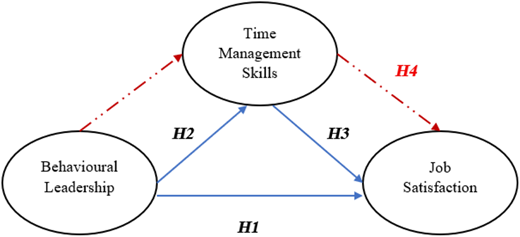
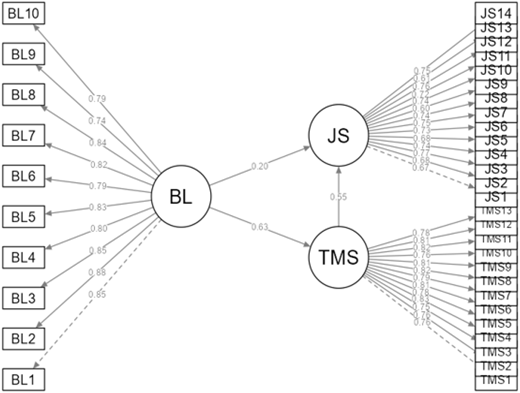
The model includes three direct effects and one mediation effect (Figure 1). In the model (Figure 2), job satisfaction (JS) and time management skills (TMS) were defined as endogenous variables, and behavioral leadership (BL) was defined as exogenous variables. There are fourteen items in the JS variable, thirteen items in the TMS variable, and ten items in the BL variable.
3.2 Measures
The scale for the behavioral leadership (BL) variable, was adapted from Siswanto et al. (2022) (Cronbach Alpha = 0.82). The time management skills (TMS) scale was adapted from Barua et al. (2019) (Cronbach’s alpha = 0.81), and the job satisfaction (JS) scale was adapted from Dodanwala et al. (2023) (Cronbach’s alpha = 0.86). The survey items are provided in Supplementary Material 1.
3.3 Research universe and sampling
This research utilizes Structural Equation Modeling (SEM), to test the conceptual model proposed in Figure 1. Data were collected through a voluntary, anonymous questionnaire designed to measure the three key variables in the model. The questionnaire was kept at a reasonable length to minimize cognitive load, missing data, and enhance ease of participation.
The sample consists of middle and senior-level managers from 86 companies operating in the chemical industry in Istanbul. The chemical sector was selected because of its complex production processes, routine handling of hazardous materials, and stringent quality standards. In this demanding environment, behavioral leadership and effective time management are particularly important for coordinating work, reducing workload pressures, supporting safety-related perceptions, and managing stress.
Moreover, given the sector’s global competitiveness, employee motivation and team cohesion are critical for achieving productivity goals. In this context, the influence of behavioral leadership and time management on job satisfaction has implications for both operational outcomes and employee well-being, making the chemical industry a relevant setting for testing the proposed model.
To assess potential common method bias (CMB), Harman’s single-factor test was conducted. All measurement items were entered into an unrotated exploratory factor analysis to determine whether a single factor accounted for most of the variance. The first factor explained 41% of the total variance, below the commonly used 50% threshold, suggesting that CMB is unlikely to be a serious concern in this study (Podsakoff et al., 2003).
Given the 37 survey items, the “10-times rule” suggests a minimum sample size of 370. However, a larger sample is desirable to improve representativeness. The survey was distributed on 14.11.2023 and closed on 24.02.2024 (open for approximately three months). In total, 634 responses were received. The response rate is 57.3%. During data screening in Jamovi (v2.3), 26 cases showing identical response patterns (i.e. the same standard deviation across items) were removed due to concerns identified during discriminant validity checks. The final analyses were therefore conducted with 608 observations.
3.4 Demographic data
The distribution of participants' answers to demographic questions is given in Table 1. Most participants were male; the most common age category was 36–40; and 11.2% held a graduate degree.
3.5 Factor analysis results
Figure 2 presents the confirmatory factor analysis (CFA) results for the study model. The values displayed above the arrows linking the latent variables to their indicators represent standardized factor loadings. These loadings are reported in detail in Table 2.
Table 2 reports the factor loadings obtained from the factor analysis. These loadings indicate the extent to which each item is associated with its underlying construct. The loadings ranged from 0.745 to 0.811 for behavioral leadership (BL), 0.599 to 0.774 for job satisfaction (JS), and 0.749 to 0.826 for time management skills (TMS). Loadings above 0.40 are typically considered acceptable in empirical research, whereas loadings above 0.70 indicate strong item-factor relationships (Hair et al., 2019). Based on these criteria, the loadings are generally within acceptable limits. Reliability and validity values obtained from the data set are given in Table 3.
Cronbach’s alpha and composite reliability (CR) assess internal consistency, and values above 0.70 are generally considered acceptable. Based on these thresholds, the constructs demonstrate adequate reliability. Convergent validity was evaluated using average variance extracted (AVE), for which values above 0.50 are typically recommended (Alarcón et al., 2015). The AVE results meet this criterion, indicating sufficient convergent validity. Finally, the R2 value indicates the proportion of variance in an endogenous (dependent) variable explained by its predictors. As a rule of thumb, R2 values of approximately 0.26 or higher are often interpreted as substantial in behavioral research (Cohen, 2013).
Table 4 shows the calculated values for discriminant validity. Heterotrait-Monotrait Ratio Table 4 reports the discriminant validity results. Discriminant validity was assessed using the heterotrait-monotrait (HTMT) ratio, which is widely recommended for this purpose (Henseler et al., 2009). Values above 0.85 generally indicate insufficient discriminant validity (Clark and Watson, 1995). Discriminant validity was also evaluated using the Fornell and Larcker (1981) criterion, which requires the italic and underlined diagonal values to be larger than the correlations in the corresponding rows and columns (Cakir, 2019). These diagonal values represent the square roots of the AVE values. The results meet both the HTMT and Fornell-Larcker criteria, indicating adequate discriminant validity. In addition, the f2 effect size values exceed the preferred minimum threshold of 0.02 (Cakir, 2019). Overall, the dataset satisfies the reliability and validity requirements, and the hypotheses can therefore be tested.
Table 5 presents the model fit indices. The incremental fit indices indicate excellent fit, with CFI (0.989), TLI (0.988), NNFI (0.988), IFI (0.989), NFI (0.984), and RNI (0.989) all exceeding the recommended 0.95 threshold (Hair et al., 2021). The PNFI value (0.925) also suggests strong parsimony, indicating a favorable balance between model complexity and explanatory power (Hair et al., 2021).
The error-based indices further support adequate fit, as RMSEA (0.068) and SRMR (0.059) are within commonly accepted cutoffs (RMSEA <0.08; SRMR <0.08) (Hu and Bentler, 1999). Overall, these results indicate that the proposed structural model fits the data well.
3.6 Hypothesis tests
The test results of the hypotheses are given in Table 6. Accordingly, all paths are statisfically significant and hypotheses were supported.
4. Discussion
The effectiveness of behavioral leadership in multinational companies depends on the ability of leaders to align their behaviors with the cultural norms of their employees. In the research conducted by Hofstede (1984), it is suggested that cultural dimensions such as individualism and collectivism and uncertainty avoidance significantly affect how employees perceive and respond to leadership behaviors.
The study analysis supported Hypothesis H1, which states that behavioral leadership positively impacts job satisfaction. When leaders exhibit behaviors that create a positive work environment, empower employees, and demonstrate genuine concern for their well-being, this naturally translates into higher job satisfaction. When leaders in the chemical industry consistently demonstrate behaviors that reduce perceived risk and increase operational clarity, employees feel more secure and valued, which directly increases job satisfaction.
Considering the study conducted to support the H2 Hypothesis: In a research conducted by Alfozan (2024), they state that leaders play an active role in managing time effectively, ensuring discipline and emphasizing employee commitment, and all of these contribute to the successful implementation of corporate transformation initiatives, while Waterhouse and Mann (2021) state that communication and active listening are at the top of the list of management skills in their research. Zampetakis (2024) states that workplace resources closer to employees (e.g. social support from coworkers and the manager-subordinate relationship) are perceived as more important in terms of leadership style.
It is strongly emphasized that task-oriented leadership plays a significant role in making time management even more important by ensuring a disciplined environment in organizations (Fleishman, 1953; Stogdill, 1974).
Support for Hypothesis H2, which demonstrates that behavioral leadership has a positive impact on time management skills, highlights an often-overlooked aspect of leadership influence. Leaders can influence how their subordinates manage their time through their actions and instructions. In the chemical industry, where processes are often complex, sequential, and time-sensitive, strong behavioral leadership is crucial for effective time management. Delays can have cascading effects, impacting safety, production schedules, and overall efficiency.
Considering the study conducted to support Hypotheses H3 and H4: Time management is an intangible resource that is discussed and criticized by everyone. According to researchers who research this subject, if people manage to manage time, they can also manage everything else (Goldsby et al., 2020). Today, a close relationship has been established between time management and success (Daniel and Santeli, 2020). If individuals cannot use their time effectively and efficiently in their working lives and cannot decide on time management correctly, it is not possible to talk about the success of the individual.
Hypothesis H3, which indicates that time management skills positively impact job satisfaction, is supported. When individuals possess strong time management skills, they are more likely to prioritize tasks, meet deadlines, reduce procrastination, and effectively manage their workload. This leads to a sense of accomplishment, reduced stress, and improved work-life balance, all of which contribute significantly to job satisfaction. Conversely, poor time management often leads to feelings of overwhelm, missed deadlines, and increased stress, which can reduce job satisfaction.
Hypothesis H4's demonstration that time management skills mediate the relationship between behavioral leadership and job satisfaction is a significant contribution of the study. This finding suggests that behavioral leadership does not directly translate into job satisfaction; rather, a significant portion of its positive impact is mediated through the development of employees' time management skills. It also aligns with theoretical frameworks in organizational psychology that emphasize the role of skill development. For example, Social Cognitive Theory posits that individuals learn behaviors and skills by observing others (e.g. leaders) and receiving feedback and support.
In the highly stressful chemical industry, leadership is more effective when employees develop the ability to manage their own time. The hypothesis is supported by findings that leadership doesn't just directly increase satisfaction; it works by giving employees the “time control” they need to survive and succeed in a high-risk environment. This means that chemical companies need leaders who are not only “visionary” but also “facilitators”.
In this context, the relationships between the variables examined in the research model are also supported by research in the literature. Although the positive effects of both Behavioral Leadership and Time Management Skills on job satisfaction are supported by hypotheses, the importance of Behavioral Leadership and Time Management Skills for companies in the chemical industry can also be explained.
5. Conclusion
The results show that behavioral leadership in the Turkish chemical industry not only makes employees “feel good” but also enables them to “act effectively.” Leaders directly improve their subordinates' Time Management Skills (TMS) by focusing on observable actions such as giving clear instructions, defining roles, and supporting task execution.
When leaders exhibit positive behavioral traits—being supportive, providing clear instructions, and serving as role models—their impact on employee perceptions and skills can be profound. In order for any job to be efficient and achieve its purpose, it must first be understood why it is necessary and important. If time is not managed correctly, nothing will be considered to be managed correctly. This statement shows how necessary and important time and time management are (Van Fleet, 2020).
If the employee is able to internalize his/her job, he/she is expected to be satisfied with his/her job and committed to the institution he/she works for. In addition, the relationship between the concept of job satisfaction and many factors such as motivation at work, stress management, salary status, possibility of promotion, task conflicts, independence and workload continues to be examined by various disciplines today (Trivellas et al., 2013). It has been shown that assigning specific tasks to employees, clearly determining the relevant processes, and clearly expressing the required expectations lead to a decrease in task uncertainty and an increase in job satisfaction (Stordeur et al., 2001).
In the Turkish context, where a high power distance is often observed, a shift from a “trait-based” (who the leader is) to a “behavior-based” (what the leader does) approach offers a roadmap for organizational development. The leadership effectiveness in Istanbul's industrial centers demonstrates that it is a learnable competency that can be systematically scaled to improve employee well-being.
And also, the application of SEM in the Turkish chemical industry context is particularly noteworthy. Many fundamental researches on management and organizational behavior are conducted in Western, developed countries. The application of an advanced technique like SEM in the Turkish context not only confirms the technique's utility in various settings but also enriches the global empirical literature on these topics. This demonstrates how complex relationships can be systematically analyzed, providing a blueprint for future research in similar non-Western, high-stress industries.
5.1 Theoretical implication
Our findings demonstrate that in sectors such as the chemical industry, a leader's actions – what they do and how they behave (Bass and Bass, 2009) – carry significant weight. Confirming H1, this research proves that behavioral leadership acts as a primary antecedent of job satisfaction and that leadership is a developable skill set rather than an innate trait (Chemers, 2014).
By integrating Hofstede (1984)’s concepts of high power distance and collectivism, this research shows that behavioral leadership is effective even in cultures where authority is traditionally centralized. In the Turkish context, the leader's role in providing a structured behavioral framework is seen as a form of support that reduces the high stress associated with hazardous jobs (Judge et al., 2021). Improving relationships between managers and employees will ultimately lead to better outcomes for both employees and the company (Tran et al., 2023).
Theoretical Extension: The mediation hypothesis (H4) adds a new dimension by explaining how the effects of BL on JS are partially mediated through TMS. This finding enriches the leadership literature by identifying a tangible skill as a key mediator, suggesting that effective leadership development programs should focus not only on interpersonal skills but also on how leaders can implicitly or explicitly improve productivity and organization within their teams. Because the leader's unethical behavior is perceived by employees as a threat to their moral self-image, and employees deal with this situation constructively (Malik et al., 2023). This mediation effect provides a more comprehensive model for understanding how leadership translates into positive employee outcomes, particularly in challenging industrial contexts where operational efficiency is critical.
5.2 Practical implications
By recognizing the mediating role of time management skills, organizations can incorporate these skills into their performance management frameworks. This includes setting clear expectations, providing resources for skill development, and evaluating outcomes based on job satisfaction measures (Armstrong and Baron, 2005). Companies can increase employee retention, reduce absenteeism, and build a more resilient workforce capable of handling the complexities and risks inherent in their roles.
It is important for employees to develop strong emotional ties with their organizations or to feel obligated to reciprocate and respond to the favors granted by their organizations (Rawashdeh et al., 2022). Therefore, the HR department needs to focus on developing a healthy work environment where employees can meet all customer demands (Elrehail et al., 2020). HR development factors (training and development, compensation, and performance appraisal) are reported to positively influence employee commitment (Rawashdeh et al., 2022). HR managers also need to pay attention to employee health and safety in the workplace. They need to develop appropriate incentive and evaluation structures to enable employees to work in line with company goals (Elrehail et al., 2020). In this context, it is important for organizations to increase manager training to support employee health and well-being, to benefit from employee health and well-being, the organization's most critical resource, and to turn it into a competitive advantage (Tran et al., 2023).
Industry associations and policy makers can use the findings to design interventions aimed at improving workplace conditions and employee well-being.
5.3 Methodological contribution
The research successfully tested a multivariate model incorporating direct and indirect (mediation) effects using SEM, providing a detailed understanding of causal pathways. It emphasizes that complex statistical models are equally effective in exploring organizational phenomena in emerging economies and across diverse cultural frameworks. This methodological rigor allows for more reliable generalizations and cross-cultural comparisons of findings, enriching the global discourse on leadership, human resource management, and organizational behavior. The use of a relatively large sample size and the inclusion of validity checks further strengthen this methodological contribution, setting a precedent for similar robust quantitative researches in similar industrial sectors.
5.4 Research limitations
The findings of the research should be evaluated within the context of the chemical industry in Istanbul. The chemical sector has a highly structured work environment due to hazardous materials and quality standards. This may explain why Behavioral Leadership has such a significant positive impact; because employees in risky sectors with high uncertainty need clear guidance and time planning more.
5.5 Suggestions for future research
Researches can be conducted to monitor changes in behavioral leadership, time management skills and job satisfaction over time and provide deeper insights into causal relationships. For example, by making a cross-cultural comparison, the universality of leadership behaviors can be tested by comparing chemical companies in Türkiye, with their highly collectivist culture, with those in Western cultures, which are more individually focused.
Sectoral Diversity: The mediating role of time management can be broadened by examining the model's boundaries in different industrial contexts that are “output-oriented” but “process-flexible,” such as service or technology sectors.
The supplementary material for this article can be found online.