


This paper empirically addresses the effect of coercive, normative and mimetic pressures on sustainability results, focussing on the three dimensions of the triple bottom line approach: environmental, economic and social. The mediating role of compliance, analyser or proactive corporate strategies towards sustainability is also considered.
The hypotheses developed in this study were tested using data from a sample of private companies from two industries: manufacture of chemicals and chemical products, and manufacture of basic metals.
The results confirm the role played by institutional pressures for sustainability in explaining the involvement of organisations in economic, social and environmental aspects. The mediating effect of corporate strategy is also confirmed, although only for environmental aspects.
Research into sustainability development is evolving rapidly; however, few studies have explored its diffusion amongst organisations from a triple bottom line perspective by considering the role of different current external pressures, the corporate strategy and the diverse results.
Introduction
Despite the growing concern about sustainability, the lack of consensus continues to present a unique challenge in the literature (Alhaddi, 2015). The term sustainable development has been defined as the “development that meets the needs of the present generations without compromising the ability of future generations to meet their own needs” (Brundtland, 1987, p. 43). Since that definition appeared, several studies have analysed sustainability by focussing on respect for society and the environment (Dyllick and Hockerts, 2002). Elkington (1998) coined the term triple bottom line (TBL) to refer to a sustainability-related construct that aims to extend the environmental agenda to cover economic and social aspects, including profit, people and the planet, for a more consistent and coherent measurement of the performance and success of an organisation (Goel, 2010).
In today’s rapidly changing environment, organisations face massive pressures to pursue high standards of environmental responsibility, such as reducing their carbon footprint, mitigating their impact on land degradation (Wijethilake et al., 2017), preventing abusive labour practices, and complying with human rights standards (Bansal, 2005), using the lens of institutional theory to analyse their reasons for adopting these practices. Corporate performance and competitiveness are increasingly dependent on economic, environmental, and social expectations (Forés and Férnández-Yáñez, 2023). Nevertheless, most of these studies have focused on a certain type of pressure (coercive, mimetic or normative) or a specific aspect of sustainability, without addressing each of the three TBL dimensions – environmental, social and economic – as equally important (Haleem et al., 2022).
The institutional theory considers organisations embedded in institutional environments that influence the practices and policies adopted by those institutions (DiMaggio and Powell, 1983). Organisations face mimetic, normative and coercive forces which act as three forms of institutional isomorphism. Organisations may adopt practices in response to these pressures to conform to institutional pressures (IP) in order to achieve legitimacy, as they will have to adjust to what their environment considers desirable, proper or appropriate (Suchman, 1995). Consequently, the diffusion of sustainability should be analysed as an isomorphic process, since the existence of coercive, mimetic and normative pressures could explain an organisation’s predisposition towards sustainability. Therefore, the first aim of this paper was to analyse the relationship between IP and organisational involvement in environmental, social and economic aspects.
Although institutional theory provides a useful lens to clarify how sustainable practices spread amongst organisations, it does not fully explain the variations in the responses to IP for sustainability (Clemens and Douglas, 2005). IP for sustainability may oblige organisations to initiate strategic processes while seeking congruence with the expectations of their surroundings (De Prins et al., 2014). The commitment to sustainability demands a strategic approach to ensure that corporate sustainability is an integrated part of the business strategy and processes (Engert et al., 2016). Specifically, previous research has highlighted the existence of different sustainable corporate strategies that may explain organisations' involvement in social, economic and environmental issues (López-Cabrales and Valle-Cabrera, 2020), responding to the increasing concern about integrating these areas (McKinsey, 2013). Different sustainability strategies and pursuing the TBL may lead to diverse results. However, little is known about sustainable corporate strategies, since studies are scarce and mainly focus on the environmental dimension (Adams et al., 2016).
Firms can adopt different strategies in response to IP, from passive conformity to active manipulation (Oliver, 1991; Zheng and Iatridis, 2022). Thus, the second goal of this study was to shed light on the mediating role that corporate strategies can play in the relationship between IP and organisational involvement in sustainability from a TBL approach. Diverse strategies may imply differences in the way sustainability is present in an organisation’s behaviour and culture (Linnenluecke and Griffiths, 2010), and they could also have an impact on the results derived from employers' involvement in sustainability.
Therefore, we contribute to the sustainability literature by exploring how IP on firms affect TBL through the design of a sustainable business strategy. Since IP influence the adoption of a given corporate sustainability strategy, it is important to know the outcomes of such a strategy on TBL. To our knowledge, this is the first study to examine the association between IP, corporate sustainability strategies and business performance in all three dimensions of sustainability (economic, social and environmental).
The study is structured as follows: the next section discusses the theoretical framework for sustainability from a TBL perspective, IP and the role of sustainable corporate strategies. We then describe the empirical analysis and the results. Finally, we present the conclusions, contributions and limitations of this research.
The theoretical framework of sustainability
Elkington (1998) set out to enlarge the concept of sustainability by including three dimensions on which sustainable development should be based: environmental integrity, social equity and economic prosperity, which he referred to as the TBL. Consistency and coherence are inherent to the construct, as the TBL is explicitly based on the integration of the three dimensions, each of which is given equal emphasis (Santoyo-Castelazo and Azapagic, 2014). Environmental integrity refers to promoting practices that do not compromise environmental resources for future generations, which requires protecting ecosystems' limited regeneration capacity. For instance, business organisations may contribute by reducing their emissions, minimising environmental degradation, or producing ecologically oriented goods and services (Kozica and Kaiser, 2012). Social equity refers to people, guaranteeing beneficial and fair practices in the labour market and society at large. By building transparent relationships, and promoting fair wages or health care coverage, an organisation may focus on its interaction with the community while creating value. Companies should contribute by ensuring that all members of society have equal access to resources and opportunities (Bansal, 2005). Finally, the economic dimension refers to the impact on the economic system, by tying organisational growth to general economic prosperity and promoting support for future generations. Companies should ensure their future viability by maintaining their competitiveness in dynamic environments (Dyllick and Hockerts, 2002).
Nevertheless, there is a situation of confusion about the theoretical concept of sustainability and how organisations should put it into practice, which has also been transmitted to empirical research on corporate sustainability. The vast majority of studies reviewed in the literature with empirical evidence use a reduced version of sustainability (environmental sustainability) and there are hardly any works analysing TBL (Cardoso de Oliveira Neto et al., 2018). In this sense, many sustainability studies have discussed environmental (Soni et al., 2020) or social issues (Mariappanadar and Kramar, 2014), although only a few of them have combined two or three dimensions (Haleem et al., 2022).
Institutional pressures and sustainability
The diffusion of different organisational practices amongst organisations has been widely explained through the lens of institutional theory (Pedersen and Gwozdz, 2014). Organisations in a similar environment face similar pressures and become isomorphic as they adopt similar practices in their attempt to gain legitimacy (Kostova and Roth, 2002; Paauwe and Boselie, 2007). Companies tend to become more alike through this response mechanism, since they adopt similar measures in response to the external forces they face to increase their legitimacy (Chua and Rahman, 2011).
Therefore, the diffusion of practices related to sustainability is considered an isomorphic process, as the existence of coercive, mimetic and normative pressures could explain an organisation’s predisposition towards sustainability. Although some previous studies have already used this theoretical approach (see Table 1), most of them have only analysed the environmental dimension and usually have taken into account only some of the external forces that companies may face (Haleem et al., 2022).
Empirical research on pressures and TBL
| Article | Pressures | Sustainability performance | Sample/Case | Method | Key findings |
|---|---|---|---|---|---|
| Tate et al. (2010) | Stakeholder pressure | Economic, social and environmental performance | 100 socially and environmentally responsible global companies | Secondary data: content analysis | IP are the major driving force behind strategy development for all of the industries studied. Companies emphasise different facets of social, environmental and economic responsibility in supply chains |
| Shnayder et al. (2016) | Regulative, normative, and cultural-cognitive pillars | People, planet and Profits | Sixteen sustainability reports, each from a different multinational packaged food company | Secondary data and interviews | External pressures can explain motivations that are framed as intrinsic or value-based. In addition to legislation and normative obligations, social pressure is an effective driver for CSR |
| Chen and Kitsis (2017) | Stakeholder pressures | Sustainable supply chain performance: economic, social and environmental sustainability performance | 200 articles published in major supply chain management and sustainability journals | Secondary data | Sustainable supply chain management implementation entails linking stakeholder pressures, moral motives, and management commitment with relational practices |
| Ni and Sun (2018) | Stakeholder pressure on sustainability | Economic, social and environmental performance | 898 cases from International Manufacturing Strategy Survey (IMSS) | Survey | The synergistic effect between supplier assessment and collaboration to achieve better performance is verified when environmental dynamism and stakeholder pressure are high |
| Thong and Wong (2018) | Environmental and social institutional pressures | Economic, social and environmental performance | 193 manufacturing firms in Malaysia | Survey | External and internal factors positively impact sustainable supply chain management practices, which is fundamentally in disagreement with the findings of previous similar studies |
| Fung et al. (2020) | Cognitive, regulative and normative dimensions | Triple bottom line: sustainable development goals to analyse the successfulness of sustainable planning strategies | Public data on the fashion giant brand Nike | Case study: secondary data | Strategic planning of fashion companies on sustainability can improve the performance of the stakeholders throughout the whole sustainable fashion supply chain |
| Kitsis and Chen (2020) | Instrumental motives, relational motives and Moral motives | Economic, social and environmental performance | A sample of 205 supply chain companies in the USA | Survey | It highlights the critical role of robust instrumental, relational and moral motives in driving sustainable supply chain management practices and achieving improvement in all three dimensions of economic, environmental and social sustainability performance |
| Raj et al. (2020) | Mimetic, normative and coercive pressures | Economic, social and environmental sustainability performance; level of sustainability adoption in public procurement | 546 public procurement practitioners from 102 countries | Secondary data | IP and citizens' attitudes towards sustainability significantly impact the level of sustainability adoption in public procurement, which, in turn, improves sustainability performance |
| Famiyeh et al. (2021) | Mimetic, normative and coercive pressures | Economic, social and environmental sustainability from global reporting initiative’s sustainability reporting guidelines (2000–2006) | 164 respondents from the mining sector in Ghana | Survey | Coercive and normative pressures emerge as potent drivers of the triple bottom line of sustainability. However, mimetic institutional pressures can influence environmental and social sustainability but not economic sustainability |
| Fritz et al. (2021) | Mimetic, normative and coercive pressures | Economic, social, environmental and managerial sustainability in supply chains | A comparative study of twelve cases of six family and six non-family businesses | Case studies: secondary data and interviews | Family businesses tend to accentuate social concerns while non-family businesses pay much less attention, focussing on the environmental dimension. Such differences are due to institutional pressures |
| Habib et al. (2022) | Mimetic, normative and coercive pressures | Cleaner production and sustainable firm performance | 246 textile and garments manufacturing units in the clothing industry of Bangladesh | Survey | The study findings show a direct and positive relationship between institutional pressure and cleaner production, environmental performance and cleaner production, and firms' environmental and economic performance |
| Shamil et al. (2022) | Institutional pressure and external stakeholder pressure | Corporate sustainability strategy | 127 companies in Sri Lanka | Survey | The adoption of corporate sustainability strategy is positively influenced by external stakeholder pressures, whereas institutional pressures have no significant impact |
| Ijaz Baig and Yadegaridehkordi (2023) | Stakeholder pressure | Organisational sustainable performance: financial, environmental and social aspects | 269 Malaysian manufacturing organisations | Survey | The results showed significant effects of stakeholder pressure, organisation capabilities, green marketing, and green entrepreneurial orientation on organisational sustainable performance |
| Pereira et al. (2023) | Mimetic, normative and coercive pressures | Sustainability certification adoption | Managers of 20 export-oriented firms were interviewed | Case studies: secondary data and interviews | Normative and mimetic pressures are central to sustainability implementation by coffee suppliers. Additionally, as a result of suppliers' sustainability improvement in their operations, new competencies emerged beyond the triple bottom line dimensions |
Source(s): Table by authors
According to DiMaggio and Powell (1983), institutional isomorphism is based on three mechanisms: coercive, mimetic and normative forces, which influence decision-making in organisations (Teo et al., 2003). Through their responses to these institutional forces, organisations adopt structures, programmes, policies and procedures for reasons of legitimacy, and not necessarily efficiency (Meyer and Rowan, 1991).
Coercive mechanisms are based on “political influence and the problems of legitimacy” (DiMaggio and Powell, 1983, p. 150). They result from pressures exerted by other organisations such as government regulatory bodies or the legal system (Kreuzer, 2017). Previous research offers various examples of the effect regulations have on the control of environmental pollution (Aragon-Correa et al., 2018), and penalties for violating environmental and labour laws (Bansal, 2005). In this sense, the search for compliance with the legislation, the avoidance of legal consequences or the requirements of employees and unions may affect the different degrees of implementation of organisational health and safety practices (López-Fernández and Pasamar, 2019). Failure to respond to these coercive pressures may have negative consequences for earnings or reputation, or may even prevent companies from operating if licences are revoked (Oliver, 1991; Wijethilake et al., 2017). In this paper, we define organisational responsiveness in sustainability from a TBL perspective as a combination of economic, social and environmental practices. Therefore, we can propose the following.
Coercive pressures are positively related to sustainability from a TBL perspective (economic, social and environmental).
Even without legal coercion, organisations may face other forces such as mimetic pressures (Combs et al., 2009). Mimetic pressures refer to those situations of uncertainty in which an organisation imitates the practices of companies that are perceived as more legitimate and successful than others, such as corporate environmental reporting (Aerts et al., 2006). Thus, mimetic pressures act in two ways: the likelihood of imitation is increased through the prevalence of a certain practice in the organisation’s industry, and through the perceived success of organisations that have adopted the practice in this sector (Teo et al., 2003). For instance, organisations that fail to respond to mimetic pressures to provide work-life programmes for their employees may suffer a competitive disadvantage in recruiting and retaining skilled personnel (Wang and Verma, 2012). However, organisations may pursue legitimacy through imitation, even if this legitimacy-based imitation could negatively affect their profitability in the short term (Barreto and Baden-Fuller, 2006). Mimetic forces may include pressures to adopt practices implemented by other companies, such as environmentally friendly policies, corporate social responsibility practices or other economic practices designed to guarantee the growth of the general economy.
Mimetic pressures are positively related to sustainability from a TBL perspective (economic, social and environmental).
Finally, normative systems are relevant to explain institutional diffusion processes (Peters and Heusinkveld, 2010). A conducive normative environment leads to the adoption of practices consistent with the norms, values and beliefs of members of the organisation (Kostova and Roth, 2002). Therefore, organisations that are more sensitive to normative pressure will be more inclined to adopt socially desirable policies, and this responsiveness confers legitimacy (Baek et al., 2012). Organisations are observant of the norms, standards and institutionalised responses to problems in their environments and professional circles. Indeed, different studies have shown how normative pressures are more important than coercive power or mimetic efforts to explain corporate social responsibility behaviours (Roszkowska-Menkes and Aluchna, 2017) or sustainability reporting (Martínez-Ferrero and García-Sánchez, 2017).
More socially sustainable organisations may be rewarded with enhanced reputation and new customers, which may create a virtuous cycle that steadily increases their level of social sustainability implementation (Huq and Stevenson, 2020). Previous research on normative pressures for sustainability has focused on the environmental and social aspects, analysing compliance with industry trade associations and professional bodies related to environmentally friendly practices (Aragon-Correa et al., 2018), the adoption and use of work-life benefits (Pasamar and Alegre, 2015), or firms' participation in the United Nations Global Compact and Global Report Initiative (Perez-Batres et al., 2010), amongst others. We can therefore suggest the following.
Normative pressures are positively related to sustainability from a TBL perspective (economic, social and environmental)
Sustainable corporate strategies
While institutional theory has been widely used to explain the diffusion of practices amongst organisations, it has been also criticised for its inability to expound the strategic approach. Business strategies play a fundamental role in achieving business objectives (Magerakis and Habib, 2021). In this sense, previous literature has pointed out that many companies assume responsibility and start corporate sustainability initiatives focussing only on an operational level, instead of integrating corporate sustainability at all business levels (Engert et al., 2016), and the reasons for this lack of a clear strategy may be related to different factors, such as uncertainty (Hahn, 2013). Nevertheless, although strategy may be vital to explain organisational involvement in sustainability, the few studies in the literature focus mainly on the environmental dimension (Adams et al., 2016), but fail to integrate the environmental, social and economic dimensions.
To date, the relationship between business strategy and sustainability has been addressed in two main ways: on the one hand, business sustainability strategies have been specifically defined and the results of this strategy on sustainability variables (mainly environmental sustainability) have been analysed (Kraus et al., 2020); and, on the other hand, Miles and Snow's classification of generic strategies has been used to detect which type of strategy is most linked to sustainability results (again, almost exclusively sustainability results understood as environmental sustainability). Forés (2019) confirms that, whereas defender strategies reduce the impact of green technology on environmental performance, analyser and prospector strategies enhance its influence. Other studies considered prospector-type firms make efforts and take more environmentally protective actions (Magerakis and Habib, 2021).
In any case, these studies link generic business strategies that are not designed to consider the three dimensions of sustainability together. Therefore, in our view, the use of the generic strategies of Miles and Snow's Theoretical Framework does not adequately capture the behaviours of companies that, in the face of IP, are obliged to design and develop strategies that jointly promote the economic, social and environmental dimensions of sustainability.
To try to overcome strategies that are too generic or too specific, while dismissing the efforts of the organisations to maintain a coherent strategy with TBL, López-Cabrales and Valle-Cabrera (2020) recently proposed a theoretical classification of sustainable strategies: from reactive or unsustainable to proactive strategies. Companies in the first group are characterised by their unsustainable behaviour; they have no planned sustainable activities, may reject sustainability initiatives (Dunphy et al., 2007) or simply act in accordance with their limited capacities to maintain their position, without considering any standards or regulations in terms of sustainability. The second group of organisations follow a compliance sustainability strategy, which implies a step forward in that they aim to meet the legal requirements established concerning the three dimensions of sustainability: environmental, social, and economic. Although these companies accept the need to comply with environmental, social and economic legislation and regulations, their main goal is to maximise returns for their shareholders (Aragon-Correa, 1998), at the expense of pursuing positive impacts for the community or generating wealth for other stakeholders. Organisations following this strategy will have low involvement in sustainability from a TBL perspective, as their compliance with minimum legal environmental requirements is simply a short-term strategy to avoid paying fines (Aragon-Correa and Sharma, 2003). The third sustainable strategy group includes companies that develop an “analyser” behaviour to respond to competitors through imitation (Miles and Snow, 1984). This strategy falls between compliance and proactive strategies in terms of impact on the TBL. These companies may have not assimilated the concept of sustainability, but they do understand that they need to act. They recognise the need to respond to pressure from external forces, competitors, customers or the community (DeSarbo et al., 2005). Finally, the fourth type of sustainable strategy is proactive. Organisations in this category do not simply comply but anticipate sustainability-related actions as an integral part of their culture and their competitive strategy. This way of operating has the highest positive impact on the TBL, as the companies that implement it are committed to outperforming in environmental, social and economic dimensions, and to securing long-term benefits as part of their competitiveness (Aragon-Correa and Sharma, 2003).
We can therefore expect that the sustainable corporate strategy adopted by companies will affect the organisational involvement in sustainability from a TBL perspective. The different types of strategies may imply diverse responses, from the lack of sustainable results in the reactive/unsustainable strategies to higher social, environmental and economic development in the proactive strategies.
Nevertheless, the relationship between strategies and IP should not be dismissed. Coercive, mimetic and normative pressures may impact sustainable corporate strategies by obliging companies to comply with laws, regulations, and social and ethical obligations (Epstein and Roy, 2003). Moreover, although institutional theory initially proposed that organisational success is based on conforming to IP, several studies have shown that it is not blind conformity which leads to success, but an active process of resistance, ranging from passive conformity to proactive manipulation (Oliver, 1991; Wijethilake et al., 2017). The strategic responses to these pressures may lead companies to adopt sustainable practices (Beddewela and Fairbrass, 2016).
Consequently, we propose the following.
The relationship between IP – coercive, mimetic and normative – and sustainability from the TBL perspective (economic, social and environmental) will be mediated by a sustainable corporate strategy.
Methodology
Setting and data collection section
A survey was conducted to empirically explore the relationship between IP, sustainable corporate strategies, and sustainability from a TBL perspective. Data were collected via a survey of companies with more than 50 employees in Spanish. Specifically, we used the SABI (Iberian Balance Sheet Analysis System) database, which is the most comprehensive database of Spanish companies. It was employed to identify all the companies meeting the firm size criteria. For the sampled firms, we focused on industries with heavy influences by IP (Yang et al., 2019). In our case, we chose the sectors of chemicals/chemical products and basic metals manufacture, as they are subjected to strong environmental, social and economic pressures. This population allows us to analyse the existence of differences in IP. Additionally, the country of our population is a country in which high efforts for sustainability have been made (Bebbington et al., 2012), and we consider that it is a good context (and heterogeneous enough) to analyse the differences in IP from the TBL perspective.
Telephone contact was established with all firms in the sample to clarify the purpose of the study, request their collaboration, and discuss the mailing of the questionnaire. Each firm was sent two questionnaires concerning its IP, corporate strategy and economic, social and environmental aspects of sustainability. Specifically, we asked the CEO and marketing managers from the top management team, since they were regarded as reliable sources to perceive IP. Our valid population comprised 678 firms, and the final sample consisted of 206 firms that returned the questionnaires completed by the CEO and marketing manager (412 responses), yielding a response rate of 30.38%.
To check for non-response bias, we compared the respondents with the non-respondents, via mean difference, based on their general features (industry membership, number of employees and revenue). The t-test for equality of means for independent samples showed that the difference between the mean scores was not statistically significant. Therefore, a non-response bias related to industry, number of employees or revenue was not present in the data.
To test our hypotheses, we used the bootstrapping method (Hayes, 2017). Specifically, mediation analyses were performed using PROCESS macro (Model #4 from Hayes, 2017) on 5,000 bootstrapped samples with a 95% confidence interval, which is a more convenient method (Keenan et al., 2006).
Measures
In general terms, we used existing multi-item scales and verified them through various analyses as described in the following section. All the variables were measured using a five-point Likert scale.
To test the reliability and validity of the measures, we conducted a first-step exploratory analysis to identify possible factors that might support the expected dimensionality of the scales, using the varimax rotation method (Luque-Martínez, 2000) with SPSS v.22. All measures showed the expected dimensionality. We then performed a confirmatory factor analysis (CFA) separately for each construct using structural equation modelling (SEM) software EQS 6.1. The confirmatory factor analysis fulfilled all the requirements noted by Hair et al. (1999). The factor loadings were statistically significant and had values of, or close to, 0.7. On this point, some authors argue that loadings of 0.5 or 0.6 are acceptable (Barclay et al., 1995). Appendix 1 presents the items used, factor loadings, R2, and CFA indexes. The average variance extracted (AVE) exceeded 0.5 in all of the constructs, providing evidence of convergent validity (Fornell and Larcker, 1981). To test discriminant validity, we used Fornell and Larcker’s (1981) criterion; namely, the average variance extracted (AVE) should be greater than the square of the correlations between the pair of factors. Discriminant validity was confirmed, as can be seen in Appendix 2. These values, together with a satisfactory Cronbach’s alpha score, provide evidence of the scale’s reliability (Hair et al., 1999). Specifically, Cronbach’s alphas ranged from 0.63 to 0.80, all above the suggested cut-off value (Bagozzi and Yi, 1988). While the alpha value of “economic and social sustainability” was relatively low (0.63 and 0.64), we considered, in line with previous studies (Xiao and Björkman, 2006), that this is largely due to a contextual difficulty of data collection at the company level. Despite this consideration, the alpha was still greater than the suggested concessive criterion of 0.60 (Nunnally, 1978). A detailed description of each measure is provided below.
IP were measured by an adaptation of the scale proposed by Kostova and Roth (2002) for the institutional profile, which provides a consistent analysis of the three types of IP, as in previous studies (Lavandoski et al., 2016). Specifically, we used four items for coercive pressures, four items for mimetic pressures, and five items for normative pressures. For confirmatory purposes, one item from coercive pressures, two items from mimetic pressures, and one item from normative pressures were dropped (confirmatory analyses are displayed in Appendixes 1 and 2).
Corporate strategy was measured using the paragraph method. Despite its limitations, this method has been widely accepted in research on strategy, since managers' perceptions have been proved to be very close to the strategic reality of the firm (Aragón-Sánchez and Sánchez-Marín, 2005; St-Pierre and Audet, 2011). The descriptions used for strategic types were adapted from López-Cabrales and Valle-Cabrera (2020), corresponding to each strategic archetype: compliance, analyser, and proactive. The companies were presented with strategic archetypes in which the situations were carefully formulated to be neutral, in order to avoid desirable response bias.
Sustainability was measured by Gallardo-Vázquez and Sánchez-Hernández’s (2014) scale. These authors aimed to define a measurement scale of corporate social responsibility as a variable that incorporates the three dimensions of Elkington’s theoretical TBL framework (Elkington, 1998). We used the original validated scale, with three items for the economic dimension, four items for the social dimension and four items for the environmental dimension. For confirmatory purposes, two items were dropped: one item from the economic dimension and one item from the social dimension (the scales are reproduced in Appendixes 1 and 2).
Control Variables. Firm size was measured by the number of employees. The average was 120 employees and the standard deviation was 112.8. The firm size ranged from 30 to 1,000 employees. Tenure was measured by the number of years working in the organisation. It ranged from 1 to 41 years and the average was 11.63 years.
Inter-group agreement (data aggregation). We asked the CEO and the marketing manager to respond to the questions related to IP, corporate strategy and economic, social and environmental aspects of sustainability. Thus, for each firm, we obtained two responses related to IP, corporate strategy and TBL dimensions. Under the assumption that the scores reflect a shared reality within each firm, we predicted that the scores obtained from the two firm managers would be similar. These arguments can be measured using the inter-group agreement coefficient (rwg) (Bliese and Halverson, 1998). These expectations were confirmed by measuring the inter-rater agreement coefficient (rwg), which has been used to aggregate data (James et al., 1984). The average rwg values were 0.90, 0.89 and 0.90 for coercive, mimetic and normative pressures, respectively; 0.92 for corporate strategy; and 0.92, 0.91 and 0.92 for economic, social and environmental aspects of sustainability, respectively. These results confirm the response consistency within each firm.
Analyses and results
Table 2 displays the main statistics and correlations amongst the study variables, showing that all theoretical relations are significant at the correlational level. IP positively correlate to corporate strategy and sustainability.
Descriptive statistics and correlationsa
| Mean | SD | 1 | 2 | 3 | 4 | 5 | 6 | 7 | 8 | 9 | |
|---|---|---|---|---|---|---|---|---|---|---|---|
| 1. Tenure | 11.63 | 5.86 | 1 | ||||||||
| 2. Firm Size | 120.1 | 112.8 | −0.091 | 1 | |||||||
| 3. Coercive pressures | 4.16 | 0.463 | 0.045 | −0.174* | (0.70) | ||||||
| 4. Mimetic pressures | 4.04 | 0.624 | 0.090 | −0.200** | 0.708** | (0.76) | |||||
| 5. Normative pressures | 16.50 | 1.76 | 0.073 | −0.197** | 0.753** | 0.716** | (0.80) | ||||
| 6. Corporate strategy | 2.60 | 0.609 | 0.071 | 0.184** | 0.373** | 0.390** | 0.431** | 1 | |||
| 7. Economic sustainability | 4.23 | 0.401 | 0.139* | −0.165* | 0.582** | 0.564** | 0.551** | 0.278** | (0.63) | ||
| 8. Social sustainability | 4.33 | 0.309 | 0.031 | −0.124 | 0.429** | 0.413** | 0.440** | 0.258** | 0.344** | (0.64) | |
| 9. Environment sustainability | 4.24 | 0.382 | −0.238** | 0.238** | 0.634** | 0.623** | 0.575** | 0.338** | 0.783** | 0.353** | (0.80) |
Note(s): An = 206; **p < 0.01, *p < 0.05; when appropriate, Cronbach’s alpha coefficients are reported in parentheses on the diagonal
Source(s): Table by authors
Figure 1 represents our statistical model. To test our hypotheses, the bootstrapping method was used (Hayes, 2017). Specifically, mediation analyses were performed using PROCESS macro (Model #4 from Hayes, 2017) on 5,000 bootstrapped samples with a 95% confidence interval. In doing so, we performed three different models for each of the IP, considering the effects on the three dimensions of sustainability (as dependent variables), taking into account the role played by corporate strategy.
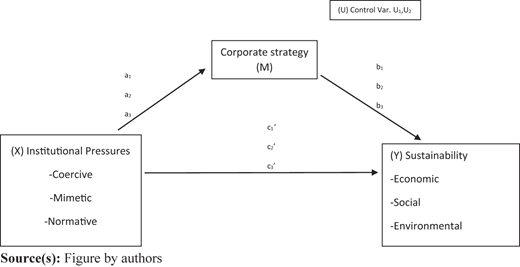
In the first step, we present the results for the direct relationships between IP and TBL dimensions (H1, H2 and H3). The results in Table 3 show that coercive pressures were directly and statistically related to sustainability. The hypothesis was confirmed for economic (β = 0.459**), social (β = 0.241**) and environmental dimensions of TBL (β = 0.447**), giving full support to H1.
Results for the test of mediation between coercive pressures and TBL sustainability
| Model 1 | Model 2 | Model 3 | |||||
|---|---|---|---|---|---|---|---|
| Economic sustainab | Social sustainability | Environmental sustainab | |||||
| Variables | Paths | β (se) | p-value | β (se) | p-value | β (se) | p-value |
| Coercive pressures (X) | a1, a2, a3 | 0.546 (0.083) | 0.000 | 0.546 (0.083) | 0.000 | 0.546 (0.083) | 0.000 |
| Corporate strategy (M) | b1, b2, b3 | 0.057 (0.041) | 0.172 | 0.070 (0.035) | 0.050 | 0.101 (0.037) | 0.006 |
| Coercive pressures (direct effect) | c`1, c`1, c`1 | 0.459 (0.054) | 0.000 | 0.241 (0.047) | 0.000 | 0.447 (0.048) | 0.000 |
| Coercive pressures (total effect) | c1, c2, c3 | 0.491 (0.049) | 0.000 | 0.280 (0.043) | 0.000 | 0.502 (0.044) | 0.000 |
| Size | U1 | 0.006 (0.003) | 0.077 | −0.000 (0.000) | 0.195 | −0.000 (0.000) | 0.003 |
| Tenure | U2 | −0.000 (0.000) | 0.184 | −0.000 (0.003) | 0.961 | 0.005 (0.003) | 0.145 |
| R2 | 0.347 | 0.186 | 0.436 | ||||
| F | 28.30 | 12.74** | 40.70** | ||||
| Note(s): **p < 0.01; *p < 0.05 | |||||||
| Bootstrap for indirect effects | ||||||
|---|---|---|---|---|---|---|
| Data | Boot | Bias | SE | Bias corrected CI | ||
| Lower | Upper | |||||
| Corporate strategy (Model 1) | 0.031 | 0.032 | 0.001 | 0.025 | −0.017 | 0.083 |
| Corporate strategy (Model 2) | 0.038 | 0.040 | 0.002 | 0.027 | −0.006 | 0.101 |
| Corporate strategy (Model 3) | 0.055 | 0.057 | 0.002 | 0.023 | 0.013 | 0.104 |
Source(s): Table by authors
Concerning Hypothesis 2, which posits the relationship between mimetic pressures and sustainability, Table 4 shows that the direct effect of the perception of mimetic pressures is positive and statistically significant for all the sustainability dimensions, giving support to the hypothesis. Specifically, we found a significant relationship between mimetic pressures and economic (β = 0.326**), social (β = 0.169**) and environmental dimensions (β = 0.321**) of sustainability.
Results for the test of mediation between mimetic pressures and TBL sustainability
| Model 4 | Model 5 | Model 6 | |||||
|---|---|---|---|---|---|---|---|
| Economic sustainab | Social sustainability | Environmental sustainab | |||||
| Variables | Paths | β (se) | p-value | β (se) | p-value | β (se) | p-value |
| Mimetic pressures (X) | a1, a2, a3 | 0.429 (0.061) | 0.000 | 0.429 (0.061) | 0.000 | 0.429 (0.061) | 0.000 |
| Corporate strategy (M) | b1, b2, b3 | 0.057 (0.043) | 0.185 | 0.071 (0.036) | 0.051 | 0.099 (0.038) | 0.009 |
| Mimetic pressures (direct effect) | c`1, c`1, c`1 | 0.326 (0.042) | 0.000 | 0.169 (0.035) | 0.000 | 0.321 (0.037) | 0.000 |
| Mimetic pressures (total effect) | c1, c2, c3 | 0.351 (0.037) | 0.000 | 0.200 (0.032) | 0.000 | 0.364 (0.034) | 0.000 |
| Size | U1 | −0.000 (0.000) | 0.241 | −0.000 (0.000) | 0.222 | −0.000 (0.000) | 0.006 |
| Tenure | U2 | 0.005 (0.004) | 0.168 | −0.000 (0.003) | 0.790 | 0.003 (0.000) | 0.302 |
| R2 | 0.320 | 0.171 | 0.413 | ||||
| F | 25.21** | 11.60** | 37.11** | ||||
| Note(s): **p < 0.01; *p < 0.05 | |||||||
| Bootstrap for indirect effects | ||||||
|---|---|---|---|---|---|---|
| Data | Boot | Bias | SE | Bias corrected CI | ||
| Lower | Upper | |||||
| Corporate strategy (Model 4) | 0.024 | 0.026 | 0.001 | 0.019 | −0.012 | 0.063 |
| Corporate strategy (Model 5) | 0.030 | 0.031 | 0.001 | 0.020 | −0.004 | 0.075 |
| Corporate strategy (Model 6) | 0.042 | 0.044 | 0.002 | 0.018 | 0.008 | 0.082 |
Source(s): Table by authors
The results of our analyses also fully supported Hypothesis 3. Table 5 shows that normative pressures had a positive and direct effect on sustainability, achieving statistical significance for the economic (β = 0.114**), social (β = 0.066) and environmental (β = 0.101**) aspects of TBL, thereby confirming Hypothesis 3.
Results for the test of mediation between normative pressures and TBL sustainability
| Model 7 | Model 8 | Model 9 | |||||
|---|---|---|---|---|---|---|---|
| Economic sustainab | Social sustainability | Environmental sustainab | |||||
| Variables | Paths | β (se) | p-value | β (se) | p-value | β (se) | p-value |
| Normative pressures (X) | a1, a2, a3 | 0.167 (0.021) | 0.000 | 0.167 (0.021) | 0.000 | 0.167 (0.021) | 0.000 |
| Corporate strategy (M) | b1, b2, b3 | 0.045 (0.044) | 0.316 | 0.054 (0.037) | 0.141 | 0.102 (0.040) | 0.012 |
| Normative pressures (direct effect) | c`1, c`1, c`1 | 0.114 (0.015) | 0.000 | 0.066 (0.012) | 0.000 | 0.101 (0.014) | 0.000 |
| Normative pressures (total effect) | c1, c2, c3 | 0.121 (0.013) | 0.000 | 0.075 (0.011) | 0.000 | 0.118 (0.012) | 0.000 |
| Size | U1 | −0.000 (0.000) | 0.260 | −0.000 (0.000) | 0.304 | −0.000 (0.000) | 0.005 |
| Tenure | U2 | 0.006 (0.004) | 0.124 | −0.000 (0.003) | 0.866 | 0.004 (0.003) | 0.234 |
| R2 | 0.306 | 0.187 | 0.360 | ||||
| F | 23.60** | 12.85** | 29.85 | ||||
| Note(s): **p < 0.01; *p < 0.05 | |||||||
| Bootstrap for indirect effects | ||||||
|---|---|---|---|---|---|---|
| Data | Boot | Bias | SE | Bias corrected CI | ||
| Lower | Upper | |||||
| Corporate strategy (Model 7) | 0.007 | 0.008 | 0.0005 | 0.007 | −0.008 | 0.022 |
| Corporate strategy (Model 8) | 0.009 | 0.009 | 0.0003 | 0.008 | −0.004 | 0.027 |
| Corporate strategy (Model 9) | 0.017 | 0.017 | 0.0007 | 0.008 | 0.002 | 0.033 |
Source(s): Table by authors
Finally, concerning Hypothesis 4, which establishes the mediator role of corporate strategy between IP and sustainability, we show paths and coefficients in Tables 3–5 for coercive, mimetic and normative pressures, respectively. Specifically, Table 3 shows that a mediator role for corporate strategy is not supported for the economic and social dimensions of sustainability, but it is supported for environmental aspects. On the one hand, corporate strategy is not directly related to economic sustainability (b1 = 0.057), and, although the relationship between corporate strategy and social (b2 = 0.070) sustainability was statistically significant, the bootstrap for the indirect effect of coercive pressure and social sustainability showed no statistical significance (Model 2, BCCI = [−0.006, 0.101]). However, we found an indirect and statistically significant effect of coercive pressures on environmental aspects through corporate strategy (BCCI = [0.013, 0.104]). These results lend partial support to H4, in that corporate strategy plays a mediator role between coercive pressures and environmental dimensions of sustainability.
In the case of mimetic pressures (Table 4), the obtained results were similar to those obtained for coercive pressures. Specifically, the relationships between corporate strategy and social and environmental dimensions of sustainability were statistically significant, although the test mediation effect was only significant in the relationship between mimetic pressures and environmental sustainability (BCCI = [0.008, 0.082]). Finally, the same outcome was obtained for normative pressures (Table 5): normative pressures had an indirect effect on environmental sustainability (BCCI = [0.002, 0.033]).
Taking into account the results of the mediation test, H4 was partially supported, specifically concerning the mediator role played by corporate strategy and environmental sustainability.
In relation to the control variables, firm size was negative and statistically significant for all the environmental dimensions of sustainability, meaning that the smaller the size, the lower the effect.
Discussion and conclusions
This study aimed to advance the understanding of the relationship between IP and organisational involvement in sustainability from a TBL perspective, including the mediating role that corporate strategies can play in that relationship. Unlike most previous studies, by adopting a TBL perspective and not only targeting individual dimensions, we offer a further understanding of sustainability, which may cover synergies and trade-offs between different dimensions (Cardoso de Oliveira Neto et al., 2018; Ijaz Baig and Yadegaridehkordi, 2023).
Theoretical implications
Our findings confirm that firms feel pressure from the environment to engage in more sustainable behaviour. Institutional theory has proved effective in explaining the process by which these pressures are realised (DiMaggio and Powell, 1983). Nevertheless, previous research linking IP and sustainability almost exclusively reports results on the environmental dimension of sustainability (Haleem et al., 2022). From an academic point of view, analysing business performance in terms of the TBL can be complex (Hubbard, 2009) or exceed the boundaries of specific research. Moreover, the urgency to reverse climate change and the impact of business on the environment may have led to the study of environmental sustainability performance over social and economic aspects.
Specifically, our results show that IP explain the organisational involvement in sustainability concerning social, economic and environmental goals. This finding is consistent with the institutional argument that organisations tend to adopt socially desirable policies related to sustainability that can grant legitimacy (Llamas-Sánchez et al., 2013). The study is therefore amongst the first to consider the three IP (coercive, mimetic and normative) and the three different lines of sustainability (social, economic and environmental dimensions).
Nevertheless, the expected mediating role of corporate strategy in the abovementioned relationship was only found for environmental aspects. Our findings confirm that the different strategy types involve diverse responses to environmental issues, whereas they have no significant effect on the social and economic dimensions. Although the TBL perspective implies balancing the ecological, social and economic sustainability aspects under the assumption that all three lines must be viable and healthy (Evans et al., 2017), corporate sustainability strategies seem to focus more on environmental issues.
Practical implications
From the practitioners' point of view, different reasons may explain their focus on environmental sustainability actions, such as the greater regulation and control of these issues in comparison, for example, to social issues. Indeed, large corporations are required to comply with increasingly stringent controls on, for example, pollution and CO2 emissions (Habib et al., 2022), and they also require their suppliers to adopt sustainability-related certifications (Hajjar et al., 2019; Pereira et al., 2023). In addition, as highlighted by several authors (Dyllick and Muff, 2016; Landrum, 2018), confusion persists between the concepts of corporate sustainability, corporate social responsibility, and environmental management. This may have led companies to focus on environmental sustainability. Thus, IP lead them not to coordinate economic, social and environmental sustainability actions, but to isolate environmental care practices that are in line with social demands in this area. Additionally, the concept of balance that is implicit in the TBL could explain this confusion, and practitioners and academics should also consider other approaches.
In that sense, the framework for Strategic Sustainable Development may contribute to a more effective management of system boundaries, and it offers the possibility of more effective collaboration between disciplines, sectors, regions, value chains and stakeholder groups. All this “prevent damages, even from yet unknown problems, and not the least, to guide selection, development and combination of supplementary methods, tools, and other forms of support, which makes it possible to increase their utility for strategic sustainable development” (Broman and Robèrt, 2017, p. 17).
Additionally, Strong Sustainability emerges as a response to the paradox that, despite companies' increasing embracement of sustainability, the environment continues to deteriorate rapidly (Landrum, 2018). It is important to understand that sustainability has been flawed, leading to a “huge disconnect” between companies' sustainability actions and their actual impact on environmental deterioration. Different reasons explain this disconnection. On the one hand, there is a limited understanding of the meaning of corporate sustainability, which has focused exclusively on the company's point of view and has ignored broader social and global concerns. On the other hand, the confusion between similar terms such as corporate sustainability, corporate social responsibility, and environmental management interferes with the implementation of effective measures.
The response to those external pressures still has to overcome certain difficulties. Firstly, there is a need to design sustainable corporate strategies that cut across all aspects of the organisation, which usually involve a thorough exercise of reflection and analysis, and which may be accompanied by major organisational changes in aspects such as product design and manufacturing, supply chain management and customer relations. Secondly, sustainable corporate strategies must be implemented to develop organisation-wide strategic capabilities (Hart and Dowell, 2011). This takes time and requires commitment from top management and HR practices that can deploy these sustainable corporate strategies through the organisations' human capital (Chen and Kitsis, 2017). There is a need for balance, since each pressure represents a necessary but insufficient condition for sustainable development (Bansal, 2005). If the most proactive companies only incorporate environmental concerns in their strategies, without investing efforts in social and economic sustainability goals, real sustainable development will not be achieved. Organisations are also challenged to create sustainable workplaces with fair employment conditions to foster social integration and reduce inequality and discrimination, while paying attention to basic economic requirements to ensure their viability over time (Kozica and Kaiser, 2012).
In sum, business management should make an effort to integrate the social and economic pillars in their sustainable strategies to reach the necessary balance from a TBL approach. To this end, the more proactive companies should go beyond strict compliance by anticipating actions and integrating them into their culture. True concern should mean an exceptional performance in the three environmental, social and economic dimensions and long-term benefits, and should be an integral part of their competitiveness (Aragon-Correa and Sharma, 2003).
Despite all the recent attention to sustainability, much confusion on the topic remains in business circles (Dyllick and Muff, 2016). Although corporate sustainability is gaining adhesion, it seems to be strongly connected to environmental goals and practices related only to environmental issues, but under the generic label of sustainable challenges (Larossi et al., 2013). Growing pressure from stakeholders, especially government, investors and customers, has led companies to increasingly implement sustainable business practices in their strategies and business models to ensure short and long-term improvements in environmentally sustainable performance (Hussain et al., 2018). These improvements focus primarily on reducing pollution, energy consumption and waste disposal by enhancing the company's circular capabilities and incorporating measures to reduce the use of finite resources (Amankwah-Amoah, 2020). These results may be explained by the industries selected for the study (manufacture of chemicals and chemical products, and manufacture of basic metals), which have traditionally been concerned about environmental issues, and which could explain the greater relevance of this dimension compared to the other two.
At the same time, coercive, mimetic and normative pressures have proved effective in promoting sustainable development from a TBL perspective. This finding could be considered in public administration and institutional policies designed to encourage the development of sustainable initiatives.
Limitations and future research
However, our findings should be interpreted in light of the following limitations. Firstly, the study was conducted in two industries, which may partially explain our results. Future research could address this limitation by analysing other industries and companies in other contexts. Additionally, our research offered a cross-section of IP and TBL and may require a longitudinal perspective if we are to prove causality. The present study's design did not permit us to investigate causality amongst the variables; it only allowed us to test relationships amongst IP, business strategy and TBL sustainability. In this line, a longitudinal study could also explain the evolution of the pressures and their effect on sustainability responsiveness from a TBL approach. Additionally, future studies may also consider other independent variables, such as the role of CEO values and leadership, in the promotion of sustainable strategies and economic, social and environmental goals.
Financial support for this research was provided by Proyecto PID2020-112599GB-I00 and Proyecto PID2021-128420OB-I00 funded by MCI/AEI/10.13039/50110001103.
References
Appendix 1
Items, factor loadings, R2 and CFA statistics for all the study variables
| Items | Factor loadings | R2 | CFA statistics |
|---|---|---|---|
| Institutional pressures (IP) | |||
| Factor one: coercive pressures | |||
| 0.633 | 0.400 | χ2 = 28.93 |
| 0.587 | 0.345 | p = 0.22 |
| 0.761 | 0.579 | RMSEA = 0.032 |
| Removed | – | CFI = 0.99 GFI = 0.96 |
| Factor two: mimetic pressures | |||
| 0.777 | 0.603 | |
| Removed | – | |
| Removed | – | |
| 0.781 | 0.611 | |
| Factor three: normative pressures | |||
| 0.748 | 0.560 | |
| 0.591 | 0.350 | |
| 0.629 | 0.395 | |
| Removed | – | |
| 0.723 | 0.523 | |
| Source(s): Adapted from Kostova and Roth (2002) | |||
| Sustainability (TBL) | |||
| Factor one: economic | |||
| Removed | – | χ2 = 4.61 p = 0.099 |
| 0.544 | 0.297 | RMSEA = 0.02 CFI = 0.99 |
| 0.715 | 0.511 | GFI = 0.99 |
| Factor two: social | |||
| 0.561 | 0.314 | |
| 0.641 | 0.411 | |
| Removed | – | |
| 0.501 | 0.262 | |
| Factor three: environmental | |||
| 0.630 | 0.397 | |
| 0.772 | 0.596 | |
| 0.669 | 0.448 | |
| 0.641 | 0.411 | |
Source(s): Gallardo-Vázquez and Sánchez-Hernández (2014, p. 18)
Appendix 2
Composite reliability (CR), average variance extracted (AVE) and squared correlations between variables
| CR | 0.793 | 0.846 | 0.847 | 0.681 | 0.690 | 0.850 |
|---|---|---|---|---|---|---|
| AVE | 0.625 | 0.589 | 0.683 | 0.542 | 0.585 | 0.685 |
| Coercive pressures | Mimetic pressures | Normative pressures | Economic sustainability | Social sustainability | Environmental sustainability | |
| Coercive pressures | – | |||||
| Mimetic pressures | 0.501 | – | ||||
| Normative pressures | 0.567 | 0.512 | – | |||
| Economic sustainability | 0.338 | 0.318 | 0.303 | – | ||
| Social sustainability | 0.184 | 0.170 | 0.193 | 0.097 | – | |
| Environment sustainability | 0.401 | 0.388 | 0.330 | 0.050 | 0.519 | – |
Source(s): Table by authors

