


This study aims to explore what types of innovation boost the exporting behavior of family firms (FFs) from a twofold perspective: in terms of the decision whether to export and how much to export. Drawing on arguments from the resource-based view, we assume that any type of innovation should positively promote the exporting behavior of FFs.
Our dataset is an unbalanced data panel of 5,471 (6,515) family (non-family) firm-year observations from Spain between 2007 and 2016.
Not all innovations have the same impact on the international behavior of FFs. Technological innovations (product and process) are key drivers of exporting behavior. Contrary to our expectations, the effect of non-technological innovations (marketing and organizational) is more complex. The effectiveness of these innovations as catalysts of exports depends on specific traits of these firms, including their generation in control, size and foreign ownership. FFs do not differ much from their non-family peers.
Empirical research on what types of technological and non-technological innovations can stimulate exporting behavior in FFs is virtually non-existent. Our study emphasizes the significance of considering specific internal attributes, such as generation, size and foreign ownership, to better comprehend the innovation-export linkage in these firms. Additionally, our empirical study provides a comparative analysis with a representative sample of non-family firms to identify potential similarities and differences between both sets of firms.
Introduction
Nowadays, firms face unprecedented environmental challenges, such as trade wars, geopolitical conflicts, health crises and digitalization, which drive the need for constant innovation. The resource-based view (RBV) views innovation as a key driving resource for a firm's competitive advantage (Barney, 1991). Innovative firms are typically expected to grow faster and become more efficient competitors than non-innovators in foreign markets (Edeh et al., 2020; Filipescu et al., 2013). Thus, it is not surprising that the last few years have witnessed the emergence of a vast body of research focused on how the potential linkage between innovation and internationalization – basically in terms of a firm’s exporting behavior – may be (e.g., Azar and Ciabuschi, 2017; Du et al., 2023; Edeh et al., 2020; Fang et al., 2018; Filipescu et al., 2013; Hernández et al., 2022; Muñoz et al., 2022). This study aims to answer the following question: What types of innovation boost the exporting behavior of family firms (FFs)?
Although internationalization and innovation are two of the most important challenges facing FFs, we still lack a complete understanding of the relationship between different types of innovation and exporting in these firms. This fact is surprising, considering that FFs play a pivotal role in the global economic landscape and contribute significantly to local and global development. Moreover, FFs tend to exhibit some distinctive characteristics (compared to their non-family peers) that can significantly influence their strategic decision-making. FFs are more conservative and dependable in their tradition, although many of the most innovative firms worldwide are FFs. This is typically known as the “willingness-ability innovation paradox” in family businesses (Chrisman et al., 2015; Meroño-Cerdán, 2024). Their insufficient resources and conservative risk attitude may hinder entrepreneurial innovation and international decisions (Iborra et al., 2024; Monreal-Pérez and Ifakhkharen-Rziki, 2024).
However, FFs have notable advantages, including greater flexibility in decision-making and a long-term view (Broekaert et al., 2016; Debellis et al., 2021). And FF managers and/or owners excel at selecting the appropriate innovation activities to support. They possess extensive expertise in their industry and firm and often dedicate significant time to the organization while regularly communicating with employees and other stakeholders. This can allow them to maximize the return on their investment regarding spending on innovation activities. These distinctive traits present FFs as relevant sources of innovative activities that can contribute to increasing the willingness of their managers and/or “owners” to invest in business growth (Alayo et al., 2022) through entry into new markets via exporting, for example.
While the RBV suggests innovation drives international activities, the findings from past research in which no distinction is made between FFs and non-family firms (NFFs) are mixed. Some studies show that certain types of innovation are positively related to exporting (e.g., Alayo et al., 2022; Azar and Ciabuschi, 2017; Hernández et al., 2022). Other studies do not find a significant relationship or report ambiguous findings (e.g., Brancati et al., 2022; Edeh et al., 2020; Filipescu et al., 2013). Most research has spotlighted technological innovations, while non-technological innovations have still received scant attention (Wu et al., 2021). This study aims to address this gap by simultaneously examining two main types of technological innovations (product and process) and two main types of non-technological innovations (marketing and organizational), aligning with the Oslo Manual classification for innovative activities (OECD, 2018) [1].
Based on a large and representative sample of Spanish FFs, we find that not all innovations impact FFs’ exporting behavior similarly. Our findings consistently indicate that technological innovations (product and process) are significant drivers of exporting behavior. In contrast, the impact of non-technological innovations (marketing and organizational) presents a more intricate picture. The effectiveness of these innovations in boosting exports depends on specific traits of the FFs, including their generation in control, size and foreign ownership.
This study contributes to the literature on innovation and internationalization in several ways. First, drawing on the RBV, it seeks to advance our knowledge about how FF resources and capabilities via innovative activities might empower their exporting behavior. The internationalization of FFs represents a pivotal step in their evolution, reflecting a strategic move to access new markets, leverage competitive advantages and ensure long-term survival and growth. This strategy is vital to preserving their family legacy for future generations (Alayo et al., 2023; Kano et al., 2021). However, the push towards international expansion is not without challenges, including the need to open up different avenues for innovation. We identify which avenues (types) of innovation can assist FF managers and/or owners in reaching this pivotal step. Researching the different types of innovation and their suitability for the FF’s international markets is critical for identifying the best path forward.
Second, this study is one of the first attempts to obtain a fine-grained picture of the innovation-export link in FFs by showing how different types of innovation influence internationalization through exports. Identifying the potential differences between technological and non-technological innovations in FFs is essential for better understanding how to balance innovation with tradition, manage resources effectively, ensure long-term success and adapt to rapidly changing market dynamics (De Massis et al., 2013; Meroño-Cerdán, 2024). By recognizing how each type of innovation uniquely impacts the exporting behavior of the firm, FF managers and/or owners can develop a more tailored and effective innovation strategy that fosters growth and continuity across generations, thereby enhancing their international entrepreneurial decisions in a practical and meaningful way.
Finally, our study also allows us to identify whether some specific traits of FFs, such as the controlling generation or foreign ownership, as well as other factors common to all firms (size), may exert some influence on the innovation-export linkage. This analysis can assist FF managers and/or owners in selecting the types of innovation that best facilitate international expansion based on some unique characteristics of FFs. In this regard, our findings also highlight the heterogeneous nature of FFs concerning the innovation-exporting link (Alayo et al., 2022; Du et al., 2023). Additionally, we examine whether there are significant differences between family and non-family businesses.
Theoretical background and hypotheses
Innovation and international behavior in family firms
A significant body of literature on exports grounded in the RBV considers certain resources as the main cornerstones to compete internationally (e.g. Lindsay et al., 2017; Peng, 2001; Sharma and Erramilli, 2004). The RBV states that innovation is an intangible resource that cannot be readily imitated, is valuable and non-substitutable and is, therefore, of particular importance in helping firms to grow and, ultimately, build a sustainable competitive advantage (Barney, 1991; Peteraf, 1993). Therefore, the firm’s innovativeness can be viewed as a strategic resource and/or capability that allows firms to bring superior customer value and to compete more effectively and efficiently in foreign markets (Bodlaj et al., 2020). Moreover, innovative firms learn from different innovation contexts and benefit from them, creating a virtuous circle (Filippetti et al., 2011). Despite FFs may find difficult to access certain resources and capabilities, such as, for example, financial resources or managerial capabilities (Alessandri et al., 2018), that are crucial for competing abroad, these firms might overcome such obstacles by relying on another type of resources that also play a decisive role abroad, namely, innovation.
Innovation is essential for FFs to remain competitive and to ensure long-term survival in increasingly dynamic and competitive markets. FFs can cultivate unique resource bundles – like long-lasting employment contracts and employee retention, social capital, patient financial capital and survival capital– that serve as important sources of innovation (Heider et al., 2022; Sirmon and Hitt, 2003). The willingness of FFs to invest in resources related to innovative activities might also be strongly influenced by their level of involvement in international markets. Consequently, it is expected that FFs with higher export levels should have more incentives to invest in such resources. This can be attributed to benefits from knowledge spillovers in foreign countries and the competitive pressures they face in international markets (Maican et al., 2023). Furthermore, participating in international markets could foster a positive cycle of innovations, growth abroad and further innovations in FFs (Castaño et al., 2016).
Our central assumption in this study is that all types of innovation positively relate to exporting behavior, since FFs will be a priori in a better position to build a sustainable competitive advantage overseas through these innovations. We propose four hypotheses: H1 and H2 explore the relationship between product and process innovations (technological), while H3 and H4 focus on the link between marketing and organizational innovations (ORGINN) (non-technological) and exporting. Exporting behavior is assessed by the decision of whether to export or not and how much to export. Both decisions are interrelated, but FFs can decide to export with varying levels of commitment to international markets, depending on their export intensity. Figure 1 illustrates our conceptual model and hypotheses.
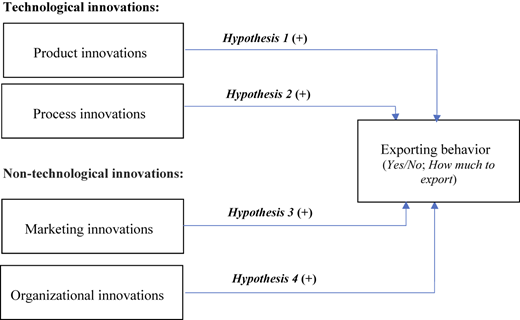
Conceptual model: Relationships between different types of innovation and exporting behavior in family firms. Source: Authors’ own work
Conceptual model: Relationships between different types of innovation and exporting behavior in family firms. Source: Authors’ own work
Technological innovations and exporting behavior in family firms
FFs can use their technological innovation capability to develop a new solution to meet the new needs of the domestic and foreign customers or be more efficient. Innovative FFs can learn more from and benefit from different international environments (Filippetti et al., 2011). We argue that higher technological resources and capabilities can become an important support for FFs entering new markets to achieve their purposes (higher investment returns). Concurrently, these resources can allow FFs to learn and use – absorptive capacity – the knowledge and technology in an international context – i.e. learning by exporting (Dimakopoulou et al., 2024; Vendrell-Herrero et al., 2024).
Product innovations are more likely to be related to more dynamic market demand and more technological innovation in FFs (Brancati et al., 2022; Capolupo et al., 2025). The main objective of FFs behind introducing this type of innovation in the market is to create new entrepreneurial opportunities and, thus, take advantage of the market power acquired through such innovations. The capacity of FFs to develop new or distinct products becomes more significant when they begin to enter foreign markets, as FFs operating in international markets face greater pressure to innovate due to global competition (Cavusgil and Zou, 1994). The introduction of product innovations can help FFs create a competitive advantage that is neither immediately achievable nor easy to imitate for potential rivals, leading to temporary quasi-rents for those firms that first introduced it in domestic and foreign markets (Brancati et al., 2022; Dosi, 1988). Therefore, product innovations can help FFs decide whether to export and obtain a high market share in domestic and foreign markets.
The potential link between process innovations and sales growth in domestic and international markets is more likely to pass through the introduction of significant improvements in production techniques, for example, by using new machines or equipment that allow production in a much more efficient way. In this regard, it is important to note that if such machines or equipment entail disruptive technologies, the use of process innovations may also provide FFs with certain market power, which should result in obtaining temporary quasi-rents (Brancati et al., 2022). Moreover, the introduction of these process innovations should help FFs that adopt them efficiently respond to increased demand for their products in international markets. In this way, those FFs that decide to compete abroad would also be better prepared to absorb potential increases in demand from foreign markets.
According to the RBV, when FFs invest in technological resources such investments will likely improve both its organizational knowledge and learning capabilities. These capabilities also represent important levers that may significantly contribute to the development of international competitive advantages based on differentiation (especially in the case of product innovations) or cost (especially in the case of process innovations) and, hence, can facilitate both the adoption of a favorable decision on international expansion through exports and/or the increase of export intensity in foreign markets (Filipescu et al., 2013; Haddoud et al., 2021). Thus, it is expected that FFs introducing product and process innovations will have stronger incentives to expand their activities abroad compared to non-innovating FFs because they can earn higher returns from the investments made in technological resources (Filipescu et al., 2013; Ramdani et al., 2023). In this vein, and even after considering the potential difficulties involved in international activities, many foreign markets can be viewed as attractive places where FFs can successfully exploit their product and process innovations and thereby increase their incomes. Thus, we hypothesize:
Product innovations will boost exporting behavior in FFs.
Process innovations will boost exporting behavior in FFs.
Non-technological innovations and exporting behavior in family firms
Marketing innovations aim to facilitate better perception, understanding, and meeting of consumers’ needs; improve or reposition a firm’s good or service in the market; open new markets – both in home and host countries – and, ultimately, increase the firm’s sales (Acikdilli et al., 2022; Bodlaj et al., 2020; Pino et al., 2016). Meanwhile, ORGINN seek to reduce different types of costs (such as administrative, personnel and/or transaction costs), enhance the efficiency and quality of individual and teamwork and/or improve the organizational learning capability through the acquisition of external knowledge (Bodlaj et al., 2020).
According to RBV, marketing innovations can enhance the FF’s competitive positioning in foreign markets by either lengthening its value appropriation prospects or reducing the value appropriation prospects of its competitors (Eng and Keh, 2007; Gupta et al., 2016). The FFs’ ability to differentiate their product offerings from domestic and international rivals through marketing innovations may also help generate substantial added value. In general, marketing resources may enable FFs to better identify, connect and serve their target markets, thus enhancing business performance (Falahat et al., 2020). In this vein, marketing innovations can boost product awareness and brand image, making it challenging for competitors to replicate. FFs introducing these innovations are more likely to commit to internationalization because they have intangible assets (such as brand recognition or a reputation premium) that can be used as a public good and, thus, be easily transferred to other countries (Olmos, 2011). Because most FFs seem to prefer to develop durable links with others that are close geographically and thus take advantage of domestic networks (Banalieva and Eddleston, 2011), it seems probable that these firms may also be forced to invest in marketing activities when they decide to compete abroad.
Reality reveals that introducing technological innovations in FFs, such as those incurred by the engagement in international activity, typically requires changes in its organizational system. ORGINN enable FFs to fit their internal parameters (i.e., internal or external relations structure, the organizational method in business practices, administrative procedures, and systems) to the challenges new international environments pose (Mol and Birkinshaw, 2009; Prange and Pinho, 2017). Many FFs may need to implement ORGINN that enhance communication, human resource practices, collaboration and coordination activities within and outside the firm and learning and innovation capabilities (Azar and Ciabuschi, 2017). Such innovations are crucial for increasing competitiveness in foreign markets, as they can improve quality or reduce production costs (Ayob et al., 2023; Brancati et al., 2022). Consequently, FFs could also benefit from these ORGINN when expanding internationally. As also emphasized by the RBV, organizational resources are necessary to compete in home and host markets and, ultimately, to achieve better performance than rivals (Brancati et al., 2022; Escandon-Barbosa and Salas-Páramo, 2023; Prange and Pinho, 2017). Therefore, we hypothesize:
Marketing innovations will boost exporting behavior in FFs.
Organizational innovations will boost exporting behavior in FFs.
Methodology
Data collection and sample
The data for this study were collected from the Survey on Business Strategies (SBS) between 2007 and 2016. This survey, conducted by the SEPI Foundation, ensures data quality through systematic collection and validation. It maintains a stable representative sample over time, making the inferences from the sample valid for the population of Spanish manufacturing firms. A firm is classified as an FF if a family holds the majority ownership and at least one family member is actively involved in management (i.e. if one or more members of the firm’s owner family occupied managerial positions in year t) [2]. Our dataset is an unbalanced data panel of 5,471 FF-year observations.
Spain (like most economies worldwide) is a country of family-owned businesses. According to Spain’s Instituto de la empresa Familiar (IEF) (2025), almost 90% of Spanish firms are family-owned, accounting for the country’s primary gross domestic product source and employment. As reported by European Family Businesses (2025), along with Estonia, Cyprus or the Czech Republic, Spain is one of the countries with the highest percentage of FFs in Europe, followed by Finland, Austria and Greece, with 80%, while in Germany, France, Italy, the United Kingdom, Portugal or Ireland, these firms represent about 75% of the industrial landscape.
Although Spanish FFs have always played a significant role in the domestic market, they have invested heavily in foreign markets in recent years to expand their business and, thus, grow. In fact, according to the IEF, more than half of the exports made in Spain come from a family business. On the other hand, a report by KPMG (2022) in collaboration with STEP Project Global Consortium and the IEF reveals that Spanish FFs stand out, especially in aspects related to proactivity and risk-taking entrepreneurial decisions (such as, for example, innovation or internationalization), where the percentage of Spanish FFs with high performance is significantly higher than in Europe (62% in Spain compared to 33% in Europe in the case of proactivity and 41% compared to 25% in the case of risk-taking decisions). However, Spanish FFs show ample room for improvement in innovation activities: 14% show high performance compared to 29% in Europe.
Variables
Dependent variables
In line with past studies (e.g. Brancati et al., 2022; Carboni and Medda, 2020; Tandrayen-Ragoobur, 2022) and consistent with our model, we evaluated a firm’s exporting behavior with two variables: (1) a dummy variable, used to know whether a firm export or not (EXPORT), and (2) a continuous variable, which is representative of export intensity (PEREXPORT) and is measured (in percentage) as the volume of international sales over the total sales and takes values between 0 and 100. While the first variable has to do with the decision of whether to export or not, the second refers to the decision of how much to export.
Independent variables
Following past studies (e.g. Brancati et al., 2022; Carboni and Medda, 2020; Edeh et al., 2020; Geldes et al., 2017), we consider four dummy variables for the different types of innovations. PRODINN/PROCINN/MARKINN/ORGINN are variables indicating whether the FF has introduced new product/process/marketing/ORGINN during the year. It takes a value of 1 if the firm has introduced new product/process/marketing/ORGINN and 0 otherwise, respectively.
Control variables
In explaining a firm’s exporting behavior (in terms of the decision to export and how much to export), the following factors can also become important. Firm size (SIZE), measured by the natural logarithm of the total number of employees, is included, as previous empirical studies have found a positive relationship between export and company size (e.g. Fang et al., 2018; Hernández et al., 2022; Tandrayen-Ragoobur, 2022). Firm AGE is measured by the number of years the business has been in operation. Some studies have reported a positive relationship between age and exports (e.g., Brancati et al., 2022; Hernández et al., 2022). SOLVENCY is measured as the percentage representing shareholders’ equity over total liabilities (e.g. Brancati et al., 2022; Fang et al., 2018). Gross operating margin (MARGIN) indicates a firm’s profitability (e.g. Fang et al., 2018). Foreign ownership (FOROWNER) is measured as the percentage of direct or indirect participation of foreign capital in the share capital of the firm (e.g., Geldes et al., 2017; Tandrayen-Ragoobur, 2022). INDUSTRY and YEAR dummies are also added to control for the sector and year. All explanatory variables (independent and control variables, except time dummies) are lagged one year to control for potential endogeneity/causality problems.
Econometric models
We use random effects Probit and Tobit regression models for panel data, according to the nature of our dependent variables (EXPORT and PEREXPOT, respectively). Notably, Probit regression can be more advantageous than Logit regression when using random effects models for estimation and the sample size is large (Hahn and Soyer, 2005). The Probit model is defined as follows:
where representing the probability of a company with exports greater than 0 (Y = 1), given that it is a FF (X = 1). .
Tobit regression is tailored explicitly for situations where the dependent variable has a lower and/or upper limit or both, as is the case in our study (values between 0 and 100). The Tobit model indicates that the observable variable yi is defined as equal to the latent variable (PEREXPORT), corresponding to a Type I model, with a and b set as lower and upper censorship limits, respectively:
where is the latent variable and the parameter β results from estimating a regression from the observed values yi in xi by maximum likelihood to ensure its consistency. For the variable dependent of interest, regression was defined as follows:
Results
Our results reveal that 69% of FFs exported, and, on average, their international sales (export intensity) represented 21.56% of their total sales during the period of study. And 22% of FFs conducted marketing innovations, 22% carried out ORGINN, 18% conducted product innovations and 35% carried out process innovations.
Tables 1 and 2 report the results of the estimation of the random effects Probit and Tobit models to test all our hypotheses [3]. In each table, we estimate six different models: Model 1 in Tables 1 and 2, respectively, only adds control variables (basic models). Model 2 adds marketing innovations (MARKINN), Model 3 adds ORGINN, Model 4 considers product innovations (PRODINN) and Model 5 includes process innovations (PROCINN). Finally, model 6 considers all control and independent variables.
Random effects Probit regression results: innovation and decision to export in family firms
| Variables | Model 1 | Model 2 | Model 3 | Model 4 | Model 5 | Model 6 |
|---|---|---|---|---|---|---|
| Intercept | −1.9936*** | −2.0265*** | −2.0008*** | −1.9973*** | −2.0197*** | −2.033*** |
| MARKINN | 0.2709*** | 0.1806*** | ||||
| ORGINN | 0.1402** | −0.0245 | ||||
| PRODINN | 0.3433*** | 0.2365*** | ||||
| PROCINN | 0.206*** | 0.1250** | ||||
| SOLVENCY | 0.0021** | 0.0022** | 0.0022** | 0.0022** | 0.0023** | 0.0024** |
| AGE | 0.0059*** | 0.0058*** | 0.0061*** | 0.0060*** | 0.0061*** | 0.0060*** |
| FOROWNER | 0.0065*** | 0.0065*** | 0.0066*** | 0.0063*** | 0.0064*** | 0.0063*** |
| SIZE | 0.5787*** | 0.5703*** | 0.5708*** | 0.5601*** | 0.5580*** | 0.5493*** |
| MARGIN | 0.0024* | 0.0025* | 0.0024* | 0.0025** | 0.0020 | 0.0023* |
| Log Likelihood | −2225.81 | −2214.42 | −2222.78 | −2212.53 | −2217.43 | −2204.62 |
| Wald χ2 | 952.78*** | 948.46*** | 956.73*** | 939.68*** | 960.13*** | 946.74*** |
| Pseudo R2 | 0.2502 | 0.254 | 0.2512 | 0.2547 | 0.253 | 0.2573 |
| N (observ.) | 5,038 | 5,038 | 5,038 | 5,038 | 5,038 | 5,038 |
Note(s): *p < 0.1, **p < 0.05, ***p < 0.01. All models include industry and year dummies as control variables
Source(s): Authors’ own work
Random effects Tobit regression results: innovation and export intensity in family firms
| Variables | Model 1 | Model 2 | Model 3 | Model 4 | Model 5 | Model 6 |
|---|---|---|---|---|---|---|
| Intercept | −22.6343*** | −22.5441*** | −22.6838*** | −22.4373*** | −22.8951*** | −22.4163*** |
| MARKINN | −1.0232 | −3.4779*** | ||||
| ORGINN | 1.729** | 1.2401 | ||||
| PRODINN | 3.4085*** | 3.1914*** | ||||
| PROCINN | 3.5857*** | 3.2618*** | ||||
| SOLVENCY | 0.0170 | 0.0167 | 0.0182 | 0.0177 | 0.0199 | 0.0203 |
| AGE | 0.0977*** | 0.0977*** | 0.0984*** | 0.0962*** | 0.0979*** | 0.0982*** |
| FOROWNER | 0.0812*** | 0.0812*** | 0.0822*** | 0.0822*** | 0.0824*** | 0.0812*** |
| SIZE | 6.3745*** | 6.4351*** | 6.2466*** | 6.1010*** | 5.9669*** | 5.8618*** |
| MARGIN | 0.0980*** | 0.0976*** | 0.0977*** | 0.0988*** | 0.0919*** | 0.0917*** |
| Wald χ2 | 1547.47*** | 1548.94*** | 1551.66*** | 1561.18*** | 1569.22*** | 1588.18*** |
| Pseudo R2 | 0.324 | 0.324 | 0.324 | 0.326 | 0.328 | 0.332 |
| Sigma | 24.26 | 24.26 | 24.25 | 24.23 | 24.21 | 24.16 |
| N (observ.) | 5,032 | 5,032 | 5,032 | 5,032 | 5,032 | 5,032 |
Note(s): *p < 0.1, **p < 0.05, ***p < 0.01. All models include industry and year dummies as control variables
Source(s): Authors’ own work
Table 1 shows that the coefficient of MARKINN is positive and significant in Models 2 and 6. This table reveals that the coefficient of ORGINN is positive and significant in Model 3 but not in Model 6. This table also shows that the coefficients of PRODINN and PROCINN are positive and significant in all models in which these variables are added (Models 4, 5 and 6, respectively). Therefore, our results highlight that product and process innovations have a positive and significant impact on the decision to export.
Table 2 reveals that the coefficient of MARKINN is negative and significant for FFs in one model (Model 6). This table shows that the coefficient of ORGINN is positive and significant only in one model (see Model 3), while in another model, such a coefficient is positive but not significant (Model 6). This table also reports that the coefficients of PRODINN and PROCINN are positive and significant (Models 4, 5 and 6, respectively). Therefore, our results highlight that for FFs, product and process innovations have a positive and significant effect on the decision of how much to export. However, ORGINN are not significantly related to such decisions, whereas marketing innovations exert a negative and significant influence on exporting intensity.
In sum, our study provides strong statistical support for H1 and H2, confirming that technological innovations (both product and process) significantly boost export behavior in FFs. However, our findings do not statistically support H3 and H4; the linkage between non-technological innovations (both marketing and organizational) and exporting behavior in FFs is mixed and dependent on the specific decision being adopted (regarding whether to export or not and how much to export).
Additional analyses
The role of generation, size and foreign ownership
Tables 1 and 2 show some control variables’ positive and significant influence in exploring the innovation-exporting link in FFs. Analyzing the possible influence of AGE (generation in control), SIZE or FOROWNER can provide interesting additional evidence. Following past research (e.g. Arrondo-García et al., 2016; Arteaga and Basco, 2023; López-Delgado and Diéguez-Soto, 2015), we classify all FFs of the sample into two categories based on their AGE, SIZE and FOROWNER. First-generation FFs are under 25 years old, while multi-generational FFs are over 25. In line with the European Commission, small and medium-sized FFs have fewer than 250 employees, while large FFs have over 250 employees. Finally, we classify FFs as nationally owned (foreign-owned) if the percentage of participation of national (foreign) capital in the firm's share capital is under (over) 50%.
Table III (see supplementary material) shows significant differences between the mean values of export intensity and export volume across FFs regarding generation in control, size and percentage of foreign ownership. The results indicate that multi-generational and large FFs and those with a higher percentage of foreign ownership exhibit a higher mean export propensity and export a higher volume.
Table IV (see supplementary material) shows that product and process innovations positively and significantly affect the exporting behavior of FFs regardless of age, size or percentage of foreign ownership. However, the effect of marketing and ORGINN is significantly conditioned by generation, size or percentage of foreign ownership.
Comparing family firms and non-family firms
We also test the potential impact of the types of innovations on the exporting behavior of NFFs for control and comparative purposes. This analysis is based on a sample of 6,515 NFF-year observations. Tables V and VI (see supplementary material) show that product and process innovations are positively and significantly related to the decision whether to export and how much to export in NFFs, as occurs in FFs. The role of non-technological innovations on firms’ exporting behavior in NFFs is also ambiguous. Marketing innovations are not statistically related to the decision whether to export in NFFs. However, this type of innovation is negatively and significantly related to how much to export. ORGINN are only a major driver in deciding whether to export NFFs, but their role is statistically insignificant regarding how much to export.
Discussion and conclusions
This study represents an initial effort to explore what types of innovations (technological and non-technological) can boost international behavior via exports in FFs. Our central assumption is that to compete internationally, FFs must innovate by introducing changes and improvements in production processes, creating new products or implementing significant improvements in their administrative and marketing methods. The main findings of our empirical analysis can be summarized as follows:
First, our findings suggest that product and process innovations are essential driver resources of FFs’ exporting behavior, aligning with the arguments from the RBV and prior research in samples of FFs and/or NFFs (e.g. Alayo et al., 2022; Azar and Ciabuschi, 2017; Bodlaj et al., 2020; Carboni and Medda, 2020). This means that innovative FFs, from a technological point of view, are in a favorable position to achieve some competitive advantages (based on differentiation, costs or good quality-price ratio) that enable them to compete actively abroad. These results are statistically consistent and robust after considering the generation in control, size or share of foreign ownership.
Second, contrary to our expectations and prior research in samples of FFs and/or NFFs (e.g., Azar and Ciabuschi, 2017; Edeth et al., 2020), the role of non-technological innovations is mixed. Marketing innovations may only be important for FFs when entering unfamiliar markets, mainly to publicize the firms’ products abroad. However, their impact might be negative if FFs seek to increase their sales in such foreign markets. Importantly, marketing innovations can enhance export intensity in multi-generational and foreign-owned FFs. Our findings suggest that ORGINN might represent a trade-off in many FFs. Indeed, they can help identify new business prospects, improve profitability and achieve sustainable growth in domestic and foreign markets, as suggested by prior research (Ayob et al., 2023; Edeh et al., 2020). However, they can also significantly negatively impact FF employee performance. For example, these innovations might lead to a loss of productivity, resistance and communication breakdown, among other challenges. This latter might be the prevalent situation in the FFs examined.
Third, our descriptive results reveal that multi-generational FFs elicit a more solid commitment to international expansion as they exhibit a higher export intensity and volume than their predecessors. This trend is also evident among large-sized and foreign-owned FFs compared to small and medium-sized and Spanish-owned FFs. These findings highlight the importance of achieving a suitable scale and/or dimension and facilitating generational transitions to remain competitive in foreign markets.
Fourth, our results reveal that FFs do not differ much from NFFs. Technological innovations are a key priority of FFs and NFFs for expanding internationally, and both types of firms seem equally capable of managing such innovation resources and are equally willing to do so, contrary to what the proponents of the “ability-willingness innovation paradox” in FFs typically claim (Chrisman et al., 2015; Meroño-Cerdán, 2024). The main difference between both types of firms lies in the role of ORGINN.
Finally, our results indirectly suggest that the assumption that the most innovative FFs (and NFFs) self-select to export needs to be qualified in some way. Our findings consistently reveal that this assumption is dependent on the type of innovation (i.e. technological vs non-technological) and other specific characteristics of FFs (Monreal-Pérez and Ifakhkharen-Rziki, 2024).
Practical implications
Our findings suggest that if FFs’ managers and/or owners consider expanding abroad via exporting, they should pay special attention to the continuous development and/or introduction of product and process innovations because they are two key levers to promoting exports. Consequently, the managers and/or owners of these firms should be willing to allocate the necessary resources to improve both products and processes. They should also consider specific traits of the firms they are running – generation, size or foreign ownership – when designing the adequate combination of innovations related to marketing that may be more effective in foreign markets. By doing so, they can better leverage potential synergies among the various aspects and components associated with this type of innovation. Managers and/or owners of large, multi-generational, Spanish and foreign-owned FFs should also carefully analyze and understand the reasons behind ORGINN's adverse effects on the ability to compete abroad. In these FFs, it might be appropriate to design adequate planning and implementation of such innovation activities to overcome their possible challenges and thus make them play a lever role in global markets.
Policymakers commonly design different support systems (e.g. via government grants or subsidies) for fostering internationalization (mainly via exports) and innovation of domestic firms to improve their competitiveness. While it seems justified to grant government aid for technological innovations in any FF, policymakers should pay attention to the unique traits of these firms for non-technological innovations. Factors such as age (generation in control), size and national ownership share should be considered when providing such aids.
Limitations and future research
This study has several limitations. First, we assess internationalization exclusively via exporting. Future research should consider other types of internationalization strategies, such as direct foreign investment and investigate the extent to which the results are upheld. Second, we cannot distinguish between export destination countries. Future studies could use more detailed data from specific destination markets to explore potential differences between advanced and emerging countries (Monreal-Pérez and Ifakhkharen-Rziki, 2024) or between those with varying trade barriers. Third, some recent studies have shown that different dimensions of family governance can create disparities in FF innovation strategies (e.g. Alayo et al., 2022; Scholes et al., 2021). Future studies might help unravel the potential effects of different dimensions or specific traits of family governance, such as generation or professionalization. Fifth, innovation can facilitate international activity, as our study suggests. However, future research should examine whether higher levels of international commitment can promote higher innovation levels in FFs, generating a virtuous circle between internationalization and innovation (e.g., Filippetti et al., 2011). Sixth, recent studies are directing their attention towards the role of green innovations in FFs (e.g. Bauweraerts et al., 2022). Researchers could further explore how these innovations are also related to the exporting behavior of these firms. Finally, our study focuses exclusively on manufacturing FFs from a specific country (Spain). Future research could check whether our findings are also generalizable to service FFs and FFs from other institutional contexts.
We thank the Editor and two anonymous reviewers for their valuable comments and suggestions, which have significantly improved the quality of this paper. Preliminary drafts were presented at the 30th Innovation and Product Development Management Conference (IPDMC) held in Lecco (Italy) in June 2023, the XXXI International Conference Asociación Científica de Economía y Dirección de Empresas (ACEDE) held in Alicante (Spain) in June 2023 and the XXX AEDEM International Conference held in Tanger (Morocco) in September 2023. We are very grateful for the feedback from the participants at these conferences. This research has been supported by Projects PID2021-124641NB-I00 from the Ministry of Science and Innovation (Spain) and PHS-2024/PH-HUM-294 from the Ministry of Education, Science and Universities (Community of Madrid, Spain).
Notes
The latter Oslo Manual edition considers two main types of innovations: product and business process. The main novelty regarding the prior edition (OECD, 2005) concerns process innovation. Page 21 states, “The taxonomy of business functions proposed in this manual maps reasonably well onto the previous edition’s categories of process, marketing, and organizational innovations”. The taxonomy used in our study is also widely used by past research on innovation (e.g., Azar and Ciabuschi, 2017; Dimakopoulou et al., 2024; Geldes et al., 2017).
This method of defining and measuring family businesses aligns with past research using the same database (e.g., Campos-García et al., 2022; Kotlar et at., 2013; Tragant et al., 2023).
Although the table of correlations is not provided due to space issues, our findings confirm that multicollinearity is not a problem in our study because most explanatory variables have correlations less than 0.2. The variance inflation factor (VIF) values analysis does not reveal evidence of multicollinearity either.
References
Further reading
The supplementary material for this article can be found online.

