This study aims to examine how human resource (HR) professionals develop learning readiness for artificial intelligence (AI) in their work and the barriers and professional development processes that shape this capability in AI-enabled HR contexts.
A qualitative research design was adopted based on 17 semi-structured interviews with HR professionals selected through purposive sampling. Data were analysed using the Gioia methodology enabling a systematic inductive analysis through first-order concepts, second-order themes and aggregate dimensions to capture how HR professionals experience learning readiness for AI. Participants engaged with a range of AI technologies, including generative AI and large language models, predictive HR analytics and automation and HR information systems, which entailed distinct learning demands.
Learning readiness for AI emerges primarily as a practice-based learning capability developed through engagement with HR work rather than through formal preparation. Barriers to learning are predominantly organisational, including limited time, lack of strategic direction and insufficient institutional support. HR professionals value contextual and interpretive learning approaches over highly technical training, highlighting the importance of professional judgement when working with AI-generated outputs.
Based on a qualitative sample within a specific national context, the findings cannot be generalised broadly. However, the study contributes to HR development research by showing how learning readiness for AI develops through workplace learning processes and how organisational conditions shape the development of professional capabilities in technologically mediated work environments.
Organisations should approach AI readiness as an ongoing, practice-based developmental process rather than as a competence achieved through formal training alone. The findings suggest that creating structured opportunities for experimentation, peer interaction and reflection within everyday work is essential to support capability development. In addition, organisations need to provide clearer strategic direction, protected time for learning and formal recognition of AI-related development to enable HR professionals to build the interpretive and judgement-based capabilities required in AI-enabled work environments.
The study provides qualitative evidence on how HR professionals experience learning for AI in practice. It contributes to the literature by linking AI-driven changes in HR work with human capital development and workplace learning processes. Furthermore, it theorises that learning readiness for AI is a capability produced through relationships rather than a pre-existing competence.
1. Introduction
Artificial intelligence (AI) is increasingly transforming how organisations manage people, make decisions and structure work, creating new learning and capability development challenges for professionals. Within human resource (HR) functions, AI-enabled tools are now used in activities ranging from recruitment and performance management to workforce analytics and employee engagement, thereby reshaping the nature of HR roles and decision-making processes (Stone et al., 2015; Tambe et al., 2019; Kim et al., 2021; Budhwar et al., 2022). As organisations adopt data-driven tools and algorithmic systems, HR professionals are required to interact with technological outputs, integrate analytical insights into organisational decision-making and navigate the ethical and practical implications of algorithmically informed HR practices (Duggan et al., 2020; Greasley and Thomas, 2020; Strohmeier, 2020).
Despite this growing technological integration, existing research has largely concentrated on the organisational consequences of AI adoption or the technical capabilities of digital HR systems. Comparatively less attention has been devoted to the developmental challenges that these technologies create for HR professionals themselves. In particular, limited research has examined how practitioners develop the capability to interpret algorithmic outputs, exercise professional judgement and adapt their professional practice to technologically mediated work environments (Hamouche et al., 2025). As a result, important questions remain about how HR professionals learn to work effectively with AI and what types of professional development are required in this context.
From a human resource development (HRD) perspective, the integration of AI represents not only a technological shift but also a profound learning challenge for HR professionals. Technological change alters the knowledge, skills and capabilities required to perform professional roles, thereby creating new demands for capability development within organisations (Becker, 1964). HR professionals are increasingly expected to make sense of tools that were not part of their professional training, critically evaluate algorithmic recommendations and integrate AI-generated insights into complex organisational decisions. These developments highlight the central role of HRD in supporting professional adaptation to technological change.
While organisations often approach technological transformation through formal training initiatives, research on workplace learning suggests that professional capabilities frequently emerge through practice-based learning processes embedded in everyday work activities (Eraut, 2004; Ellström, 2011; Wijga et al., 2025). In dynamic and uncertain environments, employees often develop new competencies through experimentation, interaction with colleagues and reflection on practical experience rather than through formal instruction alone. This perspective is particularly relevant in the context of AI, where professionals frequently learn to work with new systems while simultaneously engaging in their daily organisational tasks.
Building on these insights, this study examines how HR professionals experience learning readiness for AI in their professional practice. Rather than conceptualising readiness for AI as a pre-existing technical competence, the article approaches it as an emergent capability that develops through engagement with work activity and organisational learning processes. In this sense, readiness for AI is understood as a dynamic capability that evolves through workplace learning, experimentation and professional judgement in technologically mediated work environments.
Specifically, the study explores four interrelated questions: how HR professionals perceive their preparedness to learn for AI in HR contexts, what barriers they encounter when developing AI-related capabilities, what forms of learning they consider valuable in their professional practice and how they perceive the role of organisations in supporting such development. To address these questions, the study draws on qualitative data from semi-structured interviews with HR professionals and analyses their experiences through the Gioia methodology (Gioia et al., 2013).
This article contributes to the literature in three ways. Firstly, it extends research on AI in human resource management by shifting attention from technological adoption and organisational outcomes to the learning processes through which HR professionals adapt to AI-enabled work environments (Kim et al., 2021; Hamouche et al., 2025). Secondly, the paper contributes to HRD research by conceptualising readiness for AI as an emergent capability that develops through workplace learning processes rather than as a pre-existing technical competence. Thirdly, it advances HRD literature by examining the organisational conditions that influence the development of AI-related professional capabilities.
The remainder of the paper is organised as follows. The next section reviews relevant literature on AI and HR development. The methodology is then presented, followed by the empirical analysis. The final sections discuss the implications of the findings and outline the study’s conclusions and limitations. Through this analysis, the paper seeks to contribute to ongoing debates in HRD concerning how professionals develop capabilities and adapt their expertise in contexts of rapid technological change.
2. Theoretical background
2.1 Artificial intelligence and the transformation of human resource work
The rapid development of AI and digital technologies is transforming both how organisations manage people and how HR professionals perform their roles. Prior research shows that technology has long shaped HRM through its effects on jobs, organisations and HR activities, but recent advances in analytics and AI have intensified this transformation by expanding automation, data processing and predictive capabilities (Kim et al., 2021; Margherita, 2022). Studies on AI in HRM note that AI-based systems are increasingly associated with recruitment, selection, training, performance analysis and talent management, while also reframing decision-making processes through data-driven tools (Kaushal and Ghalawat, 2023; Tambe et al., 2019).
However, the integration of AI into HR practices does not merely represent the adoption of new tools. It also entails a deeper transformation of HR work itself. It is also important to recognise that “AI” in HR is not a single, homogeneous technology. The literature distinguishes between predictive and analytics-oriented systems (for example, turnover-prediction models, workforce dashboards and HR analytics), rule-based automation embedded in HR information systems, and, more recently, generative AI and large language models used for drafting, summarising and conversational support (Margherita, 2022; Budhwar et al., 2022). These categories impose markedly different learning demands: interpreting a predictive model requires analytical and statistical judgement, whereas working effectively with a large language model requires prompting, critical evaluation of generated content and awareness of its limitations.
Recent evidence suggests that digitalisation alters task structures, redistributes responsibilities between humans and technological systems and requires HR professionals to combine administrative, analytical, strategic and relational capabilities in new ways (Begley et al., 2025; Kim et al., 2021). Related research on digital HRM and algorithmic management also highlights how the growing use of data analytics and digital platforms is reshaping managerial practices and redefining the boundaries between human judgement and automated decision processes (Duggan et al., 2020; Greasley and Thomas, 2020; Strohmeier, 2020). In particular, Begley et al. (2025) show that digitalisation within HR evolves dynamically across subfunctions and over time, with different implications for operational work, strategic alignment and integration.
At the same time, the literature also warns that the use of AI in HR is accompanied by significant challenges. These include the complexity of HR phenomena, limited or biased data, fairness and accountability issues and possible employee resistance to algorithmically informed decisions (Tambe et al., 2019). Broader debates in HRM and employment research further emphasise that algorithmic systems may introduce new governance and ethical challenges in the management of people, requiring organisations to balance efficiency gains with transparency and accountability (Duggan et al., 2020).
In that sense, the current transformation of HR work should not be interpreted as the substitution of human expertise by intelligent systems, but rather as a context of human–AI collaboration, in which technology may support decision processes while human professionals remain essential for interpretation, contextualisation and ethical judgement.
2.2 Human capital and the development of human resource competencies
To explain how HR professionals respond to this transformation, human capital theory offers an appropriate theoretical lens. This perspective assumes that employees’ knowledge, skills and capabilities are productive assets and that investment in their development contributes to individual and organisational performance. Recent work has used human capital theory to analyse how talent development can be strengthened through organisational practices and competency development, particularly in dynamic and innovation-oriented environments (Abid and Polo, 2025).
Applied to the present study, human capital theory helps explain why the diffusion of AI in HR creates pressure for new forms of professional development. As AI changes the content of HR work, the value of HR professionals increasingly depends on their ability to combine technological understanding with broader professional competences. Prior research on technology and HRM suggests that technological change consistently reshapes the capabilities demanded from HR professionals, while more recent studies on the future of work emphasise the growing importance of analytical thinking, problem-solving, adaptability and digital competence in technology-intensive environments (Kim et al., 2021).
These transformations have also been widely discussed in the broader literature on digitalisation and HRM, which argues that the role of HR professionals is increasingly shifting towards more analytical, strategic and technology-enabled competencies as organisations adopt data-driven decision-making systems (Strohmeier, 2020; Tambe et al., 2019).
In this context, the introduction of AI does not reduce the importance of human expertise; instead, it redefines it. The relevant issue is not only whether AI can automate tasks, but also which forms of knowledge and capability become more valuable when HR work is increasingly mediated by intelligent technologies. From a human capital perspective, this implies that organisations must invest in the development of new competencies that allow HR professionals to interpret digital outputs, make sound judgements and contribute strategically to organisational decision-making (Abid and Polo, 2025; Tambe et al., 2019). Within the HRD literature, such capability development has been widely discussed in relation to talent development architectures that integrate individual learning, organisational support and strategic workforce development (Garavan et al., 2012).
2.3 Workplace learning and professional adaptation to artificial intelligence
Although formal training remains relevant, the development of these competencies often occurs through learning embedded in everyday work. The literature on workplace learning highlights that employees acquire knowledge not only through structured training, but also through participation in work activities, interaction with colleagues, reflection and experimentation in practice (Wijga et al., 2025).
This view aligns with long-standing research on informal and practice-based learning, which shows that much professional knowledge develops through participation in work activities and social interaction rather than through formal instruction alone (Eraut, 2004; Ellström, 2011). From a workplace learning perspective, learning outcomes are shaped by the interaction between contextual conditions, learning processes and individual engagement in work activities (Tynjälä, 2013).
This perspective is especially useful in contexts of technological change, where learning frequently takes place while employees engage directly with new systems, tasks and organisational demands.
Recent evidence suggests that contemporary workplaces require a more immediate and integrated understanding of learning, particularly under conditions of digitalisation, hybrid work and ongoing change. Wijga et al. (2025) show that workplace learning is shaped by both individual antecedents, such as motivation and self-efficacy, and contextual conditions, such as learning climate and job demands. Research on expansive learning environments further suggests that organisational contexts that promote participation, collaboration and experimentation tend to foster more effective learning processes in dynamic work environments (Fuller and Unwin, 2004).
This is especially relevant for HR professionals adapting to AI, since their capability development is unlikely to depend only on formal instruction and is more likely to emerge through iterative, practice-based engagement with technology in the flow of work.
This argument is also consistent with recent debates in HRD. Hamouche et al. (2025) observe that research on AI in HRD has been dominated by computer science and machine learning perspectives, with comparatively less attention given to human learning and employee development. Their review calls for stronger attention to how workers develop alongside machines, rather than focusing exclusively on technological advancement. From this perspective, practice-based learning provides a useful complementary lens to human capital theory, as it helps explain how HR professionals build new competencies through situated experience, reflection and adaptation in everyday organisational practice (Hamouche et al., 2025; Wijga et al., 2025).
These three theoretical perspectives provide the conceptual basis for this study. AI constitutes the broader context transforming HR work; human capital theory explains why new competencies become strategically important; and workplace learning clarifies how such competencies are developed through professional practice.
2.4 Towards an integrated view: capability as relationally produced under technological mediation
Although the three perspectives outlined above are frequently mobilised in a complementary manner – AI as context, human capital as explanation of value and workplace learning as explanation of process – treating them as parallel layers risks underplaying how they interact. We therefore advance a more relational reading in which capability for AI-enabled HR work is not located in any single layer but emerges through their interaction under conditions of technological mediation. Specifically, the value attributed to particular competencies by human capital reasoning is not fixed in advance: it is continually reshaped by the practice-based learning processes through which professionals encounter, interpret and domesticate AI outputs in the flow of work. Conversely, workplace learning does not merely transmit pre-defined competencies but reconstitutes what counts as valuable “capital” in the first place, as interpretive judgement, contextual sense-making and the critical evaluation of algorithmic outputs become the assets that distinguish effective practice. In this view, technological mediation is the condition under which human capital assumptions and learning processes are mutually constituted rather than sequentially related.
This relational framing also clarifies the core construct of the study and distinguishes it from adjacent concepts. We use learning readiness for AI to denote an emergent, practice-based capability to engage with, interpret and adapt to AI in professional work, rather than a measurable stock of technical knowledge. It is therefore distinct from competence, understood as a relatively stable repertoire of demonstrable skills; from adaptability, understood as a general disposition to adjust to change; and from informal learning, which names a mode of acquisition rather than the resulting capability. It is related to, but narrower than, adaptive expertise, which concerns the capacity to apply knowledge flexibly to novel problems: learning readiness for AI specifically foregrounds the disposition and situated capacity to keep learning a moving technological target whose outputs require contextual judgement. Finally, while the language of dynamic capabilities (the capacity to sense, seize and reconfigure resources) resonates with our account, we deliberately locate readiness at the level of individual professional practice and its situated, social development, rather than at the level of firm-level resource orchestration. Conceptualised in these terms, learning readiness for AI emerges as a relationally produced capability situated in practice. This framing extends human capital accounts, which tend to treat capability as an antecedent stock, and complements workplace-learning research, which has seldom been applied to AI-mediated professional work (Becker, 1964; Eraut, 2004; Wijga et al., 2025; Hamouche et al., 2025).
3. Methodology
3.1 Research design
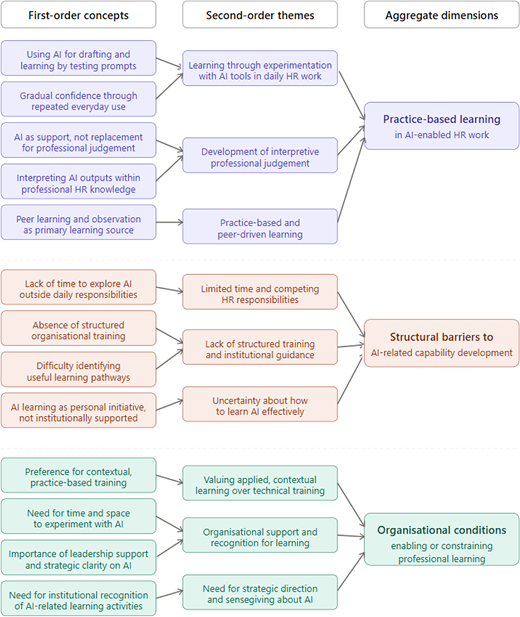
This study adopts an inductive qualitative research design guided by the Gioia methodology (Gioia et al., 2013). The study assumes that knowledge about learning and capability development is constructed through actors’ situated interpretations of their experience rather than discovered as objective fact. The Gioia approach provides a systematic framework for developing grounded theoretical insights from qualitative data while maintaining transparency in the analytical process. It distinguishes between first-order concepts, which reflect participants’ own terms and interpretations, second-order themes, which represent the researcher’s theoretical interpretation of those concepts, and aggregate dimensions, which capture higher-level theoretical explanations.
The methodology is particularly appropriate for exploring emerging phenomena in organisational contexts, where existing theoretical explanations remain limited. In the context of this study, the Gioia approach allows for a structured examination of how HR professionals experience learning readiness for AI and how they interpret the organisational conditions shaping their development.
Following this approach, the analysis progressed iteratively between empirical material and emerging theoretical interpretations. First-order concepts were derived from participants’ descriptions of their experiences with AI in HR work. These concepts were subsequently grouped into second-order themes representing broader patterns in the data. Finally, these themes were integrated into aggregate dimensions that capture the key processes shaping learning readiness for AI in HR practice. In practical terms, this iterative movement involved constant comparison across interviews: overlapping codes were consolidated, and a candidate theme was retained as a second-order theme only when it was supported across multiple participants and could be related to existing constructs in the workplace-learning and human-capital literatures. Where material did not fit the emerging structure – for example, accounts of structured formal training in a minority of organisations – the data structure was revised rather than the disconfirming case set aside. Provisional dimensions were repeatedly checked back against the transcripts, and the data structure (Figure 1) was considered stable once further passes through the material no longer altered the relationships among concepts, themes and dimensions.
3.2 Data collection and analysis
Data were collected through 17 semi-structured interviews with HR professionals. Participants were selected using purposive sampling to ensure variation in professional roles, levels of seniority, organisational size and sector, while maintaining a consistent focus on HR roles with relevant exposure to or responsibility for AI-related processes. This sampling strategy allowed the study to capture diverse professional perspectives while maintaining conceptual coherence with the research objectives.
The number of interviews was determined based on the principle of thematic saturation, which refers to the point at which additional data no longer generate substantively new conceptual insights (Guest et al., 2006; Braun and Clarke, 2019). Data collection therefore continued until recurring patterns became evident and further interviews did not significantly extend the emerging analytical categories. In qualitative research guided by inductive approaches such as the Gioia methodology, the objective is not statistical representativeness but conceptual depth and theoretical insight (Gioia et al., 2013). Within this tradition, studies typically rely on relatively small but information-rich samples that allow researchers to develop detailed conceptual interpretations of participants’ experiences.
Although all participants discussed AI in relation to HR work, their exposure to AI-enabled technologies varied considerably, and the analysis distinguished between the broad families of technologies they described. Many participants referred to generative AI and large language models, including ChatGPT, Microsoft Copilot, Gemini and internally deployed GPT-based assistants, used mainly for drafting, summarising and exploratory queries. A second group described predictive or analytics-oriented systems linked to recruitment and selection, turnover or retention prediction and workforce dashboards. A third set of accounts concerned rule-based automation embedded in HR information systems (such as SAP, Workday and SuccessFactors) supporting payroll, onboarding and administrative workflows. This variation was analytically relevant because the learning demands associated with AI were not uniform: interpreting a predictive HR analytics model, prompting and critically evaluating a large language model and operating automated HRIS workflows each required different forms of judgement, contextual understanding and workplace learning.
The interview guide addressed participants’ experiences with AI in HR contexts, perceptions of preparedness to learn, barriers to development, forms of learning considered valuable and expectations of organisational support. Interviews were conducted in Spanish, lasted between 40 and 75 min and were audio-recorded with participants’ informed consent. Recordings were professionally transcribed and anonymised prior to analysis.
All participant quotations presented in the findings are rendered in English translation; translations are by the authors and were reviewed for conceptual accuracy against the original Spanish transcripts. Table 1 presents participant characteristics.
Participants provided informed consent prior to participation, were assured of confidentiality and were informed of their right to withdraw at any stage. All data were anonymised; participants are referred to as P1 through P17.
The research team comprised HR and management scholars with prior professional and consulting experience in HR functions. This background facilitated rapport and a nuanced reading of participants’ accounts, but it also carried the risk of importing prior assumptions – in particular, a predisposition to interpret learning as practice-based. Several steps were taken to manage this. Interview questions were framed openly so that participants could describe formal as well as informal learning; coding decisions were discussed among the authors, with particular attention to accounts that did not fit the emerging interpretation; and an explicit search for disconfirming and minority perspectives was built into the analysis (see Section 4). The authors kept analytic memos documenting interpretive decisions, which were revisited when consolidating themes. We do not claim a neutral standpoint; rather, we treat interpretation as situated and have sought to make the basis of our readings transparent and traceable to the data.
4. Findings
The data structure reveals three interrelated processes shaping learning readiness for AI among HR professionals: practice-based learning processes embedded in HR work, structural barriers that constrain capability development and organisational conditions that enable or hinder workplace learning (see Figure 1).
Before presenting these dimensions, it is worth noting that participants’ experiences were not uniform. Variation was visible across roles, sectors and, especially, level of AI exposure. Participants with higher self-reported AI exposure (for example, those in large or multinational technology and services organisations) tended to describe concrete, ongoing experimentation with specific tools, whereas those with lower exposure framed AI learning as more exploratory, occasional and uncertain. The dominant account – learning as informal and practice-based – was therefore most pronounced among the former group. Importantly, this account was not universal. A minority of participants worked in organisations that had introduced structured, formal AI-related training and did not describe their learning as purely informal, which qualifies the otherwise strong emphasis on experiential learning. A further minority adopted a notably more sceptical stance, characterising current enthusiasm for AI in HR as partly a passing “fashion” or as something to be approached with caution rather than embraced. These contradictory and minority perspectives are retained in the analysis because they sharpen, rather than undermine, the central finding: where organisations did not provide structure, learning defaulted to individual, practice-based effort, but this default was a function of organisational conditions rather than an intrinsic property of AI learning.
4.1 Practice-based learning and readiness for artificial intelligence in human resource work
Most participants described their preparedness to learn for AI as informal and largely experience-based, rather than the outcome of structured training. Learning was typically framed as emerging through practice: trying tools, observing what worked and adapting based on accumulated experience. This orientation was pervasive and appeared independent of seniority or organisational context:
What we’re doing is learning on the go. We try things, we see what works and what doesn’t. There’s no other way (P9).
Preparedness was frequently associated with professional judgement rather than technical expertise. Participants consistently distinguished between knowing how a tool works and knowing what to do with what it produces:
I don’t need to know how it works on the inside. What I need is to understand what it gives me and how far I can trust it (P1).
At the same time, this adaptive stance coexisted with a persistent sense of lagging behind the pace of change. Several participants described a structural gap between the rate of AI development and their capacity to keep up:
The feeling is that technology is moving much faster than we are. You try to keep up, but you’re always one step behind (P7).
Participants also reported that readiness was unevenly distributed across their organisations – depending heavily on individual initiative, curiosity and access to informal peer networks rather than formal development pathways. Overall, preparedness to learn for AI was perceived as situational and emergent rather than established: a capability being constructed through practice rather than one possessed in advance.
4.2 Organisational barriers to artificial intelligence-related learning
Barriers to learning were consistently described as structural rather than motivational. The most frequently cited constraint was lack of time: the demands of operational HR work consistently displaced any opportunity for sustained AI-related development.
In the end, the problem isn’t willingness–it’s time. Day-to-day demands swallow you up and training always gets left for later (P16).
A second structural barrier concerned the absence of organisational direction. Participants reported difficulty identifying what to learn, in what sequence, and to what standard. Without institutional guidance, learning efforts were fragmented and unsustained:
Everyone learns a bit on their own. There is no clear path for any of this (P15).
Several participants described this absence of direction as an organisational failure rather than an individual deficit: without a defined learning roadmap, individual willingness to develop was insufficient to generate collective capability. One participant explicitly identified the problem as one of organisational priorities rather than employee motivation:
It’s a problem of priorities. If management doesn’t push it, everyone will just go their own way, without being very clear about where we’re headed (P15).
Other barriers included the absence of designated time for learning – as distinct from time generally – and the lack of institutional recognition for self-directed development. When AI-related learning was not formally embedded in professional roles, it remained a voluntary activity pursued outside working hours, and its outcomes were neither acknowledged nor accumulated. These barriers reinforced each other, producing a pattern of learning that was individually motivated but organisationally unsupported.
4.3 Practice-oriented learning for artificial intelligence in human resource
Participants made a consistent and clear distinction between learning they found genuinely useful and learning they considered disconnected from HR practice. The most valued learning was practical, contextualised and connected to real use cases within HR functions:
What works for me is seeing concrete cases–understanding how other HR professionals are actually using it (P11).
There was strong consensus that deeply technical training was unnecessary and, in some cases, counterproductive. What mattered was not understanding the internal logic of AI systems but developing the judgement to use their outputs appropriately:
We don’t need to become programmers. What we need is the judgement to use these tools well (P6).
Conversely, abstract or overly technical content was frequently described as irrelevant:
Many training programmes are too theoretical or too technical, and you don’t know how to bring that into your actual work (P13).
Peer learning and informal knowledge-sharing emerged as particularly valued. Several participants described professional networks, communities of practice and observation of colleagues’ experimentation as their primary sources of useful learning. Learning by doing – through trial, error and reflection on concrete tasks – was consistently foregrounded over structured instruction. Overall, participants emphasised the importance of learning focused on interpretation, application and professional judgement rather than on technical competence per se.
4.4 Organisational support for artificial intelligence-related learning
This dimension also includes participants’ reflections on the organisational responsibility for supporting learning processes related to AI. While the previous subsection highlighted preferred learning approaches, the interviews also revealed that such learning depends strongly on organisational conditions that enable or constrain professional development.
Although participants acknowledged personal responsibility for staying current, they also stressed the limits of individual effort in the absence of organisational support. The need for protected time, institutional recognition and material resources was consistently articulated:
If the company doesn’t give you time and space to learn, it’s very hard for any of this to move forward (P16).
A recurring theme was the importance of organisational recognition: when AI-related learning was not formally embedded in professional roles, it was consistently treated as secondary. Learning perceived as legitimate needed to be institutionally framed as such:
If learning about AI isn’t officially part of your role, it always ends up as something secondary (P13).
Participants also described a need that extended beyond resources and time: they sought strategic direction and meaning from their organisations. Several articulated this as a sensegiving need – a desire to understand where AI was taking the HR function and what it meant for their professional roles:
More than tools, what we need is for the organization to help us understand where all of this is taking us (P1).
These findings suggest that effective preparation for AI requires both individual engagement and organisational structures that enable, recognise, and provide meaning for development. Organisations that delegate AI readiness entirely to individual initiative while failing to provide direction, time and recognition are, in effect, placing an organisational learning challenge on individual shoulders.
5. Discussion
The analysis indicates that learning readiness for AI in HR work is better understood not as a pre-existing competence but as a situated learning capability. By examining the experiences of HR professionals working with AI-enabled systems, the study shows that the development of AI-related capabilities occurs primarily through practice-based engagement with work tasks, the gradual development of interpretive professional competencies and the organisational environments that support or constrain such learning processes. These insights contribute to ongoing debates in HR development by clarifying how professional capabilities evolve in technologically mediated work contexts and by highlighting the central role of workplace learning in enabling professionals to adapt to rapid technological change (Kim et al., 2021; Hamouche et al., 2025).
5.1 Learning readiness as an emergent, practice-based capability
Participants consistently described their readiness to learn for AI not as a state established in advance of engagement, but as a capability constructed through that engagement. Learning readiness was situational – dependent on access to tools, opportunities for experimentation, peer interaction and the specific demands of professional tasks. It emerged through iterative practice rather than through formal preparation.
HR professionals appear to develop readiness for AI primarily through everyday experimentation and engagement with their work tasks. Rather than developing competencies solely through formal training, participants described how their capability to work with AI evolved through experimentation, interaction with colleagues and direct engagement with new technological tools. Learning readiness therefore appears as a practice-based capability developed within the flow of work, rather than as a predefined competence acquired prior to technological adoption (Billett, 2001; Noe et al., 2014; Wijga et al., 2025).
Participants described encountering AI-generated outputs, evaluating their relevance and trustworthiness in relation to professional knowledge (P1: “I don’t need to know how it works on the inside. What I need is to understand what it gives me and how far I can trust it”), and progressively integrating this judgement-making capacity into everyday practice.
From a human capital perspective, this process reflects the development of new professional competencies that increase the value of HR expertise in technologically mediated environments. Rather than replacing human expertise, AI systems appear to shift the types of capabilities that become strategically important, particularly analytical interpretation, critical judgement and the ability to contextualise algorithmic outputs within organisational realities (Becker, 1964; Tambe et al., 2019). Read through the relational lens developed in Section 2.4, this is more than a shift in the contents of human capital: the practice-based learning process is itself what revalues these capabilities, so that “capital” and the learning that produces it are co-constituted under technological mediation rather than related as input and output.
The analysis also highlights the importance of developing interpretive professional judgement when working with AI-generated outputs. This interpretation also resonates with recent discussions on the transformation of HR work under digitalisation, which emphasise that new technologies reconfigure professional roles and require HR practitioners to combine technological awareness with broader strategic and relational competencies (Kim et al., 2021; Begley et al., 2025).
5.2 Emerging human resource competencies in artificial intelligence-enabled work
The emergence of new HR competencies observed in the findings can be understood as a consequence of the practice-based learning processes identified in the data structure. In this sense, the transformation of HR competencies does not occur independently from learning processes but emerges through professionals’ interaction with AI-enabled work practices. A second insight emerging from the findings concerns the transformation of professional competencies required in HR functions as AI becomes increasingly integrated into organisational processes. Participants repeatedly emphasised that the introduction of AI tools does not eliminate the role of HR professionals but rather reshapes the types of expertise that become most valuable in their work.
While AI systems can support data processing, pattern recognition and predictive analysis, participants stressed that the interpretation of outputs, the contextualisation of results and the ethical implications of algorithmic decisions remain strongly dependent on human judgement. In this sense, the adoption of AI shifts the emphasis from routine administrative tasks towards more analytical, interpretative and relational capabilities within HR roles (Tambe et al., 2019; Margherita, 2022).
From the perspective of human capital theory, this pattern suggests that technological transformation increases the strategic importance of professional competencies rather than diminishing it. As AI systems automate certain operational activities, the value of HR professionals increasingly resides in their ability to interpret complex information, integrate technological insights into organisational decision-making and exercise professional judgement in situations where algorithmic outputs require contextual understanding (Becker, 1964; Abid and Polo, 2025).
Participants frequently referred to skills such as critical thinking, data interpretation, adaptability and strategic awareness as becoming increasingly relevant when working with AI systems. These competencies allow professionals to move beyond purely operational functions and contribute more actively to organisational decision-making processes. In this sense, the introduction of AI appears to reinforce the role of HR professionals as interpreters and mediators between technological systems and organisational realities (Kim et al., 2021).
Importantly, these emerging competencies are not limited to technical knowledge about AI tools. Instead, participants highlighted the importance of broader professional capabilities, including ethical awareness, communication skills and the capacity to critically evaluate algorithmic recommendations. This suggests that the transformation of HR work under AI does not simply require technological literacy but also strengthens the need for complex human capabilities that allow professionals to navigate the interaction between technology, organisational contexts and human decision-making (Tambe et al., 2019).
The integration of AI into HR practices appears to contribute to a reconfiguration of HR professional capital. Rather than reducing the importance of HR expertise, technological transformation seems to increase the value of human competencies that enable professionals to interpret, contextualise and responsibly apply insights generated by intelligent systems (Kim et al., 2021; Margherita, 2022).
5.3 Workplace learning and organisational conditions for artificial intelligence adaptation
A third important theme emerging from the findings concerns the processes through which HR professionals develop the competencies required to work with AI systems. Participants consistently described learning not as the result of formal training programmes alone but as an ongoing process embedded in their everyday work activities.
In many cases, professionals reported that their understanding of AI tools developed gradually through experimentation, collaboration with colleagues and engagement with real work tasks. This type of learning reflects what the literature on workplace learning describes as practice-based capability development, where knowledge is constructed through participation in work activities rather than through formal instruction alone (Billett, 2001; Noe et al., 2014).
Participants emphasised that learning how to work with AI systems often involved testing tools, interpreting outputs, discussing experiences with colleagues and gradually integrating technological insights into their professional routines. These processes illustrate how learning occurs “in the flow of work”, where professionals adapt to technological change through iterative engagement with new tools and situations (Wijga et al., 2025).
At the same time, the findings highlight that such learning processes are strongly influenced by organisational conditions. Participants referred to factors such as access to technological resources, opportunities for experimentation, managerial support and collaborative environments as critical elements enabling professional learning. When these conditions were present, professionals felt more confident in exploring AI tools and integrating them into their work practices.
Conversely, participants also described situations in which organisational constraints limited their ability to develop the competencies required to work effectively with AI. Lack of time, insufficient organisational support or uncertainty regarding the appropriate use of AI tools were mentioned as factors that could slow down learning processes and create hesitation among professionals.
These observations underline the importance of organisational environments that support experimentation and continuous learning in contexts of technological change. From a workplace learning perspective, the development of new competencies does not depend solely on individual motivation but also on the availability of organisational conditions that enable professionals to explore, reflect and adapt their practices (Noe et al., 2014; Wijga et al., 2025).
In this sense, the integration of AI into HR functions should not be understood only as a technological adoption process. It also requires organisations to create learning environments that support the ongoing development of professional capabilities. Such environments allow HR professionals to progressively build the knowledge, confidence and judgement required to work effectively alongside intelligent technologies (Hamouche et al., 2025).
5.4 Theoretical contributions
This study contributes to the emerging literature on AI and HR development by providing a conceptual explanation of how HR professionals develop the capability to work with AI in organisational contexts. While existing research has primarily focused on technological adoption or organisational outcomes, the present study shifts attention towards the developmental processes through which professionals adapt to AI-enabled work environments (Kim et al., 2021; Hamouche et al., 2025).
More specifically, the analysis suggests that learning readiness for AI in HR work can be understood as a process shaped by three interrelated mechanisms: practice-based learning, the emergence of interpretive professional competencies and the organisational conditions that enable or constrain capability development.
Firstly, the study shows that learning readiness for AI largely develops through practice-based learning embedded in everyday work activities. Rather than acquiring the relevant competencies through formal training alone, HR professionals described how their understanding of AI tools evolved through experimentation, interaction with colleagues and reflection on practical experience. This finding extends existing research on workplace learning by illustrating how professionals develop new capabilities while engaging directly with technological systems in the flow of work (Eraut, 2004; Ellström, 2011; Wijga et al., 2025). In this sense, readiness for AI emerges as a capability constructed through practice rather than as a predefined competence possessed prior to technological adoption.
Secondly, the results highlight the emergence of interpretive competencies as a central dimension of HR capability development in AI-enabled environments. Participants consistently emphasised that the key challenge is not mastering the technical architecture of AI systems but developing the judgement required to interpret and apply algorithmic outputs in organisational decision-making. This insight contributes to human capital theory by showing that technological transformation does not diminish the importance of human expertise but rather reshapes the types of competencies that become strategically valuable in HR work (Becker, 1964; Tambe et al., 2019). Capabilities such as critical interpretation, contextual understanding and professional judgement appear increasingly central when HR professionals interact with algorithmically generated information.
Thirdly, the study highlights the role of organisational conditions in enabling or constraining the development of these capabilities. Participants repeatedly emphasised that their ability to learn and adapt to AI depended not only on individual motivation but also on factors such as access to time, organisational support and strategic direction. The interview evidence reinforces perspectives within HRD that emphasise the importance of organisational learning environments in shaping professional development processes (Noe et al., 2014; Wijga et al., 2025). Without supportive organisational conditions, individual learning efforts remain fragmented and difficult to sustain.
These three mechanisms point to the study’s central theoretical contribution: AI transformation, human capital and workplace learning are not merely complementary lenses but mutually constituted processes. Practice-based learning reshapes which forms of human capital are valued, while the technological mediation of HR work redefines what learning must accomplish, so that the relevant “capital” is continuously reconstituted through situated practice rather than invested in as an antecedent stock. The findings also qualify training-centred views of AI readiness: where formal provision existed, it was necessary but not sufficient. Understood in these terms, learning readiness for AI is an emergent capability produced through this interaction – which distinguishes it from adjacent constructs such as adaptive expertise and firm-level dynamic capabilities – and its conceptualisation offers HRD research a more precise account of how professionals develop capabilities in contexts of rapid technological change.
This perspective extends current debates on the relationship between technology and HR development by highlighting that the successful integration of AI in HR functions depends not only on technological adoption but also on the capacity of organisations to foster learning environments that support experimentation, reflection and capability development among professionals (Kim et al., 2021; Hamouche et al., 2025).
5.5 Practical implications
This study offers several practical implications for organisations and HR professionals seeking to integrate AI into HR practices while supporting meaningful learning processes.
Firstly, the findings suggest that organisations should move beyond traditional training approaches centred on formal, pre-defined programmes. Instead, learning readiness for AI should be fostered through practice-based and work-integrated learning environments, where HR professionals can experiment with AI tools in real contexts. This includes the development of pilot projects, sandbox environments and iterative experimentation spaces that allow employees to engage with AI systems as part of their everyday work. Such approaches are more consistent with how workplace learning actually occurs, as embedded in daily tasks and interactions rather than through isolated training initiatives.
Secondly, HR departments should reconsider the type of competencies prioritised in AI-related training. Rather than focusing predominantly on technical expertise, organisations should invest in the development of interpretative, critical and contextual skills, enabling HR professionals to understand, question and appropriately use AI-generated outputs. This includes capabilities related to data interpretation, ethical judgement and contextual decision-making, which remain strongly human-dependent despite increasing automation. In this sense, the role of HR professionals evolves from task execution to sense-making and responsible mediation of algorithmic outputs.
Thirdly, the study highlights the importance of addressing organisational barriers to learning, which were found to be more influential than individual limitations. Time constraints, lack of strategic direction and insufficient institutional support significantly hinder the development of AI-related competencies. Therefore, organisations should create enabling conditions for learning by allocating dedicated time for experimentation, embedding AI into HR strategies and providing clear guidance on its use. Without such structural support, learning processes are likely to remain fragmented and informal.
Fourthly, HRD practitioners should design learning interventions that are contextualised, case-based and socially embedded, rather than purely technical or standardised. Participants in this study consistently valued learning approaches grounded in real organisational challenges, peer exchange and reflective practice. This suggests that effective AI learning in HR requires not only access to technology but also spaces for reflection, discussion and shared interpretation, reinforcing the social dimension of learning processes.
Finally, organisations should be aware that an excessive focus on technological capabilities may risk overlooking the development of human competencies. As highlighted in prior research, prioritising machine capabilities without parallel investment in human development may undermine long-term skill sustainability and professional growth. Therefore, a balanced approach that simultaneously develops both technological and human capabilities is essential.
6. Conclusion
The growing integration of AI into HR functions is reshaping both professional roles and the processes through which capabilities are developed. This study shows that learning readiness for AI is not a pre-existing competence but an emergent, practice-based capability developed through engagement with work tasks, the development of interpretive competencies and the organisational conditions that enable learning.
The findings highlight that AI does not replace HR professionals but redefines their value, shifting it towards interpretation, contextualisation and professional judgement. At the same time, capability development occurs primarily through workplace learning rather than formal training, emphasising the importance of practice-based and socially embedded learning processes. Taken together, these findings redefine readiness for AI as a capability formed through the interaction of human capital, workplace learning and the technological mediation of HR work. This is the study’s central theoretical contribution and its connection with broader HRD debates on how professional expertise develops and is valued in the context of rapid technological change.
These insights suggest that the successful integration of AI in HR depends less on technological adoption alone and more on organisations’ ability to create environments that support continuous learning and capability development. The findings should nonetheless be read within their boundary conditions: they derive from HR professionals in a single national context, working in organisations at differing levels of technological maturity and AI exposure, and they capture a specific moment in a fast-moving technological landscape. They are therefore analytically generalisable to theory rather than statistically generalisable to populations. Future research could extend this work by examining how different organisational contexts shape these learning processes and the evolution of HR competencies in AI-enabled environments. In particular, by theorising and empirically testing how capability is constituted through situated practice under technological mediation, for example through longitudinal or comparative designs that trace how human capital, learning processes and AI tools co-evolve over time.