This study aims to explore the role of the small- and medium-sized enterprises (SMEs) owner-manager as an enabler of employee learning and discuss how digital transformation, as a key form of disruption, poses challenges and opportunities for enacting learning-oriented leadership.
The study is conceptual, drawing on literature on workplace learning and SME leadership. It applies Tynjälä’s 3-P model (presage, process, product) of workplace learning and the organisational agility perspective to analyse learning-oriented leadership in SMEs.
Four themes are used to describe factors that simultaneously create challenges and opportunities for workplace learning in SMEs: resource availability, limited access to formal training, the condition of “smallness” and relational dynamics. By using learning-oriented leadership, emphasising informal learning, leveraging digital tools and encouraging developmental learning cultures, SME owner-managers enhance their firm’s agility amid disruption.
The paper lays the foundation for future research examining how learning-oriented leadership affects SME innovation and survival in dynamic environments.
The findings suggest that SME owner-managers can strengthen organisational adaptability by embedding learning in daily work, leveraging low-cost digital resources and intentionally shaping relational conditions that support informal learning.
The paper advances research by conceptualising learning-oriented leadership in SMEs under volatile conditions. It integrates leadership, workplace learning and agility perspectives into a novel framework that highlights the distinctive conditions of small firms and positions learning-oriented leadership as a strategic response to disruption.
Introduction
Contemporary business landscapes are marked by volatility and disruption, which include economic shocks, pandemics and rapid technological changes (Baran and Woznyj, 2021; Grzybowska and Stachowiak, 2022). Among these changes, digital transformation stands out as a pervasive and illustrative force, reshaping markets, work practices and organisational structures (Harlin, 2024; Shet, 2024).
In such environments, small- and medium-sized enterprises (SMEs) are especially vulnerable, as they typically lack the resource buffers of larger firms (Adikaram and Surangi, 2020; Nyfoudi, 2024). The COVID-19 pandemic illustrated environmental volatility and vulnerability, as well as the pervasive influence of digital technology. Lockdowns forced SMEs to rapidly rethink business models and move operations online, with an estimated 70% of SMEs worldwide accelerating their use of digital technologies to survive the crisis (OECD, 2021). The paper refers to digital technology and digital transformation to illustrate contemporary forms of disruption and to frame the discussion of how such developments shape the roles of owner-managers in workplace learning.
In uncertain times, workplace learning is considered increasingly important for SMEs to respond flexibly and maintain operations in volatile and disruptive environments (Nolan and Garavan, 2016; Short and Gray, 2018; Watkins and Marsick, 2021). Unlike large corporations, SMEs often lack a department that can design and deliver formal training or the financial resources to purchase external training services (Johnson, 2002; Manimala and Kumar, 2012). This makes informal, on-the-job learning crucial for quickly reskilling staff and adapting to new conditions (Boerma et al., 2024). Therefore, as argued by Kitching, the owner-manager is better conceptualised as “enabler of employee learning rather than provider of training” (2008, p. 103).
Despite the numerical and economic significance of SMEs and their well-documented reliance on informal learning (Kitching, 2007), relatively few studies have examined workplace factors that influence informal learning in these settings (Jeong et al., 2018; Short and Gray, 2018). Moreover, the studies that do exist are often not sufficiently tailored to the unique characteristics of smaller organisations. For decades, scholars have emphasised that SMEs differ fundamentally from large enterprises in terms of structure, resource availability and decision-making dynamics (D’Amboise and Muldowney, 1988; Josefy et al., 2015).
Within this context, the role of the owner-manager as a learning enabler has received limited scholarly attention (Coetzer et al., 2019, 2023). Nevertheless, this role is crucial to understand, particularly because owner-managers often act as both strategic leaders and day-to-day supervisors (Woods and Joyce, 2003). Their physical and social proximity to employees, significant influence over organisational culture and extensive control over resource allocation position them as central agents in shaping learning environments (Coetzer et al., 2023).
Developing our understanding of SME managers’ leadership that enables learning, i.e. so-called learning-oriented leadership (Wallo et al., 2024), in volatile and disruptive environments is vital for several reasons. First, it can shed light on challenges and opportunities owner-managers face as learning enablers during turbulence under internal conditions of resource scarcity, flat hierarchies and informal work practices. Second, a deeper understanding of this leadership role can inform strategies for improving learning capacity and resilience in SMEs, which is especially important in times of volatility and disruption. Finally, insights into owner-managers’ learning-oriented leadership can contribute to the broader literature on leadership and workplace learning by illuminating how these processes operate outside of large, bureaucratic organisations.
Against this background, the aim of this conceptual paper is to explore the role of the SME owner-manager as an enabler of employee learning and discuss how digital transformation – as a key form of disruption – poses challenges and opportunities for enacting learning-oriented leadership. The following research question guides the paper:
Amidst ongoing volatility and disruption, what are the key challenges and enabling conditions that the digital transformation, in particular, introduces for owner-managers enabling workplace learning?
The paper addresses the research question through two main analytical approaches. The first involves drawing on Tynjälä’s (2013) 3-P model of workplace learning and the concept of organisational agility as analytic frameworks. The three P’s refer to the basic components of the learning phenomenon: presage (contextual and individual factors), process (learning activities) and product (learning outcomes). The second approach encompasses analysing four interrelated themes that shape workplace learning in SMEs: resource availability, limited access to formal training, the condition of “smallness” and relational dynamics. Each theme represents a distinctive characteristic of SMEs (Coetzer et al., 2017; Josefy et al., 2015). The four themes are overlapping conditions that collectively influence the learning capacity of SMEs. The justification for our choice of the four themes (i.e. distinctive characteristics of SMEs) is as follows. The four characteristics are recurring, critical concepts frequently discussed in the literature on fundamental differences between SMEs and large enterprises (e.g. Durst et al., 2023; Josefy et al., 2015). Thus, we choose the themes because they are grounded in established academic knowledge about distinctive characteristics of SMEs.
Furthermore, we chose the themes because of their strong links to the paper’s aim and research question. These focus on how distinctive characteristics of SMEs may present challenges and opportunities for owner-managers in their role as enablers of workplace learning amidst volatility and disruption. Although scholars have identified other distinctive characteristics of SMEs (e.g. limited market power, close customer proximity), we did not consider these characteristics to be critical factors in workplace learning. Moreover, we had to set boundaries around the scope of the paper.
To identify relevant literature, we used keywords to search for articles that examine three topic areas: distinctive characteristics of SMEs; the SME as a site for workplace learning; and the SME owner-manager’s role as an enabler of workplace learning. When selecting articles for inclusion in the current paper, we appraised each article against a set of inclusion criteria, including theoretical utility, conceptual rigour, methodological soundness and scholarly credibility. Thematic synthesis was employed to synthesise the selected literature (Braun and Clarke, 2006). This involved organising the selected workplace learning literature around each of the four distinctive characteristics of SMEs. Several of the selected articles were relevant to more than one distinctive characteristic. Within the articles, each distinctive characteristic (e.g. resource availability, relational dynamics) was analysed in terms of how it might influence the learning capacity of SMEs. The concepts of learning-oriented leadership, volatility, disruption and organisational agility were also integrated into this analysis.
Building on the analysis of the four themes that shape workplace learning in SMEs, the paper generates an integrative conceptual framework and formulates a series of propositions to guide future research. The paper conceptualises learning-oriented leadership as a strategic response to volatility and disruption, emphasising the role of owner-managers in nurturing informal learning environments conducive to organisational agility.
This paper employs a conceptual research design (Gilson and Goldberg, 2015; Jaakkola, 2020), which aims to integrate and extend existing theoretical perspectives rather than conducting a systematic literature review. Conceptual research contributes to theory development by synthesising and reconfiguring prior knowledge to generate new frameworks, constructs, or propositions. In this study, relevant literature on workplace learning, organisational agility and learning-oriented leadership was purposefully selected based on theoretical relevance and conceptual richness. Rather than following a structured review protocol suited for evidence synthesis, the selection and integration of sources were guided by conceptual fit and their ability to illuminate the research question. The analysis followed an iterative process of comparison and theoretical integration, resulting in an integrative framework and propositions on learning-oriented leadership in SMEs under volatile and disruptive conditions.
Defining small- and medium-sized enterprises
This paper adopts the European Union (EU) definition of SMEs, based on staff headcount (European Commission, 2015): small enterprises employ 10–49 people and medium-sized enterprises employ 50–250 people. Micro-enterprises (fewer than 10 employees) are excluded from the paper’s scope, as their limited formal structures and leadership roles make them less comparable in terms of workplace learning and leadership.
While defining SMEs by employee headcount provides an objective and straightforward criterion, it also has important limitations. Critics note that this approach oversimplifies the complexities of modern business structures (Berisha and Pula, 2015; Curran and Blackburn, 2001). The growing prevalence of casual, part-time and temporary employment complicates its application, making workforce size an unreliable indicator. Depending on how labour is organised, a firm may appear larger or smaller than it effectively is, resulting in inconsistent classifications. Moreover, some firms with few employees may nonetheless possess substantial capital, financial resources, or market influence, yet still qualify as SMEs. This can lead to the over-inclusion of firms that do not experience the typical constraints associated with smaller enterprises.
Despite these limitations, the EU definition remains the most suitable for our purposes. It offers a widely recognised and policy-relevant standard that ensures conceptual clarity and comparability with existing research on SMEs.
Volatility and disruption
Volatility and disruption are closely related, broad concepts. Volatility refers to rapid and unanticipated changes in the external environment (O’Keeffe et al., 2024). A recent example is the COVID-19 pandemic, which exposed vulnerabilities in global supply chains, leading to shortages and delays (Xu et al., 2020). A further example is the recent trade tensions between major economies, such as the USA and China, which have created uncertainty for businesses operating internationally (Alessandria et al., 2025). By contrast, disruption occurs when innovations (e.g. innovative technologies) or external forces (e.g. new market entrants) significantly alter traditional ways of working or produce a transformation in an industry (Buhalis et al., 2019). Recent examples include artificial intelligence (AI) automation replacing certain job roles (Tschang and Almirall, 2021) and ride-sharing services such as Uber and Lyft, which have impacted the taxi industry and transformed how people travel (Watanabe et al., 2016).
SMEs are more vulnerable to volatility and disruption compared to larger firms (Nyfoudi, 2024). Evidence suggests that investments in human resource practices are not merely discretionary in SMEs but can function as strategic responses to environmental turbulence, contributing to sustained competitive advantage over time (Sheehan, 2014). At the same time, SMEs face pronounced constraints that limit their ability to mitigate such volatility. These constraints are primarily related to limited resources. For example, one approach to mitigating the risks associated with volatility and disruption is allocating resources to environmental scanning and the development of prediction capabilities (O’Keeffe et al., 2024). However, SMEs typically lack the resources and capabilities to conduct environmental scanning to proactively detect environmental threats (Nyfoudi, 2024).
Furthermore, as suggested by the Attention-Based View (ABV) of the firm (Brielmaier and Friesl, 2023; Ocasio, 1997), a firm’s key decision-makers have a limited ability to attend to and act on the unlimited stimuli surrounding them. More specifically, in SMEs, managerial attention is a critical organisational resource that is significantly constrained (Chadwick et al., 2013) because the owner-manager’s attention is needed on multiple fronts (Nyfoudi, 2024). Owner-managers must typically perform a variety of day-to-day functions that are delegated to others in large enterprises (Harney and Alkhalaf, 2021).
The ABV is highly relevant to SME owner-managers because it argues that what key decision-makers focus on largely determines the firm’s strategic behaviour and outcomes (Brielmaier and Friesl, 2023; Ocasio, 1997). Decision-making in SMEs is typically centralised around the owner-manager (D’Amboise and Muldowney, 1988; Josefy et al., 2015), which means their personal attentional focus has a direct and powerful impact on the firm’s strategy, resource allocation and ability to adapt to volatility and disruption. In sum, the ABV is a useful framework for understanding that organisational action is largely an outcome of where and how owner-managers direct their highly constrained attention.
There is an array of approaches that can help mitigate risks and leverage opportunities in times of volatility and disruption (Baran and Woznyj, 2021). Important among these is the approach of developing an organisational culture that fosters adaptive and generative learning among employees (Chiva et al., 2010; Felipe et al., 2016; Nyfoudi, 2024). Employee learning is understood to be one of the mechanisms that supports labour functional flexibility and organisational agility (Boerma et al., 2024; Preenen et al., 2017). Functional flexibility refers to an organisation’s ability to shift workers between different roles or tasks (Michie and Sheehan, 2005). Agility is a learned, permanently available dynamic capability that enables an organisation to make timely, effective and sustained responses to environmental changes, thereby increasing business performance (Walter, 2021). Although there are several dimensions of organisational agility (e.g. business processes, information systems), workforce agility is a major contributor to organisational agility (Walter, 2021).
In sum, employee learning plays a crucial role in developing and sustaining workforce agility, a key requirement for organisational effectiveness in the context of volatility and disruptions.
Theoretical framework
Workplace learning and agility
Workplace learning is learning that takes place “at work, through work, and for work” (Tynjälä, 2013, p. 11). To help develop an understanding of this phenomenon, Marsick and Watkins (2015) distinguished three types of workplace learning: formal, informal and incidental. Formal learning encompasses planned events or experiences designed to prepare learners to attain specific knowledge and skills (Choi and Jacobs, 2011). Informal learning refers to intentional, self-directed learning that occurs through cognitive activities and learning behaviours (e.g. reflecting, seeking feedback and intentionally observing experts) that occur outside of formal programmes (Wolfson et al., 2018). Incidental learning, a subset of informal learning, occurs at the non-conscious level and lacks intention to learn and an awareness of learning (Marsick and Watkins, 2015). Cerasoli et al. (2018) noted that research indicated that 70% to 90% of workplace learning occurs informally, on-the-job.
Tynjälä (2013) proposed a 3-P model of factors that influence the quantity and quality of informal workplace learning. The three P’s equal the three basic components of the learning phenomenon: presage (antecedents), process (learning activities) and product (learning outcomes). Presage factors include individual factors (e.g. learning goal orientation, curiosity) and contextual factors (e.g. learning culture, perceived organisational support) that influence informal learning (Cerasoli et al., 2018). Process refers to the types of learning activities that employees typically participate in during workplace learning. Noe et al. (2013) identified three main types of activities: learning from oneself (e.g. reflection, experimentation); learning from others (e.g. getting feedback); and learning from non-interpersonal sources (e.g. searching for and reading published material). Product refers to learning outcomes arising from informal workplace learning, and these include generic learning outcomes (e.g. teamwork skills); job-specific learning outcomes (e.g. a manager learns how to conduct an appraisal interview); and organisational level outcomes (e.g. improved labour productivity, higher levels of work engagement).
There are several other frameworks of informal workplace learning, such as the framework of antecedents and outcomes of informal learning behaviours (Cerasoli et al., 2018) and the input-process-output perspective on informal workplace learning (Decius et al., 2021). Nonetheless, the 3-P model offers a very useful, holistic, integrative and memorable framework. This is despite the model potentially oversimplifying complex learning dynamics. For example, the 3-P model does not fully capture how power and organisational politics shape informal learning processes (Higgins et al., 2013). Similarly, the model does not adequately account for the influence of workplace social dynamics in facilitating or constraining informal learning (Marsick et al., 2017). Additionally, the boundaries between presage, process and product are not always clearly demarcated, leading to potential overlap or confusion in application. For instance, identity formation through informal learning can be seen as both a process and a product, depending on interpretation (Ali Abadi et al., 2022).
Enabling informal learning is widely regarded as a crucial way to develop and maintain workforce agility, a key building block of organisational (system-wide) agility (Alavi et al., 2014; Baran and Woznyj, 2021; Boerma et al., 2024). In brief, workforce agility refers to a workforce that is willing and able to learn and change continuously (Baran and Woznyj, 2021), whereas organisational agility is a learned, dynamic capability for increasing organisational performance in unpredictable and rapidly changing environments (Walter, 2021).
Boerma et al. (2024), drawing on the work of Wendler and Stahlke (2014), identify three components of organisational agility: structures that enhance agility, people agility and agility prerequisites. Structures enhancing agility include flat structures and organic structures (Alavi et al., 2014). People agility refers to managers and employees having an agility-oriented mindset, which is a mindset that embraces adaptability, continuous learning and responsiveness to change (Baran and Woznyj, 2021). It also refers to a willingness to enact agility-oriented behaviours such as cross-functional collaboration, innovative behaviour, experimentation and reasonable risk-taking (Ambituuni et al., 2021). Finally, agility prerequisites include an organisational culture that incorporates values such as customer satisfaction, responsiveness to change, collaboration and innovation (Baran and Woznyj, 2021; Boerma et al., 2024). Agility prerequisites also include an empowered workforce and agility-enabling IT systems (Tallon et al., 2019).
Learning-oriented leadership
Learning-oriented leadership is an increasingly important approach in contemporary organisations, emphasising the integration of learning into everyday work practices (Lundqvist et al., 2023; Wallo, 2008; Wallo et al., 2022, 2025). This leadership style involves both direct and indirect behaviours that promote employee learning and create a supportive learning environment (Wallo et al., 2024).
Direct behaviours include leaders acting as supporters, educators, confronters and role models. As supporters, they encourage employees to take on new challenges; as educators, they facilitate instruction and reflection; as confronters, they push employees beyond their comfort zones; and as role models, they demonstrate commitment to learning through their own actions (Ellström and Ellström, 2018; Wallo et al., 2024). Indirectly, leaders foster a learning culture by organising work tasks to enable learning, encouraging knowledge sharing and providing access to learning resources (Coetzer et al., 2019; Lundqvist et al., 2023; Wallo et al., 2024).
Leadership behaviours that support workplace learning are shaped by various organisational and interpersonal factors (Ellström and Ellström, 2018; Lørum et al., 2025; Wallo et al., 2024). These include structural factors such as time and resources available for learning, organisational hierarchies and management support for learning initiatives (Wallo, 2008; Wallo et al., 2024). In addition, interpersonal factors such as employee attitudes towards learning and the leader’s competence influence how leaders choose to act (Ellinger et al., 1999). For instance, leaders may adopt different behaviours depending on whether employees are eager, hesitant, or indifferent regarding engagement with learning (Wallo, 2008). These factors help explain variation in the enactment of both direct and indirect leadership behaviours.
Learning-oriented leadership has a significant impact on learning. By embedding learning into daily activities, leaders enhance individual, group and organisational development (Lundqvist et al., 2023). Moreover, organisations led by learning-oriented leaders are more adaptable and better prepared to respond to change, which contributes to improved overall performance (Baran and Woznyj, 2021; Boerma et al., 2024).
In sum, learning-oriented leadership is both situated and adaptive, shaped by the specific conditions of the workplace, the nature of learning activities and the intended learning outcomes (cf. Tynjälä, 2013).
Challenges and opportunities
To conceptually structure our analysis of the challenges and opportunities owner-managers face as learning enablers in volatile and disruptive environments, we draw upon four integrative themes derived from academic discourse (e.g. Coetzer et al., 2017; Josefy et al., 2015). Within each theme, we focus particularly on how the digital transformation presents both challenges and opportunities for learning-oriented leadership. Throughout the analysis, we utilise Tynjälä’s 3-P (2013) model and the concept of organisational agility as analytic frameworks.
Resource availability
As noted, enabling informal learning is central to the development and maintenance of people agility, which is a key element of organisational agility (Boerma et al., 2024). However, at least three presage factors (Tynjälä, 2013), which are important elements of the learning environment, pose significant challenges for owner-managers. First, owner-managers must contend with limited staff. Thus, SMEs are likely to lack access to learning and development specialists who can guide owner-managers on matters relating to employee learning (Atkinson et al., 2022). Informal learning is complex, and the quantity and quality of learning are influenced by a wide array of individual and organisational factors (Tannenbaum and Wolfson, 2022). To enable informal learning, owner-managers must acquire knowledge of the factors and act in ways that positively influence the factors.
Furthermore, they would need to understand informal learning processes and enact behaviours that reflect learning-oriented leadership. These are high expectations for owner-managers, especially those who must operate without a learning and development specialist. Moreover, as much learning in SMEs remains hidden or obscured within everyday operational activity (Short, 2019), both managers and employees may overlook it as “real” learning. This hidden nature of learning underscores the importance of learning-oriented leadership that can intentionally surface, legitimise and support these informal learning processes.
Second, consistent with the central thesis of the ABV (Ocasio, 1997), Chadwick et al. (2013) have argued that managerial attention is an organisational resource that is significantly constrained in SMEs. This is because owner-managers must perform an array of day-to-day functions, which in larger enterprises would be assigned to others. Consequently, enabling employee learning may receive less managerial attention in SMEs due to competing demands on the owner-manager’s attention. In volatile environments, a lack of attention to learning is likely to limit the learning potential of SMEs and threaten their economic viability.
Third, SMEs are more financially constrained than large businesses (Bakhtiari et al., 2020). This restricts their capacity to make investments to enable workplace learning. For example, providing digitally enabled learning experiences to upskill and reskill employees and increase workforce agility requires investments in a stable digital infrastructure (Nachmias and Hubschmid-Vierheilig, 2021). Additionally, for SMEs to survive and thrive in volatile and disruptive environments, owner-managers must invest in the technology infrastructure necessary to enhance the firm’s absorptive capacity (Limaj and Bernroider, 2019). This is the ability of SMEs to value external knowledge and apply the assimilated knowledge for commercial purposes (Cohen and Levinthal, 1990). Most SMEs lack the resources to scan, evaluate and utilise outside knowledge (Durst and Runar Edvardsson, 2012).
While technological change intensifies the resource needs of SMEs, owner-managers of resource-constrained SMEs can nevertheless leverage technology in their provision of learning-oriented leadership, for example, by developing and maintaining a culture of informal and peer learning through creative use of low-cost digital tools (e.g. YouTube tutorials, free webinars). Thus, although technological change intensifies resource needs, it also delivers affordable learning formats. Similarly, although managerial attention is severely constrained in SMEs, the structural agility (Boerma et al., 2024) of SMEs does afford benefits related to workplace learning. For example, if the owner-manager makes the strategic choice to foster an expansive learning environment, the typical flat, simple organic structure and centralised decision-making enable the owner-manager to quickly reallocate their attention and time without consulting others.
Access to training
SMEs are less likely to provide formal training for employees than larger firms (Nolan and Garavan, 2016). Limited access to formal training is a presage factor in Tynjälä’s (2013) 3-P model. For owner-managers adopting learning-oriented leadership, this presents a dual challenge: in the absence of structured programs, they must rely on informal, on-the-job learning (Coetzer et al., 2017). While this supports contextual and adaptive development, it restricts access to new ideas and lacks developmental pathways for employees.
Research highlights the complementary nature of formal and informal learning (Kock et al., 2008). Importantly, research on human resource management (HRM) in SMEs cautions against viewing formality and informality as a strict dichotomy, instead suggesting that HRM practices often evolve dynamically along a continuum shaped by organisational and external conditions (Sheehan, 2014). From a learning perspective, formal training should ideally stimulate follow-up engagement in informal learning as trainees return to work with new insights that they reflect upon, experiment with and apply in their work context (Bednall and Sanders, 2017). Sparr et al. (2017) note that to benefit from training, employees must be proactive learners who initiate and guide their learning upon return to work. This requirement for training efficacy underlines the critical leadership role of the owner-manager in creating an environment that supports knowledge transfer through feedback, coaching and creating opportunities to apply new knowledge (Coetzer et al., 2019; Grossman and Salas, 2011). In the absence of formal learning, learning-oriented leadership becomes crucial for enabling developmental learning processes, primarily through owner-manager role modelling and job design that provides jobs with novelty and challenge and that encourages reflection and learning-by-doing (Wallo et al., 2024).
Owner-managers’ reliance on informal learning can be at odds with employee expectations regarding competence development. For instance, Nolan et al. (2020) found that employees in small tourism businesses were often dissatisfied with both mandatory and non-mandatory formal training practices, citing unpaid training hours and a lack of career-relevant learning opportunities. Some employees perceived the absence of general training as limiting their employability and professional growth. These tensions point to a broader challenge for learning-oriented leadership: developing expansive learning environments that balance organisational constraints with employee development needs. In contexts of volatility and disruption, this balance is critical. People agility, that is the ability of individuals to continuously learn, adapt and innovate, is a core dimension of organisational agility (Baran and Woznyj, 2021; Boerma et al., 2024). Without access to a mix of formal and informal learning, employees may struggle to acquire the capabilities for agile responses to change.
Digitalisation of working life presents opportunities to mitigate the formal training gap in SMEs. E-learning platforms, virtual workshops and online courses can reduce costs and improve access to training without requiring employees to be away from daily operations (Tallon et al., 2019). Microlearning, that is, short, targeted training segments delivered digitally, has emerged as particularly suitable for SMEs, allowing employees to learn flexibly in real-time and immediately apply new knowledge (Boerma et al., 2024). Additionally, blended learning models that combine digital and in-person elements can offer an optimal balance of flexibility and engagement, especially in digitally maturing SMEs. These approaches are consistent with learning-oriented leadership, which involves embedding learning into daily routines, promoting just-in-time knowledge acquisition and adapting work structures to support employee development (Wallo, 2008).
Ultimately, the interplay of constraints and opportunities shapes the owner-manager’s ability to act as a learning enabler. Limited access to formal training may initially appear as a barrier. Still, it can also catalyse innovative forms of learning-oriented leadership by encouraging leaders to use informal methods and digital tools more creatively. As Coetzer et al. (2020) found, even modest investments in formal learning can yield significant benefits, including greater employee commitment, engagement and innovation. These outcomes reinforce both people agility and organisational agility, positioning the SME to better navigate disruption. In this way, learning-oriented leadership becomes both a leadership style and a strategic response to volatility and disruption.
The condition of “smallness”
From a workplace learning perspective, “smallness” creates several challenges for owner-managers. The first relates to learner factors, which is one of two main presage factors in the Tynjälä (2013) model. Learner factors are employee characteristics that are conducive to engagement in self-initiated and self-directed informal learning (Tannenbaum and Wolfson, 2022). These characteristics include learning goal orientation, curiosity and openness to experience (Cerasoli et al., 2018). SMEs may struggle to attract and retain employees with such characteristics. This is because SMEs have less labour market power compared to large businesses, which offer better pay and conditions due to resource advantages.
Furthermore, SMEs may not possess the expertise to identify the desired learning-related personal characteristics in job candidates. Additionally, the lack of internal career ladders and career progression opportunities for employees may negatively affect employees’ motivation to participate in continuous learning. A second challenge for owner-managers relates to the learning context, the second of two main presage factors in the Tynjälä (2013) model. A key ingredient of a positive learning context is an organisational culture infused with a set of cultural values that are conducive to continuous learning. However, the condition of smallness is often closely associated with informal HR practices (Marlow et al., 2010). This limits the owner-manager’s ability to leverage formal HR practices designed to build and maintain employees’ commitment to a set of cultural values that are conducive to continuous learning.
Nevertheless, from the perspective of organisational agility and specifically structures that enhance agility (Boerma et al., 2024), the condition of smallness affords some opportunities. For example, as market conditions change, SMEs can pivot quickly in response to the changes, making them more adaptable than larger businesses. With fewer management layers and less bureaucracy, SMEs can make decisions faster, enabling them to respond to challenges and seize opportunities more efficiently (Arbussa et al., 2017). Furthermore, although talent acquisition presents a challenge for SMEs, owner-managers can leverage digital work platforms to at least partially address this challenge. An example is Upwork, a global freelancing platform that connects businesses with independent professionals for various services provided by skilled freelancers (Upwork, 2025). When owner-managers leverage such digital platforms, they enhance their firm’s people agility, reduce their personal burden as learning enablers and their firm can respond more effectively in volatile environments.
Relational dynamics
Finally, relational dynamics of SMEs create unique conditions for informal learning (Coetzer et al., 2017). As Ram and Holliday (1993, p. 629) observed, “small firms are saturated with the ideology of the family.” This family metaphor is frequently invoked when describing small business cultures, often to reflect their close-knit, interdependent and socially proximate nature (Harney and Alkhalaf, 2021; Marlow et al., 2010). This may be due to a tendency to involve family and friends as workers, the small number of employees and their spatial and social proximity. These conditions can foster environments characterised by social closeness, informality and high trust (Coetzer et al., 2023). Such environments are conducive to informal learning, as employees in cohesive and supportive work groups are more likely to engage in help-seeking, feedback-seeking and knowledge-sharing behaviours (Crans et al., 2021; van der Rijt et al., 2013).
From a learning process perspective in Tynjälä’s (2013) model, these social dynamics are critical for shaping how learning unfolds in the workplace. In particular, they provide interpersonal conditions under which informal learning can thrive (Marsick and Watkins, 2015). However, a key challenge for owner-managers is to navigate the double-edged nature of strong relational ties. While social cohesion and psychological safety facilitate learning behaviours, excessively cohesive “family-like” cultures may inhibit dissent and discourage constructive conflict needed for innovation (Dimas et al., 2021). Petrou et al. (2019) argue that creativity, a precursor to innovation, peaks at moderate levels of task conflict, which involves questioning existing practices and exploring new approaches. In highly cohesive SMEs, employees may suppress such conflict to preserve harmony, fearing that challenging ideas might escalate into relationship conflict and disrupt the social balance (Marineau et al., 2018). Thus, owner-managers who practice learning-oriented leadership must skilfully balance the benefits of cohesion with the need to stimulate critical reflection and creative tension.
Digitalisation adds a further dimension to how relational learning dynamics play out. While relational closeness in SMEs usually stems from face-to-face interaction, digital platforms offer new opportunities to maintain and broaden learning relationships, especially in hybrid or distributed work contexts (Gerards et al., 2021; Rigolizzo, 2023). These tools can help sustain feedback loops, support asynchronous learning exchanges and facilitate cross-boundary knowledge sharing. However, their effectiveness depends on how learning-oriented leadership is enacted in digital spaces. Owner-managers need to actively foster psychological safety online, sustain trust and ensure digital channels support not only coordination but also reflection and peer learning (Baran and Woznyj, 2021).
In terms of agility, these relational and digital strategies strengthen people agility (Boerma et al., 2024). Through inclusive leadership practices and digitally supported relational engagement, SMEs can build the interpersonal foundations necessary for innovation, responsiveness and continuous learning – key components of resilience in volatile and disrupted contexts.
Conceptual framework
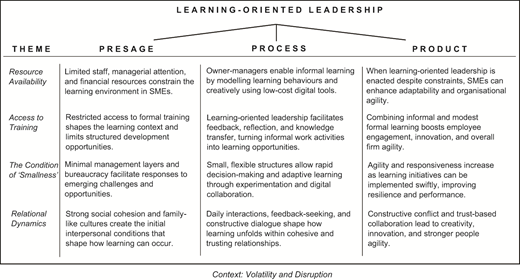
Through synthesis of insights from the preceding analysis, we developed a conceptual framework (Figure 1) that integrates learning-oriented leadership, the four themes and the presage–process–product components of workplace learning. The framework aligns the themes with the 3-P structure and provides examples of how the challenges and opportunities identified within each theme connect with the presage–process–product components.
Propositions for Future Research
Building on the above conceptual findings, four propositions are suggested to guide future research on learning-oriented leadership in SMEs. Each proposition addresses one of the key thematic challenges or opportunities and is grounded in the paper’s theoretical framing. These highly contextualised propositions are important for researchers focused on learning in SMEs, since owner-manager facilitation of informal learning is underdeveloped in SME literature (Short, 2019). Furthermore, SMEs have distinctive characteristics that fundamentally affect employee learning processes. Therefore, researchers need to study informal learning within this context to provide practical, evidence-based guidance for owner-managers on how to strategically enable employee learning. The propositions were derived from a synthesis of existing literature and a critical appraisal of existing perspectives and assumptions. More specifically, the propositions were generated as a deliberate attempt to challenge perspectives and assumptions that often underlie the extant literature. These include that:
learning in SMEs occurs mainly in the context of environmental stability;
workplace learning theories developed in large organisations can be scaled down to fit SMEs; and
SMEs constitute restrictive learning environments; owner-managers are constrained in their ability to make changes in their workplaces to create more expansive learning environments.
In resource-constrained SMEs, the owner-manager’s willingness to allocate managerial attention to employee learning significantly enhances the firm’s agility and adaptability in volatile environments.
This proposition derives from the ABV, which posits that managerial attention is a scarce but crucial resource. Owner-managers juggle multiple roles, so enabling workplace learning often competes with other demands. Future studies should investigate whether SMEs with leaders who deliberately allocate attention to learning initiatives exhibit greater workforce and organisational agility compared to those that do not devote managerial attention to learning. Flat, organic structures and centralised decision-making allow owner-managers to quickly shift the focus of attention. Even under severe resource constraints, a strategic emphasis on learning-oriented leadership can rapidly translate into improved adaptive capacity:
In SMEs with minimal training resources, augmenting informal learning with even modest formal training opportunities amplifies employee development and innovation.
SMEs tend to have limited engagement with formal training, making informal, on-the-job learning the primary mode of development. From a 3-P model (2013) perspective, lack of formal training is a presage factor that shapes the learning context. We propose that introducing modest formal learning interventions (e.g. short courses or digital training modules) into such contexts can spark new ideas and skill acquisition that feed into informal learning cycles. Prior research indicates that formal and informal learning are complementary – formal training can stimulate employees to engage in follow-up experiential learning and reflection. Indeed, even small investments in formal learning (such as workshops or webinars) have been shown to boost employee engagement and innovation in SMEs (Kock et al., 2008).
Future research could compare SMEs that blend modest levels of formal training with strong informal learning cultures with those SMEs that rely solely on informal development to assess differences in innovation, agility and employee growth:
The inherent “smallness” of an SME moderates the impact of learning-oriented leadership on organisational agility: smaller size and structural simplicity enable faster implementation of learning initiatives, strengthening the positive effect on adaptability.
“Smallness” presents several challenges, including difficulty attracting self-directed learners and the inability to leverage formal HR practices to build and maintain a learning culture. Yet the condition of smallness also offers agility advantages. With few management layers and simple structures, SMEs can pivot quickly in response to change. When an owner-manager practices learning-oriented leadership (e.g. encourages experimentation or use of new skills), the structural agility of an SME enables learning-related changes to be adopted swiftly. This amplifies the benefits of learning-oriented leadership on SME resilience and performance in disruptive contexts.
Future research might test this proposition by comparing response times and adaptation outcomes during rapid transformations between the two categories of firms within SMEs. That is, learning-focused small firms and learning-focused medium firms that have comparatively less structural agility than the small firms. Moreover, researchers could investigate how SME leaders utilise external resources to compensate for limited internal resources (e.g. using digital freelancing platforms to access new knowledge and skills) and whether this strategy enhances the firm’s learning agility:
In SMEs with strong relational cohesion, learning-oriented leadership that fosters constructive conflict and openness yields greater benefits in terms of creativity, innovation and perspective-taking than leadership that prioritises harmony alone.
The close “family-like” ties in many small firms create high trust and support, which generally facilitate informal learning. However, excessive cohesion can suppress questioning of practices and new ideas needed for innovation. Drawing on Tynjälä’s (2013) model, the interpersonal process of workplace learning thrives under conditions of psychological safety and moderate task conflict. We propose that SME leaders who actively encourage moderate dissent (e.g. challenging employees to question the status quo and offer novel solutions) while maintaining trust will see greater creativity and knowledge creation in their teams (Wallo, 2008). This aligns with research suggesting that task-related disagreement, particularly in the form of minority dissent, can stimulate divergent thinking and creativity, which can lead to innovation, especially when teams have high levels of participation in decision making (De Dreu and West, 2001). Leaders must therefore balance social cohesion with “creative tension”.
Future research should investigate questions surrounding this balancing act. For example, researchers could examine whether interventions that train owner-managers in how to facilitate constructive debate result in superior innovation and learning performance compared to owner-managers who do not receive such an intervention. Additionally, given the potential benefits of extending informal learning beyond immediate relationships, researchers might explore how SME leaders can use digital collaboration tools to broaden learning networks and increase the diversity of ideas without eroding the close-knit culture.
Conclusions and implications for theory and practice
This paper highlights the significance of learning-oriented leadership as a central mechanism for enhancing the agility and resilience of SMEs operating in volatile and disruptive environments. Drawing together theories of workplace learning, organisational agility and leadership, it positions the SME owner-manager as a critical enabler of learning under conditions of resource scarcity, limited formal training and relational proximity. The practical implications outlined below are directly derived from the paper’s theoretical integration of learning-oriented leadership, Tynjälä’s (2013) 3-P model of workplace learning, and the organisational agility perspective. In doing so, the paper provides a novel analytical framework that explains how learning-oriented leadership fosters employee adaptability and organisational responsiveness in times of turbulence.
The paper contributes to theory in several ways. First, it extends the concept of learning-oriented leadership by embedding it in the SME context, where the boundaries between strategic leadership and daily supervision are often blurred. Unlike in large organisations, the SME owner-manager’s dual role allows for direct influence over learning structures, work design and social relations. Second, the analysis advances the understanding of how informal learning unfolds under conditions of volatility. By connecting presage, process and product elements of workplace learning with the agility perspective, the framework explains how leadership behaviours translate into dynamic capabilities. Third, by incorporating the ABV, the paper highlights managerial attention as a scarce but decisive resource for learning in small firms. Allocating attention to developmental activities can be viewed as a leadership act in itself – one that enables informal learning and supports rapid adaptation. Finally, the discussion of “smallness” reframes it from a structural limitation to a potential source of agility. The simplicity and informality of small firms can accelerate the diffusion of learning-oriented practices and foster responsiveness when leaders deliberately shape learning cultures.
Regarding practical implications for SME owner-managers, the findings underscore the importance of acting intentionally as facilitators of learning. This involves modelling reflective behaviour, encouraging experimentation and legitimising mistakes as part of learning, thereby shaping key presage and process conditions for informal workplace learning. Even under tight resource constraints, owner-managers can strengthen informal learning through low-cost strategies such as peer mentoring, structured reflection meetings and the use of digital tools like webinars, online tutorials, or collaboration platforms, which support learning processes that underpin people agility. These approaches not only enhance learning capacity but also signal commitment to employee development, which can increase engagement and retention. For HRD practitioners, the findings suggest designing support initiatives that complement rather than replace informal learning. Short training programmes, regional learning networks and digital microlearning solutions can help SMEs access new knowledge while remaining operationally flexible.
For SME owner-managers, the findings highlight three practical levers:
allocate dedicated time and attention to learning activities despite competing operational demands;
integrate low-cost digital learning resources and peer learning networks to compensate for limited formal training budgets; and
purposefully balance relational cohesion with constructive dialogue to stimulate innovation.
Owner-managers in SMEs often have a high degree of proximity to their employees, which makes their role as facilitator of informal learning highly influential (Coetzer et al., 2023). Therefore, the foregoing practical implications are important for owner-managers seeking to develop their competence. In this way, the practical implications reflect how learning-oriented leadership operates as a micro-level mechanism through which SME owner-managers shape presage and process conditions for workplace learning, thereby strengthening people agility and organisational adaptability under conditions of volatility and disruption.
The paper’s propositions provide a basis for empirical studies examining how learning-oriented leadership contributes to SME agility. Future research could test the proposed relationships using mixed-method or longitudinal designs to capture how learning-oriented practices evolve during disruptive events. Comparative studies of SMEs could clarify how structural agility moderates leadership effects. Qualitative research could further illuminate how owner-managers direct attention to learning amid competing demands. Another promising avenue is to examine how digitalisation alters relational learning dynamics and whether hybrid environments can sustain the trust and cohesion typical of SMEs. Cross-cultural studies may also show how labour-market conditions shape the enactment of learning-oriented leadership.
Overall, this paper conceptualises learning-oriented leadership as a vital leadership response to volatility and disruption. It reframes turbulence not merely as a threat to SME survival but as a context that can activate developmental forms of learning and renewal. When owner-managers embed learning in daily work, encourage constructive reflection and leverage digital tools for knowledge sharing, they transform their firms into adaptive learning systems capable of sustaining performance in uncertain times.