This review examines how the expansion of gig and remote work reshapes human resource management (HRM) frameworks. It aims to reconceptualise HRM in the gig economy by highlighting sustainable practices that enhance worker well-being and long-term career development, while addressing the Western-centric bias in existing research.
The study conducted a systematic literature review following PRISMA 2020 guidelines. It analysed 144 peer-reviewed English-language articles published between 1995 and January 2026 from the Web of Science database, with emphasis on post-2014 studies reflecting the rise of digital platforms. The findings were synthesised using the antecedents–mediators–outcomes (AMO) framework.
The review identifies four antecedents shaping gig work participation: algorithmic management, work design, cognitive framing and identity, and social and technological infrastructure. Algorithmic governance and perceived autonomy are found to act as central mediators linking these antecedents to worker outcomes. The literature is observed to primarily draw on Self-Determination Theory and Social Exchange Theory but remains concentrated in Western contexts.
The review is limited to English-language, Web of Science-indexed publications, highlighting the need for broader geographical and database coverage in future studies.
This study provides insights for policymakers to help balance efficiency gains from algorithmic management with fair working conditions and sustainable worker well-being.
The review's originality lies primarily in its integrative reframing rather than in proposing a wholly new causal mechanism. Specifically, synthesising the gig-HRM literature through an explicit Antecedents–Mediators–Outcomes framework and sharpening a “consumer perspective” that positions gig workers as recipients and evaluators of HRM services. It aims to bring together research on platform-ecosystems, algorithmic-management, and digitally mediated work within a single service-oriented account of sustainable gig HRM.
1. Introduction
Digitalisation, volatile labour markets, and the growth of remote and platform-mediated work have altered the employment landscape and challenged established Human Resource Management (HRM) practices (Duggan et al., 2023). Gig work in particular differs from conventional employment because it is typically short-term, flexible, and coordinated through digital platforms. As a result, many workers have limited access to formal HRM support, including structured performance evaluation, training, career guidance, and employee assistance (Messenger and Gschwind, 2016). As we move beyond work arrangements that arose in response to an emergency pandemic, organisations must address tensions between algorithmic efficiency, social isolation, blurred work-family boundaries, digital surveillance, and worker well-being (Dong et al., 2025).
The review is motivated by the need for HRM frameworks that are strategic, sustainable, and human-centred rather than merely reactive. At the theoretical level, existing HRM models still struggle to explain the relationships among platforms, workers, and clients operating under algorithmic control. At the empirical level, the evidence remains mixed: gig work may offer flexibility and empowerment, but it may also produce insecurity, dependence, and algorithmic exploitation.
Although research on gig and platform-mediated work has expanded substantially, the HRM literature remains fragmented across several related but only partially connected streams. Prior studies have examined gig workers' motivation and psychological processes (Jabagi et al., 2019), conceptualised HRM within platform ecosystems (Meijerink and Keegan, 2019), and positioned app-based work and algorithmic control as important HRM and employment-relations concerns (Duggan et al., 2020). Other studies have explored digitally enabled HRM practices on platforms, including recruitment, coordination, monitoring, and control (Waldkirch et al., 2021; Williams et al., 2021; McDonnell et al., 2021). More recent reviews and conceptual contributions have also advanced understanding of gig HRM and algorithmic governance (Connelly et al., 2021; Meijerink and Bondarouk, 2023; Kadolkar et al., 2025). However, the field still lacks an integrated explanation of how platform design, algorithmic governance, and HRM mechanisms jointly shape worker and organisational outcomes.
Geographically, the current body of research remains heavily skewed. Most literature is concentrated within Western markets or leaves the geographical scope entirely unspecified, leaving context-specific insights from Asia and the Global South disproportionately scarce (Raghuram and Fang, 2014; Chin et al., 2023; Zong et al., 2024; Doargajudhur et al., 2026). This geographic blind spot is highly consequential. Local institutional environments, labour laws, cultural norms, and localised platform behaviours profoundly dictate how gig work is actually structured, experienced, and managed on the ground. Consequently, the field requires a more targeted, context-aware synthesis to map out the true theoretical, methodological, and empirical limits of our current understanding.
To address these concerns, this article systematically reviews HRM research on the gig economy. The purpose is not to provide another broad bibliometric overview. Instead, the review synthesises the dominant theories, contexts, methods, and HRM-related mechanisms in this field. The Antecedents-Mediators-Outcomes (AMO) framework is used to examine how platform conditions and HRM practices are linked to worker and organisational outcomes.
Three core research questions guide this investigation:
How can HRM be examined in a more integrated way that incorporates gig workers' perspectives within a broader behavioural psychology framework?
What are the main gaps in HRM research on the gig economy, particularly in relation to workforce development and organisational sustainability?
Which areas should future HRM research prioritise to enhance the management and development of gig workers?
Sections 3.2–3.5 provide the descriptive evidence base for these three research questions, while Section 4.2 interprets these findings through subsections aligned with RQ1, RQ2, and RQ3.
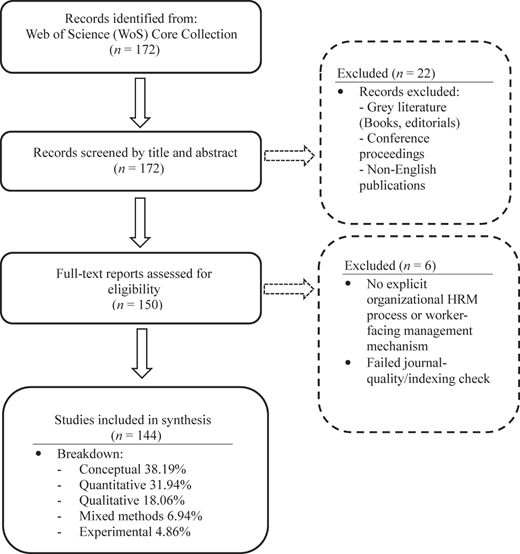
The article combines a systematic review protocol with evidence mapping to strengthen its methodological rigour. It also follows a transparent workflow aligned with PRISMA 2020, as summarised in Figure 1, and uses the stepwise protocol in Table 1. These procedures cover database selection, search strategy, screening and eligibility decisions, and quality assessment.
The novel contribution of this review is its integrative and interpretive approach. Existing scholarship has examined HRM in gig work through a platform-ecosystem lens (Meijerink and Keegan, 2019), positioned gig work as an important domain for HRM theory and practice (Connelly et al., 2021), and identified algorithmic management as a significant HRM concern in app-based work (Duggan et al., 2020, 2023). Other studies have theorised the tensions between algorithmic control, worker autonomy, and value creation (Meijerink and Bondarouk, 2023), while more recent systematic work has shown that algorithmic-management research remains fragmented across disciplines rather than theoretically consolidated (Kadolkar et al., 2025).
This review does not claim to introduce an entirely new theoretical mechanism. Instead, it reconceptualises gig HRM by bringing together related but often separately discussed research streams within a more coherent analytical frame. This is achieved through an explicit Antecedents-Mediators-Outcomes synthesis and the development of a service-oriented “consumer perspective”, where gig workers are viewed not simply as labour inputs but also recipients and evaluators of HRM activities.
This review extends prior work in three specific ways. First, it consolidates a broad HRM-focused evidence base of 144 Web of Science-indexed studies published between 1995 and January 2026. Second, it uses the AMO framework to explain how gig HRM conditions influence worker and organisational outcomes through mediating mechanisms related to governance, autonomy, and employment relationships. Third, it provides a service-oriented framing of sustainable gig HRM that positions gig workers not only as participants in platform labour processes, but also as recipients and evaluators of HRM-related services. The originality of the review therefore lies in its framing, synthesis, and conceptual clarification, rather than identifying a wholly new causal law.
Section 2 of the article explains the authors' systematic review methodology and search strategy. Section 3 presents the descriptive findings and synthesis of the reviewed literature. Section 4 discusses the theoretical and practical implications and develops the research agenda. Section 5 summarises the study's main contributions. Finally, Section 6 outlines limitations and directions for future research.
2. Methodology
The literature search was last conducted on 31 January 2026. This review therefore covers evidence published up to January 2026 but does not claim to represent all studies available at the time of manuscript submission. The systematic review was designed to make the search and selection process transparent, reduce selection bias, and support replication. It follows guidance for management reviews (Tranfield et al., 2003) and is aligned with PRISMA 2020; Page et al. (2021).
2.1 Research approach and framework integration
This review combines two elements. PRISMA 2020 guided the search, screening, eligibility assessment, and reporting process. The AMO framework was then used at the synthesis stage to organise and interpret findings from the final sample (Zahoor et al., 2020). In other words, AMO shaped the analysis, but it did not determine article eligibility or selection.
2.2 Electronic database selection and justification
Consistent with guidance for management reviews Hiebl (2023), PRISMA 2020 reporting requirements (Page et al., 2021), this review reports the information sources, search dates, and search strategy. It is therefore framed as a Web of Science (WoS)-bounded, quality-filtered synthesis rather than an exhaustive multi-database review. WoS was selected because it offers curated indexing, reliable citation metadata, and strong coverage of established high-impact journals. These features supported comparability across studies and provided a clearly bounded literature base. This decision also carries limitations. Scopus, for example, generally has broader source coverage, although this varies across disciplines and publication types (Aghaei Chadegani et al., 2013; Pranckutė, 2021). Some relevant Scopus-indexed studies may therefore be absent. However, the strength of this review lies in its analytical depth, internal comparability, and explicit evidence boundaries rather than complete coverage of the gig-HRM literature.
2.3 Search strategy, screening, and coding procedure
A Boolean search was conducted in the WoS Topic field, covering titles, abstracts, author keywords, and Keywords Plus. The search combined HRM terms, including “human resource management”, “HRM”, “HR practices”, and “talent management”, with gig, platform-based, and related non-standard work terms, including “gig economy”, “gig worker”, “contingent workforce”, “on-demand economy”, “remote work”, and “telecommuting”. Remote work and telecommuting were included because HRM research on digitally mediated work often overlaps with platform-adjacent employment arrangements (Donnelly and Johns, 2021; Connelly et al., 2021).
The WoS search was last conducted on 31 January 2026. Two researchers independently screened titles and abstracts, with disagreements resolved by a third author, achieving 96% interrater agreement. Eligible articles were then reviewed in full to confirm their organisational HRM relevance. For the final sample, bibliographic details, context, population, theory, method, and key findings were extracted and coded into antecedent, mediator, and outcome categories.
2.4 Inclusion, exclusion, and quality appraisal
Our inclusion criteria targeted peer-reviewed, English-language journal articles from 1995 to 2026 addressing organisational HRM in gig, platform-driven, or related digitally mediated work settings. This review systematically excluded grey literature, conference papers, non-indexed outlets, and non-English publications. A further six full-text reports were excluded because they lacked an explicit organisational HRM process or worker-facing management mechanism or failed journal-quality/indexing checks. Following the PRISMA screening process shown in Figure 1 resulted in a final review sample of 144 articles.
To establish clear analytical boundaries, a “specific organisational HRM focus” meant the research had to dissect at least one concrete HR process, practice, or worker-centred management routine. Eligible mechanisms spanned everything from onboarding and recruitment to task allocation, algorithmic control, performance tracking, rewards, employee voice, support, engagement, well-being, talent metrics, and career development (Williams et al., 2021; McDonnell et al., 2021; Duggan et al., 2023; Keegan and Meijerink, 2023; Straus et al., 2023; Cortellazzo and Vaska, 2025). If a full-text article merely discussed labour markets, regulation, or platform precarity broadly without evaluating a tangible HR intervention, it was dropped.
This study appraised the methodological rigour of empirical studies via the Mixed Methods Appraisal Tool (MMAT) 2018 version (Hong et al., 2018). While purely conceptual papers were kept for their theoretical insights, they were excluded from the empirical quality-appraisal scoring.
3. Results
This section presents the findings of the systematic literature review, including descriptive trends and a baseline AMO mapping of the 144-study corpus. The presentation remains descriptive, with broader interpretation reserved for Section 4. Sections 3.1–3.5 report publication distribution, theoretical foundations, geographic and contextual coverage, methodological profiles, and AMO-coded evidence.
3.1 Bibliometric distribution and journal influence
The analysis of journal influence shows variation in article counts and citation totals across 18 selected journals represented in the sample. The International Journal of Human Resource Management accounts for the largest number of articles in the sample, with 10 articles and 584 total citations. Other journals represented in the sample include Human Resource Management Review and Human Resource Management, which contain both theoretical and empirical studies relevant to the review. Representative articles from these high-impact journals, based on h-index and citation counts, are summarised in Table 2.
3.2 Theoretical trends
Behavioural perspectives are the most commonly used theoretical lenses in the reviewed literature. As shown in Table 3, Self-Determination Theory (SDT, 11.11%) and Social Exchange Theory (SET, 9.72%) are the most frequently reported analytical lenses. SDT is often used to examine how autonomy, competence, and relatedness shape motivation and well-being in digitally mediated work settings (Jabagi et al., 2019), while SET is used to analyse reciprocal exchanges, psychological contracts, and perceived organisational support among independent contractors and platform workers (Chambel et al., 2023). By contrast, macro-level frameworks such as Institutional Theory (account for 0.69% of the sample) appear less frequently. This distribution suggests that the studies under review more often apply micro- and meso-level theories than macro-level institutional perspectives.
Other theories appear less frequently in the corpus. Human Capital Theory is used in studies on skill development and long-term employability, while the Ecosystem Perspective frames platform work as a triadic relationship among platforms, clients, and workers (Meijerink and Keegan, 2019). Conservation of Resources Theory is applied to explain how workers manage personal resources and stress under precarious working conditions (Hamouche, 2023). Job Characteristics Theory is also used in studies examining task structure, operational autonomy, task identity, and job satisfaction.
3.3 Contextual coverage
Table 4 shows that the empirical studies are largely concentrated in Western countries or do not specify a geographical context. The United States leads the country-specific research footprint (7.64%), followed by smaller European clusters concentrated in Germany, Italy, and Poland. Studies from Asian countries include China, India, Vietnam, Taiwan, and South Korea, while Southeast Asian contexts are represented by a small number of studies.
Across the corpus, studies frequently address algorithmic governance, changing employment relationships, technological transformation, and service-sector platform operations. Some European studies examine regulatory frameworks and sharing-economy issues, while several Asian studies focus on platform labour and digitally mediated work environments. However, a substantial proportion of the corpus does not specify a country context, which limits the extent to which cross-contextual comparisons can be made.
This review observe a similar lack of granularity regarding study populations. A significant portion of the literature targets managers and executives (25.69%), mirroring a widespread academic focus on leadership, corporate governance, and strategic choice. Conversely, research centred on actual gig workers (11.81%) and platform labourers (2.08%) tends to explore themes of well-being, sustainability, and ethics, primarily within ride-hailing and food-delivery vectors. Table 4 also shows that 56.94% of the sampled articles do not specify the study population, while 64.58% do not specify the country context.
3.4 Methodological trends
Conceptual papers constitute the largest methodological category (38.19%) and frequently address algorithmic governance, digitally mediated HR frameworks, and platform ecosystems. Quantitative methodologies represent 31.94% of the corpus and commonly rely on surveys, regression models, and structural equation modelling to analyse variables such as engagement, motivation, worker performance, and well-being. Most quantitative studies are cross-sectional, while longitudinal designs appear less frequently in the corpus.
Qualitative research accounts for 18.06% of the review corpus. These studies examine how workers experience platform precarity, career progression, algorithmic surveillance, and personal agency (Waldkirch et al., 2021; Williams et al., 2021; Babu and Sahayam, 2024). Mixed method designs account for 6.94% of the corpus, while experimental studies account for 4.86%. These latter designs examine relationships between algorithmic supervision, worker motivation, and performance metrics (Norlander et al., 2021; Kröll et al., 2021; Burbano and Chiles, 2022). Table 5 illustrates the overarching methodological breakdown, while Table 6 highlights archetypical examples of each approach.
3.5 AMO-mapped synthesis of findings
The reviewed studies are structured around the AMO framework in Table 7, which organises the evidence by linking platform-related conditions, mediating HRM mechanisms, and worker or organisational outcomes. The studies report several HRM-related mechanisms, including algorithmic governance, autonomy-control tensions, social support, and platform architecture.
Algorithmic management is a recurring antecedent across the reviewed studies. It is associated with task distribution, performance tracking, rating systems, reward and penalty mechanisms, worker surveillance, and platform dependence. Several studies also position algorithmic management as part of the mediating layer, alongside job control, autonomy, relational support, and platform design.
The reported outcomes are grouped into individual-level and organisational/system-level categories. At the individual level, researchers frequently examine engagement, motivation, well-being, burnout, perceived control, and career development. At the organisational and system levels, the reviewed studies examine attraction, selection, coordination, distributed workforce management, value creation, and platform sustainability.
4. Discussion
The descriptive patterns reported in Section 3 point to several interpretive implications. First, the concentration of SDT, SET, and job-design perspectives suggests that gig-HRM research has been shaped mainly by micro- and meso-level explanations, while broader institutional and regulatory perspectives remain less developed. Second, the high proportion of studies with unspecified country contexts limits the field's ability to make robust cross-contextual comparisons. Third, the prominence of conceptual and cross-sectional work indicates that causal and longitudinal explanations of gig-worker development, autonomy, and well-being remain underdeveloped. Finally, the AMO mapping shows that algorithmic management operates not only as a platform condition but also as part of the mediating layer through which worker experiences and organisational outcomes are shaped.
4.1 Unpacking the AMO “black box”
This review identifies four key antecedents: (1) algorithmic management, (2) work design and HRM architecture, (3) cognitive framing and identity, and (4) social and technological infrastructure. Prior studies (e.g., Shapiro, 2020; Cameron, 2024) show that these factors play a central role in shaping worker agency. Algorithmic governance functions as the main mediating mechanism, operating as a “black box” through which these antecedents influence outcomes. These dynamics are further shaped by platform architecture, where design features directly affect perceived autonomy (Meijerink and Bondarouk, 2023). The resulting outcomes can be observed at both the individual level, such as well-being and burnout, and the organisational level, including productivity and the sustainability of platform models.
4.1.1 Antecedents
Drawing on the taxonomy of Zahoor et al. (2020), antecedents refer to the conditions that shape how a system operates and its capacity to generate outcomes. In this review, these factors are examined across multiple levels. This review identifies four primary antecedents of HRM in the gig economy.
4.1.1.1 Algorithmic management
Algorithmic management refers to a platform's use of data-driven systems to allocate tasks, monitor performance, and enforce control. The analysis indicates that algorithmic management operates as a central antecedent, shaping participation in the gig economy by influencing worker agency and perceptions. Shapiro (2020) shows that such systems often create an appearance of flexibility while masking a “calculative asymmetry” that undermines perceived autonomy. This dynamic can lead to compliance even in the face of dissatisfaction, as Cameron (2024) highlights through the notion of “constant and constrained choices”, which limit perceived alternatives and affect retention. Duggan et al. (2023) and Norlander et al. (2021) further demonstrate how monitoring and behavioural nudges embedded in algorithmic HRM influence worker decisions, encouraging actions aimed at avoiding penalties or securing rewards. Similarly, Anicich (2022) and Cameron (2024) describe how “constrained choices” and “engineered consent” within algorithmic systems prompt workers to rationalise continued participation, even under unfavourable conditions.
4.1.1.2 Work design and HRM architecture
Work design and HRM architecture refer to the structuring and resourcing of work in the gig economy, including job flexibility, contractor arrangements, recruitment strategies, and innovation-oriented practices used to engage non-traditional labour. These elements function as strong antecedents, shaping how workers experience and engage with platform-based work. Biron et al. (2021) show that the appeal of ‘agile’ or ‘skunk works–style’ arrangements can create a gap between perceived autonomy and the realities of algorithmic control, influencing initial participation decisions. Williams et al. (2021) further note that while digital recruitment systems improve access to opportunities, they may also contribute to a sense of disposability, with implications for long-term commitment. Keegan and Meijerink (2023) highlight how contractor-based HRM structures can reinforce precarious employment relationships, shaping perceptions of fairness and future engagement. In addition, McDonnell et al. (2023) demonstrate that technology-mediated HRM practices, particularly through algorithmic nudges, play a role in directing worker priorities and performance outcomes.
4.1.1.3 Cognitive framing and identity
Cognitive framing and identity refer to the psychological and social processes through which gig workers construct and interpret their roles, often drawing on narrative strategies or entrepreneurial mindsets to manage uncertainty. The analysis suggests that these processes act as important antecedents influencing participation in gig work. Anicich (2022) shows that identity narratives used to cope with precarity also shape ongoing engagement, as workers actively construct meanings that support their continued involvement. Similarly, Dew et al. (2015) demonstrate that framing gig work as entrepreneurial influences how individuals perceive risk and opportunity, thereby affecting their level of participation. Straus et al. (2023) and Byrd (2022) highlight that whether gig work is positioned as a viable opportunity or a fallback option has direct implications for well-being and engagement. Overall, these findings indicate that cognitive interpretations play a significant role in shaping how workers enter, sustain, and make sense of gig work.
4.1.1.4 Social and technological infrastructure
Social and technological infrastructure refers to the range of technological, interpersonal, and organisational support systems that enable or constrain participation in gig work, including digital connectivity, HR support, and peer networks. The analysis indicates that this infrastructure functions as a key antecedent by shaping the extent and quality of worker engagement. Straus et al. (2023) and Hafermalz and Riemer (2020) show that access to robust social and technological resources supports sustained participation, highlighting the importance of both digital and organisational support mechanisms. Varma et al. (2022) further demonstrate that elements such as leader–member exchange and digital communication influence worker satisfaction and commitment, underscoring the role of technology-mediated relationships in shaping engagement. In addition, Hafermalz and Riemer (2020) emphasise the role of ‘connectivity work’ in reducing isolation, suggesting that peer support networks play a meaningful role in enhancing well-being and ongoing participation.
4.1.2 Mediators
Within the AMO framework, mediators refer to the processes through which system conditions are translated into outcomes, particularly the management of post-formation interactions and dependencies (Zahoor et al., 2020). In the context of gig HRM, this corresponds to the “black box” of algorithmic coordination. The review identifies five key mediating dimensions that shape HRM practices in the gig economy: (1) algorithmic governance and regulatory frameworks, (2) worker autonomy and job control, (3) social and relational dynamics, (4) multi-actor influences, and (5) platform architecture, transparency, and boundary conditions.
Algorithmic governance plays a central role by restructuring control through technological monitoring (Norlander et al., 2021), pricing mechanisms that create asymmetries (Shapiro, 2020), and design features that guide worker behaviour (Cameron, 2024). At the same time, its effects are closely tied to workers' perceived autonomy and job control. Autonomy functions not only as an outcome but also as a mediating factor shaped by platform design, influencing how workers respond to demands and, in turn, affecting performance and well-being (Bartsch et al., 2021; Becker et al., 2022; Meijerink and Bondarouk, 2023).
In the gig economy, HRM processes are shaped by broader social and relational dynamics that extend beyond the platform–worker relationship. External actors such as customers (Duggan et al., 2023), peer networks and “crowd-based” practices (Waldkirch et al., 2021), and the wider ecosystem of clients and platforms (Meijerink and Keegan, 2019) all influence how HRM activities are enacted and experienced. Social support, in particular, emerges as an important resource shaping worker outcomes (Straus et al., 2023; Bartsch et al., 2021).
These interactions are further conditioned by platform architecture and design. Features such as recruitment algorithms, selection processes, communication systems, and motivational tools (e.g. ratings or badges) directly influence how HRM-related practices are implemented and how effective they are (Williams et al., 2021; Waldkirch et al., 2021; Jabagi et al., 2019). In addition, the degree of transparency in rules, roles, and reward systems plays a critical role, as ambiguity can lead to negative outcomes (Köbis et al., 2021). Career boundaries also shape opportunities for development and mobility within platform-based work (Kost et al., 2020).
Taken together, these mediating dimensions highlight that HRM in the gig economy operates through a complex interplay of technological systems, multi-actor relationships, perceived control, platform design, and institutional clarity, all of which shape how platform conditions translate into worker and organisational outcomes.
4.1.3 Outcomes
This study distinguishes two broad categories of outcomes associated with HRM in the gig economy: (1) individual-level outcomes and (2) organisational or system-level outcomes.
At the individual level, the literature focuses mainly on performance, behaviour, engagement, productivity, and well-being in virtual, remote, and platform-based work (Bartsch et al., 2021; Becker et al., 2022; Straus et al., 2023; Duggan et al., 2023; Cameron, 2024). Studies also examine emotional exhaustion, work–life balance, mental health, motivation, perceived control, career development, identity formation, and interpersonal experiences such as isolation and relationship quality (Jabagi et al., 2019; Norlander et al., 2021; Kost et al., 2020; Waldkirch et al., 2021; Hafermalz and Riemer, 2020; Varma et al., 2022). This aligns with HRM research showing that compassion, humanistic responsibility, supportive work–life practices, and training quality can enhance well-being, commitment, innovation, and thriving (Koon, 2022a, b, 2024; Koon and Yulita, 2024).
At the organisational and system level, studies examine productivity, knowledge management, leadership effectiveness, value creation, platform sustainability, and the ability of HRM practices to attract, coordinate, and engage distributed workers (Andreassen et al., 2018; Meijerink and Keegan, 2019; Gifford, 2022; Duggan et al., 2023; Serenko, 2023). These outcomes are closely linked: worker well-being shapes productivity and performance, while HRM design influences employee experiences and behaviour. Table 7 summarises these relationships through the Antecedents–Mediators–Outcomes (AMO) framework for gig HRM.
4.2 Extending our understanding of HRM in the gig economy
Conceptual work represents the largest category in the current literature, accounting for 38.19% of the corpus. This suggests that established HRM frameworks require further adaptation for work arrangements in which employer–employee boundaries are ambiguous or fragmented. In digital platform settings, where formal organisational structures are less visible, conceptual work has played an important role in clarifying what HRM means within a decentralised ecosystem (Meijerink and Keegan, 2019).
This pattern is also linked to methodological constraints. Platform firms often limit access to algorithmic systems and operational data, which makes independent data collection difficult. Gig workers are also geographically dispersed and do not share a fixed workplace, making longitudinal, comparative, and multi-level research more challenging. Regulatory variation and continuing debates over worker classification further complicate the design of empirical studies. These conditions help explain why conceptual and cross-sectional studies remain prominent in the field.
This synthesis extends previous literature reviews in three ways. First, it identifies the concentration of behavioural psychology frameworks and the relative underdevelopment of macro-level perspectives. Second, it highlights the field's reliance on Western-centric, cross-sectional, and conceptual evidence. Third, the AMO framework clarifies the mediating HRM processes through which platform conditions are linked to worker and organisational outcomes.
4.2.1 Comprehensive analysis of HRM through behavioural psychology and gig worker perspectives
In addressing the first research question (how HRM can be examined more comprehensively by incorporating gig workers' perspectives within a behavioural psychology framework), this review adopts a multi-level perspective that places workers' lived experiences alongside the structural conditions of platform work. From this perspective, HRM extends beyond transactional exchanges and includes the psychological dimensions of work, such as autonomy, competence, and relatedness (Jabagi et al., 2019), as well as workers' sense of meaning, identity, and social connection in platform-based environments.
The findings suggest that existing HRM approaches remain limited when gig workers are treated as passive units of analysis rather than as active and psychologically complex actors. A more comprehensive approach therefore requires linking micro-level behavioural theories, such as Self-Determination Theory (SDT) and Social Exchange Theory (SET), with broader institutional and agency-based perspectives. This allows the analysis to account for both individual motivation and the structural constraints embedded in platform work.
Within this framework, algorithmic management can be understood as a socio-technical mechanism. It does not function only as a tool of control but also shapes the conditions under which workers exercise agency (Meijerink and Bondarouk, 2023). Even under “calculative asymmetries” (Shapiro, 2020), workers may still derive non-monetary value from platform systems, for example by using real-time feedback to regulate their work practices and improve performance.
Overall, HRM in the gig economy is best understood as a dynamic interaction among workers, algorithmic systems, and market forces. This perspective points to the need for an integrative behavioural framework that captures both the psychological processes experienced by gig workers and the structural features that shape platform-based work.
4.2.2 Limitations of the current HRM literature
To address the second research question (what key gaps exist in HRM research on the gig economy, particularly in relation to workforce development and organisational sustainability), this review identifies four main limitations.
First, much of the literature relies on cross-sectional designs, offering only ‘snapshot’ views of gig work. This limits understanding of how work relationships evolve over time, especially in relation to career development, skill accumulation, and long-term well-being.
Second, the evidence base remains strongly Western-focused, with limited attention to diverse socio-economic and cultural contexts. Differences in regulatory systems, labour norms, and institutional environments, particularly in emerging economies, are therefore underexplored, which restricts the broader applicability of current findings (Simova et al., 2024; Cameron, 2024).
Third, workforce development is not sufficiently examined, particularly for specialised gig workers in fields such as healthcare and education. Existing studies tend to apply generalised HRM frameworks, with limited consideration of professional identity, skill progression, and sustainable career pathways (Hamouche, 2023). As a result, there is a risk of reinforcing forms of work that remain unstable over time, affecting both individual career prospects and organisational capacity.
Finally, organisational sustainability is challenged by the psychological effects associated with algorithmic management. While continuous monitoring may enhance short-term efficiency, it can also contribute to technostress and emotional exhaustion in the longer term (Norlander et al., 2021). The absence of meaningful human interaction and supportive institutional mechanisms further intensifies these issues, raising concerns about the durability of platform-based work systems.
4.2.3 Future research directions for improving gig worker management and development
To address the third research question (what areas future HRM research in the gig economy should prioritise to improve the management and development of gig workers) this review highlights several fruitful directions.
First, there is a need for stronger methodological approaches, particularly through longitudinal and experimental designs. Much of the current research relies on cross-sectional data, which limits the ability to capture how gig work relationships evolve over time. Longitudinal studies would offer deeper insight into how factors such as motivation, autonomy, and control develop under algorithmic management (Jabagi et al., 2019; Meijerink and Keegan, 2019), especially in relation to longer-term psychological and career outcomes.
Second, future research should adopt multi-level frameworks that link individual-level experiences with broader institutional and economic conditions. Existing studies tend to focus on worker-level dynamics while giving less attention to structural influences such as regulatory systems and labour market conditions. Integrating these perspectives would provide a more complete understanding of HRM in platform-based environments (Meijerink and Bondarouk, 2023), particularly given the dual nature of algorithmic management, where efficiency and control coexist.
Third, expanding the geographical scope of research is essential. The current evidence base is largely concentrated in Western contexts, which limits the wider applicability of findings. Greater attention to underrepresented regions, especially Southeast Asia, would improve understanding of how cultural norms, collective values, and institutional arrangements shape gig work practices. Cross-cultural comparisons can further reveal how HRM systems adapt across different socio-economic settings (Kost et al., 2020).
Fourth, more emphasis should be placed on developing human-centred HRM approaches that balance technological efficiency with worker well-being. While algorithmic systems enhance coordination and scalability, they may also introduce stress, uncertainty, and reduced autonomy. Designing platforms with clearer feedback mechanisms, trust-building features, and supportive interactions can help mitigate these effects and improve engagement (Norlander et al., 2021; Hamouche, 2023). This direction is reinforced by research showing that organisational compassion and corporate humanistic responsibility are linked to thriving and sustainable employee well-being (Koon, 2022a, 2024). This supports a broader shift toward viewing HRM as a value-creating function rather than purely a control mechanism.
Furthermore, advancing workforce development requires greater attention to skill formation, career pathways, and professional identity in gig work. The concept of boundaryless careers suggests that workers must often shape their own trajectories without traditional organisational support (Kost et al., 2020). Future research should therefore examine how platforms can support continuous learning and capability development. Integrating platform-generated data with qualitative insights through mixed-method approaches would provide a more comprehensive view of how gig workers build skills, maintain employability, and navigate evolving career paths over time.
4.3 Theoretical implications
Our AMO findings point to a major shift in perspective: the literature is moving away from viewing platform HR strictly as an instrument of control and toward treating it as a service-driven management practice. Institutional Theory offers a vital lens for understanding the macro-forces behind this trend, including how shifting regulatory landscapes, particularly in Asia and the Euro-Med region, influence whether platform models gain social legitimacy and how they operate.
This study makes three central contributions. First, the use of the AMO framework (Zahoor et al., 2020) helps disentangle the overlapping elements of gig HRM and provides a structured basis for future empirical investigation. Second, it reframes gig workers not simply as subjects of management but as users of HRM services, highlighting the importance for platforms to develop ‘collaboration management capabilities; that support attraction, engagement, and retention. Third, it integrates of evidence on theory use, geographic concentration, methodological patterns, and mediating HRM processes into a coherent explanation of how gig-HRM conditions shape worker and organisational outcomes.
Building on this, the study advances a “consumer perspective” of HRM (Meijerink and Keegan, 2019), positioning gig workers as clients of HRM-related services. By drawing on insights from multiple disciplines, this perspective reinterprets the employment relationship, viewing platform HR practices as services delivered to and utilised by independent workers (Meijerink and Bondarouk, 2023). This framing extends the relevance of established HRM theories to digitally mediated work and offers new insights into satisfaction, engagement, and platform loyalty.
Finally, the analysis highlights the need for more inclusive research that moves beyond dominant geographical and cultural contexts (Cooke et al., 2020). Greater attention to diverse socio-economic settings enhances the global applicability of HRM research and supports more context-sensitive understanding of platform work. Overall, this approach combines theoretical clarity with practical implications for addressing the evolving challenges of the global gig economy.
4.4 Practical implications
For platform managers, long-term sustainability increasingly depends on treating HRM as a service rather than a control mechanism. This involves offering transparent feedback systems, peer-support structures, and opportunities for skill and career development to address the sense of digital isolation often associated with platform work. In this context, algorithmic transparency should be used to build trust and engagement, not solely to improve efficiency.
These insights have implications for both organisational leaders and higher education institutions operating within the gig economy. Higher education providers can strengthen support systems for gig workers by aligning their practices with core HRM principles, placing worker well-being at the centre. This requires a holistic management approach that considers the full experience of gig workers (Rappleye et al., 2020). Adopting a systems perspective allows organisations to better integrate people, policies, and processes, improving coordination while maintaining a stable and supportive environment (Dhirasasna et al., 2021). Beyond optimising algorithms, organisations should also invest in relational aspects of the gig ecosystem, such as transparent governance and peer networks, to reduce isolation and enhance engagement.
At the same time, institutions need to move beyond a narrow focus on technical or professional requirements and consider the broader HRM experience. Gig workers (including content creators and specialist instructors) are increasingly recognised as contributors to economic and organisational development (Anwar and Graham, 2021). As the idea of gig workers as “consumers” of HRM services gains traction, organisations must adapt by reducing excessive performance pressures and fostering more inclusive and supportive work environments. Such changes are essential for strengthening day-to-day HRM practices and improving the attraction and retention of skilled freelance talent.
Relational dynamics also play a critical role in this context. Interactions with platform managers, peers, and professional networks can significantly influence engagement and opportunity-seeking behaviour (Kuhn et al., 2021). Organisations can leverage these relationships through approaches such as relationship marketing and a means–end perspective that prioritises well-being and value creation. In doing so, HRM shifts from a primarily transactional function to a strategic capability that enhances both worker experience and organisational effectiveness.
5. Conclusions
This review brings together 144 peer-reviewed HRM studies on the gig and platform economy, using a PRISMA 2020–aligned selection process (Figure 1) and an AMO (Antecedents–Mediators–Outcomes) framework to guide the analysis (Table 7). The overall body of evidence is largely grounded in behavioural perspectives and focused on the micro level, with comparatively limited development of macro-level theories and a continued concentration of empirical work in Western settings.
The AMO-based synthesis shows how antecedents such as algorithmic management, work design, cognitive framing and identity, and social and technological infrastructure shape outcomes through mediating mechanisms including algorithmic governance, autonomy and control, platform transparency, and rating mechanisms. These outcomes include well-being, engagement, performance, and career sustainability. This review therefore moves beyond broad mapping by explaining how platform conditions are translated into worker and organisational outcomes, while also clarifying the field's dominant theories, contextual and methodological boundaries, and important HRM mechanisms.
The introduction of a “consumer perspective” further emphasises that sustainable gig HRM depends on recognising gig workers as recipients of HRM services and as strategic stakeholders, rather than as interchangeable labour inputs. This perspective carries implications for the design of transparent governance mechanisms, capability development initiatives, and more ethical, sustainable HRM practices on digital platforms.
6. Future scope and limitations
This study is subject to several limitations. First, the review is confined to English-language articles published in Web of Science (WoS)-indexed journals. This single-database design supports internal comparability and replicability, but it may also exclude relevant studies indexed in Scopus or other databases. Second, the search was last conducted on 31 January 2026, meaning that studies published after this cut-off date were not included. Future research could broaden the scope by incorporating Scopus-indexed studies, non-English publications, and research from underrepresented regions, including the Euro-Mediterranean region and the Global South.
Despite these constraints, the review is grounded in a systematic analysis of 144 carefully selected studies with strong theoretical and empirical contributions. This provides a solid foundation for conceptualising “gig HRM” as an evolving area of inquiry and offers cross-disciplinary relevance across digital labour contexts. While future reviews may extend the inclusion criteria to capture emerging or niche outlets, the present selection ensures analytical depth and consistency.
Looking ahead, research on HRM in the gig economy offers considerable opportunities for further development (See Table 8 for future research direction). Greater integration with behavioural psychology can deepen understanding of worker motivation and cognitive engagement in platform settings. At the same time, revisiting HRM practices through innovative and less conventional methodological approaches may help address persistent gaps, particularly those related to the dual nature of algorithmic management.
Future studies should also give more attention to macro-level factors, including global economic conditions and shifting labour demographics, in order to move beyond individual-level analyses and capture the broader structural dynamics at work. There is a need for continued theoretical development, not only to refine existing models but also to design new frameworks suited to digitally mediated work environments. Cross-cultural comparisons between Western and non-Western contexts would further clarify how institutional differences shape HRM practices. In addition, longitudinal designs are important for understanding how employment relationships evolve over time, while combining qualitative and quantitative approaches can strengthen the robustness of findings.
Furthermore, This review also establishes a foundational basis for future inquiry into sustainable HRM within the gig economy. The AMO-based synthesis spanning algorithmic governance, worker autonomy, cognitive framing, and social infrastructure directly maps onto the core pillars of sustainable HRM, namely individual well-being, organisational resilience, and long-term value creation. Future research can therefore build on this review's consumer-perspective framing to examine how platform organisations can design HRM systems that simultaneously ensure worker capability development, reduce precarity, and sustain organisational performance moving beyond efficiency-driven algorithmic logic toward a more human-centred, ethically grounded model of platform governance.
Finally, the diversity of research designs, measures, and outcomes, together with the relatively high proportion of conceptual studies, limits the feasibility of applying meta-analytic techniques in this review.