


This study examines whether national psychosocial-risk legislation is associated with work-related stress among employer-entrepreneurs, defined here as self-employed individuals working in organizations with at least ten employees, across 35 European countries and whether this relationship operates through organizational stress-prevention plans and psychosocial working conditions.
The study links enterprise-level second European Survey of Enterprises on New and Emerging Risks (ESENER-2) data with individual-level European Working Conditions Survey (EWCS) data for self-employed respondents working in organizations with at least ten employees. Drawing on the Job Demands-Resources (JD-R) framework, it tests the relationships among national legislation, organizational stress-prevention plans, job demands, job resources, and perceived work-related stress.
Explicit national psychosocial-risk legislation is associated with a higher likelihood that organizations report a formal stress-prevention plan. However, the presence of such plans is not systematically associated with lower job demands, higher job resources, or lower stress among employer-entrepreneurs. Instead, perceived stress is positively associated with job demands and negatively associated with job resources, with the buffering role of resources more evident in countries with explicit legislation.
The study extends prior research on psychosocial-risk regulation by focusing on employer-entrepreneurs rather than on employees and by showing that formal organizational action alone does not appear sufficient to improve their psychosocial conditions. It contributes evidence that institutional regulation may encourage formal planning, but stress among employer-entrepreneurs is more closely tied to work demands and available resources.
1. Introduction
One of the most significant health challenges in the European Union nowadays concerns the mental health and psychosocial well-being of workers (Makarevičienė et al., 2023). Mental health and psychosocial risk factors do not only affect individuals, but they also have wide-ranging economic and social consequences. They contribute to absenteeism and presenteeism (Leka and Jain, 2016), lower productivity, and overall economic losses estimated at USD 1 trillion per year (OECD, 2018). While considerable attention has been devoted to employee mental health, much less is known about psychosocial risks among entrepreneurs. In this study, we focus specifically on employer-entrepreneurs, that is, self-employed individuals working in organizations with at least ten employees. Entrepreneurship is an especially relevant context for studying well-being because it combines both high work demands and high work resources (Gish et al., 2022). On one hand, entrepreneurs often face long working hours, intense workloads, and significant financial and emotional strain (Dahl et al., 2010; van der Zwan et al., 2018). On the other hand, they experience high levels of autonomy, flexibility, and meaningfulness that can offset stress (Obschonka et al., 2023; Tahar et al., 2022).
Recently, the topic of entrepreneurship and mental health has attracted growing attention not only among scholars but also in public debates (e.g. Delladio and Caputo, 2024; OECD Cogito, 2023). Nevertheless, existing research has mainly focused on positive aspects of well-being, such as life satisfaction or happiness (Fritsch et al., 2019; Wolfe and Patel, 2018; Yu et al., 2023), while little is known about the negative dimension of well-being, also referred to as ill-being, such as stress and mental strain. Most studies have examined occupational or individual-level determinants (e.g. workload, autonomy), while less attention has been paid to how institutional contexts, such as national legislation, shape entrepreneurial well-being (Stephan et al., 2022). This gap is particularly relevant for employer-entrepreneurs operating within formal organizational settings, as they are exposed not only to the demands and resources of self-employment but also to organizational structures and practices related to psychosocial risk management.
Furthermore, research on the institutional determinants of entrepreneurial well-being has primarily focused on formal and economic aspects, such as shared prosperity and business freedom (Wolfe and Patel, 2018), property rights and government activity (Yu et al., 2023), and the societal legitimacy of entrepreneurship (Stephan et al., 2020). Across these studies, a consistent pattern emerges: entrepreneurs report higher levels of satisfaction in countries with stronger institutional quality. Specifically, greater entrepreneurial well-being is observed in nations with higher Global Entrepreneurship Index (GEI) scores (Fritsch et al., 2019), broader economic freedom and shared prosperity (Wolfe and Patel, 2018), and well-protected property rights along with limited government intervention through taxation and spending (Yu et al., 2023).
Together, these findings underscore that institutional contexts play a crucial role in shaping entrepreneurs' well-being by influencing uncertainty, trust, and the general conduciveness of the business environment (Stephan et al., 2022). However, little is known about occupational health and safety institutions, in particular, legislation on psychosocial risks affects entrepreneurial well-being. The aim of this paper is to investigate whether the presence of strong national legislation on psychosocial risks contributes to better working conditions and lower stress among employer-entrepreneurs in European countries. Specifically, we examine how legislation promotes the implementation of organizational stress-prevention plans, and how these plans relate to the job demands, job resources, and perceived stress of self-employed individuals working in organizations with at least ten employees. At the same time, the formal adoption of such plans may not necessarily imply substantive changes in everyday work organization or psychosocial support. Thus, while legislation may encourage organizational compliance and planning, its effects on stress may depend on whether these formal measures are translated into meaningful changes in employer-entrepreneurs’ day-to-day working conditions. The study focuses on the negative dimension of well-being, perceived stress, and builds on the Job Demands–Resources (JD-R) model (Bakker and Demerouti, 2007). This research extends and replicates the analytical framework developed by Jain et al. (2022), who examined the relationship between national legislation, organizational practices, and employee well-being across Europe. While their study focused on employees, the present research applies the same multilevel modelling approach to a subset of the entrepreneurial population, exploring whether similar psychosocial mechanisms hold for this group.
2. Literature review and hypothesis development
This study builds on Jain et al. (2022) by examining whether national psychosocial-risk legislation shapes employer-entrepreneurs’ perceived work-related stress through organizational stress-prevention plans and psychosocial working conditions. The theoretical foundation of this study is the Job Demands-Resources (JD-R) model (Bakker and Demerouti, 2007). The JD-R framework distinguishes between job demands, which increase strain and exhaustion, and job resources, which foster motivation and buffer the negative effects of demands on well-being (Bakker and Demerouti, 2007, 2017). This framework is particularly relevant to entrepreneurs, who often combine high workload, uncertainty, and role breadth with autonomy, flexibility, and meaningfulness (Gish et al., 2022; Obschonka et al., 2023; Tahar et al., 2022). Prior research shows that entrepreneurs face long working hours, heavy workloads, and role conflict, but they also benefit from distinctive intrinsic and structural resources that can protect well-being (White and Gupta, 2020; Sardeshmukh et al., 2020; De Clercq et al., 2022; Obschonka et al., 2023). Recent evidence further indicates that quantitative demands are strongly associated with entrepreneurial exhaustion, whereas resources such as autonomy and personal agency can support engagement and reduce burnout (Kiefl et al., 2024; Obschonka et al., 2023).
At the same time, the entrepreneurial context requires a more specific interpretation of the JD-R model. Unlike employees, entrepreneurs often exercise substantial control over how work is organized, but they may also voluntarily assume or intensify demanding work patterns in pursuit of business goals, growth, or survival. In this sense, entrepreneurial autonomy is ambivalent: it is a key job resource because it provides discretion, flexibility and meaning in the job, yet it can also enable the self-imposition of long hours, constant availability and role expansion exposing them to the risk of burnout (Stephan, 2018). This makes the relationship between demands and resources more psychologically complex than in standard organizational settings, because high control does not necessarily reduce strain when entrepreneurs themselves sustain or escalate their workload (Sonnentag et al., 2021).
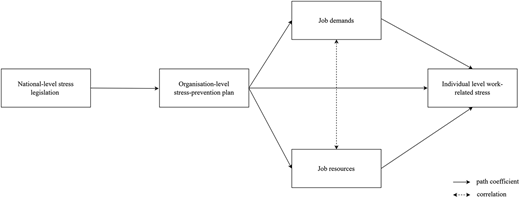
Although the JD-R model has limitations in unconventional work settings, including blurred boundaries between demands and resources and limited attention to macro-contextual factors (Schaufeli and Taris, 2014; Galanakis and Tsitouri, 2022), it remains a useful and widely adopted framework for linking institutional conditions, organizational practices, and individual stress outcomes (Delladio and Caputo, 2024). In this study, it provides the basis for examining how national legislation and organizational stress-prevention plans relate to employer-entrepreneurs’ job demands, job resources, and perceived stress. Figure 1 below represents our theoretical model.
2.1 National legislation on psychosocial risks
At the European level, psychosocial risks fall within the broader occupational health and safety framework established by Directive 89/391/EEC, but the extent of specific national legislation varies considerably across countries (Makarevičienė et al., 2023). Prior research shows that explicit psychosocial-risk legislation is associated with a greater likelihood that organizations adopt formal work-related stress-prevention plan (Jain et al., 2022). More recent evidence similarly suggests that organizations addressing psychosocial hazards in formal risk assessments are more likely to implement stress-prevention measures, especially in medium-sized firms (Beck et al., 2025). Comparative reviews also indicate that stronger and more specific legal obligations are associated with greater organizational planning and preventive activity, including in smaller firms and SME contexts (Cefaliello, 2022; Makarevičienė et al., 2023; Kuske et al., 2024). Therefore, we hypothesize that:
Having strong national-level stress legislation on psychosocial risks is positively related to the implementation of a stress-prevention plan at the company level.
2.2 Stress-prevention plans and psychosocial working conditions
A formal stress-prevention plan may help reduce employer-entrepreneurs’ stress by identifying psychosocial risks, establishing preventive routines, and promoting supportive work practices (Jain et al., 2022). Intervention research shows that structured mental-health or stress-management programs can reduce psychological distress among SME owner-managers and organizational leaders (Martin et al., 2020; Balint et al., 2022; Tsantila et al., 2024). Entrepreneurship research likewise suggests that formalized recovery, task-focused coping, and access to organizational resources are associated with lower strain and better well-being (Wach et al., 2020; St-Jean and Tremblay, 2023). From a JD-R perspective, stress-prevention plans should also shape psychosocial working conditions. By creating routines, structure, and support, such plans may reduce hindrance demands such as excessive workload, time pressure, and role ambiguity, while increasing resources such as support, control, and work organization (Schaufeli, 2017; Kiefl et al., 2024; Delladio and Caputo, 2024). Entrepreneurs who adopt more structured coping and planning practices may therefore experience lower demands and stronger resources, particularly in turbulent environments (Kiefl et al., 2024; St-Jean and Tremblay, 2023). Therefore, we hypothesize that:
The presence of a stress-prevention plan at the company level is positively related to lower reported work-related stress among employer-entrepreneurs.
The presence of a stress-prevention plan at the company level is negatively related to employer-entrepreneurs’ job demands.
The presence of a stress-prevention plan at the company level is positively related to employer-entrepreneurs’ job resources.
2.3 Job demands, job resources and entrepreneurial perceived stress
The JD-R model predicts that high job demands increase strain, whereas job resources reduce stress and buffer the negative effects of demands (Bakker and Demerouti, 2017). In entrepreneurial settings, demands such as uncertainty, workload, and role ambiguity are likely to elevate stress levels (Wincent et al., 2008; Sardeshmukh et al., 2020; Manchiraju et al., 2023). By contrast, resources such as autonomy, flexibility, and social support may help entrepreneurs manage pressure more effectively and protect well-being (Neneh, 2022; Resch and Steyaert, 2020; Obschonka et al., 2023). Therefore, we hypothesize that:
employer-entrepreneurs’ job demands are positively related to reported work-related stress.
employer-entrepreneurs’ job resources are negatively related to reported work-related stress.
2.4 The mediating role of job demands and resources
Within the JD-R framework, stress-prevention plans are unlikely to influence stress only through a direct pathway. Rather, their effects should operate indirectly by reducing job demands and strengthening job resources, which in turn shape perceived stress (Wach et al., 2020; Obschonka et al., 2023; Kiefl et al., 2024). Therefore, we hypothesize that:
3. Methodology
3.1 Data collection
This study follows the analytical approach of Jain et al. (2022) but applies it to employer-entrepreneurs rather than employees. Data were drawn from two European cross-national surveys that use multistage stratified random sampling. The first dataset is the second European Survey of Enterprises on New and Emerging Risks (ESENER-2), which collected establishment-level information in 2014 on health and safety practices and risk perceptions (EU-OSHA – European Agency for Safety and Health at Work, 2016). The survey covers public and private establishments with more than five employees and interviews the person most knowledgeable about health and safety in the establishment. From the original 49,320 establishments, we retained enterprises with at least 10 employees and excluded Iceland, which was not included in the second dataset we used, resulting in 35,765 cases. The second dataset is the sixth European Working Conditions Survey (EWCS), which provides individual-level information on employment conditions, work organization and worker health across Europe (Eurofound, 2017). Based on 43,850 face-to-face interviews conducted in 2015 across 35 countries, the EWCS was used here to identify self-employed respondents working in organizations with at least 10 employees. After these restrictions, the final analytical sample included 455 respondents (72.3% male; mean age = 45.7 years, SD = 11.6). These datasets were combined to examine how organizational psychosocial risk-management practices reported in ESENER-2 relate to employer-entrepreneurs’ psychosocial working conditions and perceived stress reported in the EWCS. We retained the same survey years and general design as Jain et al. (2022) to preserve comparability with the original framework. Table 1 presents the sample characteristics of both datasets used in our analysis.
Sample characteristics
| ESENER | EWCS | |||||||||
|---|---|---|---|---|---|---|---|---|---|---|
| Country | Total | Org. Size | Total | Org. Size | Sex (%) | Age | ||||
| 10–249 | 250+ | 10–249 | 250+ | Female | Male | Mean | SD | |||
| Albania | 371 | 353 | 18 | 1 | 1 | 0 | 100.0 | 0 | 49.0 | NA |
| Austria | 1,069 | 863 | 206 | 10 | 5 | 5 | 40.0 | 60.0 | 39.5 | 12.2 |
| Belgium | 1,206 | 1,063 | 143 | 29 | 25 | 4 | 37.9 | 62.1 | 47.4 | 13.0 |
| Bulgaria | 578 | 500 | 78 | 8 | 8 | 0 | 0 | 100.0 | 43.4 | 11.6 |
| Croatia | 555 | 482 | 73 | 5 | 4 | 1 | 60.0 | 40.0 | 40.4 | 8.7 |
| Cyprus | 560 | 536 | 24 | 8 | 6 | 2 | 25.0 | 75.0 | 43.9 | 16.6 |
| Czech Republic | 1,185 | 1,045 | 140 | 19 | 16 | 3 | 42.1 | 57.9 | 43.9 | 15.4 |
| Denmark | 1,168 | 1,002 | 166 | 7 | 6 | 1 | 28.6 | 71.4 | 43.0 | 5.9 |
| Estonia | 547 | 509 | 38 | 10 | 10 | 0 | 30.0 | 70.0 | 45.8 | 14.9 |
| Finland | 1,143 | 1,019 | 124 | 20 | 17 | 3 | 35.0 | 65.0 | 45.8 | 11.7 |
| France | 1,669 | 1,359 | 310 | 8 | 8 | 0 | 37.5 | 62.5 | 49.1 | 12.0 |
| Germany | 1754 | 1,324 | 430 | 9 | 9 | 0 | 22.2 | 77.8 | 42.9 | 8.6 |
| Greece | 991 | 925 | 66 | 34 | 25 | 9 | 29.4 | 70.6 | 50.6 | 12.8 |
| Hungary | 1,145 | 1,009 | 136 | 5 | 5 | 0 | 40.0 | 60.0 | 41.8 | 12.1 |
| Ireland | 597 | 501 | 96 | 7 | 6 | 1 | 28.6 | 71.4 | 49.1 | 10.2 |
| Italy | 1,656 | 1,422 | 234 | 16 | 13 | 3 | 18.8 | 81.3 | 53.4 | 10.3 |
| Latvia | 540 | 477 | 63 | 21 | 18 | 3 | 14.3 | 85.7 | 46.0 | 8.3 |
| Lithuania | 587 | 501 | 86 | 13 | 9 | 4 | 30.8 | 69.2 | 49.5 | 10.9 |
| Luxembourg | 554 | 502 | 52 | 4 | 4 | 0 | 25.0 | 75.0 | 46.8 | 12.7 |
| Malta | 395 | 355 | 40 | 16 | 16 | 0 | 31.3 | 68.8 | 45.0 | 11.7 |
| Montenegro | 247 | 242 | 5 | 9 | 8 | 1 | 0 | 100.0 | 45.9 | 9.6 |
| FYROM* | 505 | 464 | 41 | 3 | 2 | 1 | 0 | 100.0 | 45.0 | 7.0 |
| Netherlands | 1,131 | 927 | 204 | 14 | 13 | 1 | 28.6 | 71.4 | 48.4 | 7.6 |
| Norway | 1,301 | 1,233 | 68 | 12 | 10 | 2 | 25.0 | 75.0 | 47.2 | 9.3 |
| Poland | 1798 | 1,470 | 328 | 12 | 9 | 3 | 50.0 | 50.0 | 51.3 | 12.3 |
| Portugal | 1,062 | 918 | 144 | 10 | 10 | 0 | 20.0 | 80.0 | 51.3 | 11.2 |
| Romania | 590 | 481 | 109 | 7 | 7 | 0 | 14.3 | 85.7 | 44.4 | 11.6 |
| Serbia | 564 | 478 | 86 | 11 | 7 | 4 | 36.4 | 63.6 | 46.6 | 4.8 |
| Slovakia | 547 | 481 | 66 | 17 | 15 | 2 | 17.6 | 82.4 | 45.4 | 9.8 |
| Slovenia | 732 | 660 | 72 | 7 | 6 | 1 | 0 | 100.0 | 46.7 | 13.5 |
| Spain | 2,180 | 1931 | 249 | 35 | 27 | 8 | 34.3 | 65.7 | 45.8 | 8.4 |
| Sweden | 1,120 | 967 | 153 | 5 | 4 | 1 | 20.0 | 80.0 | 45.2 | 16.3 |
| Switzerland | 1,153 | 940 | 213 | 4 | 3 | 1 | 25.0 | 75.0 | 49.3 | 6.1 |
| Turkey | 1703 | 1,520 | 183 | 26 | 24 | 2 | 26.9 | 73.1 | 36.1 | 10.0 |
| UK | 2,862 | 2,522 | 340 | 33 | 21 | 12 | 18.2 | 81.8 | 40.6 | 13.0 |
Note(s): *Former Yugoslav Republic of Macedonia
3.2 Measures
National legislation was operationalized using the classification developed by Jain et al. (2022). Their review of the 35 countries included in the datasets (ESENER and EWCS), based on academic and grey literature, the ILO LEGOSH database, and Eurofound and EU-OSHA (2014) country profiles, identified 19 countries with specific legislation on psychosocial risks and/or work-related stress and 16 without such legislation (Table 2). Following their coding strategy, countries without specific legislation were coded 0 and those with explicit or indirect legal coverage were coded 100.
National-level legislation on psychosocial risk/work-related stress across European countries
| Country | National-level legislation |
|---|---|
| Albania | No |
| Austria | Yes |
| Belgium | Yes |
| Bulgaria | Yes |
| Croatia | Yes |
| Cyprus | No |
| Czech Republic | Yes |
| Denmark | Yes |
| Estonia | Yes |
| Finland | Yes |
| France | Yes |
| Germany | Yes |
| Greece | No |
| Hungary | Yes |
| Ireland | Yes* |
| Italy | Yes |
| Latvia | No |
| Lithuania | No |
| Luxembourg | No |
| Malta | No |
| Montenegro | No |
| FYROM* | No |
| Netherlands | Yes |
| Norway | Yes |
| Poland | No |
| Portugal | Yes |
| Romania | No |
| Serbia | No |
| Slovakia | No |
| Slovenia | No |
| Spain | No |
| Sweden | Yes |
| Switzerland | Yes |
| Turkey | No |
| UK | Yes* |
Note(s): Table from Jain et al. (2022), legislation as of December 2021 * indirect coverage in legal system
Stress-prevention plan. The presence of an organizational stress-prevention plan was measured with one ESENER-2 item asking whether the establishment had a plan to prevent work-related stress (EU-OSHA – European Agency for Safety and Health at Work, 2016). Responses were coded dichotomously, with 100 indicating the presence of a plan and 0 otherwise.
Individual-level job demands were derived from EWCS items covering four dimensions relevant to self-employment: quantitative demands, emotional demands, pace determinants, and working time arrangements (Eurofound, 2017, 2024; Horodnic and Williams, 2019). These dimensions were treated as indicators of a broader latent job-demands construct. All items were rescaled to range from 0 to 100, with higher values indicating higher demands.
Individual-level job resources were measured using EWCS indicators of social resources, job control and intrinsic job features, selected on the basis of prior work on self-employment and entrepreneurial working conditions (Eurofound, 2017, 2024). These indicators capture support from colleagues, discretion over work organization and intrinsic aspects of work such as usefulness, development and perceived reward. As with job demands, all items were rescaled from 0 to 100, with higher values indicating higher resources.
Individual-level work-related stress was measured from a single item taken from the sixth EWCS (Eurofound, 2017), specifically “how often do you experience stress in your work?”. This item was measured on a five-point scale ranging from “never” (0) to “always” (100), where higher scores indicate a higher level of stress.
3.3 Data analysis
Data analysis was conducted in R using standard packages for structural equation modelling, multilevel modelling and data handling (R Core Team, 2021; Rosseel, 2012; Bates et al., 2015; Wickham et al., 2019). All variables were harmonized to a common 0–100 metric to improve comparability across measures (Kline, 2016).
We first assessed the measurement structure of the job demands and job resources constructs using confirmatory factor analysis on the EWCS data. The model was estimated with the cat-ULSMV procedure and showed satisfactory fit (CFI = 0.97, TLI = 0.97, RMSEA = 0.04, SRMR = 0.06, χ2 = 109.4, df = 83, p = 0.028). Internal consistency was assessed using Cronbach's alpha and ordinal alpha, with ordinal alpha values ranging from 0.60 to 0.90, indicating acceptable to excellent reliability across the main constructs (De Los Ángeles Morata-Ramírez and Holgado-Tello, 2013; Zumbo et al., 2007).
Next, ESENER-2 data were aggregated at the country, sector and company-size level to construct a stress-prevention plan index. This index distinguished establishments with 10–249 employees from those with 250 or more employees and was then assigned to each EWCS respondent on the basis of country, industry and company size. The resulting merged dataset covered 35 countries: the 28 EU Member States plus Albania, FYROM, Montenegro, Norway, Serbia, Switzerland and Turkey.
We then estimated a path model within a structural equation modelling framework to test the relationships among national legislation, organizational stress-management practices, job demands, job resources and work-related stress. Because preliminary diagnostics indicated moderate non-normality for some variables, models were estimated using robust maximum likelihood with bias-corrected bootstrapping based on 1,000 replications and 95% confidence intervals (Lai, 2018). We also conducted multi-group comparisons between countries with and without specific psychosocial-risk legislation. It should be noted that the number of respondents per country in the analytical sample varies considerably. Several countries contribute only one or a very small number of cases, which limits the stability of country-level random effects and the precision of between-country variance estimates. Results from the multilevel models should therefore be interpreted with caution, particularly for countries with fewer than five observations, as random intercepts for such groups may be unreliable.
Finally, to assess residual between-country variation, we estimated two-level multilevel models with country as the grouping factor. We first estimated unconditional models and then added predictors to examine within- and between-country effects for stress, job demands, job resources and organizational stress-management practices. More fine-grained clustering was not feasible because of the limited number of cases per group.
4. Results
We present the results in the same order as the theoretical model, moving from macro-level institutional factors to organizational practices and then to individual-level psychosocial outcomes. We first examine whether national psychosocial-risk legislation is associated with the presence of stress-prevention plans and then assess whether these plans are related to employer-entrepreneurs’ job demands, job resources, and perceived stress. We subsequently report multigroup and multilevel analyses to evaluate whether these relationships differ across legislative contexts and to assess the robustness of the main findings.
Table 3 reports the correlations among the study variables, while Table 4 reports the intraclass correlation coefficients and Table 5 the standardized fixed effects from multilevel models. The structural model shown in Figure 2 provided a weak-to-acceptable fit to the data, , ; CFI = 0.78; TLI = 0.28; RMSEA = 0.11, 90% CI [0.06, 0.18]; SRMR = 0.05. The low TLI (0.28) and sub-optimal CFI (0.78) indicate that the structural specification fits the observed covariance structure only partially. This likely reflects the limited number of observed indicators per latent construct and the small overall sample size (N = 455 across 35 countries), which can inflate chi-square-based penalties and reduce incremental fit indices. Given these constraints, the path estimates and their significance levels should be interpreted with appropriate caution, and the model is best treated as an exploratory representation of the proposed relationships rather than a definitively confirmed structural solution.
Correlation matrix
| 1 | 2 | 3 | 4 | |
|---|---|---|---|---|
| 1. Stress legislation | ||||
| 2. Action plans | 0.206*** | |||
| 3. Stress | 0.025 | 0.052 | ||
| 4. Demands | −0.204*** | −0.012 | 0.331*** | |
| 5. Resources | 0.005 | −0.037 | −0.137* | −0.066 |
Note(s): *p ≤ 0.05; ***p ≤ 0.001
Intraclass correlation coefficients – null model
| Outcome | Var(country) | Var(residual) | ICC | Interpretation |
|---|---|---|---|---|
| Work-related stress | 0.008 | 0.990 | 0.008 | Negligible between-country variance |
| Job demands | 0.068 | 0.928 | 0.069 | Small between-country variance |
| Job resources | 0.062 | 0.938 | 0.062 | Small between-country variance |
| Action plans | 0.485 | 0.502 | 0.491 | High between-country variance |
Standardized fixed effects from multilevel models
| Outcome | Predictor | β (std.) | p |
|---|---|---|---|
| Work-related stress | Job demands | 0.287 | <0.001*** |
| Job resources | −0.120 | 0.034* | |
| Action plans × Law | 0.070 | 0.200 | |
| Job demands | Action plans × Law | 0.012 | 0.839 |
| Job resources | Action plans × Law | 0.016 | 0.793 |
| Action plans | National stress law | 0.181 | 0.127 |
Note(s): *p ≤ 0.05; ***p ≤ 0.001
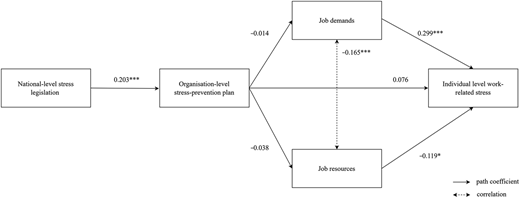
Standardized coefficients for the proposed model. Note: ***p < 0.001, *p < 0.05. Authors' own work
Standardized coefficients for the proposed model. Note: ***p < 0.001, *p < 0.05. Authors' own work
As hypothesized, national-level stress legislation significantly predicted the likelihood that organizations reported a stress-prevention plan (, 95% CI [0.10, 0.30], ), supporting H1. By contrast, stress-prevention plans showed no significant association with job demands (, n.s.) or job resources (, n.s.); therefore, H3 and H4 were not supported.
At the individual level, perceived work-related stress was positively associated with job demands (, 95% CI [0.18, 0.41], ), supporting H5, and negatively associated with job resources (, 95% CI [−0.23, −0.01], ), supporting H6. Stress-prevention plans did not have a significant direct effect on work-related stress (, n.s.), providing no support for H2. The covariance between job demands and job resources was weak and negative (, n.s.). The model explained 11.4% of the variance in work-related stress (), whereas the explained variance for job demands, job resources, and stress-prevention plans was limited (, , and , respectively).
A multigroup analysis was then conducted to examine whether the structural paths differed between countries with and without national-level stress legislation (Figure 3). In countries without stress legislation, work-related stress was positively predicted by job demands (; ), whereas job resources (, n.s.) and stress-prevention plans (, n.s.) were not significantly related to stress. The correlation between job demands and job resources in this group was negligible (, n.s.).
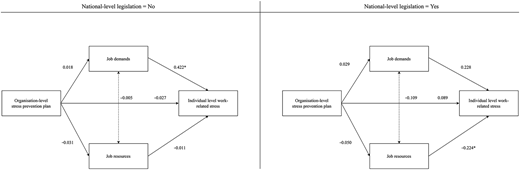
Standardized coefficients for each country group. Note: *p < 0.05. Authors' own work
Standardized coefficients for each country group. Note: *p < 0.05. Authors' own work
In countries with national-level stress legislation, work-related stress was positively associated with job demands (; ) and negatively associated with job resources (; ). Stress-prevention plans showed no significant relationship with job demands (, n.s.) or job resources (, n.s.). The correlation between job demands and job resources was again negative but non-significant (, n.s.). Overall, job demands emerged as the most consistent predictor of stress across both groups, whereas the negative association between job resources and stress was evident only in countries with national stress legislation.
To assess between-group differences more formally, we compared a freely estimated multigroup model with a constrained model in which intercepts and regression paths were held equal across groups. The constrained model fits significantly worse than the reference model (; ), indicating meaningful cross-group variation. Wald tests showed that the relationship between company size and work-related stress did not differ significantly across groups (; ). The difference in the job demands-stress path approached significance (; ), whereas the job resources-stress path differed significantly between groups (; ). These results indicate that the negative association between job resources and stress was stronger in countries with stress-related legislation.
As a robustness check, we repeated the multigroup analysis using only countries with at least five observations. The constrained-versus-intercepts-only comparison approached conventional significance (; ), and the pattern of Wald tests remained substantively similar. We then estimated two-level linear mixed models with random intercepts for country. In the unconditional models, country-level variance was negligible for stress (ICC ; LRT n.s.), modest for job demands (ICC ; LRT ) and job resources (ICC ; LRT ), and substantial for stress-prevention plans (ICC ; LRT ), indicating pronounced between-country heterogeneity in the prevalence of stress-prevention plans. Several countries in the sample contributed only one or a handful of observations (see Table 2), which may reduce the stability of country-level random intercept estimates.
In the predictor models, the multilevel results broadly reproduced the SEM findings. For stress, job demands were positively associated with stress and job resources were negatively associated with stress (both standardized; demands ; resources ). The interaction between stress-prevention plans and legislation was small and non-significant in the stress model and close to zero in the job demands and job resources models. In the model predicting stress-prevention plans, national stress legislation had a positive but non-significant coefficient (; ), while the country-level random intercept remained substantial (ICC ), again indicating marked cross-country variation in organizational stress-management practices.
Several multilevel models produced boundary or singularity warnings, suggesting that some random-effect variances were estimated close to zero. These warnings call for caution in interpreting the random-effect magnitudes. Accordingly, the substantive interpretation focuses on the converged models and on fixed effects that were stable across specifications.
5. Discussion
This study examined whether national psychosocial risk legislation is associated with the adoption of organizational stress-prevention plans and, in turn, with employer-entrepreneurs’ psychosocial working conditions and perceived stress. The findings provide partial support for the proposed model. National legislation was positively associated with the presence of formal stress-prevention plans, but these plans were not directly associated with lower job demands, higher job resources, or lower perceived stress among employer-entrepreneurs. Instead, perceived stress was primarily associated with the balance between job demands and job resources, in line with the Job Demands-Resources (JD-R) model (Bakker and Demerouti, 2017; Obschonka et al., 2023; Tena et al., 2022). This pattern suggests that legislation operates mainly as a distal institutional resource, as it shapes the broader regulatory environment and encourages formal organizational responses, whereas stress is more directly associated with proximal job-level conditions embedded in everyday work.
The positive association between national legislation and organizational stress-prevention plans is consistent with prior evidence showing that clearer psychosocial risk regulation encourages preventive organizational action (Jain et al., 2022; Beck et al., 2025; Cefaliello, 2022; Makarevičienė et al., 2023). At the same time, the absence of significant links between stress-prevention plans and employer-entrepreneurs’ demands, resources, or stress suggests that formal planning alone is insufficient to improve psychosocial conditions in entrepreneurial settings. This contrast with Jain et al. (2022) may reflect differences between employee and entrepreneurial contexts, especially in small or founder-led firms where formal policies may be adopted without producing substantial changes in day-to-day work organization. In other words, legislation may create enabling conditions for prevention, but it does not in itself constitute immediate support that employer-entrepreneurs experience in their daily work. This interpretation is also in line with the ambivalent role of entrepreneurial autonomy discussed in the theoretical framework: because employer-entrepreneurs often combine high job control with self-imposed work demands, distal regulatory support may be less likely to translate directly into the proximal conditions that shape stress in everyday work. Its effects are therefore likely to depend on whether it is translated into concrete organizational arrangements that alter workload, control, support, and other psychosocial conditions.
One plausible explanation is that many stress-prevention plans remain oriented toward secondary or tertiary interventions, such as awareness raising, training, or support, rather than primary interventions that redesign work and reduce stressors at their source (Jain et al., 2022). In entrepreneurial settings, such plans may therefore increase attention to stress without materially reducing workload, uncertainty, or role overload. Indeed, responses to pressure may depend partly on internal motivational resources, including passion and self-confidence, rather than on formalized structures alone (Boussema, 2025). This interpretation is consistent with evidence showing that structured recovery routines and targeted coping practices are more effective than generic support measures in reducing entrepreneurial strain (Wach et al., 2020; Martin et al., 2020; Balint et al., 2022). Accordingly, the weak association between formal plans and stress outcomes may reflect a gap between distal regulatory support and the proximal work conditions that more directly determine whether strain is reduced in practice.
A second explanation concerns the distinctive nature of entrepreneurial work. Entrepreneurs typically operate under high demands while also drawing on high intrinsic resources, such as autonomy, flexibility and meaning (Boussema, 2025; Obschonka et al., 2023; Otto et al., 2020). This combination may reduce the observable impact of formal organizational plans, especially when entrepreneurs have limited time, financial slack, or personnel to implement substantial changes in work design. In this sense, the present findings reinforce the view that employer-entrepreneurs’ well-being is shaped by a more complex configuration of personal, organizational and contextual factors than is often assumed in employee-based models (Stephan, 2018; Obschonka et al., 2023).
The multigroup findings further suggest that institutional context matters for how resources operate. In countries without specific psychosocial risk legislation, job resources were not significantly associated with lower stress, whereas in countries with such legislation, resources showed a clear negative relationship with stress. This pattern indicates that legislation may not reduce stress directly but may create conditions in which psychosocial resources become more effective. This interpretation is consistent with recent work showing that regulatory pressure and perceived utility can jointly encourage more substantive stress-management routines among SME owners (Kuske et al., 2024).
Theoretically, these findings make two main contributions. First, they extend JD-R research to entrepreneurship by showing that the core demand-strain and resource-buffering relationships remain relevant, but that the protective role of resources appears contingent on institutional context (Bakker and Demerouti, 2007; Schaufeli and Taris, 2014). More specifically, the findings suggest that in entrepreneurial settings the JD-R model should be read with greater attention to the distinction between distal and proximal forms of support: national legislation may shape the broader institutional context for psychosocial risk prevention, but stress remains more directly associated with proximal job demands and job resources experienced in everyday work. Second, they contribute to institutional perspectives on entrepreneurial well-being by showing that formal regulation can stimulate organizational action while still falling short of improving employer-entrepreneurs’ work conditions unless it is translated into substantive practice (Stephan et al., 2022; Fritsch et al., 2019; Wolfe and Patel, 2018; Yu et al., 2023). In this sense, the study contributes by showing that distal institutional resources do not automatically become proximal psychosocial resources: formal compliance may increase, while the day-to-day experience of work remains largely unchanged. In that sense, the results also point to a degree of decoupling between formal compliance and practical implementation, particularly in smaller firms (Meyer and Rowan, 1977).
For practice and policy, the findings suggest that regulation remains important, but it should be accompanied by practical support tailored to entrepreneurs and SMEs. Legal requirements may encourage the adoption of formal plans, yet these plans are unlikely to affect stress unless they support primary prevention through workload management, task redesign, recovery opportunities, and usable forms of social or advisory support. A more effective approach would therefore combine clear psychosocial risk regulation with accessible tools, guidance, and support mechanisms that help entrepreneurs implement meaningful changes rather than merely formal compliance. From this perspective, the policy challenge is not only to provide distal regulatory protection, but also to ensure that such protection is converted into proximal forms of support that reshape everyday work.
This study also has several limitations that point to future research. First, the data are cross-sectional, so the proposed relationships cannot be interpreted causally with certainty. Longitudinal studies are needed to examine whether legislation and organizational practices shape entrepreneurial stress over time. Second, the measure of stress-prevention plans captures their presence rather than their quality, content, or implementation depth. Future research should distinguish between symbolic plans and plans that actively change work design. Third, the sample is limited to self-employed respondents in organizations with at least 10 employees, which excludes many micro-businesses and solo entrepreneurs. Since these groups may face even greater resource constraints, future studies should test whether the same patterns hold in smaller ventures. Finally, the multilevel analyses showed some estimation instability and the study did not include other potentially relevant national conditions, such as entrepreneurial culture, economic development, or informal support systems. Furthermore, the limited number of respondents per country – with some countries contributing only one or two observations – reduces the reliability of country-level variance estimates in the multilevel models and constrains the generalizability of cross-national comparisons. Further research should therefore use larger country samples and broader institutional indicators to clarify when regulation translates into meaningful improvements in entrepreneurial well-being.
6. Conclusion
This study shows that national psychosocial risk legislation is associated with a greater likelihood of formal stress-prevention plans, but not with direct improvements in employer-entrepreneurs’ job demands, job resources, or stress. Reducing employer-entrepreneurs’ stress appears to depend less on formal plans alone than on whether work demands are reduced and usable resources are strengthened in practice.

