Workgroups are increasingly becoming more diverse. This study investigates the multilevel process and outcomes of age diversity via information-elaboration theory and social exchange theory.
Data were collected from employees and their immediate supervisors through time-lagged surveys at two banks in Pakistan. Seventy-eight groups comprising 305 group members participated in both surveys, with 78 group leaders participating in the second survey.
Multilevel analyses in Mplus indicate that objective age diversity has a positive association with well-being and perceived age diversity has a positive relationship with group performance at the group level, whereas, at the individual level, perceived age diversity is found to reduce social integration which in turn enhances employee turnover intention.
Despite multiple methodological strengths, the research is limited by geographical context and is only focused on age diversity. Several contextual variables and mediating processes were also not included in the study due to time and resource constraints.
This research highlights the need for multilevel evaluation of objective and perceived age diversity. A clear articulation of the perceptions of individuals regarding age diversity at multiple levels can help understand ongoing processes within the group and achieve high levels of group performance and employees’ well-being. Organizations can focus on training efforts to capitalize on the benefits of perceived age diversity while weakening some negative effects at the individual level. This study provides a business case for employing older members of our society which can help address their high unemployment.
This study contributes to the literature by studying objective and perceived age diversity through the lens of information-elaboration theory, pioneeringly theorizing and testing social integration as the process of perceived age diversity and providing empirical support for the multilevel influence of perceived age diversity.
Introduction
Increasing workplace age diversity is a challenge facing organizations in several countries (Burke et al., 2013; Petery et al., 2019; Phillips and Siu, 2012). The drivers of workplace age diversity include aging society and decline in the working age population, shortages of skilled labor and changes in fertility and mortality rates (Schlick et al., 2013). As organizations are increasingly relying on workgroups, high organizational age diversity is reflected in high workgroup age diversity (Blustein, 2013). Diversity is termed as a double-edged sword with possible positive and negative effects on processes and outcomes (e.g. Joshi and Roh, 2009; Liebermann et al., 2013; Ries et al., 2013; Wegge and Meyer, 2020; Wegge and Schmidt, 2009). Unmanaged or poorly managed workgroup age diversity can be detrimental to individual and group performance, leading to poor organizational performance (Mahdi Abaker et al., 2023).
At the workgroup level, objective age diversity refers to group age composition measured at the group level (Shemla et al., 2016; Shrivastava and Gregory, 2009), while perceived age diversity is group members’ perceptions of similarities or dissimilarities (Huang and Iun, 2006). Shemla et al. (2016) outlined three ways perceived diversity has been conceptualized: perception of self-to-team dissimilarity, perceptions of subgroup splits and perceptions of team heterogeneity. Perception of self-to-team dissimilarity refers to how individual team members view their differences in relation to their group. Perceptions of subgroup splits refer to how team members view their team as divided into subgroups which is closely associated with faultlines theory. Faultlines refer to hypothetical dividing lines within a workgroup that separate the group members in subgroups based on one or more characteristics (Lau and Murnighan, 1998). Perceptions of team heterogeneity refer to the extent to which team members view their team as made up of individuals who differ from one another based on specific attributes. Our study focuses on this third type as it involves measuring perceived age differences (see Ries et al., 2013; Williams et al., 2007 for measurement of perceived age diversity).
Both objective age diversity and perceived age diversity can impact group processes and outcomes (Goldberg et al., 2010; Riordan, 2000). However, perceptions are a stronger predictor of processes and outcomes than objective realities (Riordan, 2000). Despite the importance of perceptions, the extant workgroup age diversity literature mainly focused on objective age diversity (e.g. Schippers et al., 2003; Seong and Hong, 2018). The few multilevel studies considering individual and group levels also examined objective age diversity (e.g. Choi and Rainey, 2010; Sacco and Schmitt, 2005), with the exception of only one study by Liebermann et al. (2013). Thus, we know little about how objective and perceived age diversity simultaneously affect group processes and outcomes.
The extant age diversity literature uses the lenses of social identity theory and social categorization theory (e.g. Curşeu, 2013; Jungmann et al., 2020; Kirkman et al., 2004; Xu et al., 2022), highlighting the associated negative processes and outcomes. Thus, little is known about positive processes and outcome of group age diversity through the lens of information-elaboration theory (Mannix and Neale, 2005; Williams and O'Reilly, 1998). Only one multilevel study focused on cooperative norms and perceptions of cooperative norms as processes in the objective age diversity-performance relationship (Chatman and Flynn, 2001). Moreover, various moderating variables have also been studied (e.g. Hans et al., 2023; Jungmann et al., 2020; Kearney and Gebert, 2009). For example, age diversity has positive effect on group performance when complex decision-making tasks are involved, while age diversity has negative effects on self-reported health when routine tasks are involved (Wegge et al., 2008). However, only few studies have investigated how age diversity impacts outcomes via mediating variables. For instance, Schippers et al. (2003) analyzed the interaction effect of objective age diversity and outcome interdependence on team outcomes (satisfaction and performance), mediated by reflexivity. Thus, managers know little about the processes through which group age diversity affects outcomes.
The noted complications are of concern because of the following reasons. First, managers who only ensure objective group diversity may undermine perceived age diversity and its effects on processes and outcomes (Wegge and Meyer, 2020). In the absence of research evidence for possible differential effects of objective and perceived age diversity, the monitoring of age diversity’s effects on processes and outcomes may become ineffective (Wegge and Meyer, 2020). This is further exacerbated due to the little knowledge of the processes through which age diversity produces group and individual outcomes. Second, viewing age diversity mainly through the lenses of social identity theory and social categorization theory (e.g. Kirkman et al., 2004; Seong and Hong, 2018) undermines the business case for managing age diversity, possibly leading to a lack of commitment from the top management team (Kunze et al., 2011). Lehmann-Willenbrock et al. (2012) state that the appreciation of age diversity requires group members to view each other beyond the prevailing categorization processes. Third, individuals are nested in groups which makes it important to study the processes and outcomes of objective and perceived age diversity at multiple levels simultaneously (Jansen and Searle, 2021). A narrow focus on one level would inflate or understate such effects, reflected in calls for multilevel studies.
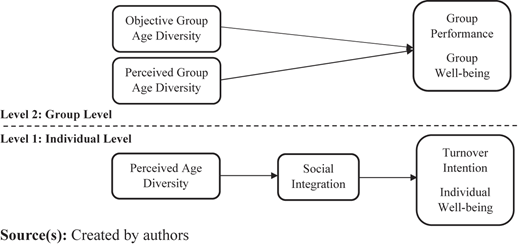
This research addresses those concerns and thus contributes to objective and perceived age diversity scholarship. First, the study investigates objective and perceived age diversity through the lenses of information-elaboration theory (Mannix and Neale, 2005; Williams and O'Reilly, 1998) and social exchange theory (Blau, 1964; Homans, 1958). In particular, it is important to consider a range of diversified life, work and organizational experiences brought in by diversified age group members (Kunze et al., 2011), providing information and efficiency when dealing with the tasks at hand (Kearney et al., 2009). Second, it pioneers in theorizing and testing the mediating variable of social integration (Harrison et al., 2002). Social integration is the degree to which individuals within the group are attracted to the group, feel satisfied with each other, socially interact and are psychologically linked (Katz and Kahn, 1978; Polzer et al., 2002). Third, as individuals are nested in groups (Peccei and Van De Voorde, 2019), this study investigates the multilevel influence of age diversity. At the group level, objective age diversity and perceived age diversity are proposed to enhance group performance and well-being, providing resources to deal with task-relevant perspectives and efficiency in problem-solving (see Figure 1). At the individual level, perceived age diversity is proposed to enhance social integration among workgroup members which reduces employees’ turnover intention (see Figure 1). This study focuses on two renowned and established banks of Pakistan, where age diversity is an important phenomenon (Idrees et al., 2013).
The following section presents theoretical underpinnings and hypotheses, followed by a noting of the methods used to collect data and the findings of the multilevel study. Finally, the discussion section contextualizes the results and notes theoretical and research contributions, practical implications, limitations and future research and conclusion.
Theoretical underpinnings and hypotheses
Theoretical lenses
We draw on information-elaboration theory (Mannix and Neale, 2005; Williams and O'Reilly, 1998) and social exchange theory (Blau, 1964; Homans, 1958) to derive our hypotheses (Mansoor et al., 2020).
Information-elaboration theory
Information-elaboration theory suggests that diversity enhances performance through a set of positive processes (Van Knippenberg et al., 2004). It proposes a mechanism that allows diverse group members to engage in sharing unique knowledge and perspectives (Harvey, 2015). Information-elaboration theory states that group composition can have positive outcomes because of the increased abilities, knowledge, skills, experiences and information of diverse group members (Ancona and Caldwell, 1992; Mannix and Neale, 2005; Tziner and Eden, 1985; Winquist and Larson, 1998). The multiple perspectives and expertise can make the demographically diverse group more effective. Thus, information-elaboration theory focuses on the benefits that diversity brings to the group. Diverse group members immerse in mutual problem-solving, experience intellectual conflict and respond with unique insights by improving their elementary assumptions (Mannix and Neale, 2005), eventually enhancing the group’s problem-solving abilities, climate and performance (Perret-Clermont et al., 1991).
Social exchange theory
Social exchange theory suggests that employees reciprocate behaviours and attitudes (Blau, 1964; Homans, 1958). The favorable behaviour of one employee towards another obliges him/her to return it in the form of good conduct under the norm of reciprocity (Gouldner, 1960). This can be characterized as the interactions aroused because of actions initiated by group members who develop a sense of obligation to return such gestures of goodwill in order to balance the exchange (Cropanzano and Mitchell, 2005). Homans (1958) identified social and economic aspects of the exchange, whereas Blau (1964) emphasized the importance of the social element in this exchange process. To the extent that group members apply the reciprocity norm in their dealings and relationships, favorable conduct by any group member will be reciprocated, leading to beneficial outcomes (Rhoades and Eisenberger, 2002).
Hypotheses development
Objective/perceived age diversity and outcomes
Based on information-elaboration theory, the present study proposes that objective age diversity and perceived age diversity can enhance group performance and well-being. The primary source underlying the positive effects of age diversity is the elaboration of task-relevant information that involves expression, discussion, knowledge, integration of ideas and perspectives relevant to the team’s tasks (Van Knippenberg et al., 2004). Age-diverse groups have access to group members with accumulated diverse life, work and organizational experiences (Kunze et al., 2011), providing extra information and alternatives when dealing with task-relevant perspectives and efficiency in problem-solving (Kearney et al., 2009). The sharing and integration of divergent viewpoints and knowledge would lead to more critical discussions regarding task accomplishment, thus stimulating problem-solving (De Dreu, 2006), and eventually enhancing group performance at both the group and individual levels. These positive processes associated with information-elaboration, such as increased communication and discussion, may enhance work environment and reduce stress, improving employee well-being (Lehmann-Willenbrock et al., 2012).
Age diversity literature provides empirical evidence for a positive relationship between objective age diversity and group performance (e.g. Kearney et al., 2009; Seong and Hong, 2018). For example, age diversity is reported to have a positive effect on the elaboration of task-relevant information when the need for cognition is high (Kearney et al., 2009), and with group performance where complex decision-making tasks are involved (Wegge et al., 2008). Some evidence is also available from past empirical research for the relationship of perceived age diversity with group performance and well-being. For instance, Scheuer and Loughlin (2019) reported a positive relationship between perceived age diversity and group performance in the presence of status congruity and cognition-based trust. Similarly, Lehmann-Willenbrock et al. (2012) found a positive association of age diversity appreciation and well-being among nurses. Thus, we hypothesize:
Objective age diversity is positively related to group performance.
Perceived age diversity is positively related to group performance.
Objective age diversity is positively related to group well-being.
Perceived age diversity is positively related to group well-being.
Perceived age diversity and social integration
Drawing on information-elaboration theory, we argue that perceived age diversity can enhance social integration at the individual level through the exchange of task-related information (Harrison et al., 2002; Jehn et al., 1999; Van Knippenberg et al., 2004). As the extensive knowledge, skills, abilities, experiences and vision of diversified group members help them to overcome the categorization effects (Fay et al., 2006), they start to look at each other with respect and as a source of guidance to perform tasks (Roberts and O'Reilly , 1979). This allows them to develop a sense of belonging and attraction towards each other. Age-diverse groups eventually improve their communication over time, including exchanging task-related information, as group members tend to learn more about each other which leads to enhanced social integration (Harrison et al., 2002). Team-rewards, supportive supervision and inclusive climate can help strengthen information-elaboration processes for improved integration (Antino et al., 2013).
The relationship between perceived age diversity and social integration has not been studied. To our knowledge, only one study reported no effect of perceived age diversity on workgroup cohesiveness which is a dimension of social integration (Goldberg et al., 2010; Gully et al., 1995). However, the benefits of enhanced communication and the elaboration of task-relevant information have been studied repeatedly in the objective age diversity literature (e.g. Kearney and Gebert, 2009; Kearney et al., 2009). Thus, we hypothesize:
Perceived age diversity is positively associated with social integration.
Social integration and outcomes
Based on social exchange theory (Blau, 1964), the present study argues that enhanced social integration among group members will increase employee well-being and reduce turnover intention. Social integration has been generally conceptualized as a function of attachment, satisfaction and quality of social relations within the given group (e.g. Harrison et al., 1998; Harrison et al., 2002; O'Reilly et al., 1989). In this paper, we focus on the quality of social relations with other group members, referring to employees’ perceptions of the status of their social relations (Asendorpf and Wilpers, 1998). Mossholder et al. (2005) argue that high-quality relations (social integration) with other actors enhance the likelihood that an employee will remain with the organization/group. This is consistent with the reciprocity norm explained through social exchange theory (Blau, 1964). The enhanced social integration creates feelings of loyalty, comfort, obligation and care towards other group members (e.g. Mathieu and Zajac, 1990; Meyer and Allen, 1997; Mowday et al., 1982), which may lead to reduced turnover intention and enhanced well-being.
Empirical research supports the argument that social integration is positively associated with employee well-being and negatively associated with turnover intention. For instance, cohesion (a primary dimension of social integration: Gully et al., 1995) is frequently reported to be associated with employees’ intentions to stay or leave (e.g. Griffeth et al., 2000; Krackhardt and Porter, 1986; Piper et al., 1983). Social integration helps overcome the detrimental effects of differences among group members (Nwobia and Aljohani, 2017), thus helping employees develop better relations, interactions and communication that enhances their well-being and reduces turnover intentions (O'Reilly and Bothfeld, 2002). Thus, we hypothesize:
Social integration is negatively associated with an individual’s turnover intention.
Social integration is positively associated with individual’s well-being.
Perceived age diversity, social integration and outcomes
Integrating information-elaboration theory with social exchange theory, we propose that social integration will mediate the relationships between perceived age diversity and turnover intention/individuals’ well-being. Past empirical research has not tested this relationship. However, some empirical research supports the argument that age diversity enhances team outcomes. For example, Sacco and Schmitt (2005) reported that the negative effect of objective age diversity on turnover fades or reverses over time (Sacco and Schmitt, 2005). Thus, we hypothesize:
Social integration mediates the negative relationship between perceived age diversity and individual’s turnover intention.
Social integration mediates the positive relationship between perceived age diversity and individual’s well-being.
Method
A three-month time-lagged research design was adopted for data collection, involving two rounds of employee survey and one round of leader survey at two banks in Pakistan.
Research setting and procedures
Workgroups in Pakistan’s banking industry were considered the population of this research. Each bank branch, undergoing frequent daily interactions, was regarded as one group. We approached the central human resource departments of five large banks; only two banks agreed to participate.
At Time 1 (January 2019), a package containing an invitation letter, consent form, ethics approval letter, return envelope, research information sheet and survey was sent to 250 bank groups (branches) comprising 1,250 employees. Later, two reminder calls (one at two weeks and the other at four weeks after the initial survey) were made to the branch managers. Three-hundred-and-fifty employees from 85 groups returned completed surveys. Respondents reported on their age, organizational and branch tenure, nature of contract, gender, perceived age diversity and social integration. At Time 2 (April 2019), a second employee survey with a return envelope was sent to 350 employees who participated in the first round and a separate survey was sent to the branch managers of 85 participating branches/groups. Group members reported on turnover intention, whereas group leaders (branch managers) reported on group performance. Data on date of birth, gender, marital status and branch name were used to match survey respondents from both rounds.
After eliminating surveys with incomplete and missing responses, and those with less than three group members (average group size of participating groups was 4), the final matched sample comprised 78 groups with 305 group members. The response rate was 31.2%. The average group size of four employees was consistent with past literature (e.g. Farh and Chen, 2014; Mawritz et al., 2014; Priesemuth et al., 2014). The mean age was 34 years (standard deviation 7.12), whereas the mean organizational and branch tenures were 6.6 years and 2.3 years, respectively. Overall, 84.4% of the respondents were employed in continuing roles, while 15.2% had temporary contracts. A total of 195 respondents were male (63.5%), whereas 112 were female (36.5%).
Self-report data can involve common method bias (Podsakoff et al., 2003). Therefore, four corrective measures were taken for this study: (1) a time-lagged research design was used where independent and dependent variables were temporally separated; (2) data were collected from two sources, namely branch managers (group leader) and branch employees (group members); (3) respondents were assured of anonymity of data as the surveys did not contain any identifiable information (e.g. names) and (4) confidentiality of data was established by providing return envelops to each respondent (Podsakoff et al., 2003). Furthermore, Herman’s single factor test was performed, where the total variance explained was only 21.4% (less than 50% is acceptable), ensuring the absence of variance attributed to the measurement method (Podsakoff et al., 2003).
Measures – time 1
Independent variables
Objective age diversity – Age was self-reported by respondents in both surveys at Time 1 and Time 2. Age diversity for each workgroup was assessed by calculating the standard deviation of group member’s age, following the prior studies (e.g. Gerpott et al., 2021; Wu and Konrad, 2023).
Perceived age diversity was measured via the one-item scale adapted from Harrison et al. (1998). The item was “In your opinion, how diverse is your group with respect to their age?” Answers were recorded on a five-point Likert scale from 1 (very similar) to 5 (very diverse). The employees’ individually perceived age diversity variable was used to test effects on individual turnover intention and individual well-being. To measure effects on group performance and group well-being, data on perceived age diversity were aggregated at the group level. Before aggregating, we calculated interrater agreement (rwg) scores (James et al., 1984). The rwg score for perceived age diversity was 0.90, within the cut-off value specified by scholars (James et al., 1984), indicating high appropriateness of aggregation for the construct (Glick, 1985; LeBreton and Senter, 2008).
Mediating variable
Social integration was measured using Seashore’s (1954) four-item scale, with a reported reliability of 0.91. A sample item is “How willing are they to help each other?” Respondents used a five-point Likert scale of 1 (not very good) to 5 (great, couldn’t be better), α = 0.80. The ICC(1) is 0.776 whereas ICC(2) is 0.790, showing good reliability (Glick, 1985; James et al., 1984; LeBreton and Senter, 2008).
Measures – time 2
Outcomes
Data on outcome variables were collected at Time 2, three months after the first round of data collection. Group performance was measured using Liden et al.'s (2006) five performance dimensions: quality of work, quantity of work, overall group performance, completing work on time and responding quickly to problems. Group leaders were asked to rate their group’s performance on these dimensions on a five-point Likert scale from 1 (much worse) to 5 (much better). The reported reliability of the scale ranges from 0.78 to 0.94. For the current study, the Cronbach’s alpha value is 0.70, which is within the accepted range stated by Nunnally (1994). The ICC(1) and ICC(2) values for the construct are 0.588 and 0.602 respectively, representing reliability (Glick, 1985; James et al., 1984; LeBreton and Senter, 2008).
Turnover intention was measured using individual employees’ responses on a three-item scale developed by Sparr and Sonnentag (2008), with a reported reliability of 0.89. A sample item from the scale is “I often think of quitting this work team.” Group members rated each item on a five-point Likert scale from 1 (very unlikely) to 5 (very likely). The alpha coefficient for this study is 0.84. The ICC(1) and ICC(2) values for the construct are 0.787 and 0.788 respectively, showing good reliability (Glick, 1985; James et al., 1984; LeBreton and Senter, 2008).
Well-being of employees was evaluated through Rosenberg’s (1965) 10-item self-esteem scale, with a reliability of 0.77–0.88 for different samples (see Blascovich and Tomaka, 1991; Rosenberg, 1986). A sample item from the scale is “I feel that I have several good qualities.” The alpha coefficient for this scale is 0.73. For an aggregation of the construct at the group level, the rwg, ICC(1) and ICC(2) values were calculated. The rwg value was 0.90, ICC(1) was 0.713 and ICC(2) was 0.718, indicating an adequate fit to justify aggregation of the construct (Glick, 1985; James et al., 1984; LeBreton and Senter, 2008).
Controls
The study controlled for perceived gender diversity, perceived ethnic diversity, organizational and branch tenure (coded as a continuous variables) and nature of the contract. They are found to be interrelated with age diversity, employee perceptions and performance (e.g. Boehm et al., 2014; Huckman et al., 2009). Perceived gender diversity and perceived ethnic diversity were each measured via a one-item scale developed by Harrison et al. (1998). The items were “In your opinion, how different is your group with respect to their gender?” and “In your opinion, how different is your group with respect to their ethnicity?” respectively.
Analytic strategy
The hypothesized theoretical model has a two-level design: employees (level 1) and groups (level 2). The variance of level-1 variables has been decomposed into within-level and between-level components to allow for the simultaneous modelling at both levels. The study analyzed the model in Mplus version 8 (Muthén and Muthén, 1998–2017). The steps suggested by Preacher et al. (2010) were followed to analyze the complete model in one syntax. The model simultaneously estimated: (1) the within-level relationship between perceived age diversity and turnover intention, mediated by social integration; (2) the within-level relationship of perceived age diversity and individuals’ well-being, mediated by social integration; (3) the relationship of objective age diversity/perceived age diversity and group performance and (4) the relationship of objective age diversity/perceived age diversity and group well-being. Furthermore, the random intercepts and fixed slopes were specified because there were no cross-level moderation effects.
Results
Preliminary analysis
Table 1 presents means, standard deviations and correlations. Consistent with prior multilevel literature (e.g. Farh and Chen, 2014; Khan, 2021; Mawritz et al., 2014), all individual- and group-level variables are presented simultaneously in one correlation matrix.
Validity of the constructs
Discriminant and convergent validity of the constructs was ensured through confirmatory factor analysis using Mplus version 8 (Muthén and Muthén, 1998–2017). All items loaded on their respective latent variable and tested using maximum likelihood estimation. To confirm, a three-factor model was tested by loading items on their respective constructs. All items loaded significantly, with factor loadings above 0.4. The root mean square error of approximation (RMSEA) value for the confirmatory factor analysis was 0.08, with comparative fit index (CFI) and Tucker Lewis index (TLI) values of 0.80 and 0.84, respectively. The standardized root mean square residual (SRMR) value for the within-model was 0.04, whereas for the between-model it was 0.05. Afterwards, the one-factor model was tested, where the total variance explained was only 21.41% [1]. Moreover, the distinctiveness of the constructs was ensured by covariation among the constructs.
Hypotheses tests
Maximum likelihood estimation was first used to test the proposed theoretical model in Mplus. The RMSEA value is less than 0.05, with CFI = 0.997 and TLI = 1.00. The SRMR value for the within-model is 0.004 and for the between-model is 0.005, representing the model fit for the study.
H1a and H1b predicts a positive relationship between objective age diversity/perceived age diversity and group performance, respectively. H1a was not supported, however, as anticipated, the relationship between perceived age diversity and group performance was supported (β = 0.381, p < 0.05). Hence, H1b is supported. H1c and H1d proposes positive association between objective age diversity/perceived age diversity and group well-being. The predicted relationship for objective age diversity (H1c) was significant (β = 0.296, p < 0.05), but H1d was not supported (see Table 2). H2 anticipate that perceived age diversity is positively related to social integration at the individual level of analysis. The results in Table 2 show that perceived age diversity was negatively associated with social integration at the individual level (β = −0.181, p < 0.01). Therefore, H2 was not supported. H3a and H3b depict a negative association between social integration and individual turnover intention and a positive relationship between social integration and individual well-being, respectively. H3a was accepted (β = −0.184, p < 0.05), however H3b was rejected.
In addition, the hypothesized model includes the testing of mediation effects. H4a and H4b state that social integration mediates the negative relationship between perceived age diversity and turnover intention and the positive relationship between perceived age diversity and well-being at the individual level of analysis, respectively. The mediating relationship between perceived age diversity and turnover intention was significant, such that social integration mediates the positive significant relationship between perceived age diversity and turnover intention (0.033, 90% CI = 0.003 to 0.063) (see Table 3). The direct effect of perceived age diversity on turnover intention was non-significant. H4b for well-being was not supported.
Discussion
The predominant objective of this study was to examine the following multilevel mechanisms for objective and perceived age diversity: association of objective age diversity (level-2 predictor) and perceived age diversity (level-1 predictor; conceptualized at both levels) with group performance (level-2 outcome) and well-being (level-1 outcome; conceptualized at both levels); association of perceived age diversity with social integration (level-1 mediator) at the individual level; association of social integration with turnover intention and well-being at the individual level and social integration as the mediator in the relationship of perceived age diversity and turnover intention/well-being. The results support the positive relationships between objective age diversity and well-being, and between perceived age diversity and group performance, whereas perceived age diversity has a negative influence on social integration at the individual level. Furthermore, social integration was found to negatively influence turnover intention. The mediating relationship of perceived age diversity–social integration–turnover intention is significant.
The findings strengthen and extend the business case for the multilevel influence of objective and perceived age diversity. The positive influence of perceived age diversity on group performance is a new finding, as literature mainly indicates a negative or no effect (e.g. Kearney and Gebert, 2009; Meyer et al., 2011). Gerpott et al. (2021) reported the negative influence of perceived age diversity on learning outcomes due to lack of knowledge sharing where psychological safety can act as a buffer to avoid the negative effects. A multilevel analysis of perceived age diversity also needs emphasis, as only one prior study has found the negative influence of age diversity on younger and older employees (Liebermann et al., 2013). Furthermore, social integration has not been previously studied as a mediating process at the individual level. In the current study, perceived age diversity shows a negative influence on social integration, whereas social integration was found to positively influence turnover intention. Thus, perceived age diversity positively impacts turnover intention through lower social integration. This finding is broadly consistent with Joshi and Roh’s (2009) results, indicating relations-oriented diversity (e.g. gender, age) has a negative impact on performance. Their meta-analysis involved studying occupational, industry and team contexts.
Theoretical and research contributions
This study presents strong theorizing for multi-level effects of objective and perceived age diversity on processes and outcomes. Our findings support (findings support the theory) and extend (our unprecedented theorizing for these relationships) information-elaboration theory (Mannix and Neale, 2005; Williams and O'Reilly, 1998) for multilevel effects of perceived age diversity on group performance. Age-diverse group members have extensive knowledge, experiences, vision, skills and abilities (Kunze et al., 2011) that facilitate their involvement in divergent thinking with the extensive elaboration of task-relevant information involving discussion, expression and integration of perspectives and ideas relevant to the task at hand (Van Knippenberg et al., 2004). Age diversity enhances creativity and helps build richness of skills and values (Lehmann-Willenbrock et al., 2012). This develops efficiency in problem-solving (Kearney et al., 2009), enhancing group performance. Similarly, the results support and extend information-elaboration theory (Mannix and Neale, 2005; Williams and O'Reilly, 1998) for multilevel effects of objective age diversity on group well-being. Age diversity appreciation may enhance work commitment and work-life balance by reducing stress, improving employee well-being (Lehmann-Willenbrock et al., 2012).
Our study supports social exchange theory (Blau, 1964; Emerson, 1976). The findings suggest that the enhanced social integration helps develop feelings of comfort, care, loyalty and obligation towards the group members that reduce employees’ turnover intentions (e.g. Mathieu and Zajac, 1990; Meyer and Allen, 1997; Mowday et al., 1982). This is consistent with the norm of reciprocity from social exchange theory (Blau, 1964; Emerson, 1976). Moreover, the results support and extend an integration of information elaboration theory and social exchange theory. The mediating process of social integration at the individual level reveals how perceived age diversity influences social integration, which, in turn, influences turnover intentions of group members.
The study also makes several research contributions through addressing knowledge gaps. First, it investigated unprecedented multilevel effects of perceived age diversity on group performance. An emerging body of literature calls for scholars to explore multilevel effects of perceived age diversity (Kunze et al., 2021). This body of literature will advance sophisticated theoretical models, offering insights for scholars and practitioners. Second, it unprecedentedly focused on age diversity as a source of information elaboration. Objective age diversity can be a potential source of information elaboration that can enhance problem-solving and decision-making abilities of the team (Burmeister et al., 2018; Jungmann et al., 2020). Third, the current study advances knowledge through studying multilevel effects of age diversity, simultaneously focusing on objective and perceived age diversity, and analyzing social integration as the mediating process of perceived age diversity. The empirical evidence for the positive influence of objective age diversity on well-being and positive effect of perceived age diversity on group performance provides new directions to researchers for analyzing other processes and outcomes.
Practical implications
Organizations are increasing investments and efforts for the successful implementation of diversity programs (e.g. AustralianMaritimeSafetyAuthority, 2014–2017; SafeWorkAustralia, 2016–2019). However, developing and implementing appropriate measures for monitoring specific benefits of diversity is a challenge for organizations (Dick, 2004). From a practical standpoint, an increase in group performance due to increased perceived age diversity asks for monitoring and support of age diversity by fostering an inclusive culture. Effective communication of the benefits of age diversity within organizations and teams is critical to promote understanding. Additionally, regular monitoring of group performance can help to document the benefits of age diversity.
Managers need to focus on increasing objective age diversity. Simultaneously, fostering, monitoring and assessing age diversity and group well-being can help employees in feeling valued and engaged. Through prioritizing age diversity and employee health, organizations can enhance cooperation and teamwork and capitalize on the unique capabilities of each member (Potočnik, 2017). Furthermore, managers should promote the importance of augmenting and monitoring social integration, as it will foster collaboration and lower turnover intentions. By organizing team-building activities and emphasizing open communication, managers can create an atmosphere of connection and satisfaction for employees (Brooke and Taylor, 2005). At the same time, regular evaluation of social integration dynamics will help managers identify areas for improvement, ultimately leading to lower employee turnover intention and enhanced group performance (Godbles and Amaluwa, 2022).
Limitations and future research
Although this study has multiple methodological strengths – namely a time-lagged research design with a multisource dataset and multilevel analysis – its few limitations are worth noting. First, the study focused only on age diversity for its theorizing of relationships. Future research can include other forms of demographic diversity, such as gender and ethnicity, for investigating their effects on processes and outcomes. This will help achieve a deeper understanding of the relative strength of processes initiated by multiple demographic diversity forms within workgroups (Gonzalez, 2010; Timmerman, 2000; Van Knippenberg et al., 2004). Second, objective age diversity was measured through self-report data (Lehmann-Willenbrock et al., 2012). Although there was no reason for employees to incorrectly report their age, future research might want to consider collecting these objective data either from the supervisors or through human resource records.
Third, this research did not measure all mediating processes (e.g. enhanced communication) suggested by the theories used. Future research can benefit from studying these and other processes, such as group cohesion. Similarly, several contextual factors, such as task complexity, team climate and age diversity appreciation, play important role in the success of age-diverse groups and should be studied (e.g. Hentschel et al., 2013; Ries et al., 2013; Shemla and Wegge, 2019). Fourth, this study considered age diversity at the group and individual levels. Perceptions developing at the organizational level can have strong consequences (e.g. McFarlane, 2010; Wilderom et al., 2012). Future researchers can consider all three levels together. Fifth, the generalization of findings are cautioned as the study was conducted in a developing country. Past diversity literature has identified a significant influence of culture on group performance outcomes (e.g. Hajro et al., 2017; Jeong and Harrison, 2017). A comparative multilevel study of objective age diversity and perceived age diversity in different cultural settings may provide valuable insights, as some cultural settings may appreciate age differences more than others (McCrae and Terracciano, 2005).
Conclusion
This study investigated the multilevel process and outcomes of age diversity via information-elaboration theory and social exchange theory. Multilevel analyses indicates that objective age diversity has positive association with well-being and perceived age diversity has a positive relationship with group performance at the group level, whereas at the individual level, perceived age diversity is found to reduce social integration which in turn enhances employee turnover intention. Our research broadened the application of information-elaboration theory and social exchange theory within the Pakistani context, offering insights that may be relevant for other emerging economies. The study offers practical insights for companies on how to maximize the benefits of both objective and perceived age diversity. Organizations can focus on training efforts to capitalize on the benefits of perceived age diversity while weakening some negative effects at the individual level.
Note
The model-fit values for the one-factor model were as follows: RMSEA = 0.137, CFI = 0.668, TLI = 0.552, SRMR for the within-model = 0.181 and SRMR for the between-model = 0.288; representing a bad fit. Therefore, the proposed theoretical model was supported over the one-factor model.
Ethical considerations: The approval from the University Human Research Ethics committee was received before starting the data collection process (approval number 1800001013).