There has been increasing research on the conceptualization of decent work at the individual worker level in different national and occupational contexts. This has resulted in several unique and overlapping dimensions of decent work, making the conceptualization of decent work fragmented. This fragmentation makes the concept of decent work incohesive and detracts scholars, practitioners and policy makers from a holistic appreciation of what decent work entails. The purpose of this study is to develop a heuristic, integrated individual level framework to provide a holistic conceptualization of decent work to guide efforts toward enhancing decent working conditions.
This study uses the Preferred Reporting Items for Systematic Reviews and Meta-Analyses (PRISMA) protocol in the selection of eligible studies. That is, empirical studies that investigated the decent work concept and identified its dimensions using primary data collected from individual workers. A thematic synthesis analysis is then applied to generate analytical themes shown through integrated dimensions of decent work.
Six integrated dimensions are established in this study namely, time for non-work; health and safety; growth and development; adequate compensation and security; meaningful and fulfilling work and value-aligned and ethical workplace.
The framework consolidates existing conceptualizations of decent work and provides conceptual clarity and cohesion which can be a valuable reference for future research and practice. It establishes a solid foundation for guiding efforts toward improving decent working conditions and experiences for individual workers as well as offers an opportunity to develop a more comprehensive measurement tool reflecting the fullness of the concept.
Introduction
Towards the end of the 20th century the International Labour Organization (ILO) introduced decent work and pursued it as a primary agenda to foster humane and productive work in conditions of freedom, equity and dignity. Employment creation, social protection, rights at work and social dialogue are the four pillars of decent work which have become widely known as the decent work dimensions (Adhikari et al., 2012; ILO, 1999; Khan et al., 2024; Sengenberger, 2001; Paredes Gil et al., 2008). Originally, decent work conceptualization was devoid of the psychological aspects of individual workers. Rather, national level socio-economic conditions were its focal point making the field of economics, sociology and public policy dominant in decent work studies (Duffy et al., 2017; Blustein et al., 2016). This line of research ignored the importance of people's construction of meaning from their work experiences, thus becoming a critique of decent work (Duffy et al., 2017). The need to conceptualize decent work from the viewpoint of individual workers has since become necessary and noticeable (Blustein et al., 2016; Di Ruggiero et al., 2015; López Peláez et al., 2023). Consequently, the conceptualization of decent work has evolved over time beyond the initial dominant fields to include others such as psychology and management studies (Saragih et al., 2024).
At the individual worker level, Duffy et al. (2017) pioneered the most widely accepted decent work scale from a psychological perspective which manifested five dimensions based on the social protection element of the ILO decent work agenda. These dimensions are safe working conditions, access to health care, adequate compensation, free time and rest and complementary values. Interestingly, two important observations are made regarding Duffy et al.’s (2017) seminal work. First, the attributes of decent work are expected to reflect individual workers' experiences of work conditions. Yet, these dimensions originated from ILO's proposition of decent work and not workers themselves nor their lived experiences (Brill, 2021; Dodd and Burke, 2021; Duffy et al., 2016). In studies where workers have had the opportunity to indicate what decent work is (e.g. Buyukgoze-Kavas and Autin, 2019; Di Fabio and Kenny, 2019; Dodd et al., 2019; Masdonati et al., 2019), other aspects not covered in Duffy et al.’s seminal work have been highlighted. This suggests that the most widely accepted decent work conceptualization is limited in scope. Second, Duffy et al. (2016, pp. 130–131) intimated that “decent work exists when all these components [safe working conditions, access to health care, adequate compensation, free time and rest, and complementary values] are present, but also note that it is possible to have some components of decent work, such that the construct is additive in nature”. This is both an acknowledgement and a forward-looking proposition that there may be additional aspects of decent work yet to be identified. Accordingly, Duffy et al. (2017) underscore the need for more research to further improve the decent work scale. It is within this important call that this study draws from empirical studies towards advancing a heuristic decent work framework using a systematic literature review.
To ascertain the universal applicability of the decent work scale, it has been validated in different national contexts such as the US, Portugal, Brazil, Turkey, Italy, South Korea, UK and France (e.g. Buyukgoze-Kavas and Autin, 2019; Dodd et al., 2019; Masdonati et al., 2019; Vignoli et al., 2020). Across these countries, several unique and overlapping dimensions of the decent work concept have emerged. Moreover, beyond the country-level dimensions, other dimensions have also been identified across different occupational contexts including hospitality, social work and knowledge work (see, Ferraro et al., 2018; García-Rodríguez et al., 2021; Kekana et al., 2023). Collectively, these studies suggest that existing frameworks do not individually capture the full complexity of decent work, highlighting the need for a unified framework to support a more comprehensive understanding of the concept. Noting the limitations surrounding individual level conceptualizations of decent work, Seubert et al. (2021) proposed a heuristic framework from a psychological perspective. However, their work further contributed to the problem of fragmented conceptualization. Rather than deriving their framework primarily from existing decent work frameworks, they conceptualized decent work by inverting dimensions identified in precarious employment research. While their approach is novel and inclusive of workers mostly underrepresented in decent work research, they place much emphasis on precarious work literature than synthesizing established decent work frameworks. Interestingly, an integrated analysis of both decent work and precarious work perspectives could have offered a more comprehensive and unified framework. Consequently, Seubert et al.’s (2021) study adds another conceptualization to an already fragmented phenomenon, a concern acknowledged by the authors themselves when they call for an “integrative work towards a more complete conceptualization of factors that comprise decent work” (p. 819).
Furthermore, even though decent work dimensions are highlighted in previous literature reviews, they are fraught with drawbacks. For example, Hult et al. (2025) and Wang and Cheung (2024) identified conceptualizations of decent work within the healthcare and tourism/hospitality industries respectively. While these studies offer valuable industry-specific insights, they are shaped by the unique characteristics of each sector. As a result, their applicability to other occupational contexts could be limited, raising concerns about the generalizability of the results. Additionally, Yeh and Wang (2024) investigated the evolution of decent work and how the phases were linked to empowerment. In a recent literature review, Andoh et al. (2026) identified several dimensions of decent work from multilevel and heterogeneous sources making their applicability in decent work research at the individual worker level particularly challenging.
Primarily, a decent work conceptualization framework that integrates the unique and overlapping individual level dimensions across the different national and occupational settings is still lacking. The fragmented nature of existing dimensions gives legitimacy to several concerns and limitations surrounding the concept of decent work (Dobbins et al., 2025; Pereira et al., 2019). It has further amplified frequent calls across decent work scholars (Di Fabio and Kenny, 2019; Dodd et al., 2019; Masdonati et al., 2019; Ribeiro et al., 2019; Seubert et al., 2021; Vignoli et al., 2020) for the integration of these fragmented dimensions into one holistic concept. Considering that decent work research at the individual worker level is on the rise (Nourafkan and Tanova, 2023), there is an urgent need to synthesize and integrate existing dimensions to create a comprehensive and more cohesive concept to enhance the efforts of researchers, policymakers and practitioners towards improving decent working conditions. Given that individual studies capture only partial aspects of what decent work is, it has given rise to the question, what exactly does decent work constitute? In contributing to the debate around this question, the study is guided by two key research questions:
What framework represents a comprehensive conceptualization of decent work at the individual worker level?
How can such a framework stimulate new theoretical directions in future decent work research?
This paper consolidates existing conceptualizations of decent work by providing conceptual clarity and cohesion which can be a valuable reference for future research and practice. Second, the paper establishes a solid foundation for guiding efforts toward improving decent working conditions and experiences for individual workers. Third, this paper offers an opportunity to develop a more comprehensive measurement tool reflecting the fullness of decent work. Thus, by integrating the several dimensions of decent work across different contexts, this paper is expected to provide conceptual refinement and clarity for the advancement of theory, empirical research and practical interventions.
Decent work and the psychology of working theory
Decent work provides income and basic workplace conditions that enable individuals to pursue social and economic advancement (Blustein et al., 2023; ILO, 2007). The psychology of working theory (PWT) offers a contemporary psychological perspective on work and links individual vocational experiences to broader social, economic and structural conditions (Duffy et al., 2016). Its central thesis is that access to decent work is essential for fulfilling basic needs, establishing social connection and supporting self-determination which culminate in workers' well-being (Allan et al., 2019; Duffy et al., 2016, 2024; Kim et al., 2021; Williams et al., 2023). Since work plays a central role in the lives of people, ensuring that work is decent is critical because it provides a context through which the needs of workers are met (Smith et al., 2024).
However, PWT also emphasizes that access to decent work is shaped by broader systemic and psychological factors (Ferreira et al., 2019; Kim et al., 2021). In particular, social and economic conditions such as marginalization and economic constraints contribute to individuals' opportunities to access decent work, while psychological resources such as work volition and career adaptability influence how individuals navigate career and labor market barriers (Duffy et al., 2016, 2017; Ezema and Autin, 2024). Thus, PWT postulates that disadvantaged social locations and limited access to economic resources constrain access to decent work. At the same time, individuals' capacity to exercise agency in their careers is shaped by these conditions, suggesting that decent work is best understood as the outcome of an interaction between structural mechanisms and individual agency (Duffy et al., 2016, 2024; Kim et al., 2023; Masdonati et al., 2019). According to Duffy et al. (2016), work is considered decent when five conditions are met: (1) it provides physically and interpersonally safe working conditions; (2) it offers working hours that allow for free time, rest and participation in life outside of work; (3) it reflects organizational values that are compatibles with workers' family and social values; (4) it provides adequate compensation for workers' labor and (5) it provides or facilitates access to healthcare.
Methods
Eligibility criteria
The criteria for inclusion in this integrated framework were studies that investigated the decent work concept and identified its dimensions using primary data collected from individual workers as well as peer-reviewed journal articles in English. The quality criterion for inclusion was articles in journals included in the Scimago Journal Ranking (SJR) list. In this regard, studies that investigated the concept of decent work based on secondary data and those that used samples other than individual workers were excluded as the focus was on the perspectives of workers themselves. Also, studies that only validated existing dimensions without identifying new dimensions were excluded. Lastly, studies that were not peer-reviewed journal articles, published in English nor in journals in the SJR list were excluded.
Search strategy
The search strategy started off with determining the search query and appropriate databases (Mengist et al., 2020; Pluye and Hong, 2014). In the database search, keywords were specified with reference to the first research question and the eligibility criteria. The key concept in the research question (decent work) was first identified and was followed by identifying key concepts that would enable us to obtain the main eligibility criteria. That is studies that investigated the decent work concept by identifying its dimensions. Based on these two considerations, appropriate keywords and closely related or alternative words were generated.
The key concept in the research question was combined with the eligibility criteria using the BOOLEAN operator “AND” while closely related or alternative words in the eligibility criteria were combined using “OR”. The foregoing led to the search query “decent work” AND (“conceptualization” OR “assessment” OR “dimension” OR “measurement” OR “scale” OR “validation”) which was used in searching the relevant TITLE-ABS-KEY fields of four bibliographic databases (i.e. Scopus, Web of Science, PsycINFO and Business Source Ultimate). Two main considerations were made in searching these databases. They contained subject areas that were of high relevance to decent work and as another means of quality appraisal because of the peer-review rigor associated with articles in these databases. In the database search, preliminary restrictions such as peer-reviewed journal articles and publications in English were applied. The restrictions did not include place and year of publication. This search yielded 910 articles.
Study selection
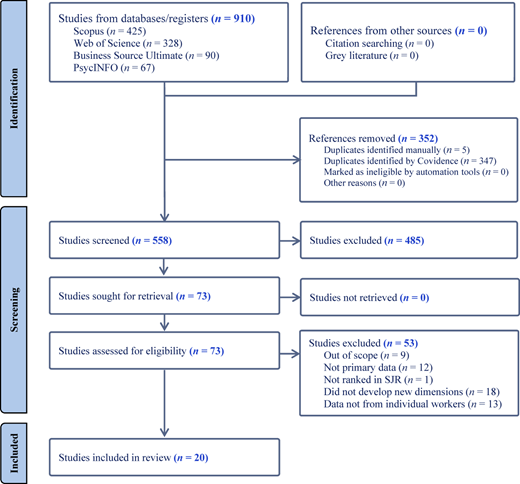
The studies found in each database were exported in an RIS file format and imported into Covidence (an online system used for systematic literature review) for screening and selection. The studies that remained for screening after duplicate removal were 558. The study selection process was in two stages, title and abstract screening followed by a full-text appraisal of studies that passed the screening. Based on the eligibility criteria, an independent title and abstract screening of the studies were conducted by two of the research team members. At the title and abstract screening stage, there was a 75% proportionate agreement and fair inter-rate reliability (Cohen's Kappa = 0.36). A meeting was held by the review team to decide on studies that had initially received conflicting votes. That is, studies selected as irrelevant by one reviewer, but relevant by another. Seventy-three studies remained as relevant afterwards and their full texts were subsequently appraised against the criteria for inclusion (Mengist et al., 2020; Pluye and Hong, 2014; Snyder, 2019). In all, 20 articles met the inclusion criteria and remained for the analysis. Figure 1 shows the PRISMA flow chart for the literature search and selection process.
Coding and analysis of selected studies
The studies that met the eligibility criteria were extracted from Covidence and saved in a code sheet using a Microsoft Excel file. The code sheet enabled the studies to be organized for extracting the relevant data from each study and subsequently analyzing the extracted data. Data in the code sheet covered author, publication year, journal and publication title. Relevant data such as study country, sample, study context, research methods, source of dimensions, theory used and findings (decent work dimensions) from the content of each article were manually coded. The journal ranking was, however, coded using the SJR list.
Apart from the decent work dimensions revealed in the findings of the included studies that were analyzed using a thematic synthesis approach, all other coded data were analyzed as frequencies. The thematic synthesis approach is a structured method of clustering textual data from multiple themes to create analytical themes and interpretive synthesis (Thomas and Harden, 2008). The thematic synthesis was conducted in three stages; text coding, clustering dimensions based on their surface level meaning and a deeper engagement beyond the surface level to generate analytical themes based on latent meanings (Braun and Clarke, 2006; Hong et al., 2017; Thomas and Harden, 2008). In this regard, the decent work dimensions in each of the studies were first coded. The coded texts were then clustered based on their surface level meaning and re-clustered after engaging with the dimensions more deeply to ascertain their latent meaning which led to analytical themes as seen in the integrated dimensions.
To ensure trustworthiness of the analysis, the coded texts were revisited and reviewed again by focusing more on their latent meanings to ensure coherence of the themes (Braun and Clarke, 2006; Nowell et al., 2017). The codes were therefore thematized at the latent level to capture their underlying meanings. For example, prosocial engagement, citizenship/community and development were initially clustered to form a standalone integrated dimension because they appeared to share similar meanings. However, a deeper analysis of their underlying meanings revealed that they aligned more closely with the dimensions in the value-aligned and ethical workplace category. They were therefore re-clustered under this integrated dimension. This final stage of the thematic synthesis procedure resulted in higher-level analytical themes (integrated dimensions) used in formulating the heuristic framework (Hong et al., 2017; Lucas et al., 2007; Thomas and Harden, 2008). Table 1 presents the final stage of the analysis, in which dimensions with similar latent meanings were grouped to form integrated dimensions.
Findings and discussion
Characteristics of selected studies
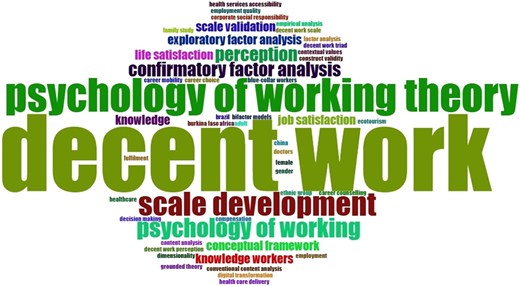
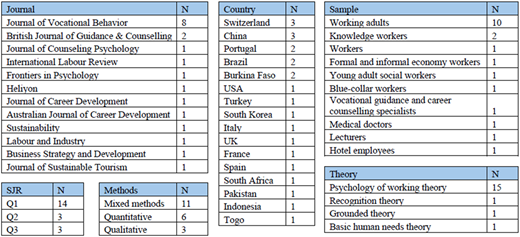
A word cloud (Figure 2) generated using the bibliometrix package in R (Aria and Cuccurullo, 2017, 2026) shows that the studies were mainly about decent work and the PWT. Additional characteristics of the selected studies are shown in Figure 3. The studies were published in 12 journals ranked Q1 (n = 14), Q2 (n = 3) and Q3 (n = 3) in SJR. The data for the studies were drawn from all the continents except Oceania and majority of the samples used were working adults (n = 10). The methods consisted of mixed methods (n = 11), quantitative (n = 6) and qualitative (n = 3). Four theories were used and the PWT was utilized in 15 of the studies with grounded theory, recognition theory and basic human needs theory being used in one study each. Appendix provides other information such as the year of publication and sources of the dimensions established. Appendix shows that the first study was published in 2017 with most of the studies (n = 7) published in 2019. Also, it shows that two of the studies (Duffy et al., 2017; Ferraro et al., 2018) generated items for testing based on experts' views on ILO documents, most (n = 8) used the items generated by Duffy et al. (2017) in addition to participants' meanings of decent work. Five (5) other studies relied on participants' meanings of decent work either alone or with other sources to generate decent work dimensions.
Integrated dimensions of decent work
Time for non-work
This integrated dimension of decent work emphasizes the centrality of temporal autonomy (Ferreira et al., 2019; Masdonati et al., 2019; Nam and Kim, 2019; Ribeiro et al., 2019; Rossier and Ouedraogo, 2021; Su et al., 2022; Vignoli et al., 2020). It reflects work that gives workers the ability to disconnect from work, rest and participate in non-work-related domains of life. In approximately two-thirds of the literature (Table 1), this integrated dimension is seen through interconnected themes of free time and rest (Buyukgoze-Kavas and Autin, 2019; Di Fabio and Kenny, 2019; Dodd et al., 2019; Duffy et al., 2017), adequate working time and workload (Ferraro et al., 2018), control over working life (Dodd et al., 2019) and work–family and work–life balance (Di Fabio and Kenny, 2019; García-Rodríguez et al., 2021). While these generally come up distinctly, they converge around a common theme. That is, work structured in a way that supports workers' physical, emotional and relational needs (Vignoli et al., 2020; Zambelli et al., 2023). For instance, free time and rest emphasize the importance of recovery and personal time from work, whereas work–family and work–life balance highlight a broader engagement in roles and responsibilities across all spheres of life. Notably, control over working life suggests an agency showing individual workers' ability to choose and manage the allocation of time and generally, circumstances at work (Di Fabio and Kenny, 2019; Dodd et al., 2019; Vignoli et al., 2020). Similarly, adequate working time and workload is work that enables workers to effectively engage in both work and personal commitments as well as execute work schedules and deadlines with relative ease (Ferraro et al., 2018). Overall, time for non-work as a core dimension of decent work from the literature underscores work that enables individuals to be sustainably involved in work by not compromising their ability to rest, care and live adequately outside of work which is a pre-requisite for the well-being of workers as suggested in the PWT (Duffy et al., 2016; Williams et al., 2023).
Health and safety
This involves the physical, social, psychological and emotional conditions in the workplace that ensure workers' protection and well-being (Vignoli et al., 2020; Yan et al., 2023, 2024). It reflects a humane workplace and work that is free from all forms of harm. Across both the general and context-specific studies, this theme was consistently represented. Almost all studies that were theoretically grounded in the PWT have highlighted access to healthcare and safe working conditions. Additional variations in this category included health and safety and fundamental principles and values at work (Ferraro et al., 2018), empathic work environment (Nam and Kim, 2019), relationships, respect, justice, recognition at work and support (Ribeiro et al., 2019) and physical safety at work (Rossier and Ouedraogo, 2021). These aspects not only point to the absence of harm at work, but the active presence of nurturing, fair and humane work environments. The coverage of health and safety as emotional, psychological, physical and social health and safety of workers require that for work to be decent, workers must not be exposed to harm in any way. Instead, their overall health and safety must be actively promoted. Health and safety are foundational to the PWT as compromising health and safety undermine workers' fulfilment of their needs and well-being, making it a critical necessity at work (Blustein et al., 2019; Duffy et al., 2016).
Growth and development
This integrated dimension refers to decent work as work that provides opportunities for individual workers to continuously expand their knowledge, skills and attitudes throughout their working lives to enhance their professional advancement and subsequent social mobility (Masdonati et al., 2019; Nam and Kim, 2019; Saragih et al., 2025). It emerges in more than half of the studies, revealing it as a critical element of what work ought to offer to be deemed decent from the perspective of workers. The homogeneity of the dimensions such as lifelong learning (García-Rodríguez et al., 2021), skills reproduction (Kekana et al., 2023), self and professional growth (Buyukgoze-Kavas and Autin, 2019; Di Fabio and Kenny, 2019) and career development (Dodd et al., 2019; Ferreira et al., 2019) is worth noting. Homogeneity signals a shared understanding across contexts that decent work must be developmental for workers and not static as this adds value to their professional lives so that they can continually evolve in the labor market. The emphasis on growth underscores the importance of work as a valuable avenue for long-term career investment where the accumulation of knowledge and skills enhances workers' ability to navigate the labor market because they become competitive. This enables upward career mobility and social mobility overtime (Kekana et al., 2023). Growth and development as a dimension of decent work is an indication that work should not only be about who a worker is, but also who a worker can become through it. Growth and development, embedded in human resource development, is heavily tied to decent work and well-being of workers (Randev and Jha, 2023). Therefore, calling for its inclusion in the conceptualization of decent work (Dodd and Burke, 2021; Masdonati et al., 2019) is not out of place especially as it emanates from workers themselves.
Adequate compensation and security
Adequate compensation and security refer to work that provides fair, sufficient and stable compensation and protection enabling workers to meet both their immediate and long-term needs (Nam and Kim, 2019; Ribeiro et al., 2019; Rossier and Ouedraogo, 2021; Su et al., 2022; Vignoli et al., 2020; Zambelli et al., 2023). This is, unsurprisingly, among the most consistently represented across existing studies (Table 1), and its focus is notably homogeneous. This broadly considers the fact that work should provide workers with adequate resources to meet their immediate needs (Buyukgoze-Kavas and Autin, 2019; García-Rodríguez et al., 2021; Masdonati et al., 2019) and as well, provide them with the assurance to plan and meet their future needs through mechanisms such as pension (Dodd et al., 2019; García-Rodríguez et al., 2021; Yan et al., 2024). The foregoing suggests a dual expectation among workers that stability of compensation is as essential as adequacy of compensation. That, work is not decent when it only provides the resources workers require to meet their immediate needs. It should in addition be possible for workers to attain their future needs with some assurances. For instance, Kekana et al. (2023) highlight that permanency of employment is appreciated not just because of its duration, but because it assures workers of the attainment of their future needs. Thus, decent work is not just about giving workers their due. It is also about providing material and psychological assurances to aid them in shaping their future even when they are out of work and at retirement.
Meaningful and fulfilling work
Work that meets workers' aspirations, offers a sense of purpose and dignity, and enables them to feel valued is what this integrated dimension of decent work entails. The importance of this as a measure of decent work is evidenced in its consistency across the reviewed studies (e.g. Nam and Kim, 2019; Saragih et al., 2025; Zambelli et al., 2023). From this integrated dimension, four core elements make work meaningful and fulfilling. First, the intrinsic characteristics of work including autonomy, work content, rewarding, ability-fit, challenging and mastery, legitimate tasks, person-job-fit and control (Dodd et al., 2019; Kekana et al., 2023). All these intrinsic characteristics of work underscore a need for worker agency and alignment between job demands on one hand and workers strengths and interests on another hand. Second, purpose and contribution, seen through fulfilling and productive work, serving others and social value of work (Ferraro et al., 2018; Hussain et al., 2024; Zambelli et al., 2023) direct attention to the importance of social impact in creating fulfilment. Thirdly, recognition, status, dignity and shamelessness (Saragih et al., 2025; Zambelli et al., 2023) reveal that meaning is not only internally constructed but also shaped through interactions and the social valuation of one's work (Atitsogbe et al., 2024; García-Rodríguez et al., 2021). Lastly, with dimensions such as professional skills, achievement motivation, personal satisfaction, self-value and self-esteem (Buyukgoze-Kavas and Autin, 2019; Ferreira et al., 2019), the role of self-worth and personal validation of workers are highlighted in fulfilling work. These dimensions generally reflect meaningful work as discussed in the literature (Blustein et al., 2023; Duffy et al., 2024; Laaser and Bolton, 2022). The foregoing portends that decent work is not solely about the working conditions but is also about the experiences workers derive from their work making the content of work key to the characterization of decent work (Deranty and MacMillan, 2012).
It is worth emphasizing that while some scholars (Allan et al., 2019, 2020; Blustein et al., 2023) have demonstrated that meaningful work is an outcome of decent work, others (Deranty and MacMillan, 2012; Seubert et al., 2021) strongly argue that without meaningful work, decent work is a constricted concept. According to Deranty and MacMillan (2012), decent work as a concept is limited to work conditions and that it misses out on including work as an activity or its content presenting a gap in the campaign for decent work. They argue for the inclusion of meaningful work within the decent work concept as it satisfies the content of work that is missing in decent work conceptualization because work can be indecent as a result of the type of activity involved, making meaningful work an important extension of decent work. For instance, a worker may receive adequate compensation, employment security, sufficient time away from work among others, but if the tasks they perform are extremely repetitive, meaningless or leave them feeling undervalued, the work may still not be considered decent. This is because decent work is not only about working conditions, but also about the lived experience of work (i.e. whether the work supports a person's dignity, purpose and sense of value). Seubert et al. (2021) corroborated this by reiterating that the psychological conceptualizations of decent work have neglected important dimensions such as meaning. Furthermore, both Duffy et al. (2024) and Masdonati et al. (2019) established in their studies that decent work and meaningful work are overlapping constructs. Masdonati and colleagues re-echoed that people's feelings and experiences are important considerations of decent work and that such a perspective adds to the characteristics of decent work. Interestingly, even though Blustein et al. (2023) indicated preference for a distinction between the two, they reveal that decent work is foundational to meaningful work suggesting that the concepts are not completely distinct.
Value-aligned and ethical workplace
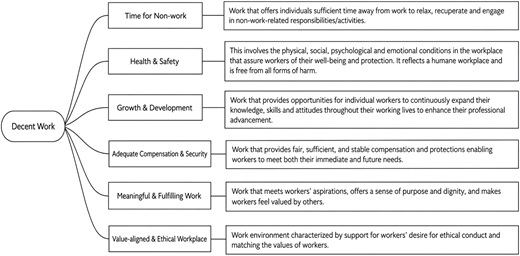
A work environment characterized by support for workers' desire for ethical conduct and work that matches the values of workers are what value-aligned and ethical workplace is about (Rossier and Ouedraogo, 2021; Su et al., 2022; Vignoli et al., 2020; Zambelli et al., 2023). This, shown in over half of the studies, borders on the expectations of workers that their work should comply with ethics and align with their identities (Dodd et al., 2019; Duffy et al., 2017; Ferreira et al., 2019). From the literature, they were presented as complementary values shared by workers and their organizations, reflecting concern for both people and the environment (Buyukgoze-Kavas and Autin, 2019; Di Fabio and Kenny, 2019; Masdonati et al., 2019; Nam and Kim, 2019; Ribeiro et al., 2019), ethical policies and practices (Nam and Kim, 2019) and person-organization value congruence (Zambelli et al., 2023). Important values for which alignment is required include family, community and environmental values. Alignment of environmental values expressed through altruism-support at work shows that work that enhances the common good is to be considered decent as it affirms and sustains social benefits for individuals beyond the workplace, but society in general (Gandullia et al., 2021; Pereira et al., 2020; Weiss-Sidi and Riemer, 2023). The revelation of corruption-free work (Atitsogbe et al., 2024) connotes a demand for honesty at work. The foregoing represents the notion that workers do not just want to work, but they regard work that is in sync with the values they uphold – value alignment. Values are shared ideas and important in how people view work and their intersection at work is essential for their well-being and social sustainability (Guillemin and Nicholas, 2022; Massoudi et al., 2018). Thus, for work to be considered decent, workers and their organizations should not be seen as entities that are independent of each other in terms of ethics and values. There should be intertwining values between workers and organizations anchored on ethical principles. Figure 4 is a heuristic framework developed based on the incorporation of the integrated dimensions discussed.
Theoretical implications
The integrated dimensions of decent work (time for non-work, health and safety, growth and development, adequate compensation and security, meaningful and fulfilling work and value-aligned and ethical workplace) into a heuristic framework, offer an extensive understanding of decent work as a concept. This integrated decent work framework, while being closely related to achieving basic, social connection and self-determination needs, shows a more extensive structure of the components of decent work from the perspectives of workers than the PWT initially suggested. As can be seen, time for non-work; health and safety; and adequate compensation and security are conditions necessary for fulfilling basic needs, social connection needs and self-determination needs of workers (Allan et al., 2019; Duffy et al., 2016; Ferreira et al., 2019). Even so, the current framework shows that time for rest and adequate compensation dimensions originally established in the PWT have been broadened. Time for non-work extends beyond work with enough time for breaks to one that enables workers to disconnect from work and participate fully across all spheres of non-work life (Dodd et al., 2019; García-Rodríguez et al., 2021). Similarly, adequate compensation and security as shown in this framework highlights both adequacy and stability of compensation to meet immediate as well as future needs. However, adequate compensation in the original PWT is focused on immediate needs.
In addition, work that ensures growth and development as well as meaningful and fulfilling work brings to light dimensions not previously covered in the PWT (see Duffy et al., 2016). These point to work that enhance professional advancement and feelings of self and social value from participating in work as important for consideration as decent. These are critical revelations from prior literature as they complement workers' ability to achieve self-determination needs (Duffy et al., 2016, 2024; Kim et al., 2021; Williams et al., 2023). Lifelong learning, skills reproduction, self and professional growth, career development, intrinsic characteristics of work, purpose and contribution, self-worth and personal validation are showcased in growth and career development, and meaningful and fulfilling work. All these contribute to the satisfaction of competence needs, relatedness needs and autonomy needs which make up self-determination needs at work (Duffy et al., 2019; Ryan and Deci, 2020). Theoretically, decent work has for long been limited to the conditions of work. The inclusion of meaningful work within the ambit of decent work signifies the importance of incorporating workers' experiences and feelings derived from work as an activity (Deranty and MacMillan, 2012; Seubert et al., 2021). It also signals the overlap between decent work and meaningful work (Duffy et al., 2024; Masdonati et al., 2019).
Moreover, while the integrated framework is largely consistent with the PWT, value-aligned and ethical workplace extends the theory. Even though organization-worker value alignment is part of decent work in the earlier version (Duffy et al., 2016), the incorporation of ethical workplace as well as altruism-supporting work into this new framework introduce ethical undertones into the PWT (Duffy et al., 2016). Interestingly, this has not been fully elucidated in the PWT as we presently know it. It is understandable that an ethical perspective is missing in the PWT since the theory primarily has a psychological focus (Duffy et al., 2017). However, workers' emphasis on value congruence and ethics in studies that were guided by the PWT (e.g. Buyukgoze-Kavas and Autin, 2019; Ferreira et al., 2019; Ribeiro et al., 2019) indicate their importance in the psychology of work. The foregoing suggests the possibility of an expansion of the PWT to accommodate it. The ethical undertones of psychology of work have been shown to shape how people think of and experience work.
Over the years, scholars (Dearnty and MacMillan, 2012; Di Ruggiero et al., 2015; Dobbins et al., 2025; Pereira et al., 2019; Seubert et al., 2021; Wang and Cheung, 2024) have pointed out limitations in the conceptualization of decent work. Also, prior studies have advocated for the addition of dimensions not included in the most widely accepted conceptualization of individual level decent work (decent work scale) to capture the fullness of the concept (Di Fabio and Kenny, 2019; Dodd et al., 2019; Masdonati et al., 2019; Ribeiro et al., 2019; Vignoli et al., 2020). Additionally, Duffy et al. (2016) acknowledged that there could be more to the decent work dimensions than what they postulated in the PWT. This admission is probably because the five dimensions they established were premised on ILO's proposition of what decent work should be and not workers' experiences and perceptions of decent work. The advancement of this heuristic framework through the integration of different conceptualizations of decent work offers a theoretically comprehensive conceptualization of decent work from the viewpoint of workers themselves, whose perceptions and work experiences are crucial in determining what decent work means. The framework supports the assertion that the existing conceptualizations of decent work do not adequately capture the totality of the phenomenon as shown in this current study, as individual studies have partially captured what decent work is.
A critical theoretical implication is the need to develop and validate a measurement scale that covers the dimensions of decent work shown in the integrated framework developed in this study. The development and validation of measures for decent work could also provide theoretical precision. Already, most of the studies that used qualitative and mixed methods (e.g. Buyukgoze-Kavas and Autin, 2019; Di Fabio and Kenny, 2019; Ferreira et al., 2019; Hussain et al., 2024; Masdonati et al., 2019; Ribeiro et al., 2019) revealed some dimensions without accompanying measures. Such a validated measurement scale will provide a holistic theoretical assessment and subsequently, a more complete understanding of decent work. Beyond the measurement items that will be developed, empirical evidence will need to be provided as to whether the six-dimensional structure shown in the integrated framework is supported, and which specific indicators belong to each dimension. This is where future research can offer valuable contribution to decent work literature.
Practical implications
This integrated framework has considerable implications for designing decent work interventions. The expanded conceptualization of decent work suggests that any form of intervention should move beyond the narrow focus commonly found in existing literature. As this framework shows, decent work is much more and includes security, meaningful and fulfilling work, growth, development and ethical workplace, all of which have not been given the needed research, policy and practical considerations. Adopting this broader, more comprehensive conceptualization of decent work as reflected in the integrated framework could equip vocational psychologists and counselors with a more complete set of assessment criteria when supporting workers. By utilizing this integrated framework, interventions aimed at promoting decent work may become more effective, given that it captures the essential elements of decent work more comprehensively than other currently available frameworks.
Conclusion
The literature is replete with different conceptualizations of decent work. The fragmentation of the conceptualization reveals several unique and overlapping dimensions of the concept across studies. Each of the studies partially captures aspects of decent work, detracting from its conceptual clarity and cohesion. This study therefore responds to the calls by scholars in the field by integrating these fragmented dimensions of decent work from empirical studies at the individual worker level into a heuristic decent work framework. The framework highlights six components of decent work: time for non-work; health and safety; growth and development; adequate compensation and security; meaningful and fulfilling work and value-aligned and ethical workplace. By offering a comprehensive conceptualization of decent work to date, the paper unravels the complexities and fullness of decent work as a concept to consolidate existing understanding.
Limitations and future research direction
A major limitation of the framework developed in this study is that it has not yet been empirically tested for validity. Although these integrated dimensions were drawn from studies conducted across different contexts, the context-specific nature of decent work (Holzberg, 2024; Louche et al., 2023) demands cautiously generalizing this framework. Future studies should empirically examine the applicability and relevance of the framework across diverse contexts to assess whether it functions as a generic model of decent work. Additionally, some inconsistencies were observed in the literature. For example, in some of the qualitative study findings (e.g. Dodd et al., 2019; Masdonati et al., 2019; Ribeiro et al., 2019; Vignoli et al., 2020), dimensions of decent work were presented at different hierarchical levels. While some studies focused on sub-dimensions, others focused on broader dimensions. Such variability is a potential source of how decent work dimensions were interpreted and synthesized. However, we relied largely on the authors' interpretations of the findings to highlight dimensions not covered in the decent work scale (Duffy et al., 2017) since they had deeper familiarity with the data.
Furthermore, some of the individual dimensions in existing literature overlapped with the integrated dimensions in this framework. In such scenarios, we categorized them under the most salient theme based on content emphasis. For instance, in the work of Vignoli et al. (2020), respect and recognition was skewed toward respect; hence, we classified it under the integrated dimension respect belonged. Future studies should validate this framework by developing and testing measures to ensure conceptual clarity and measurement consistency to ultimately advance decent work theory and practice. Lastly, this study focused solely on the decent work concept. Accordingly, only studies that explicitly examined decent work were included, while closely related concepts such as fair work and job quality were excluded. Although aspects of related concepts such as fair work, including opportunity, security, respect and fulfilment, emerged in this study, these aspects were discussed through the lens of decent work. Future research could further delineate the conceptual boundaries between decent work, fair work, job quality and other related concepts.
Appendix
Characteristics of included studies
| Authors | Title | Journal | SJR | Study country | Sample | Source of items/dimensions used | Methods | Theory |
|---|---|---|---|---|---|---|---|---|
| Duffy et al. (2017) | The development and initial validation of the decent work scale | Journal of Counseling Psychology | Q1 | USA | Working adults | ILO document-informed expert item generation and review | Quantitative, survey, factor analysis | PWT |
| Ferraro et al. (2018) | The Decent Work Questionnaire: Development and validation in two samples of knowledge workers | International Labour Review | Q2 | Portugal and Brazil | Workers | ILO document-informed labor expert interviews | Quantitative, survey, factor analysis | |
| Masdonati et al. (2019) | Decent work in Switzerland: Context, conceptualization and assessment | Journal of Vocational Behavior | Q1 | Switzerland | Working adults | Decent Work Scale and participants' meanings of decent work | Mixed methods, survey, factor analysis, open-ended questions, thematic analysis | PWT |
| Buyukgoze-Kavas and Autin (2019) | Decent work in Turkey: Context, conceptualization and assessment | Journal of Vocational Behavior | Q1 | Turkey | Working adults | Decent Work Scale and participants' meanings of decent work | Mixed methods, survey, factor analysis, open-ended questions, content analysis | PWT |
| Ferreira et al. (2019) | Decent work in Portugal: Context, conceptualization and assessment | Journal of Vocational Behavior | Q1 | Portugal | Working adults | Decent Work Scale and participants' meanings of decent work | Mixed methods, survey, factor analysis, open-ended questions, content analysis | PWT |
| Nam and Kim (2019) | Decent work in South Korea: Context, conceptualization and assessment | Journal of Vocational Behavior | Q1 | South Korea | Working adults | Decent Work Scale and participants' meanings of decent work | Mixed methods, survey, factor analysis, open-ended questions, content analysis | PWT |
| Di Fabio and Kenny (2019) | Decent work in Italy: Context, conceptualization and assessment | Journal of Vocational Behavior | Q1 | Italy | Working adults | Decent Work Scale and participants' meanings of decent work | Mixed methods, survey, factor analysis, open-ended questions, content analysis | PWT |
| Ribeiro et al. (2019) | Decent work in Brazil: Context, conceptualization and assessment | Journal of Vocational Behavior | Q1 | Brazil | Working adults | Decent Work Scale and participants' meanings of decent work | Mixed methods, survey, factor analysis, open-ended questions, content analysis | PWT |
| Dodd et al. (2019) | Decent work in the UK: Context, conceptualization and assessment | Journal of Vocational Behavior | Q1 | UK | Working adults | Decent Work Scale and participants' meanings of decent work | Mixed methods, survey, factor analysis, open-ended questions, content analysis | PWT |
| Vignoli et al. (2020) | Decent work in France: Context, conceptualization and assessment | Journal of Vocational Behavior | Q1 | France | Working adults | Decent Work Scale and participants' meanings of decent work | Mixed methods, survey, factor analysis, open-ended questions, thematic content analysis | PWT |
| García-Rodríguez et al. (2021) | Decent work in hospitality: scale development and validation | Journal of Sustainable Tourism | Q1 | Spain | Hotel employees | literature review, interviews with managers and consultants | Quantitative, survey, factor analysis | |
| Rossier and Ouedraogo (2021) | Work volition, decent work and work fulfilment, in the formal and informal economy in Burkina Faso | British Journal of Guidance & Counselling | Q3 | Burkina Faso | Formal and informal economy workers | Participants' meanings of decent work | Mixed methods, interviews, thematic content analysis, survey, factor analysis | PWT |
| Su et al. (2022) | Validating the decent work scale incorporated with a social recognition component among young adult social workers | Frontiers in Psychology | Q2 | China (Hong Kong) | Young adult social workers | Decent Work Scale and Social Recognition Scale | Quantitative, survey, factor analysis | PWT, Recognition theory |
| Yan et al. (2023) | Measuring the decent work of knowledge workers: Constructing and validating a new scale | Heliyon | Q1 | China | Knowledge workers | Participants' meanings of decent work and literature | Mixed methods, interviews, labelling, survey, factor analysis | Grounded theory |
| Kekana et al. (2023) | Unpacking the Concept of Decent Work in the Psychology of Working Theory for Blue-Collar Workers | Journal of Career Development | Q1 | South Africa | Blue-collar workers | Participants' meanings of decent work | Qualitative, focus groups, interpretive phenomenology | PWT |
| Zambelli et al. (2023) | Representations of decent work and its antecedents among vocational guidance and career counselling specialists | British Journal of Guidance & Counselling | Q3 | Switzerland | Vocational guidance and career counselling specialists | Participants' meanings of decent work | Qualitative, interviews, content and textual analysis | PWT |
| Yan et al. (2024) | A Study on a New 5S Model of Decent Work Perception | Sustainability | Q1 | China | Knowledge workers | Participants' meanings of decent work | Mixed methods, interviews, open and selective coding, survey, factor analysis | |
| Atitsogbe et al. (2024) | Toward a conceptualization of decent work in Africa: Development and cross-cultural validation of the Decent Work Triad (DWT) in Burkina Faso, Switzerland and Togo | Australian Journal of Career Development | Q3 | Burkina Faso, Switzerland, Togo | Working adults | conceptualization of decent work from a sub–Saharan African perspective (Literature) | Quantitative, survey, factor analysis | PWT |
| Hussain et al. (2024) | The value of work for doctors in Pakistan: towards a framework for ensuring decent work | Labour and Industry | Q2 | Pakistan | Medical doctors | PWT | Qualitative, interviews, thematic analysis | PWT |
| Saragih et al. (2025) | Decent Work in the Digital Context: Scale Development and Validation | Business Strategy and Development | Q1 | Indonesia | Lecturers | Maslow's hierarchy of needs and Digital Society Index | Quantitative, surveys, factor analysis | Basic human needs theory |
References
* Included studies