


Hybrid work is a working model that combines remote or home-based work with in-person work, typically from a traditional location such as an office. Although teleworking has been a model frequently used since the 1990s, it only became more common with the emergence of the COVID-19 pandemic in 2020 and the subsequent mandatory lockdowns. Thus, the post-pandemic era allowed many organizations to adopt a work regime that combines remote and in-person work, namely the hybrid model. In Portugal, this working model is relatively recent and lacks study. Therefore, this study was based on the e-work life model and aimed to test the mediating role of work–family conflict in the relationship between hybrid work and employees’ harmony and mental health.
For this purpose, a two-wave survey was conducted with 376 hybrid workers.
The results showed that individuals working in a hybrid model tended to experience less work–family conflict, consequently increasing their harmony and mental health.
The results demonstrate the importance of organizations adopting this working model and using it as a strategy to improve workers’ mental health and well-being.
Introduction
The concept of telework was first introduced by Nilles (1988) as the substitution of physical commuting with remote work facilitated by telecommunications technology, typically implying that employees work from home. Although the idea is not new, telework only became widely feasible in the 1990s with the advent of laptops and widespread internet connectivity. However, its large-scale implementation was primarily driven by the COVID-19 pandemic, which compelled organizations to adopt telework due to mandatory lockdowns (Hopkins and Bardoel, 2023; Junça-Silva, 2024a, b). The pandemic not only accelerated digital transformation (Babapour Chafi et al., 2022) but also led many organizations to transition to hybrid work models to maintain business continuity after social distancing restrictions were lifted (Alexander et al., 2021).
The hybrid work model, as defined by Beno (2021), combines remote work with in-office work and is characterized by flexibility (Grant et al., 2019), allowing employees to work remotely for part of their contracted hours within predefined work agreements (Junça-Silva and Caetano, 2024). According to the e-work life model (Grant et al., 2019), telework comprises four key perceptions (flexibility, work-family interference, organizational trust and productivity) that influence employee well-being (Charalampous et al., 2023). Collectively, these perceptions contribute to employees’ well-being by fostering greater work-life balance and reduced work-family conflict (WFC; Choudhury et al., 2024). WFC occurs when professional obligations interfere with family responsibilities or when job-related stress negatively impacts family life (Carlson et al., 2000).
Beyond increases in WFC, the pandemic profoundly affected employees’ mental health, increasing stress levels and highlighting the need for well-being protection (Junça-Silva et al., 2022a; Oleksa-Marewska and Tokar, 2022). One key indicator of well-being is harmony, which reflects individuals’ sense of balance, integration into their social environment, and alignment with life’s demands (Kjell and Diener, 2021). Delle et al. (2011) describe harmony as the perception of inner peace, self-acceptance, serenity, and fairness. Mental health, as defined by the World Health Organization (2023), is a state of well-being in which individuals realize their potential, manage everyday stress, work productively, and contribute to their communities. Since WFC is a known predictor of well-being and mental health (Antino et al., 2022), hybrid work—by promoting flexibility—has the potential to reduce WFC and, consequently, enhance employee well-being (Junça-Silva, 2023). However, to date, no studies have empirically tested these relationships.
To address this gap, this study employs the e-work life model (Grant et al., 2019) to develop and test a conceptual model examining the indirect effect of hybrid work on well-being and mental health via WFC. Considering that Portuguese organizations increasingly adopt hybrid work and move away from mandatory telework (Junça-Silva and Martins, 2023), it becomes critical to assess whether this work arrangement alleviates or exacerbates WFC. Moreover, Portugal provides a relevant context for investigating the impact of hybrid work on mental health through WFC due to its strong family-oriented culture, evolving labor policies, and distinctive workforce characteristics (Santos et al., 2024). Recent legislative advancements, such as telework regulations and the right to disconnect, make Portugal an ideal setting to analyze how hybrid work shapes WFC and mental health outcomes. Additionally, the country’s labor market is predominantly composed of small and medium-sized enterprises (SMEs) (Matias and Serrasqueiro, 2017), where hybrid work may operate differently compared to multinational corporations (Guedes et al., 2022), affecting employees’ ability to manage work-family boundaries. Portugal also faces high levels of work-related stress and mental health concerns (Vieira and Meirinhos, 2021), underscoring the need to determine whether hybrid work alleviates or intensifies these issues through WFC.
Given the increasing importance of employee well-being and mental health, this research seeks to understand employees’ perceptions of hybrid work and its impact on their work-family boundaries and overall well-being. By investigating the mediating role of WFC in the relationship between hybrid work and mental health indicators such as harmony, this study provides organizations with evidence-based insights into the benefits and challenges of hybrid work. Furthermore, by addressing a research gap in the Portuguese context, this study informs organizations about best practices for adapting to post-pandemic work arrangements and leveraging hybrid work for both employee well-being and organizational success.
Theoretical framework
Telework and hybrid work
Nilles (1988) first introduced the concept of telecommuting to define an agreement between employer and employee that allows work to be performed outside the usual workplace regularly, utilizing information and telecommunications technologies (ICT) to replicate significant aspects of the centralized work environment. Over time, the term telecommuting gradually evolved into teleworking, and recently other related concepts arose, such as home-based work, e-work, or remote work (Junça-Silva et al., 2022b).
Telework can be defined as work performed outside the conventional workplace (e.g. office), with communication done through ICT (Olson and Primps, 1984). Telework emerged as an organizational strategy for reducing costs (e.g. Egan, 1997) and addressing employees’ needs for work-family balance (e.g. Shamir and Salomon, 1985); however, telework remained relatively limited until the pandemic (Hopkins and Bardoel, 2023).
Hybrid work gained popularity during the pandemic to define a working modality in which employees divide their time between work in a traditional workplace and remote work (usually from home, or from “third places” such as a coworking space, library, or local café, etc.), attempting to combine the best aspects of telework and office work (Naqshbandi et al., 2024). This term was introduced by Beno (2021) as a model that combines work from home and in-person work from the office, characterized by flexibility and choices (Choudhury et al., 2024; Junça Silva and Martins, 2023). According to Iqbal et al. (2021), traditionally, the concept of a “workplace” has been associated with a specific location, so a hybrid workplace refers to work modalities that combine traditional office settings and telework. Thus, the hybrid work model implies that employees work in a central office and remote locations (Sampat et al., 2022).
The shift to the hybrid work model seems to considerably benefit both workers and organizations. Recent studies have shown that hybrid work yields positive outcomes for both organizations and employees, with reports linking it to a 35% reduction in burnout without any adverse impact on performance or promotion opportunities, and a significant improvement in how each individual experiences work (Hopkins and Bardoel, 2023). From the employee’s perspective, it allows for greater flexibility and work-life balance, while for organizations, it enhances productivity and reduces fixed costs (Naqshbandi et al., 2024). Other studies demonstrated that the major advantages of hybrid work included better work-life balance, more efficient time management, control over schedule and workplace location, reduced burnout, and increased productivity (Wigert and Agrawal, 2022; Wigert and White, 2022). Furthermore, the benefits of telework and hybrid work included increased well-being, reduced overall costs, productivity gains, reduced absenteeism due to illness, and more efficient work allocation (Mutebi and Hobbs, 2022). Hybrid work reduced working hours by about two hours on work-from-home days but increased them on office workdays and reduced sick days and holidays (Bloom et al., 2023). Ultimately, this work arrangement seems to offer workers a higher level of control over the location and timing of their work tasks, allowing for greater flexibility, autonomy, and work-life balance (Hopkins and Bardoel, 2023).
The E-Work Life Model
Several studies on telework adoption have sought to identify its benefits and challenges (see Charalampous et al., 2019; Oakman et al., 2020, for a review). The E-Work Life Model (EWLM), developed by Grant et al. (2019) and later refined by Charalampous et al. (2023), provides a comprehensive framework for understanding the factors that enhance telework experiences for employees.
The EWLM delineates four interrelated dimensions that shape telework perceptions: (1) organizational trust, (2) flexibility, (3) work-life interference, and (4) productivity (Charalampous et al., 2023). Organizational trust reflects employees’ perceptions of their relationship with management and the extent to which they feel supported, which can foster greater organizational engagement (Grant et al., 2019). Flexibility, a defining characteristic of telework, refers to employees’ autonomy in managing their work schedules and methods, including decisions on when and how to perform tasks (e.g. breaks, working hours). Work-life interference captures the extent to which work and personal life overlap, encompassing both positive aspects (e.g. attending to personal or family responsibilities during work hours) and potential conflicts. Since telework provides greater autonomy, it is often associated with reduced work-life interference (Charalampous et al., 2023). Finally, productivity pertains to both the quality and quantity of work delivered (Grant et al., 2019).
When employees perceive these four dimensions positively, they tend to experience higher levels of well-being, including greater satisfaction, joy, and overall mental health (Junça-Silva et al., 2022c). Thus, the EWLM suggests that optimizing these dimensions can enhance employees’ well-being, encompassing general health, mental health, and vitality (Grant et al., 2019).
Empirically, the model has been tested in various samples and occupational sectors (e.g. Junça Silva, 2022, 2025a, b). For example, some studies suggested that a positive telework experience, as captured in the four dimensions of the model, appears to be negatively associated with technostress (i.e. stress due to the inability to cope with the demands of using the computer for work purposes; Junça Silva et al., 2022c). Telework, captured by the four dimensions of EWLM, is also negatively linked to perceived loneliness and positively related to experienced flow during work (Taser et al., 2022). These results are consistent with Grant et al.’s (2019) suggestion that a positive telework experience is associated with higher levels of well-being due to greater flexibility, organizational trust, and productivity and lower interference between work and personal life.
The mediating role of work-family conflict
As argued by the EWLM, telework helps employees to better manage their work-life boundaries (Charalampous et al., 2023). Therefore, individuals who telework are likely to reduce their work-family conflict (WFC) by improving their time management skills, facilitated by the flexibility that telework offers (Junça-Silva, 2023).
WFC occurs when involvement in a professional activity interferes with participation in a concurrent family activity or when occupational stress has a negative effect on behaviors in the family domain (Greenhaus and Powell, 2003). Given recent social trends such as increased technology use, transnational work, and dual-worker households, WFC is recognized as a prominent social concern (French et al., 2018).
Greenhaus and Beutell (1985) identified three forms of WFC: (1) time-based conflict, (2) strain-based conflict, and (3) behavior-based conflict. Time-based conflict may occur when time devoted to one role hinders participation in another role (e.g. a meeting with a child’s teacher at the same time as a work meeting). Strain-based conflict suggests that strain experienced in one role interferes with participation in another role (e.g. when an argument with a spouse leaves a person in a bad mood at work, or when frustrations at work result in an argument with a child). Finally, behavior-based conflict occurs when specific behaviors required in one role are incompatible with behavioral expectations in another role (e.g. treating a spouse like a coworker or a client like a child; Greenhaus and Beutell, 1985). Regardless of the type of conflict, any one of them appears to be a significant predictor of well-being and mental health (French et al., 2018; Kossek and Lee, 2017).
Kjell et al. (2016) argued that harmony in life is a crucial indicator of a person’s well-being. Harmony in life includes a flexible global assessment of whether a person’s life is balanced, mindful, fits into their social environment, and is in tune with their life (Kjell and Diener, 2021). Harmony was further defined as “the perception of inner harmony, such as inner peace, self-acceptance, serenity, a sense of balance and fairness” (Delle et al., 2011, p. 199). The assessment of harmony encourages individuals to evaluate their global and subjective perception of harmony in their life, which includes a comprehensive assessment of whether their life involves balance, conscious and non-judgmental acceptance, adaptation, and alignment with it (Kjell and Diener, 2021; Olsen et al., 2022).
In addition, mental health is essential for health and quality of life, because it is a resource for everyday life, and contributes to the functioning of individuals, families, communities, and society (Barry, 2009). According to the WHO (2023), mental health is a state of well-being in which an individual realizes their own abilities, can cope with the normal stresses of life, can work productively, and is able to contribute to their community. This definition highlights various aspects of positive mental health, including subjective well-being and affective balance, and the development of capacities to manage life, maximize each individual’s potential, participate, and contribute to society.
The EWLM proposes that teleworking, by reducing interference between work and personal life, increases overall well-being (Grant et al., 2019; Charalampous et al., 2023). Empirically, a Gallup study (2022) showed that the second reason people prefer hybrid work is the increase in overall well-being and mental health (Wigert, 2022). The Evolving Office stated that some of these reasons are that hybrid work allow employees to recover physical health, to achieve a better balance between work and personal life, provide comfortable work environments and promote flexibility that increases job satisfaction and mental health (Ergotron, 2022). Moreover, 66% of hybrid workers stated that their mental health had improved because they had more time for themselves compared to the full-time work (Choudhury et al., 2024). Other studies showed that hybrid work promoted higher levels of well-being and mental health because employees could use their spare time spending it with family and friends, exercising, or taking a walk during the day (Tsipursky, 2023). Other studies have shown that positive working conditions, such as telework (Junça Silva and Coelho, 2023), promote mental health by promoting self-leadership practices, such as time management, flexibility, and autonomy (Grant et al., 2019; Naqshbandi et al., 2024). In Portugal, in accordance with the EWLM, some studies have evidenced that telework, by promoting greater flexibility and less interference between work and personal life, not only reduces emotional exhaustion but also improves mental health (Junça Silva et al., 2022a, b).
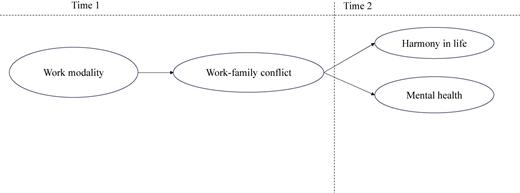
Thus, based on the EWLM (Grant et al., 2019), and the empirical studies described above, the following hypotheses were defined (Figure 1).
The work regime positively influences (a) harmony and (b) mental health by reducing WFC.
Method
Procedure and participants
The Ethics Committee of the first author’s university approved the study before it started. Two waves of data were collected to minimize the potential common method variance problem. In the first stage (Time 1), 533 surveys were distributed to employees who worked in a hybrid work modality. Participants were part of the researchers’ professional networks. This first contact was made by email in which the research purpose and scope were clarified, and the anonymity and confidentiality of the data were warranted to ensure that participation was voluntary. Those who answered this email received another one with the link for the Time 1 survey: this survey incorporated measures of work modality, WFC, and socio-demographic characteristics. In total, 451 responses were received, yielding a response rate of 84.61%. In the second stage (Time 2), one week later, questionnaires to measure harmony in life and mental health were sent to the 451 participants who answered the first survey. At this stage, 407 completed surveys were gathered, generating a response rate of 76.36%. However, only 376 valid responses were considered after excluding invalid surveys (completed in less than 2 min or perfunctory answers), with an overall response rate of 70.54%. According to a power analysis (effect size of 0.2, error probability of 0.05), this sample size was considered sufficient.
Data was collected between September and December 2023. In addition to the two-wave data collection, other precautionary measures were used to minimize potential common method bias (CMB) (Podsakoff et al., 2024). All participants voluntarily and anonymously answered the online survey. Further, the items were randomized, and attention was set to screening questions in both surveys.
The participants included working adults from managerial positions working in Portugal. Of the overall sample, 60% were female. The mean age was 35 years (SD = 12.10), and the mean organizational tenure was 8 years (SD = 9.67). Participants reported working on average 36 h per week (SD = 11.71). In terms of the work arrangement carried out in the last month, 70% were engaged in hybrid work, 25% had performed fully on-site work, and only 5% had worked entirely remotely.
Measures
All the scales used have shown high reliability and validity in previous research. All the variables were measured with a five-point Likert scale. Following Brislin’s (1986) cross-cultural translation procedure, two bilingual academic researchers conducted the back-translation process to translate the English items into Portuguese. Moreover, we invited two experts in well-being studies to review the initial draft of the Portuguese surveys and to make some revisions to the item wording and instructions for respondents to increase the content validity (Wang et al., 2023). A pilot study with 55 employees in Portuguese organizations (not part of the final sample) was initially conducted to assure content validity.
Work modality (T1)
The variable “work modality” was measured using the question “During the last week, what type of work arrangement were you in?” with response options being: (1) Fully On-Site Work; (2) Fully Telework; and (3) Hybrid Work.
WFC (T1)
WFC was measured using the abbreviated 3-item version of Carlson et al.’s (2000) multidimensional measure of WFC (Matthews et al., 2010). The scale measured the three dimensions of WFC: time-based: “I have to miss family activities because of the amount of time I need to devote to work responsibilities”; tension-based: “I often feel so emotionally drained when I come home from work that it prevents me from contributing to my family”; and behavior-based: “The behaviors I engage in that make me effective at work do not help me to be a better parent and spouse.” These items were answered on a Likert scale ranging from 1 to 5 (Strongly Disagree to Strongly Agree). The Cronbach’s α in this study was 0.83 and the McDonald’s was 0.84.
Harmony in life (T2)
Harmony was measured using the abbreviated three-item version of the Harmony in Life Scale (Kjell and Diener, 2021). An example item was “My lifestyle allowed me to be in harmony.” Participants responded on a 5-point Likert scale (1 – Strongly Disagree; 5 – Strongly Agree). The Cronbach’s α in this study was 0.91 and the McDonald’s was 0.92.
Mental health (T2)
Mental health was measured using three items from the SF-36v2 Vitality and Mental Health Scales (e.g. “How often have you felt calm and relaxed in the past week?”) developed by Ware et al. (2007). Participants responded on a Likert scale from 1 (Never) to 5 (Always). The Cronbach’s alpha was 0.70 and the McDonald’s was 0.72.
Control variables
Sex and age of the participants were used as control variables. Sex was used as a control because some studies have shown that women tend to be happier than men (Diener et al., 2020); therefore, differences between men and women could influence the outcome variables (i.e. harmony and mental health). Additionally, age may also account for influences on work-family conflict and mental health, as differences have been identified in how older and younger individuals experience professional life and their levels of mental health (Livingstone and Isaacowitz, 2021).
Data analysis
In the proposed mediating model (see Figure 1), there were three types of variables: (1) predictor (work modality); (2) two criterion variables (i.e. harmony and mental health); and (3) one mediator (WFC). SPSS 28.0 and the software JASP (version 0.14.1) were used to test the proposed research models. First, descriptive analysis was conducted to calculate the mean and standard deviation for each variable. Second, correlational analyses were performed to examine whether work modality was associated with the mediator and the criterion variables. Third, the measurement model’s goodness of fit was evaluated. In this regard, we found that the Root Mean Square Error of Approximation (RMSEA) < 0.08, Standardized Root Mean Squared Residual (SRMR) < 0.08, Comparative Fit Index (CFI) > 0.90, and Tucker-Lewis Index (TLI) > 0.90 evidenced a good fit (Kline, 2016).
Results
Common method bias and multicollinearity issues
Although we have followed some recommended procedures to reduce the potential CMB – i.e. using closed-ended questions mixed in the survey (e.g. “I like pets”) and resorting to previously validated surveys to assess the variables under study – it cannot be completely avoided (Podsakoff et al., 2024). Hence, to understand its presence in the study we followed some recommendations.
First, we performed Harman’s single factor test to check for common method bias. The findings showed that the first factor only accounted for 40.83% of the total explained variance; hence, the CMB was not a serious issue.
Second, as Kock (2015) suggested, we also performed a full collinearity evaluation test to check for the potential common method bias. The results demonstrated that all the variance inflation factor values ranged from 1.02 to 1.48; because the values were less than the cut-off point of 3.33, multicollinearity concern was not a severe issue in this study.
At last, we performed three confirmatory factor analyses (CFA) to test the independence of the variables under study. To assess the adequacy of the model and compare it with other reasonable alternative models, we analyzed diverse fit indices, namely CFI, TLI, SRMR, and RMSEA (Hair et al., 2009). Model 1 was the hypothetical three-factor model comprising separate scales for WFC, harmony, and mental health. Model 2 was a two-factor model where harmony and mental health were combined into a single factor, along with WFC loaded onto another factor. Model 3 was a single-factor solution where all items were loaded onto a single latent factor. Table 1 shows that the three-factor model (Model 1) provided the best fit to the data (χ2/df = 1.49, p < 0.001, CFI = 0.99, TLI = 0.99, SRMR = 0.05, and RMSEA = 0.04 CI 95% [0.01, 0.07]), and all other alternative models showed poorer fit. These results, along with reliability indices measured through Cronbach’s alpha in all measurement scales, demonstrated the discriminant and convergent validity of the study; therefore, we proceeded with testing the two hypotheses.
Descriptive statistics
Table 2 shows the correlations between the variables, as well as their mean values and standard deviations. According to Field (2009), relatively small standard deviations compared to the means of the variables suggested that the means represented the observed data. The results also showed that all variables were significantly correlated with each other, in the expected direction.
Descriptive statistics, correlations and reliability
| Variables | M | SD | CR | AVE | MSV | 1 | 2 | 3 | 4 | 5 |
|---|---|---|---|---|---|---|---|---|---|---|
| 1. Modality | 1.791 | 0.51 | – | – | – | – | ||||
| 2. WFC | 2.512 | 1.01 | 0.90 | 0.74 | 0.12 | −0.14* | (0.86) | [0.83] | ||
| 3. Harmony | 3.811 | 0.86 | 0.96 | 0.88 | 0.29 | 0.12* | −0.33** | (0.94) | [0.91] | |
| 4. Mental health | 3.671 | 0.71 | 0.80 | 0.58 | 0.29 | 0.12* | −0.34** | 0.54** | (0.76) | [0.70] |
| 5. Age | 35.16 | 12.10 | – | – | – | 0.00 | 0.17** | 0.05 | 0.06 | – |
| 6. Sex3 | 1.39 | 0.49 | – | – | – | 0.03 | −0.06 | 0.12* | 0.14* | 0.15* |
Note(s): N = 376; *p < 0.05 **p < 0.001
1Code: 1 - Fully on-site; 2 - fully telework; 3 – hybrid work
2Scale from 1 to 5
3Sex code: 1 – female; 2 – male
The square roots from the average variance extracted (AVE) are in brackets. M = Mean; SD = Standard deviation; AVE = Average Variance Extracted; MSV = Maximum Shared Variance. CR = Composite reliability
Cronbach alphas are in []
WFC = Work-family conflict
Source(s): Authors’ own work
As observed in Table 2, the reliability of the study variables was above the recommended threshold of 0.70, in line with Fornell and Larcker (1981). The result of convergent validity, which measures how the indicators of the latent construct correlate, revealed that the values of Average Variance Extracted (AVE) for all latent constructs in the study were above 0.5. Additionally, the AVE for each construct was evaluated in relation to its correlation with other constructs, and the AVE value was found to be higher than the correlation of the construct with other constructs, thus supporting convergent validity. Although discriminant validity, which demonstrates how the indicators of each latent variable are unique, the square roots of the Average Variance Extracted (AVE) indicated by the diagonal value of each latent variable were all greater than the correlations of each variable. Maximum Shared Variance (MSV) was also analyzed; the results of MSV showed that it was lower than AVE for all constructs; thus, discriminant validity was supported. In this way, the reliability, convergent validity, and discriminant validity of the study were confirmed. Based on the validity of the study instrument, the study hypotheses were analyzed.
Hypotheses testing
The structural equation model fit the data well: χ2(df) = 2.18, p < 0.001, CFI = 0.97, TLI = 0.95, RMSEA = 0.06, 90% CI [0.00; 0.13]), SRMR = 0.05. The standardized path coefficients between the variables are presented in Figure 2.
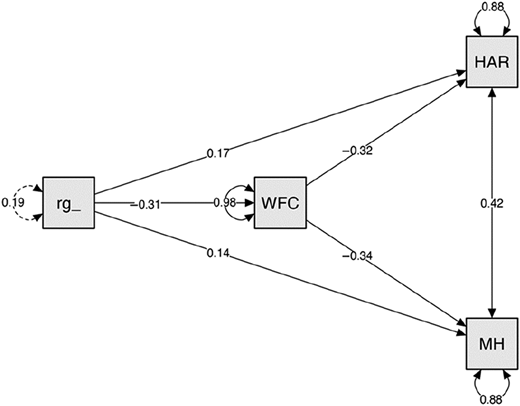
Path coefficients of the indirect effect model. Note: RG = Modality of work; WFC = Work-family conflict; HAR = Harmony; MH = Mental health. Source: Authors’ own work
Path coefficients of the indirect effect model. Note: RG = Modality of work; WFC = Work-family conflict; HAR = Harmony; MH = Mental health. Source: Authors’ own work
Firstly, the test of the indirect effect showed that WFC significantly mediated the relationship between the work regime and harmony (β = 0.10; p < 0.05; 95% CI [0.00; 0.20]). The model explained 11% of the variance in harmony (R2 = 0.11). Thus, H1a was supported by the data.
Secondly, the results showed a similar pattern for mental health, i.e. the coefficient associated with the indirect effect was statistically significant (β = 0.11; p < 0.05; 95% CI [0.00; 0.21]). Overall, the model explained 13% of the variance in mental health (R2 = 0.13) (Table 3); therefore, H1b also received support from the data.
Direct and indirect effects
| Indirect effects | Estimate | P | CI 95% LLCI | ULCI |
|---|---|---|---|---|
| Modality → WFC → Harmony | 0.10* | 0.04 | 0.00 | 0.20 |
| Modality → WFC → Mental health | 0.11* | 0.04 | 0.00 | 0.21 |
| Direct effects | ||||
| Modality → Harmony | 0.17 | 0.20 | −0.09 | 0.42 |
| Modality → Mental health | 0.14 | 0.31 | −0.13 | 0.40 |
| Total effects | ||||
| Modality → Harmony | 0.27* | 0.05 | 0.00 | 0.53 |
| Modality → Mental health | 0.24* | 0.05 | 0.00 | 0.52 |
Note(s): N = 376; *p < 0.05 **p < 0.001. WFC = Work-family conflict
Source(s): Authors’ own work
Discussion
This research relies on the EWLM (Grant et al., 2019) to design a conceptual model testing whether WFC mediates the relationship between the modality of work (on-site, versus telework versus hybrid work) and harmony and mental health. Overall, this study shows that WFC is an explanatory mechanism of the relationship between work modality and well-being indicators (i.e. harmony and mental health).
Theoretical implications
This study offers significant theoretical implications that contribute to the understanding of hybrid work and its impact on WFC, mental health, and life harmony, within contemporary organizational behavior theories. By demonstrating that hybrid work reduces WFC and improves employees’ well-being, the research extends the literature on flexible work arrangements and offers insights into how these models influence broader psychological outcomes, such as mental health and life harmony.
First, the study reinforces the importance of the e-work life model (EWLM), which emphasizes the roles of flexibility and organizational trust in shaping employees’ experiences with telework (Charalampous et al., 2023). It highlights that hybrid work is not merely a shift in location but also a change in how work-life boundaries are managed (Choudhury et al., 2024). The findings suggest that the flexibility in time and space inherent in hybrid work can serve as a mechanism to reduce WFC (Grant et al., 2019), thereby supporting the notion that managing work-family boundaries is crucial for employees’ overall well-being (Junça-Silva, 2023).
Second, the results show that employees working in hybrid environments tend to experience lower levels of WFC, which in turn contributes to greater life harmony and improved mental health. This finding aligns with the EWLM (Grant et al., 2019) and various empirical studies that have demonstrated the positive relationship between telework and mental health (Andrade and Petiz Lousã, 2021; Choudhury et al., 2024; Junça-Silva et al., 2022b).
Hybrid work is associated with increased satisfaction, well-being, and happiness among employees, as well as reduced conflict between work and family life (Mutebi and Hobbs, 2022). For example, the 2022 IWG study found that 66% of hybrid workers reported improved mental health as a result of this work modality, citing more time for personal and family activities, as well as a reduction in work-life conflict (Tsipursky, 2023). Furthermore, the UK’s Office for National Statistics (ONS) found that nearly half of remote workers reported improved well-being due to remote work, with 78% attributing better work-life balance to their ability to work from home (Mutebi and Hobbs, 2022), ultimately leading to improved mental health (Naqshbandi et al., 2024).
Moreover, the study adds depth to our understanding of the relationship between hybrid work and mental health by identifying the mediating role of WFC. It provides empirical evidence that hybrid work enhances life harmony by reducing WFC, supporting the notion that employees’ mental health is influenced not just by the amount of time spent working, but by how effectively work and personal life are integrated. Hybrid work provides the flexibility and autonomy necessary for work-life balance by offering employees greater control over when and where they perform their work tasks, which, in turn, improves mental health (Hopkins and Bardoel, 2023). Thus, hybrid work not only decreases WFC but also promotes life harmony and mental health.
Lastly, the findings contribute to the field of organizational behavior by demonstrating that hybrid work is not merely a temporary response to external crises, such as the COVID-19 pandemic, but a significant work model with long-lasting implications for employee well-being. The study suggests that future theoretical frameworks should place greater emphasis on the intersection of work flexibility, work-family balance, and employee health.
In conclusion, this study advances both the e-work life model and broader organizational theory by emphasizing the role of hybrid work in improving well-being through reduced WFC and enhanced mental health. It deepens our understanding of how work arrangements influence employee outcomes, particularly in the context of modern organizational settings.
Practical implications
This study highlights the importance for organizations to embrace hybrid work, as it has demonstrated significant benefits in reducing WFC, which in turn improves employees’ mental health and life harmony. As hybrid work increasingly becomes a key factor in attracting and retaining talent, particularly among younger generations (Hyman, 2024), organizations must recognize its potential to foster greater work-life balance.
To maximize the benefits of hybrid work, organizations should recognize that there is no one-size-fits-all approach. It is important to tailor hybrid work policies to suit the specific needs of different teams or departments, optimizing flexibility while maintaining productivity. Managers can periodically survey employees to understand their preferences and adjust work schedules, accordingly, ensuring more personalized work experiences.
Organizations should also ensure that the technical infrastructure for hybrid work is in place, providing employees with the necessary tools and resources to work efficiently from home. This includes offering training and establishing policies that guide effective telework practices (Blahopoulou et al., 2022). Monitoring employee satisfaction with telework and gathering feedback through surveys or interviews will allow human resources departments to better understand the impact on workers’ well-being and mental health, enabling them to implement targeted interventions (Naqshbandi et al., 2024).
Additionally, organizations should actively promote mental health initiatives. Given that hybrid work has been shown to reduce work-family conflict and improve mental health, providing support services such as counseling, promoting mindfulness practices, and organizing virtual support groups can help employees manage work-life balance challenges. Creating a mental health-friendly work environment contributes to employee’s well-being and mental health.
Establishing clear boundaries between work and personal life is another crucial implication. Organizations should encourage employees to set these boundaries, particularly in remote environments, by offering guidance on managing time effectively and defining recommended “off hours” to disconnect from work. Providing training on time management, self-care, and personal well-being can ensure employees maintain a healthy work-life balance.
Limitations and future directions
This study has some limitations. Firstly, the small sample size should be highlighted; small samples impair the internal and external validity of a study by limiting the generalizability of results and questioning their reliability (Faber and Fonseca, 2014). Secondly, the study used self-reported measures, i.e. measures based on an individual’s report of their symptoms, behaviors, beliefs, or attitudes (Levin-Aspenson and Watson, 2018). This type of data collection has some limitations, such as individuals being often biased when reporting their own experiences – social desirability (Devaux and Sassi, 2015), which may limit the reliability of the results obtained.
Finally, the study’s two-wave design, where data is collected at two distinct time points, is a limitation as it restricts our ability to capture long-term trends or fluctuations. Unlike a longitudinal study, with at least three time points, this approach does not allow for a more comprehensive understanding of causal relationships over time, making it difficult to fully establish cause-and-effect links.
Based on these findings, it is recommended that future research utilize larger sample sizes to yield more robust and generalizable conclusions. Additionally, employing longitudinal or daily designs could provide valuable insights into fluctuations in employees’ well-being and mental health over time, offering a deeper understanding of how these outcomes evolve. Future studies on hybrid work models could also explore the mediating mechanisms that connect work arrangements to mental health outcomes, further clarifying the pathways through which hybrid work influences employee well-being.
Conclusion
The significance of this study lies in demonstrating that telework, as a flexible approach for employees to manage both their professional obligations and personal lives, yields positive outcomes for their overall well-being. Specifically, the research highlights that hybrid work arrangements impact both work and personal domains, as individuals in such arrangements experience reduced levels of work-family conflict, increased harmony, and enhanced mental health. The COVID-19 pandemic has expedited the adoption of telework and hybrid models, fundamentally altering not only individuals’ lifestyles but also organizational perspectives on work. Consequently, organizations must leverage this newfound flexibility to enhance employee well-being, fostering a culture that prioritizes harmony and mental wellness.
Funding: This work was supported by Fundação para a Ciência e a Tecnologia, grant UIDB/00315/2020.
Conflict of interest statement: The authors declare that they have no conflicts of interest.
Compliance of ethical standard statement: All procedures performed in studies involving human participants were in accordance with the ethical standards of the institutional and/or national research committee and with the 1964 Helsinki Declaration and its later amendments or comparable ethical standards.
Informed consent: Informed consent was obtained from all individual participants involved in the study.
Data availability: The data is available only upon reasonable request to the authors.

