


When households want to hire domestic cleaning services, they need to find a suitable domestic worker candidate themselves, usually in the undeclared economy. Given the undeclared nature of domestic work, our knowledge on what households see as desirable traits in potential domestic worker candidates remains limited.
Using a vignette experiment, we investigate households' hiring preferences and discern the relative importance that households ascribe to different domestic worker characteristics. Respondents each rated fictive domestic worker candidates who differed in terms of ethnic background, language proficiency, price, quality, reliability and in whether workers are insured against income loss during illness. In total, 2007 vignettes were rated by 503 Dutch respondents.
Multilevel regression analysis shows that, except for ethnic background, all vignette dimensions matter, with reliability being most important, followed by price per hour, cleaning quality, language proficiency and insurance against income loss during illness. Additional exploratory analyses further raise questions over whether households are willing to pay a higher price for workers who better meet their preferences.
This study examines whether theories on hiring preferences are applicable to a sector in which most employers are private households. In so doing, we shed light on hiring preferences in a large but invisible sector. These findings are valuable to companies that sell domestic cleaning services on the formal market as well as policymakers who aim to formalize work in the sector and to provide better protections to domestic workers.
1. Introduction
Millions of households hire a domestic worker who cleans their homes or does their laundry (International Labour Organization, 2021; Jokela, 2015). Despite attempts of governments to intervene in this market through regulations (see Morel, 2015), up to 70% of all domestic work is estimated to take place in the undeclared economy (European Labour Authority, 2021), making it difficult for governments to effectively enforce regulations. Even when regulations exist on paper, the market for domestic services may still be structured by supply and demand forces in practice (Bernhardt et al., 2013). For example, without effective policies that ensure compliance with the statutory minimum wage and that safeguard fair hiring practices, households' hiring behaviour will mainly be informed by what they find desirable worker traits and what they consider a fair price to pay. This means that households play an important role in shaping the market for domestic services. Yet, our understanding of what households find important when looking for a domestic worker candidate remains limited. This is whilst such an understanding could be of help in formulating more effective regulations. Especially in sectors like domestic services, where compliance with regulations is hard to enforce through penalization, governments need to find ways to incentivize compliance. By taking into account the preferences of the (potential) buyers of domestic services, future attempts to regulate the sector may prove more successful. Hence, this article examines what factors shape hiring preferences in domestic services.
Previous work on hiring preferences in domestic services is scarce. Nonetheless, existing contributions have begun to identify potentially relevant factors, including households' ethnic preferences (Abrantes, 2014; Theys et al., 2020), the price of the service (Flipo et al., 2007), domestic workers' professionality and training (Nisic et al., 2023) and the organization of the labour relationship (Adriaenssens et al., 2021; Du Toit and Heinecken, 2021). This article contributes to this emerging literature by considering several potentially relevant factors simultaneously and by examining the relative importance that different factors play in shaping households' hiring preferences. Drawing on sociological and economic theories, this article examines the extent to which theoretical insights on hiring preferences in general are applicable to a sector in which most employers are private households. Specifically, we consider the price of the service, the quality and reliability of a domestic worker and their ethnic background and language proficiency. More exploratively, we also examine whether people prefer domestic workers who take out insurance against illness over uninsured workers. Especially when people engage in a direct employment relationship with a domestic worker, they often make no arrangements for what happens when a domestic worker cancels due to illness (De Kort and Bekker, 2024; De Kort et al., 2026). This renders domestic workers vulnerable to sudden losses of income, but also places households in an ambiguous position, as they may be unsure how far their responsibilities towards their domestic help reach in that respect (also see Botman, 2011; Sternberg, 2019). Knowing that a domestic worker is insured against losses of income thus provides clarity, which may not only be desirable for domestic workers, but for households as well.
Inspired by an emerging literature that uses survey experiments to study domestic work (e.g. Abraham et al., 2023; Nisic et al., 2023; Theys et al., 2020), this article uses a vignette experiment, which is also known as a factorial survey experiment. Vignette experiments are well-suited for studying hiring preferences. Compared to regular surveys, vignette experiments better mimic real-life situations. In surveys, hiring preferences are examined on an item-by-item basis, allowing people to rate the importance of different domestic worker characteristics in isolation. This does not just increase the risk of social desirability, but also poorly reflects real-life scenarios, where households are confronted with multidimensional domestic worker candidates, forcing them to make trade-offs based on the relative importance that they ascribe to different worker characteristics (Liebig et al., 2015). Vignette experiments are able to do justice to this multidimensionality, as respondents rate several multidimensional candidates that differ on theoretically relevant dimensions (Auspurg and Hinz, 2015).
Our vignette experiment was integrated in wave 3 of the Sustainable Workforce Survey, collected in the Netherlands among employees of forty-eight organizations. 503 respondents rated 2007 vignettes. Running the experiment among working individuals has two advantages. Firstly, vignette experiments are often conducted in student samples rather than in the actual target population. While convenient, student samples are known for poorly reflecting the attitudes in the target population (Hainmueller et al., 2015). Compared to students who usually lack the resources to buy domestic services, respondents in paid work are more likely to be part of the target population. Secondly, demand for domestic services can be divided into two subgroups (Devetter, 2016). One consisting of people who are dependent on domestic services due to old age, illness or disability. The other comprising working individuals who buy domestic services due to time constraints or out of convenience. In the Dutch context, the latter subgroup is not just the largest, with estimates of close to a million households (Panteia, 2014), but also hardest to regulate. Whereas the former subgroup often receives domestic services via state-funded cash-for-care or care-in-kind schemes, the latter subgroup still primarily buys services in the undeclared economy. Limiting our sample to working individuals, we limit the focus to people in the latter subgroup who hire domestic services on their own behalf and for whom no effective regulations exist.
2. Overview of potentially relevant factors and hypotheses
2.1 Price, quality and reliability
Following the basic economic laws of supply and demand (Pindyck and Rubinfield, 2017), demand for a product or service declines when the price of the product or service rises, particularly so for products and services that people do not necessarily need or that they can easily replace with alternatives, so-called substitutable goods. We assert that domestic services are substitutable for two reasons (Tijdens, 2000). Firstly, assuming that households hire a domestic worker to buy themselves time (Van der Lippe et al., 2004), households can also buy themselves time through other purchases, such as buying time-saving appliances (e.g. dishwashers and robot vacuum cleaners) or using other time-saving services (e.g., grocery deliveries and takeout meals). Secondly, with the exception of people who hire a domestic worker due to disability or old age, most people have the skills to clean their homes themselves. Households thus have the option to clean their own homes, thereby replacing domestic services with their own time and effort (Bailly et al., 2013). Given these alternatives, we assert that the price that a worker charges plays an important role in households' considerations. This resonates with the finding that demand for domestic services is price sensitive (Farvaque, 2013; Flipo et al., 2007) and results from experiments that reveal a preference for cheaper workers (Nisic et al., 2023; Theys et al., 2020). With this in mind, we pose the following Hypothesis:
There is a negative association between the price that a domestic worker charges and the hireability score that a worker receives.
When looking for a domestic worker, however, households may not just consider the price of a worker but also what that worker gives them. Hiring preferences may therefore also be shaped by the expected service quality (Du Toit, 2020; Williams et al., 2012). Although previous literature shows that skills associated with feminized cleaning and caring jobs are undervalued societally and in the labour market (England, 2005; Hochschild, 2012), it does take skills to be a domestic worker. When domestic workers have better cleaning skills, they also add more value for households, as they do not just save households time but also deliver a home that is cleaner than it would have been if households hired a less skilled alternative. This added value may render higher-skilled workers more attractive to households (Becker, 1962). Scarce previous findings also point in this direction. Nisic et al. (2023), for example, find that households have a higher hiring preference for domestic workers with higher quality signals, such as having professional training and more years of work experience. Relatedly, a study on housecleaning companies in South Africa shows that the quality and training of domestic workers play a role in households' decision to hire someone via a professional cleaning company instead of recruiting a worker on the private market (Du Toit and Heinecken, 2021). Hence, we test the following Hypothesis:
Domestic workers with better cleaning skills receive higher hireability scores than less skilled counterparts.
Related to the quality of the service, service reliability may be important too (Williams et al., 2012). Having an unreliable domestic worker who has the tendency to cancel unexpectedly can be problematic, not least as unreliable domestic workers cost households time and effort. In case of cancellations, households will need to clean their homes themselves, reschedule the appointment or live in a messy house. Relatedly, people adjust their schedules to cleaning appointments, either making sure that they are home during cleaning appointments for monitoring purposes (Abraham et al., 2023) or ensuring that they are not home during cleanings to avoid awkward interactions (Hondagneu-Sotelo, 2001; Moras, 2008). Last-minute cancellations can thus be a nuisance, as it means that households have adjusted their schedules to the cleaning appointment for no reason. This brings us to our third Hypothesis:
Domestic workers that are more reliable receive higher hireability scores than less reliable counterparts.
2.2 Discrimination
Apart from economic considerations, other factors may be at play too. Like in other sectors of the labour market, hiring discrimination may also occur in domestic work. Taste-based discrimination theory (Becker, 1971) explains hiring discrimination through employers' tastes, arguing that employers have discriminatory tastes in favour of people more similar to them and against people more different from them, causing them to avoid contact with the latter (Lippens et al., 2022). This may be particularly so in this sector, as domestic work takes place in the private household of the employer, meaning that employers are in close contact with their domestic help, especially when they stay home during cleanings. Even when employers do not stay home during cleaning visits, thus avoiding direct contact, they may still feel uneasy with the idea of that person being in their private homes and around their valuable belongings. Domestic workers' ethnic background may represent a prevalent ground for hiring discrimination, as ethnic background is known to constitute a salient distinguishing feature in the job market and society at large (Derous et al., 2016). Moreover, it is to be expected that the sector employs a large number of migrants, as the housework in wealthy households is increasingly done by women who migrate from less prosperous parts of the globe (see Lutz, 2011; Parreñas, 2000). From this, we derive the following Hypothesis:
Domestic workers with non-native backgrounds receive lower hireability scores than workers with native backgrounds.
Language proficiency may play a role too (Du Toit, 2016; Romero, 1999; Theys et al., 2020). A shared language is not just a source of cultural similarity, but also enables efficient communication between households and workers, making it easier to give instructions and to avoid misunderstandings. Based on stereotypes, households may assume that non-native workers lack native language skills, rendering non-native workers less attractive. Households' wariness of hiring a non-native domestic worker may thus also partly be due to expected difficulties in communication rather than their ethnic background per se. As per statistical discrimination theory (Phelps, 1972), it can be expected that households are less wary of hiring a non-native worker when they have positive information about that worker, in this case knowing that a non-native worker is proficient in households' native tongue. We therefore test the following Hypothesis:
The negative effect of having a non-native background on hireability scores is larger for non-native workers without native language skills.
Previous work indicates that domestic workers' ethnicity matters, but is inconclusive on how it does. Some find that households have a preference for native workers and workers with ethnicities more similar to their own (Nisic et al., 2023; Safuta, 2018; Theys et al., 2020). Findings from qualitative studies however show that workers from specific ethnicities are seen as having skills that are highly relevant to domestic work. Based on stereotypes, workers from specific ethnicities may, for example, be seen as less intrusive or harder working than natives (Abrantes, 2014; Anderson, 2007).
2.3 Worker insurance
When households hire a domestic worker, they are not just buying a cleaning service but also engaging in a labour relationship, which often means that they become employers. Previous studies however show that many households do not identify as employers or feel uncomfortable in that role (Hondagneu-Sotelo, 1997; Moras, 2008; Pfau-Effinger, 2009). Given households' avoidance of the employer-role, labour relations between households and domestic workers often are vague, lacking clear arrangements on the responsibilities that both parties carry towards each other (Cruz and Abrantes, 2014). The lack of clear arrangements can be problematic for domestic workers, as they do not know what households expect from them and are unsure about what they can expect from households. The lack of clear arrangements may however also be undesirable for households, as households will find themselves in awkward situations where they are unsure what to do and doubt how far their responsibilities towards their domestic help reach, for example whether they should continue payments when cleaning appointments are cancelled due to a domestic worker being ill or injured (also see Botman, 2011; Sternberg, 2019). In line with this, Du Toit and Heinecken's (2021) study on South African households that hire a domestic worker via housecleaning companies finds that many households resort to professional companies as it enables them to limit their financial responsibilities and contractual obligations towards domestic workers. Knowing that a domestic worker takes out insurance against losses of income due to illness also provides both parties with clarity: workers know that they will not lose income and households know that they have no further responsibilities towards domestic workers. We assert that households appreciate such clarity and therefore pose the following Hypothesis:
Domestic workers that take out insurance against losses of income receive higher hireability scores than workers without such insurance.
3. Data and methods
3.1 Sample
Our vignette experiment was added to wave 3 of the European Sustainable Workforce Survey conducted in the Netherlands in 2023/2024 (Van der Put et al., 2024). It is a hierarchical dataset on employees nested in teams and organizations. Organizations were approached using stratified sampling based on sector (manufacturing, education, healthcare, ICT, transport and financial services) and size (up to 100, 101–250 and more than 250). A national business list was used to approach organizations to participate in the online survey. Participating organizations received a benchmark report based on survey results. Forty-eight organizations filled out questionnaires. This particular research uses data from the employee questionnaire, which contains data on 2031 individuals from forty-eight organizations. Given that the survey also contained a vignette experiment on parttime workers' attitudes towards working more hours, only full-time workers were redirected to our vignette experiment. This has consequences for the representativity of the sample. Compared to full-time workers, part-time workers may, for example, have more available time and could therefore display a lower overall willingness to hire a domestic worker or be pickier in selecting a suitable domestic worker candidate. Another consequence of excluding part-time workers is that men are overrepresented in the sample (64%). It is often assumed that labour relationships in domestic services primarily exist between women, with women hiring other women to take over their housework (Hondagneu-Sotelo, 2001, p. 38). If that is true, women may have a larger say in the hiring process than their male partners, meaning that, in co-residing couples, women's hiring preferences may be more relevant for understanding hiring outcomes (we return to this point in the additional analyses and discussion). Nonetheless, male preferences are informative too, as single men also hire domestic services and as men's preferences may reflect the preferences of their partner.
Out of 2031 respondents, 537 respondents were assigned to our experiment. We excluded respondents who did not evaluate any of the vignettes as well as respondents with missings on other items used in the analysis. This leaves us with a final sample of 503 respondents, rating 2007 vignettes.
3.2 Vignette method and procedure
In vignette experiments, respondents are presented with a set of fictive scenarios that differ on theoretically relevant dimensions and are then asked to rate these scenarios (Auspurg and Hinz, 2015). In this study, respondents were presented with different fictive domestic worker candidates and asked to rate each of these candidates, stating for each candidate how likely they would be to hire them. By varying worker characteristics over vignettes, we can discern how each characteristic influences respondents' ratings and assess the relative importance of each characteristic (Liebig et al., 2015). In the Dutch context, the hiring process in domestic work often runs via informal referrals (De Kort et al., 2026). This raises the question of whether the scenario of households evaluating multiple domestic workers is realistic. We believe that it is, especially so in situations where households ask around in their network, getting information on a few domestic workers. In that case, households need to decide which worker appears more attractive to them and which domestic worker they want to give a call first.
We used a design with five dimensions, each consisting of two or three levels (3×3×2×2×2), resulting in a vignette universe with seventy-two unique domestic worker profiles. All respondents were asked to rate four vignettes that were shown to them one-by-one. The four vignettes were randomly picked from the vignette universe without replacement to ensure that respondents were not rating the same profile twice and to ensure “level balance”, meaning that all vignette levels occur roughly the same number of times (Dülmer, 2016). Before the experiment, respondents were shown the text: “We ask you to take part in a thought-experiment. Imagine that you are currently looking for a domestic worker who will clean your home for three hours every week. After this, we will show you four potential candidates. All four candidates are women. Please rate these candidates on a scale from 1 (very unlikely) to 10 (very likely) to state how likely it is that you will choose that candidate as your domestic worker”.
The introductory text shows that we fixed domestic workers' gender to female. We do not include gender as a vignette dimension, primarily as there are few male domestic workers (International Labour Organization, 2021). Vignettes describing male domestic workers may therefore appear implausible. To make the situation more realistic, we further fixed the frequency and duration of cleaning visits to three hours per week, as this is common in Dutch households (Panteia, 2014). Respondents may further be more interested in the total costs of hiring help than in the hourly price. For example, 19.50 euros per hour may be acceptable when a worker needs two hours, but not when she needs four. Fixing the frequency and duration of cleanings provides clarity about the total costs.
3.3 Measurements
3.3.1 Dependent variable
The dependent variable in this article is the hireability score that respondents give to fictive worker profiles, measured on a 10-point Likert scale ranging from 1 (highly unlikely) to 10 (highly likely).
3.3.2 Vignette dimensions
Table 1 displays the five vignette dimensions, their levels and text. Vignette dimensions were ordered the same in all vignettes (ordered as in Table 1). To measure domestic workers' ethnic background, we use three levels. Distinguishing between native workers and non-native workers with and without Dutch language proficiency, we disentangle ethnicity from native language skills (Nisic et al., 2023; Theys et al., 2020). Table 1 further shows that fictive domestic worker profiles charge three different hourly prices. The lowest price was set to 13.50 euros as lower prices may appear unrealistic. Estimates show that the majority of Dutch households that hire a domestic worker pay 15 euros an hour or more (De Kort et al., 2026), meaning that prices too far below that may seem implausible. Upon consultation with experts at the Ministry of Social Affairs and Employment, we also made sure that the lowest price option was close to the Dutch minimum wage, which was just under 13.50 euros in January 2024 (Rijksoverheid, n.d.). Lastly, low prices may result in unrealistic vignette combinations. For example, it is unlikely that a reliable worker with excellent cleaning skills charges 10 euros per hour.
Vignette dimensions, levels and text
| Dimensions | Levels | Text |
|---|---|---|
| Ethnic background/language | 0 |
|
| 1 |
| |
| 2 |
| |
| Price per hour | 0 |
|
| 1 |
| |
| 2 |
| |
| Service quality | 0 |
|
| 1 |
| |
| Service reliability | 0 |
|
| 1 |
| |
| Insurance | 0 |
|
| 1 |
|
The other three dimensions consist of two levels. As per the hypotheses, we consider domestic workers' quality (cleaning skills) and reliability (tendency to cancel unexpectedly). Assuming that no one prefers a bad cleaner or one who cancels all the time, we only distinguish between workers whose quality and reliability are average or above average. Lastly, we assess whether respondents prefer a worker who takes out insurance against income loss during illness over a worker without such insurance.
3.3.3 Controls
We control for the following respondent characteristics: gender, age, education, income, household composition and country of birth. Gender is measured dichotomously and respondent age is measured in years. For education, we use the distinction of Statistics Netherlands (CBS), distinguishing between low, middle and high. For income, we use personal net monthly income, measured continuously. For respondents who only provided their income on an interval scale, we imputed the mean of the interval's minimum and maximum (e.g. the interval 1,020–1,330 euros becomes 1,175 euros on the continuous variable). Although we would ideally use household incomes, personal income has fewer missings. The personal monthly income is measured in thousands of euros. For household composition, we consider whether respondents have a co-residing partner and co-residing children (both dichotomous). Country of birth is also measured dichotomously, with a score of 1 referring to respondents born in the Netherlands.
Previous research shows that not all households are equally open to the idea of hiring a domestic worker who helps them with their housework (e.g. Trübner and Nisic, 2024). Respondents who are less open to the idea of hiring a domestic worker in the first place may give different hireability scores. To control for this, we use two items from the survey to create the dummy variable “openness to hiring domestic help”. Respondents who answered “yes” to the question “Do you currently hire domestic help?” (17.8%) and respondents who do not hire help but answered “yes” to the item “Have you ever considered hiring domestic help?” (33%) get a score of one, others score zero. Furthermore, given that respondents rate multiple vignettes, learning effects or fatigue may be at play. We therefore also include the variable “vignette number”, indicating whether a vignette was the first, second, third or fourth vignette shown to a specific respondent. Lastly, hiring preferences may be different in highly urbanized areas, where domestic workers may be scarcer. The tighter the market, the less picky households may be. Unfortunately, we lack information on respondents' place of residence. Instead, we use the location of the organization that respondents work for. This location was linked to data from Statistics Netherlands (CBS) that provides municipalities with a score for the degree of urbanization on a 5-point scale.
3.4 Analytical strategy
In vignette experiments, vignettes are the units of analysis. Given that respondents evaluate several vignettes, vignette evaluations are nested within respondents (Auspurg and Hinz, 2015). Due to the hierarchical structure of vignette data (Hox et al., 1991), we use linear multilevel regression models. We first ran an empty model, which gave an intraclass correlation coefficient (ICC) of 0.44 (not shown), meaning that 44% of the variation in hireability scores can be attributed to characteristics on the respondent level. We do not take into account the third level (organizations), as the ICC is negligible in size (not shown). The primary goal of the analysis is to examine the main effects of vignette dimensions and to discern the relative importance of each vignette dimension. In the additional analyses, we also run a model with the interaction terms between price and other vignette dimensions to examine whether respondents ascribe less importance to price when domestic workers are better, more reliable and take out insurance. Previous research however shows that interaction effects between vignette dimensions are difficult to identify in random vignette experiment designs and require large sample sizes (see Su and Steiner, 2018; Treischl and Wolbring, 2022). Results from this additional analysis therefore primarily serve an exploratory goal and should thus not be seen as a solid test of interaction effects.
4. Findings
4.1 Main findings
Descriptives in Table 2 indicate that the randomization of vignettes was successful. For the three-level vignette dimensions (price and ethnicity/language), means are close to 0.33. For two-level dimensions (quality, reliability and insurance), the mean is approximately 0.5. This indicates that all levels of the five vignette dimensions occurred roughly the same number of times. Correlations between dimensions (not shown) are small and not significant, which is indicative of successful randomization as well. Table 2 indicates that the average hireability score was close to the middle point at 5.7. Figure 1 shows that 7 was the most occurring hireability score (20.38%). The figure also indicates that a non-negligible number of fictive worker profiles were rated with the lowest score of 1 (12.36%). 27 out of 503 respondents (5.4%) evaluated all their vignettes with a score of 1 (we return to this point in the additional analyses).
Descriptives
| Mean | Std. Dev | Range | |
|---|---|---|---|
| Dependent variable | |||
| Hireability score | 5.70 | 2.51 | 1–10 |
| Vignette dimensions | |||
| Ethnicity/language | |||
| Native Dutch | 0.34 | 0–1 | |
| Non-Dutch, speaks Dutch | 0.33 | 0–1 | |
| Non-Dutch, speaks no Dutch | 0.33 | 0–1 | |
| Price per hour | |||
| €13.50 | 0.33 | 0–1 | |
| €16.50 | 0.34 | 0–1 | |
| €19.50 | 0.33 | 0–1 | |
| Service quality | |||
| Average cleaning skills | 0.50 | 0–1 | |
| Excellent cleaning skills | 0.50 | 0–1 | |
| Service reliability | |||
| Sometimes cancels unexpectedly | 0.50 | 0–1 | |
| Rarely ever cancels | 0.50 | 0–1 | |
| Insurance | |||
| Worker has no illness insurance | 0.50 | 0–1 | |
| Worker has illness insurance | 0.50 | 0–1 | |
| Respondent characteristics | |||
| Gender | |||
| Man | 0.64 | 0–1 | |
| Woman | 0.36 | 0–1 | |
| Age | 43.66 | 12.28 | 18–66 |
| Educational level | |||
| Low | 0.10 | 0–1 | |
| Middle | 0.28 | 0–1 | |
| High | 0.62 | 0–1 | |
| Personal monthly income (1000s) | 3.02 | 0.79 | 0.63–9 |
| Partner | 0.73 | 0–1 | |
| Children | 0.47 | 0–1 | |
| Native Dutch | 0.90 | 0–1 | |
| Degree of urbanization | 2.65 | 1.38 | 0–4 |
| Openness to hiring domestic help | 0.51 | 0–1 | |
| Vignette number | 2.5 | 1.12 | 1–4 |
Note(s):N(vignettes) = 2007; N(respondents) = 503. Standard deviations are not reported for dichotomous variables
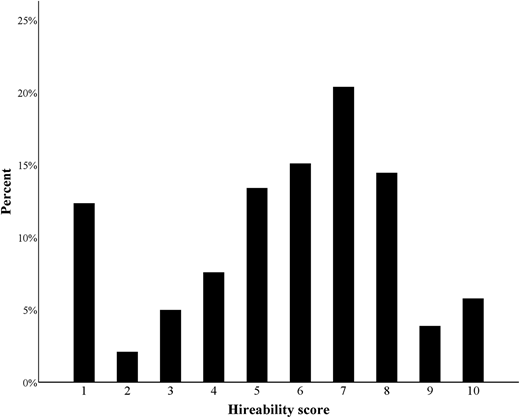
Table 3 displays the estimates from the multilevel regression model. Hypothesis 1 predicted that the price of the service negatively affects hireability scores and this does indeed show from the regression output. Compared to workers who charge 13.50 euros an hour, workers charging 16.50 euros do, on average, get a hireability score that is 0.485 lower (p < 0.001). Workers who charge 19.50 euros even get hireability scores that are more than a full point lower than workers who charge 13.50 euros (B = −1.071, p < 0.001). Changing the reference category shows that workers charging 16.50 euros are considered as more hireable than workers charging 19.50 euros (B = −0.586, p < 0.001, not shown). As per Hypothesis 2, we find that domestic workers with excellent cleaning skills receive higher hireability scores than average-skilled counterparts (B = 0.839, p < 0.001). The same goes for service reliability (Hypothesis 3). Out of all vignette dimensions, reliability has the largest effect on domestic workers' hireability scores, with reliable workers scoring 1.354 higher than workers who sometimes cancel unexpectedly (p < 0.001).
Results from multilevel regression analysis (unstandardized coefficients)
| B | S.E. | |
|---|---|---|
| Vignette dimensions | ||
| Ethnicity/language | ||
| Native Dutch | Ref. | Ref. |
| Non-Dutch, speaks Dutch | −0.046 | 0.096 |
| Non-Dutch, speaks no Dutch | −0.817*** | 0.096 |
| Price per hour | ||
| €13.50 | Ref. | Ref. |
| €16.50 | −0.485*** | 0.095 |
| €19.50 | −0.1.071*** | 0.095 |
| Service quality | ||
| Average cleaning skills | Ref. | Ref. |
| Excellent cleaning skills | 0.839*** | 0.079 |
| Service reliability | ||
| Sometimes cancels unexpectedly | Ref. | Ref. |
| Rarely ever cancels | 1.354*** | 0.078 |
| Insurance | ||
| Worker has no illness insurance | Ref. | Ref. |
| Worker has illness insurance | 0.383*** | 0.078 |
| Respondent characteristics | ||
| Gender | ||
| Man | Ref. | Ref. |
| Woman | 0.087 | 0.191 |
| Age | −0.013† | 0.008 |
| Educational level | ||
| Low | Ref. | Ref. |
| Middle | 0.037 | 0.318 |
| High | 0.182 | 0.324 |
| Personal monthly income (€1000s) | 0.130 | 0.124 |
| Partner | −0.096 | 0.203 |
| Children | −0.262 | 0.185 |
| Native Dutch | −0.138 | 0.284 |
| Degree of urbanization | −0.003 | 0.066 |
| Openness to hiring domestic help | 0.573*** | 0.173 |
| Vignette number | −0.017 | 0.031 |
| Constant | 5.325*** | 0.577 |
| Variance vignette level | 2.453 | 0.090 |
| Variance respondent level | 2.838 | 0.220 |
Note(s): †p < 0.1; *p < 0.05; **p < 0.01; ***p < 0.001
Hypothesis 4 and 5 predicted that native Dutch domestic workers are considered more attractive than workers with a non-Dutch background, especially when non-native workers do not speak Dutch. Results show that workers with a non-Dutch background who do not speak Dutch are seen as less hireable than Dutch workers (B = −0.817, p < 0.001), but find no significant difference between workers with a Dutch background and non-Dutch workers with proficiency in Dutch (B = −0.046, p = 0.635). This suggests that it is domestic workers' proficiency in Dutch that matters rather than having a Dutch background per se. Changing the reference category shows that Dutch-speaking non-Dutch domestic workers score 0.771 higher than non-Dutch workers who do not speak Dutch (p < 0.001, not shown). In line with Hypothesis 6, results show that respondents prefer domestic workers who take out insurance against illness over uninsured workers (B = 0.383, p < 0.001). Compared to the other vignette dimensions, the effect of worker insurance is small. Looking at the controls, we find that the control “openness to domestic help” is statistically significant, meaning that people who hire help or have considered doing so give higher scores. None of the other controls is significantly associated with hireability scores.
4.2 Additional analyses
We ran additional analyses to better situate our findings. As stated, men and women may have different hiring preferences. Hence, we ran a model containing the cross-level interactions between gender and the five vignette dimensions (Table A, supplementary materials). Interaction terms indicate that the effect of service quality is stronger for women than for men (B = 0.359, p = 0.029). This could mean that women have higher cleanliness standards. The interaction term for gender and insurance is not statistically significant at 5% (p = 0.061) but suggests that women's preferences may be more sensitive to workers who take out insurance against income loss during illness (B = 0.305). A possible explanation for this is that, in co-residing couple households, women are the ones responsible for managing communication with domestic workers and they will therefore also be the ones who need to make the difficult decision on what to do when a worker calls in sick. The additional analysis thus shows that men and women value the same worker traits, albeit that women value some traits more than men. As stated earlier, more than 5% of respondents evaluated all domestic worker candidates presented to them with the lowest hireability score of 1. In line with previous research, this could indicate that these respondents are principally opposed to the idea of hiring a domestic worker, for example due to normative objections against hiring someone to do their housework or because of gendered expectations regarding housework (De Ruijter et al., 2005; Trübner and Nisic, 2024). We also ran the model without respondents who rated all fictive domestic worker profiles with the lowest score of 1 (N = 1901 ratings), which did not alter results.
We also ran a model with the interaction terms between price and quality, reliability and insurance (Table B, supplementary materials). Significant positive interaction terms would suggest that the negative effect of price becomes smaller, or even vanishes, when domestic workers offer higher quality, are more reliable or take out insurance. Results show that none of the interaction terms are statistically significant. This implies that the importance that respondents ascribe to the price of a domestic worker is persistent. As was mentioned earlier, however, it requires large samples to discern interaction effects between vignette dimensions, meaning that this result is best viewed as exploratory.
5. Conclusions and discussion
When households are in the market to hire a domestic worker, they usually need to look for a suitable candidate themselves. Our understanding of what households see as desirable domestic worker traits remains limited, however. Using a vignette experiment, this article examined households' hiring preferences. 503 Dutch respondents were each asked to rate fictive domestic worker profiles, stating for each domestic worker how likely they would be to hire her. Fictive domestic workers differed on the following dimensions: ethnic background, language proficiency, hourly price, service reliability, service quality and whether they are insured against losses of income during short spells of illness.
With the exception of ethnic background, all vignette dimensions play a role in households' hiring preferences. Reliability is most important, followed by price, quality, language proficiency and insurance. This brings us to the following conclusions. Firstly, households prioritize finding a domestic worker whom they can rely upon. This corroborates previous research that hints at the importance of service reliability (e.g. Williams et al., 2012) and even shows that households value reliability more than they value the price of the service. Secondly, while jobs in domestic cleaning services are often portrayed as jobs that require few competences (Bailly et al., 2013), it seems worthwhile for domestic workers to invest in their cleaning skills as it does increase their chances of being hired. This is in line with an earlier vignette study that shows that households have a preference for domestic workers who display higher quality signals (Nisic et al., 2023). Thirdly, the finding that it is not ethnic background per se but language proficiency may suggest that hiring discrimination in the sector does not follow the logic of taste-based discrimination but that of statistical discrimination (Phelps, 1972), meaning that the wariness to hire a non-native domestic worker fades once households get positive information about a worker's language skills. This finding warrants future research as it does not fully align with previous studies using similar designs (Nisic et al., 2023; Theys et al., 2020). While these previous studies also find that language matters, they also identify a preference for native over non-native workers with language proficiency. Fourthly, although insurance is clearly valued less than other worker traits, people do prefer insured workers over non-insured alternatives. This suggests that improving the income security of domestic workers through insurance is not just beneficial for workers but also for households.
Our explorative findings imply that households want to get the best possible candidate at the lowest cost. Although this may seem commonsensical and is likely not unique to the sector of domestic cleaning services, it does pose particular challenges to this sector. As Bailly et al. (2013, p. 310) argue, the sector for domestic services faces a “precarity trap”, where households' low willingness to pay for cleaning services due to cheaper, undeclared alternatives results in poor working conditions, which in turn attracts low-skilled workers and pushes away skilled workers to jobs in other occupations. Our findings point in a similar direction, as they suggest that the negative effect of price does not get smaller when domestic workers score better on other dimensions. If this is really the case, this means that even though it is possible for domestic workers to positively distinguish themselves from other domestic workers – for example by rarely cancelling appointments, by providing higher-quality cleaning or by taking out their own insurance – chances are that their positive distinction does not pay off, at least not in a monetary sense. This finding should however be interpreted as exploratory rather than conclusive.
Our conclusions should be interpreted in light of this article's limitations. Firstly, we use dichotomous measures for ethnic background and language proficiency. It is unlikely that hiring discrimination solely runs along native/non-native divides, as it likely follows a hierarchy with some non-native ethnicities being more susceptible to discrimination than others (Theys et al., 2020). A similar point applies to language. Households and domestic workers may also communicate in English, which may be less ideal but still acceptable. Secondly, the sample is not representative as we only include full-time workers due to data restrictions, meaning that we cannot examine whether differences exist between the preferences of full-time and part-time workers. The sampling of full-time workers further results in an overrepresentation of men. The additional analyses show that the overrepresentation need not be problematic as preferences of men and women are not fundamentally different. It should be stated however that the women in our sample are all full-time workers, while the majority of Dutch working women work part-time. This warrants some caution regarding the generalizability of findings. Thirdly, while the use of fictive scenarios in vignette experiments has several advantages, it also means that hiring preferences are examined in hypothetical situations, which raises questions over the degree to which vignette outcomes resemble real-life hiring decisions. This study places all respondents in the scenario of being in the market to hire a domestic worker, even when they are not actually considering hiring someone. This may have consequences for the degree to which the identified hiring preferences reflect actual hiring behaviour and thus calls for some caution in generalizing our findings to real life.
Despite these limitations, our findings contain important insights for companies that sell formalized domestic cleaning services to households as well as policymakers who aim to formalize work in the sector. Echoing previous insights, we find that companies may be able to distinguish themselves from undeclared services by ensuring service continuity, for example by offering replacements when a domestic worker cancels (Du Toit and Heinecken, 2021); or by guaranteeing quality standards, for instance by providing training to domestic workers (Nisic et al., 2023). The conclusion that households display a preference for domestic workers who are insured against income loss during illness further suggests that companies can positively distinguish themselves from the undeclared market by advertising that they protect workers against income loss. The importance that households ascribe to price poses serious challenges, however. Investing in the qualities of domestic workers and in their social protection results in a higher price for households (Du Toit, 2020) and our conclusions cast doubt over whether companies can charge higher prices without pricing themselves out of the market (also see Bailly et al., 2013; Devetter and Rousseau, 2009). This is where governments could step in, for example through subsidy schemes like the Belgian service vouchers or the French Chèque Emploi Service Universel (CESU) (Carbonnier and Morel, 2015). In short, these schemes subsidize households that hire a domestic worker in the declared economy, often via companies, thereby reducing the price difference between hiring someone in the declared versus the undeclared economy. Although these subsidy schemes require considerable public spending, potential positive outcomes of these subsidies have often been highlighted in policy circles. Subsidy schemes may, for example, help curb undeclared work and foster female labour market participation (Morel, 2015). Moreover, domestic workers who work via these subsidy schemes often enjoy the same protections as workers in other sectors. By adopting subsidy schemes, policymakers may therefore also contribute to an improvement in the protection of a vulnerable group of domestic workers who currently work in the undeclared economy.
Ethical statement
Data collection and the study received ethical approval from the Ethics Committee of the Faculty of Social and Behavioural Sciences of Utrecht University under numbers 23-0174 and 26-0033.
The supplementary material for this article can be found online.

