


The status and attractiveness of vocational education and training (VET) is increasingly the focus of public debate internationally. A closer analysis of the literature on the topic makes it clear that many different terms are used, some with different understandings. What is hidden in the academic discussion behind terms such as status, standing or even attractiveness, image or esteem is diffuse in many respects.
This article takes up this problem by first taking up the academic literature on the definition of the term and critically reviewing it. In a second step, a structural approach is presented which contextualises the various concepts from the perspective of different actors. The focus here is not to be tailored to single institutions or to individual countries or world regions.
To achieve a structuring of the different approaches, the model design is thus to be made by means of an approach that is orientated towards an actor model and takes motivation-theoretical aspects into account. Consequently, this approach offers a link between individual behaviour and external factors. At the same time, it enables the localisation of various education policy instruments that influence VET in terms of attractiveness.
The model might not fit into all different country-specific conditions and need a socio-cultural adaption in line with the local or regional framing. At the same time, it enables the localisation of various education policy instruments that influence VET in terms of attractiveness.
1. Introduction
The status and attractiveness of vocational education and training (VET) is increasingly the focus of public debate internationally (UNEVOC and Billett, 2018). For example, Guile and Young (2003, p. 63) state: “External reforms refer to attempts to tackle the low status of vocational programmes and their tendency to recruit only lower achieving students who have been rejected for general or academic courses. External reforms involve changes in the relations between the VET system and the system of general education and are concerned with such issues as qualifications and funding.” This statement makes it clear that low status is always in relation to another factor, in this case general education.
At the same time, there is often talk of those with vocational qualifications being stigmatised (Aldossari, 2020), as Caplan (2018, p. 228) pointedly states: “Critics fear that vocational education bears a stigma. Specializing in auto shop tarnishes your image because society infers you ‘lack the talent for anything better’. Restated in the language of signalling: the vocational path sends bad signals about raw ability.” How problematic this social assessment is, however, becomes clear in Caplan’s further remarks (2018, p. 229): “What makes vocational ed’s social return so ample? Status is zero-sum; skill is not. Conventional education mostly helps students by raising their status, but average status cannot rise. Vocational education mostly helps students by building their skills – and average skill can rise.”
In addition, it is an extremely complex issue (Watters, 2009, p. 12), as Billett (2020, p. 161) describes: “Over time, it has been the voices and sentiments of powerful others (e.g. aristocrats, theocrats, bureaucrats, and academics) that have shaped the discourses about the standing of occupations and their preparation (Billett, 2014). Almost all these sentiments have been developed through perspectives that fail to acknowledge the complexity of much of these occupational activities, nor an understanding of the requirements to develop the capacities to perform those tasks.” At the same time, it is clear that the focus is similar but the terms, here in the use of “status” in the first quote and “standing” in the second, are different.
A closer analysis of the literature on the topic makes it clear that many different terms are used, some with different understandings. What is hidden in the academic discussion behind terms such as status, standing or even attractiveness, image or esteem is diffuse in many respects. Consequently, the question of how young people and their parents evaluate different VET options in the context of education planning, or how vocational make their educational choices from this, remains unclear.
This article takes up this problem by first taking up the academic literature on the definition of the term and critically reviewing it. In a second step, a structural approach is presented which contextualises the various concepts from the perspective of different actors (Ayonmike and Okeke, 2019; van der Sluis et al., 2014). The focus here is not to be tailored to single institutions (cf. e.g. Nguyen and LeBlanc, 2001; Lafuente-Ruiz-de-Sabando et al., 2018) or to individual countries or world regions. For the issue is a global one (cf. e.g. Oketch, 2007), as Billett (2020, p. 161) pointedly states: “The societal standing of vocational education is often perceived to be low, compared with other education sectors, albeit more so in some countries than others. However, this issue of standing is global and prevalent in countries with both developed and developing economies.”
2. Status of the conceptualisation and use in the scientific literature
Although the topic of VET attractiveness has been discussed intensively at the political level in many countries for years (cf. e.g. Ratnata, 2013), there is still confusion worldwide regarding the concepts and terminology. In a CEDEFOP report, Lasonen and Gordon (2009, p. 31) state: “Nevertheless, the nature of VET attractiveness is a political concern that has not been thoroughly analysed in research.”
An analysis of the literature on the image of VET also leads to the conclusion that there is no uniform definition of the term. This confusion of terms is particularly evident in a bibliography of the German Federal Institute for Vocational Education and Training (BIBB) and the UNESCO-UNEVOC Centre (2014) on the topic of “Attractiveness of Vocational Education and Training” and in a special issue of the Journal of Vocational Education and Training on the topic of “enhancing the standing of vocational education” (see Billett, 2020). In their introductory chapter to a book on the standing of VET, Stalder et al. (2022) also highlight this complexity and different use of terms and make a very rough distinction between “Institutional Factors Shaping the Standing of VET” and “Personal Factors Associated with Post-school Pathways Decision-Making”. Even this rough subdivision shows the complexity and the associated interdependence in detail. After all, individual career decisions are dependent on the institutional setting and at the same time the individual decisions of young people as a whole in turn influence the institutional conditions. Furthermore, the lines of argumentation and literature sources cited in both documents impressively show the different facets of the discussion. Thus, in connection with image and attractiveness, alternative, complementary or subordinate terms such as value, status, attractiveness, reputation, recognition, standing, prestige, acceptance and (parity of) esteem can be found.
In this section, some internationally significant approaches and definitions will be discussed in overview form, for which four groups of terms will be formed. The grouping was inductively developed form the literature analyses and based on the consistency of the respective lines of discourse. It became clear that several terms used in the literature on the topic can be combined in the first group due to their proximity.
2.1 Attractiveness/standing/reputation/image
Winch (2013, pp. 95–99) uses the term “attractiveness” in his international study. On the one hand, he interprets this in terms of the advantages that the individual can gain through vocational education. In this context, the “parity of esteem” between general and vocational education is of particular importance. On the other hand, the author takes an economic perspective and asks about the advantages of VET in the context of economic issues.
In the CEDEFOP report mentioned earlier in the text, Lasonen and Gordon (2009) also address the concept of attractiveness (p. 76): “VET attractiveness has never been defined in research literature so far, so a definition is a good place to start. As outlined by Lasonen and Manning (2001), the term “attractiveness” is different from that of “standing”, which is more targeted at reflecting educational levels and achievements […]. In a very general sense, attractiveness can be defined as the quality of raising positive interest.” Overall, an individual perspective is adopted here, and particular reference is made to access and quality in VET programmes (see similarly Aarkrog, 2020). In the study by Lasonen and Manning (2001, p. 117) mentioned in the quote, the authors explicitly address the concept of “attractiveness” on different levels of meaning: “The terms “attractiveness” and “esteem” are related to behaviour or to attitudes held by individuals or groups. These are socio-psychological concepts that in this context, except for partial interventions, go beyond the scope of our investigation. It is more appropriate therefore to refer to the “standing” of vocational education, which is an objective term related to educational levels and achievements, even if complex in its social and cultural context. Consequently, it becomes clear here that attractiveness is strongly understood from an individual perspective, while standing tends to include a systemic perspective. In contrast, another study argues very differently. In a recent study by BIBB (2015), the terms attractiveness and reputation are used. Attractiveness here is primarily attributed to the company side; basically, it is a question of why companies provide training. In this study, the reputation of VET is located more in a social and individual perspective of young people. Consequently, reputation here is closer in meaning to what is referred to as standing in the previously cited study.
In contrast to the previous explanations, the term image is more strongly associated with the outcomes of an educational program. The image of VET results from the market value and attractiveness of VET (Chankseliani et al., 2016, p. 586). Knowledge about the design of VET plays a role, as do corresponding experiences and social and economic benefits. In addition, the cultural context and associations with non-academic activities must be considered. For countries of the Global South, on the other hand, it is assumed that material motives have a comparatively high significance in the decision for VET (Clement, 2014). In addition, employment and promotion opportunities often play a role when it comes to the image of VET (Clement, 2014; ILO, 2013; UNEVOC and Billett, 2018).
The attractiveness of VET has a strong impact on its image, as described above. The evaluation always has a subjective component, as attractiveness is in the eye of the beholder (Russo et al., 2019). However, this can be influenced. In VET, the relevance of the labour market, quality assurance or the recognition of qualifications accordingly play a role (Brennan, 2014; CEDEFOP, 2014, p. 31). In concrete terms, this means that trainees mostly consider the transition to work as well as career and earning opportunities in their evaluation. Employers are interested in the labour market relevance of the qualification. The public, on the other hand, values the contribution to economic well-being and the added value for professional integration (Dunkel et al., 2009).
For VET to be attractive, it is assumed that there is interest: people are aware of VET, they are interested in it and see it as an opportunity for education. Furthermore, people have a positive opinion of this system and of VET graduates. They see VET as a way to achieve personal goals or, as employers, they see graduates as potential employees. The attractiveness of VET is also cumulative, as attractiveness increases with the number of participants in the system (CEDEFOP, 2014, p. 31).
However, the interest addressed requires a link to an interest group. Leney (2004) therefore focuses on the different stakeholders. According to this, the attractiveness of VET depends largely on the opinion of different stakeholders. Moreover, it is the result of making education systems open and thus adaptable to the needs of learners and other stakeholders. It is true that improving the quality of VET provision as well as transparency and accessibility leads to increased attractiveness (Brennan, 2014; Leney, 2004, p. 62; Rintala and Nokelainen, 2020; Höhns, 2024).
Employers are cited in the literature as an important stakeholder. However, the lack of business demand is often problematic, especially in emerging and developing countries. Companies are willing to invest in VET as soon as there is an economic return (see, e.g. Acemoglu and Autor, 2011). However, the idea of VET as a long-term investment is often not in line with corporate strategy. This is the case, for example, in the low-wage sector. Furthermore, employers often fear that a well-trained employee may later be poached by competitors (Mohrenweiser et al., 2019). The investment costs that other companies have been able to save are then reflected in higher salaries (Winch, 2013, p. 102).
The government also has a strong influence on the standing of VET. The government is basically trying to “upskill” (Winch, 2013, p. 105) to meet the demands of the markets. They have instruments at their disposal to support VET; for example, they can subsidise in-company training or provide VET directly. In addition, government measures can increase the quality of VET (Ayonmike and Okeke, 2019; van der Sluis et al., 2014). However, such activities come at a cost to the state.
As already mentioned before, the attitude of potential trainees and families also plays a major role in assessing the attractiveness of VET. Often, young people decide in favour of VET if the qualification they are aiming for also proves to be desirable within a further educational pathway and if it offers good opportunities on the labour market (Axmann, 2018, pp. 80–85). However, the most important criterion is usually whether such training leads to a well-paid job, which also impacts the view of parents, trade unions and the state (Bosch and Charest, 2008; Winch, 2013, p. 106; Ashton and Green, 1996, p. 142). Thus, the value of VET cannot be viewed in isolation from the individual stakeholder groups (Braun, 2023). Important from the perspective of potential trainees and their families is the value of the qualification sought. If an apprenticeship has a low reputation, this has a negative impact on its attractiveness. Reasons for the low standing can be historical, for example, due to the general problem of equivalence between general and vocational education (see below). In addition, the possible alternatives to vocational education play a role, relating largely to access to higher education, which seems very attractive, not least because of the subsequent earning opportunities. The opportunities on the labour market must also ultimately be considered: If there is little demand for highly qualified workers, an opportunity to enter the world of work as quickly as possible seems particularly appealing (Winch, 2013, p. 107).
The previous explanations show that the terms attractiveness, standing, reputation and image are discussed and understood relatively similarly in the literature. The following terms, however, deviate more strongly from this.
2.2 Status
The concept of status is shaped particularly by sociological approaches. In the context relevant here, the focus is on social standing or the prestige of various educational pathways (Duemmler et al., 2020; Gazeboom and Treiman, 2003; Hargreaves and Osborne, 2017; Lasonen, 2010). Social status thus results from the role or position taken in a society, which is also determined by the corresponding educational pathways (Atkins and Flint, 2015; Bolli et al., 2019). Associated with this are certain individual expectations of the position, as well as societal expectations of the position holder (Busemeyer et al., 2011). At the same time, sociological research points to the connection between status and social milieus (Duemmler et al., 2020). Status itself results from a comparison with other social groups. These relations of “higher” or “lower” are decisive for the attribution of status (Trant, 1999, p. 19).
What is important here is that the occupational status is placed in relation to the other social environment of the participants. Consequently, the social stratification caused by other factors is projected directly onto the status of the qualification pathways, according to the saying “low class affiliation leads to entry into vocational training” (see also Pring, 2007, p. 123; Ryan and Lőrinc, 2018). Secondly, the type of activity is focused on; in particular, the association of manual or physical activity, dirty or stigmatised work contexts and dangerous work environments with VET, is documented in many cultural contexts (Abrassart and Wolter, 2020; Abrassart et al., 2020; Ajithkumar and Pilz, 2019; Axmann, 2018, p. 80; Goldthorpe and Hope, 1972; Hao and Pilz, 2021; Jambo and Pilz, 2018; Lehmann et al., 2014; Vlaardingerbroek and El-Masri, 2008).
It should be emphasised that sociological research attempts to classify different occupations in terms of status (Gazeboom and Treiman, 2003; Goldthorpe and Hope, 1972). The criteria used include the level of demand of the job, managerial responsibility and income (Abrassart and Wolter, 2020; CEDEFOP, 2017, pp. 40–50; ILO, 2013; Russo et al., 2019, p. 4). Concerning income, it can be stated that social status is regularly seen in the context of income (Lehmann et al., 2014).
Regarding conceptual delimitation, however, no clear definition exists even with the status approach. For example, Duemmler et al. (2020) did not choose the status concept in their study, but like Goldthorpe and Hope (1972), used the prestige of the occupation, here specifically by means of an “occupational prestige scale”, which was then later intertwined with occupational identities. By contrast, Smith (2023, p. 32) identifies four factors affecting the attractiveness of apprenticeships: Status of VET, how well apprenticeship is marketed, the apprenticeship arrangements nature and status of the apprenticed occupations. Consequently, status is assumed to be the basis for attractiveness. Another innovative aspect is that a distinction is made between different occupations, thereby explicitly addressing the heterogeneity of the VET system in a country.
2.3 Value
Bohlinger (2013) calls her study the “value of vocational education and training”. The author subsumes four aspects under this (p. 33): firstly, value as a monetary and non-monetary benefit and as prestige; secondly, the usability of qualifications; thirdly, the equivalence of learning outcomes and qualifications and fourthly, the subjective value and personal assessment.
If the focus is placed on the concept of values in a broader context, a recourse to the discourse in philosophy suggests itself. Here, a distinction is made between subject-related values, goods values, moral values and personal and virtue values. Moreover, values are not merely formal entities, but contents that constitute a certain quality of things, relationships and persons (Findlay, 2014). To choose something based on its value according to a criterion of consent, further means to decide against something else. Furthermore, appreciation is the result of the perception and evaluation of a person (or several persons) and is accordingly subjective (Findlay, 2014). The concept of value and its meaning, also depends on the perspectives and disciplines from which it is viewed (Braun, 2023). In addition, values are always strongly culture-dependent and therefore often vary from country to country (Minkov and Hofstede, 2012). In the context of the problem, Bynner and Chrisholm (1998, p. 132) also pointedly conclude: “In other words, young people’s patterns of behaviour in charting a course from the classroom to the workplace are embedded in a complex nexus of historically specific and culturally diverse traditions and values, characterising each society.”
The meaning of a value is thus ultimately strongly determined by individual persons, whose consideration depends on their cultural background as well as perspective and takes place at different times in different situations and for different intentions (Bohlinger, 2013, p. 30). Here, the concept of value can be seen as a construct to which various properties are attributed. These result, for example, from equivalence, image or attractiveness.
2.4 Parity of esteem
Finally, attention must now be paid to the concept of parity of esteem, but without going into the diverse facets of different approaches to equivalence in different countries (see, e.g. Relly, 2021; Lasonen, 2010; Pilz, 2003; Young and Raffe, 1998). The concept of parity of esteem is often discussed in educational science — especially the equivalence of general and vocational education (CEDEFOP, 2017, p. 35; Chankseliani et al., 2016). General education has traditionally been regarded more highly than vocational education in this discourse. This is because VET is often associated with physical work, with intellectual education being held in higher esteem in society (Ajithkumar and Pilz, 2019; Bohlinger, 2013, p. 30; Hao and Pilz, 2021; Vlaardingerbroek and El-Masri, 2008). Moreover, for a long time, academic education was globally accessible only to a small elite class of the population. VET, on the other hand, was open to the majority of society. In some cases, it was a contractual employment relationship. For most of the world’s population, however, VET means learning on the job or even informal training (see, e.g. King and Palmer, 2010). For some parts of the world, this tradition is still very important.
The reputation of VET differs from country to country and in the cultural context (Winch, 2013, p. 92). According to Alexander and Pilz (2004), equivalence is primarily reflected in the opportunities and conditions for pursuing further educational pathways as well as in the achievements related to a vocational activity. What plays a particularly important role, is the length of time it takes to reach a goal. The authors have also developed indicators for the perception of equivalence and classified them according to aspects related to the education and employment system. Transition opportunities to secondary schools, universities and further education, and social recognition of the educational qualification, refer to the education system, and are regularly subsumed under the term “permeability” (CEDEFOP, 2017, pp. 60–65). The social recognition of the occupation, the level of income, the level of aspiration of the work, career opportunities and the stability of employment further relate to the employment system (Abrassart and Wolter, 2020; Alexander and Pilz, 2004; Essel et al., 2014, p. 32; Finegold, 1999; Odora and Naong, 2014). Full parity of esteem of VET and general education would mean equivalence with qualification and employment levels based on different educational pathways (Odora and Naong, 2014).
In summary, it can be stated that there are different approaches and interpretations to the topic discussed here. In many cases, and this is shown by the explanations above, the concepts overlap, or identical terms may be used in different contexts. This ultimately leads to a “jumble of terms” or “confusion” as Pring (2007, p. 121) states. As an example, this is illustrated once again by a quotation from the results of an EU study on the attractiveness of VET (Trant, 1999, p. 93), in which the various approaches are associated with a wide variety of terms (terms in the quotation marked in bold by the author): “It is clear from the case studies that parity of esteem between liberal and vocational education is inextricably bound up with the prevalent value system in society. In countries where vocational education is held in low esteem (and that seems to include the majority), the reason must be sought in the values, attitudes and beliefs that people hold. To uncover these values, we must be prepared to ask fundamental questions such as the following: Are some students deemed to be more valuable than others because of the courses they follow and the kind of schools they attend? Are some types of learning considered to be more important than others? Are some forms of knowledge and the ways in which they are assessed thought to be more prestigious that others? Honest answers to these questions will throw light on the problem of parity of esteem between the liberal and vocational traditions.”
However, this can also be interpreted in a positive way: There can hardly be an unambiguous definition in the field of extremely complex VET, in which various academic disciplines are involved in terms of analysis and interpretation. Rather, it must be accepted that different academic perspectives lead to divergent conceptualisations, which are often accompanied by overlaps or different conceptual interpretations.
A generally valid, systematic and coherent definition of the individual terms is therefore not possible. However, the terms can be interpreted contextually. Attractiveness and value include a pull factor in such a way that potential actors, and here in particular those demanding and providing education, are to be conveyed a special benefit regarding active participation in VET (McGuinness et al., 2014, pp. 33–44). Status, on the other hand, focuses on a more general social term, often in relation to a comparative measure such as general education. The same applies to the terms reputation, image and prestige. Equivalence, in turn, points to the educational policy level. Here it is a matter of considering different aspects of VET and how this can be put on an equal footing with general education through recognition regulations and certification.
3. A structuring of terms
In a review of the literature on the subject, CEDEFOP (2014, p. 31) concludes: “The concept of attractiveness is complex and difficult to define. Definitions in literature centre on two themes: the subjective nature of attractiveness (in the eye of the beholder) and the factors and characteristics that impact on attractiveness (such as relevance of IVET programmes to the labour market, quality assurance, recognised qualifications).” Central here is the distinction between a behavioural approach and external factors. The CEDEFOP study refers to corresponding approaches. The individual behavioural side is justified as follows (CEDEFOP, 2014, p. 31): “[…] in a weak sense, attractiveness means that VET is of interest to people: they are knowledgeable about it, have curiosity about it, see it as part of the education landscape, have a good opinion of it or its graduates. In a more demanding sense, it is the tendency for people to see the vocational path as a way to reach their personal goals or as a source of recruits for employers.” The external factors are also addressed, and the role of the actors is emphasised (CEDEFOP, 2009, p. 77): “[…] attractiveness depends on stakeholder opinions; the concept of attractiveness implies that opinions and priorities of various stakeholders have been heard and incorporated into VET policy and programme design. Improving the quality, transparency and accessibility of the education and training on offer will raise its attractiveness, provided such measures are responsive to stakeholder needs.”
In this study, since it is compatible with the findings of the literature analysis presented above, this distinction will be followed and thus partially based on the approach of Leney (2004). The approach developed here is a heuristic conception. In this respect, the concept of a model is only used very cautiously here and at the same time interpreted broadly.
To achieve a structuring of the different approaches, the design is thus to be done by means of an approach that is orientated towards an actor model (cf. e.g. Pilz, 2012; Streeck and Thelen, 2005; Vogelsang et al., 2021) and takes motivation-theoretical aspects into account. Consequently, this approach offers a link between individual behaviour and external factors. At the same time, it enables the localisation of various “adjusting screws” or education policy instruments that influence VET in terms of attractiveness, image and value. In a broader sense, this corresponds also to the approach by Zoellner (2024), which examines the status of vocational education and training in Australia from the perspective of various stakeholders using the institutional logic as a theoretical basis.
These different perspectives are found in various places in the literature and are considered significant for a multi-perspective analysis (Huang, 2021). In this sense, Russo et al. for example, also express (2019, p. 1): “The attractiveness of VET as a learning option depends on who is considering this question. Attractiveness may depend on how VET is perceived by individuals (subjective attractiveness) or factual indicators of cost-effectiveness and/or opportunity cost (objective attractiveness). Consequently, what may make VET attractive to individuals may be different from what makes it attractive to employers.”
Consequently, a change of perspective is needed here to circumvent the confusion of terms. The focus here is not primarily on the terms, but rather on the interests and motives of the actors in VET (Pilz, 2012). The conceptual constructions presented above are contextualised on the one hand through the perspective of different actors and operationalised on the other hand through the attribution of specific motivations. Consequently, the abstract concepts are replaced by motive attributions of different actors on a medium level of abstraction (Pilz, 2012).
In specific terms, this will be implemented by reverting to an approach by Berger and Pilz (2010) on the “Benefits of VET” and further developed by Pilz (2012, pp. 573–583), which has already proven applicable in a slightly modified form in several empirical studies (Ajithkumar and Pilz, 2019; Hao and Pilz, 2021; Pilz and Ramasamy, 2022; Jambo and Pilz, 2018) and which accordingly needs to be further developed here.
The approach defines four groups of actors. These are the individuals (and their parents) who demand educational services the companies that provide training, the labour market as an economic dimension and society as a whole. With this approach, the aspect of the parity of esteem between general and vocational education described above, which is relevant to education policy, can be integrated, as it was used, for example by Alexander and Pilz (2004) for the country analysis of Japan.
On the question of image, the approach can now be interpreted in such a way that, on the one hand, attractiveness is directly related to an individual perspective, as is common in career choice research (e.g. CEDEFOP, 2011a; Fischer-Browne et al., 2024). From this perspective, aspects such as the amount of income that can be earned, career opportunities within the company and progress in the education system, job security in the sense of avoiding precarious employment and the exercise of a “fulfilling” activity (e.g. through varied and challenging activities) can be subsumed under attractiveness (Bosch and Charest, 2008, p. 430; CEDEFOP, 2011b; Aldossari, 2020; Kopatz and Pilz, 2015; Pilz, 2003, 2009).
On the other hand, the attractiveness can be represented by the perspective of the companies (BusinessEurope, 2012). Qualified workers who can be flexibly deployed play an important role from the perspective of companies (Chankseliani and Aizuddin, 2019). Therefore, investing in training or employing skilled workers can be of great economic importance for companies (BIBB, 2015). Only a well-qualified workforce can meet the challenges of modern production processes and the resulting sophisticated products (Pilz and Li, 2014). In this respect, the quality of VET is an essential component of attractiveness and is consequently seen in various studies as the basis for the economic actions of companies, but thus indirectly also of all other actors (cf. e.g. CEDEFOP, 2013; Höhns, 2024). In addition, remuneration in relation to productivity is important for companies. At all levels of qualification, the level of pay must be in proportion to the performance of the employee (BIBB, 2015). In addition, from a company’s perspective, a high level of attractiveness is attributed if VET processes lead to a certain level of company loyalty and thus acceptable fluctuation (Chankseliani and Aizuddin, 2019).
Furthermore, the perspective of society as a whole must be taken into account. Here, in the sense of a sociological perspective, we should speak of the status or prestige of VET (see above). The status of a vocationally qualified person within a society must be seen in relation to other educational pathways. In many societies, academic education is considered more valuable in the social environment than vocational education (Deissinger and Gremm, 2017; Young and Raffe, 1998). The reasons for this can be seen in the historical context. For example, historically based studies indicate that in some countries formal VET was not able to establish itself as an adequate factor alongside academic education and in some cases was even only able to take on the role of supporting disadvantaged people (cf. Ajithkumar and Pilz, 2019; Essel et al., 2014; Odora and Naong, 2014). Furthermore, cultural or religious factors can explicitly play a role, as for example in India in the context of manual work (Jambo and Pilz, 2018; Singh, 2001). However, the identity of an occupational group, and socialisation in this group, also plays a significant role in reputation. Studies on professional structures and rituals, for example, show what significance they have in the social context (Duemmler et al., 2020; Robson, 1998).
Finally, the public or state level is also relevant. On the one hand, this is due to the sovereign task of regulating or controlling VET, and on the other hand, the task of offering this form of education itself. Regarding the education providers, the perspective of private education providers can also be included here, which in many countries play an important role in the overall education system.
From a state perspective, it is of central relevance that an orderly and transparent VET system is guaranteed. This goes hand in hand with a corresponding state-implemented or at least state-regulated certification of VET qualifications (Pilz, 2016). From the state’s point of view, this results in a gain in power that opens scope for attractiveness. From the state’s perspective, achieving parity of esteem between general and vocational education has the advantage of offering the next generation a broad range of highly diverse educational opportunities that can nevertheless be connected and expanded (Young and Raffe, 1998). In many countries, the linking of vocational qualifications to social and collective bargaining law opens opportunities for the state to exert influence and generate taxes and levies, which is not the case, for example, in the informal economy and the informal skills often found there (Gengaiah et al., 2018; Alla-Mensah and McGrath, 2023).
The model presented here contains a multitude of interdependencies that should not be negated. For example, there is a close interplay between the advantage of individual progress in the education system and the need for equivalence at the state level to avoid the danger of “dead ends” within the VET system. Also self-evident is the fact that the high quality of education is not only part of the attractiveness for companies, but also an essential component on an individual level, as well as for the entire national economy of a country.
The connection between individual income and the resulting social prestige, which in turn influences image, is also well known. Other examples of the close connections are the transparency requirement on the part of the state, and its advantage for companies in the recruitment of qualified personnel, as well as the necessity of state-regulated certificates and their benefit for the holders of the certificates, namely the individual demand for education. This focus on the exploitation interests of the individual in contrast to general and vocational education becomes particularly clear in the statement by Pring (2007, p. 122): “Perhaps ‘intention’ is the key to the distinction. ‘Academic’ is that which is pursued or is valued for its own sake, with no career or job in mind. But that is hard to sustain. Many, if not most, pupils pursue the ‘academic subjects’ not for their intrinsic pleasure but for the certificates they thereby obtain — a necessary step to further qualifications and better careers.”
The limitations of modelling are also evident in the extent to which an ideal type cannot depict the needs, expectations and resulting motives of individual persons in a group of actors. This is because the motives are individually different, not one-dimensional, and these bundles of motives also must be weighted individually (Ajithkumar and Pilz, 2019; Hao and Pilz, 2021). Especially for the non-institutionally organised group of actors of young people and their parents (individual perspective), the findings of career choice research, among others, show this fact impressively (Aarkrog, 2020; Lovsin, 2014; Fischer-Browne et al., 2024). The model also does not take into account the individual perspective of teachers in the VET sector (cf. e.g. Huang, 2021; Misra, 2011).
Nevertheless, the approach presented can provide helpful support in structuring and evaluating the complex topic. In the following, the ideal-typical modelling is therefore presented again visually, with the arrows manifesting the interdependencies (see Figure 1).
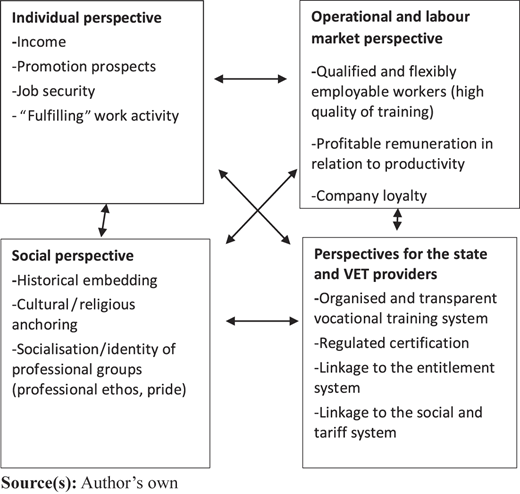
Synopsis on attractiveness of vocational education and training
Synopsis on attractiveness of vocational education and training
4. Consequences for the vocational training policy discourse
The change in perspective made here, away from ambiguously defined terms and towards the motives of individual groups of actors, can help with orientation and thus provide important impulses for the education policy discourse (CEDEFOP, 2009, pp. 84–92). In this sense, Bolli et al. (2019, pp. 30–31) also state in the context of status: “This limitation particularly includes an explanation of how the social status of VET is determined. Studying this question in future research represents the key to advising policy makers and VET professionals on how to raise or maintain the social status of VET.”
However, the model itself does not provide any possible solutions for situations that have been identified or defined as “educational policy grievances.” This applies both supranationally and at the level of individual countries. In this respect, however, the model does provide a central insight. Approaches to upgrading VET cannot be one-dimensional. Rather, a conglomerate of different measures, introduced in parallel and mutually reinforcing, is likely to be effective (cf. e.g. CEDEFOP, 2009; Trant, 1999).
Whether and how the initiatives to make VET more attractive will work in different countries cannot be answered here and is not the focus of the discussion; rather, the aim is to show which motives and consequently mechanisms may shape the developments of VET in the future. At the same time, the explanations show that the motives are very complex and, in many cases, interdependent. Therefore, a precise measurement of the influence of individual aspects or motives hardly seems to make sense (see, e.g. Huang, 2020).
The approach developed here can therefore contribute to the clarification of motivations, as the following example shows once again. In various countries of the Global South, there is a danger at the level of the individual perspective that external signals have an influence on one’s own choice of education. If, as is often the case in these countries (see the articles in this special issue), only (still) weaker pupils or only young people with educational deficits, enter VET as a “last option”, this results in negative self-selection (CEDEFOP, 2017, pp. 37–39; Oketch, 2007). This in turn has an impact on the other actors in the form of a “self-fulfilling prophecy” and possibly even reinforcing the opinion that graduates of a VET programme per se have low qualifications and are less successful on the labour market (cf. e.g. the example of India Schneider and Pilz, 2024; Tara et al., 2016). At this point, it is also not possible to discuss whether renaming VET, as is sometimes recommended, can lead to a lasting change in reputation (Lee et al., 2022).
Finally, it should be noted that there is still a considerable need for research into the motives of the various actors. There is a particular need for further empirical studies focusing on the motives of the demanders, in this case the pupils and their parents (see, e.g. Ajithkumar and Pilz, 2019; Hao and Pilz, 2021), and analysing them in detail (Watters, 2009, pp. 42–45). For example, it could be examined whether the thesis that it is rather a “direct equivalence” in the sense of direct recognition of professional qualifications in the labour market (e.g. through appropriate remuneration, challenging working activities and internal career prospects) that increases attractiveness among prospective applicants in the long term. Conversely, it would then also have to be examined whether the forms of “indirect equivalence” (Pilz, 2003) with their characteristics, such as integrative double qualification like the so-called “hybrid qualifications” (Deissinger et al., 2013), are not only “auxiliary constructions” for increasing the attractiveness of vocational training courses.

