This paper aims to share four problematic patterns found in adoption-themed picturebooks: celebrations that oversimplify adoption’s complexity, narrow representations of family, prevalent whitewashing and minimal attention to structural inequities. By examining these shortcomings, the study challenges dominant adoption narratives perpetuated in children’s literature and advocates for more nuanced representations that honor the complexities of adoption as a lifelong experience rather than reinforcing limited or potentially harmful narratives.
Researchers used critical content analysis to investigate adoption representation across 60 picturebooks. The research design was anchored in critical adoption studies theoretical frameworks. Using this lens, researchers systematically analyzed texts and illustrations to identify recurring themes, narratives and patterns in how adoption stories are told. The analysis specifically focused on examining storylines, imagery, language choices and implicit messaging about adoption experiences, moving beyond surface-level content examination to interrogate deeper ideological assumptions embedded within adoption narratives targeted at young readers.
The analysis revealed four key problematic patterns. First, many books featured celebratory narratives that oversimplified adoption’s emotional complexity and lifelong impact. Second, the research identified limited and narrow representations of what constitutes a “family” in adoption contexts. Third, the study uncovered pervasive whitewashing across the picturebooks, with racial and cultural identities being minimized or erased. Fourth, the analysis showed consistent lack of attention to social inequities and power dynamics inherent in adoption processes. These patterns collectively contribute to simplified metanarratives about adoption that fail to reflect diverse, nuanced experiences of adoptees and their families.
This study makes a distinctive contribution by utilizing a Critical Adoption Studies lens in critical content analysis of adoption-themed picturebooks – an understudied area within children’s literature research. Unlike previous research focusing on individual adoption narratives, this study identifies systemic patterns across 60 books, providing comprehensive evidence of problematic representations. The research creates valuable groundwork for reimagining adoption literature that honors complexity, acknowledges inequities and authentically represents diverse adoption experiences, ultimately benefiting adoptees, families, educators and publishers.
Portrayals of families formed through adoption in children’s picturebooks can contribute to more diverse representations of families. At the same time, such portrayals can be challenging because the adoption process is multifaceted and complicated and yet its depiction is often simple and uncomplex. In this article, we present findings of a critical content analysis in which we examined the ways in which adoption is represented in picturebooks. Our findings suggest these representations often belie problematic metanarratives that skew the construct of family, including who gains a family and what makes a family complete. Based on our findings, we offer points of consideration with regard to teachers’ roles in helping to ensure representation of diverse backgrounds and families is extended to families formed through adoption.
Critical adoption studies
Critical adoption studies (CAS) (Homans et al., 2018; McKee, 2018) serves as the primary theoretical framework in this study to understand the ways in which adoption is represented. CAS critiques adoption practices and also uses adoption as a critical lens through which to interrogate intersecting social issues/constructs such as race, identity, gender, colonialism and kinship (Hipchen, 2024; Homans et al., 2018).
CAS considers the implications of adoption practices on those involved in the adoption triad–the adoptees, birthparents and adoptive parents. In doing so, issues of privilege (e.g. families who are able to adopt) (McKee, 2021) are brought into question where ethical, legal and political issues surface about who has the right to adopt and who has the right to decide to be a family, or not. The notion of kinship (Singley, 2004) is also deconstructed to consider how the adoption triad represents the relationship of all involved. All too often, the focus of adoption narratives is on the adoptee and adoptive parents, where a happy outcome is emphasized. The birthparents’ story and the trauma an adoptee may experience from separation are deemphasized or omitted entirely (Homans, 2006).
Some scholars focus on the commodification of children as part of a global trade system, where supply and demand concepts are used to explain adoption trends from various countries over time (Ertman, 2023). This also touches on ethical considerations related to child protection rights as well as the rights of birthparents who may be exploited. Again, issues of privilege are brought into light as we consider who has the economic means to adopt and support children versus who may struggle to provide for children. Systems in place to supply children for those who want them and have the economic means may trump systems that could potentially support birthparents to retain their children despite economic and social hardships (Kim, 2021).
In terms of examining social issues/constructs, CAS offers insightful interpretations for the intersection of reproductive justice, poverty, race, capitalism, White Supremacy and colonialism (Hübinette and Tigervall, 2009; Kim and Park Nelson, 2019; McKee, 2021; Novy, 2018). When these issues are taken up with an understanding of the challenges presented by adoption, we are provided with more nuanced explanations for why such injustices may exist. For example, with regard to race and colorblind approaches to raising children of color, difficulty with identity formation and feelings of belonging can be exacerbated when the child’s birth culture and race are not acknowledged or valued and the child does not have any connection to it. CAS has critiqued this approach, with scholars arguing the need for adopted children to be treated as members of their birth culture (Quiroz, 2007).
As a theoretical lens and body of scholarship, CAS analyzes and critiques adoption practices while also grappling with the contradictions of structural injustice that privileges those who are able to adopt and at the same time push back on bionormative constructs of family. This perspective guides us in examining how adoption is represented in picturebooks. Using CAS to analyze literature, particularly narratives, characters and social contexts, is one small branch of CAS (e.g. Novy, 2004). Applying CAS to a reading of children’s picturebooks is an emerging area with few scholars doing so (c.f. Burke and Zoch, 2024; Dahlen, 2024), although analyses of adoption representation have been completed without using CAS as a lens (e.g. Ayres, 2003; Meese, 2012; Satz, 2007; Yi, 2020, 2021).
Literature review
Before discussing representations of diversity within children’s literature, we provide additional background on adoption policies, which provide context to many of the experiences of adoption depicted in children’s picturebooks. The picturebooks we analyzed included both international and domestic adoptions (or did not specify). To properly situate our understanding of adoption within the literature, we include a look at global adoption policies. Although the focus of our study was not on international adoptions per se, it is difficult to separate a discussion about adoption from the larger global context. We also examine problematic colorblind approaches to transracial adoptions in the USA and the discrimination against LGBTQIA+ adoptive parents, two areas of injustice identified in the literature.
Recent changes in global adoption policies
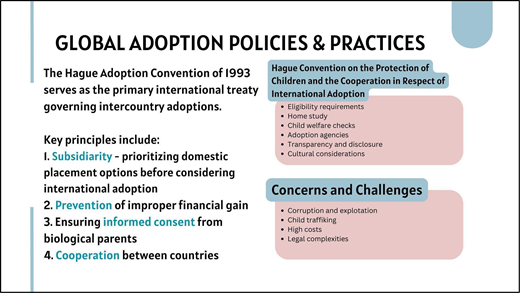
Since 1995, international adoption has been governed by principles established at the Hague adoption convention (Figure 1), which emphasized child protection through standardized practices including home studies, prioritization of domestic adoption and ensuring informed consent from birth families. However, in recent years, many traditional sending countries (e.g. Russia, China and South Korea) have implemented significant policy restrictions, including stricter requirements for proving orphan status and adoption eligibility.
These countries also have substantially limited or ceased international adoptions altogether. For instance, US citizens can no longer adopt from South Korea, Russia or China, as these nations have prioritized domestic placements. This shift was exemplified by South Korea’s Truth and Reconciliation Commission investigation (2022–2025) into alleged fraudulent practices that falsely identified children as orphans despite having suitable family guardians. The investigation’s premature termination due to insufficient documentation drew widespread criticism from adoptees across 11 countries who alleged systematic fraud.
Colorblind approaches in US transracial adoption
Approximately 40% of US adoptions are transracial, primarily involving White parents adopting children of color. This pattern reflects both the greater financial resources of White married couples and systemic inequities that disproportionately affect families of color. The National Association of Black Social Workers characterized this phenomenon as “cultural genocide” in 1972, criticizing the colorblind approach that fails to acknowledge or support adoptees’ racial and cultural identities. CAS scholars argue that colorblind policies inadequately support transracial adoptees’ identity development and perpetuate what Cheney (2014) terms the “rescue model” of international adoption – a framework that oversimplifies global inequalities and potentially commodifies children from countries outside of North America and Europe.
Discrimination against LGBTQIA+ adoptive parents
LGBTQIA+ individuals and couples face additional barriers in adoption processes, including state laws prohibiting their participation. Research by Reece et al. (2024) revealed that birthmothers exhibiting racial colorblindness were less likely to select same-sex couples regardless of race, illustrating how multiple biases intersect in adoption decision-making. These discriminatory practices compound existing challenges in creating inclusive adoption policies that serve all children’s best interests.
Diverse representations in children’s literature
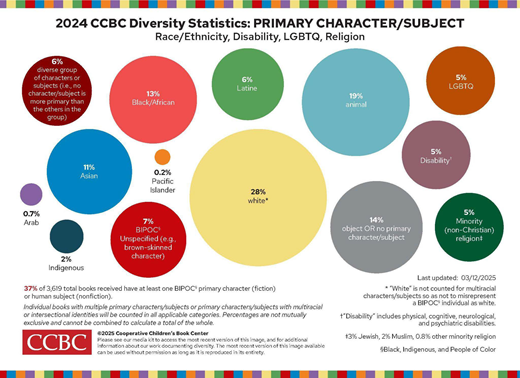
A critical examination of representation and omissions in children’s literature is important. A lack of diversity in picturebooks published in the USA has long been documented (e.g., Koss, 2015; Larrick, 1965), with researchers showing a dearth of texts that represent children and families of Color, non-dominant ethnicities, diverse languages, same-sex parents, non-gender conforming stereotypes or disabilities. The most recent analysis by the Cooperative Children’s Book Center of picturebooks published in 2024 shows that while greater representation of various ethnicities is evident, still only 37% of picturebooks feature a significant character of Color and 19% of books still feature an animal or inanimate object as the main character rather than a human. Twenty-eight percent feature a White character (see Figure 2). Taken together, this means that 47% of books do not feature a character of color. Similarly, taken separately, all racial/ethnic groups have a smaller representation not only than White characters but also characters who are animals. In addition, only 5% of books portrayed characters who are disabled, of a religion besides Christianity, or who are LGBTQIA+ (link to uwmadisonLink to the cited website.).
In addition to these areas, we have identified the lack of attention given to how adopted children and their families are represented in children’s literature. Family structure is not often discussed when analyses of picturebooks are conducted; it is not an aspect measured by the CCBS, for example. A relatively small number of picturebooks broach the topic of adoption, and very few studies have considered perspectives on adoption in children’s literature (c.f. Meese, 2012; Yi, 2020, 2021). We sought to fill this gap by conducting a critical content analysis (Short, 2017) to explore how adoption is depicted in picturebooks.
Researchers’ positionality
Both authors are university teacher educators who have also taught elementary school in settings with mostly minoritized children. We have a long history of advocating for the use of culturally relevant literature and implementing critical literacy practices. Melody is a transracial Korean adoptee who grew up in a White, middle-class home in Texas. She is a cisgender, able-bodied female who is married and has two biological children. Amy is a White cisgender and able-bodied female who grew up in an upper-middle-class home in Texas, raised by her biological and heteronormative parents.
Methods
We chose to focus our text selection on narrative picturebooks aimed at children in grades K-6. Picturebooks were our focus because we were interested in their multimodal characteristics and because of our interest in how adoption is presented in texts aimed at elementary-aged children. Additional criteria for text selection included that the text must contain an ample amount of words (e.g. not board books) and adoption as a central component to the story. For some of these books, foster care was mentioned or part of the story, but we intentionally chose books that led to adoption; therefore, books that only focused on foster care (without adoption) were excluded.
We began our search for books by using the search term “adoption” on the websites of The Horn Book and Worlds of Words. We chose these websites because we recognize them to be quality resources with well-vetted recommendations and lists by children’s literature scholars and experts. We also utilized the book list entitled “Explain Adoption to Children Easier with these Books” (Adoption Circle website). Initially, we did not intend to include books that were self-published; however, upon inspection of the lists and recommended readings, we decided to expand our criteria to include self-published texts because to exclude them would cut a significant number of texts. Another reason is that to be able to speak to the range of texts available on the topic and the ways in which adoption is presented, we needed to include these texts in our set. In the end, we examined 60 books, about half of which we explicitly mention in our findings.
Our analysis was guided by the question: what metanarratives are present in children’s books about adoption? We used short’s recursive steps for critical content analysis (2017) and used a combination of open coding and a priori coding. We began our analysis by reading each text in our collection multiple times as a way of familiarizing ourselves with them. During this exploratory phase, we used several spreadsheets to record information for each book (e.g. title, authors, main characters, plot), wrote analytical memos about each text and used open coding (e.g. the type of adoption, the gender of the adopted child, the country where the child was born). Initially, we identified three main themes as we noticed that the books tended to take one of three stances: adoption is to be celebrated (e.g. “Everyone celebrated your arrival”); adoption results in happiness for the adopted child and adoptive parents (e.g. “They have told me many times that the day I came to live with them was one of the happiest days of their lives”); or there are some challenges associated with adoption (e.g. the legal procedures, wait time, other people’s confusion about the new family, a birthmother who gives up their child).
Throughout this process of open coding, we ensured inter-rater reliability by having regular meetings to discuss the texts and our codes. If we had a discrepancy, we used these meetings to talk through and resolve the discrepancy. For example, the original codes for “feelings of completeness after adoption” versus “making a forever family” were resolved and condensed to the code “emphasis on family.”
After engaging in open coding, which allowed us to know our text set through multiple readings, we used short’s recursive steps for critical content analysis as a guide for further analysis. This is when we incorporated a priori coding as we reread the texts to code for the perspectives presented in each text (e.g. adoptive mother, adopted child) as well as those that were missing (e.g. birthmother, birthfather); how power and agency were portrayed (e.g. if birth parent was depicted as making an informed decision); and the underlying assumptions presented in the texts (e.g. a male and female couple can adopt). Tying into this level of analysis, we considered CAS and the ways in which the depiction of adoption intersected with social issues, which helped to reveal how issues such as race and class were portrayed as well as metanarratives about reproductive justice, language, poverty and capitalism.
Findings
We now consider the metanarratives present in the books we analyzed: children who are adopted are to be celebrated; families include a mother and father; adopted children of color are to be raised as White and to speak English; and children are always better off after being adopted. Following our presentation of these metanarratives, we also discuss who/what are missing from the texts.
Celebrating adopted children
A common theme across virtually every picturebook we analyzed is the ways in which adoption is celebrated and the adopted child is specifically described as “chosen” or “fated.” This framing serves to present adopted children as having little to no agency in deciding to be adopted or by whom and instead highlighting the adoptive parents’ desire for a child, thus an issue of privilege is surfaced (McKee, 2021). Crazy-much Love (Jordan-Lake and Sánchez, 2019) begins, “You are the one, precious child. We dreamed of you waiting for us…just like we were waiting for you.” In Over the Moon: An Adoption Tale (Katz, 1997), the adoptive parents receive a phone call with the message, “Your baby has been born! She is wonderful. Come quickly and get her.” The two adoptive mothers in In Our Mothers’ House (Polacco, 2009) tell their adopted children about how they “walked across dry hot deserts, sailed through turbulent seas, flew over tall mountains and trekked through fierce storms” to get their three children. Similarly, in a book based on their real family, We Chose You (2019), authors Dungy and Dungy allay their adopted son’s concerns over a class assignment telling about his family by explaining, “We searched high and low […] and near and far, because we weren’t looking for just anyone […]. We chose you.” In another example, a young girl who runs away from an abusive situation in Guatemala in Poor Marta (Boggs, 2004), is seen to have agency when she chooses to run away, but she has no other way of exerting her agency. The power resided in the couple who discovered her and then the adoption agency to “save” her and find her a family.
One book that does attempt to show the child having agency is We Match on the Inside (Bunkowski et al., 2020), where the parents teach their daughter, Anya, strategies for responding to others who ask about her adoption. Depending on the situation and Anya’s feelings at the time, they taught her she could not answer the question, make a joke or explain to others more about her family. Through teaching her these strategies, the main character is empowered to choose how she responds depending on her mood or the situation.
Another consequence of representing adopted children as “chosen” is that birthfamilies are often left out of the narrative. This is a common critique of CAS, which notes how kinship is skewed when birthparents are deemphasized or omitted (Homans, 2006). The books referenced above make no mention of the loss of family that inherently results when another family is created through adoption. One book that does show birthparents making this decision is The Story of My Open Adoption (Campbell and LaForte, 2020). In it, the narrator explains,
Sammy’s first family loved him. That would always be true. But they couldn’t care for him as they wished to do. So they made a decision to do what they could. They placed him for adoption, to have the care he should.
In the books that bring in religious scripture and references, God is shown to have agency in determining which families are formed, such as when the narrator in Yes, I’m Adopted (Zinninger, 2022) states, “For after all, my adoption was planned by God above.” Adopted and Loved Forever (Dellinger and McDonnell, 2008) begins, “Mom and Dad were excited and happy when they adopted me and God made us a family.”
In some books the legal system has the power, such as having signed papers in Adoption is for Always (Girard and Friedman, 1986). Bringing Asha Home (Krishnaswami and Akib, 2006) mentions the legal process several times throughout the book. In this book, an Indian-American family is adopting a child born and living in India. The mother explains to her biological son, “When you adopt a baby from one country and bring her to another, there are many government forms to fill out and laws to follow.” The book also mentions how difficult the long waiting is for parents.
Traditional notions of family
Analyzing picturebooks about adoption also provides insight into cultural metanarratives about family more generally. In the books we analyzed, what constitutes a family was typically depicted through a patriarchal, heteronormative lens. For instance, in Carson’s Book: A Story about Adoption from China (Busby, 2003), a Chinese couple is shown to have a baby and it is explained that “they made a plan to find a man and woman who could take care of her forever.” The direct reference to a “man and woman” illustrates the deep-seated familial construction of including both a father and a mother. Another example is in Some Babies are Adopted (Walker and Pace, 2017), when a woman is shown to make the decision “to place the baby with another. For many months, she searched to find the perfect mom and dad.”
In addition to the adoptive parents most often being a heterosexual couple, there was an implicit message that adults should want children and that children are necessary to be a complete family. For example, in We Chose You: A Book About Adoption, Family, and Forever Love (Dungy and Dungy, 2019), the adopted mother says, “We spent a long time waiting for a baby […] Waiting for you was the hardest thing we ever had to do, but we believed that God would make us a family someday.” A couple who do not have children are represented as being lonely and in need of children. In Adopted and Loved Forever (Dellinger and McDonnell, 2008), the adopted child narrates, “My parents were lonely before they adopted me because they had no children to care for and love.” Once they are able to adopt, these couples are then shown along with their adopted children as being a happy family, which also implies that families are incomplete without children.
Omnipresence of whitewashing
While many of the books depicted children of Color being adopted into White families, there was little to no acknowledgement of the differences between the children’s background and that of the parents. The children assimilate into White culture with very little discussion or depiction of the cultures they came from. There is no mention of if or how their home cultures and/or languages will be sustained. Mommy Far, Mommy Near: An Adoption Story (Peacock and Brownell, 2000) features two young girls adopted separately from China. Although the book depicts their adoptive mother explaining that they were born in China, there is no description of any culture or language from China. This is even after the older daughter, Elizabeth, becomes sad after seeing a Chinese mother and daughter together at the playground. Although Elizabeth’s adoptive mother recognizes this, the story concludes with affirmations that she loves Elizabeth very much and always will. Illustrations show Elizabeth growing up in a stereotypical American fashion, such as an image of her in a white wedding dress. Though not always mentioned in the books we examined, we also saw that in some instances the child’s name was changed to be an English-name, such as Elizabeth and her sister Katherine in the book just discussed.
Similarly, the homes where the adopted children live are portrayed as stereotypically “American.” In Through Moon and Stars and Night Skies (Turner and Hale, 1990), the boy’s new home is quintessentially “American,” with a white wooden exterior, a large front porch, and white lattice on his bedroom windowpane. In Mommy Near, Mommy Far (Peacock and Brownell, 2000), the Asian child narrates,
I am Elizabeth, which starts with an E. I have black eyes and shiny black hair. I love to do cartwheels and climb trees. I can make popcorn in the microwave, and I like to pick the biggest chocolate chips out of cookie dough. I tell knock-knock jokes, very hilarious. Also, I can do the hokey-pokey.
This description includes what many may consider code for “typical White America.” Because many of the children who are adopted are Asian, this can be interpreted as a form of Whitewashing, especially since the books do not portray attempts at incorporating these children’s home languages or cultures into their family activities and traditions.
Any differences that were addressed between parents and children are mostly physical, such as the color of skin or the shape of eyes. The most common physical difference that was discussed is eye shape in the case of White parents and Asian children. This could be the result of authors viewing these differences through the metanarrative of colorblindness. For example, in Chinese Eyes (Waybill and Cutrell, 1974) when the daughter tells her mother about being harassed about her eyes and what amounts to a racial slur at school, the mother tells her daughter that the statement was not too far off, as she is referring to the proximity of China to South Korea and does not acknowledge the ill-intent and discrimination behind the comment. Nor does the mother acknowledge the problematic oversimplification of China and South Korea as if they are not two distinct and separate countries. Even the book’s dedication, which was written by a mother to her adopted daughter, says “to our little Chinese eyes,” thereby extending the problematic expression as if it is something to be revered. The frequent depiction of cultural erasure and rapid assimilation aligns with what Briggs (2012) describes as the “clean break” model of adoption, emphasizing challenges faced by transnational adoptees in maintaining connections to their birth cultures and languages.
Lack of addressing inequities
There were a number of inequities that were alluded to in the books but were not addressed directly. Some of these inequities related to impoverished and undesirable conditions in other parts of the world. For instance, when a child’s birthcountry was featured, it was usually shown to be a troublesome place in contrast to the home environment provided by the adopted parents. In The Red Blanket (Thomas and Cepeda, 2004), which features a single mother from the USA adopting an infant girl from China, the illustrations depict the orphanage as crowded (e.g., four babies in one crib) with a solid fence surrounding it, creating an imposing image. In contrast, the adopted children’s new homes are portrayed as unfailingly loving, safe and secure. In depicting the child’s birthcountry, while there is a glimpse offered into what life might be like in those countries, it comes without any real acknowledgement of privilege versus inequity or why some parts of the world might be more impoverished than others.
In the books where the reasons children might be given up for adoption in China are depicted, there is an explanation provided of China having a one-child rule (at the time of publication), which is stated in ways that do not explain exceptions to the rule or interrogate societal inequities, human rights, or political policies and control. In contrast, the White parents are shown as being saviors for rescuing the children who were not able to remain in China.
While the creation of families through adoption was celebrated in most of the books we examined, there was little to no acknowledgement that “To gain a family means a loss of another family” (Meese, 2012, p. 131). Some of the books showed imaginings of what the birthparents (usually the birthmother) would have looked like when making the decision to place their child into adoption. In You’re Not My Real Mother! (Friedrich and Hale, 2004), the adopted mother answers her daughter’s question of why they do not look alike, to which she says, “I don’t look like you because I’m not your birth mother. Who’s that? Your birth mother is the mother who gave birth to you. She started your life, and I am thankful to her every day for that.” The birthmother’s voice, however, is missing, and there is no explanation offered of what this loss may have meant for her.
One book that touches upon the birthmother’s point of view briefly is Adoption is for Always (Girard and Friedman, 1986), where the little girl asks about her birthmother’s name. The mother answers, “Your birthmother’s name was Susan […] we never met her, but she wrote us a letter. She was very sad when she had to let you go.” When the girl asks about her birthfather’s name, her parents tell her they do not know, but her birthmother knew. “They didn’t live in the same place, and they weren’t married. So they didn’t have a home to give you.” When the girl asks her teacher if all mothers love their children, her teacher responds that her birthmother loved her because “she had to love you to give you up.” This presentation of adoption choices being made out of love may be reassuring for the child; however, it does not quite do justice to the inequities that may have surrounded the circumstances and the sense of loss that is created forever.
Discussion
We have presented an analysis of picturebooks to show how adoption and families formed through adoption are represented. We will now discuss some of the questions our analysis raised.
What/who was missing from the texts?
For the children of color, there was no acknowledgement of how these children will face racism unexperienced by their White parents. Differences in race were addressed as physical differences, usually between how the shape of Asian eyes is different from the eyes of White people. While we agree that race is a social construct, we also know that racism, because of how someone looks and stereotypes about the cultures they come from, is prevalent and traumatic. Other omissions we noted about representation include children who are born with disabilities and have special needs – which could be physical, cognitive or emotional – as well as the biological relatives of adopted children, such as their birthparents, birthgrandparents or siblings from whom they might be separated.
We also noted the overrepresentation of Asian children in the books we analyzed, which could erroneously communicate that most adopted children in the USA come from Asian countries. In reality, in the USA, most adopted children are US-born and White. The second most prevalent adopted children are Latinx (Zill, qtd. in Yi, 2020). This simultaneous omission of representations of White and Latinx children along with the overrepresentation of Asian children may paint a skewed picture about adoption or Asian representation in the USA. In addition, for picturebooks that feature Asian children, a common theme is that of adoption (Yi, 2020), thereby further contributing to problematic assumptions and stereotypes about Asian children and countries (Sun, 2021).
There was little to no acknowledgement of the trauma that occurs through adoption. No matter the age that adoption occurs, even at birth, there is evidence to show that all adopted children experience loss and trauma caused by separation (Guida-Richards, 2021). Showing the range of emotions that adoptees may experience is helpful to normalize these feelings and help adopted children be able to express their feelings. Picturebooks that show these mixed emotions may provide emotional support for adoptees, while in the picturebooks where this is missing, confusing messages may be sent to children who do not understand why they might feel the way they do. Added to this, we did not see representation of adopted parents taking measures to understand the kind of trauma that occurs through adoption and how to address it.
Whose trauma is centered?
A celebratory tone is most often presented, but when pain or challenges are depicted, it is most often that of the adoptive parent(s) before they were able to adopt. Work within CAS reminds us that adopted children and their birthfamilies often experience trauma during and after the adoption process (Homans, 2006). Yet in the books we analyzed, there is little consideration given to trauma the adopted child may have experienced, such as being transported to a different country, learning a new language, and assimilating (again, colorblindness) into a new culture. Additional significant traumas such as racism and criticism from outsiders as they age, and that of the birthfamily, are not mentioned in most books. There were some books that depicted adopted children having to answer questions about why they do not look like their parents or having to talk about what it means to be adopted. But by and large, these very real, complex issues that often come with adoption are not mentioned. This is unfortunate because it is a missed opportunity to validate children who experience this, to provide a space to talk about and practice ways to deal with it, and to educate others about these issues.
Who has agency?
Almost half of the books (about 30) used a celebratory tone to present adoption. While this in of itself is not necessarily problematic, and we agree that adopted children need to see themselves as “precious” (Meese, 2012, p.132), the celebratory tone is often delivered through a savior narrative where the parents – almost always a White heterosexual couple – save the child by providing them with a family. In these depictions, adopted children are often objectified – shown as being gifts acquired by the adoptive parents. Positioning them as objects also presents them as passive and powerless, without agency. In terms of who does have agency and power, this is usually presented to be the adoptive parents by virtue of them being able to choose to adopt and having the means to do so. The representations of adoptive parents highlight the need to consider the intersection of a person’s socioeconomic status, ethnicity, marriage status and being LGBTQIA+, which taken together or separately impact one’s ability to adopt (Hübinette and Tigervall, 2009; Kim and Park Nelson, 2019; McKee, 2021; Novy, 2018).
While adoptive parents are shown as having agency, in only a few books are the birthparents shown as having agency in deciding to give the child up for adoption. In many books, birthparents are not mentioned and when they are, it is typically just the birthmother. While the adoptive parents’ story of choosing the child may span several pages, little to no mention is made of the birthfamily and their choices. And, given what is known about many birthfamilies, there may have been little choice involved at all (McKee, 2018).
These complex circumstances that lead to adoption, while not always known, are nonetheless more complicated than merely “searching high and low” (Dungy and Dungy, 2019). Unfortunately, when the story about a child’s adoption is presented as easy and comfortable to share, such as the boy’s school assignment in We Chose You (Dungy and Dungy, 2019), there is no acknowledgement of the loss, trauma, and inequities that may have surrounded the birthparents’ decision to give up a child.
Who makes a family?
Two narratives that are often presented in the books are that “there is a child who needs to be adopted” and “there is a couple who needs a child for adoption.” These two narratives challenge the perspective of who gains a family through adoption. When the narrative that the child needed to be adopted is privileged, then a savior narrative is front and center. On the other hand, when the narrative is presented as a couple needing to adopt a child, then the central narrative is that children make a family complete.
The emphasis on how adoption makes families complete aligns with a metanarrative related to patriarchal and heteronormative constructs of family units. Whether the adoptive parents were single, married, straight, gay, men or women, they all included the message that their family was not complete until it included children. Couples who choose not to have children or who do not have children for other reasons, while not necessarily relevant to the plot in adoption stories, are nevertheless left out of the definition of what constitutes a family. While books centered on adoption logically focus on children being part of families, the discourses presented in these texts about family do not expand the definition of family to constructions that do not include children, which upholds the traditional, patriarchal, heteronormative familial structure as the norm.
What feelings are prioritized?
Considering the target audience for these books is most likely children who have been adopted, it makes sense that a focus on a loving family would be a priority. However, this overriding presentation of families as always joyful might also exacerbate some adopted children’s feelings of fear and insecurity as they adjust to a new family, especially if their familial unit does not “perform” love in the same way as is portrayed in the books. Showing the complexities people in adoptive families experience could help ease children’s fears about being adopted, as well as sadness and questions they may have surrounding their birthfamilies. What love looks and sounds like varies across cultures, while the parents portrayed in the books are overwhelmingly White and/or middle or upper class, and so again, that is the culture represented in the families in the texts.
Implications
Our analysis has implications for understanding the relationship between picturebooks focused on adoption and cultural metanarratives represented therein. By illuminating patterns of the celebration of adopted children; the representation of the overarching concept of family; Whitewashing; and the lack of attention given to inequities among children and birthparents as represented in the texts and situating them within the global adoption landscape, we show these texts serve as cultural artifacts that both reflect and shape societal attitudes towards domestic and transnational adoption. For policymakers and adoption professionals, our findings underscore the need for more culturally sensitive approaches to international adoption that prioritize preserving adoptees’ connections to their birth cultures and languages (Harvard Law School Child Advocacy Program, 2008). This aligns with recent shifts in global adoption policies towards more open adoption practices and emphasis on in-country solutions where possible. In addition, attention to who policies privilege and exclude is important. Inequities should be addressed where same-sex couples or singles may be restricted from adopting.
What does this mean for teachers?
For educators and librarians, our research highlights the importance of critically evaluating picturebooks about adoption and supplementing existing texts with more diverse and culturally nuanced narratives. This can support the development of more inclusive educational practices that better serve the needs of adoptees and their families and which provide windows for students who are not adopted, and can help diversify understanding of different family structures. This inclusion means intentionally including books that center adoption and then critically considering the metanarratives about family within those and other books. Texts do not need to present a particular metanarrative, since helping students recognize, discuss and critique metanarratives that are present is part of a critical literacy framework in which texts are routinely questioned. At the same time, teachers should seek to normalize families formed through adoption. Providing both mirrors and windows to students through text selection is important.
We also encourage teachers to reconsider assignments that we often take for granted, but which may be difficult or triggering for students who are adopted. “Simple” assignments, such as a family tree or interviewing grandparents, can be complicated for adopted children. While some may welcome the opportunity to explore their birthfamily (or adopted family), others may not be ready to share this part of their identity in the classroom. In addition, as with all issues, creating space (e.g. reading/writing workshop; class discussions) in which students can choose to talk/write about their experiences and feelings can help provide support to students in a non-invasive way.
Finally, another implication for teachers relates to the approaches they take in analyzing texts with their students. Just as we engaged in a critical content analysis of the picturebooks, teachers can also incorporate critical content analysis methods with their students to identify and interrogate whose perspectives are represented, whose are missing, how power and agency are represented and the underlying assumptions made in the text.
Conclusion
It is important to understand how adoption is currently represented so that discussions around this topic can be robust, positive and affirming, and can allow children to express both the depth and breadth of their experiences. All children have a need to see themselves represented in books, and it is important for teachers to share books pertaining to adoption with their students. This can help to normalize adoption and make it something that can be openly discussed, removing any potential stigma children may carry with them. However, it is also important that books centering adoption represent it accurately. While it is often experienced as celebratory, adoption is a complex, lifelong event that is experienced in a variety of ways. In addition, even though adoption may be pursued by a heteronormative couple, it is increasingly same-sex or single parents who adopt children. Including families formed through adoption and different types of parents can help broaden children’s understanding of what, or rather, who constitutes a family.