This study aims to examine the challenges and opportunities of citizen-centered facilities management (CCFM) in Johannesburg’s inner city, with a focus on how participatory approaches can support sustainable urban renewal and improve the performance of mixed-use developments.
An interpretivist, qualitative research design was adopted. Data were collected through semi-structured interviews with 11 senior professionals involved in facilities management, property development, finance and urban governance. Data were analyzed using Reflexive Thematic Analysis to identify key patterns related to participation, capacity, social value and governance.
The findings of this study reveal four key challenges: exclusion of residents from decision-making, resulting in weak ownership and accountability; significant skills and capacity gaps that limit community participation in facilities management; the critical social value of well-maintained facilities in enhancing safety, dignity and social cohesion; and fragmented and inconsistent governance structures that undermine effective coordination and long-term sustainability. This study finds that weak governance and limited community involvement are primary drivers of infrastructure deterioration, while participatory approaches can improve maintenance outcomes and social resilience.
This study is limited by its small, supply-side sample and lack of direct community perspectives. This study is limited in the small sample that it used.
This study highlights the need for participatory governance structures, community training and cross-sector partnerships.
CCFM can enhance inclusion, safety and quality of life in inner-city environments.
This study contributes to facilities management literature by integrating Social Infrastructure Theory, Network Governance Theory and the Capability Approach into a novel community-centered facilities management (CCFM) framework. This study advances the reconceptualization of UFM from a technical function to a socially embedded, participatory practice within the context of inner-city regeneration in the Global South.
1. Introduction
Facility management (FM) refers to the integration of people, place, process and technology to ensure the functionality, comfort, safety and efficiency of the built environment (Bröchner et al., 2019; Temeljotov Salaj and Lindkvist, 2021; Osei Assibey Antwi et al., 2025). It encompasses a wide range of services, including maintenance, operations, space management and sustainability initiatives, with the overarching goal of supporting the core functions of organizations (Nielsen et al., 2016; Bröchner et al., 2019; Opoku and Lee, 2022). By aligning the physical environment with organizational strategy, FM contributes significantly to organizational performance and user satisfaction (Juhari et al., 2024; Ishak et al., 2025).
According to Kuijlenburg (2020), even though traditionally FM used to focus on buildings and organizational support services, FM has increasingly expanded into the urban scale, giving rise to the concept of urban facilities management (UFM). UFM involves the coordinated planning, operation and maintenance of urban infrastructure and public facilities to improve quality of life and support sustainable urban development (Lindkvist et al., 2021). By linking organizational efficiency with broader urban systems, facilities management contributes to both micro-level performance and macro-level urban resilience.
Place et al. (2002) recorded names of Johannesburg CBD as “Maboneng”, meaning “the place of lights” in Sesotho, and “Kwandonga ziyaduma”, meaning “the place where the walls rumble” in Isizulu. The once celebrated vibrant, cosmopolitan CBD of Johannesburg city has witnessed decline, crime and growing public discontent. This deterioration coincides with increased migration from rural South Africa and the African continent bringing urban disorder, failing waste management, overcrowded buildings and lawlessness undermining the city’s brand as “a world-class African city,” necessitating the shift of Johannesburg’s economic hub to Sandton because of widespread perceptions of insecurity in the CBD (Bethlehem, 2013; Abrahams et al., 2018). The city’s inner core is a microcosm of these dynamics, burdened by deteriorating housing stock, overwhelmed facilities and rising demand from an economically vulnerable and diverse population. At the end of apartheid, white flight to suburban areas left inner-city properties vacant, unmanaged and vulnerable to hijacking (Wilhelm-Solomon, 2020). The 2016 local elections marked a political shift as residents demanded accountability. Since then, attention has turned to whether policies aimed at inner-city regeneration are effective, adhered to or inclusive. Numerous buildings are overcrowded and collapsing. Pavement trading and unmanaged informal activity reflect weak enforcement and planning (Bantubonse, 2008). These conditions deter investment and further marginalize citizens who rely on the inner city for housing, transport and livelihoods. Commuting patterns also make the inner city congested where low- and middle-income earners who live on the city’s periphery travel into the CBD daily (Van Ham et al., 2021). The dominance of taxis exacerbates congestion and pollution, reducing walkability (Okoro and Lawani, 2022). The call for urban renewal/regeneration in Johannesburg inner city reflects the need to correct rapid population growth, infrastructure decay, social inequality and underperforming public services in the CBD (Hanyane, 2009; Adewunmi et al., 2023).
Strategically located brownfield sites and abandoned buildings represent untapped potential for redevelopment. However, local authorities have been hesitant to fully support private sector efforts to revitalize the CBD, frustrating developers despite available land and high housing demand. High youth unemployment further necessitates job-creating urban redevelopment to support safety, SME growth and housing needs. Mixed-use developments (MUDs) emerge as a promising strategy to address these intertwined challenges. Offering live-work-play environments, MUDs promote density, accessibility and economic integration. They hold potential for revitalization, but must be supported by strong, community-oriented UFM to ensure sustainability. Financing remains a critical constraint. While MUDs carry risk because of mixed returns and long lead times (Venner and Ecola, 2007), innovative instruments like property stokvels and community development financial institutions offer viable, inclusive models (Edmonds, 2018). Despite increasing urban investments, UFM strategies often prioritize technical and financial considerations while neglecting social dynamics. In Johannesburg, citizens often experience facilities alienating, non-participatory and unresponsive to local needs. This lack of inclusion in UFM decisions perpetuates social exclusion and infrastructure decay, undermining sustainability goals (Orkpeh and Adedire, 2024).
2. Literature review
As the world is pushing for sustainable cities (Mosha et al., 2022), UFM is increasingly being understood as more than the technical operation of buildings and infrastructure, that it is an institutionally and socially embedded function that interacts with people’s everyday lives and the spatial politics of cities (Temeljotov Salaj and Lindkvist, 2021; Lindkvist et al., 2021; Gohari, 2025). This study draws on three interconnected theoretical frameworks to conceptualize UFM in Johannesburg’s inner-city renewal: Social Infrastructure Theory, Network Governance Theory and the Capability Approach. Social infrastructure theory (Klinenberg, 2018) highlights those facilities such as parks, housing complexes, community centers and schools are not merely physical structures but also critical platforms for social interaction, collective efficacy and civic engagement (Campbell et al., 2022). In this context, UFM becomes a means of fostering social resilience by creating well-maintained environments that encourage trust, safety and connection. In Johannesburg, where many inner-city spaces are associated with insecurity and decay, UFM guided by this theory can play a role in rebuilding community cohesion. Network governance theory (Rhodes, 1997; Zwitter and Hazenberg, 2020) recognizes that effective urban governance emerges through coordinated relationships among public authorities, private developers and civil society actors. Gohari (2025) emphasized that in a fragmented governance environment (such as Johannesburg), where informal actors, residents and the state intersect, UFM must be reconceptualized as a collaborative function. This perspective calls for participatory mechanisms such as co-management boards and stakeholder partnerships to share responsibility for urban space maintenance, moving beyond hierarchical control and isolated interventions.
According to Kimhur (2020), the capability approach offers a normative lens through which UFM is evaluated based on its capacity to enhance the freedoms and functioning of urban residents. Applied to UFM, this approach foregrounds access to well-managed spaces, autonomy in infrastructure decision-making and the opportunity to live in safe, dignified environments. In Johannesburg’s inner city, where vulnerability is compounded by inequality and infrastructural neglect, UFM should empower residents, particularly the urban poor, to shape and benefit from the environments they inhabit.
A recent study by Ngarakana et al. (2026) emphasizes the need to embed participatory and socially responsive frameworks within UFM. In the South African context, Simbanegavi et al. (2021) find that many inner-city FM systems remain technocratic and exclusionary, with a persistent disconnect between municipal authorities and the communities that use and depend on these facilities. This disconnection has contributed to underuse, poor maintenance outcomes and resident dissatisfaction. Orkpeh and Adedire (2024) similarly observe that the lack of transparency and communication in UFM decisions has eroded public trust and led to resident disengagement. While MUDs promoted as tools for inner-city revitalization, it also reveals social contradictions. Vejby (2015) documents the experience of Johannesburg’s Maboneng Precinct, and Qwabe et al. (2025) used a case study of the Riverside Park City Improvement District, Mbombela where urban regeneration efforts attracted private investment but inadvertently displaced low-income residents. The failure to incorporate inclusive UFM and tenancy frameworks in such developments has undermined their potential for equitable renewal. Institutional finance mechanisms, such as those led by the Trust for Urban Housing Finance, have played a role in mobilizing capital for inner-city redevelopment. However, Simbanegavi et al. (2021) note that while Trust for Urban Housing Finance has improved access to funding for small-scale developers, it has not explicitly incorporated community-driven UFM models. This limits the long-term sustainability of investments, as the social infrastructure necessary for stewardship and collective maintenance remains underdeveloped. International studies affirm these concerns. Yunda and Sletto (2020), examining urban redevelopment in Bogotá, Colombia, show how exclusionary governance in UFM undermined social cohesion and resulted in contested spaces. Conversely, Wilkinson et al. (2008) demonstrate that in UK urban policy, involving residents in UFM decision-making improved facility use, maintenance and trust. Collectively, these studies point to the risks of overlooking the citizenry in UFM planning and the benefits of participatory and localized approaches. Alexander and Brown (2006) as well as Temeljotov Salaj and Lindkvist (2021) support the argument that for UFM to contribute meaningfully to urban renewal, especially in contexts like Johannesburg, it must integrate the voices, capabilities and experiences of those who live and work in these urban spaces.
Beyond these international lessons, Johannesburg-specific scholarship provides essential context. Parnell and Robinson (2006) demonstrate that Johannesburg’s City Development Strategy, while framed as participatory, was shaped by growth-oriented imperatives and global city aspirations that often-constrained meaningful engagement. Charlton (2010) highlights the limitations of housing-led inclusion strategies in the city, pointing to enduring governance and institutional barriers that restrict urban transformation. Murray (2011) frames Johannesburg as a “city of extremes,” where exclusionary urban regimes continue to shape spatial politics and social inequality. Harrison et al. (2014) provide a comprehensive review of Johannesburg’s post-apartheid restructuring, showing how institutional reforms, elite interests and political contestation have influenced the outcomes of inner-city regeneration. Taken together, this body of literature underscores that any proposal for community-centered UFM in Johannesburg must be situated within the city’s historically embedded governance dynamics, political economy and socio-spatial inequalities.
3. Conceptual framework
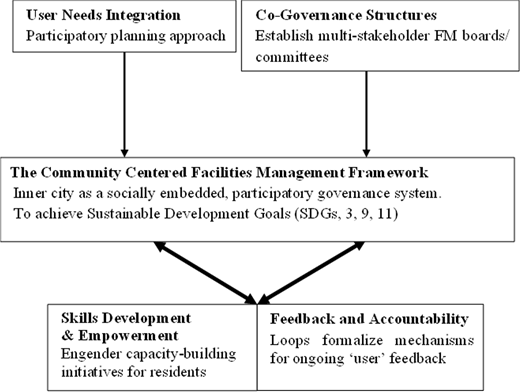
Drawing from Social Infrastructure Theory (Klinenberg, 2018) and Network Governance Theory (Rhodes, 1997; Kapucu and Hu, 2020), this study proposes a community-centered facilities management (CCFM) Framework aimed at transforming UFM practice in Johannesburg’s inner city from a technocratic function to a socially embedded, participatory governance system. At the core of this framework is the understanding that UFM must be reimagined as an instrument for equity, capability enhancement and community resilience. Social Infrastructure Theory positions CCFM spaces, such as public housing, schools and park, not merely as functional assets but also as nodes of social connectivity. This underscores the need for CCFM practices that reinforce community identity and foster collective well-being. The Capability Approach informs the ethical imperative that CCFM should enable all residents, particularly the marginalized, to exercise agency and live lives they value. Network Governance Theory, finally, emphasizes the operational mechanisms for this transformation by advocating for distributed, cooperative governance across public, private and civic stakeholders. Based on these theoretical foundations, the framework integrates four key components, repositioning CCFM from an outsourced, managerial task to a decentralized, citizen-led system that aligns with sustainable urban renewal goals. The CCFM Framework shown in Figure 1 offers a replicable, scalable model that directly responds to Johannesburg’s inner-city challenges while advancing SDG targets for inclusive, safe and resilient cities. It reinforces the theoretical position that urban transformation must move beyond infrastructure delivery to include processes that build trust, participation and long-term social sustainability.
There is need for user needs integration with a participatory planning approach that prioritizes regular, inclusive needs assessments with residents. This ensures that CCFM strategies are aligned with lived experiences and dynamically responsive to evolving user priorities. The skills development and empowerment component engender capacity-building initiatives for residents to acquire UFM-relevant skills that range from maintenance and repair to monitoring and reporting. This empowers citizens as co-stewards of their environments and supports local employment. Co-governance structures are required to establish multi-stakeholder CCFM boards or committees comprising municipal officials, technical experts and community representatives. These platforms ensure transparency, shared responsibility and consensus-based decision-making in the operation and upkeep of facilities. Finally, the feedback and accountability loops formalize mechanisms for ongoing “user” feedback, such as digital platforms, community audits or scheduled public forums. These mechanisms foster mutual accountability and allow for real-time adaptation of CCFM practices.
While the theoretical foundations of this study (Social Infrastructure Theory, Network Governance and the Capability Approach) are well established, their integration into a single framework for UFM is novel. This synthesis is particularly significant when applied to the context of inner-city Johannesburg, where the complexity of governance, socio-economic inequality and infrastructure challenges demand a reconceptualization of UFM beyond its technical function. The focus on MUDs as potential vehicles for CCFM, coupled with innovative financing instruments such as property stokvels and community development financial institutions, underscores this study’s originality and contemporary relevance.
4. Methodology
This study adopts an interpretivist paradigm, grounded in an epistemological position that views reality as socially constructed and context-specific (Saunders et al., 2023). Interpretivism aligns with this study’s goal of understanding the subjective experiences and meanings attached by stakeholders to UFM and urban renewal processes in Johannesburg. In line with this philosophical stance, this study used an inductive research approach, allowing themes and insights to emerge from participant accounts rather than testing predetermined hypotheses (Creswell and Creswell, 2018). The research is exploratory and qualitative in nature, designed to generate rich, contextualized understanding of stakeholder perspectives relating to CCFM and inner-city regeneration.
A purposive sampling strategy was used to recruit participants with relevant professional knowledge and direct experience in CCFM, MUDs, property development, finance and urban governance in Johannesburg. According to Campbell et al. (2020), purposive sampling is appropriate in qualitative inquiry where participants are selected for their ability to provide information-rich insights relevant to the research problem. To broaden access to knowledgeable respondents, reputational and snowball sampling techniques were also used, whereby early participants recommended additional individuals with relevant expertise (Pojani and Stead, 2014). The final sample comprised 11 senior professionals drawn from the property sector, finance institutions, private property development and local government (Table 1). All participants occupied senior management, executive or specialist roles within their organizations.
In qualitative research, sample adequacy is determined less by numerical representativeness and more by the depth, relevance and richness of the data obtained (Braun et al., 2024). Empirical studies suggest that saturation is often achieved within a relatively small number of interviews. For example, Guest et al. (2006) found that thematic saturation frequently occurs within the first 12 interviews, with basic themes emerging as early as six interviews. Similarly, Hennink et al. (2017) distinguish between code saturation and meaning saturation, demonstrating that code saturation can be reached with as few as 9–12 interviews. During data collection and analysis, thematic redundancy was observed, with no substantially new codes emerging in the later interviews, indicating that saturation had been reached.
The primary data collection method was semi-structured interviews. Semi-structured interviewing is widely recognized as effective for exploring perceptions, experiences and organizational practices while allowing flexibility to probe emerging issues (Braun and Clarke, 2022).
A multi-method qualitative strategy was adopted to accommodate participant availability while maintaining consistency in the themes explored. The interview guide was structured around four key themes:
challenges in CCFM and urban renewal;
community participation and stakeholder engagement;
governance and institutional structures; and
sustainability and long-term management considerations.
Open-ended questioning enabled participants to elaborate on their experiences and provide examples from practice.
Interview invitations were distributed via email, and informed consent was obtained from all participants before participation. Participants were also informed of their right to decline any question or withdraw from the study at any stage without consequence.
Data collection occurred through multiple modes to accommodate the schedules of senior professionals. Three interviews were conducted face-to-face, one interview was conducted online using Microsoft Teams, three participants provided detailed responses via email and four participants completed questionnaires through Google Docs. Although different modes were used, all participants responded to the same core thematic areas, ensuring comparability across responses. Establishing rapport and maintaining professional trust were prioritized throughout the process to encourage candid and reflective engagement. To enhance transparency and confidentiality, participants are identified through anonymized codes linked to their roles and organizational affiliations in Table 1.
While these respondents provided substantial technical, managerial and institutional insight, the sample is weighted toward supply-side actors. The absence of tenants, residents, community organizers and non-governmental organizations limits the extent to which conclusions can fully reflect grassroots experiences of participation and co-creation. This limitation is acknowledged in the discussion of study constraints.
All interview and written responses were transcribed, organized and analyzed using Reflexive Thematic Analysis following Braun and Clarke (2006) six-phase framework: familiarization with the data, initial coding, theme generation, reviewing themes, defining and naming themes and producing the final report. Reflexive thematic analysis is particularly suitable for interpretivist studies concerned with meaning-making and researcher interpretation (Braun et al., 2024). The researchers engaged in reflexive practice throughout the analytic process, recognizing how prior assumptions, disciplinary background and values may shape interpretation (Byrne, 2022).
Several strategies were used to enhance trustworthiness. Credibility was strengthened through triangulation of perspectives across developers, financial actors and municipal representatives. Dependability was supported through the use of a consistent interview guide and systematic coding procedures. Confirmability was enhanced through reflexive journaling and transparent documentation of analytic decisions. Validity was further supported by aligning data collection instruments directly with this study objectives and ensuring that all participants possessed demonstrable expertise in UFM, urban development or regeneration.
Despite the acknowledged limitations, the methodology generated context-specific and practice-informed insights into citizen-centered CCFM and urban renewal in Johannesburg, highlighting the technical, social and governance dimensions shaping inner-city regeneration from the perspective of senior stakeholders.
5. Findings and discussion
The following results are drawn from interviews with 11 senior professionals involved in FM, MUDs and urban renewal projects in Johannesburg. The analysis captures their perspectives on the challenges and opportunities in CCFM. It is important to note that the data reflect predominantly professional and institutional viewpoints; direct community perspectives were not included in this study. Findings are presented through four themes derived from Reflexive Thematic Analysis: Perceived Exclusion from Decision-Making, Skills and Capacity Gaps, Social Value of Facilities and Governance Challenges.
5.1 Perceived exclusion from decision-making
Participants emphasized the alienation of residents in inner-city CCFM processes. P1, a senior professional valuer with extensive experience assessing municipal and private real estate assets, noted that residents “feel that decisions are imposed on them,” leading to a lack of ownership and accountability. P2 and P9 added, “There’s a real gap: many tenants don’t even know who manages their building or what CCFM even means.”
P7–P11 reinforced this pattern, observing that resident participation is generally low, particularly in distressed buildings where formal engagement structures are absent or ineffective. Even where platforms such as tenant committees or informal communication channels exist, they are inconsistent and poorly institutionalized. P7 attributed this to mutual mistrust between residents and management, as well as the perception among some property managers that tenants are not long-term stakeholders.
These insights reveal how exclusion fosters apathy, weak accountability and disengagement, often resulting in vandalism and neglect of shared spaces. This theme illustrates the breakdown of participatory processes central to the Capability Approach (Kimhur, 2020), which argues that individuals must have the freedom and agency to influence their environments. Exclusion from decision-making undermines these freedoms, contributing to a cycle of neglect. From a governance perspective, this reinforces Wilkinson et al. (2008) and SACN’s (2021) calls for participatory engagement from planning to implementation. Network Governance Theory (Rhodes, 1997) further supports the need for inclusive, multi-actor coordination, suggesting that UFM decisions must shift from hierarchical delivery to citizen-inclusive networks for legitimacy and sustainability.
5.2 Skills and capacity gaps
P3, a direct customer sales manager at a financial institution engaged in funding housing and MUDs, remarked:
We don’t equip communities to manage their own spaces. They rely entirely on the landlord or city, and that’s not sustainable.
P4–P11 observed that:
We have a backlog, not just in infrastructure, but in skills. We need to start from basics, teaching cleaning schedules, waste management, tenant rules.
P7 corroborated this gap, noting that most inner-city buildings provide little to no training on essential aspects such as waste management, safety procedures, energy use or basic building systems. The respondent emphasized that communities lack practical competencies in areas such as financial literacy, conflict resolution and maintenance awareness, all of which are necessary for meaningful participation in UFM. Evidence from non-governmental organization-led initiatives in areas such as Hillbrow and Berea further demonstrates that targeted training (such as cleaning cooperatives and digital reporting systems) can improve cleanliness, safety and functionality in shared spaces.
These findings highlight the absence of foundational training and its consequences: neglected spaces and infrastructural decay. The need for skills development aligns with Social Infrastructure Theory (Klinenberg, 2018), which identifies local knowledge and trust as key to maintaining shared spaces. Herndon (2011) and Generalova and Generalov (2020) reinforce the argument that CCFM efficiency and sustainability depend on community capacity. Under the Capability Approach, enabling UFM training enhances not only infrastructure performance but also residents’ freedoms and dignity by equipping them to participate meaningfully in the urban environment.
5.3 Social value of facilities
P5, P9, P10 and P11, a professional town planner, property managers and current program manager at a state-owned property development agency, described a community-led initiative:
We had a dilapidated building. Residents came together to repaint, clean, and secure it. That changed everything: as crime went down, and pride went up.
P6, a project manager in a private property development company, added:
Young people managed the park maintenance. It wasn’t perfect, but it gave them purpose, and the park became safer.
P7 extended this perspective by emphasizing that well-maintained facilities act as stabilizing forces in the inner city. Basic services (such as lighting, functional lifts and clean communal areas) were identified as critical to dignity, safety and everyday quality of life. Conversely, neglected environments contribute to the normalization of disorder and insecurity. P7 further noted that community involvement in shared spaces, including courtyard gardens and waste management initiatives, can strengthen social cohesion, while poorly managed public spaces may become sites of criminal activity, undermining their intended social value.
The examples from participants validate the concept of CCFM as social infrastructure (Klinenberg, 2018), which fosters cohesion and resilience. When citizens are empowered as co-creators of space, they transform infrastructure from mere utility to social capital. Yunda and Sletto (2020) support this with evidence from Latin America, where participatory UFM built neighborhood identity. This is closely tied to the Capability Approach, which posits that social and civic spaces enhance individual and collective capabilities.
5.4 Governance challenges
Participants consistently highlighted inefficiencies in CCFM governance. P2 noted:
Even when communities are engaged, there’s no follow-through. Promises are made, then forgotten.
P4 and P11 stressed that:
We need co-governance, not lip service. Communities must have a seat at the table, with budgets and voting rights.
P1 added that:
There’s no mechanism for tracking what happens after plans are signed off. Communities feel tricked.
P7, P8, P9, P10 and P11 deepened this theme by pointing to systemic governance failures, including dysfunctional or absent body corporates, financial mismanagement and weak municipal responsiveness. The respondent emphasized that building deterioration is often less a technical issue than a governance failure, where delayed maintenance escalates into costly repairs because of poor oversight and planning. Additionally, fragmented coordination between municipalities, private owners, transport operators and communities creates unclear accountability and weakens intervention efforts in distressed buildings.
These insights expose critical flaws in governance frameworks. Network Governance Theory (Rhodes, 1997) emphasizes horizontal collaboration, yet current CCFM systems in Johannesburg remain fragmented and bureaucratically constrained. Denoon-Stevens and Nel (2020) caution that without structural reform, participation risks being symbolic rather than substantive. Effective co-governance requires clear mandates, accountability and resourcing to be credible. Embedding governance reform is, therefore, about not only policy alignment but also repositioning UFM as a collaborative, responsive system that integrates technical management with social realities.
6. Conclusion and recommendation
Together, these four themes offer a comprehensive understanding of the structural, operational and social barriers that undermine effective CCFM in Johannesburg’s inner city. The findings emphasize the need for a paradigm shift, away from traditional asset-centric models and toward people-centered, participatory CCFM. When citizens are excluded, urban decay, vandalism and distrust proliferate. When they are engaged, trained and given shared governance roles, facilities become not only functional but socially transformative spaces. This study contributes to a growing body of literature that frames CCFM as a tool for enhancing urban resilience, equity and inclusion. Drawing from Social Infrastructure Theory, the Capability Approach and Network Governance, this study demonstrates that inclusive CCFM can achieve broader goals such as social cohesion, local capacity-building and democratic urban governance. These transformations are essential to achieving SDGs 3, 9 and 11. The paper recommends that institutionalizing participatory UFM as a standard practice in urban planning and infrastructure policy is, therefore, not only desirable but also necessary. It repositions FM as a conduit for social justice, enabling infrastructure to serve as a foundation for vibrant, equitable and sustainable urban futures.
This study contributes originality by advancing a synthesized conceptual framework that reconceptualizes CCFM as a community-centered practice in the challenging context of Johannesburg’s inner city. By integrating theories of Social Infrastructure, Network Governance and the Capability Approach and applying them to MUDs supported by innovative financing models, this paper extends the scope of UFM discourse beyond traditional technical management towards socially embedded and context-responsive strategies.
7. Research implications
To academia, there is need to integrate participatory UFM principles into the curricula of built environment, planning and urban studies programs to ensure future professionals are trained in inclusive approaches to infrastructure management (Generalova and Generalov, 2020). Also, there is a need to promote interdisciplinary and applied research on citizen-led CCFM models across African urban contexts to generate contextually relevant knowledge.
To policymakers, there is need to institutionalize co-governance structures in urban renewal and public infrastructure policies to formally recognize the role of communities in managing public facilities.
To industry, there is need to design UFM strategies that integrate community needs assessments, skills development programs and collaborative implementation mechanisms to foster long-term sustainability.
8. Limitations of this study
While this study benefited from the rich insights of 11 experienced professionals, the relatively small sample size presents a limitation in terms of generalizability. This study was designed as an exploratory investigation, focusing on the depth of understanding rather than statistical representation. To mitigate subjectivity, respondents were purposively selected for their professional expertise and practical involvement in facility and urban management. Nevertheless, future research should build on this work by engaging a larger and more diverse sample of stakeholders, which would enhance the robustness and representativeness of the findings.
9. Recommendations for further studies
Future research should prioritize the inclusion of community and resident perspectives to complement the supply-side insights of this study. Understanding lived experiences will strengthen the empirical grounding of CCFM.
There is also a need for longitudinal studies that assess the impact of participatory UFM approaches on maintenance outcomes, safety and social cohesion over time. This would provide evidence of the effectiveness of CCFM beyond exploratory findings.
Comparative studies across different cities and contexts in South Africa and the Global South are recommended to test the transferability of the CCFM framework under varying governance and socio-economic conditions.
Further research should examine innovative financing and institutional models, including community-based funding mechanisms, to determine how CCFM can be sustainably supported.
Finally, future studies could explore the role of digital tools and smart technologies in enabling participation, accountability and real-time feedback in facilities management systems.