
Energy Saving Trust
Energy Saving Trust
Keywords Energy, Environmental monitoring,Green issues
The Energy Saving Trust(EST) was established as part of the Government's action plan in response to the 1992 Earth Summit in Rio de Janeiro, which addressed world-wide concerns on environmental issues such as climate change and global warming.
The EST is a non-profit organisation and is the UK's leading organisation working to deliver energy efficiency for domestic consumers. Energy Efficiency is an EST initiative endorsed by the government to promote the efficient use of all forms of energy in the UK by domestic customers and small businesses, leading to an overall reduction in environmentally harmful emissions, including the greenhouse gas,carbon dioxide.
The Trust's objectives are to:
raise awareness of the advantages of energy efficiency and encourage the take-up of energy efficiency measures;
effectively manage DETR-funded programmes to ensure that the energy markets work in the interest of the customers by providing energy-efficient goods and services which are commercially sustainable in the long term; and
effectively develop, manage and evaluate the Electricity Standards of Performance (SoP) schemes to enable the Public Electricity Suppliers to provide cost-effective energy efficient benefits for their customers' money.
The energy and energy efficiency markets have changed considerably since the Trust was established towards the end of 1992. During this period the average household electricity bill has fallen from £330 in 1992, to £297 in 1997, and the average gas bill has fallen from £335 to £330 (all at 1997 prices). Against this background, with funding from government and from electricity customers the following information is revealed:
The condensing boiler market has taken off, following a series of EST-managed incentives. From a very small number of sales in 1992, 150,000 units had been installed by the end of 1997.
Market penetration of energy-saving light bulbs has increased from 7 per cent of all households in 1992, to 23 per cent in 1997, while their average retail price has fallen by more than 30 per cent since 1994.
In 1992, there were around 97,000 installations of cavity wall insulation to owner- occupied properties; in 1997 this figure stood at around 203,000.
In 1992 there were very few B or above rated refrigerators available on the domestic market. A total of 750,000 had been purchased by the end of 1997, and the sector is continuing to grow.
The Trust's DoE (now DETR) supported network of 28 Energy Efficiency Advice Centres was set up in 1993 and advised 28,000 customers in the first year of operating. In 1997 there were 45 centres which advised over 167,000 customers,bringing the overall number of customers to receive EEAC advice to over 500,000.
The EST undertakes a wide range of programmes, from the high profile Energy Efficiency marketing initiative and its expanding Energy Efficiency Advice Centre network, to the Powershift clean fuel programme, on to initiatives aimed at energy suppliers,local authorities, schools and low-income consumers.
Energy Services 1998 overview
The Energy Saving Trust is now in its second year of providing grant funding support to projects that provide a complete energy service combining energy supply with the provision of energy-saving measures (see Table I).
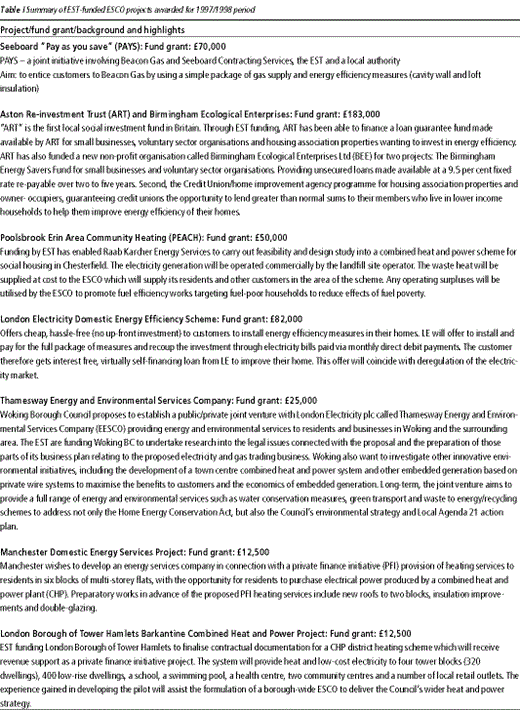
In July of this year, 35 funding applications were received, requesting a total of £1.1m from the Energy Services scheme. With the assistance of an independent advisory group,the Trust shortlisted applications to 20, providing grant funding totalling£525,000.
Over 60 local authorities and 50 housing associations were involved in the winning bids, either as the lead or as a member of a consortium. The majority of bids will draw on private sector partner support, in terms of either finance or expertise such as fuel supply and billing. The applications in 1998 exemplified the diversity of suggested energy services schemes which targeted all housing sectors, including council owned, housing association properties, private owned and private rented accommodation. Several projects also targeted schools and small businesses.
Business plans
Local authorities and housing associations received financial support to develop conceptual ESCO ideas into fully developed business plans, addressing issues such as financial viability and legal powers of local authorities to set up these ventures. These business plans will be completed by March 1999 and will be made available to all other local authorities.
The Trust plans to work closely with the Government, regulators and other partners to help deal with legal barriers that may emerge during the development of these business plans.
Innovation
Other successful award winners included several exciting, commercially-driven pilots. Union Energy, for example, will provide bulk discounted energy efficiency measures to all their energy supply customers. Packages of measures will be tailored to individual requirements by a self-completed energy audit. Another scheme led by WaterPower and Renewable Energy Ltd, in partnership with a national environmental charity,will be selling a package of "green" electricity and energy efficient measures,initially to a national database of environmentally aware consumers.
The future
The Trust is currently consulting widely on the best way to stimulate the continued development of energy services over the next two years. This is likely to include continued financial support for ESCO developments, and increased publicity about progress of all pilots.
The Trust will publicise the new funding programme shortly, together with the second ESCO conference,planned for spring 1999.
If you would like further information or to speak to someone in greater detail regarding the Energy Services Scheme run by theEnergy Saving Trust, contact Rebecca Southgate or Catherine Salmon on 0171 331 5300.
Summary of EST-funded ESCO Projects 1998/1999 (also see Table I)
Successful innovation bids
Title: Save Your Energy(SYE)Lead: MEB Powerline Energy Services Ltd.Partners: Powerhouse Retail Ltd.EST funding: £70,000;external funding: £70,000.Scheme description: MEB propose a very large marketing campaign and are considering inclusion of an energy services package (free audit and recommendations); discounted energy efficient goods (including white goods); evergreen tariff electricity, for the "fuel rich", owner occupiers and small businesses.
Title: Union Energy Services SchemeLead:Union Energy Ltd.Partners:National Energy Services Ltd.EST funding: £71,000; external funding: £379,000.Scheme description: establishment of a bulk discount scheme to offer union energy customers discounted energy efficiency measures. Packages of measures will be tailored to individual requirements via a self-completed energy audit. Measures also include standard guarantee, energy cost guarantee and where required an optional financing package will be available.
Title: School Energy ServicesLead:Chalmor.Partners:none specified.EST funding: £44,100; external funding: £44,100.Scheme description: a school energy-saving initiative. Installing energy-saving measures followed by ongoing energy advice and monitoring results with regular reporting. It will provide impetus to "Whole school approach" and lead to funds for energy efficiency measures. Financial viability is based on the school paying a subscription only if they save energy of greater value.
Title: Langdon Energy Saving SchemeLead:Waltham Forest Energy Services Ltd.Partners: Basildon District Council.EST funding: £25,000; external funding: £25,000.Scheme description: a CHP/community heating and energy-saving measures scheme on Langdon Hill estate. Financed by council and partly by equipment manufacturers who receive a share of the savings.
Title: WRE Green ESCOLead: WaterPower &Renewable Energy Ltd (WRE Ltd).Partners: ESD Ltd, WRE AG,environmental charity.EST funding: £69,000; external funding: £116,000.Scheme description: a new business venture selling "green" electricity and promoting energy-efficient measures to customers. The supply of green electricity will be at a premium price, but made cheaper by energy-efficiency measures put in through an informative and support service. As a joint venture with a national charity,gives access to a large database as start-up customers. Part of a large new business anticipated to reach more than £10 million in sales by year three. Funding required to set up the energy-efficiency component of WRE Ltd.
Successful social housing bids
Title: Pilot Energy Services Scheme for Edinburgh Sheltered HousingLead: Lothian & Edinburgh Environmental Partnership.Partners: City of Edinburgh Council, Scottish Power.EST funding: £15,000; external funding: £15,500.Scheme description: a proposed ESCO for Edinburgh's sheltered housing(1,100 houses). Scottish Power is to provide reduced rate fuel and access to energy-efficiency financing. A rent system within Edinburgh's sheltered housing will be set up to enable the tenants to repay the cost of the energy-efficient measures over seven years. Tenants will be interested because, even with the rent increase, they will be saving money through reduced energy costs.
Title: Black Country Energy Services ClubLead: Black Country HA.Partners: three other HAs, Dudley MBC, Powerline.EST funding: £22,852; external funding: £23,280.Scheme description: a feasibility study to set up an ESCO. It will involve a consortium of four HAs and an LA and will negotiate terms and conditions for the supply of electricity, gas or other fuel to tenants. It will aim to negotiate bulk discounts on energy-efficient measures. It will also aim to establish a "Not for profit" direct labour organisation.
Title: HeatSeekersLead: Derby City Council.Partners:Powerline Energy Services Limited, Wallbrook HA, NEA.EST funding: £15,000; external funding: £15,000.Scheme description: the development of an ESCO model to introduce energy-efficient improvements to dwellings, and to tackle barriers "head on" by means of a legal issue review. The scheme will produce an ESCO business plan using the KPMG ESCO model.
Title: St Edmundsbury Energy Services Developing a PFI approachLead: St Edmundsbury Borough Council.Partners:Graham Moody Associates, BRECSU.EST funding: £15,000; external funding: £18,423.Scheme description: to prepare an option appraisal and an outline business case for PFI funding for the installation of energy-efficiency measures and the provision of fuel supply following the KPMG model.
Title: The Save Energy Society "Fill & Save Scheme"Lead: Aylesbury Vale District Council.Partners:Save Energy Society Ltd.EST funding: £15,000; external funding: £64,000.Scheme description: to develop a social housing ESCO to look at cheaper fuel and energy-efficient measures, primarily for low-income groups, whereby it is planned that tenants pay a surcharge. However, cheaper fuel will be offered to all households.
Title: Nottingham Community EnergyLead:Nottingham City Council.Partners: City Wide Construction, Nottingham Energy Partnership, Trent Surveys.EST funding: £12,500; external funding: £12,500.Scheme description: energy supply brokering and the provision of grants and loans for energy-efficient measures.
Title: Affordable Warmth in SandwellLead:Sandwell MBC.Partners:HESTIA, Sandwell Health Authority.EST funding: £14,000; external funding: £22,100.Scheme description: the aim is to provide grants from capital receipts to subsidise energy efficiency improvements to low-income owner-occupiers. It will investigate the potential for a "premium" tariff to recover some of the investment, but initially will involve a consumer contribution up-front to trigger grant (therefore no bad debt problems). The aim is to set up and pilot a non-profit agency to co-ordinate on behalf of a consortium of LAs.
Title: Southampton Energy Supply CompanyLead:Southampton Environment Centre.Partners: Southampton City Council.EST funding: £9,000;external funding: £8,100.Scheme description: to evaluate the potential for setting up an ESCO targeted at people living in deprivation in Southampton. It will offer cheaper energy, costed advice and assistance in implementing measures. An operational plan will be prepared to identify what is necessary for success and sustainability.
Title: A Pilot ESCO for SMEs in the Tourist SectorLead: Forest of Dean Energy Team.Partners: Forest of Dean Council,PowerlineEST funding: £14,500; external funding: £19,000Scheme description: to investigate the potential for developing an ESCO targeting SMEs in the tourism sector. The ESCO would offer an energy supply and energy efficiency measures package. The investment in measures will be recovered in energy savings. SME will pay for the service.
Title: Energy ConnectionsLead: Gloucestershire Housing Association.Partners: Gloucestershire Rural HA, Gloucestershire Churches HA.EST funding: £14,000;external funding: £17,750.Scheme description: these two HAs are looking to invest in HA properties and recover the investment over a period up to ten years, by means of the rental charge to the tenant. This comes up against housing corporation "caps" on rents. Bulk fuel purchasing would part-subsidise the energy-efficient investment.
Title: Partnership in Energy (PIE)Lead:Northern Consortium of Housing Associations (NCHA).Partners: 54 local authorities (LA)and 38 Housing Associations (HA).EST funding: £39,000; external funding: £78,000.Scheme description: a large consortium of LA and HAs, co-ordinated by the NCHA, wish to carry out a feasibility study to look at setting up a charitable trust. The trust would give out grants, as well as costs of administration and promotion being sustained by the ESCO. The objectives are to provide a special tariff to low-income social housing tenants. The profits will be used to invest in energy efficiency.
Title: Catford Energy LinkLead: LB of Lewisham.Partners: AHS Emstar.EST funding: £15,000;external funding: £15,000.Scheme description: a CHP-based community heating system and fabric improvement to 304 LA dwellings; two schools(private and public), one leisure centre, one hospital, one town hall and a greyhound stadium. PFI type project.
Title: Earth Eating ESCOLead: East Thames Housing Group.Partners:Poplar Housing and Regen Community, LB of Tower Hamlets.EST funding: £15,000; external funding: £15,000.Scheme description: a community heating scheme fuelled by energy from waste plant with CHP. It aims to provide heating, hot water and electricity to domestic customers (two HAs), local businesses and schools. It involves shared savings and the ESCO's portion will fund other services including controls,insulation, double-glazing, advice and ratings.
Title: Kingsmead Energy Co-operativeLead:Kingsmead Homes.Partners:AHS Emstar.EST funding: £15,000; external funding: £15,000.Scheme description: to establish energy co-op on ex-LB Hackney estate, large-scale voluntary transfer to HA,based on private gas and electricity network. The ESCO will serve the estate with all electricity and heat together with energy-efficiency measures. Funding will come from avoided distribution use of system (DUOS) charges, and bulk purchase discounts, invested in capital upgrades.
Title: Manchester Alexandra Park and Longsight Energy Services (MAPLES)Lead: Manchester City Council.Partners: AHS Emstar.EST funding: £15,000;external funding: £15,000.Scheme description: a feasibility study/business plan for three CHP/community heating schemes serving 2,615 dwellings on two Manchester City Council estates. Existing systems would be upgraded to provide heat and electricity to tenants, as well as capital improvements including loft insulation, draught proofing and heat recovery extractor fans. Potential for linking in schools or other public buildings.


