


Building Services Systems (BSS) accounts for up to 60% of the cost of a construction project with multiple stakeholders, lengthy life cycles and high financial investment, making their procurement and management (P&M) more challenging than structural or architectural components. Despite this significance, there is a lack of research which focuses on the issues in procurement and management of BSSs and solutions to address them. Thus, this paper aims to address three knowledge gaps: identify the significant issues in procurement and management of BSS, examine the criticality of the issues and analyse the validity of blockchain (BT) as a technological solution.
A Delphi-based expert forum was conducted, and data were analysed using the content analysis technique. Twenty-eight issues were identified using a systematic literature review, and they were prioritised. Finally, features of the blockchain are mapped against the issues to analyse the potential of blockchain technology.
Analysis results identified that a lack of trust, transparency and collaboration are the root causes of the major issues. Comparative analysis of technologies established that blockchain has the potential to address the major issues.
It is important to acknowledge limitations of blockchain adoption, such as scalability, interoperability, legal uncertainty and industry readiness, especially in small and medium-sized enterprises’ and Business-to-Business applications.
BSS is the operational backbone of facilities management. Issues emerging during the early life cycle stages of BSS often manifest as performance and maintenance challenges in the operational phase. This study positions BT within the BSS domain across the entire life cycle of a facility. This problem-driven approach enhances collaboration, trust and transparency for sustainable facilities management.
1. Introduction
The global construction industry is experiencing more than 30% of cost overruns due to improper procurement and management practices (McKinsey Global Institute, 2024). This situation remains the same in the Australian construction industry, spending around $239m annually on inefficient procurement practices (Oxford Economics Australia, 2023). Meanwhile, building services systems (BSSs) stand as a cornerstone of any construction project, providing the vital engineering services required to ensure the efficient, safe and comfortable functioning of the built environment. It has been reported that building services consume a higher cost, up to 60% of the total project cost and approximately up to 50% of the entire duration (Chauhan et al., 2022). Considering the above facts, it is evident that procurement and management of BSSs is an imperative contributor to the Australian economy. Moreover, BSSs often entail more intricate procurement and management requirements throughout their life cycle, due to the need for strategic planning, complex design requirements, multidisciplinary back-to-back approvals, specialised knowledge from installers and manufacturers, complicated installation and commissioning processes and rigorous maintenance procedures (Gurmu and Wijeratne, 2023). This highlights the requirement of a systematic procurement and management approach for BSS.
Additionally, numerous challenges of the procurement and management of BSS are identified: lack of trust among stakeholders, lack of transparency of data delivery, poor collaboration/communication, delays in approvals, disputes over warranties and service provisions, contract conflicts, inadequate inspection records, misplaced documentation and the absence of clearly accountable parties (Akhil and Das, 2019; Hassanain et al., 2018). However, the existing systems which are available for procurement and management of BBS have revealed the inadequacy in addressing these persistent issues. This has resulted in the adoption of emerging technologies by construction organisations to address these issues. Building Information Modelling (BIM) has been identified as a common platform used in BSS for information sharing and data management. However, it falls short in updating or tampering with digital records, encompassing date changes, time or other metadata operations within the BIM model (Celik, Petri and Barati 2023). Further, BIM adoption is limited in later stages of the project life cycle, particularly at the transition to asset management and facility management (Shojaei, 2019). Enterprise Resource Planning (ERP) systems have been instrumental in managing the operations in the life cycle of building services; however, these systems exhibit some limitations. ERP systems operate in centralised silos, preventing the collaboration of external stakeholders (Gessa et al., 2023; Hewavitharana and Perera, 2020; Hewavitharana et al., 2025a). This prevents real-time updates, tamper-proof record-keeping, as well as data consistency and data traceability (Hewavitharana and Perera, 2019; Malik and Khan, 2021). A digital twin is another popular digital tool in building services. It is a digital replica of the physical system, which enhances the real-time monitoring, simulation and decision-making capabilities (Sepasgozar et al., 2023). The primary challenge in digital twins is the lack of data integrity and trust in the information exchanged among stakeholders, especially when the data is sourced from various proprietary systems (Opoku et al., 2021). It also struggles with data security, ownership rights and the authenticity of updates (Alnaser et al., 2024). AI and machine learning are increasingly being considered for applications in the construction industry (Francis et al., 2025; Perera et al., 2024). Lacking high-quality, structured and interoperable historical data, which is critical for training accurate predictive models, demotivates the use of AI and machine learning technologies in the procurement and management of BSS (Luo et al., 2023). This establishes the prevailing gap due to the unavailability of a unified system, which records all the transaction data from the planning to the disposal stage of the building services.
Considering the above-mentioned limitations of the current technologies for procurement and management of BSSs, blockchain has been identified as a feasible solution which has proven its potential in many construction domains, including contract management, supply chain management, quality management, asset management, etc. (Lafhaj et al., 2024; Nanayakkara et al., 2021; Zhang et al., 2023; Zhong et al., 2022). In terms of the application of blockchain in the construction domain, Supplementary Tables-Table 1 provides a comprehensive analysis of the previous studies. This analysis established that none of the previous studies has effectively addressed the identified research gap. Hence, this research aims to identify the existing issues in procurement and management of BSS and examine their criticality to provide a rationale for the blockchain adoption in procurement and management of BSS.
Application of blockchain in construction and facilities management
| No: | Paper title | Context in construction | Reference |
|---|---|---|---|
| 1 | Blockchain applications for construction contract management: a systematic literature review | Blockchain for contract management in construction | Zhang et al. (2023) |
| 2 | Blockchain and the built environment: Potentials and limitations | Potential application of blockchain technologies in enhancing the framework for automating the construction design review process | Nawari and Ravindran (2019) |
| 3 | Developing a BIM single source of truth prototype using blockchain | Integration of BIM with blockchain | Hijazi et al. (2022) |
| 4 | A blockchain-based framework for on-site construction environmental monitoring: Proof of concept | On-site construction environmental monitoring | Zhong et al. (2022) |
| 5 | Blockchain implementation quality challenges: a literature review | Quality management through blockchain | Koteska et al. (2017) |
| 6 | Copula: a decentralized solution for construction project monitoring using blockchain | Construction project monitoring through blockchain | Lafhaj et al. (2024) |
| 7 | Guest editorial: Blockchain and building information management: digital construction transformation | BIM and blockchain integration for improving the data management in the construction industry | Abrishami et al. (2024) |
| 8 | Blockchain for construction supply chains: a literature synthesis | Blockchain for construction supply chain | Rodrigo et al. (2018) |
| 9 | Potentials of blockchain technology for construction management | Potential of blockchain in construction management | Turk and Klinc (2017) |
| 10 | Securing land registration using blockchain | Application of blockchain for government approval and authentication | Krishnapriya and Sarath (2020) |
| 11 | Green procurement process model based on blockchain–IoT integrated architecture for a sustainable business | Improving the efficiency in the green procurement process for supply chain | Rane and Thakker (2020) |
| 12 | A study on the application of blockchain in the construction industry | Blockchain application in construction project life cycle, project cost/change management, contract bidding and formation and procurement evaluation | Kim et al. (2020) |
| 13 | BIM fork: Are smart contracts in construction more likely to prosper with or without BIM? | BIM and blockchain integration for dispute resolution | Mason (2019) |
| 14 | Blockchain technology: is it hype or real in the construction industry? | Application of blockchain in procurement, asset management, waste management, water trading, embodied carbon management, energy management, building maintenance system, construction management | Perera et al. (2021) |
| 15 | Effective use of blockchain technology for facilities management procurement process | Procurement and management of facilities management | Gunasekara et al. (2021) |
| 16 | Blockchain technology in the construction industry: Current status, challenges, and future directions | Blockchain in construction contract management | Wu et al. (2022) |
| 17 | Blockchain technology toward smart construction: Review and future directions | Blockchain in construction project management, supply chain management, digital twin application and smart city | Liu et al. (2023) |
| 18 | Blockchain and smart contracts: a solution for payment issues in construction supply chains | Blockchain for payment issue handling | Nanayakkara et al. (2021) |
| 19 | Blockchain for internet of things: a survey | Blockchain integrated with IoT | Dai et al. (2019) |
| 20 | Blockchain standards for compliance and trust | Blockchain for compliance checking | Anjum et al. (2017) |
| 21 | Shifting trust in construction supply chains through blockchain technology | Blockchain in supply chain management | Qian and Papadonikolaki (2020) |
| 22 | Blockchains for governmental services: Design principles, applications, and case studies | Blockchain for government approvals for construction designs | Martinovic et al. (2017) |
| 23 | Development of a blockchain-based embodied carbon estimator | Blockchain in embodied carbon estimation | Rodrigo et al. (2024) |
| 24 | A blockchain-based integrated document management framework for construction applications | Blockchain for construction document management | Das et al. (2022) |
| 25 | Blockchain for insurance and claims fraud detection | Blockchain in insurance and claims fraud detection | Ali (2019) |
| 26 | Construction information authentication and integrity using blockchain-oriented watermarking techniques | Blockchain for data management in construction | Lou and Lu (2022) |
| 27 | Adoption of blockchain technology through digital twins in the construction industry 4.0: A PESTELS approach | Integration of digital twin in construction | Teisserenc and Sepasgozar (2021) |
As the first step of this research, issues involved in the procurement and management of BSSs are identified through a systematic literature review. Second, issues were prioritised based on their prevalence and negative impact on the construction project using a Delphi- based expert forum. Finally, blockchain was proposed and conceptually mapped to demonstrate the potential of blockchain in solving these issues. This paper comprises six (6) sections, namely, introduction, literature review, methodology, results and discussion, conclusion and references.
2. Literature review
The literature review of the paper consists of three main sections, including issues in procurement and management of BSS and blockchain, and achieving sustainability in facilities management through blockchain integration.
2.1 Issues in procurement and management of building services systems
The complexity of the procurement and management of BSS, compared to the procurement and management of other construction elements, was identified by Hewavitharana et al. (2025b). With this complexity, BSS gives rise to procurement and management issues, which have a high negative impact on the productivity of the construction projects.
This section is structured using the identified articles from the systematic literature review. As a result, 28 issues were extracted under five groups:
Issues related to stakeholder coordination and trust;
Issues related to data integrity and transparency;
Issues related to regulatory compliance and governance;
Issues related to design requirements; and
Issues related to procurement and operational workflow, as presented in Supplementary Figures-Figure 1.
 The flow begins with a systematic literature review using PRISMA, which identifies research gaps and issues in the procurement and management of building services and leads to Research Question 01 and Research Gap 01. Semi-structured interviews, a Delphi-based expert forum, and thematic content analysis contribute to categorising issues based on their criticality, leading to Research Question 02 and Research Gap 02. Logical mapping of blockchain features and issues then establishes the potential of blockchain technology in solving issues in the procurement and management of building services, leading to Research Question 03 and Research Gap 03.
Research design
Source: Author’s own work
The flow begins with a systematic literature review using PRISMA, which identifies research gaps and issues in the procurement and management of building services and leads to Research Question 01 and Research Gap 01. Semi-structured interviews, a Delphi-based expert forum, and thematic content analysis contribute to categorising issues based on their criticality, leading to Research Question 02 and Research Gap 02. Logical mapping of blockchain features and issues then establishes the potential of blockchain technology in solving issues in the procurement and management of building services, leading to Research Question 03 and Research Gap 03.Research design
Source: Author’s own work
These issue categories were clustered using the knowledge gained from the previous grouping in the literature.
2.1.1 IS1: Issues related to stakeholder coordination and trust.
BSS involve a wide range of specialist builders, consultants, manufacturers, installers and facility managers, with different contractual obligations driven by their project-specific objectives (Mosley and Bubshait, 2017). The interdependencies among these stakeholders are exaggerated by the complexities of the procurement and management of the BSS and the multidisciplinary nature of the systems (Teo et al., 2022). In the current practice, BSS involve significant collaboration issues, especially in the design phase. Lack of collaboration and trust/confidence among individuals and teams (organisational trust) in the workflows leads to inefficiencies in the workflow. Thus, it is required to have a mechanism for back-to-back approvals and real-time updates to enhance trust and collaboration among stakeholders.
2.1.2 IS2: Issues related to data integrity and transparency.
Exchange of accurate, consistent and timely data across a wide range of stakeholders and throughout the processes is a major concern in BSS. As a large amount of data is generated across diverse disciplines, systematic management of data is required. The current industry is characterised by fragmented information systems, siloed data storage and limited interoperability between digital tools such as BIM, ERP and procurement platforms (Abdelhameed and Saputra, 2020). This fragmentation compromises data integrity, as discrepancies, duplication and errors can occur when information is manually transferred or inconsistently updated across platforms (Pradeep et al., 2020). These issues not only hinder informed decision-making but also increase the risk of rework, disputes and non-compliance.
2.1.3 IS3: Issues related to regulatory compliance and governance.
BSS must adhere to building codes, safety standards, quality standards, environmental performance criteria and FM governance principles throughout their life cycle (Wu et al., 2022). Manual and paper-based approval processes, isolated record-keeping and the lack of trustworthy compliance monitoring systems increase the risk of non-conformance, regulatory breaches and delayed approvals (Latiffi et al., 2013). In many cases, building services components fail to meet required quality standards due to gaps in inspection protocols, incomplete documentation and the absence of regular inspections (Oyeyipo et al., 2022). These gaps can lead to legal disputes, project delays and reputational damage.
2.1.4 IS4: Issues related to procurement and operational workflow.
Building services involve specialised contractors/installers for the installation of the system. Beyond installations, it requires operation and maintenance procedures to ensure that system performance aligns with design intent and regulatory standards. Warranty and service provision are other concerns in building services (Dzulkifli et al., 2021). Issues related to the above concern need to be avoided to maintain proper procurement and operational workflow.
2.1.5 IS5: Issues related to design requirements.
BSS are highly design-driven, as their successful installation relies on the precise alignment of client-specific functional needs, structural constraints, regulatory compliance and market standards (Abdelhameed and Saputra, 2020). Additionally, their design requirements are complex due to a high degree of interdependencies in different types of BSSs (service integration). Currently, there are issues related to clash detection, unclear requirements of the client, incompatibilities in design formats, etc (Farooq and Sharma, 2017). Proper design integration with every discipline is required to avoid inconsistencies in designs.
2.2 Application of blockchain in the construction industry
Blockchain (BT) is a distributed, immutable ledger that facilitates recording transactions more trustworthily and securely. It has demonstrated its potential in multi-disciplinary areas in construction, such as asset management, insurance and claim fraud detection, governance in dispute resolution, accounting and auditing (Refer Table 1). It is highlighted that the application in BSS throughout its life cycle remained unexplored.
Further, as outlined in Supplementary Tables-Table 1, various technologies, including Building Information Modelling (BT), Artificial Intelligence (AI), Building Management Systems (BMS), Digital Collaboration Tools (DCT), Digital Twin (DT), Internet of Things (IoT), have capabilities to address some aspects of procurement and management of BSS with some limitations. Achieving effective procurement and management of BSS, therefore, requires collective integration of these technologies. In this research, the potential of blockchain in addressing the issues in procurement and management of BSS was investigated while examining its limitations.
2.2.1 Drivers of blockchain adoption.
Distributed Ledger and Trust: Blockchain uses a distributed ledger instead of depending on a central authority to manage transactions (Perera et al., 2021). This reduces the fragmented data across stakeholders, especially at the facility handover from contractor to owner.
Smart Contracts and traceability: Smart contracts are logical algorithms that execute with pre-defined rules without the need for intermediaries (Rodrigo et al., 2024). This prevents disputes by providing verifiable records, particularly for contractual payments and claims in large BSS investments.
Real-time updates and transparency: Blockchain records transactions securely and makes them available in real time only to authorised users (Plevris, 2025). As a result, BSS operators can access reliable, up-to-date data for energy monitoring and operational decision-making.
Immutability and data security: Once data is recorded on the blockchain, it cannot be changed or deleted (Weerapperuma et al., 2025). This auditability supports BSS maintenance by providing an accurate and reliable historical record of system performance.
However, previous literature mentioned that procurement and management issues are not purely informational but socio-technical, governed by stakeholder connection and trust. Blockchain is a strategic enabler to improve that connectivity with reliable information (Nawari and Ravindran, 2019; Singh et al., 2025).
2.2.2 Barriers to blockchain adoption.
Regulatory barriers: Blockchain adoption is limited by the lack of clear legal frameworks in many regions. As blockchain is decentralised, it is difficult to define a rule common to all regions. In addition, the legal status of smart contracts is still uncertain. To address these issues, governments and regulatory bodies need to develop clear policies and guidelines. The application of permission blockchain systems is useful to avoid privacy issues with data (Waqar et al., 2024).
Technical barriers: The life cycle of BSSs deals with large amounts of data, which creates scalability issues. Further, some blockchain platforms do not support existing information systems, leading to interoperability issues. Lack of technical specialists to implement blockchain-based solutions is also another challenge. These challenges can be addressed by using more scalable solutions, improving system compatibility and investing in training to build technical expertise (Kiu et al., 2024).
Social and managerial barriers: Many stakeholders in the construction industry lack trust in digital technologies and resist moving away from traditional environments. Managers are uncertain about the return on investment, integration risk and disruption to workflows and hierarchies. Overcoming these barriers requires strong leadership, stakeholder education and awareness programs, collaborative change management and clear organisational policies for blockchain adoption (Celik et al., 2024).
Financial barriers: The Australian construction industry predominantly consists of small-′ and medium-sized enterprises (SMEs), which face difficulties in making large investments in technologies. (Perera et al., 2021). These organisations are reluctant to adopt blockchain due to high initial costs and uncertainty about long-term benefits. In addition to setup costs, ongoing expenses such as system maintenance and technical support are also required (Perera et al., 2021). Governments should provide incentives or tax benefits for SMEs in the early stage of technology adoption, while organisations may share costs and risks through funding models like private-public partnerships (Shojaei, 2019). Pilot implementations can be initiated to conduct cost‐benefit analyses and demonstrate Return on Investment (ROI) to stakeholders (Heydari and Shojaei, 2025). However, existing case studies are still limited and do not yet provide detailed empirical evidence of cost savings in construction (Waqar et al., 2024).
2.3 Achieving sustainability in facilities management through blockchain integration
Building services go beyond the construction phases. While the design and installation of these systems typically occur during the construction phase, their management, maintenance and optimisation become the primary responsibility of Facilities Management (FM) once the building is occupied. Therefore, the application of blockchain throughout the life cycle of building services is directly linked with achieving sustainability in facilities management.
Blockchain demonstrates a promise in facilitating “green leasing” and sustainable building management. Green leases are agreements where owners and tenants commit to operate a facility according to sustainability targets (energy efficiency, waste reduction, etc.; Collins et al., 2016). Facility managers need shared data to ensure both parties uphold environmental commitments. Blockchain can act as a trusted mediator for sharing sustainability data and automating lease clauses. For instance, a smart contract could enforce a clause that rewards the tenant for reducing energy consumption by automatically adjusting rent or releasing a deposit when energy usage data (pulled from IoT meters) meets the agreed benchmark (Collins and Lindkvist, 2022).
Furthermore, blockchain ledgers can store and certify building sustainability certifications and histories (e.g. green building ratings, maintenance logs, retrofit records). This creates a permanent “green passport” for a facility. A building’s BREEAM or LEED certification data, energy performance records and maintenance history can be stored on a blockchain accessible to stakeholders like owners, FM service providers, insurers and even prospective tenants. This not only supports ongoing sustainable practices (since any upgrade or change is logged and transparent) but also adds value by showcasing the building’s sustainability credentials. Prospective occupants can easily verify a building’s past energy efficiency or environmental compliance on the open ledger, aiding informed decision-making (Meinen et al., 2024).
The integration of blockchain in FM could lead to innovative practices like a comprehensive “building passport”. This is a blockchain-based repository of all critical information about a building across its life cycle, ownership records, leases, maintenance and repair history, environmental performance, etc. Shi and Tay (2019) highlighted that blockchain is a data space where any authorised party (owners, tenants, service contractors, etc.) can contribute or retrieve information. Such a passport, secured with time-stamped blockchain entries, would make the building’s history incorruptible and easily transferable upon sale or handover. Banks could even streamline financing by accessing the transparent records of a property’s condition and cash flows, and real estate due diligence could be simplified. In this vision, experts predict that work done by auditors will disappear once trustworthy blockchain records are in place. This indicates both economic sustainability (lower transaction costs) and social sustainability (increased trust and accountability in real estate transactions; Lu et al., 2021).
Blockchain also introduces new considerations, such as the environmental footprint of blockchain itself, particularly for public blockchains that rely on energy-intensive consensus mechanisms. For instance, Bitcoin’s proof-of-work mining consumes lots of energy: by 2024, annual Bitcoin blockchain energy use in China alone was projected to reach 296.59 TWh, resulting in 130.50 million metric tons of carbon emissions, an amount exceeding the yearly greenhouse gases of entire countries like the Czech Republic or Qatar (Collins and Lindkvist, 2022). This highlights a paradox: using blockchain to drive sustainability in facilities could inadvertently increase carbon emissions if the chosen platform is energy inefficient. Facilities managers must thus be mindful of which type of Distributed Ledger Technology (DLT) they adopt. Newer blockchain networks are moving towards greener solutions; for example, some use proof-of-stake consensus or carbon offset programs to achieve carbon neutrality. The WAX blockchain, as one case, markets itself as a carbon-neutral platform, partnering with environmental organisations to offset emissions (e.g. planting trees for transactions; Rathnayake et al., 2025).
However, data quality and privacy on blockchain are critical considerations. A blockchain-based FM system is only as reliable as the information entered into it. If facility data (maintenance records, performance metrics, etc.) is recorded inaccurately or dishonestly, the blockchain will faithfully preserve those errors, potentially misleading decision-makers. Thus, robust data validation processes and trusted data feeds are needed to ensure the integrity of blockchain records. Additionally, privacy concerns arise because blockchain’s strength is transparency, which can conflict with the confidentiality needs of some FM data. For example, making detailed maintenance logs or energy usage data publicly accessible could expose sensitive information about a company’s operations or competitive strategy. Facilities managers will need to balance openness with privacy, possibly by limiting third-party access or anonymising certain data on the ledger to protect corporate confidentiality (Singh et al., 2025).
3. Research design and methods
A few methods are integrated to answer the questions established in this study. To recognise the issues in procurement and management of BSSs, a systematic literature review was performed initially. This was followed by a Delphi-based expert forum to validate the identified issues in the Australian construction industry based on their criticality. The collected data was analysed through content analysis. Furthermore, the mean values of the responses obtained from the expert interviews (Likert Scale) were used as supporting evidence for the analysis. Finally, the blockchain features are logically mapped against the identified issues to analyse the feasibility of blockchain in solving the issues. It is important to note that the criticality of issues was empirically supported by domain experts, whereas the solutions to the issues using blockchain technology remain conceptual. In this study, Figure 1 shows the progressive steps in this study.
3.1 Systematic literature review
To identify the knowledge gaps in this research area, a systematic literature review was conducted based on the “Preferred Reporting Items for Systematic Reviews and Meta-Analyses (PRISMA)” approach. Accordingly, the Scopus database was used to search keywords, as it has a broader range of scientific publication coverage than other databases, a faster indexing process and the ability to retrieve more recent publications (Darko and Chan, 2017). The research string is as follows; (“Construction” OR “Built Environment” OR “Civil Infrastructure”) AND (“Digital Technolog*”OR “Blockchain” OR “BIM” OR “Building Information Modelling” OR “Digital Twin” OR “Building Management System” OR “IoT” OR “Internet of Things” OR “AI” OR “Artificial Intelligence” OR “BMS” OR “Building Management System”) AND (“Design Phase” OR “Procurement” OR “Tender*” OR “Construction Phase” OR “Installation” OR “Commissioning” OR “Operation and Maintenance” OR “Decommissioning”). To optimise results, an asterisk (*) was used as a wildcard. The Boolean operators “AND” and “OR” were used to combine keywords and link synonyms, respectively. Supplementary Figures-Figure 2 illustrates the methodological flowchart followed in the current study based on the PRISMA approach.
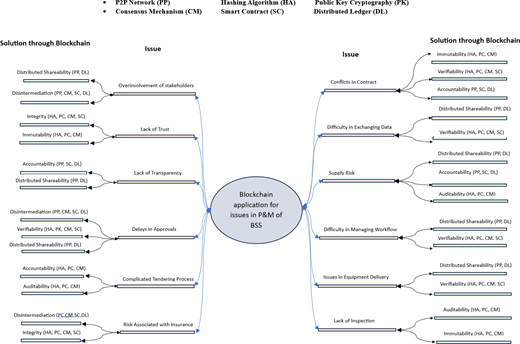
Blockchain-based solutions for the major issues in procurement and management of building services
Source: Author’s own work
Blockchain-based solutions for the major issues in procurement and management of building services
Source: Author’s own work
To evaluate each work for inclusion, many criteria were considered when filtering. The publication year was not limited due to the consideration of results from the beginning. Peer-reviewed journals that were written in the English language were included, as it is an international language. “Records at the final stage” were only included, and “records under review” were excluded to improve the accuracy of inputs. In summary, 2,184 records from 3,568 were excluded, allowing 1,384 records for the next screening. To further reduce the sample size, the abstract, introduction and conclusion sections of each record were assessed. From that, 998 records were excluded: duplications and not relevant to the research questions. There were four inaccessible records. Consequently, 53 records were included for the next step. In addition, nine records were also included through cross-referencing from the sample of full record review. Finally, 62 records were included for the in-depth review as they enriched the literature development of the study. Supplementary Tables-Table 1 summarises the issues applicable to the existing procurement and management of BSSs, and the potential technologies to solve the issues. Identified issues in the procurement and management of BSSs are discussed separately in the Literature review section.
3.2 Delphi-based expert forum
The Delphi technique is a structured group communication method that engages specialist knowledge to achieve a consensus view about a topic. It is commonly applied to address “real-world” problems, characterised by eliciting personal insights from participants regarded as experts, who provide feedback based on their experiences (Brown, 2018). In this study, semi-structured interviews were adopted in the Delphi-forum, allowing the researcher to ask both structured and unstructured questions, and thereby clarify the doubts to validate the identified issues through literature to the Australian construction context. Participants were selected based on purposive sampling. Purposive sampling helps to select participants who are able and eager to provide insights based on their experience or knowledge of a specific phenomenon (Ababio et al., 2023). Further, Ameyaw et al. (2016), stated that the ideal size of the participant represented in the expert forum is between 3 and 12. Thus, a total of 19 experts (DE2-DE19) who have engaged in BSS for more than five years (≥5 years) participated in the expert forum. Table 2 presents the respondent details. As stated by Saunders et al. (2019), the number of interviews involved in a qualitative study is mainly based on the research area and “theoretical saturation”. In this study, blockchain experts were not included in the expert forum, as they lacked domain-specific knowledge (procurement and management of BSSs). The selected experts provided comprehensive coverage of all five main building services as well as the entire life cycle stages. Table 3 provides the experience of the experts, varied across the different types of building services. Given these criteria, the 19 semi-structured interviews were deemed sufficient, particularly as data saturation was observed, receiving repeated responses.
Respondent details
| Expert | Experience (yrs) | Role code | Interviewee code | Phase | |||||||
|---|---|---|---|---|---|---|---|---|---|---|---|
| P0 | P1 | P2 | P3 | P4 | P5 | P6 | P7 | ||||
| Building owner/client | 10 | CL | DE2 | X | X | X | X | X | X | X | X |
| Builder | BU | ||||||||||
| Project manager | 15 | PM | DE16 | X | X | X | X | X | X | X | |
| Structural engineer | 7 | SE | DE14 | X | X | X | X | ||||
| Architect | 7 | BAR | DE12 | X | X | ||||||
| Building service engineer | 8 | BBE | DE1 | X | X | X | X | X | X | X | X |
| BIM manager | 7 | BI | DE3 | X | X | X | |||||
| Quantity surveyor | 7 | QS | DE6 | X | X | X | X | X | |||
| Consultant | CO | ||||||||||
| Project manager | 15 | PM | DE16 | X | X | X | X | X | X | X | |
| Structural engineer | 7 | SE | DE14 | X | X | X | X | ||||
| Architect | 14 | CAR | DE9 | X | X | X | X | X | |||
| Building service engineer | 7 | CBE | DE8 | X | X | X | X | X | |||
| Electrical engineer | 16 | EE | DE18 | X | X | X | X | X | X | X | X |
| BIM manager | 7 | BI | DE3 | X | X | X | |||||
| Quantity surveyor | 7 | QS | DE6 | X | X | X | X | X | |||
| Manufacturer | 7 | MN | DE11 | X | |||||||
| Subcontractor (installer)/fabricator | IN | ||||||||||
| Mechanical (HVAC) | 16 | INM | DE17 | X | X | ||||||
| Electrical | 12 | INE | DE19 | X | X | ||||||
| Plumbing | 12 | INP | DE4 | X | X | ||||||
| Vertical transportation | 30 | INL | DE15 | X | X | X | X | ||||
| Fire services | 30 | INF | DE15 | X | X | X | X | ||||
| Building manager | 18 | BM | DE7 | X | X | ||||||
| Operation and maintenance personnel | 16 | OM | DE10 | X | X | X | |||||
| Government legislative bodies | 24 | GL1 | DE13 | X | X | ||||||
| 7 | GL2 | DE5 | X | X | X | X | X | X | X | X | |
Experience of the experts according to type of BSS
| Code | Stakeholder | Interviewee code | Role code | Type of building service | Overall | ||||
|---|---|---|---|---|---|---|---|---|---|
| Mechanical (HVAC) | Electrical | Plumbing | Vertical transportation | Fire services | building | ||||
| S1 | Building owner/client | DE2 | CL | X | |||||
| S3 | Builder | BU | |||||||
| S4 | Project manager | DE16 | PM | X | |||||
| S8 | Structural engineer | DE14 | SE | X | |||||
| S9 | Architect | DE12 | BAR | X | |||||
| S5 | BSS engineer | DE1 | BBE | X | X | X | X | X | |
| S6 | BIM information manager | DE3 | BI | X | X | X | X | X | |
| S7 | Quantity surveyor | DE6 | QS | X | |||||
| S10 | Consultant | CO | |||||||
| S4 | Project manager | DE16 | PM | X | |||||
| S8 | Structural engineer | DE14 | SE | X | |||||
| S9 | Architect | DE9 | CAR | X | |||||
| S5 | BSS engineer | DE8 | CBE | X | X | X | X | X | |
| S5 | Electrical engineer | DE18 | EE | X | |||||
| S6 | BIM information manager | DE3 | BI | X | X | X | X | X | |
| S12 | Manufacturer | DE11 | MN | X | |||||
| S14 | Subcontractor(Installer)/Fabricator | IN | |||||||
| Mechanical (HVAC) | DE17 | INM | X | ||||||
| Electrical | DE19 | INE | X | ||||||
| Plumbing | DE4 | INP | X | ||||||
| Vertical transportation | DE15 | INL | X | ||||||
| Fire services | DE15 | INF | X | ||||||
| S15 | Building manager (BM) | DE7 | BM | X | X | X | X | X | |
| S16 | Operation and maintenance personnel | DE10 | OM | X | X | X | X | X | |
| S20 | Government legislative bodies | DE5 | GL2 | X | |||||
| Government legislative bodies | DE13 | GL1 | X | ||||||
The first round of the Delphi was carried out via Zoom, and interviewees were asked to rank the Likert scale (from 1 to 5, where 1 denotes “Very Low” and 5 denotes “Very High”) and explain the answer based on the prevalence of the issues and the level of impact (positive or negative) in the construction industry. The quantitative responses were analysed using the “mean of responses” in Excel, and qualitative opinions were analysed thematically by giving priority to the “minority gives way to the majority” theory. Due to the small sample size, qualitative data analysis was performed manually. The second round of Delphi was conducted via email to get their consensus on the results.
4. Results and discussion
This section discusses the criticality of issues in the procurement and management of BSSs. In the Delhi-based expert forum, experts were asked to rank the issues on a Likert scale based on prevalence and the negative impact on project cost and timeline. They were further asked to elaborate on the value given on the scale. This explanation was used for the content analysis, and the values on the scale were used to support the judgments. Therefore, the categorisation of issues (major/moderate/minor) reflects expert perceptions and is exploratory in nature, avoiding any implication of statistical generalisability.
4.1 Categorisation of issues
The categorisation of issues in procurement and management of BSSs, along with the corresponding percentage of expert agreement, is presented in Table 4. This quantitative assessment complements the content analysis.
Categorisation of issues in procurement and management of BSSs based on expert feedback
| Issue number | Issues in the procurement and management of BSSs | Criticality of issues | Expert agreement (%) | ||
|---|---|---|---|---|---|
| Major | Moderate | Minor | |||
| IS1: Stakeholder coordination and trust issues | |||||
| C1 | Overinvolvement of stakeholders in the building services process leads to numerous clashes | √ | 84.2 | ||
| C2 | Difficulty in establishing trust among stakeholders | √ | 78.9 | ||
| C3 | Difficulty in managing workflow due to a lack of collaboration among parties | √ | 89.5 | ||
| C4 | Conflicts in contracts | √ | 87.5 | ||
| C5 | Delays in approvals | √ | 78.9 | ||
| IS2: Regulatory compliance and governance issues | |||||
| C6 | Noncompliance with building practitioner regulations | √ | 16.7 | ||
| C7 | Lack of adherence to government regulations | √ | 25 | ||
| C8 | Not complying with quality standards | √ | 33.3 | ||
| C9 | Lack of transparency in the manufacturing procedure | √ | 53.8 | ||
| C10 | Clashes between design and specifications | √ | 58.3 | ||
| IS3: Data integrity and transparency issues | |||||
| C11 | Difficulty in exchanging data (e.g. drawings, project info) | √ | 78.9 | ||
| C12 | Poor decision-making due to inaccurate/lack of information | √ | 53.8 | ||
| C13 | Inconsistencies between the documentation | √ | 50 | ||
| C14 | Lack of transparency in working processes | √ | 77.8 | ||
| IS4: Procurement and operational workflow issues | |||||
| C15 | Low quotation-to-order ratio | √ | 58.3 | ||
| C16 | Long and complicated tendering processes | √ | 70 | ||
| C17 | Supply risks in procurement | √ | 75 | ||
| C18 | Large-scale dark purchasing | √ | 12.5 | ||
| C19 | Risks associated with insurance | √ | 77.8 | ||
| C20 | Issues with equipment delivery | √ | 76.9 | ||
| C21 | Issues in service provision | √ | 50 | ||
| C22 | Warranty leakages | √ | 50 | ||
| C23 | Lack of proper inspections | √ | 70 | ||
| IS5: Design requirement issues | |||||
| C24 | Unclear conceptual designs | √ | 53.8 | ||
| C25 | Instantaneous design changes | √ | 58.3 | ||
| C26 | Unclear client requirements | √ | 69.2 | ||
| C27 | Sudden changes in the client’s requirements | √ | 66.7 | ||
| C28 | Incompatibility among design software | √ | 21.4 | ||
As observed in Table 4, all issues under “stakeholder coordination and trust” were considered major issues in the procurement and management of BSSs. The overinvolvement of stakeholders and related intermediaries in procurement and management creates a fragmented environment where aligning interests becomes highly challenging. DE2 mentioned that “it is difficult to consolidate stakeholders with diverse perspectives who prioritise their interests on a single platform”. This point is further justified by DE8, “Trust will be diminished when professionals take decisions for their own benefit”. This highlights that, in terms of trust, whatever technology is introduced, still issues can be raised due to human nature. However, trust issues can be reduced by a transparent mechanism. Arguing to this DE14 mentioned that:
[…] some consultants are hesitant to share data, as they think it is a potential risk to their careers. Further exposing confidential information to different parties also becomes a threat to them in the future.
Therefore, even with the platforms currently available, many stakeholders are reluctant to share information as they perceive it as a threat to their careers. Further, DE15 mentioned that:
Data management tools are there, still not fully embraced. A large number of small contractors don’t know how to manage data. Materials and installed machinery details need to be properly documented.
Lack of required information and documentation creates unnecessary contractual disputes among parties. In BSS, a number of parties must work collaboratively from planning through to installation in a seamless manner. DE1 mentioned that the project manager should take necessary actions to keep all stakeholders informed, as the project manager is responsible for managing workflow and enhancing collaboration among the workforce. Further, in practice, separate approvals are first obtained for different drawings, and final approval is only granted for coordinated drawings, which causes delays. DE14 highlighted that “It takes time to get approval for coordinated drawings”. If real-time updates were available to keep all stakeholders informed, such issues would not be created.
In terms of integrity and transparency issues, DE3 linked transparency directly to technological choices, stating, “Transparency can relate to the type of software tool the organisation uses. If they use a common data environment, transparency builds up.” This highlights how the adoption of shared digital platforms, such as Common Data Environments (CDEs), can facilitate transparency by enabling uniform access to information across stakeholders. However, DE11 mentioned that transparency protocols should be maintained regarding manufacturing procedures in terms of intellectual property, production process, the authenticity of the material, test standards and results, where third-party organisations can check the materials, assessing authority, companies’ history and experience.
Major issues in “procurement and operational workflows” of BSS arise from both contractual practices and post-installation management deficiencies. DE6 highlighted that most of the provisional sums in tender processes are allocated for BSS, which introduces ambiguity and uncertainty in later stages of project delivery. DE2 emphasised the complications in insurance management by mentioning “insurance companies provide coverage for BSS systems; they often manipulate terms and conditions to their advantage when issues arise”. This indicates a misalignment between insurance policies and the realities of BSS operations. DE18 reinforced this concern, stressing that given the high cost of insurance, the terms and conditions should be closely aligned with the contractual obligations to ensure fairness and protection for all parties. In the maintenance stage, DE1 noted, although maintenance personnel are keeping records, they are not consistently kept up to date and are subject to numerous inaccuracies and manipulations.
The majority of Experts (68%) highlighted that if the major issues can be addressed, then moderate and minor issues could be resolved more easily as a natural progression. This is because most moderate issues in BSS are linked to the design stage, which forms the foundation for the next phases of the project. Construction organisations have already adopted technologies such as BIM during design, which has successfully mitigated numerous design-related challenges. While issues like tracking of design changes or coordination among stakeholders persist, these are not as critical as fundamental design misalignments. Those issues can be addressed through enhanced digital features such as version control and real-time updates. Issues such as non-compliance with building regulations, lack of adherence to government requirements and failure to meet quality standards are large-scale dark purchasing are considered minor because they are not prevalent in contexts like Australia. Agreeing that, DE12 mentioned, “Professionals always try to align with the building regulations and specifications in Australia”. These issues are managed through existing regulatory frameworks and compliance processes rather than requiring new technological interventions.
4.2 Blockchain as solution
This section presents the analysis of blockchain features in solving the identified issues. This analysis was carried out by integrating findings from a Delphi-based expert forum and the systematic literature review. Smart contracts, P2P network, consensus mechanism, hashing algorithms and public key cryptography facilitate accountability, verifiability, auditability, proper history records, immutability, distributed shareability and integrity features, which can resolve issues in procurement and management of BSSs. Figure 2 demonstrates the potential of blockchain in solving the major issues identified in the procurement and management of building services.
4.2.1 Smart contracts.
Smart contracts are predefined if/then principle-based logics which execute once the conditions are met (Adekunle et al., 2024). In facilities management, they directly address issues such as delays in approvals with a one-time notification system; risk in insurance with auto-trigger payouts; supply risk by condition-based delivery tracking; and lack of inspection by timestamped image logs. However, adoption of smart contracts remains limited due to unresolved legal uncertainties and a lack of regulatory frameworks. Integrating existing legal and legacy systems, along with smart contracts, with a smooth transition, would be a solution for this barrier (Martinovic et al., 2017).
4.2.2 P2P network and distributed ledger.
A peer-to-peer (P2P) network supported by a distributed ledger enables authorised stakeholders to access a single, shared record of procurement and FM activities without reliance on central intermediaries (Perera, 2021). Shared records reduce rework and disputes during handover by ensuring that procurement decisions, warranties, commissioning outcomes and maintenance obligations remain accessible to FM teams. However, procurement and management of BSSs handle substantial data volumes throughout their life cycle (features by Business-to-Business (B2B) projects), raising blockchain scalability challenges. Efficient management of on-chain (e.g. contractual logic, payment triggers) and off-chain data (e.g. BIM files, sensor logs) is essential to ensure system performance (Nawari and Ravindran, 2019).
4.2.3 Consensus mechanism.
In BSS procurement and facilities management, consensus mechanisms primarily address disputes and delays arising from multi-party approvals across specialist subcontractors, consultants and asset owners (Angelis and Ribeiro da Silva, 2019). Consensus-based validation supports transparent tender evaluation, coordinated commissioning approvals and jointly verified insurance claims, reducing reliance on unilateral decision-making. During facilities management, shared agreement on inspection outcomes and maintenance responsibilities improves accountability and limits post-handover disputes (Anjum et al., 2017). However, in construction practice, decision-making often relies on the subjective experience of professionals, making it difficult to encode qualitative judgments into structured, consensus-driven processes. This cultural and operational shift must be smoother with proper education and training (Abrishami et al., 2024).
4.2.4 Hashing algorithm.
A hash key is a fixed-length string generated by a hashing algorithm from input data, representing that data in a secure, unique way (Abrishami et al., 2024). Hashed tender data reduces post-submission manipulation and supports fair evaluation of specialist bids, while hashed inspection and commissioning records provide verifiable evidence during FM handover and ongoing operations. In facilities management, immutable hash references strengthen maintenance histories and limit disputes related to asset performance and compliance. However, integrating blockchain systems with legacy infrastructure presents interoperability challenges. A solid transition requires not only technical adaptation but also cultural and organisational shifts to align with blockchain-enabled workflows (Ali, 2019).
4.2.5 Public key cryptography.
Public key cryptography ensures the secure identification of participants and the encryption of sensitive facilities management information (Rodrigo et al., 2018). Digitally signed approvals reduce delays and prevent inspection or commissioning fraud, while encrypted design documents, compliance records and maintenance logs can be safely shared across multiple service providers. Permissioned blockchain networks further ensure that sensitive information is accessible only to authorised stakeholders, supporting both transparency and confidentiality throughout the BSS life cycle (Weerapperuma et al., 2025).
However, the following considerations should be acknowledged when converting the proposed conceptual blockchain framework into an application. The recommended blockchain platform is a permissioned blockchain, such as integrated Hyperledger Fabric and Hyperledger FireFly, due to the sensitivity and confidentiality of data associated with building services projects in different organisations. Further, effective management of on-site and off-site data is required to avoid scalability issues as this application manages a high volume of data throughout the life cycle of the BSS. Supplementary Tables -Table 2 presents the categorisation of on-chain and off-chain data considered during the application development process. In this context, transactional records, approvals and hash keys of design and documentation are maintained on-chain to ensure blockchain features, while BIM models, technical reports, specifications and other large data sets are managed through an off-chain database. Data governance and authenticity of the application can be managed through role-based authorisation levels and a pre-defined access permission. For example, clients of the system should be able to handle all transactions, while subcontractors may only handle one module, such as “installation”.
5. Conclusion
This research examined the criticality of existing issues in the procurement and management of BSS and the adoption of blockchain as a feasible solution for the identified issues. Twenty-eight issues were identified through a systematic literature review, and subsequently, they were prioritised using a Delphi-based expert forum. These issues were prioritised based on their criticality as Minor (5 issues), Moderate (11 issues) and Major (12 issues). The identified major issues are overinvolvement of stakeholders, lack of trust, lack of transparency, delays in approvals, complications in the tendering process, risk associated with insurance, conflicts in contracts, difficulty in exchanging data, supply risk, difficulty in managing workflows, issues in equipment delivery and lack of inspection. As solutions, blockchain provides trust, transparency, immutability, accountability, disintermediation, traceable log, verifiability and audibility using its technologies, P2P network, hashing algorithm, consensus mechanism, distributed ledger, public key cryptography and smart contracts. It is important to note that prioritisation of issues was validated by domain experts, while the proposed blockchain-based solutions remain conceptual in nature within the scope of this study. However, it is important to acknowledge limitations of blockchain adoption, such as scalability, interoperability, legal uncertainty and industry readiness, especially in SME’s and Business-to-Business (B2B) applications.
This study is theoretically worthwhile in presenting the issues in procurement and management of BSS and identifying the technological solution of blockchain across the life cycle of BSS. Understanding these major issues is important when adopting any technological solution, not just blockchain. As it is impractical to solve all identified issues simultaneously, it is more convenient to address the major issues first. This will enable the remaining issues to be resolved with comparatively less effort. In practical terms, facilities managers and SME’s can use a blockchain-enabled procurement management system for design and planning, tender management, contract management, maintenance activities, compliance certificates and warranty claims throughout the building service system life cycle. For example, blockchain can record and timestamp bids, ensuring impartial tender evaluation, milestone-based payments linked to verified commissioning events and immutable inspection logs enable accurate handover, reduce delays and support compliance reporting. However, SME’s financial status directly affects the adoption of any technological solution in workflows. From a policy perspective, blockchain-enabled transparency offers regulatory compliance, sustainability reporting and occupational health and safety management. For instance, immutable and traceable logs related to energy usage can support sustainability reporting and alignment with environmental performance benchmarks, while digital audit trails can help regulators monitor compliance with building codes, licencing and safety standards in real time. These applications enhance the efficiency and productivity of the construction industry, leading to the achievement of sustainable development goals.
Although the aim of this study was achieved, it was not without limitations. First, the findings are subjective, as the evaluation of results was based on the experiences and opinions of the respondents. Second, given the small sample size of the interviews, the findings should be interpreted and generalised with caution. Future studies could address this by incorporating comprehensive questionnaire surveys to identify issues and assess their level of impact from multiple perspectives. Third, the findings may be influenced by organisational structures, regulatory frameworks and the level of digital maturity in the Australian context, leading to differences in the criticality of the issues. While findings offer guidance for similar developed contexts, their transferability to other countries should be validated with further studies. Comparative investigation across developing countries can be performed to assess the scalability and adaptability of blockchain. In addition, future work could include developing a prototype system and obtaining blockchain expert feedback on the system’s design to verify its validity prior to actual implementation. It is also important to carefully consider scalability, as well as the balance between off-chain and on-chain data, before applying blockchain. Ultimately, this research contributes to the Sustainable Development Goals of the United Nations 9 and 11, which focus on fostering innovation, sustainable infrastructure and making cities inclusive and resilient.
This study forms part of a research project being conducted at the Centre for Smart Modern Construction at Western Sydney University, Australia.
Authors contributions
Hewavitharana, S: Conceptualisation, Methodology, Data Curation, Writing- Original Draft, Writing-Review and Editing, Visualisation, Formal Analysis, Perera, S: Conceptualisation, Methodology, Writing-Review and Editing, Supervision, Resources, Project Administration, Jin, X: Conceptualisation, Writing-Review and Editing, Supervision, Seneviratne, K: Conceptualisation, Writing-Review and Editing, Supervision, Bamdad, K: Conceptualisation, Writing-Review and Editing, Supervision.
References
Supplementary material
The supplementary material for this article can be found online.

