This study explains how platform finance contributes to digital accounting inclusion (DAI) within informal economies in Sub-Saharan Africa. While fintech has expanded financial access, limited attention has been given to how digital transactions become recognised as auditable and reportable accounting information.
The study adopts a theory-building approach using systematic conceptual synthesis to integrate literature on fintech diffusion, financial inclusion, digital accounting transformation, and institutional governance.
The study introduces DAI as a construct capturing the integration of platform-generated transaction data into formal accounting systems. It identifies five interrelated elements: platform finance penetration, digital trace generation, algorithmic financial intermediation, institutional and regulatory alignment, and digital accounting inclusion, and explains how their interaction shapes outcomes. The framework shows that digital visibility alone is insufficient; meaningful accounting inclusion depends on institutional alignment, without which data remains fragmented and underutilised.
The framework offers guidance for policymakers, regulators, fintech providers, and informal actors by emphasising the need to align digital platforms with accounting and regulatory systems to support auditability and reporting.
The study reframes financial inclusion as an accounting and governance process, positioning platform finance as an emergent accounting infrastructure and highlighting the role of institutional embedding in achieving meaningful inclusion.
1. Introduction
Financial technology has rapidly reconfigured how financial transactions are initiated, processed, and governed across both formal and informal economic systems. Rather than incremental innovation, fintech represents a structural reorganisation of financial intermediation, reshaping how value is exchanged, recorded, and intermediated (Gomber, Kauffman, Parker, & Weber, 2018) and through which digital platforms, mobile money systems and algorithmic infrastructures have reorganised the production and distribution of financial services. Within emerging and developing economies, fintech has been consistently associated with financial inclusion, particularly in contexts characterised by weak or inaccessible banking infrastructure (Allen, Demirgüç-Kunt, Klapper, & Martinez Peria, 2016; Demir, Pesqué-Cela, Altunbas, & Murinde, 2022). A substantial body of scholarship has therefore concentrated on the expansion of access to financial accounts, digital payments, and credit services (Del Sarto & Ozili, 2025; Afjal, 2023). However, this literature remains largely silent on how such financial inclusion translates into structured, auditable, and institutionally recognised accounting systems, particularly within informal economies.
In Sub-Saharan Africa (SSA), where informal economic activity accounts for a substantial share of output and employment, this limitation becomes particularly pronounced. While mobile money and platform-based financial services have expanded transactional participation, informal actors largely remain outside formal accounting, reporting, and audit systems. Existing studies show that digital financial services improve transaction efficiency and enterprise performance (Gosavi, 2018; Hamdan, Lehmann-Uschner, & Menkhoff, 2022; Lorenz & Pommet, 2021), yet they do not explain how such transactions become institutionally recognised as accountable economic records. As a result, a critical disconnect persists between financial participation and accounting integration. Social networks, trust, and access to infrastructures have been identified as adoption determinants (Okello Candiya Bongomin, Ntay., Munene, & Malinga, 2018; Akinyemi & Mushunje, 2020; Amoah, Korle, & Asiama, 2020), whereas bottom-of-the-pyramid markets have been identified to have dynamics around frugal innovation (David-West, Iheanachor, & Umukoro, 2019). Nonetheless, despite the increased access in the form of finance, a systemic study of integration in formal accounting structures has not been performed. Financial inclusion is conceptualised using mainly ownership and use of formal accounts (Allen et al., 2016), diffusion of digital services (Aloulou, Grati, Al-Qudah, & Al-Okaily, 2024), or macroeconomic impacts including reduction of inequality and sustainability linkages (Demir et al., 2022; Ababio, Yiadom, Mawutor, Tuffour, & Attah‐Botchwey, 2023; Arner, Buckley, Zetzsche, & Veidt, 2020). Nonetheless, little analytical attention has been paid to the structural inclusion of informal actors into auditable, reportable, and governable accounting systems.
Recent studies demonstrate that there is involvement of systemic risks and regulatory tensions in the fintech growth. Inclusion by Fintech has been associated with risk-taking behaviour in the banking industry (Banna et al., 2021, 2022) and the spread of lending platforms has brought concerns of financial stability and damage to users (Ali & Marisetty, 2023; Junarsin, Pelawi, Kristanto, Marcelin, & Pelawi, 2023). Regulation adjustment and regtech change have thus been highlighted as key to this disruption caused by fintech (Anagnostopoulos, 2018). But these deliberations have always been largely located in formal financial systems as opposed to informal enterprise systems. At the same time, the digital transformation in the accounting profession has been defined as a structural change consolidated by the use of big data analytics, artificial intelligence (AI) and blockchain technologies (Ibrahim, Elamer, & Ezat, 2021; Alex, Teresa, Liz, & Mariuxi, 2022). The introduction of AI into the auditing process has been described as both evolutionary and disruptive (Omoteso, 2012), and later studies have shown what it can imply for audit quality and analysis processes (Abdelwahed, Abu-Musa, Badawy, & Moubarak, 2025; Tušek, Ježovita, & Halar, 2021). Digital transformation has been framed as a catalyst for new accounting infrastructures and sustainable business practices (Shehadeh, 2024; Shehadeh & Hussainey, 2025), while empirical evidence has indicated that fintech adoption may improve accounting practices (Osei-Assibey Bonsu et al., 2023). Nonetheless, these insights have largely been generated within formal organisational settings such as banks and SMEs (Nguyen, Le-Anh, Nguyen Thi Hong, Huong Nguyen, & Nguyen Xuan, 2025), leaving informal platform-mediated activity theoretically disconnected from digital accounting discourse.
This disconnect between financial participation and accounting integration constitutes the central problem addressed in this study. While platform finance has expanded financial inclusion, it remains unclear whether, and under what conditions platform-generated transaction data translates into formal accounting inclusion. Existing research treats digital transactions as indicators of access but does not conceptualise them as components of accounting infrastructure. Mobile money and platform ecosystems are increasingly producing transactional information, but the governance, auditability and regulatory integration of this information is less clear. The experience in Uganda and Eastern SSA indicates that mobile money creates unmet opportunities despite extensive use (Hamdan et al., 2022), and the market separation processes can be used to explain that the development of digital payments does not necessarily mean systemic integration (Potnis, Gaur, & Singh, 2020). The introduction of electronic transaction levies in Ghana further demonstrates that digital financial visibility may produce contested fiscal consequences rather than seamless formalisation (Amoah, Kwablah, Amoah, & Adjei-Mantey, 2023; Nutassey, Agyei, Frimpong, & NoKoe, 2023).
Moreover, fintech adoption has been shaped by environmental and regulatory pressures (Bani Atta, 2025), and digital transformation within financial institutions has been embedded in broader sustainability and AI integration agendas (Mohsen, Hamdan, & Shoaib, 2025). Yet, literature has not synthesised these streams to explain how platform-generated data infrastructures interact with informal economic practices and state-level accounting systems. Although fintech has been described as a tactic within accounting and auditing (Thottoli, 2024), and as a disruptive force in financial intermediation (Cai, 2018), the translation of platform data into formal accounting inclusion remains conceptually unresolved. This conceptual piece addresses this gap by developing the concept of Digital Accounting Inclusion (DAI), defined as the structural integration of platform-generated transaction data into auditable, reportable, and governable accounting systems. Unlike financial inclusion, which focuses on access and usage, DAI captures the extent to which economic activity becomes institutionally visible and accountable. A theoretical framework is constructed by synthesising the findings of fintech diffusion literature (Del Sarto & Ozili, 2025; Jarvis & Han, 2021), financial inclusion literature (Allen et al., 2016; Demir et al., 2022), digital accounting transformation literature (Ibrahim et al., 2021; Osei-Assibey Bonsu et al., 2023), and regulatory adaptation literature (Anagnostopoulos, 2018), in which the datafication of transactions through this synthesis, a shift is proposed from access-oriented financial inclusion towards governance-oriented accounting inclusion. DAI is conceptually distinct from adjacent constructs. Unlike digital financial inclusion, which emphasises access to digital financial services, DAI focuses on the transformation of transactional data into accounting-relevant information. Unlike financial datafication, which refers to the generation of digital traces, DAI captures the institutional embedding of such data within governance and reporting systems. Finally, while formalisation refers broadly to regulatory recognition, DAI specifically concerns the accounting visibility and auditability of economic activity. This kind of reconceptualisation is relevant to the body of knowledge since it brings together fintech, informal economy dynamics and digital accounting transformation into a single theoretical framework that can be used in new market settings. The study is therefore guided by these research questions (RQ):
How does platform finance expansion reshape transactional visibility and data generation within informal economies in SSA?
Under what regulatory, institutional, and technological conditions does transaction datafication translate into digital accounting inclusion?
What governance tensions emerge when platform-controlled financial data intersect with state-level accounting and taxation systems?
2. Theoretical foundation
The conceptual development of Digital Accounting Inclusion (DAI) within SSA's informal economies requires a theoretically grounded explanation that integrates fintech-enabled intermediation, institutional dynamics, and digital transformation in accounting systems. While these streams have evolved in parallel, their intersection has not been systematically theorised. It is therefore necessary to develop a theoretical foundation that explains how platform finance reshapes accounting visibility, governance capacity, and institutional integration. To address this gap, this study adopts Institutional Theory as the primary analytical lens to explain how digitally generated transactions become legitimised and embedded within formal accounting systems.
2.1 Fintech as structural reconfiguration of financial intermediation
Fintech has been conceptualised not merely as incremental innovation but as a structural reordering of financial intermediation (Gomber et al., 2018; Cai, 2018). Mobile money, platform lending, blockchain infrastructures, and AI-driven services have become central components of digital financial ecosystems. The proliferation of these technologies has been widely associated with increased access to financial services in developing economies (Del Sarto & Ozili, 2025; Afjal, 2023) with inclusion typically measured through account ownership, usage intensity, and transaction engagement (Allen et al., 2016). Mobile money was adopted in SSA as a low-cost innovation in which the current banking infrastructure is substituted (David-West et al., 2019) enabling firms to mitigate financing constraints (Gosavi, 2018) and enhance enterprise innovation (Lorenz & Pommet, 2021). Social networks and trust structures and rural infrastructural conditions have defined adoption (Okello Candiya Bongomin et al., 2018; Akinyemi & Mushunje, 2020), whereas institutional and regulatory preparedness has been expressed through diffusion patterns (Aloulou et al., 2024). These developments demonstrate that platform finance generates new transactional circuits that operate alongside, and sometimes beyond, traditional financial systems. From an institutional perspective, however, the existence of transactional activity does not guarantee its recognition as legitimate accounting information. However, fintech expansion has also been associated with heightened systemic and behavioural risks. Evidence indicates that the inclusion of lending via fintech can elevate risk-taking behaviour in banks and microfinance institutions (Banna et al., 2021, 2022), and lending app proliferation has been a cause of concern concerning consumer harm and financial instability (Ali & Marisetty, 2023; Junarsin et al., 2023). These dynamics indicate that fintech does not merely expand access but restructures incentives, information asymmetries, and governance systems. Consequently, fintech should be conceptualised as an emergent source of transactional data whose transformation into accountable information depends on institutional validation.
2.2 From financial inclusion to institutional integration
The traditional concept of financial inclusion has been primarily distributive, focusing on expanding access to financial services (Demir et al., 2022). The connection between it and sustainability and environmental performance has also been reviewed (Ababio et al., 2023; Arner et al., 2020). However, inclusion has largely been conceptualised as entry into financial service markets rather than integration into formal accounting and reporting systems. This distinction is central to this study. While financial inclusion captures access and usage, DAI refers to the institutional embedding of economic activity within auditable and governable accounting systems. The views of market separation indicate that the increased development of digital payment does not necessarily mean the systemic integration (Potnis et al., 2020). Uganda findings have shown that mobile money diffusion does not always incur an opportunity cost (Hamdan et al., 2022), thus, transactional participation does not always result in institutional embedding. Furthermore, e-tax response measures indicate that online visibility can create controversial social attitudes and compliance conflicts (Amoah et al., 2023; Nutassey et al., 2023). These results imply that there is no linear and homogenous inclusion, but inclusion is mediated by regulatory capacity, public trust, and governance design. However, regulatory adaptation has been conceptualised by the creation of regtech and supervisory transformation (Anagnostopoulos, 2018) and the adoption of fintech has been associated with environmental and policy pressures (Bani Atta, 2025). The digital transformation of financial institutions has also introduced artificial intelligence and automation into the core decision-making systems (Mohsen et al., 2025; Sharif Abu Karsh, 2020). These changes imply that institutional inclusion necessitates more than access to digital finance, but coordination between the platform infrastructures and state-tier governance regimes. In such a way, there should be a conceptual difference between the terms of financial inclusion and digital accounting inclusion. The former concerns access and usage; the latter concerns structural integration into auditable, reportable, and governable accounting frameworks.
2.3 Digital transformation and the reconfiguration of accounting infrastructures
Accounting scholarship increasingly acknowledges that digital transformation is reshaping data production, verification, and reporting mechanisms. The integration of big data analytics into accounting has expanded research possibilities and reshaped information architectures (Ibrahim et al., 2021). The use of artificial intelligence has been identified as transformative for auditing practices (Omoteso, 2012), influencing both analytical procedures and decision-making processes (Osei-Assibey Bonsu et al., 2023). Blockchain applications have been analysed as mechanisms capable of restructuring ledger systems and audit trails (Alex et al., 2022), while analytical procedures in blockchain environments have required adaptation from both internal and external auditors (Tušek et al., 2021). Big data and analytics adoption have been shown to enhance audit quality (Abdelwahed et al., 2025), and digital transformation has been positioned as a catalyst for sustainable business practices and reporting integration (Shehadeh, 2024; Shehadeh & Hussainey, 2025). SME accounting systems have similarly been transformed through digitalisation (Nguyen et al., 2025). Despite these advances, digital accounting research has remained predominantly centred on formal organisations. Informal enterprises operating within platform ecosystems have not been systematically theorised as participants in emerging accounting infrastructures. From an institutional perspective, accounting systems function as mechanisms that confer legitimacy on economic activity by rendering it visible, verifiable, and governable. Yet, fintech platforms function as quasi-ledger systems: transactions are timestamped, categorised and algorithmically stored. Fintech has been described as an active influence within accounting and auditing domains, shaping how financial information is generated and interpreted (Thottoli, 2024), implying that digital platforms increasingly influence how financial information is structured and interpreted. Nevertheless, the possibility therefore emerges that platform finance serves as a de facto accounting infrastructure within informal economies. However, creative accounting determinants and reporting quality concerns (Abed et al., 2022) caution that data availability does not guarantee transparency or integrity. The relationship between datafication and accountability remains conditional upon governance design and institutional oversight.
2.4 Toward a conceptual integration
Drawing from fintech intermediation, institutional theory, and digital accounting transformation research, this study develops an integrated conceptual explanation of Digital Accounting Inclusion. The generation of digital transaction data enhances visibility and traceability within informal economic activity. However, the translation of such visibility into digital accounting inclusion depends on regulatory integration, technological interoperability, and governance alignment. Consequently, digital accounting inclusion should be understood as an emergent outcome of interactions between platform infrastructures, informal economic practices, and state-level accounting systems. Therefore, this perspective shifts the analytical focus from access-based financial inclusion to governance-oriented accounting inclusion, highlighting that digital transactions only become economically meaningful when they are institutionally recognised, structured, and made accountable.
3. Methods
A theory-building approach grounded in Jaakkola's (2020) conceptual article methodology was adopted to develop the proposed framework. Rather than testing relationships empirically, conceptual development was undertaken through systematic problematisation, integrative synthesis and construct elaboration. In accordance with this approach, the objective was not to summarise extant literature, but to identify conceptual gaps, clarify constructs and develop theoretically grounded propositions that extend existing knowledge. Following Jaakkola's (2020) framework, the study was structured into four stages: (1) identification of the phenomenon, (2) literature selection, (3) integrative synthesis and construct development, and (4) formulation of a conceptual framework.
The phenomenon under investigation concerns the relationship between the expansion of platform finance and informal economic activity in SSA. While financial inclusion has been widely examined, the integration of informal actors into formal accounting systems remains conceptually underdeveloped, although the financial inclusion is well-researched (Allen et al., 2016; Demir et al., 2022; Del Sarto & Ozili, 2025). The study therefore shifts the analytical focus from financial access to digital accounting inclusion. The conceptual boundaries were deliberately restricted to fintech-driven platform ecosystems, mobile money infrastructures and digital accounting transformation scholarship. Broader macroeconomic, sociological, or purely developmental narratives were excluded to preserve theoretical coherence. Peer-reviewed journal articles and academic sources were selected to ensure theoretical rigor and credibility. Literature was identified using major academic databases, including Scopus, Web of Science, ScienceDirect, Emerald Insight, Taylor & Francis, and SpringerLink. These databases were selected due to their coverage of accounting, fintech, development finance and digital transformation research. Keywords were developed iteratively to capture three domains: fintech and digital finance, informal economies and inclusion, and accounting and governance. Boolean combinations were applied to ensure conceptual relevance across these domains. Articles were included if they addressed fintech or digital financial services in emerging economies, examined financial inclusion or informal economic participation, and provided insights into accounting transformation, governance, or institutional integration. Studies were excluded if they focused solely on developed markets, technical implementations without governance implications, or lacked theoretical grounding. This procedure was necessary to guarantee conceptual consistency and analytical profundity.
In line with Jaakkola's (2020) approach, an integrative synthesis was undertaken to develop theoretical insights. Rather than summarising studies descriptively, the literature was synthesised into three analytical clusters: (1) infrastructural transformation (Gomber et al., 2018; Cai, 2018; Jarvis & Han, 2021). (2) Financial inclusion and institutional dynamics (Allen et al., 2016; Demir et al., 2022; Hamdan et al., 2022; Amoah et al., 2023) (3) Digital transformation in accounting and auditing (Ibrahim et al., 2021; Osei-Assibey Bonsu et al., 2023; Shehadeh & Hussainey, 2025; Abdelwahed et al., 2025). In each of the clusters, conceptual tensions, complementarities, and boundary conditions were found. As an example, financial inclusion and digital accounting inclusion were distinguished; the diffusion of fintech was distinguished by institutional integration; and formal auditability was differentiated by transactional visibility. This abductive process enabled theoretical integration rather than descriptive aggregation. Constructs were generated after principles of conceptual clarity: constructs were defined at a theoretical but not operational level, redundant terms were removed, relations were specified directionally, mediating, and moderating mechanism were identified. Construct development followed principles of conceptual clarity, with each construct defined at a theoretical level, redundant terminology removed, and relationships specified directionally to reflect mediating and conditional mechanisms within the framework. This approach supports rigorous theory development by ensuring transparent literature selection, systematic synthesis, and the generation of clearly defined constructs and relationships.
4. Discussion
This paper set out to reconceptualise the relationship between platform finance and informal economies by introducing a framework for digital accounting inclusion in SSA. The discussion now clarifies how this contribution extends existing knowledge, resolves conceptual fragmentation, and opens new theoretical trajectories within fintech, accounting and governance scholarship.
4.1 Reframing inclusion: from access to accounting visibility
Financial inclusion has traditionally been framed in terms of access to financial services and participation in formal financial systems (Allen et al., 2016). Later studies have attributed the growth of fintech to a wider scope of developmental impacts, such as equality and sustainability shifts (Demir et al., 2022; Ababio et al., 2023; Arner et al., 2020). Bibliometric syntheses have also established that access-oriented narratives have been the leading scholarship of fintech (Del Sarto & Ozili, 2025; Afjal, 2023). Although this literature provides valuable insights, it implicitly treats inclusion as an endpoint rather than a process of institutional integration. This study shifts the analytical focus from participation in financial systems to integration within accounting and governance structures through the concept of digital accounting inclusion. While mobile money and platform ecosystems generate transactional data that enhances visibility, such visibility does not necessarily translate into formal accounting integration. Evidence that fintech diffusion may coexist with persistent institutional gaps (Hamdan et al., 2022; Potnis et al., 2020) supports the proposition that access alone is insufficient for structural integration. Thus, inclusion must be reconceptualised as a multi-layered institutional process rather than a binary access outcome. This reframing extends financial inclusion discourse into the domain of accounting and governance by emphasising institutional embedding rather than access alone. Whereas prior studies have concentrated on behavioural adoption determinants (Akinyemi & Mushunje, 2020; Amoah et al., 2020; Okello Candiya Bongomin et al., 2018), the current framework emphasises institutional embedding and auditability. In doing so, inclusion is repositioned as a governance phenomenon.
4.2 Platform finance as accounting infrastructure
Fintech has been described as disruptive to traditional intermediation structures (Gomber et al., 2018; Cai, 2018), and its diffusion has been associated with innovation trajectories in emerging markets (Jarvis & Han, 2021). However, fintech has rarely been theorised as a de facto accounting infrastructure. The conceptual integration advanced here suggests that platforms operate not merely as payment channels but as quasi-ledger systems that timestamp, categorise and algorithmically store financial transactions. Accounting transformation research demonstrates that big data, artificial intelligence, and blockchain technologies are reshaping audit trails and reporting processes (Ibrahim et al., 2021; Alex et al., 2022). The quality of and depth of analytics have been reported to be improved with the integration of audit analytics and AI (Omoteso, 2012; Abdelwahed et al., 2025), whereas the use of fintech has been associated with quality accounting practices (Osei-Assibey Bonsu et al., 2023). However, such developments have mostly been analysed in formal organisations like banks and SMEs (Nguyen et al., 2025). By extending digital transformation discourse to informal platform-mediated activity, this paper broadens the scope of accounting research beyond corporate boundaries. The idea that fintech influences accounting and auditing practices is extended here into a broader claim: Platform ecosystems function as emergent accounting infrastructures within informal economies (Thottoli, 2024) is therefore expanded into a systemic claim: Platform ecosystems may be understood as emergent accounting infrastructures within informal economies. This conceptual move advances the literature by bridging two previously disconnected domains, informal economic participation, and digital accounting transformation.
4.3 Institutional mediation and governance tensions
The framework further contributes by highlighting the role of institutional mediation. It has also been demonstrated that the application of fintech has led to higher risk-taking in financial institutions (Banna et al., 2021, 2022) and provides a source of stability issues when lending is taken to excess levels (Ali & Marisetty, 2023; Junarsin et al., 2023). These findings indicate that digital transformation reshapes incentive structures and regulatory exposure. This has been followed by a characterisation of regulatory to regtech as necessitated (Anagnostopoulos, 2018), and the environmental policy pressures have had a role to play in the use of fintech (Bani Atta, 2025). By incorporating institutional and regulatory alignment as a moderating condition, the framework shows that transaction data alone does not guarantee accounting inclusion, the present framework demonstrates that transaction datafication alone cannot produce digital accounting inclusion. Evidence from electronic transaction levy debates in Ghana illustrates that fiscal integration of digital transactions may generate contestation and compliance challenges (Amoah et al., 2023; Nutassey et al., 2023). Accounting visibility can therefore both enhance transparency and generate resistance, depending on governance design. Such tension brings out a more theoretical point that digital transparency is not necessarily tantamount to accountability. The abundance of data does not imply integrity because of creative accounting determinants and reporting quality issues (Abed et al., 2022). The framework therefore emphasises that governance alignment, interoperability and oversight mechanisms determine whether platform-generated data becomes institutionally embedded.
4.4 Advancing knowledge in emerging market contexts
Scholars of emerging markets have often emphasised differences in the institutional structures (García-Lillo, Claver, Marco-Lajara, Seva-Larrosa, & Ruiz-Fernández, 2021). Mobile money can be suggested as a frugal innovation in the context of SSA (David-West et al., 2019) that has increased enterprise funding and innovation capabilities (Gosavi, 2018; Lorenz & Pommet, 2021). Inclusion narratives, however, have typically ignored the relationship among these technological advantages on accounting systems, and public finance mechanisms at the state level. This study contributes to emerging market theory by situating digital accounting inclusion within the institutional realities of SSA. The framework complements existing sustainability-oriented perspectives by introducing a governance-based view of accounting inclusion (Ababio et al., 2023). By synthesising fintech diffusion, institutional integration and digital accounting transformation scholarship, a theoretically integrated framework has been developed that clarifies how transaction datafication may, under specific governance conditions, translate into structural accounting visibility. In doing so, the paper contributes to the body of knowledge by reconciling fragmented literature and by articulating a governance-centred understanding of fintech's transformative role in SSA. Rather than treating digital finance as merely an access-enhancing tool, it has been conceptualised as a foundational mechanism through which economic activity may become visible, auditable, and institutionally embedded. Table 1 summarises key themes in the literature and highlights the gaps addressed by this study.
5. Conceptual framework
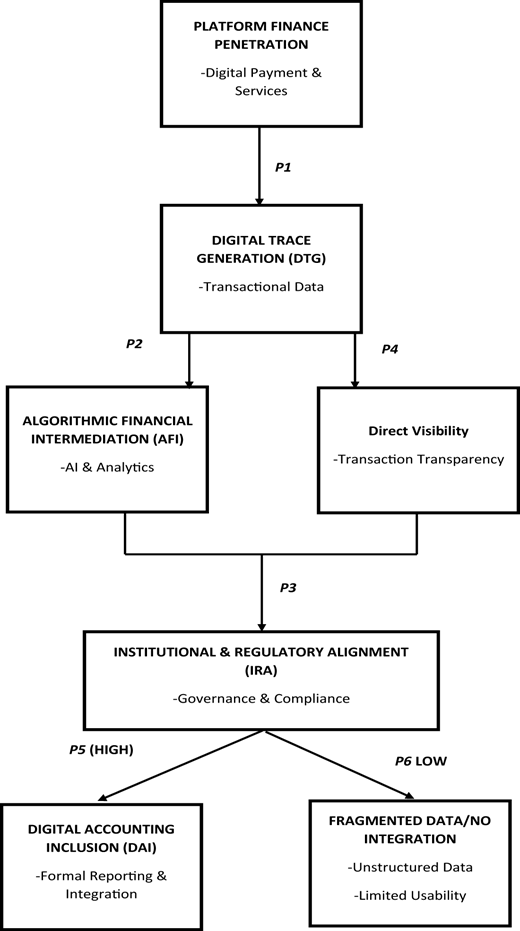
The conceptual framework illustrated in Figure 1 explains how platform finance can enable digital accounting inclusion in SSA's informal economies by integrating fintech diffusion, digital accounting transformation, and institutional governance scholarship. The framework is organised around five constructs that are related to each other, namely: Platform Finance Penetration (PFP), the degree to which digital platforms (such as mobile money and e-commerce, ride-hailing) mediate financial transactions (David-West et al., 2019; Lorenz & Pommet, 2021); Digital Trace Generation (DTG), the degree to which financial transactions result in the generation of structured, retrievable and analyzable records (Ibrahim et al., 2021; Osei-Assibey Bonsu et al., 2023). The framework adopts a conditional transformation logic rather than a purely linear progression. Platform-mediated transactions generate digital traces (P1), which provide the data foundation for algorithmic financial intermediation (P2) and enhance transaction visibility (P4). Algorithmic financial intermediation processes these traces into structured and interpretable financial information, thereby enabling accounting integration (P3), while digital traces independently enhance visibility (P4). However, the translation of digital traces into digital accounting inclusion is not automatic but depends on institutional and regulatory alignment, which determines whether digital data is recognised, standardised, and integrated into formal accounting systems (P5 and P6) (Hamdan et al., 2022; Amoah et al., 2023). This model integrates insights from institutional theory, information asymmetry theory, and platform governance literature (Gomber et al., 2018; García-Lillo et al., 2021). By reconceptualising informal economies as data-rich yet structurally unrecognised environments, the framework contributes theoretically by differentiating financial inclusion from digital accounting inclusion, positioning platform-generated data as emergent accounting infrastructure, and foregrounding institutional alignment as the critical determinant of inclusive digital transformation, providing a foundation for empirical testing and policy guidance in SSA. Hence these suppositions are put forward. The framework therefore recognises two possible outcomes. Where institutional alignment is strong, platform-generated data is incorporated into formal accounting and governance systems, enabling digital accounting inclusion. Conversely, where alignment is weak, transaction data remains fragmented, unstandardised, and institutionally unrecognised. In such cases, digital visibility does not translate into accountability. This conditional structure highlights that data generation alone is insufficient without institutional embedding. Therefore, we suggest these propositions:
Platform finance penetration increases digital trace generation by shifting transactions into digitally recorded environments.
Digital trace generation enables algorithmic financial intermediation by providing structured data for automated processing.
Algorithmic financial intermediation facilitates the transformation of transaction data into structured financial information.
Digital trace generation directly enhances transaction visibility and traceability.
High institutional and regulatory alignment enables the integration of platform-generated data into formal accounting systems, resulting in digital accounting inclusion.
Low institutional and regulatory alignment prevents the transformation of digital trace data into usable accounting information, resulting in fragmented data and non-integration.
6. Theoretical implications
This study advances theoretical understanding across fintech, accounting, and emerging market research by introducing DAI as a distinct analytical construct, especially in SSA. First, the study extends the concept of financial inclusion by distinguishing it from digital accounting inclusion. Prior research has primarily examined financial inclusion in terms of access to financial services and usage patterns (Allen et al., 2016; Del Sarto & Ozili, 2025), in contrast, this study emphasises the institutionalisation of financial transactions within formal accounting systems and the fact that engaging in digital finance is not necessarily matched with auditable and decision-useful records (Hamdan et al., 2022; Amoah et al., 2020). By conceptualising inclusion as a multi-layered process encompassing transactional visibility, algorithmic intermediation, and regulatory alignment, the study reconceptualises inclusion as both a technological and governance-driven phenomenon, rather than merely a behavioural outcome.
Second, the study positions platform finance as an emergent accounting infrastructure. Traditional accounting research has largely examined formal corporate entities, leaving informal economic activity largely unaccounted for (Osei-Assibey Bonsu et al., 2023; Alex et al., 2022). The framework extends digital accounting transformation research (Ibrahim et al., 2021; Alex et al., 2022) by incorporating informal platform-mediated economic activity into an informal economy by showing how platform-mediated transactions create digital traces that can be algorithmically organised into accounting measures. This shift expands the scope of accounting research beyond formal organisations to include data-generating informal economic systems as fintech platforms are not just financial intermediaries, they are data-driven systems of governance, which can redefine institutional recognition and responsibility.
Third, the framework introduces institutional and regulatory alignment as a boundary condition that determines whether digital visibility translates into accounting inclusion. Building on Institutional Theory, the study shows that digital transactions only become accounting-relevant when they align with institutional rules, governance structures, and regulatory expectations (Banna et al., 2022; Junarsin et al., 2023). This contribution is particularly important in emerging markets, where weak regulatory capacity and high levels of informality constrain the institutional integration of digital transactions. Fourth, the framework bridges information asymmetry theory with platform governance perspectives. Digital traces reduce uncertainty in financial transactions, enabling risk assessment and credit allocation (Omoteso, 2012; Lorenz & Pommet, 2021), yet their efficacy depends on institutional receptivity. This connection between trace generation and algorithmic intermediation and the inclusion of accounting, the framework explains how transaction data can reduce information asymmetry while remaining dependent on institutional structures for its transformation into accountable information.
Finally, the framework offers a geographically grounded theoretical contribution by focusing explicitly on SSA. Most fintech and accounting research focuses on developed market settings when this study highlights structural and institutional conditions of emerging markets, such as the prevalence of mobile-money, regulatory fragmentation, and informality in the economy (David-West et al., 2019; Gosavi, 2018). By situating digital accounting inclusion within this context, the study provides a framework for understanding how platform-mediated financial activity becomes institutionally embedded in emerging markets.
Collectively, the study demonstrates that the transformation of digital transactions into accounting information is not a technological inevitability but an institutional process shaped by governance structures, regulatory alignment, and system integration. This structured articulation of theoretical implications aligns with recent studies that emphasise the need to clearly distinguish prior knowledge, conceptual advancement, and theoretical contribution within emerging research domains (Ahmad et al., 2025a, b, 2026).
7. Practical implications
The framework provides actionable implications for policymakers, regulators, fintech providers, and informal economic actors in SSA. First, it highlights the need for policy interventions that go beyond financial access. While mobile money and other platform finance tools have expanded financial participation, the study shows that inclusion is meaningful only when transactions are captured, structured, and integrated into formal accounting systems. Policymakers should introduce regulatory frameworks that require platforms to standardise transaction reporting formats, enable interoperability across payment systems, and integrate platform-generated data into national fiscal and accounting infrastructures. Hamdan et al. (2022), Amoah et al. (2023).
Second, regulators and tax authorities can use platform-generated transaction data to improve auditability and tax compliance by identifying patterns of economic activity that are currently unrecorded. This requires designing proportionate compliance mechanisms that minimise administrative burden while ensuring that digital transactions can be translated into reportable and verifiable records.
Third, fintech firms and platform providers can benefit by understanding their role as emergent accounting infrastructures. Platform providers can embed accounting functionalities such as transaction categorisation, automated record generation, and reporting dashboards to support the conversion of transaction data into usable financial records (Lorenz & Pommet, 2021; Osei-Assibey Bonsu et al., 2023).
Fourth, informal entrepreneurs can use platform-generated transaction histories to build verifiable financial records that improve access to credit, insurance, and formal support programmes. Consistent use of digital platforms enables informal actors to generate traceable financial histories that can be recognised by lenders and regulators (David-West et al., 2019; Gosavi, 2018).
Finally, the framework highlights the need for coordinated ecosystem development across technology providers, regulators, and public institutions. Training, digital literacy programs, and accounting integration standards can be implemented by policymakers and platform providers to ensure that technology adoption is translated into sustainable and accountable economic participation.
Overall, the findings show that fintech adoption alone is insufficient. Meaningful inclusion requires alignment between technological capabilities, regulatory frameworks, and institutional processes in order to ensure that informal economic activity can be audited, accountable, and registered within formal financial and accounting systems in order to have meaningful inclusion. Consistent with recent research emphasising actionable and stakeholder-specific implications (Ahmad et al., 2025a, b), this study translates conceptual insights into practical recommendations for policymakers, regulators, fintech providers, and informal economic actors.
8. Conclusion
This study develops a conceptual framework that reframes financial inclusion in SSA by shifting the focus from access to digital accounting inclusion. The framework explains how platform finance, digital trace generation, algorithmic intermediation, and institutional alignment interact to enable the integration of informal economic activity into auditable and decision-useful accounting systems. The propositions explain how platform-mediated transactions create digital traces, which when processed through algorithmic systems and reinforced by institutional alignment, can be converted into structured accounting visibility. The research adds to the literature in finance and accounting by combining the literature on fintech and accounting, placing platform finance as a new accounting infrastructure, and emphasising governance alignment as the critical condition that defines the outcome of inclusion. Grounded in the institutional realities of SSA, the study offers a context-sensitive explanation of how digital financial systems can reshape accounting visibility and governance. It provides a foundation for future empirical studies to test the proposed relationships and examine the conditions under which platform finance translates into meaningful accounting inclusion.