


This research investigates the structural performance and design optimization of square-based tapered hollow tubes, which are increasingly utilized in various industrial applications.
A finite element model of a thin-walled square tube is developed to analyze critical design parameters, including taper angle, twist angle and wall thickness. Key performance outcomes such as buckling load, strain energy, stress and specific strain energy are evaluated. The study employs a face-centered central composite design (CCD) approach integrated with response surface methodology (RSM) to enhance the accuracy of predictions. Interactions between design parameters are visualized using 3D surface plots to identify optimal conditions.
The optimized design parameters were determined as taper angle = 8.714°, wall thickness = 0.643 mm and twist angle = 33.460°. These configurations resulted in a buckling load of 27,262 kN, strain energy of 1.262 x 10⁻¹¹ J, stress of 233.449 Pa and specific strain energy of 89.817 x 10⁻¹¹ J/kg.
The findings provide valuable insights into the advantages of tapered hollow tube designs and demonstrate the significant impact of design parameters on performance outcomes.
The results contribute significantly to advancing the design and application of tapered hollow tubes across multiple engineering domains, offering valuable references for both industry professionals and researchers working with tubular structures.
Introduction
Hollow columns subjected to axial compressive loads serve as key structural components in many contemporary structures. The phenomenon of buckling in such components is a critical consideration in engineering design and analysis. While buckling does not inherently signify structural failure, it often leads to a notable reduction in load-bearing capacity and compromises the stability of the entire structure. This issue becomes particularly pronounced in lightweight structures, where the risk of stability loss is heightened. The structural efficiency of hollow tubular geometries lies in their inherent stability under compressive and tensile loads. These arrangements provide consistent stress distribution throughout the cross section, maximizing load-bearing capacity while balancing material efficiency and structural performance. A tapering design, characterized by a decreasing cross-sectional area from base to top, further enhances material usage and structural efficiency by reducing weight without compromising strength (Elkawas et al., 2017). Additionally, introducing a twist to the geometry imparts torsional rigidity, which is particularly advantageous under torsional or dynamic loads. This design feature enables better stress distribution under eccentric or lateral loading conditions. The stress analysis of a square-based, tapered, twisted hollow tube presents unique challenges due to its non-uniform geometry (Bai, 2018). Its structural complexity arises from the combination of a square base, tapering cross section and twisted profile. The stress distribution in such a structure is influenced by various factors, including the type of loading, boundary conditions, material properties and geometric parameters (Bendsøe, 1989). Understanding the tube’s behavior under diverse load conditions is vital for accurate structural analysis. The primary issue with contemporary load-bearing structures is how they behave after buckling. The load supporting the post-buckling equilibrium path is stable, and the loss of stability does not lead to structural failure. Nonetheless, up until it reaches the limit state, which is referred to as a limit point, the structure can function securely. Automotive structures and railroads have made extensive use of thin-walled tubes to enhance manufacturing, strength, weight reduction and energy absorption efficiency, especially those with rectangular or circular cross sections. Since tapered thin-walled tubes are more likely to show a desirable constant mean crush load-deflection response during axial crushing, they are preferred over traditional straight tubes (Reid and Reddy, 1986).
When compared to straight tubes, tapered tubes have a steady crush load and deformation response because they can sustain impact loads that are oblique and axial.
Research has been conducted on the load-deformation response, energy absorption capacity under axial loading and other important characteristics of tapered thin-walled tubes due to their numerous applications (Paavola and Salonen, 1999; Zhang et al., 2022; Lee and Oh, 2000; Liu and Dag, 2009; Nagel and Thambiratnam, 2005; Gupta et al., 2006; Mamalis and Johnson, 1983; Mamalis et al., 1984). At high strain rates, axial compression has been applied to thin-walled steel frusta with semi-apical angles between 5° and 10°.
These investigations looked at a range of tapered tubes having different taper degrees and cross sections that are either circular or rectangular. Shell element models or for all computer studies and simulations in those projects, comprehensive models, are utilized.
They accomplish great computational accuracy by maintaining a high degree of faithfulness to the physical geometry (Marques et al., 2012; Da Silva et al., 2012; Tankova et al., 2018; Prater et al., 2005). Still, beam element models are the preferred method for simulating thin-walled tubes since they enable rapid and effective computer simulation and provide users with a rough understanding of how many alternative designs will behave (Mamalis et al., 1984). The Ayrton–Perry method is applied to assess columns with varying cross-sectional shapes, and it also supports refined design principles for tapered structural elements and is recommended for adding a component to the column design equations in Eurocode (Da Silva et al., 2012) to include the influence of second-order effects in tapered columns, a consideration later confirmed by Tankova et al. (2018). The concept of employing such element models, also known as concept models, has been proven in previous studies and used in impact and quasi-static analyses (Prater et al., 2005; Liu and Day, 2006). Nguyen et al. (2021) employed an artificial neural network (ANN) to forecast the web-tapered columns’ crucial buckling load. They created a large database collection of 269 specimens using the finite element approach in order to create an ANN model. To estimate the critical buckling load of the web-tapered columns while taking into consideration a number of input variables, an ANN-based algorithm was created.
Bazeos and Karabalis (2006) introduced a simplified method that utilizes standard design tables to calculate the elastic buckling load of prismatic, bearing-restrained tapered columns with varying end conditions. The design charts developed by Karabalis and Bazeos were derived from accurately matched curves corresponding to various tapered structural members, determined through a precise analytical process (Karabalis and Beskos, 1983). The design charts were used to determine the position of the critical section in the web-tapered column, which was identified through analysis of the taper ratio and boundary conditions. The corresponding buckling load was calculated considering the effective buckling length and the moment of inertia at that location (Rahim et al., 2016, 2017; Rahim and Bharti, 2020a; Umer et al., 2018).
Many researchers (Kim et al., 1997; Valipour and Bradford, 2012; Chiorean and Marchis, 2017) to evaluate the elastic buckling stresses in tapered columns with variable cross-sectional geometries and finite element (FE) formulas were devised. These studies include a wide range of subjects, such as the kind of cross section, connection flexibility and boundary conditions for tapered columns (Kucukler and Gardner, 2018). Kucukler and Gardner (2019) developed a function to account for rigidity reduction that may be used in FE analysis for axial and bending strength both. While very few researchers have focused on the twisted, tapered and corrugated tubes, some of them are study evaluate the axial compressive behavior of a novel welded corrugated steel tube concrete flat steel tube column and proposes accurate analytical models based on test results (Su et al., 2021), comparable to the behavior and numerical resistance of short, double-skin corrugated steel tube columns filled with concrete under axial compression (Hassanein et al., 2024). And recently, many have also considered the multi-cell, double-skin corrugated tubular geometries for the bio-inspired works (Zakir et al., 2021; Wu et al., 2025; Song et al., 2022; Wu et al., 2023; Huang et al., 2023; Zhang et al., 2024; Naqvi et al., 2019). Van der Heijden and Thompson (2000) provide a review of the geometric rod theory for a naturally straight, circular, inextensible and linearly elastic rod undergoing bending and torsion. The primary focus is on the final moment and post-buckling behavior under stress. The primary focus is on the post-buckling behavior subjected to end moment and tension. Geometrical properties of buckled rods were observed by considering classical helical and localized buckling. Qian et al. (2010) carried out a study on analysis of corrugated tubes' axial rigidity. For the corrugated tube, an axial loading displacement analysis was developed and suggested. It was found that the stiffness weakness factor is sufficiently precise for the corrugated tubes’ engineering use. Mitchell (2004) developed how torque affects buckling while constructing ship hollow propeller shafts. Torque may be the cause of buckling and helical buckling may produce torque. This article provides all the information needed to calculate torque and shear (Yang et al., 2015). In his study, the axial stiffness of twisted tubes was determined using finite element analysis. To confirm the calculation, experiments were conducted. Investigations are conducted into the effects of thickness, lead and twist ratio on axial stiffness. It is found that when the twist ratio rises or the lead falls, the twisted tube’s axial stiffness falls.
This research focuses on developing an integrated strategy that combines computational algorithms and statistical techniques for structural analysis. The paper aims to create conceptual models for twisted, tapered thin-walled tubes, specifically for axial buckling analysis. Using the central composite design (CCD) approach in response surface methodology (RSM), a parametric study was carried out to create such models and examine the impact of design factors and an algorithmic optimization approach to identify the most effective design parameters. This work stands out for its unique focus on twisted tapered tubes, the innovative application of optimization techniques, and its potential impact on lightweight structural designs. Notably, very few studies have addressed the little research that has been done on how twisted tapered tubes behave under axial compression to combine computational optimization with statistical design methodologies for these geometries. As such, this research fills a critical gap in the literature and contributes significantly to advancing the design and analysis of complex structural forms.
Material and method
In this study, the material used was 316 stainless steel. Table 1 displays its nominal chemical composition, while Table 2 displays its mechanical characteristics. The chromium-rich oxide surface film that forms on these steels is invisible and sticky, giving them their anti-corrosion characteristics. This oxide creates and fixes itself when oxygen is present. These steels’ ability to withstand corrosion is a result of this oxide layer. Molybdenum, copper, titanium, aluminum, silicon, niobium, nitrogen, sulfur and selenium are other elements added to enhance specific properties, including nickel, which is the primary gamma-forming element in austenitic stainless steels.
The chemical compositions (wt %) of American Iron and Steel Institute (AISI) 316
| C | Si | Mn | P | S | Cr | Mo | N | Ni |
|---|---|---|---|---|---|---|---|---|
| 0.007 | 0.8 | 1.86 | 0.012 | 0.006 | 17.99 | 1.48 | 0.024 | 12.31 |
Source(s): The authors
Mechanical property of AISI 316
| Property | Value |
|---|---|
| Density | 8,000 kg/m3 |
| Young’s modulus | 193 GPa |
| Poisson’s ratio | 0.3 |
| Yield strength | 250 MPa |
| Ultimate tensile strength | 570 MPa |
| Tensile strain | 0.55 |
| Hardness | 80 (approximate) |
| Thermal conductivity | 16 W/m·K |
| Coefficient of thermal expansion | 16.5 × 10⁻⁶/°C |
| Shear modulus | 77 GPa |
| Bulk modulus | 140 GPa |
| Thermal expansion | 16.5 × 10⁻⁶/°C |
Source(s): The authors
The twisted tapered tubes are created with a square base as shown in Figure 1 in which the extrusion height was kept at 30 mm, which is kept constant and the square base dimensions were taken as 25 mm. In this study, a series of mesh sizes were evaluated to identify the optimal size for accurate linear buckling analysis using Ansys Workbench. With 0.5 mm increments, the mesh sizes varied from 0.5 mm to 2.0 mm. For each mesh size, the analysis was performed, and the results were compared to assess both the accuracy and convergence of the solution. The optimal mesh size was determined based on the convergence of key parameters, such as buckling load and mode shapes.
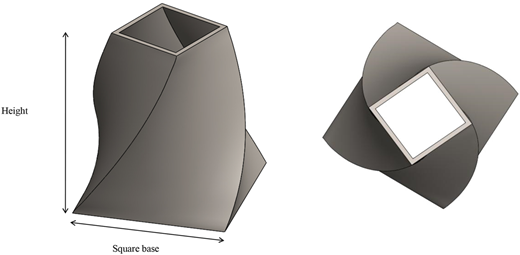
A mesh size of 0.8 mm was found to offer the best balance between computational efficiency and solution accuracy, yielding converged results while minimizing computational costs. Consequently, the ideal mesh size for the analysis carried out in this study was determined to be 0.8 mm.
During the analysis, the tubes were subjected to compressive load at one end while the other end was kept fixed, maintaining the fixed-free column condition for each program. The input parameters considered for the analysis are shown in Table 3. The range of parameters selected for the design space has been considered from the previous published work (Zhang et al., 2024). The selected ranges for the tapered angle, thickness and twist angle were chosen to ensure that a broad spectrum of design possibilities was covered, enabling a comprehensive analysis of how these parameters affect the tapered hollow tubes' structural performance.
Input variables and their levels CCD
| Independent input variation | Coded variables levels | ||||
|---|---|---|---|---|---|
| −α | Minimum | Median | Maximum | +α | |
| Tapered angle (degree) | 00 | 3.750 | 7.50 | 11.250 | 150 |
| Thickness (mm) | 0.25 | 0.438 | 0.625 | 0.813 | 1 |
| Twist angle (degree) | 00 | 22.50 | 450 | 67.50 | 900 |
Source(s): The authors
A standard RSM design called CCD was used to evaluate the parameters required for linear buckling analysis. With the least amount of testing, the RSM approach helps with process parameter optimization, fitting a quadratic surface and evaluating the relationship between the parameters (Yang et al., 2015). RSM is a set of statistical and mathematical methods that help to create empirical models, refining and optimizing process parameters and determining how several influencing elements interact (Montgomery, 2017; Khuri and Cornell, 2018; Rahim and Bharti, 2020b; Moradi and Burton, 2018).
RSM is a statistical technique that determines the regression model and optimizes an output variable (response) that is influenced by multiple independent factors using quantitative data from the linked experiment (input variables).
A CCD is usually composed of 2n factorial runs with 2n axial runs, and the experimental error is measured using center runs. The two axial points (±α, 0, 0 … 0), (0, 0, ± α, 0 … 0)... (0, 0, ± α … 0) and center points nc (0, 0, 0 … 0) are added to the two factorials in this experimental design, which are coded by ±α notation. Every variable is examined three times, and the number of runs required to completely duplicate the design rises with the number of variables (n). CCD was used to calculate the quadratic effect since 2n factorial designs are unable to quantify the individual effect of second order independently for every factor in this study, there are three design levels: ±α, 0 and ±1. The independent variables for the CCD are presented in Table 3, along with their corresponding coded and uncoded levels.
Validation
To validate our current numerical model, simulations were conducted for buckling analysis based on the study by Umer et al. (2018). The results obtained from the simulations were compared with Umer et al. (2018), as shown in Table 4, which illustrates the comparison of critical load. The results demonstrate that the current numerical method aligns closely with the results from Umer et al. (2018), indicating its potential for future buckling analysis.
Comparison between results obtained from Afaque et al. and the present numerical model
| Specimen | Critical load (105 N) | Current results (105 N) | % error |
|---|---|---|---|
| ATTT-1-00 | 0.7126 | 0.7263 | 1.93% |
| ATMD-2-00 | 8.1329 | 8.1970 | 0.79% |
| ATAC-4-00 | 4.1687 | 4.2470 | 1.87% |
| ATPC-3-00 | 7.9154 | 8.0003 | 1.07% |
| ATFC-2-00 | 3.3508 | 3.4027 | 1.55% |
Source(s): The authors
Tapered model analysis
A highly effective engineering technique is the use of RSM with the face-centered CCD. This approach is commonly employed to develop both coded and actual empirical models, particularly when direct quantification of the outcomes is difficult or impractical. Most engineering projects require extensive simulations and tests to assess constraint functions and design objectives in relation to design factors. To reduce this load, approximation or proxy models, such as those developed using RSM, are employed. In this study, the model was developed using Design Expert 13 by simulating the system’s response to a few carefully selected data points. CCD was used to assess and predict the impact of significant components and their interactions at different levels. Table 5 defines the number of experiments required for CCD in both coded and uncoded forms. The three critical factors taper angle, twist angle and thickness were evaluated, with their levels defined based on specified limits using Design Expert software. A total of 20 trial runs were conducted to establish statistical significance.
Coded and uncoded level of experimental variables of the CCD
| No. of run | Coded form | Actual form | ||||
|---|---|---|---|---|---|---|
| Tapered angle (degree) | Thickness (mm) | Twist angle (degree) | Tapered angle (degree) | Thickness (mm) | Twist angle (degree) | |
| 1 | −1 | −1 | −1 | 3.75 | 0.438 | 22.5 |
| 2 | 1.68179 | 0 | 0 | 15 | 0.625 | 45 |
| 3 | 0 | 0 | 0 | 7.5 | 0.625 | 45 |
| 4 | 1 | 1 | 1 | 11.25 | 0.813 | 67.5 |
| 5 | −1 | 1 | 1 | 3.75 | 0.813 | 67.5 |
| 6 | 0 | 0 | 0 | 7.5 | 0.625 | 45 |
| 7 | 0 | 0 | 0 | 7.5 | 0.625 | 45 |
| 8 | −1.68179 | 0 | 0 | 0 | 0.625 | 45 |
| 9 | 1 | −1 | −1 | 11.25 | 0.438 | 22.5 |
| 10 | 1 | 1 | −1 | 11.25 | 0.813 | 22.5 |
| 11 | 0 | 0 | 0 | 7.5 | 0.625 | 45 |
| 12 | 0 | 0 | 1.68179 | 7.5 | 0.625 | 90 |
| 13 | 0 | 0 | 0 | 7.5 | 0.625 | 45 |
| 14 | 0 | 1.68179 | 0 | 7.5 | 1 | 45 |
| 15 | 0 | −1.68179 | 0 | 7.5 | 0.25 | 45 |
| 16 | 0 | 0 | −1.68179 | 7.5 | 0.625 | 0 |
| 17 | −1 | −1 | 1 | 3.75 | 0.438 | 67.5 |
| 18 | 1 | −1 | 1 | 11.25 | 0.438 | 67.5 |
| 19 | 0 | 0 | 0 | 7.5 | 0.625 | 45 |
| 20 | −1 | 1 | −1 | 3.75 | 0.813 | 22.5 |
Source(s): The authors
For the polynomial regression model, a second-order model was utilized to capture the nonlinear relationships between the input parameters (taper angle, twist angle and thickness) and the corresponding outputs (buckling load, stress, strain energy and specific strain energy). This choice was based on the assumption that a second-order model would adequately capture the curvature of the response surfaces while avoiding overfitting. Key terms, including linear effects, quadratic effects and interaction effects, were selected based on their contribution to the model’s fit, guided by both statistical significance (assessed using ANOVA) and physical reasoning. The ANOVA ensured that only the most influential factors were retained for the final model. This modeling strategy balanced complexity with predictive accuracy, effectively capturing underlying patterns in the data while maintaining simplicity for practical application. As a result, the second-order polynomial equations accounted for key factors and interactions, with F and P values validating the model’s reliability.
Results and discussion
The response surface plot and regression analysis of the simulation data were created using the statistical “Design Expert” software. To estimate the statistical parameters, ANOVA is employed. Based upon the design of the experiment, an extensive parametric study was carried out to examine the effect on buckling load, strain energy, stress and specific strain energy by varying the input design parameters.
Combined effect of twist angle, tapered angle and thickness on buckling load
The three factors' independent and combined effects on the buckling load of square base tapered hollow tubes were examined using the RSM. ANOVA was employed to assess how each combination of input elements influenced the buckling load, as illustrated. In Table 5, Figure 2(a–c) display the appropriate three-dimensional response surface plots. Equation (1) displays the final empirical model in terms of a buckling load input factor, where negative signs signify inhibitory effect, whereas positive signs signify synergistic effects. Equation (1) illustrates the establishment of polynomial (second order) mathematical models for the buckling load response based on the regression technique.
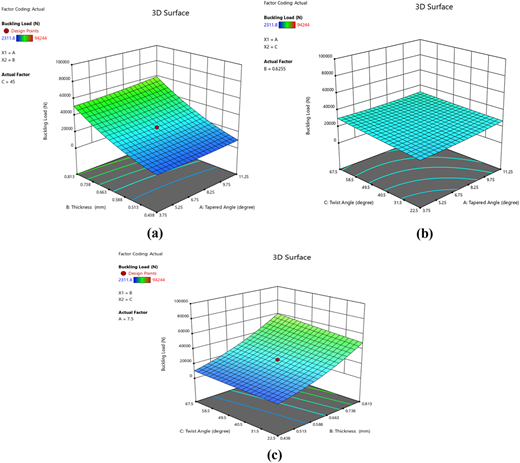
Response surface graph for buckling load; (a) variation of taper angle and thickness, (b) variation of twist angle and taper angle and (c) variation of twist angle and thickness. The authors
Response surface graph for buckling load; (a) variation of taper angle and thickness, (b) variation of twist angle and taper angle and (c) variation of twist angle and thickness. The authors
Final equation in terms of actual factors
The buckling load value ranges from 2311.8 N to 94244N. Figure 2(a–c) use three-dimensional response surface graphs to illustrate how the input variables interact. The values of the y-axes in Figure 2(a–c) are the buckling load values. Figure 2(a) indicates the combined effect of thickness and tapered angle, which shows that by increasing thickness and taper angle, the buckling load also increases, Figure 2(b) indicates the combined effect of twist angle and tapered angle, which shows that varying the twisting angle and taper angle has the least significance on buckling load and Figure 2(c) demonstrates how thickness and twist angle work together to affect buckling load, showing that changing the taper angle has less of an impact than changing the thickness to achieve the highest buckling load. Using the response surface analysis method, Table 5 and Figure 2(a–c) showed that, in contrast to the taper angle and the twist angle, thickness had the highest impact on buckling load. The study shows that increasing thickness greatly enhances the buckling load, with a far more significant effect than taper or twist angles. The maximum recorded buckling load was 94,244 N, with percentage increases of 17.30, 32.40 and 532.37% for taper angle, twist angle and thickness, respectively. This improvement is mainly due to the increase in the moment of inertia and structural stiffness. A thicker section strengthens the column, improving resistance to lateral deflection and instability, allowing it to withstand higher compressive loads without buckling. Additionally, greater thickness reduces the impact of local imperfections, further enhancing stability and load-bearing capacity.
Combined effect of twist angle, tapered angle and thickness on stress
This section examined the individual and combined effects of the three factors on the stress of square-based tapered hollow tubes using the response surface methodology. The effects of each combination of input factors on stress load were ascertained using ANOVA, as indicated in Table 5; matching three-dimensional response surface plots are displayed in Figure 3(a–c). Eq. (2) displays the final empirical model in terms of a stress input component, where positive signs denote synergistic effects and negative values indicate inhibitory effects. Polynomial (second order) mathematical models for the reaction of stress have been developed based on the regression technique, as Equation (2) illustrates.
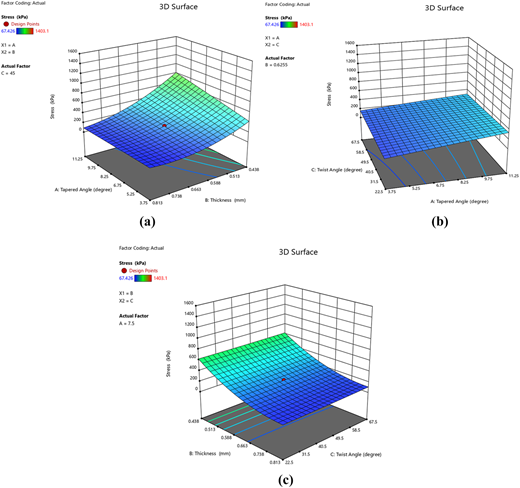
Response surface graph for stress; (a) variation of taper angle and thickness, (b) variation of twist angle and taper angle and (c) variation of twist angle and thickness. The authors
Response surface graph for stress; (a) variation of taper angle and thickness, (b) variation of twist angle and taper angle and (c) variation of twist angle and thickness. The authors
Final equation in terms of actual factors
The stress value ranges from 67.426 kPa to 1403.1 kPa. Figure 3(a–c) use three-dimensional response surface graphs to illustrate how the input variables interact. The y-axes’ respective values in Figure 3(a–c) are the stress values. Figure 3(a) indicates the combined effect of thickness and tapered angle, which shows that by increasing the taper angle the stress also increases, whereas by increasing the thickness, the stress decreases. Figure 3(b) indicates the combined effect of twist angle and tapered angle which shows that by varying twisting angle the stress increases, but not as much as compared to the taper angle, which shows a tremendous amount of gain in the stress value. Figure 3(c) demonstrates how thickness and twist angle work together to affect stress, showing that while stress drops with increasing thickness, it increases with changing the taper angle. Using the response surface analysis method, Table 5 and Figure 3(a–c) showed that, in contrast to the taper angle and the twist angle, thickness had the greatest impact on stress control. It was observed that the stress in the tapered, twisted tube exhibits distinct variations based on the geometric parameters due to the redistribution of internal forces and structural deformation. As the twist angle increases, the stress rises from 225.545 kPa to 234.131 kPa, corresponding to an increase of 3.81%. This increase can be attributed to the additional torsional deformation induced by the twist, which creates higher shear stress along the tube.
In contrast, the taper angle significantly affects the stress, increasing it from 126.214 kPa to 321.307 kPa, with a percentage change of 154.57%. The pronounced impact of tapering results from the reduction in the cross-sectional area along the tube’s length, which concentrates the load over a smaller region and increases the stress. However, the thickness exhibits the most dominant effect on stress. As the thickness increases, the stress decreases drastically from 624.434 kPa to 94.277 kPa, a percentage reduction of −84.90%. This is because a greater thickness enhances the tube’s ability to resist deformation under loading, thereby distributing the stress over a larger area and reducing the overall magnitude of stress. These results demonstrate that thickness has the most substantial controlling effect on stress compared to the twist angle and taper angle, primarily due to its role in influencing the structural stiffness and load distribution of the tube.
Combined effect of twist angle, tapered angle and thickness on strain energy
The three factors’ independent and combined effects on the strain energy of square-based tapered hollow tubes were examined using the response surface methodology. The results of the ANOVA for the effects of the input factors are displayed in Table 5 on strain energy, combining response surface projections in three dimensions are shown in Figure 4(a–c). Eq. (3) displays the final empirical model in terms of an input component for strain energy, where positive signs indicate synergistic effects and negative signs indicate inhibitory effects. The development of polynomial (second order) mathematical models for the strain energy response based on the regression technique is demonstrated by Equation (3).
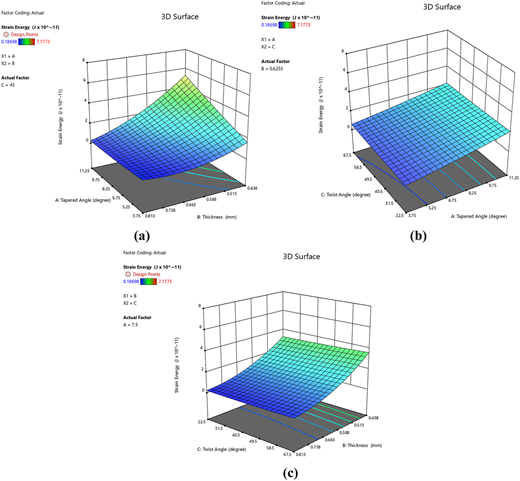
Response surface graph for strain energy; (a) variation of taper angle and thickness, (b) variation of twist angle and taper angle and (c) variation of twist angle and thickness. The authors
Response surface graph for strain energy; (a) variation of taper angle and thickness, (b) variation of twist angle and taper angle and (c) variation of twist angle and thickness. The authors
Final equation in terms of actual factors
The strain energy value ranges from a minimum 0.18698 x 10⁻¹¹ J to maximum 7.1773 x 10⁻¹¹ J. Figure 4(a–c) use three-dimensional response surface graphs to illustrate how the input variables interact. The y-axes’ respective values in Figure 4(a–c) are the strain energy values. Figure 4(a) indicates the combined effect of thickness and tapered angle, which shows that by increasing thickness, the strain energy decreases and on increasing the taper angle the strain energy increases, Figure 4(b) indicates the combined effect of twist angle and tapered angle which shows that by increasing the twisting angle and taper angle the strain energy also increases and the combined effect of twist angle and thickness on strain energy is depicted in Figure 4(c), which illustrates that while strain energy reduces with increasing thickness, it increases with increasing twisting angle. Using the response surface analysis method, Table 5 and Figure 4(a–c) showed that the twisting angle and taper angle combination had the biggest impact on the strain energy relative to thickness. Changes in geometric parameters were found to have a substantial impact on the strain energy in the tapered, twisted tube because they affect the tube’s ability to deform and absorb energy. As the twist angle increases, the strain energy rises from 1.0957 × 10⁻¹¹ J to 1.3216 × 10⁻¹¹ J, corresponding to an increase of 20.62%. This increase is attributed to the additional deformation caused by twisting, which induces higher strain within the material and consequently stores more energy.
The taper angle has an even greater effect on strain energy, increasing it from 0.36394 × × 10–11 J to 2.1352 × × 10–11 J, a significant rise of 486.69%. Because of the decrement in cross-sectional area as the taper angle increases, which amplifies the stress concentration and deformation, leading to higher energy storage. However, the thickness has the most substantial impact on strain energy. As the thickness increases, the strain energy decreases drastically from 3.3933 × × 10–11 J to 0.2467 × × 10–11 J, a reduction of −92.73%. This occurs because increasing the thickness enhances the stiffness and structural resistance of the tube, thereby limiting deformation and reducing the ability to store strain energy. These results highlight that thickness has the most dominant effect on strain energy, followed by taper angle and twist angle, owing to its critical role in governing the stiffness and deformation characteristics of the tube.
Combined effect of twist angle, tapered angle and thickness on specific strain energy
The three parameters' separate and combined effects on the specific strain energy of a square-based tapered hollow tube were examined using the response surface methodology. The findings on the impacts of input factors based on ANOVA, as shown in Table 4 on specific strain energy and Figure 5(a–c) display matching three-dimensional response surface plots. Equation (4) displays the final empirical model in terms of an input factor for a particular strain energy, where negative signs signify inhibitory effects, whereas positive signs signify synergistic effects. Equation (4) illustrates the establishment of polynomial (second order) mathematical models for the response of a certain strain energy based on the regression technique.
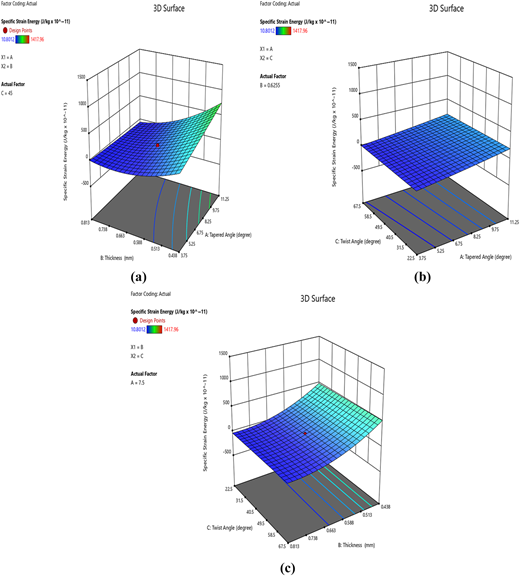
Response surface graph for specific strain energy; (a) variation of taper angle and thickness, (b) variation of twist angle and taper angle and (c) variation of twist angle and thickness. The authors
Response surface graph for specific strain energy; (a) variation of taper angle and thickness, (b) variation of twist angle and taper angle and (c) variation of twist angle and thickness. The authors
Final equation in terms of actual factors
The specific strain energy value ranges from 10.80 x 10⁻¹¹ J/kg to 1417.96 x 10−11 J/kg. Figure 5(a–c) use three-dimensional response surface graphs to illustrate how the input variables interact. The y-axes’ respective values in Figure 5(a–c) are the specific strain energy values. The combined effect of thickness and tapering angle is shown in Figure 5(a), which demonstrates that as thickness increases, specific strain energy decreases, whereas on increasing the taper angle, the specific strain energy increases. The combined effect of twist angle and tapered angle is shown in Figure 5(b), which demonstrates that as the twisting angle and tapered angle rise, the specific strain energy also increases and the combined effect of twist angle and thickness is depicted in Figure 5(c), which indicates that specific strain energy increases with increasing taper angle and reduces with increasing thickness. The twist angle and tapering angle have the biggest effects on the specific strain energy when compared to the tube’s thickness, according to Table 5 and Figure 5(a–c) obtained using the response surface analysis approach. It was observed that with the increase in twist angle, specific strain energy increases from 76.5 x 10⁻¹¹ J/kg to 93.36 x 10⁻¹¹ J/kg with the increase of 22.03%, whereas with the increase in taper angle, the specific strain energy increases from 11.6 x 10⁻¹¹ J/kg to 198.1 x 10⁻¹¹ J/kg with the increase of 1,607.76% and the effect of thickness on specific strain energy has the least impact as than the other parameters and was found to be decreasing from 507.9 x 10⁻¹¹ J/kg to 11.72 x 10⁻¹¹ J/kg with the percentage change of −97.69%.
CCD–RSM optimization
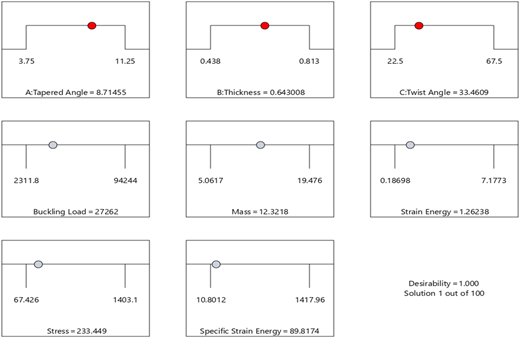
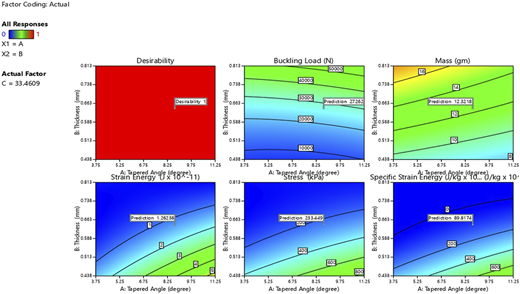
Figures 6 and 7 display the ideal option for achieving optimal process parameters values such as tapered angle (A) = 8.7140, thickness (B) = 0.643, twist angle(C) = 33.4600, buckling load = 27,262 kN, mass = 12.321 kg, strain energy = 1.262 x 10⁻¹¹ J, stress = 233.449 Pa, specific strain energy = 89.817 x 10⁻¹¹ J/kg for optimal buckling load, strain energy, stress and specific strain energy are under desirability = 1. These optimum values are implemented for a confirmation test.
Conclusion
In this paper, the geometric input parameters taper angle, twist angle and thickness of the hollow tube are analyzed employing a technology known as response surface methodology (RSM). For the investigation, three-dimensional finite element models are simulated. Square-based tapered hollow tube subjected to axial compressive load. The output parameters during the analysis were considered as linear buckling load, stress, strain energy and specific strain energy. The results obtained have the following observations.
For buckling load: The study shows that increasing thickness greatly enhances the buckling load, with a far more significant effect than taper or twist angles. The maximum recorded buckling load was 94,244 N, with percentage increases of 17.30, 32.40 and 532.37% for taper angle, twist angle and thickness, respectively. This improvement is mainly due to the increase in the moment of inertia and structural stiffness. A thicker section strengthens the column, improving resistance to lateral deflection and instability, allowing it to withstand higher compressive loads without buckling. Additionally, greater thickness reduces the impact of local imperfections, further enhancing stability and load-bearing capacity.
For stress: Both taper angle and twist angle increase stress, while increasing thickness reduces stress. This reduction occurs because stress is inversely proportional to the cross-sectional area, so a larger thickness distributes the load over a greater area, lowering stress intensity. The maximum recorded stress was 1,403.1 kPa, with percentage changes of 154.57, 3.81 and −84.90% for taper angle, twist angle and thickness, respectively. Thus, increasing thickness is the most effective way to minimize stress compared to variations in taper and twist angles.
For strain energy: The analysis shows that both taper angle and twist angle increase strain energy, whereas the strain energy decreases as thickness increases. Thicker structures are stiffer and undergo less deformation under a given load, leading to lower strain energy. The peak strain energy recorded was 7.1773 × 10⁻¹¹ J. The percentage variations in strain energy for taper angle, twist angle and thickness were 486.69, 20.61 and −92.73%, respectively. This indicates that increasing thickness is not favorable for maximizing strain energy and a smaller thickness is preferable. Compared to the twist angle, the taper angle has a greater effect on strain energy and both exhibit an increasing trend as they vary.
For specific strain energy: Specific strain energy increased with both taper and twist angles but decreased significantly with an increase in thickness. The maximum recorded specific strain energy was 1,417.96 × 10−11 J/kg. The percentage changes in specific strain energy due to taper angle, twist angle and thickness were 1,607.76, 22.04 and −97.69%, respectively. This is due to the relationship between strain energy, material stiffness and geometry. Increased taper and twist angles lead to more deformation under load, raising the specific strain energy and strain energy. On the other hand, because the same strain energy is dispersed across a larger mass, thicker structures are stiffer and reduce deformation, strain energy and specific strain energy.
The optimization studies identified common optimal ranges, resulting in the following optimal values: taper angle (A) = 8.7140°, thickness (B) = 0.643 mm, twist angle (C) = 33.4600°, buckling load = 27,262 kN, mass = 12.321 kg, strain energy = 1.262 x 10⁻¹¹ J, stress = 233.449 Pa and specific strain energy = 89.817 x 10⁻¹¹ J/kg.
The authors gratefully acknowledge the Research and Development cell, Integral University, Lucknow, for providing manuscript number IU/R&D/2025-MCN0003585 and kind support.

