


This article will select 25 years of subdivided data to perform Kaplan–Meier survival analysis on the export trade relations of Chinese wooden flooring, use discrete-time cloglog models to analyze influencing factors, use logit and probit models to test the robustness, and try to systematically reveal the duration of China's wood flooring export trade and its influencing factors.
This study used Kaplan–Meier survival function estimation method. In the survival analysis, survival function and hazard rate function are often used to characterize the distribution of survival time.
The continuous average export time of China's wooden flooring is relatively long, about 14 years. China's wooden flooring has a negative time dependency. After the export trade exceeds the threshold value of 15 years, the failure rate of trade greatly decreases, which has a “threshold effect.” Gravity model variables have a significant impact on the duration of China's wooden floor export.
Studying the duration of forest products trade is of great significance for clearing deep-level trade relations and promoting sustainable development of forest products trade.
1. Introduction
China's initiative and creativity to build and lead the “Belt and Road” global value chain, the UK leaving the EU, the US withdrawing from Trans-Pacific Partnership (TPP) and the Paris Climate Agreement … Under the background that new globalization and anti-globalization tide bump into each other, how is the vitality of export trade of Chinese wood floor? What factors can prolong the duration of its export trade? How to stabilize the trade relationship and promote the sustainable development of China's wood floor export trade.
China is a large country in the production and trade of wooden flooring. Its export scale has been expanding, and it has maintained a trade surplus for many years. However, the concentration of exports is relatively high. In addition, in recent years, Europe and other major Chinese wooden flooring export destination countries have continuously raised market entry barriers, increased green barriers, carrying out a “double-reverse” investigation of China's wood forest products has caused chain reactions to varying degrees, increased export risks and slowed trade growth. In this regard, on the one hand, the state and industry associations strive to formulate higher standards and regulate the market, and enterprises strive to improve production technology and product quality to meet the stringent requirements of importing countries. On the other hand, enterprises want to disperse the risks of a highly concentrated export market, diversify export markets and seek a wider range of trading partners. However, the dynamic process of constantly seeking new trading partners is not conducive to the establishment of long-term and stable trading relations. Rather than diversifying, maintaining existing trade relations is more important for promoting trade growth (Brenton et al., 2010). For developing countries, the most critical factor in achieving sustained growth in total exports is to maximize the duration of existing trade volumes (Besedeš and Prusa, 2006a).
The comparative advantage theory, the factor endowment theory and the new trade theory all argue that once a trade relationship is established, it will be maintained for a long time. Among them, the theory of factor endowment believes that the trade between the two countries originates from the difference in factor endowment between countries, and the factor endowment of a country will not change in the short term, so the trade relationship is also stable. The new trade theory of Melitz (2003) deems that due to the large initial investment costs of trading companies, the sunk costs cause the two parties to the trade not to interrupt trade links due to some costs incurred in the trade process. However, the reality is not always in line with theoretical expectations: trade relations have a lifetime. Besedeš and Prusa (2006a) used Kaplan–Meier survival analysis to find that the duration of US import trade from 1972 to 2001 was generally short, with a median of about 2–4 years. Besedeš and Prusa (2006b) used Cox's proportional risk model finding that the probability of a trade link interruption of a homogenous product is higher than that of a heterogenous product, with a 23% higher risk. High and depreciating currencies of exporting countries are conducive to the extension of trade duration. Nitsch (2009) found that the import trade of most Harmonized System (HS) eight-digit coded products in Germany from 1995 to 2005 lasted only 1–3 years, and was affected by the characteristics of exporters, product types and market structures, and the volume of imports in the country, the trade distance with Germany, the trade volume of products and the elasticity of substitution. Brenton et al. (2010) used the discrete duration analysis model (PGM model) to study the influencing factors of the export trade duration of 82 developing countries from 1985 to 2005, and concluded that if there were trade links between the two countries, this kind of early contact will be beneficial to the development of later trade relations between the two countries; exporting the same product to different markets or exporting different products to the same market can greatly improve the survival rate of export trade relations. Following the research method of Besedeš and Prusa (2006a, b), Hess and Persson (2011) found that the duration of the import trade of the 15 European Union (EU) countries in 1962–2006 was short, with a median of only 1 year. Esteve-pérez et al. (2013) found that the median export survival time of Spain from 1997 to 2006 was 2 years, and the probability of export failure decreased after more than 2 years.
Over the past 10 years, domestic research on the duration of trade has gradually increased. Among them, Shao (2011) found that the average duration of China's export trade from 1995 to 2007 was only 2.84 years; the initial trade value, the size of the export destination market, the type of export commodities, the value of commodity units and the stability of the exchange rate will all affect the duration of trade significantly. He and Zhang (2011) found that the duration of agricultural exports from China to the United States from 1989 to 2008 was generally short, with an average of 3.9 years and a median of 2 years. Chen and Li (2012) found that the average export duration of Chinese enterprises from 2000 to 2005 was less than 2 years, with a median value of 3 years, and there was a significant negative time dependence; the effects of variables in the traditional gravity model on duration are similar to their effects on trade flows. Feng and Shao (2013) studied the duration and its influencing factors of agricultural export trade linkage of China's HS six-digit code from 1995 to 2007 based on three survival models. Du and Wang (2015) found that China's export trade dynamics changed significantly, with a median duration of only 2 years, and there was a “threshold effect.” The failure probability was significantly reduced after 4 years; the gravity model variable, the first export value, the value of commodity units and the exchange rate all have an impact on trade survival rates. Zhang and Tang (2017) based on the trade intensity index model to study the trade relations between China and the regions along the “Belt and Road.” Xu and Liu (2018) based on the discrete-time cloglog model, using the matching data of the China Industrial Enterprise Database and the Customs Database from 2000 to 2006, to analyze the export information network composed of neighboring export enterprises through the information overflow on the export duration of the enterprise influences. These studies have broken the hypothesis that trade is permanently persistent and believes that trade links are living and may be interrupted without regeneration or after regeneration, or may continue.
Against the backdrop of climate change and the development of a low-carbon economy, forest material functions and multifunctional competition issues such as carbon sinks and ecology are prominent. Forest products are environmentally sensitive and difficult to transport, and they have logical characteristics that cause changes in its own trade duration. Studying the duration of forest products trade is of great significance for clearing deep-level trade relations and promoting sustainable development of forest products trade. Unfortunately, many related studies have focused on the national level, and few have targeted the forestry industry.
In summary, this article selects 25-year subdivided data to perform Kaplan–Meier survival analysis on the export trade relations of Chinese wooden floor. We also use discrete-time cloglog models to analyze influencing factors, using logit and probit models to test the robustness, and try to systematically reveal the duration of China's wood floor export trade and its influencing factors.
2. Terminology definition and methods
2.1 Terminology definition
2.1.1 Basic concepts
“Export trade relation” refers to the export of a product to a certain country until its complete withdrawal from the state and its trade relations.
“The duration of export trade” refers to the time that a product is exported to a country until it withdraws from the market. If it ceases trading within a period of time and continues to export later, it will not be a complete duration of export trade. That is, the year from when product i was exported to country j to when it stopped exporting.
“Discontinuous export” refers to a phenomenon that within a certain period of time, export trade often exits after a period of time, and then re-enters the export market. Referring to Li and Jiang (2014), this article does not define a discontinuous export relationship as a new export trade relationship, but regards the combination before and after the discontinuity as an export trade relationship. Then, according to the discontinuity, the duration segment of the trade relationship contained in it (referred to as the trade segment) is counted.
2.1.2 Wooden floor classification
This study divides wooden floors into three categories and eight sub-categories, as shown in Table 1. The relevant HS codes were greatly adjusted in 2007. In order to facilitate subsequent data processing, except 440910 (recorded as product 5) and 441300 (recorded as product 8), this paper merged some of the same products with HS six-digit codes before and after 2007: 441213 and 441231 merged as product 1; 441214 and 441232 are merged and recorded as product 2; 441219 and 441239 are merged and recorded as product 3; 441222, 441223, 441229, 441292, 441293, 441294 and 441299 are merged and recorded as product 4; 440920 and 440929 are merged and recorded as product 6; 441830, 441890, 441871, 441872 and 441879 are merged, which is recorded as product 7. Trade data comes from the UN COMTRADE database.
Classification of wooden floor and its HS code
| Wood floor category | Wooden floor class | HS code (before 2007) | HS code (after 2007) |
|---|---|---|---|
| Solid wood composite flooring | Product 1 | 441213 | 441231 |
| Product 2 | 441214 | 441232 | |
| Product 3 | 441219 | 441239 | |
| Product 4 | 441222,441223,441229,441292,441293,441299 | 441294 | |
| 441222,441223,441229,441292,441293,441299 | 441299 | ||
| Solid wood flooring | Product 5 | 440910 | 440910 |
| Product 6 | 440920 | 440929 | |
| Product 7 | 441830 | 441871 | |
| 441830,441890 | 441872 | ||
| 441830,441890 | 441879 | ||
| Aggrandizement wood floor | Product 8 | 441300 | 441300 |
Source(s): World customs organization
2.1.3 Data processing of duration of trade relations
Data censorship processing methods: During the survival analysis of export trade, data censorship will be encountered. For example, the sample interval of this study is the export trade relationship of China's wooden floor covering a total of 25 years from 1992 to 2016. If a trade relationship still exists for a product in 2016 and we do not know when the trade relationship will end, such data are referred to as right-censored data. Some products were exported in 1992, and we cannot tell whether the trade relationship was established before 1992. We call this data left-censored. Referring to Pan (2018), we will retain the right-censored data and complete data, and delete the left-censored data. Reason: If the left-censored data are not processed and the export duration is calculated from 1992, it is possible to underestimate the trade duration. However, at present, there is no good method to deal with the left-censored data, so it has to be deleted. The survival analysis method can deal with right censored data well.
Outcome of export trade relations and duration: According to the above method, the data were processed initially, and the results are shown in Table 2. (1) From 1992 to 2016, the effective observation records of China's export of wooden flooring to the world were 10,853; the total number of trade relations was 1,231; the total number of trade segments was 2,827; and the average trade relationship contained 2.30 trade segments. (2) There are only 410 trade relations in one trade segment, accounting for 33.31% of the total trade relations; 821 trade relations in two or more trade segments, accounting for 66.69% of the total trade relations. This shows that our country's wooden floor enters and exits the destination market more frequently. (3) As shown in Table 2, the duration of 48.28% of the trade segments is only one year, and the duration of 90.77% of the trade segments does not exceed 12 years. This preliminary indicates that the survival time of China's wooden floor export trade relations is generally short.
Statistics on duration and trade segments of China's wooden floor export trade
| Duration /t | Trade segment of duration T per segment | Ratio of trade segment of duration t/% | Accumulated percentage of trade segments of duration t/% | Duration /t | Trade segment of duration T per segment | Ratio of trade segment of duration t/% | Accumulated percentage of trade segments of duration t/% |
|---|---|---|---|---|---|---|---|
| 1 | 1,365 | 48.28 | 48.28 | 13 | 62 | 2.19 | 92.96 |
| 2 | 433 | 15.32 | 63.60 | 14 | 26 | 0.92 | 93.88 |
| 3 | 254 | 8.98 | 72.59 | 15 | 33 | 1.17 | 95.05 |
| 4 | 110 | 3.89 | 76.48 | 16 | 27 | 0.96 | 96.00 |
| 5 | 62 | 2.19 | 78.67 | 17 | 37 | 1.31 | 97.31 |
| 6 | 56 | 1.98 | 80.65 | 18 | 23 | 0.81 | 98.13 |
| 7 | 86 | 3.04 | 83.69 | 19 | 12 | 0.42 | 98.55 |
| 8 | 80 | 2.83 | 86.52 | 20 | 10 | 0.35 | 98.90 |
| 9 | 28 | 0.99 | 87.51 | 21 | 12 | 0.42 | 99.33 |
| 10 | 23 | 0.81 | 88.33 | 22 | 11 | 0.39 | 99.72 |
| 11 | 30 | 1.06 | 89.38 | 23 | 2 | 0.07 | 99.70 |
| 12 | 39 | 1.38 | 90.77 | 24 | 6 | 0.21 | 100.00 |
Source(s): UN Comtrade database and author's own organization
2.2 Methods
2.2.1 Kaplan–Meier survival function estimation
In the survival analysis, survival function and hazard rate function are often used to characterize the distribution of survival time (Peng and Wang, 2004). The basic function describing the statistical characteristics of survival time is survival function, which reflects the probability of observing the individual's survival time to x:
where indicates the probability of . When X is a continuous random variable, the survival function is complementary to the cumulative distribution function: , . At the same time, the survival function is also an integral of the probability density function:
When X is a discrete random variable, assume that X takes on a value (j = 1,2,3 …), the probability accumulation function is , when X1 < X2< … , then the survival function of the discrete random variable X is:
Kaplan–Meier analysis method can solve the problem of right-censored data well. Therefore, this study chose to use Kaplan–Meier product limit estimator for non-parametric estimation of survival function. Assume n independent observations , where is the survival time, and is the censored index variable of observation i. If failure occurs, is set to 1; otherwise, 0 is set. Let represent the number of observation cases that have not failed and have not been truncated at the beginning of period t. Let dt represent the number of failures in these observations during period t. The Kaplan–Meier survival function's estimate of survival over time t is the continuous product of the survival probability at time t and the periods before that:
For example, when China exports a product to 102 countries, there is an export trade relationship ceases after one year. At this time, no observations have been truncated. Therefore, the probability that the trade relationship “lives” for more than time = 1 is ; If three export trading relationships end in the second year: .
2.2.2 Kaplan–Meier survival function estimation results
Based on the above formula (3), Kaplan–Meier survival function is performed based on all Chinese wooden floor export trade data (referred to as a full sample) and Chinese wooden flooring export trade data with an initial trade value of more than 10,000 US dollars in 2010 constant dollar prices (referred to as a specific sample of trade value). The results are shown in Table 3.
Full sample estimation
Kaplan–Meier survival function estimation results of China's wooden floor export trade
| Lifetime/year | Survival rate estimated by K-M method | ||||||
|---|---|---|---|---|---|---|---|
| Median | Average | 1 years (%) | 5 years (%) | 10 years (%) | 15 years (%) | ||
| Overall estimate | First trade segment | 6 | 11.32 | 71.97 | 51.28 | 44.59 | 39.48 |
| Only one trade segment | 13 | 12.93 | 68.72 | 57.08 | 53.02 | 47.96 | |
| All samples | 16 | 14.43 | 89.60 | 70.22 | 59.00 | 50.46 | |
| Estimation of initial trade volume | Initial trade volume ≥$10,000 | 22 | 15.58 | 92.21 | 76.70 | 63.73 | 55.03 |
| All samples | 16 | 14.44 | 89.60 | 70.22 | 59.00 | 50.46 | |
The analysis found that, first, the duration of China's wooden floor export trade is relatively long. During the observation period of 25 years, the overall survival time is about 14 years, and the median is 16 years. The mean and median survival time of the first trade segment was the lowest, with an average of only 11 years and a median of 6 years. This shows that China's wooden floor export trade was unstable at the initial stage of establishment, with a short duration and a relatively high risk of failure. Only one trade segment survived longer than the first one, with an average of 12.93 years and a median of 13 years. The median and mean survival times of only one trade segment are lower than those of the full sample. The possible reasons are the export company improved its production technology and production quality after the first trade segment stopped exporting. Higher quality products, after being exported again, have gained the trust of the importing country, thus extending the time for the second export and obtaining a more stable trade cooperation relationship. Second, the export of Chinese wood floor duration is “ Negative Duration Dependence”, namely as the growth of the trade relationship duration, trade relations with a decreased risk of interruption. The failure rate of export trade was 10.39% in the first year, 29.78% in the fifth year, 41% in the tenth year and 49.54% in the fifteenth year. The increase of failure rate decreased with the increase of export years, and the failure rate increased by 19.76% from the fifth year to the fifteenth year, which was consistent with the 19.39% increase of failure rate from the first year to the fifth year. Other related studies have similar results (Besedeš and Prusa, 2006a; Brenton et al., 2010). Third, there is a “threshold effect” in the export of wood floor in China, with a threshold value of about 15 years. As can be seen from the estimated results of the survival function in Figure 1, the survival rate before the fifth year decreased significantly, and after the fifth year, the survival rate decreased year by year, and after the 15th year, the survival rate tended to be at a level. This shows that if Chinese wood floor export enterprises want to extend the trade relationship, they need to spend a lot of effort to consolidate the trade relationship in the early stage. After lasting about 15 years, the trade relationship will tend to last longer, and the cost of maintaining the bilateral trade relationship will gradually decrease.
Sample estimates of specific trade volumes/initial trade volume estimates
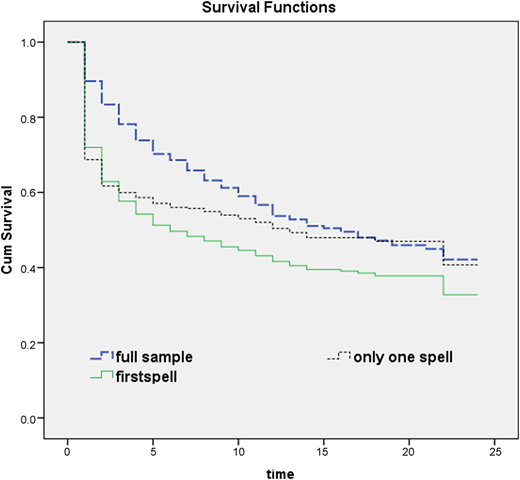
Survival function estimation (full sample)
Survival function estimation (full sample)
With reference to Figure 2, it can be seen that the first export trade volume has a greater impact on the duration of China's wooden floor exports. A Kaplan–Meier analysis was performed on samples whose initial trade volume was greater than 10,000 US dollars. The results showed that the median and average values of their durations were much larger than all samples, with a median of 22 years and an average of 15.584 years. And the survival rate of trade relations with the first export value ≥ $ 10,000 is also higher than the full sample. This shows that the impact of the first trade volume on the duration of China's wooden floor export cannot be ignored, and how it specifically affects the duration of China's wooden floor export will be further analyzed in the fourth part. The survival curve estimated from the survival function in Figure 2 can also be seen that the survival rate of the export duration of a trade relationship with an initial trade value greater than 10,000 US dollars is greater than the survival rate of the entire sample, and the failure rate is lower than the entire sample.
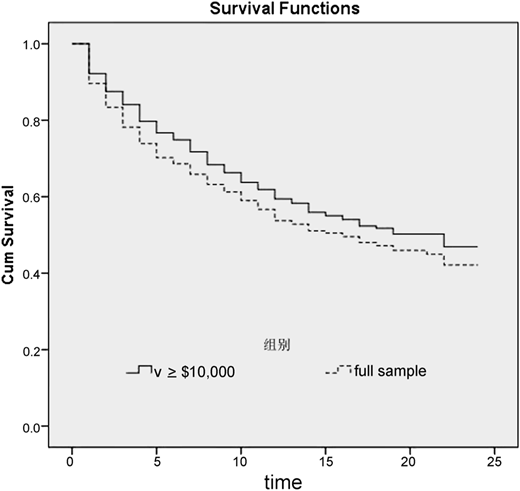
Survival function estimation (sample with initial trade value greater than $10,000)
Survival function estimation (sample with initial trade value greater than $10,000)
2.2.3 Model reconstruction and variable setting
At present, there are mainly two models for studying the factors affecting the duration of trade relations (Chen and Li, 2012), namely continuous-time Cox proportional hazard model and discrete-time clolog model. The research of Hess and Persson (2012) and Peng and Wang (2004) shows that the continuous-time Cox proportional hazard model has the following three shortcomings when conducting continuous research on trade relations: (1) the node problem of duration: most export relationships are discontinuous, the beginning and end of the trade relationship can be any time of the year; and because the statistics of the duration of exports are in units of years, the cut-off of a large number of export relationships are at the same precise time, which leads to node problems. The Cox proportional hazard model is a continuous time model. The local likelihood estimation used cannot solve the problem of time nodes. If the Cox model is used, it will lead to a biased estimation of the regression coefficient and the corresponding covariance matrix. (2) Unobservable heterogeneity: The Cox model is difficult to control unobservable heterogeneity, but ignoring the unobservable heterogeneity will lead to deviations in parameter and survival function estimates. (3) The proportional risk assumption is unreasonable: The use of the Cox model must meet the assumption of proportional risk. The unreasonable proportional risk assumption will lead to an unreasonable estimation of the covariate effect. Although the use of the extended Cox model can overcome this problem, it is necessary to estimate a large number of extra parameters. The discrete time model has the following advantages: (1) it can deal with the problem of a large number of time nodes in the duration of the trade; (2) the discrete time model can use traditional regression methods to estimate the binary classification dependent variable panel data; therefore, it is operable on most metrology software; (3) even if the sample observations are large, the discrete time modulus can be easily extended to explain the unobservable heterogeneity and (4) discrete time models can avoid setting strict proportional hazard assumptions. Therefore, we decided to establish a discrete-time model to analyze the influencing factors of the duration of China's wooden floor export trade.
2.2.3.1 Explained variable
Because the cloglog model is a binary dependent variable model, we treat the explanatory variables as follows: If the duration of a trade relationship is censored, the export time for each year in the trade relationship is recorded as 0; if the duration of the trade relationship is complete, that is, the “no export trade” failure event occurs, the last year of the export is counted as 1, and the rest of the time is recorded as 0.
2.2.3.2 Explanatory variables
Existing literature shows that the gravity model variables not only affect the trade flows between the two trading nations but also have a significant impact on the export duration of trade relations. Therefore, we put the gravity model variables as explanatory variables.
Economic scale (lngdp). The larger the economic scale of a country, the stronger the consumption capacity and the greater the demand for China's wooden flooring. Therefore, the duration of trade between the two sides will be longer. Gross domestic product (GDP) is measured in 2010 constant dollar prices and is taken into the model on a logarithmic scale.
Whether a trading country is a landlock. If a country is a landlocked country, the transportation cost of trade will increase, which is not conducive to China's trade with it, and it will have a restraining effect on extending the duration of China's export trade. This variable is a dummy variable. If it is a landlocked country, the value is 1; if it is not a landlocked country, the value is 0.
Whether a trading country borders China (conting). If a country borders China, it can reduce trade costs and reduce the risk of failure in export trade. This variable is a dummy variable. If it borders China, the value will be 1 and if it is not bordered by China, the value will be 0.
The trade distance (lndist) between a trading country and China. The longer the trade distance between a country and China, the more the corresponding trade cost and the more difficult it is to carry out trade. Therefore, an increase in trade distance increases the risk of failure. The trade distance is taken as the distance between the capitals of both sides of the trade and taken into the model in logarithm.
Initial trade volume (lninitial). Generally speaking, the larger the initial trade volume of a traded product, the greater the willingness of both parties to cooperate, and the greater the confidence in continued trade in the future, thus reducing the risk of failure. Log the initial trade volume into the model.
Whether there are multiple trade durations. If a trade relationship is interrupted once and re-established, we consider that there are multiple trade durations. The re-establishment after the trade relationship is interrupted is because the interrupted products have been improved and the quality has been improved. Therefore, the original partners are willing to re-establish trade relations with them, and the duration of the newly established trade relations will be greatly increased. Therefore, we expect the existence of multiple trade durations to reduce the risk of failure. This variable is a dummy variable. If multiple trade durations exist, the value is 1, otherwise, the value is 0.
Variable descriptions and data sources are shown in Table 4 (limited space, no descriptive statistical results of the variables are reported).
Variable description and data source
| Variable symbol | Meaning | Source of data | Coefficient expected result |
|---|---|---|---|
| Lngdp | GDP of trading country | WDI | − |
| Landlocked | Whether the country is a landlocked country | CEPII | + |
| Conting | Whether the country is bordering on China | CEPII | − |
| Lndist | The geographical distance between China and the trading country | CEPII | + |
| Lninitial | Initial trade volume | UNCOMTRADE | − |
| Multispell | Whether there are multiple trade segments | UNCOMTRADE | − |
3. Results and discussion
3.1 Analysis of the influencing factors of the duration of China's wooden floor export trade
This study involves three levels of product-country-time and requires dimension reduction. Eight kinds of products are brought into the model for testing in turn. The estimated results are shown in Tables 5 –7. Based on the discrete-time model, this paper uses the stata software to perform panel cloglog estimation with the command “xtcloglog” and analyzes the influence of various factors on the duration of China's wooden floor export trade (export trade failure risk). If the estimated coefficient is positive, it means that this factor is not conducive to extending the duration of export trade, that is, it increases the probability of failure of export trade. On the contrary, if the coefficient is negative, it means that this factor can extend the duration of trade. In order to ensure the robustness of the conclusions, this study also uses the commands “xtlogit, xtprobit” to perform panel logit and panel probit estimation respectively.
Cloglog model estimation results
| Variable | (1) | (2) | (3) | (4) | (5) | (6) | (7) | (8) |
|---|---|---|---|---|---|---|---|---|
| Product 1 | Product 2 | Product 3 | Product 4 | Product 5 | Product 6 | Product 7 | Product 8 | |
| lngdp | −0.397*** (−4.929) | −0.365* (−1.877) | −0.281*** (−4.195) | −0.463*** (−5.314) | −0.204*** (−2.723) | −0.525*** (−8.439) | −0.404*** (−6.989) | −0.130** (−2.044) |
| lninitial | −0.0823 (−0.710) | 0.0520 (0.190) | 0.220*** (2.726) | 0.0493 (0.548) | −0.284*** (−3.862) | 0.0177 (0.264) | −0.0341 (−0.591) | −0.146** (−2.430) |
| multispell | −1.079*** (−2.831) | −0.717 (−0.868) | −0.0701 (−0.256) | −0.297 (−0.691) | −2.222*** (−6.177) | −0.914*** (−3.302) | −1.440*** (−5.266) | −1.950*** (−7.292) |
| landlock | 3.486*** (5.883) | 1.858* (1.951) | 1.219*** (4.123) | 1.506*** (4.535) | 0.176 (0.443) | 0.966*** (3.333) | 0.945*** (3.602) | 0.693*** (2.579) |
| conting | −0.685 (−0.766) | −0.670 (−0.334) | −0.346 (−0.493) | 0.178 (0.226) | −0.576 (−0.961) | 0.154 (0.242) | −0.325 (−0.473) | −0.504 (−0.971) |
| lndist | 0.380 (0.911) | 0.589 (0.563) | 0.330 (0.940) | 1.026** (2.273) | 0.342 (1.016) | 1.458*** (4.092) | 0.974*** (3.011) | 0.461 (1.639) |
| Constant term | −3.053 (−0.784) | −10.30 (−1.006) | −7.341** (−2.234) | −11.14** (−2.573) | 1.145 (0.359) | −12.32*** (−3.594) | −7.773** (−2.512) | −2.710 (−1.047) |
| Observation value | 1,354 | 1,820 | 2,101 | 1,887 | 393 | 1,163 | 1,176 | 959 |
| Number of countries | 156 | 186 | 174 | 166 | 102 | 136 | 144 | 143 |
| χ2 | 63.31 | 8.421 | 38.71 | 48.54 | 98.33 | 107.8 | 104.4 | 119.4 |
| p Value | 0.000 | 0.209 | 0.000 | 0.000 | 0.000 | 0.000 | 0.000 | 0.000 |
Note(s): (1) The z-statistics corresponding to the estimated coefficients are shown in brackets; (2) *, ** and *** indicate that they are significant at the statistical levels of 10%, 5% and 1%, respectively
Logit model estimation results
| Variable | (1) | (2) | (3) | (4) | (5) | (6) | (7) | (8) |
|---|---|---|---|---|---|---|---|---|
| Product 1 | Product 2 | Product 3 | Product 4 | Product 5 | Product 6 | Product 7 | Product 8 | |
| lngdp | −0.427*** (−4.651) | −0.400* (−1.849) | −0.288*** (−4.198) | −0.471*** (−5.275) | −0.255*** (−2.463) | −0.572** (−7.647) | −0.436*** (−6.790) | −0.137* (−1.951) |
| lninitial | −0.0787 (−0.596) | 0.0564 (0.184) | 0.227*** (2.740) | 0.0529 (0.575) | −0.313*** (−3.129) | 0.0282 (0.374) | −0.0637 (−0.963) | −0.158** (−2.364) |
| multispell | −1.064** (−2.424) | −0.773 (−0.824) | −0.0664 (−0.237) | −0.271 (−0.617) | −2.884*** (−5.662) | −0.876*** (−2.780) | −1.592*** (−4.773) | −2.261*** (−6.916) |
| landlock | 4.164*** (5.528) | 2.201* (1.784) | 1.256*** (4.076) | 1.554*** (4.451) | 0.0359 (0.062) | 0.993*** (3.006) | 1.021*** (3.456) | 0.838*** (2.592) |
| conting | −0.916 (−0.883) | −0.737 (−0.324) | −0.374 (−0.520) | 0.167 (0.205) | −0.706 (−0.916) | 0.162 (0.240) | −0.370 (−0.515) | −0.595 (−1.072) |
| lndist | 0.407 (0.863) | 0.636 (0.544) | 0.329 (0.921) | 1.051** (2.268) | 0.390 (0.894) | 1.538*** (3.984) | 1.026*** (2.968) | 0.488 (1.577) |
| Constant term | −3.194 (−0.723) | −10.99 (−0.949) | −7.360** (−2.200) | −1.138** (−2.563) | 2.114 (0.510) | −12.83*** (−3.436) | −7.608** (−2.302) | −2.475 (−0.859) |
| Observation value | 1,354 | 1,820 | 2,101 | 1,887 | 393 | 1,163 | 1,176 | 959 |
| Number of countries | 156 | 186 | 174 | 166 | 102 | 136 | 144 | 143 |
| χ2 | 53.13 | 7.150 | 38.05 | 46.95 | 71.45 | 84.73 | 85.49 | 90.54 |
| p Value | 0.000 | 0.307 | 0.000 | 0.000 | 0.000 | 0.000 | 0.000 | 0.000 |
Note(s): (1) The z-statistics corresponding to the estimated coefficients are shown in brackets; (2) *, ** and *** indicate that they are significant at the statistical levels of 10%, 5% and 1%, respectively
Probit model estimation results
| Variable | (1) | (2) | (3) | (4) | (5) | (6) | (7) | (8) |
|---|---|---|---|---|---|---|---|---|
| Product 1 | Product 2 | Product 3 | Product 4 | Product 5 | Product 6 | Product 7 | Product 8 | |
| lngdp | −0.208*** (−4.369) | −0.180* (−1.728) | −0.128*** (−4.284) | −0.202*** (−5.213) | −0.136** (−2.326) | −0.287*** (−7.553) | −0.219*** (−6.636) | −0.0709** (−1.964) |
| lninitial | −0.0365 (−0.542) | 0.0251 (0.190) | 0.105*** (2.810) | 0.0267 (0.686) | −0.168*** (−2.950) | 0.0145 (0.381) | −0.0419 (−1.266) | −0.0773** (−2.243) |
| multispell | −0.465** (−2.003) | −0.318 (−0.779) | −0.0229 (−0.186) | −0.0662 (−0.352) | −1.682*** (−5.841) | −0.382** (−2.376) | −0.777*** (−4.329) | −1.276*** (−6.798) |
| landlock | 2.259*** (5.538) | 0.867* (1.732) | 0.574*** (3.892) | 0.702*** (4.291) | −0.0165 (−0.049) | 0.471*** (2.714) | 0.507*** (3.278) | 0.429** (2.465) |
| conting | −0.495 (−0.936) | −0.290 (−0.298) | −0.211 (−0.650) | 0.0215 (0.059) | −0.407 (−0.957) | 0.0489 (0.149) | −0.140 (−0.416) | −0.298 (−1.095) |
| lndist | 0.188 (0.786) | 0.294 (0.578) | 0.133 (0.867) | 0.441** (2.185) | 0.184 (0.752) | 0.721*** (3.942) | 0.495*** (2.939) | 0.242 (1.553) |
| Constant term | −1.703 (−0.754) | −5.236 (−1.059) | −3.519** (−2.453) | −5.237*** (−2.711) | 1.436 (0.615) | −6.153*** (−3.445) | −3.704** (−2.298) | −1.246 (−0.854) |
| Observation value | 1,354 | 1,820 | 2,101 | 1,887 | 393 | 1,163 | 1,176 | 959 |
| Number of countries | 156 | 186 | 174 | 166 | 102 | 136 | 144 | 143 |
| χ2 | 49.32 | 5.37 | 37.88 | 45.75 | 78.28 | 79.99 | 82.67 | 88.35 |
| p Value | 0.000 | 0.497 | 0.000 | 0.000 | 0.000 | 0.000 | 0.000 | 0.000 |
Note(s): (1) The z-statistics corresponding to the estimated coefficients are shown in brackets; (2) *, ** and *** indicate that they are significant at the statistical levels of 10%, 5% and 1%, respectively
The cloglog estimation results show that, except for product 2, the other seven products have a higher level of significance; the overall fit of the model is high, indicating that the explanatory variable has a high degree of influence on the duration of China's wooden floor export trade. If it is negative, it indicates that the impact direction is different.
The estimated results of the logit and probit models show that the influence directions of all variables and the significance of the overall model are consistent with the cloglog model, indicating that the impact of each explanatory variable on the duration of trade is more stable, and the estimated results are mostly in line with our expectations: the increase in the size of the country's economy and the existence of multiple segments of the trade relationship are conducive to extending the duration of China's wooden floor export trade, increasing the survival rate of the export trade and reducing the risk of failure in the export trade. If the trading country is a landlocked country, the trade distance with China increases will reduce the duration of China's wooden floor export trade, reduce the survival rate of export trade, and increase the risk of failure of export trade. Whether the trading country is bordered by China, there are two product model estimation coefficients that are positive but not significant, the coefficients of the model estimation results of the six products are negative but not significant. It can be preliminarily considered that this variable has not significantly promoted the extension of the duration of China's wooden floor export trade. The impact of the initial trade volume is different from expectations, and only the increase in the initial trade volume of product 5 and product 8 can significantly reduce the risk of export failure.
Specifically: The coefficients of “lngdp” of the eight products are all significantly negative, which is in line with expectations. This shows that the expansion of the economic scale of the export destination country can significantly reduce the risk of failure of China's wooden floor exports. The larger the country's economic scale, the stronger its consumption capacity and the increased demand for forest products. Therefore, China's export of wooden flooring to regions with large economic scale can improve the survival rate of Chinese wooden flooring export trade and reduce the risk of failure of export trade.
“multispell” variable: The coefficients of all eight products are negative, which is in line with expectations. This shows that the existence of multiple export segments in the trade relationship can reduce the risk of failure of China's export of wooden flooring, but this is contrary to the conclusions drawn by Besedeš and Prusa (2006b). When studying the duration of US import trade, they believe that the interruption of the first trade duration will increase the risk of the failure of the second trade duration, that is, the existence of multiple durations in the trade relationship will increase the probability of trade failure. This paper believes that the main reason is that the research by Besedeš et al. is based on the duration of the import trade of all goods in the United States. The United States is the world's largest economy and occupies a dominant position in trade relations. There is more choice in the source countries of imports. Therefore, after the first trade failure, the US importer can choose a large number of exporters from other countries to cooperate, and the willingness to continue cooperation with the original trading country is not high. However, China's situation is different. The main destination countries of China's wooden flooring are developed countries such as Europe and the United States. Although these countries have higher entry barriers, after the first export trade is interrupted, it is difficult for Chinese export manufacturers to re-choose. So they have to improve production technology, and improve product quality to meet the stringent requirements of importing countries. At the next trade cooperation, importers will be attracted by the improved trade practices and higher-quality products of Chinese companies and will have an interest in cooperation. The cooperation time will increase due to the improvement of product quality.
“landlock” variable: There are 7 kinds of product coefficients that are significantly positive, which indicates that if the export destination country is a landlocked country, the failure rate of China's wooden floor export will be greatly increased. Most international trade uses maritime transportation. If a country is a landlocked country, its transportation cost is much higher than that of coastal countries. The exporter tends to cooperate with buyers of coastal countries to save costs on both sides. Therefore, trade with landlocked countries will not be conducive to the extension of the duration of China's wood flooring exports.
“conting” variable: only six products have negative coefficients, the coefficients of products 4 and 6 are contrary to expectations, and the estimation results are not significant. This shows that the border between the importing country and China cannot significantly improve the survival rate of bilateral trade, which is inconsistent with the research conclusions of relevant scholars in Europe and the United States such as Nitsch (2009) and Esteve-pérez et al. (2013). Possible explanation: The transportation is convenient and the cultures are similar between European countries. The adjacency effect can significantly promote the extension of the export duration. However, most of the countries and regions bordering China are sparsely populated, have inconvenient transportation and their economic level is not high. They are quite different from China in terms of language, culture and systems. Trade with some bordering countries even requires shipping bypass which increases the cost of trade and is not conducive to the sustainable development of trade relations. Secondly, the problems left over by the history of China and some neighboring countries will also have an adverse impact on the bilateral trade. Therefore, whether the trading country borders China has no significant effect on the duration of China's wooden floor exports.
“lndist” variable: The estimated results are in line with expectations and are significant. This shows that the failure rate of trading relations between trading countries and China will increase as the trade distance between the two countries increases. Wooden flooring is bulky. Most of its international trade transportation uses sea and rail transportation, and the market price of forest products fluctuates greatly. If a country trades too far with China, it will increase product transportation time and costs, and increase various risks. Therefore, as the trade distance increases, the failure rate of China's wooden floor export trade also increases.
“lninitial” variable: In Table 5, the variables of 6 products are not significant, and do not meet expectations.
In order to further study the impact of the “initial trade volume” variable on the duration of China's wood flooring exports, we further processed the model of six products in which the “lninitial” variable was not significant in the above estimates: product 1, product 2, product 3, product 7 delete the “lngdp” and “landlock” variables; Product 4 delete the “lngdp,” “multispell” and “lndist” variables; Product 6 delete the “lngdp” and “lndist” variables. The estimated results after processing are shown in Table 8: except for product 3, the coefficients of the other 5 products are significantly negative. It can be determined that in addition to product 3, the increase in the initial trade volume can significantly increase the duration of China's wooden floor export trade. The larger initial trade volume often means: First, the two parties in the trade have greater confidence in this cooperation and are optimistic about future cooperation; second, the early sunk costs are too high, and the two parties in trade tend to cooperate for a long time.
Cloglog model estimation results
| Variable | (1) | (2) | (3) | (4) | (5) | (6) | (7) | (8) |
|---|---|---|---|---|---|---|---|---|
| Product 1 | Product 2 | Product 3 | Product 4 | Product 5 | Product 6 | Product 7 | Product 8 | |
| lngdp | / | / | / | / | −0.204*** (−2.723) | / | / | −0.130** (−2.044) |
| lninitial | −0.423*** (−5.39) | −0.105** (−1.98) | 0.115–1.71 | −0.112* (−1.62) | −0.284*** (−3.862) | −0.210** (−2.47) | −0.200*** (−2.78) | −0.146** (−2.430) |
| multispell | −1.523*** (−6.29) | −1.087*** (−6.29) | 0.14–0.53 | / | −2.222*** (−6.177) | −1.440*** (−2.72) | −1.806*** (−4.08) | −1.950*** (−7.292) |
| landlock | / | / | / | 1.460*** (−4.45) | 0.176 (0.443) | 1.219*** (3.14) | / | 0.693*** (2.579) |
| conting | 0.74 (−1.59) | 0.428–0.580 | 0.45 (−0.72) | −0.726 (−1.31) | −0.576 (−0.961) | −1.398* (−1.83) | 0.0489 (0.149) | −0.504 (−0.971) |
| lndist | 0.691*** −2.84 | 1.186*** −6.560 | 0.59 (−2.03) | / | 0.342 (1.016) | / | 1.091*** (−2.85) | 0.461 (1.639) |
| Constant term | −4.605** (−2.01) | −17.105*** (−10.00) | −10.05 (−3.64) | −3.000*** (−4.32) | 1.145 (0.359) | 0.14–0.15 | −9.108** (−2.53) | −2.710 (−1.047) |
| Observation value | 1,354 | 1,820 | 2,101 | 1,887 | 393 | 1,163 | 1,176 | 959 |
| Number of countries | 156 | 186 | 174 | 166 | 102 | 136 | 144 | 143 |
| χ2 | 57.54 | 82.33 | −10.55 | 22 | 98.33 | 23.14 | 38.34 | 119.4 |
| p Value | 0.000 | 0.000 | 0.1123 | 0.000 | 0.000 | 0.000 | 0.000 | 0.000 |
Note(s): (1) The z-statistics corresponding to the estimated coefficients are shown in brackets; (2) *, ** and *** indicate that they are significant at the statistical levels of 10%, 5% and 1%, respectively
4. Conclusions and implications
4.1 Conclusions
Main conclusions: (1) The continuous average export time of China's wooden flooring is relatively long, about 14 years (2) China's wooden flooring has a negative time dependency. After the export trade exceeds the threshold value of 15 years, the failure rate of trade greatly decreases, which has a “threshold effect.” (3) Gravity model variables have a significant impact on the duration of China's wooden floor export: the increase in the economic size of trading countries, the existence of multiple segments of trade relations, and the increase in the initial trade value will help extend the duration of China's wooden floor export trade and increase survival rate of export trade, and reduce the risk of failure of export trade. If the trading country is a landlocked country and the trade distance with China increases, it will reduce the duration of China's wooden floor export trade, reduce the survival rate of export trade and increase the risk of export trade failure. Whether the trading country borders China has not significantly improved the duration of China's wooden floor export trade.
4.2 Implications
China's export of wooden flooring has a negative time dependence. The export time threshold is 15 years, which indicates that the initial failure rate of wooden flooring export trade is relatively high. When the threshold is crossed, the duration of trade will be extended. Therefore, exporters should consolidate and deepen their relationships with existing trading partners while seeking new partners and expanding their export markets. Even if there is a discontinuity in trade, it should not be easy to abandon the original trade relationship. (2) Attach importance to maintaining the trade partnership of export of wooden flooring with the rapid economic development and neighboring countries and regions. (3) Attaching importance to the first cooperation with foreign businessmen and striving to establish a good relationship can lay a good foundation for future long-term cooperation.
The authors are indebted to the anonymous reviewers and editor.
Funds: “Transfer Stickiness, Agglomeration and Industry Upgrading of China's Timber Processing Industry (71873016) ” supported by National Natural Science Foundation of China; “Major Scientific Research Achievement and Cultivation Project: Research on China's Trade Characteristics, Development Momentum Mechanism and Market Precautions Technology Application in Forestry Industry Development (20170316)” supported by Beijing Forestry University.
Conflicts of Interest: The authors declare no conflict of interest.

