


We survey a growing field studying aspects of finance that are potentially illegal, illicit, or immoral. Some of the literature is investigative in nature to uncover malfeasance that is recent and possibly ongoing. Other forensic finance research examines past events to generate a fuller understanding of the activities, economic magnitudes, incentives, and players involved. The work spans newer areas such as cryptocurrencies, financial advisor and broker misconduct, and greenwashing; and newer research in established fields that are still developing, such as insider trading, structured finance, market manipulation, political connections, public finance, and corporate fraud. We highlight investigative forensic finance, common economic questions, common empirical methods, industry and political opposition, censoring, and the importance of avoiding publication biases. Compared to other finance papers, forensic work has similar citations and SSRN downloads, and more media and Securities and Exchange Commission (SEC) citations. Along with prominent examples of industry reform and awareness, this highlights the potential for real-world impact. By laying out commonalities in research themes, questions, methods, and approaches across fields that may at first seem disparate, we hope to encourage more investigation of incentives and mechanisms in darker corners of finance.
1 Introduction
One needs only to open a newsfeed to realize that financial shenanigans, fraud, and other forms of financial malfeasance are constantly in the headlines. From the spectacular collapse and disappearance of crypto at the second-most popular crypto exchange (FTX), to various Ponzi and pump-and-dump schemes and accusations of hedge funds manipulating markets, a quick perusal of financial news indicates that there is an ample supply of such activities. Cost ranges of financial fraud are noisy but typically vary between three and nine percent of GDP (Gee and Button, 2019). What does academic research have to say about the prevalence, magnitude, and economic mechanisms regarding potentially nefarious activities in finance?
Newspapers that fund investigative journalism have experienced a recent decline (Turkel et al., 2021), but the top finance journals are dedicating substantial space to investigative and forensic topics, and there appears to be a growing awareness of the importance of these topics. Forensic finance encompasses a wide range of subject areas, and researchers may not fully realize the connections across diverse forensic topics. Additionally, forensic research varies widely in the nature and timeliness of events, the empirical methods being used, and the legality, magnitude, and economic incentives of the conduct being investigated. Nonetheless, there are important common themes across forensic topics.
From talking to many professors and PhD students, we see an interest in examining forensic areas in finance but limited understanding of where to start, how to weave an interesting practical examination into an academic exercise, and whether there will be sufficient academic interest. There is also little sense of how examinations of different markets may relate to one another. One of our main goals from this review is to highlight common themes and purposes in this field that can hopefully provide ideas to encourage future research with the possibility of real-world impact.
What is Forensic Finance? The term forensic finance is not widely used but is related to the more well-known field of forensic accounting. In contrast to forensic accounting, which often focuses on the auditing of financials, forensic finance uses knowledge of specific financial areas along with multidisciplinary methods from econometrics, statistics, and data science to investigate forms of potential malfeasance that are of a financial nature or related finance. We define the field of forensic finance as the examination of anything that is potential ly illegal, illicit, or immoral in financial markets. The examined events may or may not be illegal and could be proven or disproven by the research. We view this definition as a useful way of describing the growing body of research summarized in this monograph, but we also note that others may describe this field with different names, and the term forensic finance does not have a settled definition.
A common and growing concern about business school research is that much of it lacks tangible, real-world impact on society. For example, a group of leading business school scholars, editors, and deans trying to address the issue states, “With a few notable exceptions, scholarly research rarely reaches the worlds of business or policy, and academic journals are neither read nor cited widely beyond the academic community” (Glick et al., 2018).1 Similarly, Hoffman (2021) notes that there is a growing concern that academic research is becoming “increasingly irrelevant” and “insular” but also notes a shift among younger scholars that wish to “contribute to the real world” and “make a difference.” More broadly, Sarewitz (2016) details how science “advances most rapidly, and is of most value, when it is steered to solve problems” with “direct engagement with the real world” as opposed to focusing on publication of incremental new results in unrealistic lab settings.2 While one response to the lack of practical impact is for universities to decrease the weight they put on publications in top journals (Hoffman, 2021), forensic finance research shows a path on which publication success and practical impact often co-exist. Forensic finance addresses important economic questions with the rigor and academic interest to be publishable in top finance journals while also being of interest to
A recent continuation of this movement can be seen with the session for business school deans on “Increasing the Impact of Faculty Research” at Emory#x2019;s March 20 and 21, 2023 Business School Dean’s Summit. Along the same lines, the Financial Times business school ranking team is exploring how to assess research’s “resonance with a broader audience and applicability to societal needs” (see https://www.ft.com/content/7cf1deb9-f8dd-498e-9cab-e8bf3a615ee9). In conversations with fellow finance academics, many colleagues express concerns about how useful some finance research is to society. An additional complexity is that real-world impact of academic research is difficult to measure and there are many avenues of potential impact.
Sir Leszek Borysiewitz, vice chancellor of the University of Cambridge writes, “Universities in turn are charged with holding a mirror to society — a duty that sometimes requires institutions of higher learning to speak ‘unpalatable truths’ that society might not want them to hear” (Merchant, 2017).
In some cases media coverage and practitioner summaries can help to bridge this gap. For example, Toffel (2016) notes that one avenue of impact is “attracting the interest of those who write columns, blogs, and articles about research for practitioners.”
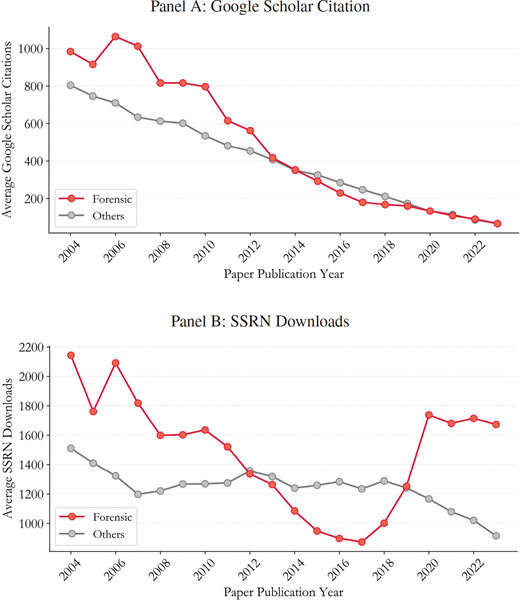
We show descriptive statistics about the publication, citations, and media of 6334 papers in the top three finance journals from January 2000 to April 2023. While it is difficult to precisely categorize forensic papers, 6.7% of papers published in the top 3 finance journals exhibit concentrated use of forensic words. Papers with forensic words have similar Google Scholar citations and slightly more SSRN downloads. Forensic papers have substantially more SEC citations and more media attention, indicating that they may be influencing SEC policy and could have a deterrent effect against nefarious activities. Perhaps not surprisingly, most of this impact is by a small set of papers. As an example of a paper with a seemingly large measurable impact, Egan et al. (2019) documented the players and incentives in the financial advisor misconduct records, which led to substantial media scrutiny of financial advisor companies and changes to processes used by the SEC, the state of Massachusetts, and the Financial Industry Regulatory Authority (FINRA).
In addition to directly impacting nefarious activity, forensic research can also provide a useful balance to other finance research. In particular, academic research (as well as media coverage) about new markets and technologies (such as crypto and FinTech) may inadvertently slant toward their potential benefits. Forensic finance can potentially serve as a counterweight by examining what is happening at the ground level. Nevertheless, as with many fields, a perceived publication bias towards shocking findings combined with open-ended methods of examination can also potentially lead to a publication bias. This is why we emphasize the importance of “potential ly ” in defining the contours of forensic finance. Non-results can be informative too, and we point to papers (including our own) that examined potentially nefarious activities and convincingly find no such evidence. We also highlight potential opposition to research from industry players and the importance of revealing the firm names of responsible parties to foster public scrutiny and practical change.
This monograph builds upon important earlier surveys of forensic economics by Zitzewitz (2012) and forensic finance by Ritter (2008).4Karpoff (2021) examines whether financial fraud, largely corporate fraud, is becoming larger or smaller over time. Griffin (2021a) surveys the academic literature surrounding the role of fraud in the financial crisis. A vast literature has developed since these prior surveys, with the nature of the questions, topics, and types of evidence shifting considerably along with the growing financial environment. For example, Ritter’s survey focused on mutual fund late trading, option backdating, initial public offering (IPO) allocations, and the changing of a database of analyst coverage. We examine academic studies involving financial reporting misconduct, financial market misconduct, financial advisor misconduct, and public finance misconduct. Examples include corporate fraud, structured finance, greenwashing, cryptocurrencies, market manipulation, insider trading, public corruption, tax evasion, and more. We focus on recent forensic finance research in areas that have not been widely surveyed with less focus on areas of forensic economics (Zitzewitz, 2012), such as price collusion and healthcare fraud, or forensic accounting (Honigsberg, 2020), although we see the intersection of these areas and finance as ripe for potential research.
Khwaja and Mian (2011) also survey some common agency issues in the literature on corruption and rent seeking in financial markets. Alexander and Cumming (2020) provide chapters written by different authors on market manipulation, insider trading, and other forms of misconduct. Cumming et al. (2015) survey the literature on causes and consequences of financial market misconduct. Amiram et al. (2018) survey the literature on corporate financial reporting fraud.
By focusing on forensic finance, we do not wish to leave readers with the impression that finance is negative for society. On the contrary, finance is enormously beneficial, but its role in allocating resources is more effective when there are fewer frictions from malfeasance. Trust is also a necessary ingredient for participation in the financial system (Guiso et al., 2008). Exposing malfeasance can enhance trust both by eliminating misconduct and by increasing transparency for financial interactions that are free from misconduct. Zingales’ (2015) presidential address argues that corruption and other forms of financial malfeasance have colored the perception of the finance field and that finance academics need to carefully consider their research and teaching on these important topics. We hope that this monograph will provide context and mechanics to move toward the goal of adding more transparency to potentially nefarious activity in finance. We highlight the ways in which forensic finance has brought additional clarity to different areas of finance, and we include thoughts on areas for future research. This starts by understanding the mechanics of how a market functions, identifying potential conflicts of interest within the market, and assessing whether the market is properly functioning. In a world with increased complexity, polarization, and distrust, detailed and objective academic research on forensic topics can help restore integrity and trust to our global financial system.
The survey is broken down into three main pieces. First, we identify forensic papers published in top finance journals to broadly describe the field and its potential impact. Second, we summarize common themes and suggestions for impactful work. Third, we review important recent forensic research, organized by four main topic areas: financial reporting misconduct, financial market misconduct, financial advisor misconduct, and public finance misconduct. Financial reporting misconduct includes misreporting by corporations and investment firms, misreporting and related issues in structured finance (e.g., residential and commercial mortgage-backed securities), and misreporting of environmental, social, and governance measures, often referred to as greenwashing. Within financial market misconduct, we discuss cryptocurrencies, market manipulation, and insider trading. Financial advisor misconduct consists of fraud and other forms of misconduct by brokers and other financial advisors. Within public finance misconduct, we discuss public corruption, tax evasion, and government program fraud. We conclude with suggestions for future research and thoughts on how to shape the future of forensic finance.
2 Trends in Forensic Finance
What topics does forensic finance cover, how widespread is the research, and is it having an impact within and outside of academia? In this section, we identify forensic finance papers in top finance journals based on terms used in the articles to discern a sense for the forensic field from a perspective that is quantitative and as objective as possible. In particular, we examine words and terms frequently used by forensic finance papers, topic areas addressed by forensic finance papers, and the frequency with which forensic papers appear in top finance journals. We then examine measures of potential academic, general audience, and regulatory impact of forensic finance papers.
2.1 Forensic Areas and Words
To estimate the coverage and nature of forensic papers in finance journals, we identify papers related to forensic finance across the top three finance journals (Journal of Finance, Review of Financial Studies, and Journal of Financial Economics ) from January 2000 to April 2023. Our focus on the top three finance journals is to identify a large and representative sample of prominent forensic finance research. Good forensic finance research also appears in other outlets including general economics journals and other finance journals as well as law and accounting journals. In our more detailed review of the literature, we consider many papers in other journals.
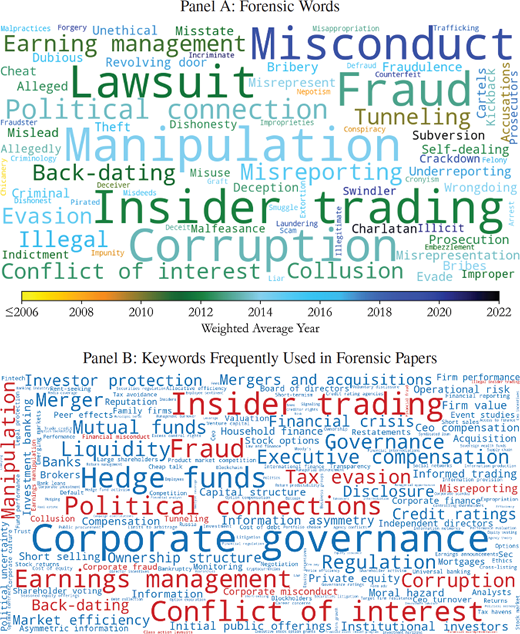
Because there is no JEL code or standardized keyword for forensic finance, we identify papers by searching the text of papers for words related to general forensic terms such as “fraud,” “misreporting,” and “conflict of interest”, as well as specific terms related to types of forensic finance research such as “insider trading,” “earnings management,” “back-dating,” “political connection,” “self-dealing,” and “tunneling.” The full list of forensic words is reported in Table IA.1 in the Online Appendix. To check that this list of terms identifies fraud-related papers, we reviewed all words individually and dropped terms for which more than 30% of the flagged papers were false positives or which are frequently used in contexts that are not related to forensic finance. The full set of forensic finance terms is displayed as a word cloud in Panel A of Figure 2.1. Word variants are also included, and the size of each term represents the frequency with which the word is used in forensic papers. Some of the most common forensic terms are “insider trading,” “conflict of interest,” “political connection,” “manipulation,” “earnings management,” “back-dating,” “mislead,” “self-dealing,” “misreporting,” “corruption,” “alleged,” “illegal,” and “lawsuit.” We categorize a paper as being forensic finance if it uses forensic terms at least 20 times or at least 10 times with at least one usage in the title or abstract. See the Online Appendix for additional details, validation, and sensitivity to alternative definitions.
Word cloud.
Notes: This figure shows the forensic words and keywords frequently used in forensic finance papers. Panel A presents the full set of forensic words. The colors indicate the weighted average year of each word’s appearances. Panel B presents the keywords frequently used in forensic papers. Red represents the keywords which are (contains) forensic words, while blue represents the rest. In both panels, the words are sized by the frequency. The full sample includes 6334 published and forthcoming papers in the top three finance journals between 2000 and April 2023. Keywords are collected from working paper versions of published papers, which are available for 72% of papers.
Word cloud.
Notes: This figure shows the forensic words and keywords frequently used in forensic finance papers. Panel A presents the full set of forensic words. The colors indicate the weighted average year of each word’s appearances. Panel B presents the keywords frequently used in forensic papers. Red represents the keywords which are (contains) forensic words, while blue represents the rest. In both panels, the words are sized by the frequency. The full sample includes 6334 published and forthcoming papers in the top three finance journals between 2000 and April 2023. Keywords are collected from working paper versions of published papers, which are available for 72% of papers.
Close Figure 2.1Panel B of Figure 2.1 summarizes the keywords used in papers classified as forensic. Common keywords include many of the forensic terms, as well as topic areas such as corporate governance, hedge funds, mergers and acquisitions, and financial crisis. Common keywords present in non-forensic papers but not in forensic papers are asset pricing, capital structure, mutual funds, and institutional investors.
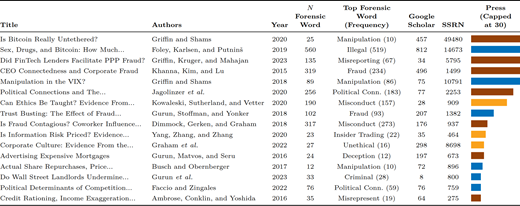
After applying this methodology to all Journal of Finance, Review of Financial Studies, and Journal of Financial Economics papers published between January 2000 and April 2023 (including forthcoming papers as of April 2023), we identify 426 forensic finance papers, which represents 6.7% papers published in the top 3 finance journals during this time period. Table IA.11 in the Online Appendix lists all papers identified as forensic based on our methodology, sorted by the number of forensic words. The papers at the top of the list with the most forensic words are Foley et al. (2019) (“Sex, drugs, and bitcoin: How much illegal activity is financed through cryptocurrencies?”), Liu (2016) (“Corruption culture and corporate misconduct”), and Piskorski et al. (2015) (“Asset quality misrepresentation by financial intermediaries: Evidence from the RMBS market”).
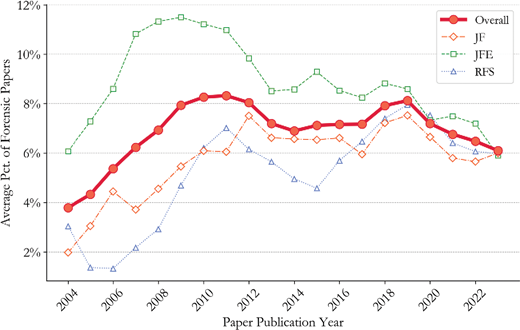
Figure 2.2 plots the percent of papers with forensic finance terms overall and by the journal on a five-year rolling average basis from January 2004 to April 2023. The trend is upward sloping in the early 2000s with forensic papers growing from 4% of papers in 2004 to 8% of papers in 2010. In addition to increased forensic research, this trend could also reflect growing acceptance of using forensic terms in finance research. Since 2010, the share of forensic papers has been roughly constant in the range of 6 to 8%. The Journal of Financial Economics exhibited a higher rate of forensic papers early in the sample, and all three top finance journals have converged to similar rates more recently.
Trend of forensic finance papers.
Notes: This figure shows the percentage of forensic finance papers among all published and forthcoming papers in the top three finance journals between 2000 and April 2023. The top three finance journals are the Journal of Finance (JF), Journal of Financial Economics (JFE), and Review of Financial Studies (RFS). Editor announcements, presidential addresses, comments, and book reviews are removed from the sample. There are in total 6334 academic papers. A paper is categorized as being forensic finance if it uses forensic words at least 20 times or at least 10 times with at least one usage in the title or abstract. The percentages are calculated using the 5-year rolling window among all papers, among JF papers, among JFE papers, and among RFS papers.
Trend of forensic finance papers.
Notes: This figure shows the percentage of forensic finance papers among all published and forthcoming papers in the top three finance journals between 2000 and April 2023. The top three finance journals are the Journal of Finance (JF), Journal of Financial Economics (JFE), and Review of Financial Studies (RFS). Editor announcements, presidential addresses, comments, and book reviews are removed from the sample. There are in total 6334 academic papers. A paper is categorized as being forensic finance if it uses forensic words at least 20 times or at least 10 times with at least one usage in the title or abstract. The percentages are calculated using the 5-year rolling window among all papers, among JF papers, among JFE papers, and among RFS papers.
Close Figure 2.2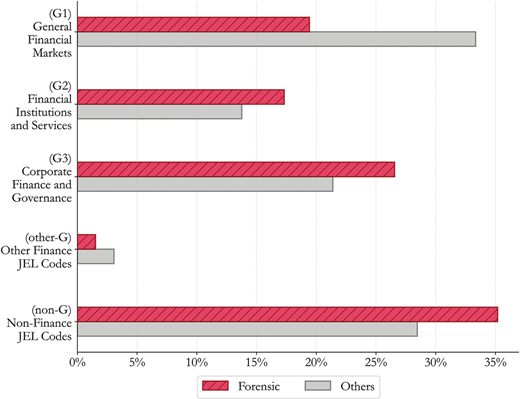
JEL classification.
Notes: This figure compares the composition of topics between forensic finance and other papers, showing the percentage of papers in each 2-digit JEL classification. The JEL category G, which pertains to Financial Economics, includes the 2-digit subcategories General Financial Markets (G1), Financial Institutions and Services (G2), Corporate Finance and Governance (G3), Behavioral Finance (G4), and Household Finance (G5). Non-G JEL codes refer to classifications outside the finance category. If a paper has n > 1 JEL codes, each JEL code is weighted by . For the Journal of Financial Economics and recent papers in the Review of Financial Studies, we collect JEL codes from papers’ published versions. For the Journal of Finance and earlier papers in the Review of Financial Studies, we collect JEL codes from working paper versions of published papers, which are available for 69% of
JEL classification.
Notes: This figure compares the composition of topics between forensic finance and other papers, showing the percentage of papers in each 2-digit JEL classification. The JEL category G, which pertains to Financial Economics, includes the 2-digit subcategories General Financial Markets (G1), Financial Institutions and Services (G2), Corporate Finance and Governance (G3), Behavioral Finance (G4), and Household Finance (G5). Non-G JEL codes refer to classifications outside the finance category. If a paper has n > 1 JEL codes, each JEL code is weighted by . For the Journal of Financial Economics and recent papers in the Review of Financial Studies, we collect JEL codes from papers’ published versions. For the Journal of Finance and earlier papers in the Review of Financial Studies, we collect JEL codes from working paper versions of published papers, which are available for 69% of
Close Figure 2.3See https://www.aeaweb.org/econlit/jelCodes.php for detailed descriptions of JEL codes. The Journal of Financial Economics lists JEL codes for each paper, and the Review of Financial Studies lists JEL codes starting in September 2015. For the Journal of Finance and earlier papers in the Review of Financial Studies, we collect JEL codes from working paper versions of published papers, which are available for 69% of papers.
2.2 Impact of Forensic Finance Research
We use data provided by Geoffroy and Lee (2021) prior to 2017 and extend their sample from 2018 to present. They show that there were few citations before 2011 when the court’s 2011 ruling against the SEC in the Business Roundtable v. SEC (647 F. 3d 1144, Court of Appeals, D.C. Cir. 2011) drastically increased the citations of academic papers in proposed rulemaking and resulted in fewer negative comment letters. SSRN downloads may be undercounted to the extent that working paper versions carry different titles and are not linked in SSRN to the published version. Additionally, some authors post versions on their websites or other places and not SSRN.
Google Scholar citations and SSRN downloads.
Notes: This figure shows the comparison of Google Scholar citations and SSRN downloads between forensic finance and other papers. A paper is categorized as being forensic finance if it uses forensic words at least 20 times or at least 10 times with at least one usage in the title or abstract. In Panel A, it shows the 5-year rolling average Google Scholar citations of forensic finance (other) papers. The full sample is used, which includes 6334 published and forthcoming papers in the top three finance journals between 2000 and April 2023. In Panel B, it shows the 5-year rolling average SSRN downloads of forensic finance (other) papers. The sample includes 5142 papers (81% of full sample) which have posted a working paper version on SSRN. In both panels, red represents forensic finance papers and grey represents all other papers in the sample. Both Google Scholar citations and SSRN downloads are collected in 2023.
Google Scholar citations and SSRN downloads.
Notes: This figure shows the comparison of Google Scholar citations and SSRN downloads between forensic finance and other papers. A paper is categorized as being forensic finance if it uses forensic words at least 20 times or at least 10 times with at least one usage in the title or abstract. In Panel A, it shows the 5-year rolling average Google Scholar citations of forensic finance (other) papers. The full sample is used, which includes 6334 published and forthcoming papers in the top three finance journals between 2000 and April 2023. In Panel B, it shows the 5-year rolling average SSRN downloads of forensic finance (other) papers. The sample includes 5142 papers (81% of full sample) which have posted a working paper version on SSRN. In both panels, red represents forensic finance papers and grey represents all other papers in the sample. Both Google Scholar citations and SSRN downloads are collected in 2023.
Close Figure 2.4Citation regressions
| Google Scholar | SSRN | Press | SEC | |||||
|---|---|---|---|---|---|---|---|---|
| (1) | (2) | (3) | (4) | (5) | (6) | (7) | (8) | |
| Forensic | 38.926 | 37.454 | 125.916** | 163.412** | 0.303** | 0.315*** | 0.069*** | 0.069*** |
| (24.562) | (23.606) | (59.475) | (60.757) | (0.094) | (0.094) | (0.019) | (0.021) | |
| JEL FE | ✓ | ✓ | ✓ | ✓ | ||||
| Journal FE | ✓ | ✓ | ✓ | ✓ | ✓ | ✓ | ✓ | ✓ |
| Year FE | ✓ | ✓ | ✓ | ✓ | ✓ | ✓ | ✓ | ✓ |
| Observations | 6,334 | 5,423 | 5,142 | 4,768 | 2,816 | 2,642 | 6,334 | 5,423 |
| R2 | 0.310 | 0.340 | 0.035 | 0.066 | 0.017 | 0.019 | 0.021 | 0.029 |
| Dep. Var. Mean | 299.134 | 286.841 | 1001.224 | 1014.602 | 0.454 | 0.455 | 0.079 | 0.083 |
Notes: This table examines the difference in four main measures of impact between forensic finance and other papers. We estimate the OLS regression of the form:
Citationi = α + βForensici + FEs + ϵi,
Figure 2.5 assesses the broader impact of forensic papers by also analyzing citations in SEC regulations and press mentions. Press coverage data come from Altmetric. Figure 2.5 plots 5-year rolling averages of SEC citations per paper and press mentions per paper by publication year, separately for forensic and non-forensic papers. The time series for this data is limited by the fact that SEC citations were rare prior to 2012, and Altmetric data is limited for papers published before 2016 and seems to undercount even afterward. Thus, we group all papers published prior to 2016 together. SEC citations for forensic papers are higher than non-forensic papers in all years, and press mentions per paper are meaningfully higher for forensic papers starting in 2019. Regression results in Table 2.1 indicate that both of these differences are statistically significant.3 Results are similar with generally higher statistical significance for all four impact measures when using a continuous measure of forensic words instead of the binary indicator for forensic finance research (see Table IA.3 in the Online Appendix).
The regression analysis in Table 2.1 is Winsorized at the 95% level with standard errors clustered by year. The Online Appendix (Tables IA.4 to IA.6) repeats this analysis with alternative Winsorization and standard error calculations with similar results.
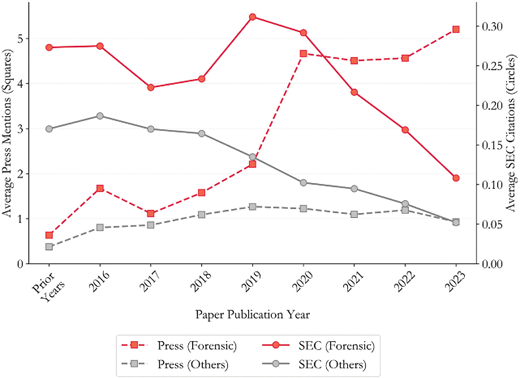
SEC citations and press mentions.
Notes: This figure shows the comparison of SEC citations and press mentions between forensic finance and other papers. A paper is categorized as being forensic finance if it uses forensic words at least 20 times or at least 10 times with at least one usage in the title or abstract. The circles (squares) show the average SEC citations (press mentions) of papers published between year t - 4 and t, i.e. 5-year rolling averages. The data points lie on t = P rior Y ears on the left represent the average citations of papers published between 2000 and 2015. Red represents forensic finance papers, while grey represents all other papers in the sample. The SEC citations are collected from both proposed and final SEC rules released between 2007 and April 2023. Press citations are obtained from Altmetric and include news articles from various media outlets. Both SEC and press mentions are collected in 2023.
SEC citations and press mentions.
Notes: This figure shows the comparison of SEC citations and press mentions between forensic finance and other papers. A paper is categorized as being forensic finance if it uses forensic words at least 20 times or at least 10 times with at least one usage in the title or abstract. The circles (squares) show the average SEC citations (press mentions) of papers published between year t - 4 and t, i.e. 5-year rolling averages. The data points lie on t = P rior Y ears on the left represent the average citations of papers published between 2000 and 2015. Red represents forensic finance papers, while grey represents all other papers in the sample. The SEC citations are collected from both proposed and final SEC rules released between 2007 and April 2023. Press citations are obtained from Altmetric and include news articles from various media outlets. Both SEC and press mentions are collected in 2023.
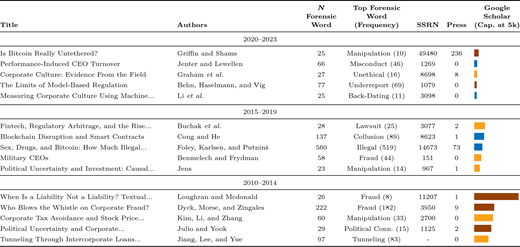
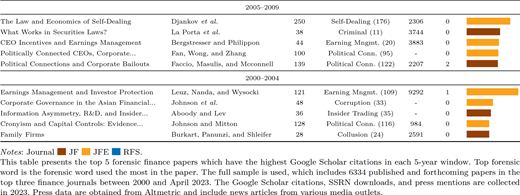
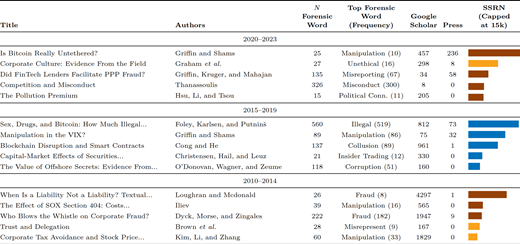
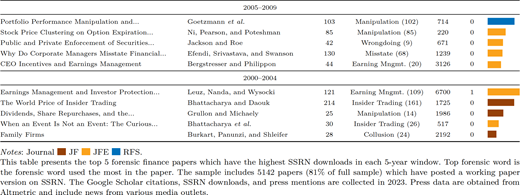
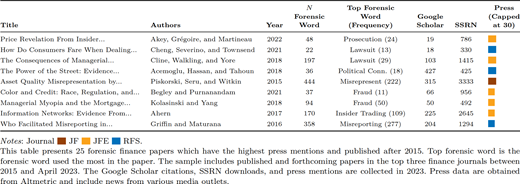
Close Figure 2.5For additional context on forensic finance papers that are having a particularly large impact, Tables 2.2, 2.4, and 2.4 list the forensic papers with the most citations, SSRN downloads, and press mentions, respectively. Table IA.10 in the Online Appendix similarly lists the forensic papers with the most SEC citations. The titles and authors from these papers indicate that the field is quite disparate. Overall, the data indicate that forensic finance papers have many examples of papers that are heavily downloaded, discussed in the press, and quoted by the SEC.
3 Common Themes for Forensic Work
Before delving into specific areas of work, we outline investigative forensic finance, common economic questions for interesting work, common empirical methods, forensic finance theory, the importance of specificity for impact, potential opposition and censoring, the importance of avoiding publication bias, and impact and enforcement. These themes are present across all areas of forensic finance research, including financial reporting misconduct, financial market misconduct, financial advisor misconduct, and public finance misconduct. We outline these topics with an eye toward suggestions for future impactful work.
3.1 The Investigative Branch of Forensic Finance
Investigative forensic finance is a branch of forensic finance that focuses on recent or ongoing activity that is of a potentially nefarious nature, but that has not been fully explored. The activity may not be known to have occurred at all or may have been rumored or reported to some extent but with a limited understanding of the actual occurrence, scope, facts, players, and economic incentives. Similar to how an investigative reporter might do a deep dive into an interesting topic to examine potentially dubious activity, a financial economist can also do impactful investigative work armed with detailed data, a scientific framework, and an understanding of financial methods. Uncovering something new is generally harder than building on existing work, but investigative finance has the benefit of shedding light on relatively unexplored phenomena, which has the potential for larger real-world impact through public awareness, enforcement, and regulatory changes.
Delving into a completely new space can be daunting. Perhaps for this reason, many researchers often focus primarily on existing areas with established academic literatures. For example, from 2004 to 2007, there were 40 papers published in the top three finance journals with “IPO” in the abstract or title, and no papers with “CDO” (collateralized debt obligation) in the abstract or title over this same period. However, the market cap of CDOs issued in 2006 was over fifteen times the value of IPOs, and as we now know, CDOs were at the heart of the financial crisis.1 Researchers subsequently found many dubious and illegal activities in CDOs and structured finance more generally. Investigating growing markets and relatively new financial products is often useful for identifying forensic topics. Additionally, in areas of rapid growth, the checks and balances that mitigate misconduct and conflicts of interest may not be fully developed.
In 2006, approximately $500 billion in CDOs were issued (Benmelech and Dlugosz, 2009), compared to $30.5 billion in IPO issuance according to Jay Ritter’s website (see https://site.warrington.ufl.edu/ritter/files/IPO-Statistics.pdf ).
The two largest impediments to doing investigative research are often not knowing what types of potentially nefarious activities to investigate and the ability to find data. One place to start is to examine what controversies are simmering under the surface in an area based on industry reports, regulatory proceedings, and discussions with market participants. While some market participants may have a strong incentive for secrecy, other market participants who are potentially harmed by the suspected activity may be more prone to talk. Sometimes questionable activities are so normalized in a space that the actors do not see anything amiss. Several times we have had market participants tell us that ‘of course’ this is the way the markets work, everyone knows it, and/or no one is harmed (except maybe unsophisticated actors). Potential activity may also be discussed on blogs or even in the broader media. A detailed understanding of institutional details is also needed to test the underlying mechanics of a market, such as settlement procedures, rating procedures, and underwriting processes.
3.2 What Makes for an Interesting Forensic Finance Topic?
An ideal forensic topic is one that is broad enough to be of interest to an academic audience and also has enough practical importance to catch the attention of market participants and the general public. One hurdle is how new or surprising the activity is, and a second hurdle is the economic magnitude of the activity. While it would be difficult to publish a paper about a single Ponzi scheme in an obscure market, a scheme that is large enough to meaningfully fuel movements in a sizeable market such as Bitcoin is both surprising and economically meaningful. Alternatively, aggregating many incidents of potential financial misconduct with common themes or players can also be of broad interest. In our experience, there are often differences of opinion among academics, with some academics not appreciating the importance of some topics that may be more important to practitioners and market participants.
Most papers develop from reading or hearing about real-world controversies or areas of potentially questionable activity. Even if the press is reporting on a topic, it is doubtful that they have fully explored the details and economic mechanisms. Rigorous research is needed to quantify how common the activity is, its economic magnitude, the mechanics of how the activity works, the players involved, and the costs and damage associated with the activity. For example, even though anecdotes of mortgage fraud occurred in the press in 2006 and 2007 and were featured in the 2011 Financial Crisis Inquiry report (Financial Crisis Inquiry Commission, 2011), it was not until the emergence of detailed academic research, mostly starting in 2013 (five or more years after most of the fraud occurred), that one learned that the fraud included more than half of loans in residential mortgage-backed securities (RMBS), that firms were the major responsible parties, that most major originators and underwriters participated, that the fraud increased over time and was much higher in certain originators, and that the fraud led to inflated house prices (see Griffin, 2021a). For most topics, there are an array of things that can be learned from detailed academic analysis that go well beyond what can be learned from practitioner anecdotes, press articles, and even government investigations.
3.3 Common Empirical Methods and Data
Empirical methods for forensic finance vary across topic areas and overlap considerably with methods used in other empirical corporate finance and asset pricing settings. In particular, analysis that focuses on the causes and consequences of financial misconduct often faces the same types of identification challenges as other research topics. Natural experiments, matching, and instrumental variables can all be useful approaches to these questions. In particular, it is common to exploit differences in incentives and enforcement over time and across markets or market participants.
The specific form that forensic evidence takes can vary significantly and needs to be tailored to the topic being investigated. To the extent that economic incentives vary around specific thresholds, researchers can use differences in differences and discontinuity analysis to examine competing hypotheses. For example, discontinuities around zero may be tied to bonus incentives that could induce misreporting (Bollen and Pool, 2009). Detailed data on timing can also be revealing, such as Ben-David et al.’s (2013) evidence of hedge fund market manipulation based on abnormal returns in the closing minutes of trading at quarter-end dates. Patterns around salient cutoffs and thresholds are also potentially informative. For example, Garmaise (2015) identifies borrower misreporting of personal assets in residential mortgages based on clustering above round number thresholds. Griffin and Shams (2018) show starkly different trading behavior in derivates that are nearly identical except that one can be used to move the benchmark at the settlement and the other cannot.
Rounding at particular numbers can also point to dubious behavior. For example, Christie and Schultz (1994) start with the simple observation that trading volumes are higher at quarter price increments compared to odd-eighths. Their in-depth investigation indicates that this pattern is likely due to dealers colluding to generate larger bid-ask spreads. Griffin et al. (2023a) follow this lead and find that, thirty years later, rounding is common in the municipal bond market and is often associated with higher dealer markups. Relatedly, Benford’s law focuses on the distribution of the first significant digit in a series. It is widely used in accounting since people that are making up financial series tend to tilt to avoid certain numbers (Durtschi et al., 2004). Cong et al. (2023b) use Benford’s law along with rounding and trade size distributions to examine the prevalence of potential wash trading on 29 cryptocurrency exchanges.
Regulatory changes and acquisitions can make for compelling difference-in-difference analysis, particularly if the questionable activity has different economic incentives around the change. Forensic papers frequently use multiple methodologies and go to great lengths to consider alternative explanations. Subsequent out-of-sample analysis can also be useful, particularly when regulatory changes (e.g., Dimmock and Gerken, 2015; Honigsberg, 2019) or publicity from the research (e.g., Christie et al., 1994) has the potential to reduce misconduct without affecting other explanations.
Cross-validating data can also be a useful approach to check for nefarious activities. If the misconduct being investigated involves misreported data, it can be instructive to compare the data being investigated to data reported in other settings without the same misreporting incentives. For example, Chen et al. (2021) find that summary risk assessments disseminated by Morningstar (and self-reported by funds) do not match up with risk assessments for the underlying holdings matched to external databases of bond ratings. Similarly, Griffin and Maturana (2016) and Piskorski et al. (2015) match loan-level data reported in RMBS prospectus supplements to county deeds data and credit bureau data to show that the RMBS loan characteristics were misreported.
Limitations on what a researcher can say often come down to the granularity and richness of the data being analyzed. A common theme in forensic research is that transaction-level data is often far more useful than aggregated data. For example, Griffin et al. (2023b) use detailed loan-level data to identify suspicious loans, including businesses obtaining Paycheck Protection Program (PPP) loans that simply never existed and counties with more loans in certain industries than the number of businesses that exist in census data. This analysis may not have been possible if the SBA had not released loan-level PPP data with identifying information for individual borrowers. Cryptocurrencies are another setting in which transaction data can be used for forensic research. Though transactions initially appear to be anonymous, the combination of clustering algorithms, attribution data (linking addresses to named users), and other tracing techniques allows researchers to create flows that can be associated with particular entities and crypto exchanges (Meiklejohn et al., 2013; Griffin and Shams, 2020; Makarov and Schoar, 2022). Other examples of granular and detailed data include datasets with IP addresses linked to companies (Chen et al., 2020), geolocations (Gurun et al., 2023), satellite images (Mukherjee et al., 2021), flight tracking (Yermack, 2014), housing deeds (Fang et al., 2019), return reporting revisions (Patton et al., 2015), broker misconduct and revisions to misconduct data (Dimmock et al., 2018; Honigsberg and Jacob, 2021), criminal records (Griffin et al., 2023b), government procurement contracts (Brogaard et al., 2021), connections to lobbyists (Gao and Huang, 2016), and identities linked to credit cards (Agarwal et al., 2020).
Occasionally, private data unexpectedly becomes available to academic researchers due to leaks, hacks, or other surprise disclosures. Wagner and Zeume (2023) survey the literature on data leaks associated with tax havens including the 2016 leak of the Panama Papers. Using this data, O’Donovan et al. (2019) identify public companies associated with the Panama Papers and find that these firms suffered stock market losses as a result of the leak. Another example of private data surprisingly becoming public is the hack and subsequent public disclosure of individual-level usage data from Ashley Madison, a dating platform associated with marital infidelity. Griffin et al. (2019b) show that individuals who use Ashley Madison are more likely to commit police misconduct and engage in multiple forms of white-collar crime. Academics may not understand the legality of using such data. Similar to rules that apply to investigative reporters, leaked data that has been publicly disclosed is in the public domain and permissible for use in academic research.
A final empirical challenge to forensic research is that there is often a tradeoff between proving the existence of misconduct and quantifying its magnitude. A narrow lens is often needed to identify smokinggun patterns in the data that lack other plausible explanations, but focusing narrowly can underestimate the magnitude of the misconduct. Successful forensic papers often contain both narrow and wide empirical approaches to examine mechanisms and precise conduct while also estimating economic magnitudes.
3.4 Forensic Finance Theory
The broadest theoretical perspective for forensic finance is simply that agents respond to incentives. As proposed by Becker (1968), this applies to crime and misconduct just as clearly as other areas of economics. Another general theoretical lens for examining fraud is that fraud often correlates with the business cycle. A common observation formalized in a model by Povel et al. (2007) is that more fraud exists in economic booms because individuals are more trusting and monitor their investments relatively less closely, but fraud is revealed in down market conditions. The Bernie Madoff Ponzi scheme fits the pattern in that it occurred over a long period of positive markets but was only revealed by the financial crisis. The FTX crypto exchange grew in reputation and influence during booming markets, but severe problems were revealed when crypto crashed. There is also a more radical view that illegal activity can, at least partially, cause the boom. Though missing in standard economic models, Easley and O’Hara (2023) propose a psychological game theory model of ethics that endogenizes ethical behavior and proposes that misconduct can be contagious. Hatfield et al. (2020) show that syndicated markets, common to IPOs and financial debt markets, can facilitate collusive behavior even without market concentration. Akerlof and Romer (1993) argue that historical actors involved in looting an organization (such as banks in the U.S. savings and loan crisis) can move capital into a space in a manner that systematically increases asset prices. While most forensic finance research is empirically oriented, we also describe relevant theoretical research in specific areas such as in market manipulation along the way.
3.5 The Importance of Specificity
One interesting discussion we have had with other academics is on naming the companies responsible for potentially nefarious activity. Academics are often reluctant to name the responsible organizations. Common reasons discussed are that they feel that doing so would not appear sufficiently general or academic in nature, that the questions they are answering are broader than any one entity, that the government and others will follow up and investigate participants further, and that they are afraid to be accused of defamation or face other pushback from powerful corporate interests.
Our experience is that these concerns, though with some merit, are usually trumped by the benefit that naming entities has to the potential for practical impact. Not listing the responsible parties substantially dampens a paper’s potential impact. While academic audiences are accustomed to somewhat abstract research, the general public (including market participants, regulators, and the press) is much more responsive to specific details. For example, as we discuss below, one reason Egan et al.’s (2019) research on financial advisors had such a large impact is that they named the financial advisory firms with the highest levels of financial misconduct. These firms then faced intense media scrutiny and questioning with the opportunity to both respond.
Further complicating disclosure of names, some databases are anonymized and prohibit de-anonymization. This has the effect of reducing scrutiny on firms, who are also often customers of the data providers. Regulatory data can also come with this restriction. For example, The Municipal Securities Rulemaking Board (MSRB) is a municipal bond rulemaking board that “protects and strengthens the municipal bond market.” Yet their data at the market maker level is only released with a three-year lag and their agreement specifically prohibits de-anonymization. This has unfortunately kept market makers who have been found in academic work to have high markups from being named and called out. The academic community should push for greater transparency.
3.6 Opposition and Censoring
While being explicit and naming names has substantial benefits, it can also have costs. Interference from industry participants can occasionally be turned on papers. In our experience, company lawyers, academics, and consultants have tried to interfere in the release and publication of our papers. Companies have also released disparaging public statements about our work, but later evidence disproved the company statements. Examples include mortgage underwriters, the Chicago Board Options Exchange (CBOE), Tether, and FinTech loan originators. Other authors we have talked to have also experienced companies or their lawyers trying to interfere in their work prior to publication, and fears that this could happen may dissuade some people from pursuing forensic research. Fortunately, in our experience at the University of Texas, and from other examples we have heard, universities understand the importance of academic freedom.
Additional hurdles of this sort on top of the refereeing process can be stressful and potentially deter forensic finance research to some extent. Universities and journals should be aware of the problem and should be prepared to support academic freedom. Given the potential for negative industry scrutiny, forensic finance authors should also be aware of this challenge and would be wise to be prepared for motivated criticism.
Academic audiences are inherently skeptical and, in our experience (and in the experience of others we have talked to), can be particularly skeptical about allegations of fraud or misconduct. This may be partially influenced by legal and cultural norms that accustom us to demand a high evidentiary burden for allegations of criminal or unethical behavior. However, imposing a higher bar on research with practical relevance is not an optimal policy if one wishes to encourage impact. Researchers should clarify potential limitations of their findings but should not be so cautious as to avoid speaking clearly.
Research censoring is also a potential problem and can come in several forms. Explicit and implicit censoring in non-democratic countries is perhaps the clearest example. China is particularly challenging in this respect. As a large and growing country with complicated dynamics between the political and private sectors, there are many areas for potential forensic research. However, academics may fear censoring, loss of data access, and other repercussions if they pursue this research. On the relatively benign but explicit end of this spectrum, one of us was instructed to change the seminar topic to something less “sensitive” before presenting at a Chinese university due to political pressure. Discussions after this experience indicated that members of the Communist Party within universities examine research to be presented and filter certain research dissemination. A sizeable number of Chinese academics have privately told us that they would like to examine forensic issues in China, but are concerned that it is too risky for them to do so given the uncertainty about how one’s findings might be viewed by the government. Recently an academic sent one of us an outline of a thought-provoking paper that could help financial markets be more informative. Sadly, the researcher indicated they were not going to be able to pursue the project given the increasing political sensitivities in China and Hong Kong. Chinese researchers in the U.S. and other countries may also feel pressure due to Chinese affiliations, family in China, and a desire to keep their options open to access data and travel back and forth to China. Given that many papers have highlighted corruption as an impediment to economic growth, forensic research could potentially lead to more change in high-corruption countries, but this research is constrained if these countries lack academic freedom.
Censoring and self-censoring also occurs (to a lesser degree) in countries that have stronger protections for academic freedom. Implicit or explicit restrictions from data providers are one example of this problem. We strongly encourage researchers to avoid data agreements that give the data provider a right to review and approve research prior to publication. Several researchers have told us privately of how such vendors have stopped their papers prior to dissemination, costing them months or more of work. Researchers may also face implicit pressure to avoid some topics to retain future data access. Based on conversations with academics working with government data at multiple agencies (e.g., the Federal Reserve, the SEC, and the Treasury Department), censoring of research is a common concern for topics that are politically sensitive.2 While there is probably no way to fully eliminate these pressures, professional norms opposing review and approval of research findings may help. Ideally, government agencies should adopt academic policies to prohibit research censoring. Academic journals may be able to nudge government agencies in this direction by requiring more explicit disclosure of the details of research approval processes.
Despite this censoring, there is some research uncovering nefarious activities at these agencies such as a paper by Cicero (2009) on option exercise backdating that originated while he was an employee at the SEC.
3.7 Avoiding Publication Bias
One concern with forensic papers is that, like many other fields, there can be a publication bias toward finding surprising results and against publishing non-results. To counter this force, it would be useful to publish more thoughtful non-results and refutations of existing research. A recent case in point is Azar et al. (2018), a provocative paper published in the Journal of Finance that finds rather shocking evidence that concentrated ownership of firms in the airline industry causes higher ticket prices. The implication is that large institutional holders implicitly or explicitly discourage competition between firms they hold in the same industry to keep prices high, thereby helping shareholders and hurting consumers. The paper attracted the attention of the media, policy proposals to limit institutional ownership, over 750 Google Scholar citations, and was widely presented and appeared to pass a litany of robustness concerns. However, Dennis et al. (2022) carefully unpack this analysis and find that the higher airline prices in Azar et al. (2018) are driven by higher airline market shares as opposed to variation in institutional ownership.3Gilje et al. (2020) develop a new measure of common ownership and find no evidence of a relation between common ownership and airline ticket prices. Koch et al. (2021) find no evidence (with a tight confidence interval) of a relationship between ownership concentration and product market competition across a wide variety of industries. Lewellen and Lowry (2021) use a variety of plausibly
Azar et al. (2022) respond that the placebo test of Dennis et al. (2022) is incorrect, but Dennis et al. (2022) provide even further evidence to refute these claims.
There are also a number of published papers finding non-results, or explanations for things that may at first seem nefarious. For example, Augustin et al. (2021) examine the controversial February 5, 2018 blowup of inverse VIX products, (XIV, SVXY) that some market participants speculated was a result of market manipulation. They show the shortterm one-day spike in VIX is likely a non-nefarious feedback loop caused of roll-over hedging partially facilitated from the large growth of inverse VIX products. In the informed trading literature, many papers find that investment banks trade opportunistically and utilize their private information for trading, but Griffin et al. (2012) use more detailed broker-level trading data and find no evidence to support investment bank trading desks utilizing private information for trading. Hilscher et al. (2015) find that there is no evidence for informed trading in the credit default swap market in contrast to findings in a smaller sample by Acharya and Johnson (2007). Mehran and Stulz (2007) survey articles for the Journal of Financial Economics regarding potential conflicts of interest at financial institutions and find that because of incentive systems set up to mitigate potential conflicts, this earlier literature “reaches conclusions that are weaker and often more benign than the conclusions drawn by journalists and politicians.”
The papers discussed above and others finding non-results (e.g., Bates et al., 2006, Jorion and Schwarz, 2014, Kempf, 2020, and Ben-David et al., 2019) were published in the top finance journals. To avoid publication bias, it is important that the literature continues to publish well-designed empirical papers that find no evidence of nefarious activities and papers finding flaws in prior research.
3.8 Enforcement and Practical Implications
This monograph includes concrete examples of forensic finance research increasing public awareness, leading to enforcement actions, lawsuits, and regulatory changes. Nevertheless, we also note more soberly that, like most research, change can be slow and may not be the norm; and there are examples of nefarious activities being convincingly uncovered by academic research (including that of the authors) with little discernable change afterward. The disconnect between academic research and real-world impact may exist for a variety of reasons, including industry entrenchment disconnects between academics and practitioners, including people in the legal and regulatory community.
One issue is that academic papers often rely on large-scale evidence involving multiple firms over a number of years to prove that something is statistically likely to be happening. In contrast, enforcement investigators often start with a single observation that can be proven with certainty. Thus, the language and nature of statistical findings are often quite different from the type of evidence that is most useful for prosecution and regulatory actions. Additionally, lawyers typically look for statistical evidence to be corroborated by eyewitness accounts and evidence from industry insiders. Government enforcement actions also can also face significant pushback from firms with large resources for their defense, including top-notch lawyers and well-paid academic and industry consultants.
A final note regarding the impact of research is that authors may need to discuss items in a clearer manner to reach a broader audience. Academic researchers often speak with many caveats and complexities that can obfuscate the central findings and implications of their research. Impactful forensic finance research requires a balance between being detailed enough for an academic audience and writing clearly enough that the research can be understood by lay readers. There is also an important role for journalists that understand finance to help bridge this gap.
Based on the measures discussed in the previous section and many individual examples, forensic papers clearly have the potential to make a substantial impact. We now turn to surveying particular topics in the forensic arena.
4 Financial Reporting Misconduct
Financial reporting misconduct involves misreporting financial information to potential investors. The most established part of this literature focuses on misreporting by corporations and investment firms. We also review a rich literature on misreporting in structured finance that developed following the 2008-2009 financial crisis as well as a newer literature on misreporting of environmental, social, and governance (ESG) information.
4.1 Corporations and Investment Firms
Corporate misconduct and financial statement manipulation are two of the most prominent forensic finance topics. There is a large literature on corporate misconduct and culture that has been active for a long time and spans finance, economics, law, and accounting. Some of the most highly cited papers in Table 2.2 are from this literature. For example, “Earnings management and investor protection: an international comparison” (Leuz et al., 2003) finds that investor protections decrease earnings management. Another one of the most cited papers in the area, “Who Blows the Whistle on Corporate Fraud?” (Dyck et al., 2010), finds that smaller players like employees, media, and industry regulators are more important actors than the SEC and auditors.
The literature on corporate misconduct and misreporting is expansive and has been surveyed elsewhere, so we do not attempt to fully summarize it here. For more comprehensive treatment, Amiram et al. (2018) surveys the literature on corporate financial reporting fraud. Kar-poff (2021) examines whether financial fraud, largely corporate fraud, is becoming larger or smaller over time. Karpoff et al. (2017) compare widely-used corporate fraud data sources to detailed SEC and DOJ case histories. Dyck et al. (2023) exploit the demise of Arthur Andersen to estimate the prevalence of hidden corporate fraud and find that two thirds of corporate fraud is undetected. We also note that several recent trends in this literature include the examination of contagion in earnings management to peer firms (Kedia et al., 2015), the role of corporate culture (e.g., Hilary and Hui, 2009; Guiso et al., 2015; Liu, 2016; Parsons et al., 2018; Graham et al., 2022) and the ethics of individual executives (e.g., Benmelech and Frydman, 2015; Davidson et al., 2015; Cline et al., 2018; Griffin et al., 2019b), and the role of CEO incentives (Bergstresser and Philippon, 2006).
There is also growing research about manipulation of valuations in private markets. Because of the illiquid and uncertain nature of private firm valuations, private equity funds are able to misstate valuations or reported IRRs when raising new equity. Brown et al. (2019) find that this activity concentrates in underperforming funds and that top funds may actually understate valuations. Gornall and Strebulaev (2020) find that even though the features of share classes offered in different venture capital rounds differ substantially, venture capital firms frequently value them as if they are the same. In a sample of 135 unicorn firms, this leads to large overvaluations. These overvaluations can help venture capital firms raise funds, and mutual funds investing in these companies also frequently report inflated valuations, both of which can mislead potential investors. Gahng (2023) finds that there is considerable bunching in private valuations just above one billion dollars, which is the threshold for “unicorn” status. The valuations are stretched upward by firms including authorized but unissued employee share options in the valuation calculations despite considerable uncertainty as to whether these shares will ever be granted, vested, or exercised. Glassdoor reviews indicate that employees seem to be excited to work for a unicorn firm and may not understand that the true valuation of their options has been diluted.
Manipulation of reported values can also occur in other areas of investment. For example, Chen et al. (2021) compare the credit ratings on actual bond holdings to those self-reported by managers to Morningstar. They find that mutual fund bond managers systematically overstate the fraction of their portfolios in high rating categories when they self-report to Morningstar. Since Morningstar is a trusted source that investors look to for information, funds with overstated credit ratings and higher yields attract substantial flows and also allow the managers to charge 11.4 bps higher fees. Younger managers are more likely to misclassify their portfolios. Misclassified funds underperform when junk bonds crash, which is consistent with the hidden risk materializing for these funds. The effects that Chen et al. (2021) identify are economically sizeable, persistent, and harm both individual and institutional investors. Mullally and Rossi (2023) find that mutual funds strategically change their historical benchmarks to manipulate their benchmark-adjusted returns. This practice is most common in high-fee funds and attracts fund flows despite continued underperformance.
4.2 Structured Finance
Structured Finance, which involves debt that is collected into pools, tranched, and securitized, is generally perceived to be at the heart of the 2008-2009 financial crisis. Academic research into the space did not detect the problems as they were occurring but did substantially help to understand the full extent of the conflicts of interest and misreporting in the space in the aftermath of the crisis. Academic research after the crisis also frequently assesses the impact of post-crisis regulatory fixes.
The most prominent example of structured finance fraud is mortgage misreporting. Piskorski et al. (2015) examine the role of asset misrepresentation in mortgage-backed securities (MBS) in the run-up to the financial crisis. Initially released as a working paper in February 2013, this paper was the first to show wide-scale evidence of fraud in 2005-2007 non-agency MBS securities. By comparing MBS prospectus supplement data to alternative data sources without incentives for misreporting, Piskorski et al. (2015) show that MBS deals frequently understated how many of their underlying loans had second liens and were not owner-occupied, both of which are important risk factors for predicting default. Overall, 9% of loans have one of the two forms of misrepresentation. Misreporting is associated with higher loan default rates but did not affect MBS pricing, indicating that MBS investors were seemingly unaware of the misrepresentations in the MBS prospectuses.
Griffin and Maturana (2016) (released shortly after Piskorski et al., 2015) use different data sources for cross-validation and find similar second-lien and owner occupancy misreporting, and substantially more widespread evidence of loan-to-value misreporting due to inflated appraisals. Combined, these measures indicate that 48% of loans securitized from 2003 to 2007 exhibited at least one of the three forms of misreporting. Misreporting rates vary widely across originators, and most large underwriters passed along these misrepresentations to investors despite hiring due diligence firms to scrutinize the loans. Additional research also shows evidence of misreported borrower income (Jiang et al., 2014; Ambrose et al., 2016; Mian and Sufi, 2017), misreported borrower assets (Garmaise, 2015), intentional appraisal overstatements (Agarwal et al., 2015; Kruger and Maturana, 2021), and inflated transaction prices (Ben-David, 2011). Mortgage originators and underwriters paid over $137 billion in fines and legal settlements for creating and marketing fraudulent MBS.1 These findings indicate that investigations of the MBS sponsors were not a witch hunt by the Department of Justice (DOJ), as some bankers seemed to claim. Rigorous academic scrutiny with public presentation of facts and analysis can be increasingly important in a world where the DOJ and other enforcement agencies are increasingly perceived to contain a political component. Deceptive or unfair loan terms, known as predatory lending, were also widespread in the subprime mortgage market during this time period (Agarwal et al., 2014).
See Griffin et al. (2019a) for details. Griffin (2021a) surveys additional research and government reports on mortgage misreporting as well as the interactions between the various securitization participants.
Can academic research be more proactive to help identify and prevent problems before they blow up? In the aftermath of the financial crisis, Dodd-Frank substantially expanded regulations related to structured finance, including mandated risk retention, increased transparency and monitoring, and enhanced oversight of credit ratings.212 Industry reports suggest that problems in structured finance have largely been fixed (e.g., Morningstar, 2015). However, Baghai and Becker (2020) find that S&P issued inflated ratings relative to its competitors to gain back market share starting in July 2011 after being shut out of a subset of the commercial mortgage-backed security (CMBS) market consisting of fusion deals. Flynn and Ghent (2018) find that new entrants in the CMBS market from 2009 to 2014 engaged in more credit rating catering than the legacy competitors. Similarly, Cornaggia et al. (2022) find that rating agencies issue inflated municipal bond ratings compared to their competitors when they receive higher fees. A second major problem leading up to the financial crisis was that assets going into structured finance products were modeled as if they were nearly uncorrelated (Griffin and Nickerson, 2017) but turned out to be substantially more correlated. Griffin and Nickerson (2017) find that the correlation assumptions used by S&P and Moody’s in the aftermath of the financial crisis are considerably lower than those generated by the historical data, indicating that the rating agencies are still modeling deals too aggressively. A third lesson learned from the financial crisis is that rating agencies applied inconsistent standards across rating classes (Cornaggia et al., 2017), with areas like structured finance having inflated ratings due to the opacity of the space, which makes it more difficult to rate.3 In the COVID crisis,
Credit ratings enabled the growth of structured financed in the runup to the financial crisis and overwhelmingly missed risks and malfeasance in the MBS and CDO markets, potentially due to conflicts of interest between rating agencies and deal sponsors. See He et al. (2011), Griffin and Tang (2011, 2012), Efing and Hau (2015), and Griffin (2021a).
Consistent with this finding, a DOJ settlement with S&P found that they were slow to downgrade structured finance products in 2007 due to business concerns. Following this settlement, the DOJ noted, “As S&P admits under this settlement, company executives complained that the company declined to downgrade underperforming assets because it was worried that doing so would hurt the company’s business. While this strategy may have helped S&P avoid disappointing its clients, it did major harm to the larger economy” (see https://www.justice.gov/opa/pr/justice-department-and-state-partners-secure-1375-billion-settlement-sp-defrauding-investors).
Commercial mortgage-backed securities seemingly did not play a role in the financial crisis, but also may have suffered from conflicts of interest. Wong (2018) examines a conflict of interest in CMBS in which special servicers dispose of assets to related parties. After acquiring four large special servicers in 2010, the servicers began liquidating properties at a 14% discount relative to other properties, leading to losses to the CMBS pools. More recently, Griffin and Priest (2023) find that CMBS loans from 2013-2019 are commonly structured based on inflated income projections and that loans with inflated income projections experience higher losses both prior to and especially during the COVID time period. Certain originators consistently inflate both underwritten and historical income. Risk-retention policies of Dodd-Frank make no difference in income overstatement, potentially because there are ways for issuers to dispose of their risk-retention exposure. The falsification of commercial MBS income is again similar to the use of doctored financials in pre-crisis residential MBS.
Despite this academic evidence, we are not aware of significant efforts by industry participants or government regulators to fix these issues. Perhaps this is because there have not been widescale losses in post-financial-crisis structured finance products, often touted in industry as structured finance “2.0.” However, because of the way that structured products are designed and modeled, true asset quality is not fully revealed until the stress test of a prolonged economic downturn occurs, not during boom periods when ratings may be inflated (as modeled by Bolton et al., 2012). If the academic research discussed above is correct, the structured finance space may fail the test, though in different spaces (CMBS and CLOs) than in the financial crisis (RMBS and CDOs). More investigative research could be done to examine additional areas of structured finance such as student loans, other asset-backed securities (ABS), post financial crisis RMBS, and the structuring of leveraged loans and the bond market more generally.
4.3 Greenwashing
As recently surveyed by Starks (2023) in her AFA Presidential Address, there is a large and growing literature extolling the nature and benefits of ESG investing. There is also an emerging literature examining activities that may be consistent with “greenwashing” or actual ESG activity that is inconsistent with stated ESG objectives. We can roughly segment the literature into potential greenwashing by funds, greenwashing by individual firms, and inconsistencies and even misreporting in ESG rankings.
There is an active debate in the literature about the extent to which ESG mutual funds positively impact the causes they purportedly support. Observable metrics for funds’ ‘greenness’ include what type of stocks they hold and how they vote on shareholder proposals. Regarding mutual fund holdings, Gibson et al. (2022) find that European institutions that sign the Principles for Responsible Investment (PRI) improve their ESG scores as one might expect, but in the U.S. there is no improvement in the average ESG rating of their portfolios. For a subset of institutional PRI signers, they even report that “they do not incorporate ESG issues in their investment process” despite this being principle #1 of the document they signed. Similarly, Kim and Yoon (2023) examine U.S. mutual funds and find that, for funds that sign the PRI, on average, they do not hold portfolios with higher ESG scores, nor do they improve the ESG scores after signing. Nevertheless, they heavily market PRI affiliation and attract large inflows. Liang et al. (2022) also find that hedge funds greenwash by signing the PRI and advertising ESG, but do not hold stocks with higher ESG ratings or engage in ESG activities. Raghunandan and Rajgopal (2023) find that ESG funds hold firms with a higher amount of labor and environmental law violations and more carbon emissions. Andrikogiannopoulou et al. (2023) identify greenwashing based on discrepancies between text-based ESG prospectus discussions and actual ESG holdings and find that greenwashing is growing and attracts fund flows.
Regarding shareholder voting, Dikolli et al. (2022) find that ESG funds are more likely to vote for ESG shareholder proposals, but Li et al. (2023a) find that ESG funds vote against these proposals when voting is close. Andrikogiannopoulou et al. (2023) find mixed results. Atta-Darkua et al. (2023) find that climate-conscious investors mainly green their portfolios by re-weighting investments as opposed to engaging with management to decrease emissions at existing portfolio companies. Dumitrescu et al. (2023) define greenwashing as when funds market themselves as an ESG fund and then either fail to invest in firms with a high sustainability ranking or fail to vote for ESG shareholder proposals more than other funds. By this criteria they find that 29% of U.S funds are greenwashing.
Regarding potential greenwashing by firms, Ferrés and Marcet (2021) find that firms participating in illegal price fixing increase their corporate social responsibility scores to offset the stigma of their corporate misconduct. Similarly, Akey et al. (2024) find that firms increase their charitable contributions after suffering data breaches as a way to rebuild their reputations. Hong et al. (2019) find evidence that high ESG may pay off for firms in the form of preferential government treatment, as evidence by more favorable settlements for Foreign Corrupt Practices enforcements. He et al. (2024) measure firms’ green talk on conference calls compared to their green walk in terms of environmental incidences and find that greenwashing precedes more environmental incidents, enforcement actions, and carbon emissions, but yet higher environmental ratings. Wu et al. (2020) have a model where among other predictions, high transparency can eliminate greenwashing and encourage firms to make more observable ESV investments.
In addition to variation in ESG ratings across agencies (Berg et al., 2022), there is also work examining whether ESG ratings are influenced by conflicts of interest. Consistent with conflicts of interest influencing ESG ratings, Tang et al. (2022) find that firms who hold larger ownership positions in MSCI receive relatively higher and less informative ESG ratings from MSCI’s newly acquired KLD ratings. Li et al. (2023c) find that after ESG rating agencies are acquired by Moody’s and S&P, they issue more favorable ESG ratings to their credit rating clients and that the biases are greater the more extensive the business ratings. Berg et al. (2021) find that a major rating provider backdates ESG scores to apparently appear positively correlated with future stock returns. Cornaggia and Cornaggia (2023) find that when ESG rating models change their weights, firms respond in the same month to increase their scores on the criteria receiving more weight. These changes appear to be purely cosmetic as firms do not reduce future ESG incidents nor the release of toxic chemicals. Firms with more ESG shareholders are more likely to engage in this form of ESG rating management. Overall, given the dollar amounts riding on ESG investments and ratings and the ambiguity of definitions and ratings, it appears that the market may be plagued with incentive issues that are similar to the credit rating agency literature. Further forensic research drawing out these connections could be of substantial practical benefit.
5 Financial Market Misconduct
Financial market misconduct consists of illegal and illicit activities involving financial markets. We start this section with a survey of forensic research related to cryptocurrency markets and then summarize more traditional financial market misconduct research related to market manipulation and insider trading.
5.1 Cryptocurrencies and DeFi
Academic research in cryptocurrencies was at first predominately in computer science but then gravitated to using finance tools and frameworks to understand financial activity. Cryptocurrencies provide an interesting framework to examine financial activity because the transactions are digitally recorded on blockchains, which are generally public ledgers designed to operate largely outside of the traditional financial system’s regulatory framework. As discussed in the data section, these public ledgers can also be a source for a diligent researcher to use clustering techniques, attribution, and other big data techniques to understand crypto movements. For example, Meiklejohn et al. (2013), a computer science paper, details how clustering algorithms of Bitcoin activity can be used to identify transactions moving through the Silk Road, a darknet marketplace for illicit products and services such as illegal drugs, weapons, forgeries, credit cards, and pornography that operated between 2011 and 2013.
Foley et al. (2019) build upon this framework to provide an examination of the total magnitude of potential illicit activity transacting in dark markets from January 2009 to April 2017. They find that 46% of non-exchange-related Bitcoin activity is associated with darknet websites known for illegal activities. Towards the end of their sample in April 2017, this number decreases below 25%, coinciding with the use of other less traceable cryptocurrencies such as Monero and Zcash, the use of ETH trading on the Ethereum blockchain, and the popularization of Bitcoin more generally. Overall, they estimate that 27 million Bitcoin market players conduct $76 billion in annual illegal activity, which is approximately three-fourths of the size of the U.S. illicit drug trade. Their study has important implications for law enforcement as the techniques used in the paper demonstrate concrete methods and approaches to systematically examining darknet activity that could warrant further investigation.1
Cryptocurrency is also frequently used to facilitate ransomware, and Sokolov (2021) finds that Bitcoin transaction activity and fees increase around times of ransomware activity in 2014-2015.
Makarov and Schoar (2022) provide a general analysis of the players in the Bitcoin market and find that illegal activity, scams, and gambling account for less than 3% ofBitcoin volume from 2015to 2021. Differences in their approach compared to Foley et al. (2019) are that they ignore within-cluster dark market volume (including peeling chains), take a more conservative labeling for related-party dark market transactions, and start with a larger denominator by counting total volume including exchanges (which is over 75% of total volume). Even with this more restrictive approach, given the increase in the size of the Bitcoin market in 2020, they estimate $1.6 billion in dark market activities, $1.7 billion in online gambling, $1.4 billion associated with mixers (a technique designed to obfuscate the origins of cryptocurrency holdings), and $550 million associated with scams. They document that illegal marketplaces such as Hydra (a Russian dark marketplace) frequently transact with off-shore exchanges with questionable policies. These off-shore markets then interact with more regulated crypto exchanges that follow Know-Your-Customer (KYC) and Anti-Money Laundering (AML) rules.
One challenge for investigating darknet marketplaces is that they are constantly migrating and developing new technologies such as tumblers, mixers, and less-traceable crypto protocols.2Cong et al. (2023a) provide a useful overview of crypto investment scams, Ponzi schemes, ransomware, money laundering, and dark markets. Several companies such as Chainalysis, and TRM Labs focus on “attribution” or gathering detailed information regarding potential identities and even IP addresses of darknet activity. Chainalysis (2024) produces an interesting annual summary report that tracks possible amounts of stolen funds, scams, sanctions, dark markets, ransomware, cyber security, fraud shows, child abuse materials, terrorism finance, and malware. However, the report does not detail its methodology and seems mostly limited to funds that flow into addresses that have been specifically identified as illicit, which likely severely understate the scope of illicit activity.3
Tumblers and mixers pool tainted and non-tainted cryptocurrency funds together and then split them apart in ways that make it difficult to trace the tainted funds.
Chainalysis also provides monitoring services to industry participants and rarely identifies specific entities.
Rigorous academic research can help better understand the nature, scope, locations, and economics of the dark market activities that are occurring in crypto. Cong et al. (2023) find that ransomware is often underreported and is carried out by an array of sophisticated direct and indirect ransomware gangs that use Bitcoin to split and obfuscate funds. They identify 43 ransomware gangs that carried out 2,690 separate attacks from May 2019 to July 2021. Griffin and Mei (2024) use reported addresses from scams (sometimes referred to as pig butchering) to track crypto on the Ethereum blockchain. They find that funds from scam victims often enter the system through transparent exchanges like Coinbase and Crypto.com and exit through more opaque exchanges such as Binance and Huobi. Most of the scamming activity from 2021 to 2024 occurs on the Ethereum blockchain, and 84% of these transactions are in the Tether Stablecoin. On-chain fees to facilitate this money laundering are less than one percent. Deposit addresses that collect significant funds from scams are associated with $75 billion of activity, demonstrating the pervasive magnitude of scamming activity. Their findings have substantial implications for enforcement, policy, and the crypto industry as they indicate that the legitimate crypto ecosystem is serving as the main entry and exit point for criminal activity.
In addition to facilitating illicit commerce, the opaqueness and lack of regulation in cryptocurrency markets may also open the currencies themselves to fraud and manipulation. Griffin and Shams (2020) examine the role Tether played in the earlier Bitcoin ecosystem. Tether is associated with one of the largest crypto exchanges, Bitfinex. Bitfinex historically claimed that each Tether stablecoin is worth a dollar and backed by U.S. dollar reserves. However, starting in 2017, some market observers questioned whether Tether was actually fully backed by reserves.4Griffin and Shams (2020) develop a set of hypotheses testing what one should expect to see if Tether was fully backed as claimed, and what one might expect if Tether were, at least partially, unbacked by U.S. dollars. Drawing on the literature in international finance, they create flows of Tether and examine the relation of these flows to crypto exchanges. If Tether was being created unbacked and pushed out to the market, they hypothesize that it would have an inflationary effect on crypto prices. Indeed, they find that Tether flows are large and are often being used to purchase Bitcoin following a drop in Bitcoin price. During a period of a meteoric rise in Bitcoin from March 2017 to March 2018, they find that 1% of the time series with the largest amount of Tether moving out of Bitfinex can explain 59% of Bitcoin’s compounded return and 64.5% of the returns for the next six largest cryptocurrencies.
The most outspoken critic of Tether is an anonymous Twitter account named Bitfinex’ed that provides a cohesive argument that Tether is not being transparent in showing the funds for its backing. Tether noted that hiring auditors in the emerging space is difficult and provides a partial audit showing that the stablecoin is fully backed as of particular dates.
In revising the paper through the journal review process, the authors dug into the precise Bitcoin wallets and found that almost all this priceinflating behavior traces to one large account (often known in cryptospeak as a whale) that brings more than half of the incoming Bitcoin to Bitfinex. Additionally, the paper digs into the mechanics of how Tether is used to stabilize prices.5Griffin and Shams (2020) also look at potential backing issues by focusing on end-of-the-month and one mid-month partial audit, with evidence suggesting that Bitfinex/Tether likely sold Bitcoin for cash before these dates (putting temporary downward price pressure on Bitcoin) in order to show sufficient cash reserves.
For example, in days after Tether issuance, the large account pushes Tether out to the market and purchases Bitcoin at levels just below round-number thresholds. This is consistent with the large Tether-related whale providing a price floor for Bitcoin around salient price thresholds.
When the working paper version of the paper was released, it created substantial controversy sparking coverage in over 800 media outlets. Tether issued strong statements about the “deeply flawed paper,” affirming that it was fully backed, driven by demand, and that the company and its affiliates had never engaged in market or price manipulation6 On April 30, 2021, Tether’s lawyer admitted that Tether was at times backed by only 74 cents of cash and equivalents, and Tether paid fines to both the New York Attorney General’s office ($18.5 million) and the Commodity Futures Trading Commission ($42.5 million) for not being fully dollar-backed as Tether had originally claimed.7 Beginning in March 2019, Tether changed its public statements to allow for reserves from sources other than cash equivalents.8 Tether and Bitfinex have still, to our knowledge, not provided detailed audits despite previous promises. In at least 14 documents related to rejections of Bitcoin ETNs, the SEC cited the Griffin and Shams paper regarding potential manipulation of the underlying Bitcoin price.9
See https://www.bloomberg.com/news/articles/2019-04-30/tether-says-stablecoin-is-only-backed-74-by-cash-securities, https://ag.ny.gov/press-release/2021/attorney-general-james-ends-virtual-currency-trading-platform-bitfinexs-illegal, and https://www.cftc.gov/PressRoom/PressReleases/8450-21.
See Winklevoss Order, 83 FR at 37585-86; Bitwise Order, 84 FR at 55405 n.379, https://www.sec.gov/rules/sro/nysearca/2022/34-95180.pdf , https://www.sec.gov/rules/sro/nysearca/2022/34-94395.pdf , https://www.sec.gov/rules/sro/cboebzx/2022/34-94396.pdf , and https://www.sec.gov/rules/sro/cboebzx/2021/34-93559.pdf.
Examining an earlier time period, Gandal et al. (2018) find that manipulation related to suspicious trading on the Mt. Gox Bitcoin exchange likely caused Bitcoin’s price rise in late 2013 from approximately $150 to more than $1,000 in two months. Interestingly, issuance of Tether grew from $2.5 billion at the end of the Griffin and Shams (2020) sample period in March 2018 to $68 billion as of January 2023. Much of this subsequent increase in Tether issuance occurred during late 2020 and 2021, when Bitcoin grew from below $10,000 to over $68,770 at its peak in November 2021. Potential manipulation has been raised as a possibility during this time period, but the details seem largely confined to some blog posts.10 It would be interesting to assess the generalizability of findings of this nature.
There are also other areas of the crypto space worth examining. Cong et al. (2023b) find that trillions of dollars and more than 70% of the total volume was due to wash trading on unregulated exchanges, but little wash trading occurred on regulated exchanges. Exchanges eager to draw attention and customers seem to undergo a lifecycle effect whereby new exchanges engage or allow substantial fake trading volume to grow in rankings, and more established, larger exchanges allow less wash trading. Amiram et al. (2024) confirm and extend this analysis with additional measures of fake volume documenting potentially fabricated trades from 2013 to 2021. Pennec et al. (2021) use web traffic and compare statistics across twelve exchanges to estimate that wash trading exchanges may overstate volume by 25 to 50 times.11 A positive development related to this research is that ranking websites such as CoinMarketCap and CoinGecko changed their metrics from being purely volume-based to filter out fake volume using approaches similar to those utilized by Cong et al. (2023b).
Aloosh and Li (2024) complement these studies with detailed data providing direct evidence of wash trading on the Mt. Gox exchange.
Li et al. (2023b) detail how groups on Telegram organized pumps of particular coins with a sample of around 500 pumps on centralized exchanges and 1500 pumps on PancakeSwap, a decentralized crypto exchange. Insiders buy the coins ahead of the pump and make money at the expense of outsiders who buy the coin after the first 30 seconds. The authors point out that it is puzzling why so many outsiders participate in pump-and-dumps and suggest that they may do so because of overconfidence and gambling preferences. Hamrick et al. (2021) search Discord and Telegram for six months in early 2018 and find similar evidence of nearly 5,000 pump-and-dump operations. Pumps initiated on the Discord platform for less liquid coins moved prices by 23%, and prices of top-75 coins increased by 3.5% on average.12
See also Xu and Livshits (2019) and Kamps and Kleinberg (2018) for additional analysis of cryptocurrency pump and dump activity.
Despite the growing academic research in crypto and acknowledging that this survey is not exhaustive, particularly with respect to working papers and papers in computer science, there appear to be many areas for possible further examination. For example, the collapse of the FTX crypto exchange was surrounded by accusations of the draining of reserves (to a related hedge fund) and the manipulation and use of FTX’s coin (FTT) as collateral. Quadriga, once the largest Canadian exchange, also had reserves drained right before its mysterious founder purportedly died while on a trip to India in December 2018, which was the source of substantial controversy and speculation.13 In February 2014, the largest exchange in the crypto world, Mt. Gox, declared bankruptcy and announced the loss of over $500 million worth of Bitcoin missing from their own accounts and from customers’ accounts due to a mysterious “hack.”14 Many other crypto exchanges and projects have experienced “hacks” and the disappearance of capital. For example, a website that keeps track of losses from 2020 to 2022 details 136 occurrences, 39 of which involved estimated losses of $25 million or more.15 Research with the benefit of blockchain data could perhaps shed greater light on the mechanics and economics behind these patterns.
See Decker and Wattenhofer (2014), https://www.reuters.com/investigates/special-report/bitcoin-gox, and https://blog.wizsec.jp/2015/04/the-missing-mtgox-bitcoins.html.
See https://rekt.news/leaderboard, https://www.nytimes.com/2022/09/28/technology/crypto-hacks-defi.html, and Charoenwong and Bernardi (2024).
Crypto also experienced over 2,390 initial coin offerings (ICOs), raising $12 billion in capital with spectacular returns in 2017 and early 2018. Benedetti and Kostovetsky (2021) examine the ICO market and conclude, “Our paper shows that ICOs investors are compensated handsomely for investing in new unproven platforms through unregulated offerings. It suggests that scams, while plentiful in number, are not as important in terms of stolen capital because investors are shrewd enough to spot (and underfund) them.” Lee et al. (2022) highlight the spectacular returns to ICOs while also discussing a role for monitoring in that “analysts’ ratings predict potential fraud and token-price volatility.” The sample periods in both papers end in 2018. Phua et al. (2024) provide a more sobering view with a broader sample of 5,935 ICOs where they estimate that 38.7%, or $12 billion in capital, are likely scams using a detection-controlled model.1 Overall, it is unclear how much of the ICO boom and bust cycle was due to excessive speculation versus exit scams, pump and dumps, or other fraud.
In a whitepaper, Griffin (2021b) examines the EOS ICO in 2017 and 2018, which was the largest ICO ever, raising $4.2 billion. Though this whitepaper only examines a single ICO, its deep dive into blockchain data details how a recycling scheme from a set of investors pumped the price of the EOS token during the long ICO period. If this pattern held for other large coins, it could provide evidence against the narrative that scams are easily identified by the market and left only to smaller coins.
Crypto news in 2021 and 2022 mainly had an optimistic spin.17 Academic research on crypto has also been mostly positive and may play a role in encouraging the space more generally. Harvard finance Professor Marco Di Maggio’s whitepaper concluding that Terra’s decentralized peg to the dollar was highly robust (Platias and Di Maggio, 2019) is perhaps the most prominent example of pro-crypto academic research.18 The whitepaper details conditions in which Terra, a decentralized stablecoin pegged to another coin, Luna, might break the peg and concludes, “Our
This could be due to the general optimism of those who work in and write about the industry. However, at least one crypto news site also received secret sources of funding (see https://www.axios.com/2022/12/09/bankman-fried-funded-crypto-news-site-block).
Di Maggio is co-director of the Fintech, Crypto, and Web3 lab at Harvard and has an impressive publication record. He also played a leading role in the Terra project and Terra’s stability (see https://medium.com/terra-money/have-you-met-marco-216ca2a8b944).
The fundamental mechanics of the Terra peg to a dollar is that the amount of Luna per Terra would fluctuate based on the value of Luna. As Luna’s price collapsed, this mechanism broke down. In another whitepaper (titled “Anchor: The Gold Standard for Passive Income on the Blockchain”), Platias et al. (2020) introduce Anchor as a stable DeFi savings protocol on the Terra blockchain.
In a heavily downloaded SSRN article and book, Harvey et al. (2021) herald DeFi as the future of finance. The book devotes a chapter to risks in Defi. Nevertheless, a reader could easily become lost in the concepts of what DeFi might be someday at the expense of losing sight of what is currently taking place in DeFi.20 Numerous theoretical papers also describe and narrate the economics, mechanics, and general appeal of decentralized ledgers and a crypto economy (e.g., Schilling and Uhlig, 2019; Cong et al., 2021; Huberman et al., 2021). While potentially useful for understanding the possible benefits of crypto, some theories model how things like smart contracts can resolve frictions including principalagent and commitment issues.21 Casual readers may not understand that these simplifications may mean that the modeled crypto monetary universe differs in important ways from actual crypto products and markets observed today. As an example of a balanced perspective, Cong and He (2019) model how smart contracts can mitigate informational asymmetry but blockchain consensus generation can encourage collusion. More research on the dark side of crypto is likely useful for balancing this perspective to better understand what is currently occurring in the
DeFi pools and platforms are home to thousands of unregistered tokens and coins that have been used for various investment and market manipulation schemes including the creation and draining of liquidity pools, rug pulls, hacks, and code exploits. Crypto trading firm Elliptic produced a report detailing that DeFi users lost $12 billion from scams and hacks in 2020 and 2021 (see https://www.elliptic.co/resources/defi-risk-regulation-and-the-rise-of-decrime).
For example, Schilling and Uhlig (2019) articulate this positive narrative by assuming away real-world frictions. In particular, they state, “[W]e imagine a future world here, where such impediments, instabilities, and manipulation issues are resolved or are of sufficiently minor concern for the payment systems both for Dollars and the cryptocurrency.”
5.2 Market Manipulation
Market manipulation is an area with significant academic work and even more attention from government and media investigations. The most prominent recent example of market manipulation is the London Interbank Offered Rate (LIBOR), which was one of the most important reference points in finance until recently, with prominent use as a reference rate for variable interest rate loans and as the basis for $200 trillion worth of derivative trades annually (Alternative Reference Rate Committee, 2018). Evidence of potential LIBOR manipulation was first revealed in investigative reporting in the Wall Street Journal (Mollenkamp and Whitehouse, 2008). Abrantes-Metz et al. (2012) and Gandhi et al. (2019) examined LIBOR deviations and found some evidence of potential manipulation but were not able to make definitive inferences.22Bonaldi (2017) builds a structural model of LIBOR rates and finds that modeled rates are significantly higher than actual rates, consistent with misreporting. Government investigations into LIBOR led to penalties of $9 billion for nine firms (Gandhi et al., 2019), and LIBOR was largely replaced by the Secured Overnight Financing Rate (SOFR) in 2022.
Eisl et al. (2017) find that a potential manipulative submission by even one to three banks can significantly change LIBOR rates.
Growing evidence of market manipulation has motivated several interesting theory papers. In a rookie job market paper resulting in a University of Chicago placement, Zhang (2022) provides a theoretical overview of cross-market derivative manipulation. He finds that manipulation can be defined, harms hedgers and the spot market, and causes non-fundamental basis risk for contract holders, which can lead to decreased trading volume. The paper defines illegal market manipulation as any situation in which traders move the spot market to increase payoffs on their derivative contract positions. A potential policy implication is to limit contract sizes in the spot market. Duffie and Dworczak (2021) model tradeoffs for benchmarks to avoid manipulation and find that it is optimal to use value-weighted average prices and avoid thinly traded benchmarks. They also find that it is beneficial to avoid benchmarks whose underlying asset market is thinly traded relative to the market for financial instruments that are contractually linked to the benchmark. However, they also note that it is difficult and may not be optimal to design benchmarks that cannot be manipulated, which creates a role for enforcement with costly detection from regulators.23 As part of their role on the Financial Stability Board to reform LIBOR, Duffie and Stein (2015) propose two main fixes: using reference rates derived from market prices and alternative benchmarking rates.24
Theoretical work by Kumar and Seppi (1992) and Spatt (2014) also discusses conditions that may facilitate manipulation. Spatt (2014) and Putnin, š (2012) provide a broader overview of the earlier theory literature on manipulation as well as the incentives, types, and empirical evidence of manipulation.
They summarize this part of the problem as, “[L]IBOR-based derivatives markets can accommodate extremely large derivatives positions. A trader with a sufficiently large position can profit significantly from even tiny distortions in [L]IBOR fixings.”
The Chicago Board Options Exchange’s (CBOE’s) Volatility Index (VIX) is one of the most prominent indexes derived from market prices. Once a month at settlement, the calculated VIX value is used to settle billions of dollars worth of derivative contracts. Griffin and Shams (2018) document large swings in the VIX index at the exact times of the settlement. They set up three main hypotheses for the swings, including hedging, liquidity, and manipulation. A striking feature that weighs heavily against the hedging and liquidity explanations is that there are less expensive ways to hedge volatility and VIX exposure. Extremely out-of-the-money Standard and Poor’s 500 Index (SPX) put options have substantial weight in the VIX formula and sometimes trade as high as $0.30 in the VIX settlement despite trading at $0.05, or not at all, seconds before or after the settlement. Pushing the price of these options can have a large impact on the VIX settlement value, and it is hard to explain why traders would massively overpay for such options when they could hedge volatility more cheaply using liquid in-the-money options, volatility swaps, or purchases of the same options at their normal price a minute after the settlement.
Interestingly, the designers of the European volatility index (VS-TOXX) were seemingly concerned that putting too much weight on illiquid out-of-the-money put options in their settlement process could expose the index to potential manipulation. In contrast to the VIX, the VSTOXX settlement formula cuts off the tails at €0.50 and also calculates the index once a minute for a thirty-minute window. Despite these precautions, Griffin and Shams (2018) show that some VSTOXX settlements feature (a) large spikes in volume and prices for options out to the €0.50 but not beyond, (b) spikes in volatility only for the 30-minute interval followed by a reversal, and (c) volume spikes exactly at the cadence of every minute over the entire 30-minute interval. With both the VIX and VSTOXX, settlement deviations did not track other volatility measures. The pattern in both the VIX and VSTOXX suggests that whoever trades in the underlying SPX options at settlement is more concerned about moving the respective settlement formulas than trading volatility cheaply. This would make sense if the trader had a large futures position that would benefit from this uneconomic lower-level SPX trading activity.
Rather than VIX settlement deviations decreasing after the release of the paper, the settlement deviations from August 2016 to April 2018 averaged 6.98% of the VIX price, which is 4.5 times the percent deviations identified in the academic paper. A large 12.8% deviation in April 2018 with no other market events drew some public discussion that caused the CBOE to release a statement indicating that they had analyzed the settlement and that the movement was caused by one large trader but was consistent with normal market activity. They also took time to again criticize Griffin and Shams for having a “fundamental misunderstanding about how VIX derivatives are traded and settled.”25 In other markets, three firms were fined by the CBOE for “disruptive trading” in smaller volatility markets (emerging markets, Brazil, and oil) with the same settlement patterns and mechanics that were highlighted by Griffin and Shams (2020). These products, all of which generated
This is after the authors had extensively studied the settlement, been through the academic review process, and talked to numerous market participants including representatives from the exchange. Griffin released an op-ed agreeing that a 12.8% settlement deviation was, unfortunately, becoming more normal and asking why the CBOE had not revealed whether the large trader that moved the settlement had held (and profited from) an upper-level VIX futures position (see https://www.bloomberg. com/opinion/articles/2018-05-01/does-the-vix-need-fixing-sure-looks-that-way).
In the Matter of Akuna Securities LLC, (File No. 19-0002, STAR No. 20160520613), Decision Accepting Letter of Consent, p. 3. In the Matter of DRW Securities LLC, (File No. 17-0063, STAR No. 20150448574), Decision Accepting Letter of Consent, p. 3. Docket/Case Number 15-0039 /20150449107.
Although the empirical manipulation literature is not large, there are other noteworthy papers. Merrick et al. (2005) examine manipulation in a 1997-1998 market squeeze using United Kingdom Financial Services Authority regulatory data and show how trader identities can help identify the mechanics of how traders move prices in the cash market to profit in their futures positions. Henderson et al. (2020) examine manipulation in the pricing of retailed structured products issued between 1994 and 2016. They find abnormal price increases of individual equities used to determine structured product prices. These price increases are driven by large trades, reverse the following day, and are larger for products issued by banks that have been fined more by the SEC and DOJ. The inflated prices at the closing of these products add to the growing evidence that the increasingly complex design features in retailed structured products shroud their risk, high markups, and low returns to retail investors (e.g., Henderson and Pearson, 2011, Célérier and Vallée, 2017, and Egan, 2019). Comerton-Forde and Putnin, š (2014) find that many stocks in the U.S. and Canada exhibit features of closing price manipulation, but only a small percentage are investigated.
There is a significant literature on mutual funds and hedge funds manipulating stock prices at a quarter or month ends to generate higher reported returns. Zweig (1999) and Carhart et al. (2002) find that mutual funds push certain stock prices prior to quarter ends to generate higher returns.28Ben-David et al. (2013) find that some hedge funds
Hu et al. (2014) find that this is mostly caused by a lack of sell trade activity rather than direct buying.
Overall, the literature on incentives and potential manipulation of prices and reported returns for mutual funds, hedge funds, and private equity funds is considerably more developed than the literature on market manipulation. This is probably due to both data availability and the extensive amount of research on financial institutions more generally. The derivatives area may be ripe for more investigative research. Media reports showed investigations into manipulation of foreign exchange manipulation, gold, silver, and oil markets.29 Recent theoretical work by Hatfield and Lowery (2023) shows that spot-price contracting in the beef-processing industry can be used to sustain collusive pricing. Spoofing, an activity in which traders seek to move markets with layers of limit orders that are entered (and later withdrawn) in large quantity to move market prices without actually transacting, is another topic that appears ripe for more academic research. Spoofing investigations by the DOJ and Commodity Futures Trading Commission (CFTC) have led to substantial fines and criminal penalties, but there is almost no empirical research on spoofing.30Williams and Skrzypacz (2021)
See reports on foreign exchange https://www.bloomberg.com/news/articles/2013-08-27/currency-spikes-at-4-p-m-in-london-provide-rigging-clues, gold https://www.reuters.com/article/banks-gold-forex-idCNL6N0NE3K920140422, silver https://www.marketwatch.com/story/jp-morgan-hsbc-sued-for-silver-manipulation-2010-10-27, and oil https://www.telegraph.co.uk/finance/newsbysector/energy/100570-17/BP-Shell-and-Statoil-investigated-over-suspected-oil-price-manipulation.html and https://www.reuters.com/article/us-brent-lawsuit/nymex-traders-allege-big-firms-manipulated-brent-oil-prices-idUSBRE9A510320131106.
Lee et al. (2013) examine spoofing trades in Korea. JPMorgan paid a $920 million dollar fine for spoofing (see https://www.wsj.com/articles/jpmorgan-paying-920-million-to-resolve-market-manipulation-probes-11601393666), and traders at other firms have also been convicted of spoofing (see https://www.justice.gov/opa/prformer-wall-street-precious-metal-traders-sentenced-wire-fraud).
5.3 Insider Trading
Figure 2.1 shows that insider trading is one of the more commonly used forensic words, and also one that occurs more often in the earlier years of the study. Nevertheless, insider trading is an area that still experiences ongoing research and debate. Using data on registered insiders in the U.S., early work found evidence of the informativeness of insider trades (Lorie and Niederhoffer, 1968; Jaffe, 1974), but not enough to cover transaction costs (Seyhun, 1986), and only from purchase transactions (Lakonishok and Lee, 2001).3144 One way to divide the literature is by examining registered trades to insiders and unregistered insiders. An extensive literature has been developed examining the registered trades to insiders because the data is readily available from corporate insider filings from the SEC in the U.S. Insider trading in trades not registered or reported by insiders is potentially more prevalent but is harder to detect.
Bhattacharya (2014) surveys the evidence in favor of disallowing and allowing insider trading and, in the process, surveys most of the older evidence. Rather than debating the efficacy of insider trading, our analysis will focus on surveying the more recent research and discussing its potential impact.
Executives often enter into agreements with brokers to sell prespecified shares well in advance. Cohen et al. (2012) separate these routine insider transactions from those that are atypical and find that non-routine insider transactions earned sizeable abnormal returns. Ali and Hirshleifer (2017) argue that this effect is generated by a subset of opportunistic insiders who trade profitably ahead of large movements in quarterly earnings announcements in both buy and sell trades. Linking to the corporate culture literature, they also find that firms involved in these trades have more firm-level misconduct based on financial restatements, SEC enforcement actions, litigation, and earnings management. Kallunki et al. (2018) find that less wealthy executives and those with past criminal histories are more likely to engage in insider trading. Alldredge and Cicero (2015) find that some of what appears to be profitable insider selling is from public information, and insiders may be more attentive to public news. Akbas et al. (2020) divide insiders into those with short or long investment horizons and find that the trades of short-horizon insiders are most informative of impending future earnings announcements. Firms with short-horizon insiders also have more earnings management and less research and development. Biggerstaff et al. (2020) find that utilizing information in the timing of the insider’s trades is useful for predicting returns from both insider buys and sells. Beyond insider filings, Yermack (2009) finds that insiders may backdate gifts to their charitable foundations to stock price peaks before the stocks fall. Jagolinzer (2009), Larcker et al. (2021), and Fich et al. (2023) show evidence of executives abusing SEC Rule 10b5-1 stock trading plans to disguise insider trading. Some of the most abusive practices including trading soon after adopting a plan (sometimes even on the same day) and executing all sales on a single day have subsequently been limited by the SEC.32 A recent paper by Jackson et al. (2024) digitizes paper filings of previously unexamined forms and finds that foreign executives of U.S.-listed firms heavily exploit their inside information in their trading activities. The patterns are particularly pronounced in countries without extradition treaties such as China and Russia. Their study was followed by the recent introduction of the 2023 “Holding Foreign Insiders Accountable Act,” and the SEC changed its rules to require these forms to be submitted electronically starting in 2023.33
Trading on inside information that is not reported in corporate filings from insiders is inherently more difficult to detect. One avenue is to look for where insiders might trade ahead of material events. Trading of this nature could be due to trading by insiders or trading based on information obtained through legal means. Tighter confidence windows and more aggressive trading raise the inference that the information may have been leaked from insiders. Derivatives give investors more leverage and may be the method of choice for someone with precise information. Consistent with this prediction, Cao et al. (2005) find that short-term out-of-the-money call options frequently experience a sudden increase before material takeover announcements. Acharya and Johnson (2010) find evidence that information leaks show up in the stock and options market more often on acquisition deals with a larger number of banking participants. In a large sample of over 1,800 takeovers, Augustin et al. (2019) find that 25% of takeovers have highly suspicious out-of-the-money option activity and that at least half of the leakage may be due to insider information. Interestingly, they find that the SEC prosecutes only 9% of the deals they identify as highly suspicious.34
Augustin and Subrahmanyam (2020) survey the broader literature regarding informed and illegal option trading before corporate events.
While most of the papers on insider trading examine trading in the U.S., there is also a literature comparing potential insider trading across countries. Bhattacharya and Daouk (2002) show that while most markets have insider trading laws, fewer actively enforce these laws, and lack of enforcement is associated with a higher cost of capital. Bushman et al. (2005) show that analyst coverage increases after enforcing these laws. Griffin et al. (2011) show that in emerging and some developed markets with considerable insider trading, stock prices react little to major news announcements. This is because most participants are trading ahead of public announcements. Proportionally, insider trading is likely more pronounced in developing markets, but analysis is often hampered by lack of data.
Another angle to examine is trades that may be connected to insiders. Ahern (2017) collects information from SEC and DOJ insider trading cases and finds most inside information in these cases originates from corporate executives and passes to close family and friends ahead of major events such as takeover and earnings announcements. One method to assess the extent of such leaked information is to find connections between investment banking and closely related institutional trading behavior suggesting the use of inside information. Massa and Rehman (2008), Bodnaruk et al. (2009), and Ivashina and Sun (2011) all document connected institutional trading. Lowry et al. (2019) find that advisory banks in takeover activity engage in informed trading in options rather than stock. Li et al. (2021) identify the broker through which each insider trades and find that mutual funds and analysts affiliated with these brokers make more informative trades and forecasts immediately following insider trades.
Griffin et al. (2012) use more detailed broker-level trading data with more possible connections than many of the previous papers but find no evidence to support the view that investment bank trading desks utilize private information for trading. They argue that the connected trading literature may suffer a publication bias in that there is an open-ended process for finding potential insider connections, and journals may implicitly favor positive results rather than non-results. Similarly, Ben-David et al. (2019) examine the personal trades of corporate insiders in their retail brokerage accounts and find no evidence of insider trading for related firms. As discussed previously, giving voice to non-results like this (especially when the non-results have high statistical power) is an important antidote to potential public bias in favor of non-zero results.
6 Financial Advisor Misconduct
One of the best recent examples of forensic finance research with practical impact is the growing literature on financial advisor misconduct, spearheaded by a series of papers by Mark Egan, Gregor Matvos, and Amit Seru and separately Stephen Dimmock and William Gerken. For example, Dimmock et al. (2018) examine financial advisor records from FINRA including 26,000 cases of misconduct from 1999 to 2011 and ask whether fraud is contagious among advisors. They use advisory firm mergers to carefully show that plausibly exogenous changes in firm advisor relocations affect firm culture. Advisors now placed in the same office as advisors with a misconduct record become 38% more likely to commit financial fraud.
In their first paper, Egan et al. (2019) find that seven percent of financial advisors have misconduct on their records. The major forms of misconduct are unsuitable securities, misrepresentation, unauthorized activity, omission of key facts, improper fees, fraud, and violations of fiduciary duty. While half of the advisors lose their jobs for misconduct, some firms seem to specialize in hiring advisors with previous misconduct records.1 An important aspect of the paper is that the authors list firm names with their summary misconduct percentages. Oppenheimer, First Allied Securities, Wells Fargo, and UBS top the list, with more than 15% of their advisors having misconduct records.2 This listing, along with the substantial media attention that the paper received (55 press citations according to Altmetric), seems to have had a disciplinary effect.3 As the number one offender, Oppenheimer received substantial media attention and stated that they made significant changes to address the issue.4 In September 2016, the SEC prominently cited the study in a memo stating that the examination staff will examine investment advisors that “have a history of disciplinary events.”5 In 2016, the Massachusetts securities division examined 214 advisor firms with higher than average misconduct.6 In January 2017, FINRA prioritized examination of recidivist behavior, and in May 2019 FINRA proposed a new rule that imposed extra obligations for higher misconduct firms.7 The authors also created a website (https://advisermisconduct.com) to provide summary numbers regarding misconduct in an accessible form,
Labor market outcomes for individuals involved in misconduct appears to vary across settings. For example Karpoff et al. (2008) find that culpable managers overwhelmingly lose their jobs following SEC and DOJ enforcement actions for financial misrepresentation, whereas Griffin et al. (2019a) find that bankers involved in fraudulent RMBS securitization experienced no labor market consequences.
A paper by FINRA staff finds lower misconduct rates of approximately 1.5% using a restricted definition of misconduct and concludes that public availability of financial advisor records successfully mitigates misconduct. “Our findings suggest that investors have access to valuable information that allows them to discriminate between brokers with a high propensity for investor harm from other brokers” (Qureshi and Sokobin, 2015).
If this paper (published in the Journal of Political Economy) was covered in our database, its 55 Altmetric press citations would place it fourth on our list. The authors also list 22 articles in major media outlets on their website (see https://eganmatvoserru.stanford.edu/index.php/press/).
Egan et al. (2022b) examine misconduct by gender and find that men are more likely to engage in financial misconduct than women, but women are significantly more likely to be fired and less likely to be hired at another job following financial misconduct. Since these differences dissipate at firms with more female or minority employees, they interpret their findings as indicating that managers are more likely to be forgiving of misdeeds for those of the same gender. They also find similar results for ethnic minorities. Egan et al. (2021) examine arbitration in the securities industry and find that firms differentially select industry-friendly arbitrators. Arbitrators internalize this incentive and respond by tilting their decisions toward industry. Both of these channels hurt consumers.
Financial advisor misconduct might be even more widespread than the FINRA BrokerCheck data indicates. In particular, Honigsberg and Jacob (2021) find that FINRA expunges many potentially valid reports of misconduct, and Honigsberg et al. (2022) find that many advisors who exit FINRA regulation following reports of misconduct remain active as state-regulated insurance agents.
Finally, a number of papers examine causes, consequences, and potential policy solutions for financial advisor misconduct. Gurun et al. (2017) show that victims of the Bernie Maddoff Ponzi scheme are less likely to use financial advisors and simply move to holding more cash at banks. Griffin et al. (2019b) find that financial advisors with misconduct on their records also have elevated evidence of marital infidelity, suggesting a personal component to financial misconduct. Egan et al. (2022a) find that a labor department rule holding brokers to a higher fiduciary standard reduced the sales of expensive variable annuities and caused a spread of lower-expense annuities. Kowaleski et al. (2020) show evidence that misconduct is one-fourth less likely for financial advisors who took an exam with a stronger ethics component. Dimmock et al. (2021) find that financial advisors are more likely to engage in misconduct when they experience a negative wealth shock in the form of a housing price decline. Law and Zuo (2021) find that advisors who start their profession in a recession are less likely to commit misconduct. More broadly, Dimmock and Gerken (2012) show that SEC (ADV) filings by money managers that disclose information regarding past regulatory violations and conflicts of interest predict future fraud risk, suggesting that disclosure is helpful. Gelman et al. (2021) find that firms with high local market power tend to have lower rates of financial advisor misconduct.
There is also growing evidence of conflicts of interest in other retail financial advice including real estate agents (Barry et al., 2024) and the pricing that brokerage firms give to their customers. In a seminal paper, Christie and Schultz (1994) find that Nasdaq market makers strategically avoided trading on odd-eights and instead traded on quarter increments resulting in higher bid-ask spreads. After ruling out other explanations, they leave collusion as the most logical explanation. As discussed by Ritter (2008), this led to the practice ending and substantial changes in the industry. But this begs the question as to whether brokers today might still trade and price some securities in ways that are not in the best interests of their customers. Barbon et al. (2019) find that brokers share information about forced stock liquidations to facilitate predatory trading by other market participants. Bryzgalova et al. (2023) find that option market makers and other arbitrageurs fail to compete away profits on a dividend capture trade. When arbitragers do enter the market there is typically only one and market makers typically avoid markets in which their entry would dilute the profit share of the incumbent market makers. These facts fit closest to their model of tacit collusion.
Many products offered by financial advisors trade in markets that are considerably less transparent than the stock market. For example, municipal bonds trade in a dealer market, and concerns have been raised that high spreads could, among other reasons, be driven by market makers exploiting their market power (Green et al., 2007). Griffin et al. (2023a) find that municipal bonds frequently trade on quarter price increments and that these trades have much higher price markups. Markup policy varies widely across dealers. Higher markups appear driven by specific dealers who also engage in strategic pricing by quoting in yields just above round number thresholds. The Municipal Securities Rulemaking Board (MSRB) requires that municipal bond trades should receive consistent pricing, but markup dispersion of at least 1% occurs 44% of the time. These patterns hold even for the same bond trading on the same day. Additionally, some brokers charge widely varying markups to different customers.
Many other securities are sold in similarly opaque settings. For example, Egan (2019) studies reverse convertible bonds and finds that brokers sell more of the bonds that offer the highest commission, even when there is an identical note with better terms. Depending on who sells these products, this could violate standards of fiduciary duty, and at a minimum it indicates that some brokers are selling inferior products. Barbu (2023) examines another rarely studied market, and finds that insurance companies often exchange customers out of variable rate structured notes from favorable to less favorable terms. This activity, which exploits investor inattention and lack of sophistication, costs customers over $400 billion from 2010 to 2019. These papers serve as indicators that there could be many other opaque markets that would benefit from careful examination.
Public Finance Misconduct
Public finance misconduct research examines illicit behavior at the intersection of finance and public economics. We start by summarizing research related to public corruption and then review the literature on tax evasion and government program fraud.
7.1 Political Connections and Public Corruption
As shown in Figure 2.1, the political connections literature is one of the larger areas of study within forensic finance and fairly evenly spans the time period.1 The literature often cannot pinpoint specific activities which are illegal, but generally maps a connection between firms and the political landscape that could reflect bribes and suggest that resources are often being allocated on the basis of political ties. The prevalence and nature of political connections is most severe in developing markets, but the literature also focuses on the nature and use of political connections in the U.S. and other developed markets.
From 2000 to 2023, there are 35 papers with political connections referenced ten or more times and 50 papers with political connections referenced five or more times.
We first highlight the literature that is focused outside of the U.S., particularly on emerging markets. Faccio (2006), which is one of the most highly-cited papers in the literature, builds a database of corporate managers and controlling shareholders with political connections in over 47 countries. The paper finds that corporate executives and controlling shareholders that are connected to politicians represent 7.72% of the world market capitalization. However, the fraction is much higher in more corrupt countries, with the extreme example of Russia having 87% of the market capitalization tied to firms with political connections. Firms experience a positive stock price reaction when executives join higher areas of government. Faccio et al. (2006) find that these politically connected firms are more likely to receive local and international bailouts, and connected firms underperform their peers after these bailouts. Another interesting and recent cross-country paper by Faccio and Zingales (2022) finds that countries with politically connected phone executives have less competition and higher phone prices. For example, they find that the introduction of regulation encouraging competition in Mexico caused prices to decrease by 47%. Newly privatized firms often have lasting political connections that are associated with poor accounting performance (Boubakri et al., 2008). Zeume (2017) finds that an anti-bribery law in the United Kingdom hurts firm value for firms that do business in corrupt countries, indicating that bribes are important for doing business in these countries.
There are also many country-specific papers that are more detailed on the nature and benefits of political connections. The largest such literature is in China, perhaps because of its rich data, broad connections between politicians and firms, large and growing economy, and shifting political environment. Fan et al. (2007) focus on the effects of political connections of newly privatized firms in China. They find that 27% of CEOs are politically connected and that these firms appoint unqualified bureaucrats to the board and underperform by about 30% over three years. The negative stock price reaction to a state selloff (Calomiris et al., 2010) and negative reaction on a political regime shock (Liu et al., 2017), shows that these connections can be useful to firms. More broadly, political connections in China have been shown to have a mainly negative influence on Chinese firms in terms of expropriation of minority shareholder rights (Cheung et al., 2010; Chen et al., 2011),2 earnings management (Chi et al., 2016), and more work-place deaths (Fisman and Wang, 2015). There is also a literature documenting implicit bribes to Chinese politicians. Agarwal et al. (2020) find that Chinese politicians get larger credit lines and are more likely to default on these credit lines. Banks with higher credit lines in turn receive more government deposits. Even though government bureaucrats have lower reported incomes, Fang et al. (2019) find that they are able to purchase larger apartments in more expensive apartment complexes at discounts.
Expropriation of minority shareholders by controlling shareholders is a major problem in China as shown by Jiang et al. (2010).
Relatedly, several papers study the highly publicized anti-corruption campaign instituted by Chinese President Xi Jinping, which began in 2012 and expanded over time. Lin et al. (2023) find that the first announcement of the campaign was greeted with positive stock price reactions, especially among state-owned firms with higher entertainment expenditures. Griffin et al. (2022) find that the campaign was more likely to target firms with poor governance and signs of self-dealing, but the campaign was also more likely to target firms with executives tied to the previous administration. Additionally, they find no evidence that the campaign reduced measures of potential corruption or increased efficiency for firms more broadly with the exception of a reduction in entertainment expenditures. The main focus of the campaign seems to be political cleansing. Cao et al. (2018) find that firms suppress negative information during the campaign to avoid being targeted. Ke et al. (2022) document that firms reduced expenses on luxury goods during the anti-corruption campaign, but there is little increase in firm value. Chen and Kung (2019) document large price discounts in real estate sales to politicians and find that the anti-corruption campaign reduced this activity.
Svensson (2005) surveys the earlier literature on public corruption and findings that anti-corruption campaigns are generally not effective at reducing corruption. Instead, the evidence indicates that reducing corruption requires broader changes to the legal, regulatory, and informational landscapes. Forensic finance research could have a major impact by informing and motivating this type of reform, but as discussed earlier, there are unique challenges to forensic research in China. More promising results are obtained from the anti-corruption campaign in Brazil. Using random audits of municipalities and detailed firm data, Colonnelli and Prem (2022) find that the crackdown on corruption from 2003 to 2014 reduced corruption and allowed new firms to enter the market both through direct detection and through deterrent effects. Colonnelli et al. (2022) find that Brazil’s anti-corruption campaign also benefited many firms receiving government contracts as they moved away from government contracts and competed more for private demand.
An important theme of the public corruption literature is that detailed data on individual connections can often be highly valuable. With detailed data, examining political connections and their effects in specific countries can uncover the mechanisms of political connections, many of which relate to finance. Schoenherr (2019) finds that in 2007 the new president of Korea appointed people within his network to state-owned companies that then allocated contracts to connected private firms leading to worse performance on government contracts. Acemoglu et al. (2018) find that daily variation in Egyptian street protests against the Mubarak government covary with stock market valuations of politically connected firms, demonstrating the tangible effects of the street protests on political rent-seeking. Khwaja and Mian (2005) use detailed lending data from Pakistan and find that politically connected firms receive larger loans and have 50% higher default rates. Using candidate-level disclosed campaign contributions in Brazil, Claessens et al. (2008) find that firms experience positive stock price reactions when their candidates win the election and that this benefits them in terms of future bank financing. In Thailand, Bunkanwanicha and Wiwattanakantang (2009) find that business owners enter politics and implement regulation to benefit their firms. Focusing on Denmark, Amore and Bennedsen (2013) find that rent-seeking through political connections can be economically sizeable even in a country with low perceived corruption. They exploit an exogenous change in the number and size of Danish municipalities and find changes in local politically connected government spending as a result of the municipality reassignment.
Though likely smaller in magnitude, public corruption is also present in more developed countries such as the United States. Glaeser and Goldin (2006) provide historical evidence and details on how the U.S. went from widespread public corruption in the 1800s to becoming one of the least corrupt countries in the world by the end of the 20th century. The increase in independent media and the separation in government powers are identified as leading factors that may have reduced corruption.
Several papers examine the extent to which political ties are important in the U.S. based on stock return event studies. For example, Acemoglu et al. (2016) find that financial firms connected to Timothy Geithner experienced economically large market reactions upon his nominee for Treasury secretary in 2008; Child et al. (2021) find that firms with presidential ties to Donald Trump experience abnormal returns upon his 2016 election; and Goldman et al. (2008) find that firms with Republican ties had positive stock-price responses to the Republican win in the 2000 presidential election, along with evidence that politically-connected board appointments generate positive stockprice reactions more generally. However, Cohn et al. (2024) show that with single events it is difficult to account for unobserved cross-sectional covariances between firms. As a result, standard errors and significance thresholds can be far too low, even when standard errors are clustered. It could be interesting to further examine some of the results in the political connection election literature, including international evidence, after controlling for this issue.
Duchin and Sosyura (2012) find that politically connected firms were more likely to receive Troubled Asset Relief Program (TARP) funds and that these firms subsequently underperformed. Tahoun (2014) finds that members of Congress are more likely to own shares in firms that donate to their campaigns and that these firms are more likely to receive government procurement contracts. Yu and Yu (2011) find that corporate lobbying is associated with lower rates of fraud detection. Grotteria et al. (2023) collect detailed data on the visits of foreign lobbyists to U.S. Legislators down to the trip level. They find that the visits can be directly tied to foreign aid and government contracts. Along the same lines, Brown and Huang (2020) find that White House visits by corporate executives are associated with abnormal stock returns, increased government contracts, and regulatory relief. Lenders appear to recognize the value of political connections and offer better loan terms to politically connected firms, consistent with political connections enhancing the borrower’s creditworthiness (Houston et al., 2014). Faccio and Hsu (2017) find that politically connected private equity firms create more jobs at target companies than non-connected private equity firms, particularly in election years and in states with high levels of corruption. Mehta et al. (2020) find the acquirers and targets received relatively favorable antitrust merger reviews when they are located in Congressional districts with representation on committees with antitrust oversight.
There is also a small literature on the intersection of the insider trading and political connection literature. Boyd et al. (2004) find profitable trading by members of the Senate.3Gao and Huang (2016) find that hedge funds appear to make informative trades on politically sensitive stocks based on information gained through lobbyists, but less so after 2012 legislation prohibiting the spread of insider information from members of Congress. Jagolinzer et al. (2020) find that registered corporate insiders traded profitably ahead of the 2008-2009 Troubled Asset Relief Program (TARP) bailout when board members recently worked at a TARP-related government agency.
The STOCK Act of 2012 seemingly made these trades illegal, but it may not be as effective as originally hoped (see https://www.npr.org/sections/itsallpolitics/2013/04/16/177496734/how-congress-quietly-overhauled-its-insider-trading-law). In particular, profitable trading by 78 members of Congress has recently been documented (see https://www.businessinsider.com/congress-stock-act-violations-senate-house-trading-2021-9), but proposed legislation has failed to pass.
Trading by legislators, judges, and executive branch officials has also received substantial recent attention from investigative reporting.4 This attention potentially indicates that rigorous research on these topics would likely be fruitful and may inform ongoing policy deliberations.
For example, see https://www.wsj.com/articles/lawmakers-trade-bank-stocks-while-working-on-u-s-bank-failure-fallout-b4ccbf5, https://www.wsj.com/articles/federal-judges-brokers-traded-stocks-of-litigants-during-cases-walmart-pfizer-1163-4306192, and https://www.wsj.com/articles/six-takeaways-from-wsjs-investigation-into-the-stock-trades-of-government-officials-11665491360. Earlier work by Boyd et al. (2004), Boyd et al. (2011), and Cohen et al. (2013) examine political trading.
7.2 Tax Evasion
A related public finance literature on tax evasion and hidden assets also heavily features forensic methods. Slemrod (2019) surveys the literature on tax evasion and enforcement. Zucman (2013) estimates that 8% of global wealth is held in tax havens. As a result, national statistics significantly underestimate the wealth and exaggerate the net debt levels of developed countries.5 The use of offshore tax havens distorts downward statistics on bilateral direct investment from developed countries to emerging markets (Coppola et al., 2021). Offshore havens are used by both corporations and individuals (Zucman, 2014). Using data on tax evasion in the Netherlands, Leenders et al. (2023) estimate that over 10% of households at the top of the wealth distribution engage in tax evasion. Tax evasion is likely even higher in developing countries as evidenced by Londono-Vélez and Avila-Mahecha’s (2021) that 40% of the wealthiest households in Columbia engage in tax evasion. Alstadsæter et al. (2018) use country-level data on bank deposit ownership in leading offshore financial centers to estimate the magnitude of hidden assets by country. Offshore holdings in tax havens are equivalent to 10% of global GDP and are even higher in some countries, with rates exceeding 50% of GDP in some Latin American and Arab Gulf countries. Using similar data, Andersen et al. (2022) finds that disbursements of foreign aid are quickly followed by deposit inflows to offshore havens, suggesting that economic and political elites capture a large share of foreign aid.
See also Zucman (2015) for a book-length examination of tax havens.
Alstadsæter et al. (2019a) match leaked data on potentially hidden assets to Scandinavian administrative data. This analysis involved impressive investigative work, leveraging two independent leaks of data on individuals and entities involved in potential tax evasion. The first leaked data source is a 2007 client list from Swiss Bank HSBC that has been used for tax evasion investigations by multiple countries. While the HSBC client list is not publicly available, the authors were able to coordinate with Scandinavian authorities to match its contents to administrative data. The second leaked data source is a list of names and addresses for the owners of shell companies created by a Panamanian law firm, Mossack Fonseca, commonly known as the “Panama Papers.” The authors find that the 0.01% wealthiest households in Scandinavia evade approximately 25% of their taxes. Relatedly, O’Donovan et al. (2019) identify public companies associated with the Panama Papers. These firms suffered stock market losses of 0.9% around event dates associated with the leak.6 More generally, the authors estimate that between 14% and 29% of firms use secret offshore vehicles. Sharman (2010) details how anonymous shell companies can be set up and used to hide assets. In addition to minimizing taxes, use of offshore tax havens may also expose firms to a greater risk of expropriation and tunneling by firm managers (Bennedsen and Zeume, 2018). Tax information exchange agreements between countries mitigate offshore tax evasion at least to some extent (Hanlon et al., 2015), but tax evaders appear to adapt to find new strategies offsetting the effectiveness of these treaties (Johannesen and Zucman, 2014; Menkhoff and Miethe, 2019). The magnitude of tax evasion may be largest for wealthy households, but it can also be present for more modest households. For example, Artavanis et al. (2016) estimate that 43-45% of Greek self-employment income is unreported.
In contrast, Nesbitt et al. (2023) find a positive stock price reaction for firms implicated in a 2014 leak of tax shelters from the Luxembourg tax authority, likely due to a reduction in tax uncertainty. Wagner and Zeume (2023) survey the literature on data leaks associated with tax havens.
In addition to evasion, individuals and corporations also use aggressive strategies to avoid and minimize taxes, including the use of tax havens. Graham and Tucker (2006) find that tax shelters are frequently large relative to firm assets and that tax shelters substitute for debt interest. Tørsløv et al. (2023) estimate that multinational firms shift 36% of their profits to tax havens, and Saez and Zucman (2019) argue that tax avoidance significantly decreases taxes paid by the wealthiest Americans, thereby exacerbating wealth inequality. Alstadsæter et al. (2019b) find that tax avoidance spreads through social networks. Cracking down on tax evasion can significantly enhance tax payments without offsetting increases in legal tax avoidance (Alstadsæter et al., 2022). Information available to governments also plays an important role in deterring tax evasion. For example, Pomeranz (2015) finds that third-party information for value added tax enforcement significantly increases tax compliance in a randomized experiment in Chile.
7.3 Government Program Fraud
Fraud, waste, and abuse are prominent concerns for the design of government programs. Glaeser and Goldin (2006) show that government fraud in the United States has decreased significantly over time. Bandiera et al. (2009) highlight the potential for waste due to poor program design and administration. Along the same lines, Duflo (2017) emphasizes the importance of program details. Chetty et al. (2013) study tax fraud in the form of income manipulation incentivized by the Earned Income Tax Credit program. They find that it grows and spreads slowly over time, with levels of manipulation increasing from one percent in 1996 to around three percent in 2009.
Against this backdrop of rather low fraud in public programs, Griffin et al. (2023b) examine potential fraud in the $793 billion dollar Paycheck Protection Program (PPP). They conservatively identify $64.2 billion of identified suspicious loans at the loan-level fraud, most of which was originated by FinTech lenders. Based on additional county-level measures, they estimate that total fraud was likely closer to $117 billion. Inconsistent with the fraud being a necessary cost of moving funds out the door quickly in 2020, they find that PPP fraud in 2021 was four times as large. This suggests that fraud perpetrators may have geared up their operations and that FinTech lenders did not sufficiently improve their screening mechanisms. Government inquiries and SBA audits have also found troubling signs of little safeguards and screening by FinTech lenders and the SBA. There is also growing evidence that a sizeable portion of the funds distributed by the Economic Injury Disaster Loan (EIDL) program and unemployment insurance programs may have been fraudulent.7 In related research, Griffin et al. (2024b) show that pandemic fraud spread through social connections, resulting in concentrated local pockets of fraud. Griffin et al. (2024a) find that
For example, see https://www.sba.gov/sites/default/files/2021-10/SBA OIG Report 22-02.pdf and https://www.propublica.org/article/how-unemployment-insurance-fraud-exploded-during-the-pandemic.
Griffin et al. (2024b) compute zip code and county-level measures of potential EIDL and unemployment fraud and find that they have high geographic correlations with PPP fraud, indicating that they spread in a similar manner.
8 Concluding Thoughts
We have surveyed some of the areas of forensic finance but also note that there are many other impactful papers and interesting areas that we do not have space to discuss, including important related literatures in economics, law, and accounting. Our survey includes encouraging examples of forensic finance research with tangible impact at a time when there is an increasing focus on promoting research with practical impact. We believe that academic publication alone should not be the only goal. Forensic finance research has the potential to inform positive changes through public awareness, enforcement, and regulatory reforms. Nevertheless, forensic research can also suffer from a disconnect between paper and practice, and authors and editors should not be surprised if industry participants steeped in an activity seek to mislead the narrative. A researcher can rest knowing that they have done their research objectively and accurately, and hopefully leave it to others such as journalists, lawyers, and regulators to carry forward potential enforcement and regulatory implications. As we have shown through objective measures and detailed review in certain incidents, forensic papers can have a substantial impact through the press and regulatory considerations.
Financial markets tend to become more complex over time with the creation of new products and financial instruments. Industry experts with detailed knowledge of the securities they create may hide behind financial complexity as a way to dupe others (Partnoy, 2009; Gabaix and Laibson, 2006; Ghent et al., 2019). As the global financial crisis vividly illustrated, this type of financial deception can be a severe disease in the financial system that moves capital from positive value-creating projects to instruments that are value-destroying and stifle true financial innovation and trust. Forensic research has the potential to bring much-needed transparency to opaque markets. Financial researchers with the benefit of detailed data, sound economic thinking, and robust econometric tools can unravel the unique features of these markets to disentangle nefarious and non-nefarious hypotheses. For this reason, the world of increased digitization and big data is a large benefit to forensic finance research. To assist in these efforts, researchers and regulators should encourage more transparency and disclosure of data so that the true nature of financial products can be more easily seen. If researchers are able to detail that the inner workings of seemingly opaque markets are functioning properly with appropriate safeguards and incentives, then this is also an important finding.
In summary, in a world with no shortage of areas with potentially questionable activities, it is our hope that this monograph gives the reader a better playbook for how researchers armed with detailed data, the time to understand relevant institutional details, a strong economic framework, and econometric and other tools can delve into many new and exciting areas of finance, or perhaps explore existing areas with a fresh look. Given the increased complexity of finance, the close examination of financial markets should not be solely left to law enforcement and government regulators. Academic researchers, including doctoral students with inquisitive minds and energy, also have an important role to play. As researchers who are afforded the flexibility to work on a variety of problems, it is our hope that a subset of researchers focusing on problems of forensic interest can create positive externalities by patrolling our financial markets. Exposing and enlightening darker areas of finance can help the global financial system to function properly and provide more beneficial outcomes for society.
Acknowledgments
We thank the editor, Chester Spatt, and the referee, Jonathan Karpoff, for helpful comments. Special thanks to Patrick Augustin, Zahi Ben-David, Nick Bollen, William Cong, Quentin Dupont, Alex Edmans, Francesco Franzoni, Jonathan Karpoff, Philipp Krueger, Zach Kowaleski, Pedro Matos, Aaron Pancost, Alex Priest, Marius Ring, Michael Sockin, Marti Subrahmanyman, Jay Ritter, Andrea Rossi, Laura Starks, Dragon Tang, Dan Taylor, Luke Taylor, Stefan Zeume, and Eric Zitzewitz for comments. We thank Max Sacher and especially Zirui Wang for excellent research support. Griffin is an owner of Integra FEC which engages in financial consulting and recovery on a variety of issues related to the investigation of financial fraud.

