This study investigates the impact of health literacy and knowledge on undergraduates’ mental health and attitude towards help-seeking in public universities in Ekiti State, Nigeria; with gender and age serving as moderating factors.
The study adopted the correlational research design. The population of the study comprised undergraduates in public universities in Ekiti State, Nigeria. In all, 601 undergraduates (with respect to their gender) constituted the study’s sample. The instruments used for this study’s data collection were the Health Literacy Questionnaire (r = 0.87), Health Knowledge Questionnaire (r = 0.94), Mental Health Questionnaire (r = 0.91) and Attitude towards Help-Seeking Questionnaire (r = 0.84). Data were analysed at a 5% significance level, using the Hayes macro process in SPSS version 26.0.
Findings indicate a direct, positive and significant relationship exists among undergraduates’ health literacy, health knowledge, mental health and attitude towards help-seeking. Health literacy significantly impacts undergraduates’ mental health and attitude towards help-seeking. Gender (in favour of males) has a significant moderating effect on the relationship between health literacy, mental health, and attitude toward help-seeking among undergraduates.
Undergraduates’ health literacy significantly impacts their mental health and attitude towards help-seeking, with gender having a significant moderating effect. Concerted efforts of governments and health and education stakeholders should be concentrated on creating and promoting health literacy and knowledge as well as mental health and positive help-seeking attitudes among undergraduates with special attention to gender parity, irrespective of age. Future research could focus on this study’s concerns for younger learners, especially early childhood as well as the effect of undergraduates’ socioeconomic and family status, such as poverty and disabilities, on mental health and attitudes towards help-seeking.
Introduction
The achievement of the third Sustainable Development Goal (SDGs) – “ensuring and promoting healthy lives for all and at all ages” is dependent upon citizens' literacy and knowledge of health. Education remains the pathway through which health literacy and knowledge can be imbibed (Sharma et al., 2020). In education settings, students' academic performance, engagement, or attitude toward learning, centers on their mental health, and this can be sustained via robust health literacy and knowledge (Aruleba et al., 2024; Giosan et al., 2024; Suwanwong et al., 2024). In situations where students' mental health is under threat, their attitudes toward help-seeking, resulting from the literacy and knowledge of health they possess, do ameliorate such threat (Koutra et al., 2024; Yang et al., 2024). In universities, students are constantly being challenged by several health-related or non-health-related issues (Aruleba et al., 2024; Gilham et al., 2018).
An individual’s knowledge and awareness of health as well as its related conditions is essential for such an individual’s health status and literacy. Health literacy, as we define in this study is the extent to which persons can access, assess, comprehend, and utilise health-related information or services in making timely health decisions and evaluations for self and others. Rahimi et al. (2022) maintain that health literacy is a cognitive and social skill that assesses a person’s motivation and capacity to get, comprehend, and apply knowledge in a way that preserves and advances their health. According to Nielsen-Bohlman and Panzr (2004), health literacy is the “degree to which individuals can obtain, process, and understand basic health information and services needed to make appropriate health decisions.” The efficacy of disease preventive and control initiatives targeted at health inequalities depends on health literacy’s association with other determinants of health, such as education, income, area-based indicators of socioeconomic disadvantage, and access to healthcare (Simmons et al., 2017).
According to Aljassim and Ostini (2020), those with inadequate health literacy are more likely to appear with advanced illness, which delays diagnosis and treatment and leads to worse outcomes. Undergraduates are expected to be literate on both mental and physical related health concerns (Sampaio et al., 2022; Sharma et al., 2020), necessitating the need for immense research in the area (Iswanto and Ayubi, 2023). Significant relationship has been affirmed between health literacy and knowledge (Razazi et al., 2018). Through health literacy, students acquire the necessary health information and knowledge for disease prevention, health promotion, and higher life expectancy (Onwe and Okocha, 2019).
Health knowledge (measured as perceived knowledge in this study) entails detailed and specific information concerning the origin, prevalence, symptoms, transmission, treatment of diseases, and health resources and services (Trevethan, 2017). The knowledge of health among students can deter the spread of diseases and ensure the promotion of individual and community health (Khaled et al., 2017; McCallum et al., 2016). Accurate health knowledge on diseases and general health issues helps to dispel myths about situations related to endemics, and pandemics, increasing perceptions of vulnerability to infection risk, and enhancing self-protective efficacy (Ping and Ching, 2011). Studies have shown that an individual’s health knowledge predicts their attitudes toward health-related concerns, including attitudes toward help-seeking (Sampaio et al., 2022; Zhang et al., 2020).
Attitude toward asking for help is complex and varies greatly from one person to another (Siby and Vijayan, 2021), and this is positively influenced by individuals' health literacy and knowledge (Fleary et al., 2022). Individuals' preferences for requesting assistance can be influenced by their attitudes, and a negative attitude toward help-seeking is a leading cause of illnesses among young people (Picco et al., 2016). Three factors make up one’s attitude towards seeking professional and psychological assistance: being open to getting help, appreciating getting support, and preferring to handle issues by oneself (Siby and Vijayan, 2021).
A person’s psychological, emotional, and social well-being are all parts of their mental health. Mental health pertains to a person’s manner of thinking, feeling, and acting, notably regarding stress management, social interactions, and making good choices (Centre for Disease Control and Prevention, 2023), and is important for every period of life, from childhood and adolescence through maturity. According to the World Health Organisation (2017), mental health is a condition of well-being in which people are aware of their capacity to manage everyday pressures, engage in productive employment, and give back to the community.
To achieve economic, societal, and individual development, mental health is a vital human right. Humans' capacity to express emotions, earn a living, interact, think, and enjoy daily activities is influenced by it (Sharma et al., 2020; Lai et al., 2022). Fadiya and Akinola (2024), and Balogun et al. (2002) report that students' mental health, if not given the attention it deserves, could lead to psychological distress amongst them. Studies have shown that students' mental health is paramount for the continuance of physical health, enhanced academic outputs, improved social interactions, and the achievement of their future aspirations (Lai et al., 2022; Metz, 2023).
Poor health literacy and knowledge among students could affect their awareness of health resources around them and their attitude toward help-seeking, which results in their becoming lonely, isolated, depressed, and suicidal irrespective of their gender or age (Kutcher et al., 2016). Several studies have shown that an individual’s gender affects his or her health literacy levels (Dessauvagie et al., 2022; Gorczynski and Sims-Schouten, 2022; Miles et al., 2020; Simões de Almeida et al., 2023; Rantanen et al., 2021; Wong, 2016). Likewise, women are more likely to view seeking assistance favourably (Park et al., 2018), and seem to have higher levels of health literacy (Dessauvagie et al., 2022; Miles et al., 2020; Wong, 2016).
Gender and age could play a significant role in an individual’s health literacy and knowledge levels, as well as their mental health status and attitude towards help-seeking (Furnham and Swami, 2018; Lee et al., 2020; O’Connor et al., 2024). This is because individuals psychologically respond or perceive to events or phenomena in line with their gender and age, for instance, females are likely to be more health-conscious than males, and the same is true for older individuals (Carmel, 2019; Gamper et al., 2022; Jacob and Panwar, 2023). Gender has been identified as a moderator of health and help-seeking intentions among young individuals (Lee et al., 2020; O’Connor et al., 2024; Goodfellow et al., 2023)—A moderator is a third variable that influences the value of the dependent variable’s slope on the independent variable or the zero-order correlation between two other variables, (and the variable in a causal sequence between two variables is called a mediator) while low health literacy and poor mental health have been reported among the older population (Rantanen et al., 2021). As such, examining gender and age differences in health concerns needs to be prioritised (Goodfellow et al., 2023; Rantanen et al., 2021).
Aluh et al. (2019) advocate for more research on students' mental health. In the extant literature, only a few studies have investigated the moderating effect of gender and age in connection to health literacy and knowledge on undergraduates' mental health and attitude toward help-seeking (Miles et al., 2020; Rababah et al., 2019), with contrasting reports (Baklola et al., 2024; Goodfellow et al., 2023; Song et al., 2022; Yang et al., 2024). Older individuals (especially from the ages of 18 years) seem to have lower health literacy and poorer mental health (Chen et al., 2020; Huang et al., 2021; Song et al., 2022; Panagioti et al., 2018; Ryser et al., 2023; Verney et al., 2019; Yang et al., 2024). Aruleba et al. (2024) and DeBate et al. (2022) advocate for further research on mental health help-seeking behaviour, concerning gender. Similarly, studies regarding health literacy and knowledge, mental health, and help-seeking among undergraduates, especially in the Nigerian space are limited in the literature (Aruleba et al., 2024) (depicting the originality of the study).
Underpinning this study is the functional-interactive-critical health literacy theory as propounded by Kickbusch and Maag (2008). The theory opines that individuals should be competent in making decisions regarding their health, as obtainable in the home, community, schools, workplace, and healthcare centers. Through this theory, individuals are to be empowered to manage their health in deciding the measures to be undertaken to ensure their health sustenance. In the context of this study, students' health literacy and knowledge are essential for their decision-making concerning their mental health status, and where necessary, would apply the same in seeking help. The study provides empirical baseline information on the influence of health literacy, knowledge, gender, and age on students' mental health and attitude towards health-seeking. This information shall be useful to the university health practitioners, management, psychologists, and counselors on strategies for promoting and enhancing health literacy, sknowledge, mental health, and attitudes towards help-seeking of students, staff, and members of the university community.
Statement of the problem
There seems to be a recent surge in the number of deaths among Nigerian tertiary education students, and this has become worrisome (Aruleba et al., 2024). This seems to be related to the misuse of drugs, alcohol, substance abuse, engaging in risky sexual behaviours, poor mental health, and lack of health literacy or knowledge (Onwe and Okocha, 2019). Adequate health literacy and knowledge are paramount to healthy living. However, health literacy and knowledge remain empirically understudied and inconclusive (Gellert and Tille, 2015). A deficit of health literacy and knowledge has been linked to poor help-seeking intentions and students' mental health (Smith and Shochet, 2011; Fleary et al., 2022), with little emphasis on the moderating effect of students' gender or age. This study, therefore, investigates the impact of health literacy and knowledge on undergraduates' mental health and attitude towards help-seeking in Nigerian public universities; with gender and age serving as moderating factors.
Theoretical rationale for age and gender as moderators
For the purposes of this study, in particular, the moderating effects of age and gender on health literacy, health knowledge, mental health, and help-seeking attitudes are important because age affects cognitive abilities, which in turn affect health literacy, knowledge, mental health status, and help-seeking attitudes (Furnham and Swami, 2018; Lee et al., 2020). While older adults frequently experience cognitive decline that can impede health literacy, younger people may have better cognitive skills that facilitate understanding health information (Onwe and Okocha, 2019; Siby and Vijayan, 2021). Age can also affect attitudes towards getting treatment; younger people may be more willing to seek mental health support because of shifting social standards, whereas older adults may feel stigmatised or be unaware of the services that are accessible to them (Yang et al., 2024). Additionally, studies indicate that health literacy levels are significantly influenced by gender. Due to socialisation processes that promote women to interact with healthcare systems and information more, women often have greater levels of health literacy than men (Sun et al., 2022). According to studies, women are more likely than males to seek treatment for mental health problems, and men may feel stigmatised for being vulnerable (Clouston et al., 2017).
Literature review
Health literacy
The term health literacy emanated in the 1970s with more than 250 definitions ascribed to it (Malloy-Weir et al., 2016), and has been described as an individual’s competence in the demands of maintaining and promoting health (Liu et al., 2020). It highlights the need for people to exercise more self-control in maintaining their health and make better use of available medical resources and is instrumental for the attainment of the SDG goals (WHO, 2017). Health literacy affects people’s general well-being (Ickes and Cottrell, 2010; Onwe and Okocha, 2019), especially in providing students with health information and knowledge that impacts their health and those of the community. According to Sørensen et al. (2012), there are three fundamental components of health literacy: functional (reading, writing, and numeracy); communicative (using health knowledge to connect with the environment or people about health); and critical (personal and community advocacy).
Health literacy is positively related to preventative health behaviours and better attitudes toward help-seeking (White et al., 2016). Haeri-Mehrizi et al. (2024) used samples from Iran, which included literate people between the ages of 18 and 65, to examine the relationship between health literacy and mental health status. The study used multistage sampling. 38.1% had more education, and 51% were female. The results show that people’s mental health state was strongly correlated with their level of health literacy. Using information from the 2021 Korean Community Health Survey (KCHS), Kim (2024) sought to understand how health literacy helps people with chronic illnesses deal with depression. She specifically looked at how sociodemographic and subjective characteristics affect this relationship. The results highlight the significance of health literacy as a key determinant of mental health outcomes.
Health knowledge
Health literacy and health knowledge have been related (Gellert and Tille, 2015). Health knowledge is described by Chin et al. (2011) as facts, information, and skills acquired via education or experience as well as the theoretical or practical understanding of a subject related to health and healthcare. Because they can conceptualise and objectively appropriate both general and specialist health topics, people with strong health knowledge are better able to communicate health protection and prevention methods (Rincón et al., 2021). Communities could grasp risk factors and develop timely responses to contain health challenge through health knowledge. The systematic study by Iswanto and Ayubi (2023) confirms that mental health literacy and help-seeking behaviours are positively correlated. According to Fleary et al. (2022), people’s attitudes towards getting help and their mental health are positively influenced by their health literacy and knowledge.
In their 2011 study, Smith and Shochet looked at the connection between mental health literacy and intentions to seek treatment, and they found that mental health literacy promotes those intentions. The study concludes that help-seeking attitudes can be improved to a greater extent at higher levels of mental health literacy. In a Chinese community, Chen et al. (2020) investigated the attitudes and circumstances around seeking out qualified psychological assistance. The results showed a substantial relationship between an individual’s age and their attitude towards asking for help. Rababah et al. (2019), through a cross-sectional approach, examined the relationship between the dimensions of health literacy and sociodemographic factors (gender, age, smoking status, field, and year of study). Results revealed a significant effect of these factors on students' health literacy.
Topkaya (2021) examined the correlates of attitudes toward seeking health help among college students in Turkey. Findings indicate that females have higher positive attitudes than males. The study of Chen et al. (2020) revealed a negative attitude of the study participants towards seeking professional help, with a significant difference in gender in favour of females. Through a literature review, Wong (2016) looked at gender inequalities in university students' knowledge of mental health in Western societies. The results showed that women were more literate and knowledgeable than men. Young individuals favoured informal aid from friends and family over professional services, and this preference was especially pronounced among males.
Mental health
Mental health is a prerequisite to the overall health status of an individual (Iswanto and Ayubi, 2023). According to Jorm and Anthony (2012, p. 7), psychological well-being, which encompasses mental health, is “a happy state in which individuals can function at a satisfactory level of emotional and behavioural adjustment.” By increasing their health literacy through health enlightenment and awareness programmes, college students' mental health can be significantly improved. It exists on a multidimensional continuum that is perceived differently from person to person, with varying degrees of difficulty and discomfort, and potentially very diverse social and clinical results (WHO, 2022). According to Furnham and Swami (2018) and Lee et al. (2020), mental health literacy is generally lower among males and older individuals than among women and younger individuals. Psychosocial impairments, mental disorders, and other mental states associated with high degrees of pain, functional restrictions, or risk of self-harm are all examples of mental health issues that have been on the rise recently (Lee et al., 2022). People who have a high degree of mental health literacy are less likely to suffer from psychological distress, according to Zhang et al. (2023). It is not always the case, but generally, people with mental health difficulties tend to have poorer levels of mental wellness (WHO, 2022).
People can use their skills in accordance with the fundamental values of society, thanks to a dynamic internal equilibrium known as mental health (Galderis et al., 2015). In their study of university freshmen mental health, mental health literacy, and overall adaptation, Song et al. (2022) examined the relationship between mental health literacy and mental health, as well as the mediating roles of gender and overall adaptation. They found that mental health literacy was significantly positively correlated with both mental health and overall adaptation and that overall adaptation was significantly positively correlated with mental health, with gender acting as a moderating factor. Rahimi et al. (2022) investigated the connection between Iranian public librarians' mental health, resilience, and health literacy. The findings demonstrated a strong and positive correlation between librarians' resilience and their level of health literacy, as well as between their mental health and resilience. Similar findings have been attributed to Solhi et al. (2024), indicating a positive relationship between health literacy and mental health.
Help-seeking behaviour
Help-seeking behaviour is a coping mechanism that depends on others; hence it frequently revolves around interpersonal relationships and social relationships. Informal social connections like friends and family are where people go when they need help. Professionals that have a recognised position and adequate training in offering support and guidance, such as mental health and health professionals, instructors, or even religious experts, are considered formal assistance when looking for professional sources of aid (Rickwood et al., 2012). Help-seeking indicates a need for assistance and reflects the mental health status of individuals (Iswanto and Ayubi, 2023). Lien et al. (2024) found that mental health literacy (MHL) predicts help-seeking attitudes. Using a meta-analytic structural equation modeling (MASEM) approach, Lien et al. (2024) investigated whether stigma associated with mental illness, help-seeking efficacy, and maintenance of positive mental health mediated the relationship between recognition of mental disorders and help-seeking attitudes. The results indicate that lowering stigma or raising help-seeking efficacy is a useful tactic for encouraging help-seeking behaviours among people who can recognise mental disorders.
In 2019, Onwe and Okocha investigated how Nigerian students sought out health information. The sample of the study was 397 students, 220 were males while 162 were females. Respondents were within the age range of 18 and 46 years. The study’s conclusion demonstrated that students have different needs for health information based on their gender. It was also discovered that students specifically needed information on exercise, nutrition, and preventative health while having the least need for information on mental health and substance abuse, and gender playing a significant role. Aluh et al. (2019) examined the knowledge of mental health disorders (schizophrenia) and help-seeking behaviour among undergraduate students in a Nigerian university. Respondents were mainly female (64.9%, n = 252) and were between the ages of 18 and 24 years (75.8%, n = 294). The results revealed a poor knowledge of mental health disorders among the sampled students. In his study, Metz (2023) assessed college students' knowledge of mental health concerns as well as their attitudes toward getting treatment for mental health problems. Findings indicate that attitudes toward obtaining mental health care are positively correlated with mental health literacy.
The goal of Samar and Perveen’s study in 2021 was to assess undergraduate students' knowledge of mental health issues and how that knowledge relates to how they seek treatment. The findings showed that students had a poor level of mental health literacy and that help-seeking behaviour had only a weakly negative connection. Within the public university system, Miles et al. (2020) conducted a study that examined students' mental health literacy in relation to their demographics, college, and mental experience. Findings show that students' race, gender in favour of females, academic levels, and age (28–32) impacted on their mental health literacy. To evaluate associated factors, Kaneko and Motohashi (2007) evaluated the mental health literacy in rural communities in Japan. Findings indicate a high correlation between masculine gender and low mental health literacy.
In a sample of teenage boys, Laura et al. (2020) investigated the connections between anxiety mental health literacy, conformity to conventional masculine norms, and help-seeking attitudes, intentions, and behaviour. Results show that masculinity has an impact on mental health initiatives. Studies by Gorczynski et al. (2017) and Ibrahim et al. (2019) reaffirm a favourable relationship between health literacy and attitude toward requesting assistance. In a study published in 2021, Siby and Vijayan explored the connection between understanding of mental health issues and attitudes towards getting treatment. Findings indicate a successful outcome, with a sizable gender difference in favour of women. Ratnayake and Hyde (2019) examined the connection between senior high school students' wellbeing, help-seeking intentions, and mental health literacy. Ten male and twenty-two female students, ages sixteen to eighteen, made up the sample. The results showed that both general help-seeking and suicidal ideation help-seeking were positively correlated with wellbeing. Aspects of mental health literacy and intentions to seek help were found to differ by gender.
Study’s aims, objectives, and hypotheses
This study aimed to investigates the impact of health literacy and knowledge on undergraduates' mental health and attitude towards help-seeking in Nigerian public universities; with gender and age serving as moderating factors. Its objectives are to determine the moderating effect of gender and age on the relationship between health literacy, health knowledge, mental health, and attitude toward help-seeking of undergraduates in Nigerian public universities.
Hayes model 2 moderation analysis
Figure 1 presents the conceptual and statistical diagrams for the conceptualisation and hypotheses of the study. The study conceptualised that both gender and age moderate the relationship between health literacy and health knowledge on mental health and attitudes toward help-seeking of undergraduates in public universities in Ekiti State. The statistical diagram shows the statistical impact and the moderating effects of gender, age, health literacy and health knowledge on mental health and attitudes toward help-seeking of these undergraduates.
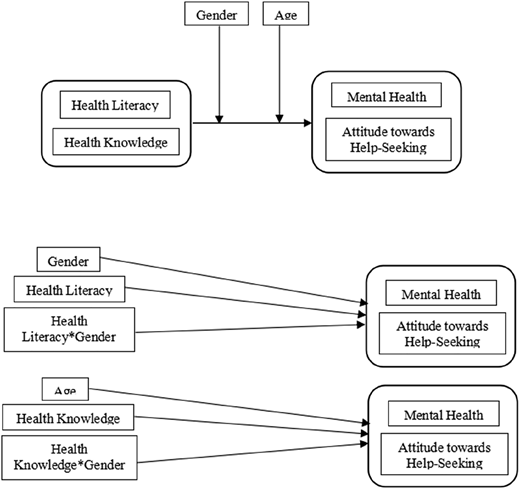
Hayes model 2 moderation analysis. Notes: Where: Health literacy and health knowledge: independent variables; gender and age: moderator variables; mental health and attitude to help-seeking: dependent variables. Source: Authors’ own work
Hayes model 2 moderation analysis. Notes: Where: Health literacy and health knowledge: independent variables; gender and age: moderator variables; mental health and attitude to help-seeking: dependent variables. Source: Authors’ own work
Hypotheses
Gender will significantly moderate the interaction between health literacy and
- (a).
Mental health of undergraduates in Nigerian public universities.
- (b).
Attitude to help-seeking of undergraduates in Nigerian public universities.
Gender will significantly moderate the interaction between health knowledge and
- (a).
Mental health of undergraduates in Nigerian public universities.
- (b).
Attitude to help-seeking of undergraduates in Nigerian public universities.
Age will significantly moderate the interaction between health literacy and
- (a).
Mental health of undergraduates in Nigerian public universities.
- (b).
Attitude to help-seeking of undergraduates in Nigerian public universities.
Age will significantly moderate the interaction between health knowledge and
- (a).
Mental health of undergraduates in Nigerian public universities.
- (b).
Attitude to help-seeking of undergraduates in Nigerian public universities.
Methodology
Research design
The study adopted the non-experimental design of the correlational research type.
Population, sampling techniques and sample
The population of the study comprised undergraduates in public universities (Federal University of Oye-Ekiti, Ekiti State University and Bamidele Olumilua University of Education, Science, and Technology) in Ekiti State, Nigeria. A purposive sampling technique was used to select universities in Ekiti State that were government-owned based on similar faculties (Campbell et al., 2020; Nyimbil and Nyimbili, 2024). A simple random sampling technique was used to select six hundred and one (601) undergraduates (353 in FUOYE and 248 in BUESTI) across various faculties and departments in each university who voluntarily clicked on the informed consent tick box in the online Google Form. Data were cropped with an Excel sheet and transferred into the SPSS sheet for further analysis. Table 1 shows the demographic information of undergraduates as sampled. The table reveals that FUOYE 353 (58.7) has the highest number of sampled respondents; the Faculty of Arts has the highest number of sampled respondents 464 (77.2); on gender distribution, males 313 (52.1) had the highest frequency compared to females 288 (47.9). On the age of the respondents, the highest age range was within 20–24 years while the lowest was above 30 years.
Demographic information
| S/N | Demographics | Frequency | Percent |
|---|---|---|---|
| University | |||
| 1 | BUESTI | 248 | 41.3 |
| 2 | FUOYE | 353 | 58.7 |
| Faculty | |||
| 3 | Agriculture | 67 | 11.1 |
| 4 | Arts | 464 | 77.2 |
| 5 | Education | 16 | 2.7 |
| 6 | Engineering | 37 | 6.2 |
| 7 | Law | 17 | 2.8 |
| Gender | |||
| 8 | Male | 313 | 52.1 |
| 9 | Female | 288 | 47.9 |
| Age | |||
| 10 | 15–19 | 102 | 17.0 |
| 11 | 20–24 | 443 | 73.7 |
| 12 | 25–29 | 43 | 7.2 |
| 13 | Above 30 | 13 | 2.2 |
| Mean age | 20 years | ||
Source(s): Authors’ own work
Measures
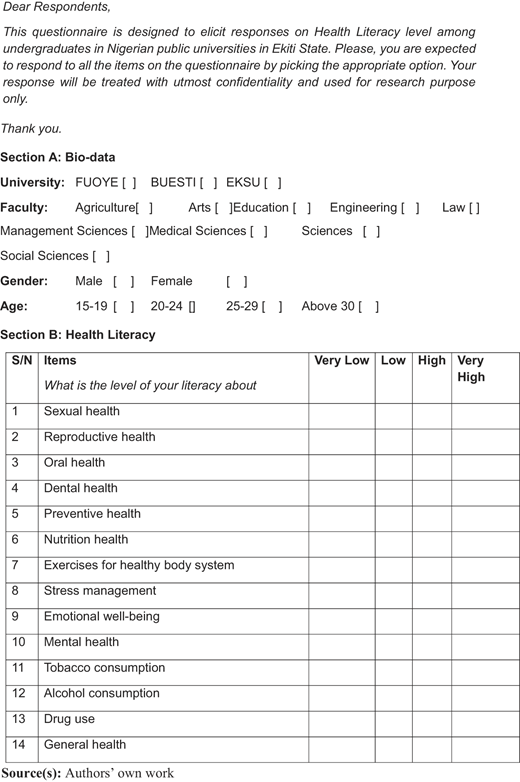
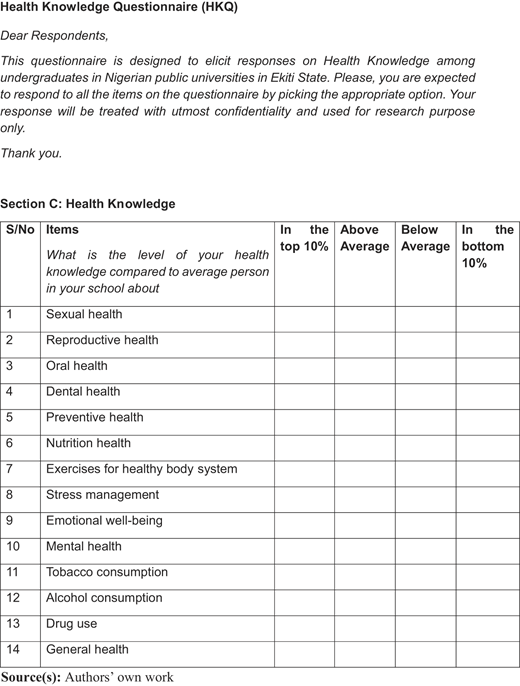
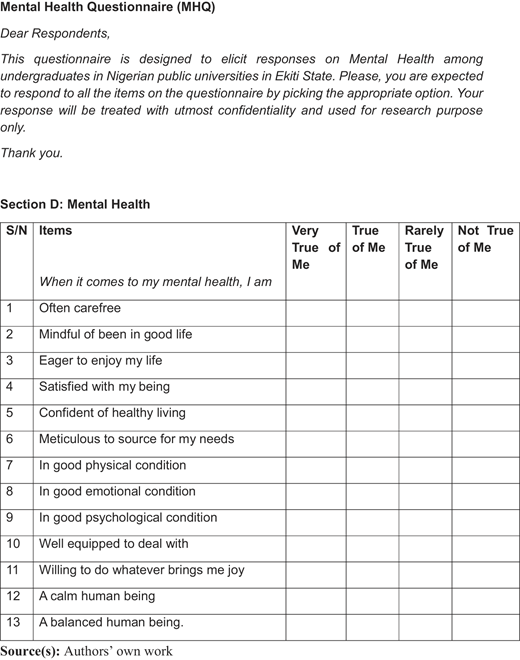
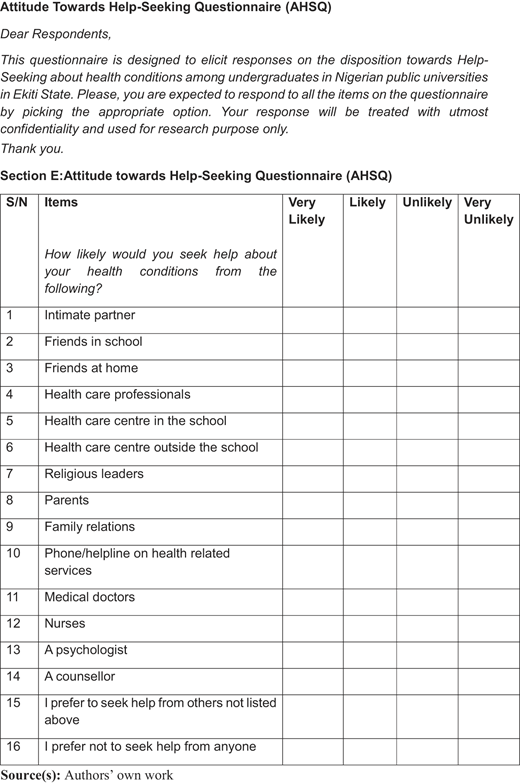
The instruments used for this study’s data collection were Health Literacy Questionnaire (HLQ), Health Knowledge Questionnaire (HKQ), Mental Health Questionnaire (MHQ) and Attitude towards Help-Seeking Questionnaire (AHSQ) which were in Annexure Sections B to E while Annexure Section A elicited information on respondents' demographic characteristics such as University, Faculty, Gender, and Age. The HLQ (see the final version in annex Section B) was adapted from the work of Onwe and Okocha (2019) which had nine items on a 5-Likert scale of Very Low, Low, Moderate, High, and Very High with Test-retest reliability of 0.81 and internal consistency of 0.93. See the Annexure for further information about the instruments.
The HLQ for this study was modified (during the pilot survey, few respondents claimed that they could not understand some of the items/terms used in the items, in the original version. We modified these items to suit the contextual language of expression) to measure the health literacy level of undergraduates with fourteen (14) items on a 4-Likert scale format of Very low (scored as 1), Low (scored as 2), High (scored as 3) and Very High (scored as 4). The HKQ (see the final version in annex Section C) was adapted from the work of Onwe and Okocha (2019) which had nine items on a 5-Likert scale of Very Low, Low, Moderate, High and Very High with psychometric properties of the scale as stated above. The HKQ for this study was modified to measure the health knowledge level of undergraduates with fourteen (14) items on a 4-Likert scale format of Bottom 10% (scored as 1), Below Average (scored as 2), Above Average (scored as 3) and Top 10% (scored as 4). The MHQ (see the final version in annex Section D) was adapted from the work of Lukat et al. (2016) which had nine items on a 4-Likert scale of Very True of Me, True of Me, Rarely True of Me, and Not True of Me. The MHQ for this study was modified to measure the mental health status of undergraduates with thirteen (13) items on a 4-Likert scale format of Not True of Me (scored as 1), Rarely True of Me (scored as 2), True of Me (scored as 3) and Very True of Me (scored as 4).
The AHSQ (see the final version in annex Section E) was adapted from the work of Wilson et al. (2007) which had twelve items on a 5-Likert scale of Very Unlikely to Very Likely with a Cronbach alpha of 0.83. The AHSQ for this study was modified to measure the level of disposition of undergraduates toward help-seeking, with sixteen (16) items on a 4-Likert scale format of Very Unlikely (scored as 1), Unlikely (scored as 2), Likely (scored as 3) and Very Likely (scored as 4). Permission has been obtained for the use/adaptation of these scales via email correspondence.
Our reason for adapting these scales was borne out of the need to make the scales as well as their wordings and contents easily understood by the study’s sample. The content validity of the instruments was ascertained by experts in item development and Test and Measurement Evaluation (TME) in one of the universities while the internal consistency of the instruments was established using Ordinal Alpha reliability estimate in R software due to the ordinal nature of the instruments. These yielded Health Literacy Questionnaire (r = 0.87), Health Knowledge Questionnaire (r = 0.94), Mental Health Questionnaire (r = 0.91) and Attitude towards Help-Seeking Questionnaire (r = 0.84).
Procedure for data collection
Ethical clearance for this study was obtained from the office of the Dean of the Faculty of Education of the sampled universities, and approval was granted (FUOYE/FED/11/2023). The instruments were designed and hosted on an online application (Google Forms). Informed consent of the sampled undergraduates and the purpose of the study was requested through the various undergraduates’ communication group platforms (Telegram, WhatsApp, and Google Classrooms). Also, an option for voluntary participation was created on the Google link form to either accept to participate and proceed on the online survey or not. The option to withdraw or not to participate was repeated twice and emboldened for further emphasis. Respondents were encouraged after lectures to fill out the questionnaires to increase the response rate. The contact details of the researchers were made available on the form for respondents who needed more clarification to questions while filling out the questionnaires. Data collection lasted for four months (March to June 2023).
Method of data analysis
The analysis of the data was done using the Hayes macro process in SPSS version 26.0 due to its specialised approach of dealing with both continuous, ordinal, and categorical data in establishing interaction effects. Descriptive statistics were used to summarise the characteristics of the respondents, while inferential statistics (Hayes macro process V4.0, Model 5) was used to test the hypotheses at 0.05% significance level.
Results
Ho1: Gender will significantly moderate the interaction between health literacy and
- (a)
Mental health of undergraduates in Nigerian public universities.
- (b)
Attitude to help-seeking of undergraduates in Nigerian public universities.
- (a)
- (a)
Gender will significantly moderate the interaction between health literacy and mental health of undergraduates in Nigerian public universities.
Table 2 presents the result on the direct impact of health literacy and gender on mental health of undergraduates in public universities in Ekiti State. The result in the Table reveals that health literacy (b = 0.35; t = 3.58; p < 0.00) and gender (b = 4.47; t = 2.49; p < 0.05) have a positive significant impact on mental health. The result in Table 2 also presents the moderating (interaction) impact of gender on the relationship between health literacy and mental health of undergraduates in public universities in Ekiti State. The result reveals a negative significant moderating impact (b = −0.15; t = −2.15; p < 0.05). Thus, the result further shows that the overall moderation (model summary) of gender on the relationship between health literacy and mental health is positive and significant (R = 0.21; F = 9.48; p < 0.05). More so, the test of unconditional interaction (gender) accounted for a significant change in the relationship between health literacy and mental health among undergraduates (R-chng = 0.01; p < 0.05). Thus, the conditional effect shows a positive significant moderating impact of gender in favour of male on the relationship between health literacy and mental health (b = 0.19; t = 5.11; p < 0.05). Hence, the hypothesis (Ho1a) is supported. This implies that gender moderates the relationship between health literacy and mental health of undergraduates in public universities in Ekiti State. This significant interaction is depicted in Figure 2.
- (b)
Gender will significantly moderate the interaction between health literacy and Attitude to help-seeking of undergraduates in Nigerian public universities.
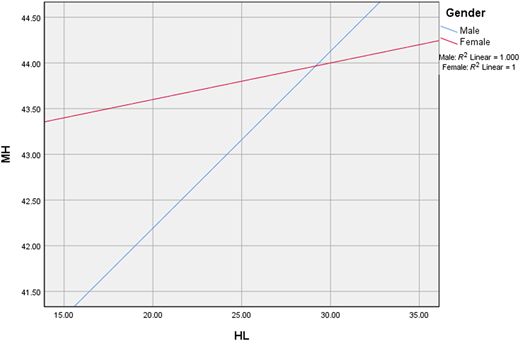
Interaction effect of gender on health literacy and mental health. Source: Authors’ own work
Interaction effect of gender on health literacy and mental health. Source: Authors’ own work
Impact of gender on the relationship between health literacy and mental health
| Model summary | ||||||
|---|---|---|---|---|---|---|
| R | R-sq | MSE | F | df1 | df2 | p |
| 0.21 | 0.05 | 29.66 | 9.48 | 3.00 | 597.00 | 0.00 |
| Model | ||||||
|---|---|---|---|---|---|---|
| Coeff | Se | T | p | LLCI | ULCI | |
| Constant | 33.86 | 2.46 | 13.79 | 0.00 | 29.04 | 38.68 |
| HL | 0.35 | 0.10 | 3.58 | 0.00 | 0.16 | 0.54 |
| Gender | 4.47 | 1.80 | 2.49 | 0.01 | 0.94 | 8.00 |
| Int_1 | −0.15 | 0.07 | −2.15 | 0.03 | −0.29 | −0.01 |
| Test(s) of highest order unconditional interaction(s) | |||||
|---|---|---|---|---|---|
| R2-chng | F | df1 | df2 | p | |
| HL*gender | 0.01 | 4.64 | 1.00 | 597.00 | 0.03 |
| Conditional effects of the focal predictor at values of the moderator(s) | ||||||
|---|---|---|---|---|---|---|
| Gender | Effect | Se | T | p | LLCI | ULCI |
| Male | 0.19 | 0.04 | 5.11 | 0.00 | 0.12 | 0.27 |
| Female | 0.04 | 0.06 | 0.67 | 0.50 | −0.08 | 0.16 |
Note(s): Dependent: Mental Health; Int_1: Health Literacy*Gender
Source(s): Authors’ own work
Table 3 presents the result on the direct impact of health literacy and gender on attitude to help seeking of undergraduates in public universities in Ekiti State. The result in the Table reveals that health literacy (b = 0.41; t = 3.05; p < 0.05) and gender (b = 6.36; t = 2.52; p < 0.05) has a significant impact on attitude to help seeking of undergraduates in public universities in Ekiti State. The results in Table 3 also presents the moderating (interaction) impact of gender on the relationship between health literacy and attitude to help seeking of undergraduates in public universities in Ekiti State. The result reveals a negative significant moderating impact (b = −0.19; t = −1.94, p = 0.05). Thus, the result shows that the overall moderation (model summary) of gender on the relationship between health literacy and attitude to help-seeking is positive and significant (R = 0.19; F = 7.54; p < 0.05). Furthermore, the test of unconditional interaction (gender) accounted for a significant change in the relationship between health literacy and attitude to help seeking among undergraduates (R-chng = 0.01; F = 3.75; p = 0.05). Thus, the conditional effect shows a positive significant moderating impact of gender in favour of male on the relationship between health literacy and mental health (b = 0.22; t = 4.16, p < 0.05). Hence, the hypothesis (Ho1b) is supported. This implies that gender moderates the relationship between health literacy and attitude to help seeking of undergraduates in public universities in Ekiti State. This significant interaction is depicted in Figure 3.
Ho2: Gender will significantly moderate the interaction between health knowledge and
- (a)
Mental health of undergraduates in Nigerian public universities.
- (b)
Attitude to help-seeking of undergraduates in Nigerian public universities.
- (a)
- (a)
Gender will significantly moderate the interaction between health knowledge and mental health of undergraduates in Nigerian public universities.
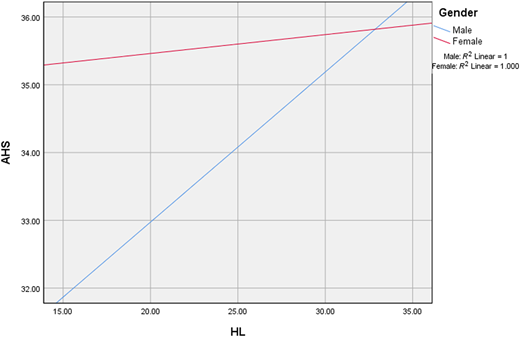
Interaction effect of gender on health literacy and attitude to help seeking. Source: Authors’ own work
Interaction effect of gender on health literacy and attitude to help seeking. Source: Authors’ own work
Impact of gender on the relationship between health literacy and attitude to help seeking
| Model summary | ||||||
|---|---|---|---|---|---|---|
| R | R-sq | MSE | F | df1 | df2 | p |
| 0.19 | 0.04 | 58.64 | 7.54 | 3.00 | 597.00 | 0.00 |
| Model | ||||||
|---|---|---|---|---|---|---|
| Coeff | Se | T | p | LLCI | ULCI | |
| Constant | 22.19 | 3.45 | 6.43 | 0.00 | 15.41 | 28.97 |
| HL | 0.41 | 0.14 | 3.05 | 0.00 | 0.15 | 0.68 |
| Gender | 6.36 | 2.52 | 2.52 | 0.01 | 1.40 | 11.32 |
| Int_1 | −0.19 | 0.10 | −1.94 | 0.05 | −0.39 | 0.00 |
| Test(s) of highest order unconditional interaction(s) | |||||
|---|---|---|---|---|---|
| R2-chng | F | df1 | df2 | p | |
| HL*gender | 0.01 | 3.75 | 1.00 | 597.00 | 0.05 |
| Conditional effects of the focal predictor at values of the moderator(s) | ||||||
|---|---|---|---|---|---|---|
| Gender | Effect | Se | T | p | LLCI | ULCI |
| Male | 0.22 | 0.05 | 4.16 | 0.00 | 0.12 | 0.33 |
| Female | 0.03 | 0.08 | 0.33 | 0.74 | −0.14 | 0.19 |
Note(s): Dependent: Attitude towards Help Seeking; Int_1: Health Literacy*Gender
Source(s): Authors’ own work
Table 4 presents the result on the direct impact of health knowledge and gender on mental health of undergraduates in public universities in Ekiti State. The result in the Table reveals that health knowledge has positive (b = 0.10; t = 1.65; p > 0.05) and gender has negative (b = −0.01; t = −0.01; p > 0.05) insignificant impact on mental health of undergraduates in public universities in Ekiti State. The results in Table 4 also presents the moderating (interaction) impact of gender on the relationship between health knowledge and mental health of undergraduates in public universities in Ekiti State. The result reveals a positive insignificant moderating impact (b = 0.02; t = 0.38; p > 0.05). However, the result shows that the overall moderation (model summary) of gender on the relationship between health knowledge and mental health is positive and significant (R = 0.25; F = 12.82; p < 0.05). Furthermore, the test of unconditional interaction (gender) did not account for significant change in the relationship between health knowledge and mental health among undergraduates (R-chng = 0.00; F = 0.14; p > 0.05). Hence, the hypothesis (Ho2a) was rejected. This implies that gender does not moderate the relationship between health knowledge and mental health of undergraduates in public universities in Ekiti State. The non-significant interaction is depicted in Figure 4.
- (b)
Gender will significantly moderate the interaction between health knowledge and attitude to help seeking of undergraduates in Nigerian public universities.
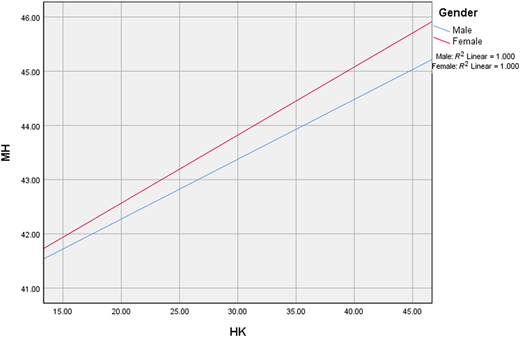
Interaction effect of gender on health knowledge and mental health. Source: Authors’ own work
Interaction effect of gender on health knowledge and mental health. Source: Authors’ own work
Impact of gender on the relationship between health knowledge and mental health
| Model summary | ||||||
|---|---|---|---|---|---|---|
| R | R-sq | MSE | F | df1 | df2 | p |
| 0.25 | 0.06 | 29.20 | 12.82 | 3.00 | 597.00 | 0.00 |
| Model | ||||||
|---|---|---|---|---|---|---|
| Coeff | Se | T | p | LLCI | ULCI | |
| Constant | 40.08 | 1.75 | 22.93 | 0.00 | 36.64 | 43.51 |
| HK | 0.10 | 0.06 | 1.65 | 0.10 | −0.02 | 0.21 |
| Gender | −0.01 | 1.26 | −0.01 | 0.99 | −2.48 | 2.46 |
| Int_1 | 0.02 | 0.04 | 0.38 | 0.71 | −0.06 | 0.09 |
| Test(s) of highest order unconditional interaction(s) | |||||
|---|---|---|---|---|---|
| R2-chng | F | df1 | df2 | p | |
| HK*gender | 0.00 | 0.14 | 1.00 | 597.00 | 0.71 |
Note(s): Dependent: Mental Health; Int_1: Health Knowledge*Gender
Source(s): Authors’ own work
Table 5 presents the result on the direct impact of health knowledge and gender on attitude to help-seeking of undergraduates in public universities in Ekiti State. The result in the Table reveals that health knowledge (b = 0.12; t = 1.43; p > 0.05) and gender (b = 1.58; t = 0.88; p > 0.05) has a positive insignificant impact on attitude to help-seeking of undergraduates in public universities in Ekiti State. The results in Table 5 also presents the moderating (interaction) impact of gender on the relationship between health knowledge and attitude to help-seeking of undergraduates in public universities in Ekiti State. The result reveals a negative insignificant moderating impact (b = −0.01; t = −0.14; p > 0.05). However, the result shows that the overall moderation (model summary) of gender on the relationship between health knowledge and attitude to help-seeking is positive and significant (R = 0.18; F = 6.80; p < 0.05). Furthermore, the test of unconditional interaction (gender) did not account for significant change in the relationship between health knowledge and attitude to help-seeking among undergraduates (R-chng = 0.00; F = 0.02; p > 0.05). Hence, the hypothesis (Ho2b) was rejected. This implies that gender does not moderate the relationship between health knowledge and attitude to help-seeking of undergraduates in public universities in Ekiti State. The non-significant interaction is depicted in Figure 5.
Ho3: Age will significantly moderate the interaction between health literacy and
- (a)
Mental health of undergraduates in Nigerian public universities.
- (b)
Attitude to help-seeking of undergraduates in Nigerian public universities.
- (a)
- (a)
Age will significantly moderate the interaction between health literacy and mental health of undergraduates in Nigerian public universities.
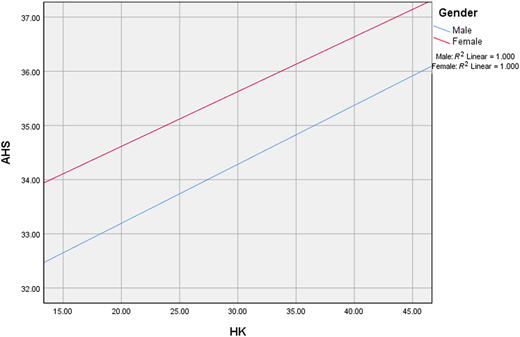
Interaction effect of gender on health knowledge and attitude towards help seeking. Source: Authors’ own work
Interaction effect of gender on health knowledge and attitude towards help seeking. Source: Authors’ own work
Impact of gender on the relationship between health knowledge and attitude to help seeking
| Model summary | ||||||
|---|---|---|---|---|---|---|
| R | R-sq | MSE | F | df1 | df2 | p |
| 0.18 | 0.03 | 58.85 | 6.80 | 3.00 | 597.00 | 0.00 |
| Model | ||||||
|---|---|---|---|---|---|---|
| Coeff | Se | T | p | LLCI | ULCI | |
| Constant | 29.43 | 2.48 | 11.86 | 0 | 24.56 | 34.31 |
| HK | 0.12 | 0.08 | 1.43 | 0.15 | −0.04 | 0.28 |
| Gender | 1.58 | 1.79 | 0.88 | 0.38 | −1.93 | 5.09 |
| Int_1 | −0.01 | 0.06 | −0.14 | 0.89 | −0.12 | 0.1 |
| Test(s) of highest order unconditional interaction(s) | |||||
|---|---|---|---|---|---|
| R2-chng | F | df1 | df2 | p | |
| HK*gender | 0.00 | 0.02 | 1.00 | 597.00 | 0.89 |
Note(s): Dependent: Attitude to Helping Seeking; Int_1: Health Knowledge*Gender
Source(s): Authors’ own work
Table 6 presents the result on the direct impact of health literacy and age on mental health of undergraduates in public universities in Ekiti State. The result in the Table reveals that health literacy (b = 0.00; t = 0.06; p > 0.05), age group 15–19 (b = −3.97; t = −1.85; p > 0.05), age group 20–24 (b = −5.97; t = −1.33, p > 0.05) and age group 25–29 (b = −2.62; t = −0.53; p > 0.05) has insignificant impact on mental health of undergraduates in public universities in Ekiti State. The result in Table 6 also presents the moderating (interaction) impact of age on the relationship between health literacy and mental health of undergraduates in public universities in Ekiti State. The result reveals that only age group 15–19 has a positive significant moderating impact of on the relationship between health literacy and mental health (b = 0.18; t = 2.10; p < 0.05). Although, the overall moderation (model summary) of age on the relationship between health literacy and mental health is positive and significant (R = 0.22; F = 4.28; p < 0.05). Furthermore, the test of unconditional interactions shows that change in the interaction between health literacy and age groups (health literacy*age) is not significant (R-chng = 0.01; p > 0.05). Hence, the hypothesis (Ho3a) was rejected. This implies that age does not moderate the relationship between health literacy and mental health of undergraduates in public universities in Ekiti State. The non-significant interactions is shown in Figure 6.
- (b)
Age will significantly moderate the interaction between health literacy and attitude towards help-seeking of undergraduates in Nigerian public universities.
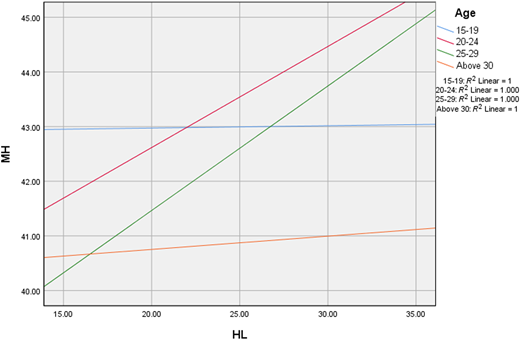
Interaction effects of age on health literacy and mental health. Source: Authors’ own work
Interaction effects of age on health literacy and mental health. Source: Authors’ own work
Impact of age on the relationship between health literacy and mental health
| Model summary | ||||||
|---|---|---|---|---|---|---|
| R | R-sq | MSE | F | df1 | df2 | p |
| 0.22 | 0.05 | 29.78 | 4.28 | 7.00 | 593.00 | 0.00 |
| Model | ||||||
|---|---|---|---|---|---|---|
| Coeff | Se | t | p | LLCI | ULCI | |
| Constant | 42.88 | 1.93 | 22.22 | 0.00 | 39.09 | 46.66 |
| HL | 0.00 | 0.08 | 0.06 | 0.95 | −0.15 | 0.16 |
| 15–19 | −3.97 | 2.15 | −1.85 | 0.07 | −8.19 | 0.26 |
| 20–24 | −5.97 | 4.48 | −1.33 | 0.18 | −14.78 | 2.83 |
| 25–29 | −2.62 | 4.94 | −0.53 | 0.60 | −12.33 | 7.09 |
| Int_1 | 0.18 | 0.09 | 2.10 | 0.04 | 0.01 | 0.35 |
| Int_2 | 0.22 | 0.16 | 1.38 | 0.17 | −0.09 | 0.54 |
| Int_3 | 0.02 | 0.20 | 0.10 | 0.92 | −0.36 | 0.40 |
| Test(s) of highest order unconditional interaction(s) | |||||
|---|---|---|---|---|---|
| R2-chng | F | df1 | df2 | p | |
| HL*age | 0.01 | 1.73 | 3.00 | 593.00 | 0.16 |
Note(s): Int_1: Health Literacy*15–19; Int_2: Health Literacy*20–24; Int_3: Health Literacy*25–30
Dependent: Mental Health
Source(s): Authors’ own work
Table 7 presents the result on the direct impact of health literacy and age on attitude to help-seeking of undergraduates in public universities in Ekiti State. The result in the Table reveals that health literacy (b = 0.20; t = 1.84; p > 0.05) and age group 15–19 (b = 1.99; t = 0.67; p > 0.05) has a positive insignificant impact on attitude to help-seeking while age group 20–24 (b = −5.64; t = −0.91; p > 0.05) and age group 25–29 (b = −12.55; t = −1.83; p > 0.05) has negative insignificant impact on attitude to help-seeking of undergraduates in public universities in Ekiti State. The result in Table 7 also presents the moderating (interaction) impact of age on the relationship between health literacy and attitude to help-seeking of undergraduates in public universities in Ekiti State. The result reveals that age group 25–29 (b = 0.52; t = 1.94; p = 0.05) has a positive significant moderating impact on the relationship between health literacy and attitude to help-seeking. Thus, the overall moderation (model summary) of age on the relationship between health literacy and attitude to help-seeking is positive and significant (R = 0.26; F = 6.25; p < 0.05). Furthermore, the test of unconditional interactions shows that the interaction between health literacy and age groups (health literacy*age) accounted for a significant change (R-chng = 0.02; p > 0.05). Thus, there is a positive significant moderating impact in favour of age groups 25–29 (b = 0.54; t = 2.74; p < 0.05) and above 30 years (b = 0.72; t = 2.91; p < 0.05) on the relationship between health literacy and attitude to help-seeking. Hence, the hypothesis (Ho3b) is supported. This implies that age moderate the relationship between health literacy and attitude to help-seeking of undergraduates in public universities in Ekiti State. The significant interactions is shown in Figure 7.
Ho4: Age will significantly moderate the interaction between health knowledge and
- (a)
Mental health of undergraduates in Nigerian public universities.
- (b)
Attitude to help-seeking of undergraduates in Nigerian public universities.
- (a)
- (a)
Age will significantly moderate the interaction between health knowledge and mental health of undergraduates in Nigerian public universities.
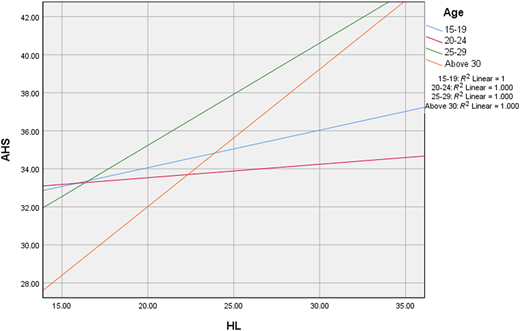
Interaction effect of age on health literacy and attitude towards help-seeking. Source: Authors’ own work
Interaction effect of age on health literacy and attitude towards help-seeking. Source: Authors’ own work
Impact of age on the relationship between health literacy and attitude towards help-seeking
| Model summary | ||||||
|---|---|---|---|---|---|---|
| R | R-sq | MSE | F | df1 | df2 | p |
| 0.26 | 0.07 | 57.06 | 6.25 | 7.00 | 593.00 | 0.00 |
| Model | ||||||
|---|---|---|---|---|---|---|
| Coeff | Se | t | P | LLCI | ULCI | |
| Constant | 30.12 | 2.67 | 11.28 | 0.00 | 24.87 | 35.36 |
| HL | 0.20 | 0.11 | 1.84 | 0.07 | −0.01 | 0.41 |
| 15–19 | 1.99 | 2.98 | 0.67 | 0.50 | −3.86 | 7.83 |
| 20–24 | −5.64 | 6.21 | −0.91 | 0.36 | −17.83 | 6.55 |
| 25–29 | −12.55 | 6.84 | −1.83 | 0.07 | −25.98 | 0.89 |
| Int_1 | −0.13 | 0.12 | −1.06 | 0.29 | −0.36 | 0.11 |
| Int_2 | 0.34 | 0.22 | 1.52 | 0.13 | −0.10 | 0.78 |
| Int_3 | 0.52 | 0.27 | 1.94 | 0.05 | −0.01 | 1.06 |
| Test(s) of highest order unconditional interaction(s) | |||||
|---|---|---|---|---|---|
| R2-chng | F | df1 | df2 | p | |
| HL*age | 0.02 | 3.88 | 3.00 | 593.00 | 0.01 |
| Conditional effects of the focal predictor at values of the moderator(s) | ||||||
|---|---|---|---|---|---|---|
| Age | Effect | Se | t | p | LLCI | ULCI |
| 15–19 | 0.20 | 0.11 | 1.84 | 0.07 | −0.01 | 0.41 |
| 20–24 | 0.07 | 0.05 | 1.37 | 0.17 | −0.03 | 0.17 |
| 25–29 | 0.54 | 0.20 | 2.74 | 0.01 | 0.15 | 0.92 |
| Above 30 | 0.72 | 0.25 | 2.91 | 0.00 | 0.23 | 1.21 |
Note(s): Int_1: Health Literacy*15–19; Int_2: Health Literacy*Age_20–24; Int_3: Health Literacy*Age_25–29
Dependent: Attitude towards help-seeking
Source(s): Authors’ own work
Table 8 presents the result on the direct impact of health knowledge and age on mental health of undergraduates in public universities in Ekiti State. The result in the Table reveals that health knowledge (b = −0.03; t = −0.58; p > 0.05), age group 20–24 (b = −1.26; t = −0.45; p > 0.05) and age group 25–29 (b = −5.15; t = −1.09; p > 0.05) has negative insignificant impact while age group 15–19 (b = −4.61; t = −2.86; p < 0.05) has a negative significant impact on mental health of undergraduates in public universities in Ekiti State. The result in Table 8 also presents the moderating (interaction) impact of age on the relationship between health knowledge and mental health of undergraduates in public universities in Ekiti State. The result reveals that age group 15–19 (b = 0.18; t = 3.04; p < 0.05) has a positive significant moderating impact on the relationship between health knowledge and mental health. Thus, the overall moderation (model summary) of age on the relationship between health knowledge and mental health is positive and significant (R = 0.28; F = 7.32; p < 0.05). Furthermore, the test of unconditional interactions shows that the interaction between health knowledge and age groups (health knowledge*age) accounted for a significant change (R-chng = 0.02; p > 0.05). Thus, there is a positive significant moderating impact in favour of age group 15–19 (b = 0.15; t = 6.88; p < 0.05) on the relationship between health knowledge and mental health. Hence, the hypothesis (Ho4a) is supported. This implies that age moderate the relationship between health knowledge and mental health of undergraduates in public universities in Ekiti State. The significant interactions is shown in Figure 8.
- (b)
Age will significantly moderate the interaction between health knowledge and attitude to help-seeking of undergraduates in Nigerian public universities.
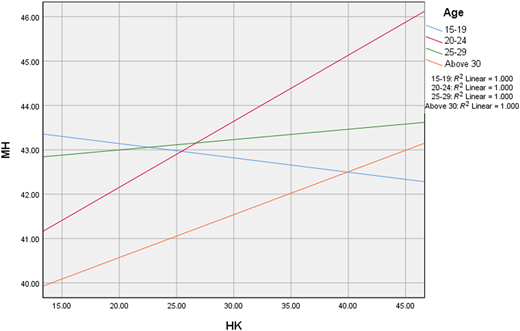
Interaction effect of age on health knowledge and mental health. Source: Authors’ own work
Interaction effect of age on health knowledge and mental health. Source: Authors’ own work
Impact of age on the relationship between health knowledge and mental health
| Model summary | ||||||
|---|---|---|---|---|---|---|
| R | R-sq | MSE | F | df1 | df2 | p |
| 0.28 | 0.08 | 28.8 | 7.32 | 7.00 | 593.00 | 0.00 |
| Model | ||||||
|---|---|---|---|---|---|---|
| Coeff | Se | t | p | LLCI | ULCI | |
| Constant | 43.79 | 1.47 | 29.79 | 0.00 | 40.9 | 46.67 |
| HK | −0.03 | 0.06 | −0.58 | 0.56 | −0.14 | 0.08 |
| 15–19 | −4.61 | 1.61 | −2.86 | 0.00 | −7.78 | −1.44 |
| 20–24 | −1.26 | 2.81 | −0.45 | 0.65 | −6.79 | 4.26 |
| 25–29 | −5.15 | 4.71 | −1.09 | 0.27 | −14.39 | 4.09 |
| Int_1 | 0.18 | 0.06 | 3.04 | 0.00 | 0.06 | 0.30 |
| Int_2 | 0.06 | 0.09 | 0.62 | 0.53 | −0.12 | 0.23 |
| Int_3 | 0.13 | 0.19 | 0.67 | 0.50 | −0.25 | 0.51 |
| Test(s) of highest order unconditional interaction(s) | |||||
|---|---|---|---|---|---|
| R2-chng | F | df1 | df2 | p | |
| HK*age | 0.02 | 3.72 | 3.00 | 593.00 | 0.01 |
| Conditional effects of the focal predictor at values of the moderator(s) | ||||||
|---|---|---|---|---|---|---|
| Age | Effect | Se | t | p | LLCI | ULCI |
| 15–19 | 0.15 | 0.02 | 6.88 | 0.00 | 0.11 | 0.19 |
| 20–24 | −0.03 | 0.06 | −0.58 | 0.56 | −0.14 | 0.08 |
| 25–29 | 0.02 | 0.07 | 0.33 | 0.74 | −0.11 | 0.16 |
| Above 30 | 0.10 | 0.18 | 0.52 | 0.60 | −0.27 | 0.46 |
Note(s): Int_1: Health Knowledge*15–19; Int_2: Health Knowledge*20–24; Int_3: Health Knowledge*25–29
Dependent: Mental Health
Source(s): Authors’ own work
Table 9 presents the result on the direct impact of health knowledge and attitude towards help-seeking of undergraduates in public universities in Ekiti State. The result in the Table reveals that health knowledge (b = 0.01; t = 0.12; p > 0.05) and age group 25–29 (b = 3.16; t = 0.48; p > 0.05) has positive insignificant impact while age group 15–19 (b = −4.00; t = −1.76; p > 0.05) and age group 20–24 (b = −2.07; t = −0.52; p > 0.05) has negative insignificant impact on attitude to help-seeking of undergraduates in public universities in Ekiti State. The result in Table 6 also presents the moderating (interaction) impact of age on the relationship between health knowledge and attitude to help-seeking of undergraduates in public universities in Ekiti State. The result reveals that none of the age groups has significant moderating impact on the relationship between health knowledge and attitude to help-seeking. Although, the overall moderation (model summary) of age on the relationship between health knowledge and attitude to help-seeking is positive and significant (R = 0.26; F = 5.91; p < 0.05). Furthermore, the test of unconditional interactions shows that the interaction between health knowledge and age groups (health knowledge*age) accounted for an insignificant change (R-chng = 0.01; p > 0.05). Hence, the hypothesis (Ho4b) is rejected. This implies that age does not moderate the relationship between health knowledge and attitude to help-seeking of undergraduates in public universities in Ekiti State. The insignificant interactions is shown in Figure 9.
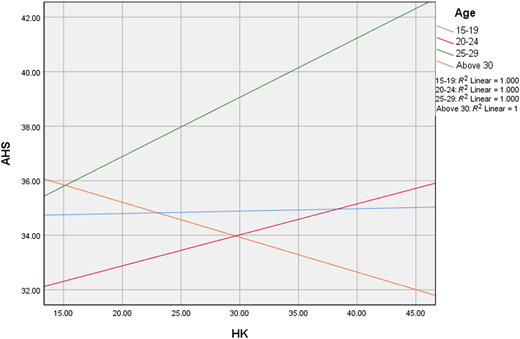
Interaction effect of age on health knowledge and attitude towards help-seeking. Source: Authors’ own work
Interaction effect of age on health knowledge and attitude towards help-seeking. Source: Authors’ own work
Impact of age on the relationship between health knowledge and attitude to help-seeking
| Model summary | ||||||
|---|---|---|---|---|---|---|
| R | R-sq | MSE | F | df1 | df2 | p |
| 0.26 | 0.07 | 57.27 | 5.91 | 7.00 | 593.00 | 0.00 |
| Model | ||||||
|---|---|---|---|---|---|---|
| Coeff | Se | t | p | LLCI | ULCI | |
| Constant | 34.61 | 2.07 | 16.7 | 0.00 | 30.54 | 38.68 |
| HK | 0.01 | 0.08 | 0.12 | 0.91 | −0.14 | 0.16 |
| 15–19 | −4.00 | 2.28 | −1.76 | 0.08 | −8.47 | 0.47 |
| 20–24 | −2.07 | 3.97 | −0.52 | 0.60 | −9.86 | 5.72 |
| 25–29 | 3.16 | 6.64 | 0.48 | 0.63 | −9.87 | 16.2 |
| Int_1 | 0.10 | 0.08 | 1.24 | 0.21 | −0.06 | 0.27 |
| Int_2 | 0.21 | 0.13 | 1.65 | 0.10 | −0.04 | 0.46 |
| Int_3 | −0.14 | 0.27 | −0.50 | 0.61 | −0.67 | 0.40 |
| Test(s) of highest order unconditional interaction(s) | |||||
|---|---|---|---|---|---|
| R2-chng | F | df1 | df2 | p | |
| HK*age | 0.01 | 1.22 | 3.00 | 593.00 | 0.30 |
Note(s): Int_1: Health Knowledge*15–19; Int_2: Health Knowledge*20–24; Int_3: Health Knowledge*25–29
Dependent: Attitude to Help-Seeking
Source(s): Authors’ own work
Discussion
The main crux of this research was to investigate the impact of health literacy and knowledge on undergraduates' mental health and attitude towards help-seeking with the moderating effect of gender and age. In line with the results of this study, a direct, positive, and significant relationship exists among undergraduates’ health literacy, health knowledge, mental health, and attitude toward help-seeking. This denotes that individuals with high health literacy are likely to have high health knowledge, which invariably results in their high mental health and attitudes toward help-seeking. This corroborates the findings of previous research that indicate a positive and significant association among these variables (Fleary et al., 2022; Haeri-Mehrizi et al., 2024; Ickes and Cottrell, 2010; Iswanto and Ayubi, 2023; Kim, 2024; Onwe and Okocha, 2019; Smith and Shochet, 2011; Solhi et al., 2024; White et al., 2016). Health literacy and gender from the foregoing of this study significantly impact undergraduates' mental health and attitude towards help-seeking. Health literate undergraduates, in this case, males are more prone to stable mental health and have positive attitudes toward help-seeking. We have wondered why this is so since it is expected that females should be more likely to experience health-related issues such as menstruation pains, toiletry infections, and the like (Girigoswami et al., 2024; Hennegan et al., 2019; Holst et al., 2022; Schoep et al., 2019).
As such, in this study’s context, the male undergraduates are more informed (literate), regarding mental health issues and have more positive attitudes toward seeking help. The finding supports those of Gorczynski et al. (2017), Ibrahim et al. (2019), Onwe and Okocha (2019), Metz (2023), Haeri-Mehrizi et al. (2024), and Miles et al. (2020), have reaffirmed the connection among individuals' health literacy, mental health and attitude towards help-seeking. Essentially, regarding gender (in favour of males) moderating the relationship between health literacy and mental health of undergraduates, the finding agrees with the findings of Kaneko and Motohashi (2007) and Laura et al. (2020) which proved a high correlation between masculine gender and mental health related concerns. Yet, the finding contrasts those of Sambah et al. (2023), Baklola et al. (2024), and Siby and Vijayan (2021) which had revealed a positive outcome in favour of the female gender. We think that this difference stems from the sample or context. The results are also in tandem with Song et al. (2022) that affirm the moderating role of gender on mental health literacy and health.
Findings reveal that health knowledge and gender have a nonsignificant impact on mental health and attitude towards help-seeking among undergraduates. We think that an individual’s knowledge of health could be passive or active overtime. If passive, such individual would likely not be mentally healthy or positively predisposed to help-seeking. This finding supports those of previous studies (Abd El Salam et al., 2023; Fleary et al., 2022; Lee et al., 2022; Samar and Perveen, 2021). The studies of Siby and Vijayan (2021) and Fleary et al. (2022) that reveal that individuals' health knowledge fosters mental health and attitudes towards help-seeking contradicts this study’s finding. More so, results show that gender does not moderate the relationship between health knowledge, mental health, and attitudes towards help-seeking among undergraduates. This contrasts the findings of Siby and Vijayan (2021), Topkaya (2021) and Chen et al. (2020), which indicate that gender moderated the relationship between health knowledge, mental health, and attitudes towards help-seeking in favour of the female gender.
Findings reveal that health literacy and age have a nonsignificant impact on mental health and attitude towards help-seeking of undergraduates, with age having no moderating effect. Nonetheless, ages above 25 years contributed high moderation effects. This agrees with previous studies that reported lower health literacy among older population (Huang et al., 2021; Panagioti et al., 2018; Ryser et al., 2023; Verney et al., 2019). However, regarding age and attitudes toward mental health and help-seeking, this finding is not consistent with those of Chen et al. (2020) and Baklola et al. (2024) that indicate a significant relationship between an individual’s age and their attitude towards asking for help, and Sambah et al. (2023) that reported that age has a significant moderation effect on health-related issues.
Implications of the study
It is implied by this study that university hospitals and clinics conduct thorough health literacy sensitisation programmes for the university community (especially undergraduates) on mental health and positive help-seeking attitudes. Educational psychologists, counsellors, lecturers, and other members of staff in universities need professional training and development on health literacy and promotion regarding students' mental health and attitudes toward help-seeking. Designers of the curriculum in universities should include health literacy and mental health courses/programmes into the curriculum (Fadiya, 2023; Lai et al., 2022; Miles et al., 2020), as this would boost undergraduates’ general health literacy status, mental health and attitudes toward help-seeking.
This study’s findings suggest that targeted interventions, regardless of the ages and gender of individuals, should guide the development of targeted educational programmes aimed at improving general health literacy, knowledge, and help-seeking attitudes. Effective strategies should integrate appropriate resources while recognising gender-specific barriers and facilitators in accessing healthcare services, especially in universities. The development of mental health literacy initiatives in Nigeria, including non-educational contexts, would be significantly impacted by these findings. Although the results are informative, it is important to acknowledge the limitations associated with the sampling and self-reporting methods. All things considered, the study is a critical first step towards a more knowledgeable and resilient strategy for improving young people’s health literacy and knowledge, as well as their mental health and help-seeking behaviour among undergraduate students in Nigeria, or young people in general. Future research could focus on this study’s concerns for younger learners, especially at early childhood levels as well as the effect of undergraduates' socioeconomic and family status such as poverty and disabilities on mental health and attitudes towards help seeking.
Conclusion and recommendations
Undergraduates' health literacy significantly impacts on their mental health and attitude towards help-seeking, with gender having a significant moderating effect. The health knowledge of undergraduates does not significantly impact on their mental health and attitude towards help-seeking with gender having no significant moderating effect. Conversely, the ages of undergraduates do not have a significant moderating effect on their health literacy, mental health and help-seeking attitudes.
The study, therefore, recommends that concerted efforts of governments, health and education stakeholders be concentrated on creating and promoting health literacy and knowledge, as well as mental health and positive help-seeking attitudes among undergraduates with special attention to gender equity, irrespective of their ages. The university curricula should be tailored more on health literacy and promotion, as these would foster undergraduates' mental health and positive attitudes toward help-seeking. Future research on this subject matter may thus explore the socioeconomic drivers of student behaviour in addition to the barriers preventing them from seeking assistance. Furthermore, comparable studies using bigger population samples, different research methodologies, or longitudinal designs may yield new insights.
Limitations
The study acknowledges its limitations. First, the results cannot necessarily be generalised because the sample may not accurately represent all undergraduate students in Ekiti State, Nigeria. A causal inference between the researched variables may also be misleading since the study was cross-sectional in design. Since only one time measurement was used to collect the data, causal relationships cannot be proven. As a result, the use of terminology like “interaction effect,” “main effect,” or “moderating effect” in statistical reporting does not imply a cause-and-effect association and should not be taken as such. Additionally, memory bias problems may have arisen because of the use of self-reported instruments. As a result, the study’s results should be evaluated with care. Despite these drawbacks, the study utilised validated instruments and offers intriguing data that highlight the crucial roles that gender, and age variations play, in shaping mental health and attitudes towards help-seeking based on individuals' literacy and knowledge of health.
References
Further reading
Annexure Health literacy questionnaire (HLQ)