This study aims to investigate the impact of work-integrated learning (WIL) on the workplace readiness of healthcare students by examining their work self-efficacy, WIL preparation, perceptions of WIL and their future work prospects. By exploring these factors through the lens of social cognitive career theory, this study seeks to provide a comprehensive understanding of how WIL can be optimised to better prepare students for the demands of their professional careers.
This study used a mixed-method survey design involving 103 undergraduate health science students who had completed placement-based WIL experiences. Quantitative measures assessed work self-efficacy, WIL preparation, perceptions of WIL and confidence in future employment, while open-ended-survey questions explored students' experiences, challenges and perceptions of placement-based WIL.
Based on 103 students' responses, findings suggest statistically significant positive associations between participants' perceived WIL preparation, work self-efficacy, perceptions of WIL and confidence in future employment. Self-efficacy was the significant predictor of perceived WIL preparation and the strongest contributor to positive perceptions of WIL. Whilst over 85% of students found WIL beneficial in understanding future work relevance and degree applicability, over a third of them raised concerns about a lack of psychological or emotional preparation for the WIL placement. Other challenges merged from qualitative responses included a perceived lack of support from supervisors, difficulty adjusting to workplace environments and substantial resource demands (financial and time-based) associated with balancing placement with other responsibilities.
The study findings are based on a single university survey with a relatively small sample size which may limit generalisability. Future research should investigate the long-term impact of WIL on employability and career progression, examine placement quality more explicitly and utilise interviews or longitudinal approaches to gain deeper insight into students' experiences.
Efforts to improve WIL practice outcomes should extend beyond placement allocation and competency attainment to include targeted financial, academic and psychosocial supports before, during and after placement experiences, as well as addressing the structural barriers associated with students’ WIL participation is essential to promoting equitable access, supporting student wellbeing, strengthening work readiness and facilitating successful transition into professional practice.
This study offers original value by examining the underexplored relationships among work self-efficacy, WIL preparation, workplace readiness and employment confidence within health professional education. The mixed-method findings highlight the importance of psychological preparation, supervisory support and reducing structural barriers to maximise the benefits of placement-based work-integrated learning for workforce readiness.
Introduction and literature review
In today's rapidly evolving health professional landscape, the integration of theoretical knowledge with practical application is paramount to preparing students for the workforce. Research has highlighted that Australian graduates often lack essential capabilities in self-management, communication and teamwork (Prikshat et al., 2020). Work-integrated learning (WIL) experiences that connect students to industries and work environments can help students become aware of the technical and transferable skills they acquire during their studies, as well as the professional skills required for complex and varied work environments (Schweinsberg et al., 2021). For example, Hamilton et al. (2018) reported that due to the lack of practical application of skills in undergraduate psychology degrees, students tend to feel incompetent and inundated with difficulty identifying possible careers, tasks and roles for which they are qualified. Whereas in other health science degrees such as nursing, employability skills such as clinical skills, communication and teamwork skills are often integrated into the curriculum and have been shown to increase nursing students' capability to work independently (Hamilton et al., 2018). These findings highlight the importance of connecting the learning experience and real-world application to support employability and professional readiness (Neall et al., 2022).
Internationally, WIL has become an increasingly important component of higher education, with growing attention to its various forms and to assessing its impact (McRae and Johnston, 2016), particularly within health professional education. Studies from North America, Europe and Asia consistently report that authentic workplace experiences can strengthen professional identity formation, workplace confidence and graduate employability (Pham and Jackson, 2020; David et al., 2020; Lasrado et al., 2024; Holden et al., 2015). However, international education research also highlights common WIL challenges in high education sector, including variability in placement quality, access to appropriate supervision, students' overall wellbeing during placements and balancing academic professional and financial demands (Lasrado et al., 2024; Patton, 2023; Konstantinou et al., 2023). There remains a need for better understand the factors that optimise student's outcome across different high educational and health care contexts.
WIL and workplace readiness
The WIL is a pivotal pedagogical approach that bridges skills gaps by embedding real-world experiences within the academic curriculum. Defined broadly, WIL encompasses various practice-based methods such as cooperative education, consultancy, simulation, clinical practice, work placements and projects (Berndtsson et al., 2020). This multi-faceted approach aims to enhance students' workplace readiness, equipping them with the necessary capabilities and skills to transition into their professional fields. Although WIL is consistently associated with improved employability and workplace readiness (Jackson and Dean, 2023; Hamilton et al., 2018), its effectiveness is difficult to evaluate systematically because WIL encompasses diverse pedagogical approaches, placement characteristics and discipline specific learning context. This variability complicates the comparability of findings across reported studies. Nevertheless, research demonstrates that both industry-based (placements or internships) or non-workplace (simulation or consultancy) WIL activities can effectively strengthen employability related capabilities (Jackson and Dean, 2023; Hamilton et al., 2018). As a result, the impacts of WIL are often measured through facets such as perceived workplace readiness, transferable skills and work self-efficacy, all of which contribute to students' success in gaining employment upon graduation (Luk and Chan, 2024; Brooks and Youngson, 2016).
Workplace readiness is characterised by the acquisition of a diverse skill set that enables students to proficiently perform professional tasks and duties specific to their fields (Schweinsberg et al., 2021; Rogers et al., 2021; Coorey and Firth, 2013). However, despite the theoretical framework indicating that WIL should enhance workplace readiness through increased self-efficacy, empirical research findings on the effectiveness of WIL in enhancing workplace readiness have been mixed (Dudley et al., 2020). Dudley et al. (2020) utilised a pre-post follow-up design and reported varied outcomes, attributing these inconsistencies to the subjective nature of students' WIL experiences. This highlights the non-standardised nature of WIL, such as clinical placement, and its varied impact on students' perceived readiness for the workforce.
A crucial component of workplace readiness is work self-efficacy, which refers to an individual's confidence in managing workplace experiences (Venville and Andrews, 2020). Venville and Andrews (2020) measured seven domains of work self-efficacy: learning, problem-solving, pressure, role expectations, teamwork, sensitivity and work politics. These domains suggested that WIL significantly enhances the level of self-efficacy across various healthcare disciplines, indicating a positive correlation between WIL participation and students' confidence in their professional capabilities. Adding to the argument, some researchers have suggested that improved work self-efficacy through WIL programs is a predictor of employment outcomes (Chesnut and Burley, 2015; García-Aracil et al., 2021). In addition to work self-efficacy, both transferable and technical skills play a vital role in workplace readiness. Transferrable skills, including self-management, communication and problem-solving are applicable and highly valued across most professional settings (Hilton and Pellegrino, 2012). Herbert et al. (2020) found that transferable skills and competencies are critical determinants of workplace readiness, further underscoring the importance of WIL in fostering these attributes. Nevertheless, the application of these skills does not occur independently of students' believes about their capabilities. Self-efficacy hence remains a key factor underpinning successful engagement in WIL, impacting students' willingness to embrace challenges, persist through difficulties during WIL and navigate the study to WIL transition.
Social cognitive career theory
The social cognitive career theory, which is grounded in Bandura's broader social cognitive theory, provides a useful framework for understanding how WIL influences students' outcomes. It proposes that learning experiences shape self-efficacy beliefs and career outcome expectations, which in turn influence career development and preparedness (Schaub, 2004). Within WIL contexts, students gain exposure to authentic workplace environments, professional role modelling and opportunities to observe and apply interdisciplinary and discipline knowledge, all of which may contribute to the development of workplace readiness. Accordingly, the theory offers theoretical explanation for how placement experiences influence students' confidence, employability and work-placement readiness.
Factors influencing WIL outcomes
Researchers have highlighted several key factors that can impact the quality and structure of the WIL experience for university students, e.g., the importance of consistency and collaboration between educational institutions and WIL settings regarding preparedness and readiness by students to undertake industry-based clinical placements (Leonardsen et al., 2021; González-García et al., 2021). This collaboration allows expectations regarding readiness and professional performance to be shared and clearly communicated. It is particularly important in clinical and health professional WIL, where the learning environment can substantially influence students' confidence, skill development and overall WIL outcomes. However, preparing students for WIL is not only a university responsibility, but shaped by a complex interaction of factors including individual students, educational structure and other institutional factors. For example, some studies have observed differences in students representing varied age groups and universities within WIL preparation, together with different perceptions of responsibility for placement preparation between supervisors, educational providers and the students themselves (Scammell et al., 2020; Ford et al., 2016; Smith et al., 2016). Other researchers have highlighted the impact of broader contextual factors on successful WIL outcomes including students' sense of belonging and support provided including, opportunities to practise and develop skills rather than being relegated to an observer role (Aprile and Knight, 2020; Ford et al., 2016; Martin et al., 2023). These findings suggest that successful WIL experiences depend not only on placement participation, but also on the broader learning and support environment in which WIL activities occur.
Research gap and study aim
The social cognitive career theory emphasises the dynamic process where personal factors interact with contextual and learning experiences to shape career interests, decisions and success (Schaub, 2004). Despite literature demonstrating the value of WIL for enhancing employability, workplace readiness and professional development, several important gaps remain as little is known about how WIL preparation, work self-efficacy, workplace readiness and employment confidence interact across health discipline. In response to these gaps, this study draws upon social cognitive theory to examine the impact of WIL on healthcare students' workplace readiness through their work self-efficacy and their perception of WIL on future work prospects, including employability and transition to the professional workforce. Although WIL encompasses a range of practice-based learning activities, the present study focuses specifically on placement-based WIL experiences undertaken within health professional programs. Specially, this study aims to identify factors associated with positive perceptions of WIL and workplace readiness and explore students’ experiences of barriers, challenges and supports encountered during WIL placement. By exploring these factors, we seek to provide a comprehensive understanding of how WIL can be optimised to better prepare students for the demands of their chosen careers.
Method
Participants
A mixed-method survey approach was used. Quantitative measures enabled test of the relationship between work self-efficacy, placement preparation, perceptions of WIL and confidence in future employment, while open-end questions in the survey provided additional insight into students’ experiences, challenges and perceptions. This approach was considered appropriate for exploring WIL experiences across multiple health disciplines within a large and diverse student cohort, as well as to maximise participation and facilitate the collection of comparable data across multiple disciplines. Undergraduate students from the School of Health and Biomedical Sciences at a large Australian university in Melbourne offering undergraduate and postgraduate programs in health and biomedical sciences were invited to complete a 15-min survey following approval from the University Human Research Ethics Committee. Implied written consent was used for this study as the appropriate choice given the risk of participation was low, and allowing implied consent was permitted by the Ethics Committee. Eligible students were undergraduate students enrolled in programs within the School of Health and Biomedical Sciences who had undertaken a WIL placement as part of their degree requirements. Students were recruited through invitations which were created and disseminated via the University's Learning Management System. For the purpose of this study, references to WIL relate to required clinical or industry placement experiences completed as part of participants' accredited degree programs. Participating programs included professionally accredited health disciplines in which WIL forms a mandatory component of curriculum and degree completion, for example, nursing, medical radiations, psychology, which are subject to national accreditation and professional standard requirements. WIL experiences are delivered through partnerships with healthcare providers and typically include a combination of academic oversight and workplace-based supervision. Students receive preparation prior to placement and ongoing support from both academic and industry supervisors throughout their WIL experiences.
Measures
Participants completed the survey that addressed demographics, the measures of students' perceived work self-efficacy, preparation for undertaking WIL, perceptions of WIL on employability and open-ended questions regarding their overall WIL experience. These measures were selected to address the study aims of explaining the relationship between workplace readiness, work self-efficacy, WIL preparation and perceptions of future employability.
Demographic information: Participants were requested to provide basic demographic information, and academic information, such as their gender, age, employment, degree, campus and previous WIL experience. Participant employment status refers to paid work undertaken independently of required WIL placement activities.
The work self-efficacy inventory (WSEI): The instrument (Raelin et al., 2011) was utilised to assess and provide insight into the participant's confidence regarding skill development, workplace activities and perceived capacity for the future workforce. The WSEI comprises 32 statements scored related to self-efficacy in an occupational setting on a one-to-five-point Likert scale with a response format ranging from one “not at all”, “a little”, “a moderate amount”, “a lot”, to five “completely”. The WSEI assesses seven subscale dimensions, including learning (four items), problem-solving (six items), pressure (four items), role expectations (four items), teamwork (four items), sensitivity (four items) and work politics (four items). The total score ranges from 30 to 150 with higher scores indicating greater work self-efficacy. A mean is compiled for each subscale and overall to evaluate work self-efficacy. The WSEI was determined to be a highly reliable measure with Cronbach alphas in the 0.80 range for both the subscale dimensions and overall scores (Venville and Andrews, 2020). Construct validity and internal consistency of the WSEI was supported in past (Raelin et al., 2011).
Confidence and readiness in future work prospects are assessed using two question items on a one-to-five-point Likert scale with a response format ranging from one “not at all confident”, “a little”, “a moderate amount”, “a lot”, to five “very confident”. Question one examines how confident students are ready to commence work in their discipline or field and question two examines how confident they are to be able to obtain work relevant to their studies.
Preparation for undertaking WIL: Participants rated their perceived preparedness and support received from educational institutions and WIL settings using a five-point Likert scale, ranging from strongly agree to strongly disagree.
Student perception of WIL: A list of seven questions adapted from previous study from Rayner and Papakonstantinou assessed students perceptions of WIL relevance, learning and career development (Rayner and Papakonstantinou, 2015) using a five-point Likert scale, from “strongly agree” to “strongly disagree”.
Students were also given two open-ended survey questions requesting reflections on their perspectives such as challenges and ideas during their WIL experiences: (1) “What were some of the challenges you experienced in undertaking placement?”, (2) “Any other thoughts/ideas to add about your WIL experience?”, addressing the study aim of identifying barriers, challenges and supports encountered during placement.
Data analysis
Data were analysed with the IBM SPSS Statistics software (Version 29). The participants' demographics were presented based on the number of completed values through frequency tables. Out of 103 participants, 10 participants failed to respond to instruments and were excluded from the inferential statistical analysis and pairwise deletion was utilised for model testing. The occurrence of other missing values on the outcome variables was analysed indicating random and small number. Series mean values were then used to substitute missing values to allow the researchers to utilise the collected data (Kang, 2013). The Pearson correlation coefficient was used to evaluate the correlation between the continuing outcome variables. Preliminary analyses were performed to ensure no violation of the correlation assumptions. Multiple regression analysis was conducted to determine the influence of students' characteristics in WIL work. Preliminary analyses were conducted to ensure no violation of the standard regression assumptions.
Responses to open-ended questions were analysed using reflexive thematic analysis (RTA) guided by Braun and Clarke (2006). The RTA outlines a multiple-stage approach to qualitative data that includes familiarisation with the dataset, coding responses and generating initial themes, developing and reviewing themes, refining themes, defining and naming themes and finally, writing the report. The current study adopted an inductive approach to coding for responses relating to barriers and challenges faced during WIL experiences. Line-by-line phrase coding was used to attach semantic and latent codes to the data, and then codes were conceptually grouped into themes. Initial themes were revised, and themes were audited by the research team.
Results
Participant demographics
A total of 103 eligible health science students participated in the survey in May 2024 (Table 1). Out of the students who disclosed their gender and age in the survey, most participants are female (N = 66, 71%) and younger than 26 years old (N = 77, 74.8%). Most students completed their study profile questions indicating they have regular on-campus engagement (N = 100, 97.1%), and study full-time (N = 75, 94.5%). Nursing (N = 30, 29.1%), medical radiation (N = 24, 23.3%) and laboratory medicine (N = 18, 17.5%) are the top three fields of study from the participants.
Students’ insights of the WIL experience
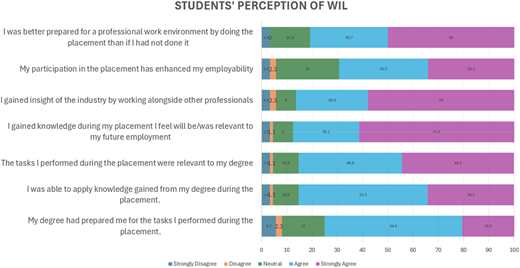
Figure 1 illustrates students' perceptions of the WIL work they experienced during the study. Over 85% of participants either agreed to or strongly agreed that WIL placements have helped them gain insights and knowledge of future work, high relevancy of WIL to their degree of study and application of knowledge gained from the degree to the WIL placements. Approximately between 75% and 80% of students indicated that the degrees have supported them well and that the WIL placement prepares them better for the professional work environment. The result however indicated that 30.7% of the participants expressed a low perception that their participation in WIL placements has enhanced their employability.
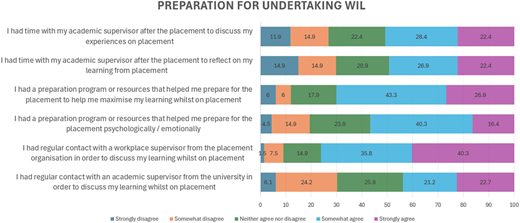
The participants were further asked about the extent to which they have engaged in WIL experience and preparation (Figure 2). 76.1% of the participants indicated their WIL placement learning needs were regularly discussed with workplace supervisors. Academic supervisors' roles during WIL placements appeared to be less prominent; approximately half of the participants agreed or strongly agreed that they had the opportunities to regularly discuss their learning needs during or after the placements. The participants' responses also indicated that, despite the preparation efforts made by the study programs in terms of resource allocation to maximise WIL learnings (with 70.2% agreed or disagreed), 43.3% highlighted the concerns about the lack of psychological or emotional preparation for the WIL placement.
As observed in Table 2, statistically significant positive associations were found between participants' perception of preparation for undertaking WIL, their work self-efficacy and confidence in future work using Pearson's correlation tests. As illustrated, the total score of the work self-efficacy and readiness bears a strong significant correlation (p < 0.001) with that of the level of WIL preparation. With reference to the relationships with the perception of WIL placement, strong statistically significant correlations (p < 0.001) were evident with the level of work self-efficacy and moderately strong and statistically significant correlations (p < 0.05) were found with the level of WIL preparation. However, the Pearson correlation revealed a weak and not statistically significant relationship between the perception of WIL placement and confidence in future work.
The result of the multiple regression indicated that age, gender, year of study and work self-efficacy explain 31% of the variance in the perceived level of WIL preparation and 15% of the perceived perception of WIL placement. Of all the independent variables in the model, work self-efficacy was the only variable that made a statistically significant contribution to the level of WIL preparation model with β value of 0.614 and made the largest unique contributor (β = 0.257) to the perception of WIL placement model (Table 3).
In exploring the challenges and barriers healthcare students faced during their WIL experiences, a total of 81 responses were recorded for the open-ended two questions outlined additional suggestions to address barriers, or further reinforced statements relating to WIL challenges. As the responses were relevant to students' self-efficacy and perception of WIL, a reflexive thematic analysis of these open-ended questions outlined four key themes and one subtheme, which are explored below.
Challenges of WIL
To complement the quantitative findings, responses to the two open-ended survey questions were analysed using reflexive thematic analysis, with 81 students providing qualitative comments describing challenges barriers, and reflections on their WIL experiences. The analysis identified four overarching themes and one subtheme that influenced students' perceptions of placement experiences, preparedness for practice and confidence in navigating work placement environments. These themes provide additional insight into factors that have supported or hindered the development of work readiness during WIL and are presented below.
Lack of support
One of the most reported challenges relating to WIL was a perceived lack of support. Participants often stated that their mentors, supervisors or other involved staff on placement did not provide them with adequate training or instruction and had limited availability or time to assist students. As one participant explained: “… supervisors were not available most of the time to answer queries or attend to placement assessments.” (Female, 18–25, 2nd year Medical Radiations). In addition to reporting a lack of support from placement providers and staff, participants also outlined issues regarding support from their education institutions. For example, one participant reported a lack of ongoing communication with university staff: “The academic supervisor did not check in with me during the placement, despite saying they would be doing so periodically.” (Female, 18–25, 4th year Laboratory Medicine). A related subtheme “poor reception from staff” was also identified, where a subset of participants reported finding some staff members unapproachable, unhelpful, and at times mean. This was particularly common for nursing students, noting difficult interactions with nurses. As one participant explained: “Nurses not being nice and friendly. They didn't want to teach students” (Female, 18–25, 2nd year Nursing).
Adjusting to work
Another source of challenge for participants was associated with adjusting to work environments. These challenges were multi-faceted and broad, though all encapsulated a central theme of adjustment. Some participants mentioned adjustments related to workload or the requirements of the role/work itself. For example: “Just a lot to learn. Also getting used to such long hours.” (Nonbinary, 18–25, 3rd year Laboratory Medicine), “Worried about not getting scans right or knowing what I'm doing.” (Male, 18–25, 2nd year Medical Radiations). Other participants noted challenges associated with acclimatising to a new workplace: “Difficulty knowing what's going on in the first couple of shifts at placement. … had to learn computer programs for documentations.” (Male, 18–25, 2nd year Nursing). Some adjustments related to challenges working with/communicating with the public (i.e. patients, clients), including language barriers: “Patient communication, language barrier and cultural barrier.” (Female, 18–25, 2nd year Medical Radiations). Participants also outlined challenges adapting from a university environment to an applied setting within the workplace. As one participant explains:
The translation for [from] book work to real-world practice. The comfort of having the staff available at uni and the students to compare notes is sorely missed when you are dealing with real patients. It’s a mindset to get used to. (Male, 26–35, 2nd year Medical Radiations)
Resource demands
The WIL placement periods appeared to place substantive demands on many participants. As with adjusting to work, these demands were multi-faceted, and strained participants' available resources. In many instances, participants highlighted the challenges associated with balancing WIL placement alongside study demands: “the lack of down time outside of placement, university classes and university assignments.” (Male, 46-Above, 1st year Master of Clinical Psychology). Moreover, several participants noted conflict between the new demands of placement and their existing responsibilities to their employers. That is, many participants noted challenges associated with continuing to work in their existing jobs while also on placement (and completing assignments): “Juggling placement, part-time work and uni.” (Gender not specified, 18–25, 4th year Laboratory Medicine); “Maintaining any life outside of work and placement was impossible.” (Female, 3rd year Laboratory Medicine). Such sentiments were particularly common for laboratory medicine students, who also noted difficulties with long placements (e.g. several participants reported 32-week placements).
WIL experiences also appeared to place substantive demands on financial resources. Many participants noted the lack of financial reimbursement from placement as a challenge to their WIL experiences: “Not making money” (Female, 18–25, 2nd year Nursing); “Not being paid while working made everyday living hard” (Gender not specified, 26–35, 4th year Laboratory Medicine). One participant elaborated that the lack of financial compensation, coupled with a long placement period resulted in the feeling of being used:
The placement for my program was too long, it began to feel like the students were being used to work. I had already learnt majority of the laboratory functions in the first half of my placement period, and I was no longer learning in the second half, and I was only contributing to the laboratory’s workload- which was without pay- this is why I felt used. (Female, 18–25, 4th year Laboratory Medicine)
Location of WIL placements also appeared to place additional demands on participants. Several participants noted distance to placement (i.e. travel time) as a challenge. For example: “I get put in placements far from where I live.” (Male, 18–25, 2nd year Nursing); “distance for travel for some facilities.” (Gender not specified, 26–35, 2nd year Nursing). Some participants also mentioned challenges associated with the additional financial demands of rural placements, though they did not elaborate on such costs.
Suitability
This theme represented a subset of participants who faced challenges regarding the suitability of their WIL placement. One student expressed that their placement had not prepared them with necessary skills for their future employment: “I was placed in a specialised laboratory and so I didn't learn how to perform the basic lab med tasks that would be expected of me post-graduation.” (Female, 18–25, 4th year Laboratory Medicine). Others noted the need for more placement opportunities, or more WIL opportunities earlier in their degree: “I think it would have been beneficial if we had a placement in our first or second year for a day/week in each discipline to actually show us what those disciplines are like in the real world.” (Female, 18–25, 4th year Laboratory Medicine). Finally, some participants, particularly psychology students, had completed WIL placements online which some felt limited their experience. As one participant explained:
I think having the WIL online was a poor choice, given psychology is a profession generally based around interpersonal abilities. It didn’t really give me any idea of what it would be like to work in my chosen field (psychologist).
-Female, 18–25, 4th year Psychology.
Discussion
The aim of this paper is to explore the impact of WIL on healthcare students' work readiness by examining their work self-efficacy and employment prospects. In the context of healthcare students’ participation in WIL placements, a higher level of work self-efficacy can significantly contribute to better WIL readiness, positive perception of their WIL experiences and preparation. This finding echoes previous research that students who believe in their professional abilities are more likely to take initiative and challenges, be adaptive and show enhanced critical thinking skills (Fuller et al., 2018; Ballen et al., 2017; Komarraju and Nadler, 2013). The results of this study convey the use of the concept of work self-efficacy as a critical element in creating a supportive environment that empowers university students' transition into the workforce (Smith and Worsfold, 2015). This finding is also consistent with international studies, which report that authentic workplace experiences contribute to stronger professional identity formation, confidence and preparation for practice (David et al., 2020; Holden et al., 2015). Research has shown that embedding programs or activities supporting employability skills, such as skill development play or simulation, professional career counselling, industry mentoring programs, resilience and emotional intelligence training are some of the strategies used to predict positive change in students' level of self-efficacy (Bradley et al., 2022; Carpi et al., 2017; Hamzah et al., 2021). Similarly, international WIL frameworks increasingly emphasise structured reflection, mentoring and professional networking as mechanisms for translating workplace experiences into career confidence and readiness. It is argued that in addition to providing students with a list of desired skills and capabilities to prepare them for professional capability, the university also needs to recognise the importance of professional network learning that builds socially-based transdisciplinary networks for students, that sustain their motivation in professional development (Bridgstock, 2017; Anders, 2018).
The current study reinforces challenges identified in previous research regarding the effective implementation of WIL, such as the inconsistent commitment of academics to WIL activities. Dalrymple et al. (2014) emphasised that WIL is a collaborative process involving academics, industry partners and students. The limited involvement of academics may stem from the models of WIL have been largely based around the use of industry partners. Additionally, there are challenges of engaging with WIL as an industry partner, as reported by Jackson et al. (2017), including identifying appropriate tasks, sourcing suitable students and addressing risks/concerns related to student performance. Nevertheless, universities should support the triad that connects students, WIL providers and academics, as it is essential for translating theoretical learning into practical WIL experiences (Dalrymple et al., 2014). Importantly, these challenges are not unique to Australia; international reviews have similar identified variabilities in placement quality, supervision practices and university industry partnership as persistent barriers to maximising WIL outcomes (Lasrado et al., 2024; McRae and Johnston, 2016). Additionally, the triad collaborative effort should also focus on preparing students emotionally and psychologically for WIL. With only partially developed professional skills, students may face significant emotional challenges during WIL. Research suggests that students often struggle to regulate and incorporate emotions into their WIL tasks, so helping them develop emotional regulation and reasoning skills will enhance their engagement in WIL (Hurley et al., 2020).
WIL experience is often seen as essential for preparing students to enter the workforce, but this study suggests that tertiary education providers need to focus on elements that directly enhance employability, as a limited connection was found between the students' perception of employability and WIL. When the skills acquired through WIL don't match the capabilities sought by future employers, it can reduce the perceived benefits of WIL for improving employability. In a national study conducted in Australia, Smith et al. (2016) examined the curriculum elements that predict the development of employability skills. Comparable findings have been reported internationally, emphasising that employability benefits are strongest when students are provided with meaningful workplace tasks, opportunities for reflection and integration of academic and workplace learning rather than mere placement participation (Pham and Jackson, 2020). They found that creating a curriculum that effectively integrates theoretical knowledge with practical experiences, while providing opportunities for skill-building, depends on key factors such as authenticity, supervision, preparation, debriefing and integrative learning. These elements have been shown to support the development of employability skills (Smith et al., 2016).
Findings of the current study contribute further to a timely discussion of resource burdens associated with WIL placement. The current study demonstrated financial strain, difficulties associated with juggling existing work, WIL placements and study as a potential barrier to positive WIL experiences. This was further exacerbated by the additional costs associated with travel, or relocation for rural placement. Given the lack of financial support some students faced, it is perhaps unsurprising that several students reported continuing to work their existing jobs while completing course placement components, thus placing further demands on students. In their review of the Australian Higher Education system, the Australian Universities Accord highlighted strong feedback from students regarding unpaid placements, resulting in a recommendation to limit such placements to address “placement poverty” (Australian Government Department of Education; AGDoE, 2024a). Steps have also been taken by policymakers to address such concerns, given the introduction of the Commonwealth Prac Payment scheme ensuring paid placement for eligible students undertaking nursing, teaching, midwifery and social work practicum (AGDoE, 2024b). However, this scheme does not ensure paid placements for all students or all disciplines represented within the current study (i.e. medical radiations, laboratory medicine), suggesting the need for broader consideration. Further, concerns regarding the financial burden of WIL are increasingly reported internationally. Students in other higher education systems have similarly described challenges associated with unpaid placements, travel expenses, accommodation costs and reduced opportunities for paid employment while undertaking mandatory professional placements (Braithwaite et al., 2026; Garant-Jones et al., 2024). Moreover, although assisting with financial burdens associated with placement alleviates some impacts, the current study outlines several other aspects of placement that appear to impact on students' available resources such as time commitment and travel restrictions which aligns with prior studies on this topic (Usher et al., 2022), suggesting that resource-related barriers may represent a broader international challenge affecting equitable participation in WIL.
These findings have further important implications for higher education institutions, placement provider or partners and policy makers. Efforts to improve WIL practice outcomes should extend beyond placement allocation and competency attainment to include targeted financial, academic and psychosocial supports before, during and after placement experiences. Universities and placements partners should work collaboratively to minimise avoidable placement-related burdens to students through improved placement planning, travel and accommodation assistance where possible, flexible curriculum and assessment arrangement and proactive student wellbeing support for a successful WIL outcome. This recommendation aligns with international calls for more student-centred and sustainable WIL models that recognise the academic, financial and emotional requirements with WIL experiences (Lasrado et al., 2024).
The study findings also have broader workforce implications as health care services increasingly rely on WIL experiences to prepare future workforce capacity in Australia. Addressing the structural barriers associated with students’ WIL participation is essential to promoting equitable access, supporting student wellbeing, strengthening work readiness and facilitating successful transition into professional practice. This can be particularly important for rural and regional WIL placements which are central for future workforce development, but at the same time create additional financial and logistical challenges for students. Further research should focus on examining how different forms of institutional support, placement models and financial assistance programs influence students' work self-efficacy, perception of WIL and future employment long-term outcomes across variable health disciplines, such insights would help educators and policy makers identify strategies that maximise both students outcomes and workforce development objectives.
The results reported by this study were derived from a small group of students in a survey context. Amongst those who started the survey, there was a high rate of incompletion. As such, high attrition and low response rates lead to an impact on the generalisability of the student results. Moreover, given that the quality of placement is an important factor in determining WIL experience and outcomes, the inclusion of such information should be taken into consideration in the future through the use of qualitative data as well as insights from future employers and universities (Ford et al., 2016; González-García et al., 2021). While the inclusion of open-ended survey questions provided valuable qualitative insights, interviews or focus groups may have enabled a deeper exploration of students' experiences and allowed for further probing of issues related to workplace readiness, placement preparation, supervision and support. Future studies could utilise interviews, focus groups or longitudinal qualitative approaches to develop a richer understanding of how WIL experiences influence students' professional development and workforce transition. While this study provides insights into the Australian context, direct international comparisons were beyond its scope. Future research could undertake cross country comparisons of WIL models and work readiness outcomes to better understand the influence of differing educational, regulatory and workforce contexts on graduate preparedness.
Conclusion
Enhancing work readiness in health education is essential for preparing students to transition effectively into the workforce. This study highlights the critical roles that work self-efficacy, placement preparation and contextual support provided by educational institutions and WIL settings play in this process. It found that students who are confident in their ability to perform tasks and adapt to workplace challenges demonstrate greater work readiness, while thorough preparation before placements ensures they can apply theoretical knowledge in real-world settings. To optimise these outcomes, educational programs must focus on fostering self-efficacy through supportive learning environments and providing comprehensive preparation for placements. Additionally, preparing students emotionally and psychologically for WIL can enhance their engagement and success in these placements. The resource burdens and structural barriers associated with WIL placements, including financial strain, need broader support across all health disciplines to alleviate these pressures. The higher education provider needs to consider supporting the students' personal and professional growth before, during and after WIL as these factors can influence their perception of a successful experience and an increased likelihood of employment after graduation. Future research needs to explore the long-term outcomes of WIL on employability and career progression, as well as effective strategies for integrating emotional and psychological preparation into WIL programs. Additionally, further studies could investigate the impact of financial support schemes across a wider range of health disciplines to ensure equitable access to WIL opportunities. By addressing these areas, students could be better equipped with the skills, confidence and experience needed to succeed in health professions.