


The purpose of this paper is to propose a model of the Islamic sovereign wealth funds (ISWFs) based on Islamic finance principles to modify the precarious image of SWFs from Muslim countries. The Shariah laws are the cardinal direction for this study.
The authors applied a qualitative research technique that consists of three approaches: exploratory case study approach to critically examine and rank the existing status of SWFs; descriptive analysis; and content analysis to present a model of ISWFs in comparison of conventional SWFs.
The authors propose a model of the “Islamic Sovereign Wealth Funds” based on four key pillars: the major Shariah principles; the Islamic corporate governance framework; the Islamic transparency and disclosure framework; and the Islamic corporate social responsibility framework. Furthermore, the authors argue that the potential effect of the ISWFs on Islamic finance and economy will be positive.
The model is an initial work and idea to convert SWFs from Muslim countries into ISWFs, which required an in-depth policy review by governments.
The findings of the paper are useful for policymakers and governments of the Muslim countries to overcome the issues and criticism on SWFs by converting them in ISWFs.
This paper contributes to the literature related to Islamic finance and sovereign wealth fund by presenting a first model of ISWFs for Muslim countries.
1. Introduction
The traditional states are re-designed as advanced secretarial governments have full ownership and control of the institutional investors (Aguilera et al., 2016). States have emerged in the global financial system as a dominant and large player through intensive “State-Capitalism” (Musacchio and Lazzarini, 2014). Sovereign wealth funds (SWFs) are modern vehicles used by the state or government to increase the state-capitalism nationally and internationally. The governments are reacting as commercially oriented global investors to manage the wealth of nations as a legal guardian (Megginson and Fotak, 2015).
The term sovereign wealth funds (SWFs) was coined by Rozanov (2005) in his work “Who Holds the Wealth of Nations?” (Dewenter et al., 2010). SWFs are government-owned and controlled funds (Knill et al., 2012). They have appeared as vast and unique investors having a total size of $7,997.07bn that consists of 80 SWFs around the world. Muslim countries own 30 SWFs out of 80 having a total size of $3,328.5bn (see Figure 2). The SWFs enormous size and control by political governments have increased their threating image as an investor.
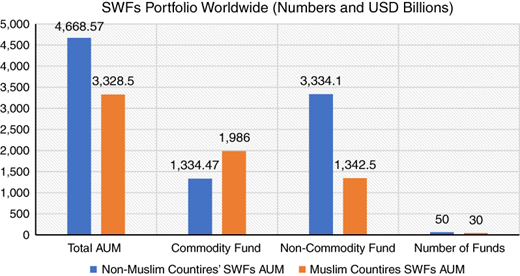
80 SWFs division by Non-Muslim, Muslim countries funds and commodity and non-commodity
80 SWFs division by Non-Muslim, Muslim countries funds and commodity and non-commodity
The governments of the Arab Gulf countries are unable to fully cover the western concept of democracy (Table II) and to reform governance and control mechanism of their SWFs. Consequently, the host country and corporates that receive an investment of SWFs from Muslim countries look it as a public and commercial hazard (Cohen, 2009). Muslim countries can amend the menacing image of their SWFs through adaptation and implementation of ethical standards of investments, finance, transparency and governance. While exploring the ethical standards for Muslim countries, the Islamic finance is one of the mainstreams of the international economic system that explains every aspect of investment, governance, management, transparency and control of business (Zaher and Hassan, 2001; Al-Bashir Al-Amine, 2015; Hendransatiti and Asutay, 2016; Khaled, 2018; Mansoori, 2013; Mili, 2014; Wan Jusoh and Ibrahim, 2017). Shariah law is the foundation of Islamic finance that guides all facets of business and economic activities of Muslims (Delorenzo, 2002). It could be argued that the application of Islamic finance principles on conventional SWFs that belong to Muslim countries will improve governance mechanism and reduce the threatening image of SWFs.
List of SWFs from Muslim countries
| S. No. | Name of fund | Country | Region | Incor-portion | Source of fund | AUM1 | L-MTI, 2018 | Score2 board | Islamic/Shariah law3 | Government system |
|---|---|---|---|---|---|---|---|---|---|---|
| 1 | Abu Dhabi Investment Authority | Abu Dhabi | MENA/AGC | 1976 | Oil | 683 | 6 | 58 | Full | Non-DMO |
| 2 | Kuwait Investment Authority | Kuwait | MENA/AGC | 1953 | Oil | 592 | 6 | 73 | Partial | Non-DMO |
| 3 | SAMA Foreign Holdings | Saudi Arabia | MENA/AGC | 1952 | NON-COM | 494 | 4 | n/a | Full | Non-DMO |
| 4 | Qatar Investment Authority | Qatar | MENA/AGC | 2005 | Oil and gas | 320 | 5 | 17 | Full | Non-DMO |
| 5 | Public Investment Fund | Saudi Arabia | MENA/AGC | 2008 | NON-COM | 250 | 5 | n/a | Full | Non-DMO |
| 6 | Investment Corporation corporation of Dubai | Abu Dhabi | MENA/AGC | 2006 | NON-COM | 229.8 | 5 | 21 | Full | Non-DMO |
| 7 | Mubadala Investment Company | Abu Dhabi | MENA/AGC | 2002 | NON-COM | 125 | 10 | n/a | Full | Non-DMO |
| 8 | Abu Dhabi Investment Council | Abu Dhabi | MENA/AGC | 2007 | Oil | 123 | n/a | n/a | Full | Non-DMO |
| 9 | National Development Fund of Iran | Iran | MENA | 2011 | NON-COM | 91 | 5 | n/a | Full | DMO |
| 10 | Libyan Investment Authority | Libya | MENA | 2006 | Oil | 66 | 4 | 6 | Full | DMO |
| 11 | Samruk_Kazna JSC | Kazakhstan | Others | 2008 | NON-COM | 60.9 | 10 | n/a | Partial | DMO |
| 12 | Kazakhstan National Fund | Kazakhstan | Others | 2000 | Oil | 57.9 | 9 | 71 | Partial | DMO |
| 13 | Brunei Investment Agency | Brunei | Others | 1983 | Oil | 40 | 1 | 21 | Partial | Non-DMO |
| 14 | Turkey Wealth Fund | Turkey | Others | 2016 | NON-COM | 40 | n/a | n/a | Partial | DMO |
| 15 | Khazanah Nasional | Malaysia | Others | 1983 | NON-COM | 38.7 | 9 | 59 | Partial | DMO |
| 16 | Emirates Investment Authority | UAE-Federal | MENA/AGC | 2007 | Oil | 34 | 3 | 6 | Partial | Non-DMO |
| 17 | State Oil Fund | Azerbaijan | MENA | 1999 | Oil | 33.1 | 10 | 35 | Partial | DMO |
| 18 | State General Reserve Fund | Oman | MENA/AGC | 1980 | Oil | 18 | 4 | 27 | Partial | Non-DMO |
| 19 | Mumtalakat Holding Company | Bahrain | MENA/AGC | 2006 | NON-COM | 10.6 | 10 | 39 | Partial | Non-DMO |
| 20 | Revenue Regulation Fund | Algeria | MENA | 2000 | Oil and gas | 7.6 | 1 | 29 | Partial | DMO |
| 21 | Oman Investment Fund | Oman | MENA/AGC | 2006 | Oil | 6 | 4 | n/a | Partial | Non-DMO |
| 22 | National Investment Corporation | Kazakhstan | Others | 2012 | Oil | 2 | n/a | n/a | Partial | DMO |
| 23 | Bayelsa Development and Investment Corporation | Nigeria | Others | 2012 | NON-COM | 1.5 | n/a | n/a | Partial | DMO |
| 24 | Nigerian Sovereign Investment Authority | Nigeria | Others | 2012 | Oil | 1.4 | 9 | n/a | Partial | DMO |
| 25 | Senegal Fonsis | Senegal | Others | 2012 | NON-COM | 1 | n/a | n/a | Partial | DMO |
| 26 | Development Fund of Iraq | Iraq | MENA/AGC | 2003 | Oil | 0.9 | 1 | n/a | Partial | DMO |
| 27 | Palestine Investment Fund | Palestine | Others | 2003 | Oil | 0.8 | n/a | n/a | Partial | DMO |
| 28 | National fund of Hydrocarbon Reserves | Mauritania | Others | 2006 | Oil and gas | 0.3 | 1 | n/a | Partial | DMO |
| 29 | Turkmenistan Stabilization Fund | Turkmenistan | Others | 2008 | Oil and gas | n/a | n/a | n/a | Partial | DMO |
| 30 | Sharjah Asset Management | Sharjah | MENA/AGC | 2008 | NON-COM | n/a | n/a | n/a | Partial | Non-DMO |
Notes: n/a, not applicable; AUM, total asset under management; NON-DMO, non-democratic; DMO, democratic; NON-COM, non-commodity; COM, commodity; MENA/AGC, Middle East and North Africa/Arab Gulf Countries, L-MTI.1, Linaburg−Maduell Transparency Index. The table presents a detailed overview of the conventional SWFs belong to Muslim countries aIn $-billion; bBagnall and Truman (2013); claws implemented-full, or partial
Source: Sovereign Wealth Funds Institute (2018) and compiled by authors
This study proposes a theoretical model of the ISWFs based on Islamic finance principles to modify the precarious image of SWFs from Muslim countries. The Shariah laws are the cardinal direction to establish ISWFs. We introduce the model by critically analyzing the following research questions related to SWFs:
How to define SWFs and which belong to Muslim and non-Muslim countries?
What is the prominent criticism on SWFs from Muslim countries?
What is the current status of the structure, management, governance, transparency and accountability of SWFs from Muslim countries?
What could be the appropriate model of the ISWFs?
What could be the role of ISWFs in the growth and development of Islamic finance and economy?
We use state-of-the-art methods including, content, descriptive and exploratory case study analyses to produce the model of ISWFs (Gaur and Kumar, 2018; Given, 2008). Our study provides the following contributions of theoretical and practical nature for scholars and policymakers.
First, we discuss the concept of “sovereign wealth fund” and divide eighty SWFs between non-Muslim (50) and Muslim (30) based on their origin country and dominant religion (Tables I–II and Figure 2).
List of SWFs from non-Muslim countries
| S. No. | Name of fund | Country | Incorporation | Source of fund | AUM ($ billion) | L-MTI, 2018 |
|---|---|---|---|---|---|---|
| 1 | Government Pension Fund-Global | Norway | 1990 | Oil/commodity | 1,035.24 | 10 |
| 2 | China Investment Corporation | China | 2007 | Non-commodity | 941.4 | 8 |
| 3 | Hong Kong Monetary Authority Investment Portfolio | China–Hong Kong | 1993 | Non-commodity | 522.6 | 8 |
| 4 | SAFE Investment Company | China | 1997 | Non-commodity | 441 | 4 |
| 5 | Government of Singapore Investment Corporation | Singapore | 1981 | Non-commodity | 441 | 4 |
| 6 | Temasek Holdings | Singapore | 1974 | Non-commodity | 375 | 10 |
| 7 | National Social Security Fund | China | 2000 | Non-commodity | 295 | 5 |
| 8 | Korea Investment corporation | South Korea | 2005 | Non-commodity | 134.1 | 9 |
| 9 | Australian future Fund | Australia | 2006 | Non-commodity | 105.4 | 10 |
| 10 | National Welfare Fund | Russia | 2008 | Oil/commodity | 66.3 | 5 |
| 11 | Alaska Permanent fund | USA–Alaska | 1976 | Oil/commodity | 61.5 | 10 |
| 12 | Taxes Permanent School Fund | USA–Texas | 1854 | Oil/commodity | 37.7 | 9 |
| 13 | New Zealand Superannuation Fund | New Zealand | 2003 | Non-commodity | 28.5 | 10 |
| 14 | New Mexico State Investment Council | USA–New Mexico | 1958 | Oil/commodity | 20.2 | 9 |
| 15 | Permanent University Fund | USA–Texas | 1876 | Oil and gas/commodity | 17.3 | 9 |
| 16 | Timor-Leste Petroleum Fund | East Timor | 2005 | Oil and gas/commodity | 16.6 | 8 |
| 17 | Social and Economic Stabilization Fund | Chile | 2007 | Cooper/commodity | 14.7 | 10 |
| 18 | Alberta Heritage Fund | Canada | 1976 | Oil/commodity | 13.4 | 9 |
| 19 | Russian Direct Investment Fund | Russia | 2011 | Non-commodity | 13 | 7 |
| 20 | Pension Reserve Fund | Chile | 2006 | Cooper/commodity | 9.4 | 10 |
| 21 | Ireland Strategic Investment Fund | Ireland | 2001 | Non-commodity | 8.5 | 10 |
| 22 | Fiscal Stabilization Fund | Peru | 1999 | Non-commodity | 7.9 | n/a |
| 23 | Permeant Wyoming Mineral Trust Fund | USA | 1974 | Minerals/commodity | 7.3 | 9 |
| 24 | Sovereign Fund of Brazil | Brazil | 2008 | Non-commodity | 7.3 | Removed |
| 25 | Oil Revenues Stabilization Fund of Maxico | Mexico | 2000 | Oil/commodity | 6 | 4 |
| 26 | Paula Fun | Botswana | 1994 | Diamonds and millers | 5.5 | 6 |
| 27 | Heritage and Stabilization Fund | Trinidad and Tobago | 2000 | Non-commodity | 5.5 | 8 |
| 28 | China-Africa Development Fund | China | 2007 | Non-commodity | 5 | 5 |
| 29 | Fundo Soberano de Angola | Angloa | 2012 | Oil/commodity | 4.6 | 8 |
| 30 | North DoKota Legacy Fund | USA | 2011 | Oil and gas/commodity | 4.3 | 10 |
| 31 | Colombia Saving and Stabilization Fund | Colombia | 2011 | Oil and mining | 3.5 | n/a |
| 32 | Alabama Trust Fund | USA | 1985 | Oil and gas/commodity | 2.7 | 9 |
| 33 | Utah-SITFO | USA | 1896 | Land and mineral | 2 | n/a |
| 34 | Idaho Endowment Fund Investment Board | USA | 1969 | Land and mineral | 2 | n/a |
| 35 | Louisiana Education Quality Trust | USA | 1986 | Oil and gas/commodity | 1.3 | n/a |
| 36 | Fondo De Ahorro de Panama | Panama | 2012 | Non-commodity | 1.2 | 10 |
| 37 | FINPRO | Bolivia | 2012 | Non-commodity | 1.2 | n/a |
| 38 | FEM | Venezuela | 1998 | Oil/commodity | 0.8 | 1 |
| 39 | Revenue Equalization Reserve Fund | Kiribati | 1956 | Oil/commodity | 0.6 | 1 |
| 40 | State Capital Investment Corporation | Vietnam | 2006 | Non-commodity | 0.5 | 4 |
| 41 | Gabon Sovereign Wealth fund | Gabon | 1998 | Oil/commodity | 0.4 | n/a |
| 42 | Ghana Petroleum fund | Ghana | 2011 | Oil/commodity | 0.45 | n/a |
| 43 | Western Australia Future Fund | Australia | 2012 | Minerals/commodity fund | 0.3 | n/a |
| 44 | Fiscal Stability Fund | Mongolia | 2011 | Minerals/commodity fund | 0.3 | n/a |
| 45 | Funds for future Generations | Equatorial Guinea | 2002 | Gas/commodity | 0.08 | n/a |
| 46 | Papua New Guinea Sovereign Wealth Fund | Papua New Guinea | 2011 | Gas/commodity | n/a | n/a |
| 47 | West Virginia Future Fund | USA | 2014 | Oil and gas/commodity | n/a | n/a |
| 48 | Fondo Mexico del Petroleo | Mexico | 2014 | Oil and gas/commodity | n/a | n/a |
| 49 | Luxembourg Intergenerational Sovereign Fund | Luxembourg | 2015 | Non-commodity | 0 | n/a |
| 50 | Reserve Fund | Russia | 2008 | Oil/commodity | 0 | 5 |
Notes: AUM, total asset under management (USD billion), L-MTI, Linaburg-Maduell Transparency Index (2018). The table presents the details about SWFs that belong to non-muslim countries
Source: Sovereign Wealth Funds Institute (2018) and compiled by authors
Second, we identify the following four issues and criticisms on SWFs from Muslim countries: the lack of stabilization effect, the SWFs establishment and large size, the geopolitical objectives of SWFs and the governance, transparency and operational issues of SWFs.
Third, we critically review the existing status of SWFs from Muslim countries and rank them into three dimensions; the structure and management, the governance and the transparency and accountability (Tables III–V). We apply exploratory case study approach to rank SWFs. The results show that SWFs from Muslim countries are essential to reform their structure, management, governance, transparency and accountability mechanism.
Survey of structure and management of SWFs from Muslim countries
| Sr. No. | Name of fund | Mission/objectives (key points) | Culture/principle/values (key points) | Organization structure* | Management Structure* | Media and resource* | Other factors | Rank |
|---|---|---|---|---|---|---|---|---|
| 1 | ADIA | (i) Long-term prosperity (ii) disciplined investments | Prudent innovation, effective collaboration, disciplined Execution, | Y | Y | Y | Details about fund investments | 4th |
| 2 | KIA | (i) Long-term returns, (ii) reduce uncertainty in future, (iii) excellence in private sector | Integrity, social responsibility, empowerment and accountability, team work, | Y | Y | Y | Details about BOD, management, and organization | 1st |
| 3 | SAMA-FH | (i) SWF of Saudi Arabia Monetary Authority (central bank) | No information available | N | N | N | No website and reports are available | 8th |
| 4 | QIA | (i) Long-term return, (ii) support economic development | Integrity, mission focus, excellence, respect for people, entrepreneurship | Y | Y | Y | Details about investment, CEO, CFO given | 2nd |
| 5 | PIF | (i) Long-term return, (ii) support global opportunities, (iii) economic development | No information available | N | N | Y | Future program upto 2030 | 5th |
| 6 | ICD | (i) Wealth improvement, (ii)economic development | Excellence, commitment, sustainability, integrity, respect | N | N | Y | Future program upto 2021, portfolio strategy | 6th |
| 7 | MIC | (i) Long-term benefit of Abu Dhabi | Ethical standards of business, integrity, speaking up, respect and fairness | Y | Y | Y | Portfolio overview performance, strategy | 3rd |
| 8 | ADIC | (i) Financial success, (ii) growth and development of economy | No information available | N | N | N | No website and reports | 7th |
Notes: ADIA, Abu Dhabi Investment Authority (UAE-Abu Dhabi); KIA, Kuwait Investment Authority (Kuwait); SAMA-FH, SAMA Foreign Holdings (Saudi Arabia); QIA; Qatar Investment Authority (Qatar); PIF, Public Investment Fund (Saudi Arabia); ICD, Investment Corporation of Dubai (UAE-Dubai); MIC, Mubadala Investment Company (UAE-Abu Dhabi); ADIC, Abu Dhabi Investment Council (UAE-Abu Dhabi). The table represented the survey and analysis of the structure and management of the top eight SWFs and ranked them in eight positions. The information is given on the website. aY=Yes; N=No
Survey of governance of SWFs from Muslim countries
| Board of directors’ details (yes or no) | Board committees (yes or no) | Santiago principles (yes or no) | |||||||||||||||||
|---|---|---|---|---|---|---|---|---|---|---|---|---|---|---|---|---|---|---|---|
| Sr. No. | Name of fund | 1 | 2 | 3 | 4 | 1 | 2 | 3 | 4 | 5 | 6 | Govt and fund association | 1 | 2 | 3 | 4 | 5 | Remarks | Rank |
| 1 | ADIA | Y | 7 | N | Y | Y | Y | Y | Y | Y | N | (i) Independent (ii) Govt provide funds | Y | Y | Y | Y | Y | Good presentation of CG | 1st |
| 2 | KIA | Y | 9 | N | N | Y | Y | Y | N | N | Y | (i) Independent (ii) Govt provide funds | Y | Y | Y | N | Y | Reasonable information is available as compared to others | 2nd |
| 3 | SAMA-FH | N | N | N | N | N | N | N | N | N | N | No information | N | N | N | N | N | No official website and repots, etc. | 8th |
| 4 | QIA | Y | 7 | N | Y | N | N | N | N | N | N | (i) Independent (ii) Report to (SCFAI) | Y | N | N | Y | Y | Lack in proper information | 3rd |
| 5 | PIF | Y | 9 | N | N | Y | Y | Y | N | N | Y | (i) Independent fund (ii) Report to CEDA | Y | N | N | N | Y | Lack in proper information | 4th |
| 6 | ICD | Y | 5 | N | N | N | N | N | N | N | N | No information | Y | N | N | N | N | Lack in proper information | 5th |
| 7 | MIC | y | 7 | N | N | N | N | N | N | N | N | No Information | N | N | N | N | N | No Information but have official website | 6th |
| 8 | ADIC | N | N | N | N | N | N | N | N | N | N | No information | N | N | N | N | N | No official website | 8th |
Notes: ADIA, Abu Dhabi Investment Authority (UAE-Abu Dhabi); KIA, Kuwait Investment Authority (Kuwait); SAMA-FH, SAMA Foreign Holdings (Saudi Arabia); QIA, Qatar Investment Authority (Qatar); PIF, Public Investment Fund (Saudi Arabia); ICD, Investment Corporation of Dubai (UAE-Dubai); MIC, Mubadala Investment Company (UAE-Abu Dhabi); ADIC, Abu Dhabi Investment Council (UAE-Abu Dhabi); SCFAI, Supreme Council for Economic Affairs and Investment; CEDA, Council of Economic and Development Affairs. The table represented the survey and analysis of the governance of the top eight SWFs and ranked them in eight positions; Variables: (i) board of directors’ details (1. Information available, 2. Size of the board, 3. Number of meetings, 4. Governance organism); (ii) Board committees (1. Audit committee, 2. Investment committee, 3. Risk management, 4. management committee, 5. governance committee, 6. Executive committee); (iii) Santiago principles (1. Information is given, 2. Adoption of principles, 3. Detail compliance with all 24 principles, 4. Governance framework, 5. Investment policy framework). Y=Yes; N=No
Survey of transparency and accountability of SWFs from Muslim countries
| Portfolio overview | Publication of reports | ||||||||||
|---|---|---|---|---|---|---|---|---|---|---|---|
| Sr. No. | Name of fund | 1 | 2 | 3 | 4 | IAD | 1 | 2 | Audit report | L-MTI-2018 | Rank |
| 1 | ADIA | Strategy and planning department | Developed equities (42%), emerging equities (20%), small cap equities (5%), govt. bonds (20%), credit (10%), alternative (10%), real estate (10%), private equity (8%), infrastructure (5%), cash (10%) | North America (50%), Europe (35%), Emerging Markets (25%), Developed Asia (20%) | 6.1% | Y | 2016 2015 2014 2013 | 68 | N | 6 | 2nd |
| 2 | KIA | Planning and senior management department | General reserves, marketable securities, alternative investments | N | N | Y | N | N | N | 6 | 4th |
| 3 | SAMA-FH | N | N | N | N | N | N | N | N | 6 | 8th |
| 4 | QIA | Investment teams report to CEO/general council and legal | Equities, real estate assets, credit/fixed income, private equity, multi-strategy, real assets | N | N | Y | N | N | N | 5 | 5th |
| 5 | PIF | BOD | Saudi Holding, sector development, real estate and infrastructure development, saudi giga-projects, international strategic investment, international diversified pool | N | N | N | N | N | N | 5 | 7th |
| 6 | ICD | Three step Investment process/BOD | Finance and investment (27.9%), transportation (18.8), real estate and construction (17.2), hospitality and leisure (15.6), retail and other holdings (2.7) | Africa, Europe America, Middle East, Australia Asia | 4.37% | Y | 2017 2016 2015 2014 2013 | 131 | Y | 5 | 1st |
| 7 | MIC | Investment committee | Aerospace, capital investment, defense service, healthcare Information and communication technology, metals and mining midstream | N | N | Y | N | N | N | 10 | 3rd |
| 8 | ADIC | N | N | N | N | N | N | N | N | n/a | 8th |
Notes: ADIA, Abu Dhabi Investment Authority (UAE-Abu Dhabi); KIA, Kuwait Investment Authority (Kuwait); SAMA-FH, SAMA Foreign Holdings (Saudi Arabia); QIA, Qatar Investment Authority (Qatar); PIF, Public Investment Fund (Saudi Arabia); ICD, Investment Corporation of Dubai (UAE-Dubai); MIC, Mubadala Investment Company (UAE-Abu Dhabi); ADIC, Abu Dhabi Investment Council (UAE-Abu Dhabi); IAD, Internal Audit Department. The table represented the survey and analysis of accountability and transparency of the top eight SWFs and ranked them in eight positions. Variables: (i) Portfolio overview (1. Department play investment role, 2. Portfolio by asset class (max percent), 3. Portfolio by regions (max percent), 4. Annual returns); (ii) Publication of reports (1. During years, 2017, 2016, 2015, 2014, 2013, 2. Number of pages of report); (iii) L-MTI, Linaburg-Maduell Transparency Index (2018) (out of 10). Y=Yes and N=No
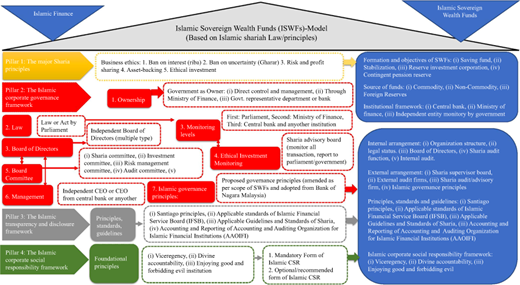
Fourth, we present a theoretical model of the “Islamic Sovereign Wealth Fund” through the application of Islamic finance principles that consist of Shariah laws (Figure 3). The model includes four essential pillars: Pillar 1: the major Shariah principles; Pillar 2: the Islamic corporate governance framework (Table VI and Figure 4; Pillar 3: the Islamic transparency and disclosure framework (Table VII); Pillar 4: the Islamic corporate social responsibility (ICSR) framework (Table VIII). We use the term conventional SWFs for the SWFs from Muslim countries before the implementation of Islamic finance principles.
Proposed governance principles of Islamic sovereign wealth funds
| Proposed Islamic governance principles for SWFs (authors contribution based on BNM principles) | |
|---|---|
| 1. Board composition and structure: the board should be independent of the owners, which are mostly governments in case of SWFs. The board should be very active, strong and experience to manage the fund. The experts from relevant fields are required to be on board | 7. Qualification of the board and management: the directors on board, Shariah advisory board and key executives should have enough and relevant qualification, skills and experience to be appointed on the board |
| 2. Board composition and type of directors: the board should contain several types of directors to make it independent like a private mutual fund. The board should maintain a balance among directors’ appointments, and they should be representative of different stakeholders, for example; directors as representative of shareholders, directors from a private mutual fund, from a central bank, ministry of finance and outside directors as well | 8. Board committees and their functions: the SWFs should have the following committees: audit committee, Shariah committee, risk management committee, governance committee and investment committee. An SWF must have following committees on the board, and it is required their regular meetings with disclosure. These committees should be very independent in their task. The responsibilities, task, authorities and functions of these committees should be adequately defined |
| 3. Board responsibilities and board committees: the primary function of the board is work as a bridge among owners (government) and the management of the fund. The board is responsible for formation of the board committees like (i) risk management, (ii) audit committee, and (iii) governance committee, (iv) Shariah committee and (v) investment committee | 9. Remuneration and conflict of interest: there should be a formal and transparent procedure for fixing the compensation of boards and management. There should not be any conflict of interest; the person who is involved in the decision-making process should work for the benefits of the SWFs |
| 4. Shariah advisory board: the SWFs should have independent Shariah advisory board that should be based on the experts. The advisory board should directly report to the parliament/government and perform main functions related to Shariah review and audit | 10. The separation between the owner (government) and management: the government should not be involved in direct management and control of the funds. The board, Shariah advisory board and management should be independent |
| 5. Implementation and monitory of Shariah principles/law: it is responsibility of owners, board, boards committees, Shariah advisory board and Shariah audit committee to implement and monitor the implementation of the Shariah principles/law for every investment and transaction | 11. Board performance and meetings: the board, Shariah advisory board should meet regularly and furnish the complete record of the meeting. There should be a formal way of analyzing the performance of the boards and board committees |
| 12. Risk management and disclosure: the risk management committee, investment committee and board itself should actively perform the function of risk management. The risk related to every transaction must be managed and appropriately disclosed in annual reporting | |
| 13. Transparency, disclosure and communication: the SWFs should develop a proper system of discussion at both levels; vertical and horizontal and inner and outer. There should be a separate department that will perform these actives. There should pre-defined system and mechanism of disclosure and to be monitor by the boards by following multiple Santiago principles (GAAP) and Islamic finance principles. The SWFs should develop, adopt and implement the both Santiago principles, Shariah principles and any other accounting requirements under Islamic finance, such as rules, standards by AAOIFI, IFSB, and IIFMO. The SWFs actively must increase their annual reporting, in the form of annual review, quarterly review, governance and ethical investment report, etc. | |
Notes: The table presents the governance principles presented by authors. The primary source of these principles is Bank Negara Malaysia (BNM) in 2013. However, we recommend amendments keeping in view the scope of SWFs
Proposed rules and standards for ISWFs
| Sr. No. | Details | Principles, standards, guidelines and rules | Total numbers | Proposed to be implemented on Islamic SWFs |
|---|---|---|---|---|
| 1 | Santiago Principles | 24 | All 24 are recommended to be implemented | |
| 2 | Islamic Financial Service Board (IFSB) (IFSB, 2018) | Standards | 19 | Relevant are recommended to be implemented with amendments are per requirement and scope of SWFs |
| 3 | Accounting and Auditing Organization for Islamic Financial Institutions (AAOIFI) (AAOIFI, 2018) | (i) Shariah Standards (ii) Accounting statements and standards (iii) Accounting guidance notes (iv) Auditing standards (v) Governance standards (vi) Ethics standards | (i) 48 (ii) 26 (iii) 1 (iv) 6 (v) 7 (vi) 2 | Relevant are recommended to be implemented with amendments are per requirement and scope of SWFs |
Note: The table presents the Islamic principles standards, guidelines and rules that can be implemented ISWFs after amendments
Proposed principles of Islamic corporate social responsibility for ISWFs
| Mandatory principles of ICSR | Recommended principles of ICSR |
|---|---|
| (i) Screening of investment as per Shariah principles (ii) Screening of earning prohibit as per Shariah principles (ii) Rights of employees (iv) Implementation of Zakah system | (i) Qard Hasan (ii) Reduction of worst impact on environment (iii) Screening of industries (iv) Social impact-based investment quotes (v) Excellent customer services (vi) Safeguard the micro-scale business (vii) Employees welfare (viii) Charitable activities |
Note: The table shows the principles of Islamic corporate social responsibility principles to be implemented by Islamic SWFs
Finally, we critically review the role of SWFs on the development of Islamic finance and economy by using descriptive analysis as a case study. We confirm that ISWFs will be helpful to improve Islamic finance and economic growth.
As per our knowledge, this is the first study that presents the theoretical model of the “Islamic Sovereign Wealth Funds (ISWFs)” based on Islamic finance principles by considering Shariah laws. The model of the ISWFs may have a specific interest from policymakers of Muslim countries that own and control conventional SWFs. Furthermore, the critical review of conventional SWFs may be useful for the government bodies, parliaments, the board of directors and management to perceive the existing status of the fund’s structure, governance, and transparency presentation toward stakeholders. Finally, a model of the ISWFs may be useful to governments who owned SWFs from Muslim countries to convert their conventional SWFs into ISWFs.
2. Methodology
We applied qualitative methods of research. Qualitative methods are research approaches used to explore a specific field of a study (Given, 2008). We used three important approaches: an exploratory case study approach, to critically examine and rank the existing status of the SWFs (Khalfan, 2004); descriptive analysis; and content analysis, to provide the theoretical model of the ISWFs in comparison of conventional SWFs (Gaur and Kumar, 2018; Potter and Levine-Donnerstein, 1999).
Our method consists of the following stages: the identification of SWFs from Muslim and non-Muslim countries; the identification of prominent criticism related to SWFs from Muslim countries; the systematic ranking of top SWFs from Muslim countries; the presentation of the ISWFs model based on Islamic finance principles guided by Shariah law; the comparison of the ISWFs model with world top-ranked SWF; and the analysis of the impact of the ISWFs on the growth of Islamic finance and economy. Figure 1 shows our methodology.
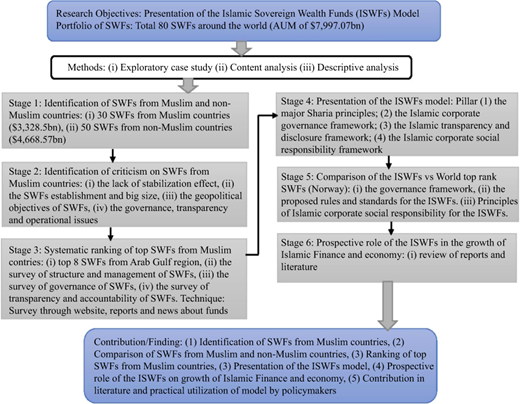
3. Theoretical analysis of SWFs
3.1 How to define SWFs and which belong to Muslim and non-Muslim countries?
3.1.1 SWFs overview and growth
In 2005, Rozanov for the first time introduced the term “Sovereign Wealth Funds”. They generally fall into two main categories based on their source of foreign exchange assets, such as oil, gas or any other/commodity funds and non-oil/non-commodity funds (Paltrinieri et al., 2014; Sun et al., 2014; Rozanov, 2005; Aizenman and Glick, 2009). Furthermore, International Monetary Fund divides SWFs into five types based on their objectives (International Monetary Fund, 2008, p. 2): stabilization funds, saving funds, reserve investment corporations, development funds and contingent pension reserve funds. SWFs have become an essential class of institutional investors in term of their asset under management (AUM) (Boubakri et al., 2017). The period between the 2000s and 2018 experienced the creation of more than 80 SWFs, whereas their AUM has dramatically increased from the $1 trillion in the early 2000s to nearly $7.97 trillion in 2018 (SWFI, 2018). Figure 2 shows a detailed portfolio of SWFs.
3.1.2 SWFs from non-Muslim countries
We discuss and explore the SWFs established by Muslim and non-Muslim countries based on the main religion of the state. The 50 SWFs are from non-Muslim countries as given in Table I. The total AUM of these 50 funds is $4,668.57bn and see Figure 2 for the division of commodity and non-commodity funds.
3.1.3 SWFs from Muslim countries
The 30 SWFs belonging to Muslim countries have a total AUM of $3,328.5bn. They are further divided into 18 commodities and 12 non-commodities, having a portfolio of $1,342.5bn (Figure 2). Table II shows the origin country, size, transparency index of these funds. The scoreboard shows that governance mechanism is weak and need systematic improvement.
3.2 What is the prominent criticism on SWFs from Muslim countries?
During the financial credit crisis in late 2007, SWFs came to rescue the financial institutions in the USA and other western countries and invested over $60bn (Cohen, 2009). In 2007, Bob Davis, a senior market analyst quoted that SWFs should stand for “salvaging withering franchises” in his article “Wanted: SWFs Money Sans Politics (Cohen, 2009)”. However, there are several risks related to the investment of SWFs, especially when they belong to the non-democratic government with poor governance and management systems. We identified criticisms about SWFs through a review of the previous literature, reports and public news.
3.2.1 The lack of stabilization effect
SWFs impact turn out to be pro-cyclical rather than stabilizing to market fluctuations. In 2008, Bear Stearns and Wachovia Bank requested for SWFs investments to get stabilization, but they both collapsed. One reason was the negative publicity they faced after SWFs investment. According to Stephen Schwartzman, “The availability of money from SWFs was beneficial to a limited number of American and other financial institutions around the world (Cohen, 2009)”. Kirshner (2009) presented that SWFs are only political tools and have no relationship with stabilization. Moreover, Bahgat (2010) argued in the same direction that the SWFs has no stabilization effect and mostly they are not integrated with country’s fiscal policy. Furthermore, this criticism improves when non-democratic countries own SWFs.
3.2.2 The SWFs establishment and large size
Several developed countries had the current account deficits in the 1990s, but over the past decade, many emerging markets like China became global creditors. These global imbalances started in the twenty-first century, and the shift of wealth led to the building of a huge amount of foreign exchange reserves and the formation of SWFs (Eichengreen, 2006). Moreover, the countries having major income source of oil, gas and minerals shifted their revenues in stabilization funds by creating SWFs (e.g. Korea, China, Norway, Arab Gulf countries and Russia) (Megginson and Fotak, 2015). However, Monk (2009) argued that governments establish SWFs to safeguard state autonomy and sovereignty. Similarly, Hatton and Pistor (2011) considered SWFs formation as “autonomy-maximization theory” in non-democratic countries, such as Kuwait, Abu Dhabi, Saudi Arabia and China. The status and reputation of the SWFs from non-democratic countries caught the eye of policymakers from western countries, and they are concerned about enormous size and non-economic objectives of the SWFs (Gilson and Milhaupt, 2009).
3.2.3 The geopolitical objectives of SWFs
Wu and Seah (2008) showed that the goals of SWFs creation are dual: first, political to accomplish geopolitical tasks and, second, economical for the stabilization and growth of the country’s economy. Lenihan (2014) argued that SWFs are non-military internal balancing tools among nations through the power of finance. Similarly, Braunstein (2016) claimed that SWFs establishment is political and there is a role of political strategies in economic policy. In response to such arguments, big size and non-democratic size of SWFs, the western countries and the USA regulated or banned their investment (Gilson and Milhaupt, 2009; Kunzel et al., 2011). This argument of political risk related to SWFs is strong for non-democratic countries, such as Russia, Saudi Arabia, UAE and Qatar (Cohen, 2009).
3.2.4 The governance, transparency and operational issues
The lower level of governance standards, transparency, and operational issues is the critical criticism of SWFs. One of the main arguments behind these lower standards is non-democratic governments that want to keep control of these funds for political objectives (Gilson and Milhaupt, 2009). Furthermore, the operations of SWFs are highly concerned as they are in direct control of the political governments (Norton, 2010). Surprisingly, the large SWFs, such as China, Abu Dhabi and Saudi Arabia, are managed by less than 3,000 employees (Megginson and Fotak, 2015). Another concern is the transparency, as SWFs do not generally publish annual reports or data. The Santiago principles, established by the International Forum of SWFs (ISWF), are not implemented by Muslim countries. In 2013, Truman evaluated the implementation of the Santiago principles and found that SWFs from Muslim countries have a low level of compliance. Our analysis of transparency and governance indexes also shows that SWFs from Muslim countries have a little value of the index (Table II).
3.3 What is the current status of the structure, management, governance, transparency and accountability of SWFs from muslim countries?
We critically examine the current status of SWFs from Muslim countries instead of merely relying on the previous literature or thoughts of policymakers. We conduct an exploratory case study analysis of the biggest top eight SWFs by following the methods of Kensicki (2003) and Lee et al. (2001) and Bahoo et al. (2018). We review their websites, published data, reports, news and any other information available on internet related to their structure, management, governance, transparency and accountability mechanism and rank them from 1st (best) to 8th (worst). These eight funds belong to the following Muslim countries UAE-Abu Dhabi (4 funds), Kuwait (1), Saudi Arab (2) and Qatar (1).
3.3.1 The structure and management of the SWFs
We survey the structure and management of SWFs through the website and published reports of SWFs as given in Table III. We rank all eight SWFs based on their available information and reporting by the fund. The Kuwait Investment Authority and SAMA foreign holdings are classified at first and eight positions.
3.3.2 The governance of the SWFs
The poor governance mechanism of SWFs creates a threating opinion of policymakers. Non-adoption of Santiago principles is the main reason that produces doubts about these funds. We conduct an in-depth review of the governance mechanism by considering important indicators used by Wanyama et al. (2009). The analysis and ranking are given in Table IV. Our results show that Abdu Dhabi Investment Authority and SAMA Foreign Holdings and Abu Dhabi Investment Council have first and last position.
3.3.3 The transparency and accountability of the SWFs
The discussion of corporate governance without transparency and accountability is not complete. Hermalin and Weisbach (2007) argued that the proper and right disclosure depends on the board of directors and governance mechanism. The SWFs from Muslim countries face criticism of non-transparency and politically biased due to weak governance mechanism being considered as a geopolitical tool of autocratic and non-democratic governments (Chwieroth, 2014). Therefore, we critically reviewed these funds and ranked them between first and eight positions. The Investment Corporation of Dubai and SAMA Foreign Holdings and Abu Dhabi Investment Council are listed at first and eight positions (Table V).
3.4 What could be the appropriate model of the Islamic sovereign wealth funds?
The SWFs from Muslim countries face a massive criticism of their political objectives (Hatton and Pistor, 2011), weak governance (Cohen, 2009), poor transparency and accountability (Calluzzo et al., 2017). Therefore, we conducted an in-depth review of the top eight SWFs that belong to Muslim countries. Overall, we conclude that it is essential for SWFs to improve its governance mechanism by following a systematic framework.
3.4.1 Practical and theoretical background
The SWFs are exclusive purpose investors with highly specific objectives. Braunstein (2016) and Chwieroth (2014) argued in two different studies that creation of SWFs is politically biased and have governance and transparency issues. This criticism improves if SWFs belong to non-democratic governments (Cohen, 2009; Gilson and Milhaupt, 2009). Mostly, SWFs from Muslim countries fall under the definition of non-democratic governments (Table II). Furthermore, our rational analysis of structure, management, governance and accountability shows that SWFs from Muslim countries need to improve their framework and mechanism. Thus, SWFs from Muslim countries have two options: first to follow the structure or mechanism of top conventional SWFs like Norway and, second, to formulate and adopt their system based on Islamic finance principles that are based on Shariah law.
3.4.2 Implementation of Islamic finance as a solution to SWFs from Muslim countries
Islamic finance is a reliable system that is available with Muslim countries that consists of Shariah laws. Islamic finance is a prominent stream of the international financial system that represents the Islamic financial system and coined in the mid-1980s but developed very fast. The Islamic financial system includes the Islamic economy, banking, institutions and products based on Shariah laws (Zaher and Hassan, 2001). Archer and Abdel Karim (2002, p. 3) defined Islamic finance as: “Islamic Finance is the provision of financial services on the basis that is compliant with the principles and rules of Islamic commercial jurisprudence (fiqh al mu’amalat), a branch of Islamic Shariah jurisprudence.” The Shariah laws guide Muslims on every aspect of their life, like the business, finance and personal daily life (Delorenzo, 2002; Alexakis and Tsikouras, 2009).
The implementation of the Islamic finance could serve as a solution to improve the structure, management, business ethics, governance, transparency and accountability of conventional SWFs from Muslim. The Islamic finance principles under the light of Shariah laws can provide a systematic model of the ISWFs. Therefore, we propose a model of ISWFs based on key pillars of Islamic finance. This model of the ISWFs will be a countermeasure to improve the structure and image of conventional SWFs from Muslim countries in comparison to Norway SWFs (Government Pension Fund-Global (GPFG)) that is considered as a most transparent fund (Clark and Monk, 2010). We use term conventional SWFs for the funds before implementation of the ISWFs model.
3.4.3 Islamic sovereign wealth funds model
We develop a systematic model of the ISWFs by implementing the Islamic finance principles under the guidelines of the Shariah law. Figure 3 represents our model of ISWFs. The model consists of four pillars:
Pillar 1: The major Shariah principles.
Pillar 2: The Islamic corporate governance framework.
Pillar 3: The Islamic transparency and disclosure framework.
Pillar 4: The ICSR framework.
3.4.3.1 Pillar 1: the major Shariah principles
The Shariah law is the main set of guidelines for Muslim related to business, finance and personal life. There are five major principles of Shariah, which differentiate Islamic finance from conventional finance. The adoption and implementation of these major principles are mandatory at the first stage to establish ISWFs. The following five Shariah principles must be followed by SWFs from Muslim countries (Alam, 2009): the ban on interest (riba)-based transaction, the ban on uncertainty (gharar), the risk-sharing and profit-sharing, ethical investment, and the asset-backing transactions. The SWFs from Muslim countries first need to implement these basic five Shariah principles in true spirit.
3.4.3.2 Pillar 2: the Islamic corporate governance framework
(a) Governance principles. The conventional SWFs from developed countries like Norway and the USA follow the Santiago principles to formulate the mechanism of their structure, management, governance, operations and transparency. In terms of governance mechanism, the Organization of Economic Co-operation and Development (OECD) issued governance principles in 2004 with the aim of guiding the governments and organizations. Furthermore, the Basel Committee on Banking Supervision presented governance principles for financial institutions that are amendments of the OECD principles. However, in Islamic finance, the available governance principles are related to financial institutions, such as published by the Bank Negara Malaysia (BNM) in 2013. Therefore, we adopted and amended the principles of BNM according to the scope of the SWFs. We propose these principles keeping in view that SWFs are a special type of investors as compared to financial institutions and other asset management companies. Table VI shows the list and details of 13 principles.
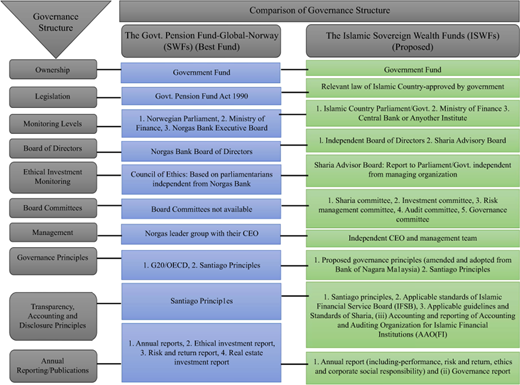
(b) Governance framework. The corporate governance framework of these special type investors (SWFs) should be convenient, realistic and adaptable. The SWFs are special purpose investors with unique objectives as compared to the financial institutions and asset management companies. Therefore, we propose a highly systematic and comparative framework based on Islamic finance principles. Our framework is based on two elements: first, the governance framework of SWFs should be unique from Islamic financial institutions, and, second, comparative to “The Government Pension Fund-Global (GPFG), Norway” that is world most transparent fund (Truman, 2007; Clark and Monk, 2010). Our ultimate goal is to present and formulate the best governance framework as compared to GPFG based on Islamic governance principles (Figure 3). Furthermore, we compare the proposed ISWFs and GPFA governance framework in Figure 4.
3.4.3.3 Pillar 3: the Islamic transparency and disclosure framework
The transparency and disclosure framework have a key role in good management and performance of the SWFs. We found that conventional SWFs has weak transparency and disclosure mechanism. We propose to establish a good transparency and disclosure framework based on the existing mechanism for Islamic financial institutions and propose to amend them as per the requirement of SWFs. First, we recommend the implementation of Santiago principles. Second, we review and recommend amendments as per the scope of SWFs in the audit, transparency, disclosure, accounting and reporting standards formulated by Islamic Financial Service Board (IFSB) (IFSB, 2018), and Shariah and accounting guidelines and standards by Accounting and Auditing Organization for Islamic Financial Institutions (AAOIFI, 2018). Table VII shows the details of the transparency and disclosure principles and standards.
3.4.3.4 Pillar 4: the Islamic corporate social responsibility framework
The 4thth pillar of the ISWFs model is the adoption and implementation of the ICSR principles. In Shariah, the Holy Quran and Hadith are the primary references for the ICSR. The religious book of the Muslims guides about ethics and social responsibilities (Ismaeel and Blaim, 2012). We argue that conventional SWFs from Muslim countries should follow the ICSR principles as given in Table VIII and framework (Figure 3). The tenets of ICSR based on the following concepts (Farook, 2007): First, vicegerency: this principle denotes that humans are the representatives of God on the earth. Humans must behave as per the guidance of the Allah in the world in aspects of life, personal or business and trade. Second, divine accountability: this principle follows the vicegerency principle that if a human does not behave ethically and socially responsible as per the guidance of Allah that is presented for them in Quran, he/she will be accountable before Him/herself at the day of judgment. Finally, forbidding evil: this principle denotes that Allah places the Muslim in the world as trustee and inform them that you can enjoy this thing and you are prohibited from sin. Therefore, Muslim is forbidden doing wrong in their personal daily life and business.
3.5 What could be the role of Islamic sovereign wealth funds in the growth and development of Islamic finance and economy?
The impact of conventional SWFs on international finance and economy is significant especially after the subprime financial crisis of 2007–2008 (Mihai, 2013). The main objectives of SWFs creation are the stabilization and sustainable economic growth and development of the economy (Li, 2015). The concept to use the SWFs as a tool of stabilization to convert the commodities revenues in funds is started by Arab Gulf countries, such as Kuwait, Qatar, UAE and Saudi Arabia. Mochebelele (2013) examined the effect of the SWFs on host country economy and concludes that SWFs have a limited impact on economic growth and development. Recently, Mishrif and Akkas (2018) examined the effect of SWFs on Islamic finance through the descriptive case study for the Gulf countries. They conclude that despite both industries have grown during the last decade, the real effect of SWFs is limited to Islamic finance due to several management issues of the SWFs.
Contrary to the above, Rugman (2014) argued that SWFs and Islamic finance growth are linked with each other in Arab Gulf countries. The role of the SWFs on the economic development of the Middle East region is critically analyzed by Li (2015). He showed that in 2014, the GDP of Middle Eastern countries reached $2.64 trillion after the creation of SWFs. He concluded the SWFs have a positive effect on the economic growth and macroeconomic policies.
Besides, Guerrero and Fuentes (2015) explored the relationship between Islamic finance and SWFs. They presented the following two aspects: first, a link between economic growth and Muslim population; they argued that due to increase in Muslim population their economic growth will increase. In 2010, the Muslim population was 23.4 percent of the world population, and it is expected to grow upto 26.4 percent in 2030 that will result in the expected growth of 37.5 percent. Similarly, they report IMF data show reflects that 57 member countries of the Organization of Islamic Corporation will grow an average rate of 6 percent between 2013 and18.
Second, they report that SWFs from Muslim countries are drivers of the halal industry through utilizing the Islamic banking channels, 77 percent of the governance bodies of SWFs from Muslim countries doing transactions under Islamic finance, 28 percent support the Islamic business strategy, 71percent follow Islamic principles of investment, 26 percent are Shariah compliant, and 61 percent are working with non-Muslim countries based on Islamic principles.
Despite the above fact, currently, no full-fledged ISWF exits in Muslim countries. The 30 conventional SWFs from Muslim countries indirectly support the economy, halal industry and Islamic finance. ISWFs have a unique type of structure, function and governance mechanism as discussed in relevant sections. These facts about the positive role of SWFs also support our model and argument that Muslim countries are required to adopt the pure model of ISWFs to improve their governance, image and function in growth and development of Islamic finance and economy.
4. Conclusion
Currently, 30 SWFs from Muslim countries exist around the world that have total AUM of $3,328.5bn. The funds are under high criticism of having a weak structure, governance and transparency mechanism. Moreover, these SWFs are owned by non-democratic and tyrannical governments, such as Saudi Arabia, UAE, Qatar, Russia, China and Kuwait as per definition of democracy by the USA and western countries. The policymakers of several developed countries consider investment by SWFs as a national and commercial risk. As a response to this threating image of SWFs from Muslim countries, many developed host-countries banned or critically examine the SWFs investments. Therefore, it is essential for the SWFs from Muslim countries to overcome this criticism and improve their structure, governance, and transparency by adopting a well-tested and start-of-the-art mechanism based on fundamental principles and laws. The SWFs from Muslim countries have two options: first, to take the arrangement of developed countries SWFs, such as Norway, America and the Netherlands that is based on Santiago principles; and, second, to establish and formulate their mechanism based on Islamic finance principles and Shariah laws. However, the implementation of Shariah law by Muslim countries is more practical and already well-tested in the case of Islamic banking and finance. Consequently, this paper argues that conventional SWFs from Muslim countries required an ISWFs through the implementation of the Islamic finance principles and Shariah laws.
As a solution, this paper presents an the ISWFs model based on fundamental four pillars: the major Shariah principles, the Islamic corporate governance framework, the Islamic transparency and disclosure framework and the ICSR framework. The vital contribution of this paper is first, the division of the portfolio of SWFs between Muslim and non-Muslim countries; second, exploration of the criticism on SWFs from Muslim countries; third, practical and critical examination of the existing status structure, management, governance, transparency and disclosure of SWFs from Muslim countries; fourth, the investigation of the prospective role of ISWFs on growth and development of the economy; and finally, the presentation of the first ISWFs model based on Islamic finance principles and Shariah law for Muslim countries.
This study has two limitations. First, the model is an initial work and idea to convert SWFs from Muslim countries into Islamic SWFs requires in-depth policy review by governments of the funds. Therefore, it is essential to design several policies, rules and principles related to this model at the individual fund and country level. Second, we are unable to empirically check the effect of SWFs on Islamic finance and economy due to the non-availability of the data.

