


This paper investigates the structural model of vector autoregression (SVAR) of the interdependent relationship of inflation, monetary policy and Islamic banking variables (RDEP, RFIN, DEP, FIN) in Indonesia. By using monthly data for the period 2001M01-2019M12, the impulse response function (IRF), forecasting error decomposition variation (FEDV) is used to track the impact of Sharīʿah variables on inflation (prices).
This research uses quantitative approach with SVAR model to reveal the problem.
The empirical results of SVAR, the IRF show that policy shocks have a negative impact on all variables in Islamic banking except the equivalent deposit interest rate (RDEP). The impact of both conventional (7DRR) and Sharīʿah (SBIS) policies has a similar pattern. While the transmission of Sharīʿah monetary variables as a policy operational target in influencing inflation is positive. In addition, the FEDV clearly revealed that the variation in the Sharīʿah financial sector was relatively large in monetary policy shocks and their role in influencing prices.
The empirical results of SVAR, the IRF show that policy shocks have a negative impact on all variables in Islamic banking except the equivalent deposit interest rate ‘RDEP’. The impact of both conventional “7DRR” and Sharīʿah “SBIS” policies has a similar pattern. While the transmission of Sharīʿah monetary variables as a policy operational target in influencing inflation is positive. In addition, the FEDV clearly revealed that the variation in the Sharīʿah financial sector was relatively large in monetary policy shocks and their role in influencing prices.
Introduction
A monetary policy transmission mechanism describes how the monetary policy adopted by the central bank influences various economic and financial activities so that it can reach the final goal set (Bernanke and Gertler, 1995). Monetarists think money is most important in influencing output, whereas Keynesian contemplate that there are other important variables that affect output, such as government spending.
In the Indonesian context, the question of how the monetary policy transmission mechanism operates is also interesting to study. In accordance with the Law of the Republic of Indonesia Number 23 of 1999 which has been amended by the Law of the Republic of Indonesia Number 3 of 2004, the objective of Bank Indonesia is to achieve and maintain stability in the Rupiah, namely price stability (inflation) and the exchange rate. In reality, the transmission mechanism of monetary policy is a complex process in which interaction of both the financial and real sectors are involved.
Since the issuance of the Banking Act in 1998, Indonesia has de jure implemented a dual banking system, when conventional banks with an interest rate system and an Islamic bank with a profit and loss sharing system or interest-free system can operate side by side in Indonesia. In 2018, the condition of Sharīʿah banking resilience has become stronger. This is reflected in the increase in CAR ratio of Sharīʿah Commercial Banks by 248 bps (yoy) to 20.39%. Meanwhile, the Sharīʿah banking intermediary function also improved. Sharīʿah banking assets still showed positive growth, despite slowing compared to the previous year. In the last three years, the growth of Sharīʿah banking assets has been maintained in double digits, with the asset share reaching 5.96% of the national banks, an increase compared to the previous year which was 5.78%. Islamic Commercial Bank (ICB), Islamic Business Unit (IBU) and Islamic Rural Bank (IRB) showed positive growth. Now, 29 of the 34 Islamic banks (14 ICB and 20 IBU) have a Conventional Commercial Bank parent. Despite this growth, the share and capitalization of Islamic banking and financial assets and markets is still small. Although in terms of growth and acceptance of the community it is very good and increasing, when compared with conventional banks it is still very far away (Syafrida and Aminah, 2015).
Research in the realm of monetary policy has been conducted using Indonesian sample. Ascarya (2012, 2014), Herianingrum and Syapriatama (2016), Setiawan and Karsinah (2016), Widodo (2017) and Fikri (2018) investigated the transmission process through both conventional and Islamic banking. Zulkhibri and Sukmana (2017) and Octaviani and Arif (2018) examined the transmission process through Islamic banking, specifically by passing through Islamic banks financing. Zulkhibri and Sukmana (2017) employed panel regression analysis. In another research, Ozkan and Erden (2015) conducted a comprehensive study that combined dynamic conditional correlation and generalized autoregressive conditional heteroskedasticity (DCC-GARCH) and panel threshold regression analyses to assess time-varying exchange rate pass-through and macroeconomic determinants of the degree. This study covered a sample of 88 countries composed of 19 less-developed, 41 developing and 28 advanced countries and found low exchange rate pass-through (ERPT) over the past 30 years, and that it is declining since the mid of the 1990s. Further, the study evidenced a positive relationship between ERPT and average inflation but the negative response of inflation rate volatility to exchange rate volatility, the degree of openness and the output gap. Helmy et al. (2018) adopted SVAR model, impulse response function (IRF) and variance decomposition (VD) to evidence pass-through effects in Egypt. In Malaysian context, Akhatova, Zainal and Ibrahim adopting structural vector autoregression (SVAR) specification, validated the significant responses of both conventional bank credit and Islamic bank financing to monetary policy shocks even shocks tend to be different. Majid and Hasin using an autoregressive distributed lag (ARDL) bound testing approach showed that Islamic financing channel for monetary transmission exists in Malaysia. Islamic financing is unequally distributed to economic sectors in response to monetary policy shock. Furthermore, the findings also reflect that Islamic banking as operating in a dual banking system is not spared from interest rate and monetary conditions of the country.
Through a comprehensive review of the empirical literature, it is found that several known scholars have confirmed MPTM through both the bank lending and the balance sheet channels for different economies (Bernanke, 1993; Bernanke et al., 1995; Cecchetti, 1999; Hamza and Saadaoui, 2018; Kashyap and Stein, 1994). However, these researchers have also reported the effect of monetary policy shocks on banks’ lending ability that differs considerably across bank size and banks liquidity positions. Similarly, Anwar and Ngyend (2018), Auclert (2017), Aysun and Hepp (2013), Erdogdu (2017), Evans et al. (2015) and Jermann (2019) have found the significance of Central Banks in monetary policy transmission mechanism.
What is so special about Islamic banks is that financial stability is enhanced by the existence of risk sharing activities (Yungucu and Saiti, 2016; Miah and Uddin, 2017). Whenever there are shocks to the financial system, Islamic banks can absorb these shocks and transmit them. Shocks will mostly affect the assets-side of bank’s balance sheet. However, due to their risk sharing nature, these shocks will be transmitted to the liabilities side. This capability will render Islamic banks capable of withstanding the uncertainty in the economy (Rashid et al., 2017).
This study will try to identify the process of monetary transmission through Sharīʿah macro monetary variables then how the Islamic monetary variables play a role in the ultimate goal of monetary policy, namely price stability which is proxied by inflation. The problem is how the process carried out in the transmission (black box) affects the real sector or inflation target. In the process what variables are influential and what are their role and lags of time (operator lag). The present paper differs from the earlier studies as it uses time-series econometrics, i.e. SVAR.
Theoretical and empirical literature
The mechanism of monetary policy transmission is an intricate phenomenon, because transmission to the macro-economy takes place through multiple channels. The channel categories identified in the literature include the interest rate channel, exchange rate channel, credit channel and asset price channel (Cecchetti, 1999; Taylor, 1995). The impact of each channel is determined by country-specific factors such as economic structure, statutory guidelines, market formation and financial con- figurations. The key element for an efficient monetary policy is identification of the relative significance of these channels related to a specific country.
In an Islamic economy, the banking sector does not recognize interest rate instruments. The Islamic financial system implements profit-loss sharing (PLS) based transaction and trend based transactions. The distribution of the proportion of profits is based on business activities (investment) and the provision of funds to the real sector. This means that the Islamic monetary system (monetary policy) has a dependency on the real sector. Nevertheless, there are no specific Islamic principles discussing the monetary transmission mechanism regarding credit and financing channels. The central bank uses monetary policy in order to encourage economic growth by maintaining a smooth circulation of money in the medium and long term, within the framework of stable prices and other socioeconomic targets (Chapra, 2000).
Previous research on the mechanism of monetary transmission, especially bank lending channels, has been carried out by Ascarya (2012), Wulandari (2012), Yarasevika et al. (2015) and Amaluddin (2007) economic growth in Indonesia. Other studies such as Agha et al. (2005), Simpasa et al. (2015), Montes and Monteiro (2014) and Sanfilippo-Azofra et al. (2017), emphasize credit channel. They state that the credit channel is a very effective monetary transmission mechanism that affects economic growth in 33 developing countries. However, research studies on the mechanism of Islamic monetary transmission, especially the new bank financing channel are recent and still very limited. Studies on bank financing channels including those by Amaluddin (2007), Ascarya (2012) and Hamza and Saadaoui (2018) found that although the influence of the Islamic monetary system is still relatively small compared to the conventional system in transmitting monetary policy to the real sector, the Islamic system can reduce the adverse impact of interest rates, so it will not cause inflation and increase economic growth. Ascarya (2012) uses the methods of VAR, ECM and ARDL and argues that the conventional systems provide the expected results, except that the increase in interest rate (rSBI) will increase inflation. Beik and Arsyianti (2013) describe the Sharīʿah monetary transmission mechanism that has been practiced in Indonesia for real output growth and inflation. The result is that all Sharīʿah variables have a significant impact on the growth of the real sector; there are no variables that affect inflation. Except that the SBIS instrument is not able to encourage economic growth and is only used as an instrument to absorb funds that are not allocated to the real sector. The Islamic system mostly provides the expected results similar to conventional systems. The dual system still indicates some inconclusive results.
A stream of literature has revealed the role of Islamic banking in the monetary transmission process in the Islamic world (Aysan et al., 2018; Majid and Hasin, 2014; Sukmana and Kaseem, 2014; Yungucu and Saiti, 2016). The earlier notable study by Agha et al. (2005) explained that along with the traditional exchange rate channel, the banking channel is also a significant source of monetary transmission in Pakistan. Similar research by Mohsin (2011) determined the impact of monetary policy on lending and deposit rates in Pakistan. Janjua et al. (2014) found a negative relationship between monetary policy and bank loan supply. In addition, they showed that contracting monetary policy is adversely associated with smaller banks as compared with larger banks. The study will add new insights to the little research that exists on the subject and could also be generalized to other similar growing Islamic banking markets around the globe.
Methods
There are still only few studies in small-open economies which examined the effect of the monetary policy shocks by using an open SVAR approach. For example, some SVAR studies of a small-open economy include Cushman and Zha (1997a, b), Brischetto and Voss (1999), Dungey and Pagan (2000), Parrado (2001) and Buckle et al. (2007). Most of the studies have used block exogeneity restrictions in modeling the international economic linkages to the small-open economy. The present study uses the SVAR method as an extension of vector autoregression (VAR). In the VAR method a theoretical restriction is not made based on economic theory that is relevant to the variables used in the analysis, whereas in SVAR a restriction is made based on a strong theoretical relationship to the scheme in the form of the variables used in the VAR system. The fundamental difference between the VAR and SVAR models lies in the emphasis of restriction. That is, the critical phase of the SVAR model lies in the identification of elements in the matrix (see Table 1).
Definition of variables
| Notation | Definition of variables | Explanation |
|---|---|---|
| EFFR | Effective Federal Funds Rate | The Fed's interest rate as a proxy for the world interest rate |
| 7DRR | BI rate/7 days repo rate | Official interest rate for 3 months |
| SBIS | Outstanding placement on Sharīʿah SBI | Outstanding placement on Sharīʿah SBI |
| RDEP | Equivalent rate of return of Sharīʿah deposits | Interest rates 1-month deposits |
| RFIN | Equivalent rate of return Sharīʿah financing | Average level of profit sharing ratio for banks |
| DEP | Total Sharīʿah banking deposits | Total deposits successfully collected Islamic banks |
| FIN | Financing | Total financing provided by Islamic banks |
| P | Inflation | Monthly nominal inflation rate |
The VAR (1) and SVAR (2) models are denoted as follows:
where:
: (n × 1) endogenous variable vector representation.
c0: (n × 1) representation of constant vector.
: (n × n) matrix (i = 0, …, p) of structural parameters,
D: (n × 1) vector of exogenous variables and.
: (n × 1) structural innovation, assumed to be orthogonal and not correlated.
The basic specification model of VAR that will be used is a dynamic model, reduced form VAR namely:
where:
: vector endogenous variable.
: autoregressive lag polynomial.
: vector reduced form innovations.
Reduced form innovations can be an instrument that describes the movement shock of variables in VAR with certain restrictions according to economic theory so that the SVAR model is produced. In accordance with the standard literature in SVAR, the correlation between reduced form innovations and structural shocks is represented in the following equation known as the AB model:
A and B are n × n matrices that explain the instant relationship between variables and the linear relationship between reduced forms innovations with structural shocks. These structural shocks are assumed to be independent and are identically distributed so that they do not contain zero cross correlation. The VAR structural form can be generated by multiplying Eqn (1) with A and using the relationship in Eqn (2) so that it becomes the following equation:
Eqn (5) can be solved to find Xt so as to produce the SVAR specification as follows:
The SVAR equation for the above model can be summarized according to Zivot (2000) into the following equation:
The main purpose of SVAR estimation is to obtain a non-recursive orthogonalization error term for the analysis of impulse response, while the alternative recursive orthogonalization from Cholesky requires including sufficient restrictions to identify the components orthogonal error term. B is an 8 × 8 matrix containing structural parameters of endogenous variables in this paper namely EFFR*, 7DRR, SBIS, RDEP, RFIN, DEP, FIN and P, yt is an endogenous variable vector at k dimensions at time t, is an intercept, is a vector of endogenous inaction variables at k dimension, et is a structural innovation vector k dimension, where ∼ is a constant in the vector, k- dimensional Γ1 is a matrix of polynomials (finite order matrix) with a lag of one operator at k × a structural coefficient k.
The relationship between reduced form and structural model can be stated as below:
Exact identification requires parameters in B0 and D, totaling , which can only be obtained from the reduced form equation. Because Σ has a parameter , we need restrictions on B0 and D. That is the standard in the SVAR literature for D its shape diagonal, wearing a restriction , also restriction on the matrix B0. For example the matrix B0 lower triangular, called standard recursive or Wold causal ordering is often used in SVAR studies.
SVAR model, restriction and identification
Based on the relationship between variables as formulated next, an analysis of influence and the SVAR basic model of the transmission mechanism of Sharīʿah monetary policy in Indonesia will use 8 main variables. That is, the external economy (for example, the United States) is not affected by fluctuations in the Indonesian economy both contemporary and lagged. So the basic model SVAR monetary economy of Sharīʿah Indonesia is represented by a vector Xt:
The main purpose of the use of models SVAR is to obtain non-recursive orthogonal on the error term for analysis of impulse the response. Therefore the SVAR model includes a number of restrictions to identify structural or orthogonal components of the error term. For this reason, must be included for short-term restrictions (contemporaneous restrictions/K-models).
Recursive relationship notation is not sufficient to identify the relationship simultaneous contemporaneous between policy instruments and Sharīʿah macro monetary variables. To determine the dynamic shock of structural monetary policy and mitigate its impact, a non-recursive SVAR is used, which allows the imposition of restriction assumptions into the model. The non-recursive structure provides an explanation of the simultaneous contemporaneous interactions between variables.
Non-recursive SVAR models in this study have restrictions as written in the matrix below: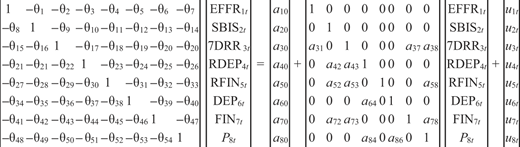
Structural variance covariance matrix is D assumed to be diagonal, so the model is over-identified because there are more 4 restrictions. To compile the equation notation in the matrix form above explicitly, it can be seen in its partial equation. For example the price equation (inflation) as follows: . Likewise, for the other equations.
An explanation of the restrictions imposed is as follows: the first two variables EFFR and SBIS are considered as external variables that are not affected by the temporary shock of the domestic variables in the system. The EFFR and SBIS variables are only influenced by themselves. EFFR here used to shows that Indonesia is a small open economy that influenced by exogen variable. The 7DRR variable is influenced by the EFFR, because the benchmark interest rate in a small open economy will inevitably be influenced by the world interest rate represented by the Fed's interest rate. In addition, the determination of 7DRR is also influenced by the variable financing (FIN) and inflation (P), the amount of financing will affect the determination of the amount of 7DRR because it is used to stimulate it, likewise inflation will be adjusted to the development of the reference interest rate.
Results and discussion
This paper found that although the influence of the Islamic monetary system is still relatively small compared to the conventional system in transmitting monetary policy to the real sector, the Islamic system can reduce the adverse impact of interest rates, so it will not cause inflation and increase
Stationarity test and optimum lag
The test method used to carry out stationary tests is the ADF test with a maximum lag of 4. If the t-ADF value is smaller than the critical value of MacKinnon, it can be concluded that the data we use do not contain unit roots. Several preliminary tests are required including unit root test, stability test, optimum lag test and cointegration test. Unit root test is used to determine whether data (variable) is stationary in level or stationary in first difference. When unit root exists, it means that the data is not stationary and has trend component in it, which should be removed to produce un-spurious results. Augmented Dickey-Fuller or ADF test and Phillips-Perron or PP test are used simultaneously to test the existence of unit root or the stationary of the data. Using 5 per cent McKinnon critical value, there are only two variables that stationary at level (EFFR effective federal funds rate and rFIN Islamic financing rate of return). However, all variables are stationary at first difference.
The estimated optimal lag length selection, SC (Schwarz information criterion) and HQ (Hannan-Quinn information criterion) recommend lag 1 and 2, while FPE (final prediction error), LR (sequential modified LR test statistic at 5%) and AIC (akaike information criterion) recommend lag length the same is 4. Because the best choice between 2 lag or 4 lag, referring to Liew and Terence (2005) and Ivanov and Kilian who recommend AIC as the strongest criterion for monthly observational data, then the lag is chosen 4.
SVAR estimation
The result of an estimate of SVAR with established restrictions, of the 14 parameters produced, most are significant, there are only 3 coefficients that have a significance value greater than 5%, namely c(1) in the BI reference interest rate equation (7DRR), c(3) and c(13) in the RFIN equation. In general as shown in Table 2, these results reflect good estimation results because the core of SVAR analysis is the analysis of impulse responses and the decomposition of variations. The EFFR coefficient apparently has no effect on the 7DRR, it is certainly an unexpected result, theoretically with a small open economy, changes in the interest rates of the US Fed will affect almost all the central bank's benchmark interest rates in the world. equivalent return on deposits in Islamic banks (RDEP) directly. This could happen because in the research period the reference was stable both the 7DRR and the EFFR itself, so that there was no shock reading from the EFFR. Furthermore SBIS has no effect on the equivalence of financing interest rates (RFIN), meaning that the determination of profit sharing ratio as a proxy for financing interest is not influenced by the level of SBI returns and funds deposited on the instrument. Likewise inflation (P) does not affect the interest rate on Islamic bank financing. The other parameters are in line with expectations, so the results are good enough for an analysis of the shock response of a policy.
Stability test
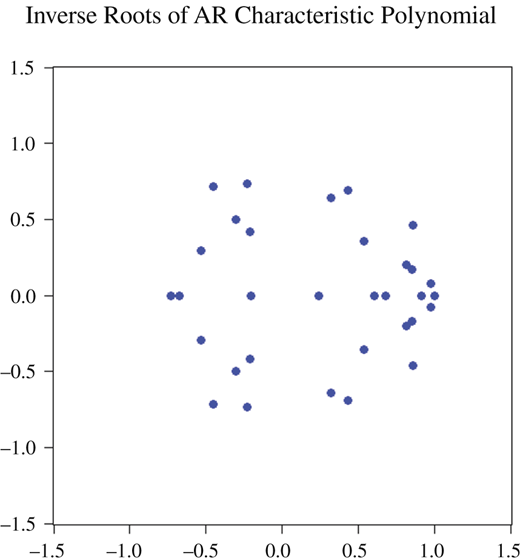
Based on the VAR stability test in the figure, Islamic monetary transmission shows the modulus value of the model entering the circle. Based on these results it can be concluded that the VAR model is stable so that antest can be performed impulse response and VD on this model. Figure 1 shows that all modulus values are less than one, and there are no explosive variables so that the model is stable.
Impulse response function
Figure 2 below shows that the vertical axis in the IRF image describes the standard deviation used to measure how much response will be given by RDEP, RFIN, DEP AND FIN if there is a shock to the 7 days repo rate (7DRR). Whereas, the horizontal axis shows the duration of variable response time in the model if there is a shock at 7DRR. If the 7DRR response above the horizontal axis indicates that the shock will have a positive effect, vice versa if the 7DRR response below the horizontal axis indicates that the shock has a negative effect.
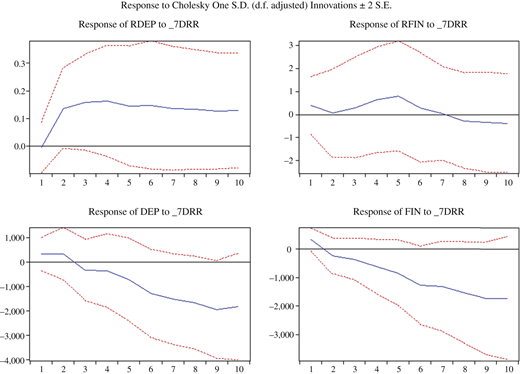
IRF analysis on Islamic monetary transmission in the next 10 months. It can be explained that monetary policy shocks have been responded positively by Islamic banks with an increase in the equivalent rate of return (DEP) and financing (FIN). Although the pattern of change in the rate of return is different because the RFIN level starts to fall in the 5th month and negative in the 7th month, both the DEP and FIN variables continue to show a decline. The highest response to the shock of 7DRR monetary policy is the equivalent level of savings in Islamic banks (RDEP), where RDEP responds positively about 1.5% to 7DRR shock at one standard deviation. This means that the higher the 7DRR, BI implements a tight monetary policy, the Islamic banks will also increase yields by increasing the equivalent rate of return.
The level of return on deposits in Islamic banking is consistently positive until it reaches a balance of around 1% in the 10th month. Therefore, it is true that the movement of the BI benchmark interest rate will encourage both conventional banks and Islamic banks to raise interest rates, so that this positive relationship is proven. That way BI policies are also aligned transmitted by Islamic banks by increasing the rate of return so that people save their funds in the banking system. However, the public's response in responding to the increase in the rate of return only lasted for 2 months, after which time deposit funds (DEP) actually responded to being negative starting to enter the 3rd month, during the 10th month it only began to rise again.
The DEP variable only responds to the short term because at the same time the response to the financing interest equivalent rate (RFIN) also rises with an increase of 7DRR. In this case the two indicators of the rate of return show a similar response that is positive to the shock of monetary policy. Even though in the 7th month the financing interest rate (RFIN) began to fall even negative to minus 1%, at the same time financing (FIN) continued to show a downward trend. The response of both RDEP and RFIN returns shows a positive relationship until the 5th month, where the interest rate of financing responds to greater monetary policy shock. This large response was apparently not consistent enough because starting from month 5 it tends to decrease even negatively entering month 7. It can be explained that the high level of interest financing equivalent will subsequently result in declining financing so that banks will eventually reduce their financing interest rates again. This is consistent with FIN's response to 7DRR which tends to continue to decline. While the DEP variable, although initially decreased, recovery began in the 9th month. The difference in adjustment is related to the time value of money, where people still need banks as a place to store their funds in the long run.
Figure 2 shows that the vertical axis in the IRF image describes the standard deviation used to measure how much response will be given by RDEP, RFIN, DEP AND FIN if there was a shock of 7 days repo rate (7DRR). Whereas, the horizontal axis shows the duration of variable response time in the model if there is a shock at 7DRR. If the 7DRR response above the horizontal axis indicates that the shock will have a positive effect, vice versa if the 7DRR response below the horizontal axis indicates that the shock has a negative effect.
IRF analysis on Islamic monetary transmission in the next 10 months. It can be explained that monetary policy shocks have been responded positively by Sharīʿah banks with an increase in the equivalent rate of return (DEP) and financing (FIN). Although the pattern of change in the rate of return is different because the RFIN level starts to fall in the 5th month and negative in the 7th month, both the DEP and FIN varuabels continue to show a decline. The highest response to the shock of 7DRR monetary policy is the equivalent level of savings in Islamic banks (RDEP), where RDEP responds positively about 1.5% to 7DRR shock at one standard deviation. This means that the higher the 7DRR, BI implements a tight monetary policy (tight), the Islamic banks will also increase yields by increasing the equivalent rate of return.
The level of return on deposits in Islamic banking is consistently positive until it reaches a balance of around 1% in the 10th month. Therefore, it is true that the movement of the BI benchmark interest rate will encourage both conventional banks and Islamic banks to raise interest rates, so that this positive relationship is proven. That way BI policies are also aligned transmitted by Islamic banks by increasing the rate of return so that people save their funds in the banking system. However, the public's response in responding to the increase in the rate of return only lasted for 2 months, after which time deposit funds (DEP) actually responded to being negative starting to enter the 3rd month, during the 10th month it only started to rise again.
The DEP variable only responds to the short term because at the same time the response to the financing interest equivalent rate (RFIN) also rises with an increase of 7DRR. In this case the two indicators of the rate of return show a similar response that is positive to the shock of monetary policy. Even though in the 7th month the financing interest rate (RFIN) began to fall even negative to minus 1%, at the same time financing (FIN) continued to show a downward trend. The response of both RDEP and RFIN returns shows a positive relationship until the 5th month, where the interest rate of financing responds to greater monetary policy shock. This large response was apparently not consistent enough because starting from month 5 it tends to decrease even negatively entering month 7. It can be explained that the high level of interest financing equivalent will subsequently result in declining financing so that banks will eventually reduce their financing interest rates again. This is consistent with FIN's response to 7DRR which tends to continue to decline. While the DEP variable, although initially reduced, recovery began in the 9th month. The difference in adjustment is related to the time value of money, where people still need banks as a place to store their funds in the long run.
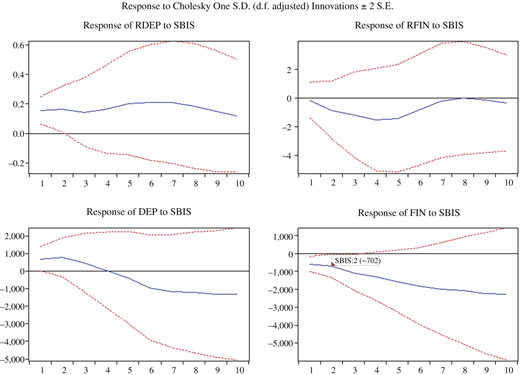
Figure 3 above shows the response of Sharīʿah monetary variables to SBIS shock variables. RDEP consistently responds positively until the end of the observation period, even going up slightly in the middle of the 6th and 7th months. This means that the higher the SBIS as indicated by the increasing number of Islamic banking funds parked in the SBIS instrument, the bank will increase the rate of return on deposit so that the DEP rises, with the expectation the funds can be placed on SBIS that provide a good and safe return rate. However, DEP responded differently in the 4th month, where the community began to respond negatively to SBIS shock. When Islamic banks increase RDEP, the public stays to increase their deposits (DEP) up to the 4th month. For the return on financing (RFIN), Islamic banking immediately responds negatively by lowering the financing interest rate (FIN), but tends to return initially at 8 months onwards stable. But the amount of financing (FIN) even tends to continue to decline negatively from the original condition. This condition is related to risk, where placement in SBIS will be safer than providing financing for the real sector which is more risky even with a profit sharing scheme. In general, Sharīʿah transmission variable responses to 7DRR and SBIS monetary policy shock tend to show the same pattern and in accordance with monetary theory. A slight difference was shown in the RFIN variable because it immediately responded negatively by 16% at the start of shock and returned to the initial balance at the 10th month.
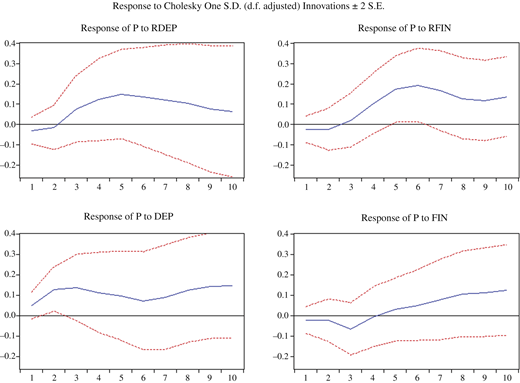
Now we see how the transmission of monetary policy can be crossed by Islamic monetary variables in influencing inflation. We can see that all RDEP variables, RFIN. DEP and FIN all contribute to the increase in inflation, it is shown by the response P which is above the midline (positive) in Figure 4, all variables affect inflation around 1% even though with different fluctuations, for example the FIN variable was responded negatively in the 3rd month, but only briefly later rose again. It can be said that, monetary policy by raising the benchmark interest rate of 7DRR and SBIS is still unable to restrain inflation, but at least Islamic banks can transmit to inflation moderately, an increase of 1% inflation in a year is a natural phenomenon in a developing economy.
Variance decomposition
After analyzing dynamic behavior through impulse response, the characteristics of the model will be seen through VD. The analysis here focuses on how variables in Islamic banking affect inflation (P). As can be seen in the table, the most dominant RDEP variable is influenced by its own variable which reaches 90% in the first month, then consistently becomes 70% at the end of the period. The next variable that influenced RDEP was SBIS by 16% and 7DRR by 10%. This shows that the SBIS Sharīʿah monetary policy variable shows a greater influence than the 7DRR as a proxy for conventional policies, although it also influences RDEP.
VD on the transmission of Islamic monetary policy to determine the contribution of the RDEP, RFIN, DEP AND FIN variables to changes in 7DRR AND SBIS and their effect on inflation (P) in the coming periods. VD analysis shows that the variable that is expected to have the greatest contribution to P is itself which reached 90% at the beginning of the period and continues to fall until it reaches a firm figure of 45%. In the next ten months RFIN, DEP and RDEP and FIN contributed 16%, 12%, 8% and 7%, respectively. But at the beginning of the period, DEP made a greater contribution because it affected the money supply (JUB) as a target between monetary policy of 1.5%.
Conclusion
From the results of the above study, it can be concluded that the variables in Islamic banking which are proxy with FIN, RFIN, DEP and RDEP have different responses in parameters both in impulse and decomposition, but in general give a similar response when there is a change or shock of monetary policy both conventional (7DRR) and Sharīʿah (SBIS). Likewise Islamic monetary variables can affect the economy in this case inflation (P), but with little impact. This is in conformity with Amaluddin (2007), Ascarya (2012) and Hamza and Saadaoui (2018) who found that although the influence of the Islamic monetary system is relatively small compared to the conventional system in transmitting monetary policy to the real sector, the Islamic system can reduce the adverse impact of interest rates, so it will not cause inflation to increase.
Analysis of the IRF proves that the pattern of relationships between Sharīʿah monetary instruments (SBIS) and Islamic banking financing (LFIN) is negative. This means that the higher the SBIS determined by Bank Indonesia, the lower amount of Islamic financing provided to the public. This is understandable because with a relatively high SBIS, Islamic banking will tend to choose to deposit funds in Bank Indonesia and become reluctant to extend loans to customers. The impact will certainly be counterproductive, people who need capital will be more difficult to find business financing, including Islamic banking. Similarly, the relationship that occurs between 7DRR with FIN.
Other IRF results show that the DEP relationship pattern with SBIS is negative, meaning that the higher SBIS will cause a decrease in the collection of Islamic funds and vice versa. Although the initial shock could respond positively. The reason is, when the monetary authority conducts a policy of raising SBIS interest rates, it will trigger the conventional banking industry to raise interest rates on loans, savings and deposit rates. This will have an impact on the decline in competitiveness of Islamic banking. The profit sharing return provided by Islamic banks will be less competitive compared to savings and deposit interest given by conventional banks. Directly or indirectly this will affect the reduction in the amount of third party funds (DPK) received and the amount of financing channeled by the Islamic banking industry.
Judging from the variation decomposition, SBIS Sharīʿah monetary instrument is more contributed to the Sharīʿah banking financing variable (FIN) compared to the conventional 7DRR instrument. This is reasonable and can be understood that Islamic banking financing is more influenced by Islamic monetary policy instruments, this is evidenced by the greater contribution. Another important conclusion is that the pattern of relationships between Islamic monetary variables and inflation (P) is volatile; it can be positive or negative. This condition can be explained when inflation is getting higher, Bank Indonesia as the monetary authority will respond by raising SBI interest rates, which is why conventional banks generally raise interest rates. Like the condition above, when conventional bank interest is high, it will cause Islamic banking to be less competitive. In the end, it is very likely that the number of third-party funds along with Islamic bank financing will decline. The higher the amount of Indonesian Islamic banking financing, it will have an effect and contribute positively to the decrease in Indonesia's inflation rate. Bank of Indonesia should focus to maintain inflation using SBIS and short term interest rate. The financing bank lending channel still dominated the role for economic growth. Bank of Indonesia has recognized this and issued regulation supporting Islamic banking intermediary.

