The informal sector construction artisans are critical to the economic growth of a nation. The frequent incidence of hazards, especially where informal sector construction artisans are engaged, may threaten achieving Sustainable Development Goal (SDG) 3. Records show that anti-safety issues (absence of personal protective equipment [PPE]) threaten the lives and well-being of artisans and may be rampant in informal construction sites. Thus, this study aims to investigate the level of the informal sector’s artisans’ PPE awareness and offer suggestions to improve it and, by extension, improve achieving Goal 3.
The researchers collected the study’s data through face-to-face interviews from selected building sites with the approval of the clients and/or representatives in Benin City and Lagos, Nigeria. In total, 40 artisans were engaged across major construction trades, and the study achieved saturation. The researchers manually analysed the collected data and presented them using the thematic method.
Results show lax compliance with basic safety awareness and PPE, ignorance of the consequences to their health, the client’s attitude not to incur extra cost for safety kits, weak educational background, lax supervision of construction sites, lax safety compliance by authorised agencies and absence of informal sector artisans’ engagement regulation emerged as the root cause for the low compliance.
As part of the study’s implications, it recommends that the relevant government ministries, departments and/or agencies improve and extend their safety monitoring to informal construction sites to improve achieving SDG 3. This study may stir policymakers to persuade the Nigerian President to sign the Labour, Safety, Health and Welfare Bill 2012 (updated in 2016) into law and, by extension, improve achieving Goal 3.
1. Introduction
The construction industry is a critical component that contributes to countries’ economic growth. The industry is labour-intensive (Sanchez et al., 2017), especially in developing countries (Ebekozien, 2021) and one of the largest sectors that create job opportunities for the young adult unemployed (Ebekozien et al., 2018). Despite the advantages of the industry, hazard occurrence remained an ongoing issue. Studies like Ogundipe (2017) and Ebekozien (2021) worked on hazard occurrence in developing countries’ industries and recommended measures to encourage occupational safety practices. Yet, there are issues of high occurrence of accidents on project sites. This is why the construction sector is known for its high occurrence of accidents. Sanchez et al. (2017) avowed that the industry is ranked top among the risky industries. This assertion corroborated Park et al. (2015), who stated that the industry is a hazardous sector, and that safety should be strictly given attention by the stakeholders, including the clients and the construction contractors. Liu et al. (2020) emphasised that human fault by contracting employees is the most ranked root cause of most accidents on site. Yap and Lee (2019) argued that the lax safety performance associated with the industry has made many perceive the sector as unsafe, muddy, and problematic. Ebekozien (2021) corroborated Yap and Lee (2019) that it may be the most dangerous sector. This is debatable and calls for concern, especially in the informal private sector.
Safety regulations and Personal Protective Equipment [PPE] usage by construction artisans in the informal sites may be lax, especially in one-man construction site. For this study, construction artisans are specialised trades in the building sector. This includes painting, landscaping skills, aluminium fixing, roofing, steel fixing, concreting/plastering, block-laying, bricklaying, joinery, carpentry, welding, tiling, electrical, and plumbing (Afolabi et al., 2017; Ebekozien et al., 2023a). The researchers’ preliminary findings reveal that construction artisans in informal construction sites, especially in some developing countries such as Nigeria do not comply with PPE. The construction site’s protective equipment kits include safety footwear, ear and eye protectors, mark and respirators, safety nets, safety helmets, protective clothing, protective gloves, safety belts, use of equipment/tools, etc. This may challenge the artisans’ health and well-being and threaten to achieve Sustainable Development Goal (SDG) 3. This is because anti-personal protective equipment issues threaten the lives and well-being of artisans and are rampant in informal construction sites.
This is critical because of the informal sector’s role in advancing economic growth. Thus, human beings, including construction artisans in the informal sector, are critical to the 2030 Agenda for a sustainable future. There is a paucity of literature concerning compliance with basic PPE on informal sector artisans in developing countries, including Nigeria. This is a gap and one of the study’s motivations. The construction artisans in the informal sector may be the most vulnerable, especially in developing countries like Nigeria where there may not be functional government laws or unions to marshal their vision and challenges, including the provision of basic PPE kits as a requirement at the point of engagement for the day. Many contractors and self-help developers may leverage that to explore them and then expose them to health and well-being issues. These are some of the pertinent reasons for the study. This may threaten achieving Goal 3 for a specific group if not addressed. The health and well-being of the construction artisans are threatened because of non-availability of PPE kits. Thus, this study investigates the level of the informal sector’s artisans’ protective equipment awareness and offers suggestions to improve it and, by extension, improve achieving Goal 3. Hence, this study investigates the level of compliance and the root cause of low PPE compliance and offers measures to improve the implementation of PPE on artisans in the informal sector and, by extension, improve achieving Goal 3. Thus, the aim is accomplished via the following:
To assess the awareness level of the informal sector’s artisans’ PPE.
To investigate the cause of low compliance with PPE by construction artisans in the informal sector.
To suggest measures to improve the implementation of PPE for artisans in the informal sector and, by extension, improve the achievement of Goal 3.
2. Literature review
The informal construction sector is professed to be characterised by insufficient coordination and standardisation. A sector where anything can go with or without rules and regulations. For this study, construction artisans in the informal sector serve as a name used to describe private practices. Construction artisans can be hired by small-scale construction contractors or self-help housing developers to render skilled craftsmanship service and disengage them after the project to reduce overhead costs. In most cases, payment is made daily. Ebekozien et al. (2023a) opined that construction artisans can be trained in the informal sector and gain the skills required to make a livelihood. The issue of lax safety practices threatens Goal 3 and related sustainable development goals. However, researchers’ preliminary findings reveal a lax attitude to basic safety site practices among the construction artisans in the informal sector. If addressed, the presence of basic safety practices by construction artisans in the informal sector may help achieve Goal 3 and related SDGs. Also, construction artisans in the informal sector must embrace basic safety practices like daily use of PPE. Martin (2023) found that despite the sector (informal) being outside government regulation or beneficence, it can grow employment opportunities and generate a labour market for job seekers. This corroborated Hadisi and Snowball (2022), who stated that artisans are encouraged because of their ability to create work and contribute to gross domestic products. Thus, construction artisans in the informal sector should not be excluded from these benefits. This study argues, among other objectives, that measures should be sought to mitigate hindrances facing the informal sector construction artisans, embrace basic PPE usage, and, by extension, improve achieving Goal 3 in Nigeria. Embracing basic safety practices may improve measures to mitigate environmental hazards through sustainable construction and infrastructure (Target 3.9) and reduce informal construction artisans’ accidents and hazard issues on sites (Target 3.7).
A few studies (Abdulahi et al., 2015; Onyebeke et al., 2016; Ayessaki and Smallwood, 2017; Ogundipe et al., 2018; Meng and Chan, 2020; Ebekozien, 2021; Opoku et al., 2024) either address Goal 3 or PPE compliance in the industry but none regarding how compliance with basic PPE on informal sector construction artisans in developing countries like Nigeria can improve achieving Goal 3. Abdulahi et al. (2015) discovered that 76.4% of construction tradesmen have been involved in site-related accidents. This is extremely high and a threat to the health and well-being of certain groups of people if not curtailed. Onyebeke et al. (2016) focused on the size of PPE provided by contracting companies and found that they were unsuitable for female employees. Ayessaki and Smallwood (2017) ranked PPE as the best acceptable by construction directors, and insufficient safety measures and site accidents ranked best as the factors influencing employees’ performance. Meng and Chan (2020) discovered that employees with weak academic backgrounds displayed weak safety consciousness in projects. Ebekozien (2021) investigated contracting firms’ level of acquiescence to PPE with an emphasis on junior employees in Nigeria. Besides Opoku et al. (2024) review covering how SDGs can promote health and well-being in the built environment, artisans’ engagement in the informal sector was absent.
Therefore, it is appropriate to continuously research on measures to improve safety in the informal built environment sector, particularly in countries with lax rules and regulations regarding informal artisans’ engagement. Exploring the root cause of construction artisans’ lax compliance will assist in finding feasible solutions to improve achieving Goal 3. This corroborated van Heerden et al. (2018), who recommended investigating the underlying issues for non-execution of safety practices. Wong et al. (2020) discovered insufficient studies to investigate the basic barriers facing the use and non-use of PPE among construction practitioners. Engineer et al. (2021) affirmed that our surroundings, including the working environment, can influence our health and well-being. Goal 3 is among the few Goals yet to receive global attention in the built environment (Opoku et al., 2024). The built environment is critical to the SDGs (Ebekozien et al., 2024), including Goal 3. It may influence health directly or indirectly through health-related behaviours like promoting safe working environment. The non-availability of PPE to construction artisans in the informal sector may threaten the universal objectives of Goal 3, “ensuring a healthy life and promoting well-being for all ages” (Guegan et al., 2018).
3. Research method
In line with the research onion the study adopted a qualitative approach to address safety issues regarding achieving Goal 3 to explore the underlying issues. This corroborated Ebekozien (2021), which adopted a qualitative approach as an alternative to address the persisting issues even after several quantitative methods in the previous studies. Hence, the researchers adopted constructivism as the research philosophy (Saunders et al., 2012; Ebekozien et al., 2025a, b; Ramli et al., 2025). This consists of exploration to explain the participant’s actions and emotions. In the next layer, the researchers adopted an inductive approach followed by the qualitative research design. The study is investigative and involves gathering feasible measures from knowledgeable participants (Creswell and Creswell, 2018; Ebekozien et al., 2023b). In the fourth layer (research strategy), the study adopted the phenomenology method and was supported by the researchers’ observation of 14 selected construction sites in two locations (Benin City and Lagos, Nigeria). The study adopted phenomenology because it can provide a healthier investigative mechanism to explore the underlying issues influencing non-compliance with PPE and provide measures to improve embracing PPE and, by extension, improve achieving Goal 3. This aligns with Wong et al. (2020), who adopted a phenomenology perspective to participate in construction employees in Hong Kong and not from the perspective of artisans in the informal sector. This approach is among the few qualitative methods that have been adopted to address issues with PPE in developing countries and contribute to the methodological gaps and, by extension, to the body of knowledge.
Regarding the sampling technique, the researchers employed purposive and snowball sampling techniques. The essence of the techniques is to ensure that qualified participants are recruited for the task. The researchers adopted a purposive sampling technique to obtain data from specific clusters that are acceptably placed (Ebekozien et al., 2023b). The researchers identified good representations of the locations and stakeholders for this study. For the snowball sampling, it aided in achieving the study’s saturation. The researchers engaged in an oral approach through semi-structured interviews with 14 small construction sites, and two artisans from each site were interviewed to get their perspectives. Forty participants were captured from Benin City and Lagos, Nigeria, as presented in Table 1. Appendix presents the cover letter and sample of the semi-structured interview questions. The least experience participant was 10 years working experience. The data achieved saturation at the 37th interviewee. This was established when the collected data had no newer construct. The participants include small contractors, construction informal artisans, residents, health and safety experts, environmentalists, and government officials. The study selected these two locations to have a good representative highly (Lagos) and not highly (Benin City) populated with construction activities in Nigeria. The collected data were analysed manually using a thematic approach to provide answers to the three main objectives. The interviews were held between October 2023 and February 2024. The participants’ identities were masked, but the interviewee’s post reveals that engaged participants were knowledgeable about PPE. Besides Participants (33–40) interviewed in their offices/homes, other interviews took place on construction sites after closed hours. It took 45 min average for each interview. In line with Corbin and Strauss (2015) and Aigbavboa et al. (2023), the researchers adopted narrative, theming, invivo, emotion, and attribute coding methods. The researchers adopted quality assessment strategies to strengthen the reliability of the data, as presented in Table 2. This adds value to the credibility and dependability of the study’s findings. One hundred and three codes were created and re-clustered based on occurrence, frequency, and reference. Twelve sub-themes emerged from the 103 codes. Three themes emerged from the 12 sub-themes; details are presented in the following section.
4. Findings and discussion
Construction artisans in the informal sector’s compliance with PPE implementation is one area under-studied in developing countries, including Nigeria. This research attempts to investigate the root cause of issues of low compliance with PPE by construction artisans and offer measures to improve the implementation of PPE on artisans in the informal sector and, by extension, improve achieving Goal 3. Results from this research are reported here:
4.1 Theme one: level of the informal sector’s artisans PPE awareness
Theme one presents the level of awareness of the informal sector’s artisans’ PPE across selected construction sites in Nigeria. The study focused on contracting firms (small-scale contractors) and self-help individuals that engage construction artisans in the informal sector. Findings across the 14 engaged sites show that the informal sector’s artisans’ PPE awareness and compliance levels are poor. Also, the findings show that besides the poor level of awareness of the relevance of PPE to health and well-being during and after work, there is no evidence of complete PPE kits available at the 14 sites engaged. This call for concerns Participant 4 says, “… safety issues have nothing to do with us managing small construction projects. We hardly have issues with collapsed buildings, but that is not to say that we have never experienced a site accident. We have, but it was not fatal, and no life was lost …” Findings agree that the non-compliance of safety issues by artisans’ cuts across the country and may be improved if there is national legislation that could be domesticated by the respective states and enforced (P35 – P40).
Participant 38 says, “… the Nigerian Factory Act 2004 may be helpful if the sector is infused in as part of the Act through amendment. Who will call the attention of the National Assembly to that is another issue …” Ebekozien (2021) affirmed that the Nigerian Factory Act 2004 can mandate construction stakeholders like the contracting firms or self-help developers to do the needful for the artisans. Participants (P35, P36, and P38) argue why there is a delay in the Presidential ascent to the Labour, Safety, Health, and Welfare Bill 2012 (updated in 2016). It is almost a decade, yet to be signed into law and may have significantly mitigated hindrances facing lax PPE compliance by all stakeholders in the industry. The results align with those of Williams et al. (2018), who discovered lax PPE compliance among employees. Still, Jimoh et al.'s (2017) findings disagree and discovered high compliance PPE on sites. Jimoh et al. (2017) engaged medium and large construction firms. This implies that larger firms are better organised in complying with basic safety regulations than smaller firms, as revealed in this study’s findings.
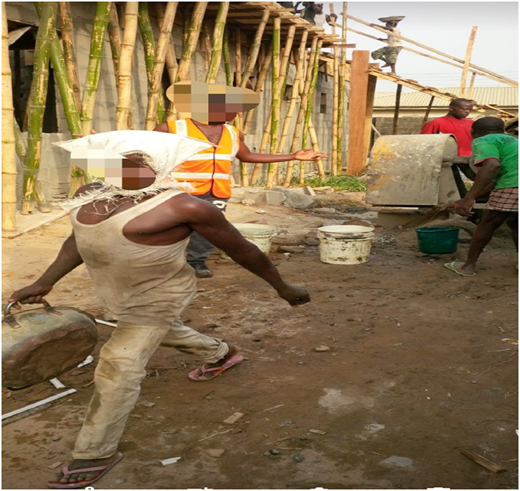
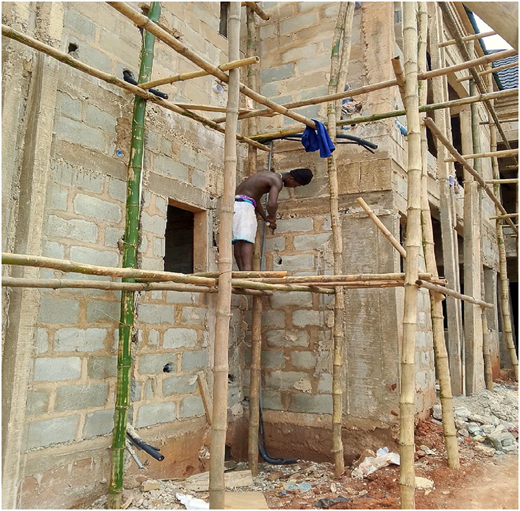
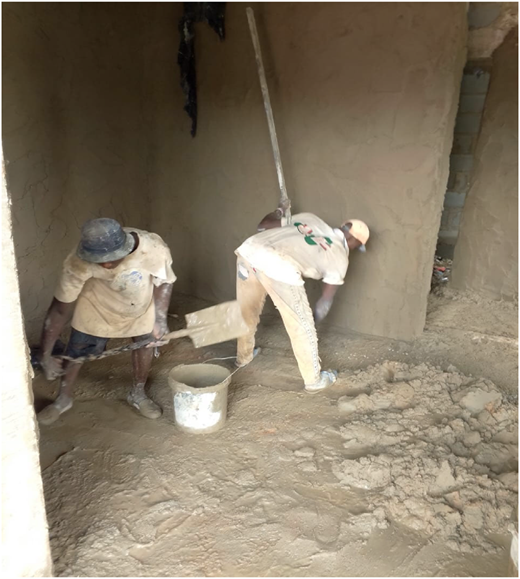
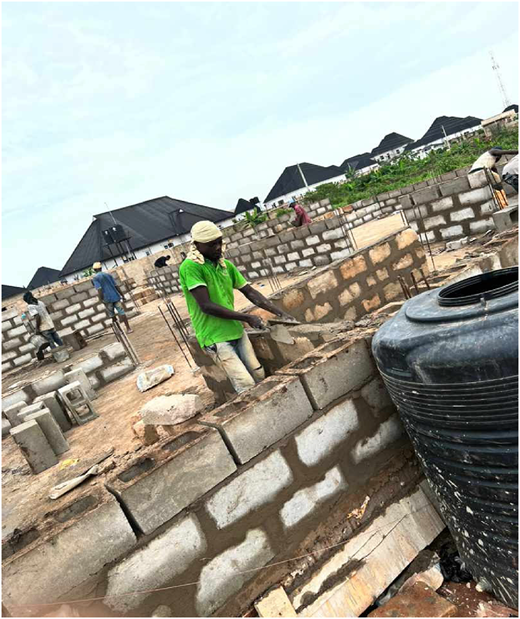
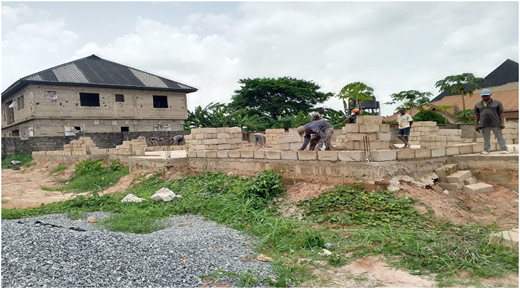
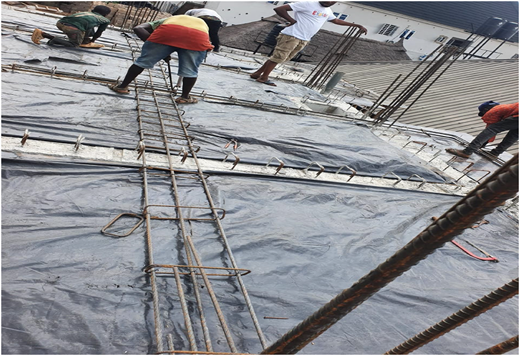
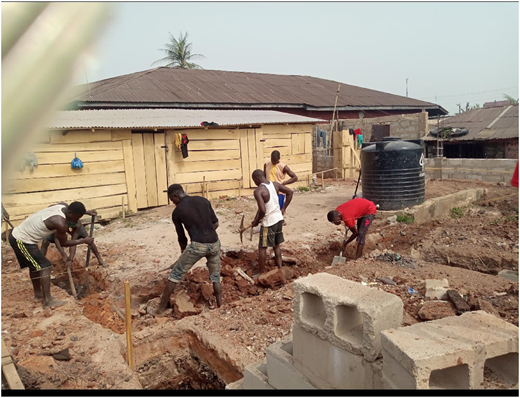
Figures 1–7 are evidence of some photo pieces from the visited construction sites. They speak volumes to express that construction artisans in the informal sector are not bothered about PPE and their well-being regarding safety and health. This is a threat to Goal 3 if not addressed. Figures 1–7 show artisans without basic PPE kits. The absence of safety footwear, protective gloves, safety helmets, and protective clothing cut across Figures 1–7. Figures 1–4 were captured from Lagos and Figures 5–7 were captured from Benin City construction sites covered. It reveals that across major site activities, from trenches excavation to finishes (wall rendering), informal construction artisans do not comply with basic safety rules due to ignorance of the consequences on their health and well-being. Findings reveal that construction artisans in the 14 sites covered receive daily payment (per/day worker) and sometimes double pay for the day depending on the artisan’s speed. This calls for urgent attention in sites where informal artisans are engaged.
4.2 Theme two: root cause of low compliance of PPE by construction artisans in the informal sector
Theme two presents the main root cause of low compliance with PPE by construction artisans in the informal sector. One pertinent point from this theme is that the major root cause is human-related factors (majority). Lax compliance with basic safety awareness, including PPE, ignorance of the consequences to their health, weak educational background, client’s attitude not to incur extra cost for safety kits, lax supervision of construction sites regarding safety compliance by authorised agencies, and absence of government regulation regarding informal sector artisans’ engagement emerged as the root cause for the low compliance. The findings also show that one possible outcome of non-compliance with PPE construction sites is sub-standard construction methods leading to sub-standard projects. Participant P40 says, “ …. don’t expect 100% perfect job (well-mixed concrete) from concrete bankers without a safety booth to protect their feet …” Findings agree with the New South Wales Ministry of Health (2020), which found that poorly constructed environments can negatively affect the social, mental, and physical health of the communities using the facilities. The consequences of the hazards are now and, in the future (P35, P37, P38, and P40). This submission corroborated the hardy hand palm of a manual excavator during a handshake after the brief interview. The participant’s handshake was stiff and hard indeed. Regarding the negative impact of their educational background, Participant P37 says, “ …. many are not concerned about the immediate or aftermath of cement on their feet or skins. Even if you make the PPE kits available and optional, I can bet the majority will not put them on. I feel educational level matters, too. To many, it’s a survival field as against living rightly …” Findings agree with Hughes and Ferrett (2016), Ogundipe et al. (2018), and Meng and Chan (2020). Hughes and Ferrett (2016) and Ogundipe et al. (2018) discovered that most construction artisans belong to the junior employees’ group, and the challenge of compliance with this group is a global issue. Meng and Chan (2020) discovered that construction employees with weak academic backgrounds display weak safety consciousness during construction project execution compared to educated employees. Only a few construction artisans went to higher educational institutions. Majority did not complete their senior secondary school level (majority). Thus, poor educational background is one of the root causes of non-compliance. Participants P6, P11, P17, P23 and P28 argued that it would be difficult if it became enforceable and monitored with strict penalties. Participant P28 says, “ …. is it the client that erects a building without government approval that will buy PPE kit for the daily artisans engaged or the small-scale contractors trying to maximise the profit that will set aside money for PPE kit?” It is a complicated issue because these artisans can be employed today in site A and move to site B tomorrow.
In all the 14 sites that agreed to participation and observation conducted by the researchers, on average, there were six workers (three construction artisans and three probationer artisans) on each construction site, there was no one safety officer or first aid box to manage any emergency. The artisans are on their own because there is lax enforcement regarding individual small construction sites (majority). Findings agree with Williams et al. (2018) and Ogundipe et al. (2018). Ogundipe et al. (2018) discovered inadequate Safety Officers on project sites, personnel’s failure to adapt to safety methods, and insufficient training on the appropriate use of PPE. In this instance, there were no first aid or PPE kits on the covered construction sites. This cannot be allowed to continue. Williams et al. (2018) identified inadequate PPE as the top-ranked factor for site accidents. In summary, the root causes are related to human-related factors like workers’ attitudes, absence of regulators and regulations, lax safety laws regarding small construction sites, absence of safety policy statements in small-scale contracting firms, and exemption of the industry site tasks from the Nigerian Factory Act 2004, and lax PPE awareness among the informal artisans across the selected construction sites in Nigeria. This study also focused on contracting firms (small-scale contractors) and self-help individuals that engage construction artisans in the informal sector. Findings across the 14 engaged sites show that informal sector’s artisans’ PPE awareness and compliance levels are poor, as presented in Figures 1–7.
4.3 Theme three: measures to improve the implementation of PPE on artisans in the informal sector
Based on the poor level of compliance and the identified root cause, providing measures to mitigate them and, by extension, improve achieving SDG 3 is pertinent. This theme provides the interviewees the privilege to offer feasible and practical measures to improve the implementation of PPE on artisans in the informal sector and, by extension, improve achieving Goal 3. Findings show lax PPE compliance levels by construction artisans in the informal sector. This attitude that the human factor would have been mitigated if the Labour, Safety, Health and Welfare Bill 2012 that will authorise the National Council for Occupational Safety and Health was passed into law. Participant P37 says, “ … we will continue to push for a revisit of the Labour, Safety, Health and Welfare Bill 2012 (as amended 2016) for this current National Assembly to review and lobby the presidency to sign it into Law. This work is timely and hoping it will get to one or two policymakers and legislative representatives when finally published …” Also, findings agree that safety and basic PPE compliance should be extended to small-scale contracting projects to ensure the informal artisans health and well-being are not threatened. Most works are managed by either small-scale contractors or self-help developers. There is a need for all-inclusive measures to regulate policies and safety practices with feasible laws, including public awareness/sensitisation of PPE relevance to health and well-being, training and education of how to use basic PPE kits, reawakening the relevant government ministries/departments/agencies in charge of monitoring and enforcement, especially in small projects, enforcement, and implementation (majority). An all-inclusive approach cannot be over-stated. Results align with Howden-Chapman and Chisholm (2018), Meng and Chan (2020), and Opoku et al. (2024). Howden-Chapman and Chisholm (2018) suggest an increasing focus on planetary health. This is because of the relationship between human health and the environment. Meng and Chan (2020) recommend that construction firms, including small-scale firms, provide basic safety training and PPE kits to engaged informal artisans.
Basic training is pertinent to awaken their weak safety consciousness and behaviour (majority). The level of education is a contributing factor to the weak safety consciousness and behaviour (P2, P4, P12, P24, P36, and P40). Participant P36 says, “… majority of the construction artisans, especially from developing countries such as Nigeria have low educational background and can flow well in pidgin English than the formal means of communication. It becomes a challenge for a safety officer who cannot relate in the language they can understand. Hence, practical training section is germane …” Opoku et al. (2024) opined that since human well-being is central to the 2030 Agenda for a sustainable future, they suggest contextualised policy measures to accomplish sustainable development and enhance well-being at the same time, including construction artisans in the workplace. Also, the findings agree with the World Green Building Council (2020), who created a high-quality educational resource framework. The concept ensures all parties are involved in achieving Goal 3. This includes construction consultants, small contractors, informal sector artisans, residents, health experts, environmentalists, and government officials. Implementation and enforcement of PPE to construction artisans in the informal sector would be made easy if these stakeholders spoke with one voice, that is, focusing on improving achieving Goal 3 across all construction industry employees (majority).
Besides sensitisation of stakeholders, especially construction artisans, regarding the consequences of non-compliance with PPE, the informal sector should embrace safety practices to improve achieving Goal 3. Results align with Williams et al. (2019) and recommend that top stakeholders should implement compliance with safety practices, including PPE usage. The findings also recommend that the relevant government ministries/departments/agencies should improve and extend their safety monitoring to construction sites where informal artisans are engaged to improve achieving SDG 3 in the informal sector. This may stir policymakers to initiate the move to pass the Labour, Safety, Health and Welfare Bill 2012 (updated in 2016) into law and improve achieving Goal 3 in the construction sub-sector. The results also align with Adeyemo and Smallwood (2017), who suggest feasible safety legislation to improve safety practices on construction sites. The legislation should make provision for stringent penalties for serial defaulters. This will reawaken small-scale contractors to embrace “safety pep-talk or drilling” with their informal construction artisans and provide basic PPE kits for their use. Currently, the safety legislation regulating construction artisans in the informal sector engaged by small-scale firms or self-help developers in Nigeria is weak.
5. Conclusion
Based on the extant literature and findings, there is a lax level of the informal sector’s artisans’ PPE awareness, especially artisans engaged by self-help developers and small-scale contractors. This shows lax safety cultural practices among the small-scale contractors, mostly indigenous and self-help developers. Findings reveal that the absence of a feasible Act or legislation to address construction safety-related issues contributed to the inability of relevant government ministries/departments/agencies to implement and enforce basic safety practices, even in small-scale construction sites. Findings reveal lax compliance with basic safety awareness, including PPE, ignorance of the consequences to their health, client’s attitude not to incur extra cost for safety kits, weak educational background, lax supervision of construction sites regarding safety compliance by authorised agencies, and absence of government regulation regarding informal sector artisans’ engagement emerged as the root cause for the low compliance. These are all human-related factors and could be mitigated with stakeholders’ right safety and cultural practices, including small-scale contractors, self-help developers, and informal construction artisans in developing countries. The study recommended a multi-measures approach that will boost PPE availability and usage by the construction artisans. One thing is to make it available; another is whether the artisans will embrace and use it. With integrated coordination and collaboration, engaging as an artisan on any construction site will become a condition for using PPE. This can only be possible if all stakeholders see safety practices as an all-inclusive primary responsibility against waiting for the government to sanction you before you do the right thing to protect your workers’ health and well-being. This mindset needs to change to improve achieving Goal 3 in all ramifications.
As part of the study’s implications, it may reawaken the Labour, Safety, Health and Welfare Bill 2012 (updated in 2016) and facilitate the passing into law by President Ahmed Tinubu’s Government. The outcome of the Presidential ascent will suggestively reawaken relevant government ministries/departments/agencies across the states charged with enforcing and implementing construction safety matters. Regarding the theoretical implications of this study’s findings, it surpasses individual practical applications and offer insights into the broader understanding of the root cause of low compliance and measures to improve the implementation of PPE for artisans in the informal sector and, by extension, improve the achievement of Goal 3. This study underscores the idea that construction artisans, especially in the informal sector embracing of PPE cannot be considered in isolation. Rather, they represent a complex relationship of health, safety, economic viability, and regulatory compliance. This all-inclusive mechanism necessitates a holistic theoretical method to engaging construction artisans in site operation. Also, for the policy implications, this research has reawakened policymakers to consider the coverage of small construction sites in implementing and enforcing safety guidelines. This is because small-scale contractors and self-help developers engage most informal construction artisans in most developing countries, including Nigeria.
The study’s primary data were sourced from Benin City and Lagos, Nigeria. This is because of the intent to have a good representation of highly populated and populated city representation. The researchers also adopted a phenomenology type of qualitative research design. However, this does not weaken the study’s strength. The study suggests that future research should relate the impact of safety practices to other SDGs and evaluate its impact. Formulating an institutional framework with the support of a theory as part of suggested future studies is germane at this point to enhance sustainability and monitoring for proper evaluation. Consideration can be given to validating emerging variables in future studies through a quantitative approach and possibly adopting some of the findings in other developing countries with similar challenges.
The authors specially thank the participants for providing scholarly contributions to enhance the findings of this study and also thank Dr S. S. Umar (Rector, Auchi Polytechnic) and his team for creating an enabling environment to contribute to this research. The authors appreciate the comments, suggestions and recommendations provided by the anonymous reviewers, which honed and strengthened the quality of this manuscript during the blind peer-review process.
Funding: The research was funded by the Faculty of Engineering and the Built Environment and CIDB Centre of Excellence (No: 05-35-061890), University of Johannesburg, South Africa.
References
Appendix Semi-structured interview questions
Dear participant,
Request for interview
The informal sector construction artisans are critical to the economic growth of a nation. However, the frequent incidence of hazards, especially on construction sites where informal sector artisans are engaged, may threaten improving achieving SDG 3. Records show that anti-safety issues (absence of PPE) threaten the lives and well-being of artisans and may be rampant in informal construction sites. There is a paucity of literature concerning compliance with basic PPE among informal sector artisans in developing countries. Thus, this study is titled: Investigating PPE Awareness of Construction Artisans in the Informal Sector: Issues and Measures to Improve Achieving SDG 3. Specifically, this study is proposed to be accomplished through the following objectives:
To assess the awareness level of the informal sector’s artisans’ PPE.
To investigate the cause of low compliance with PPE by construction artisans in the informal sector.
To suggest measures to improve the implementation of PPE for artisans in the informal sector and, by extension, improve the achievement of Goal 3.
The questions for the interview are going to be within the stated objectives. Also, your responses will be collated and analysed with other participants. This will make up a valuable, helpful contribution to achieving the success of this research. All information provided will be handled with the utmost confidentiality.
Hence, your valuable time and input in answering the questions and making other contributions will be highly appreciated. Note that findings from this study will be shared with the participants who indicate interest via email address to be supplied.
Kind regards.
Yours faithfully,
(Researchers)
Basic questions for the participants
For record purposes, what is the name of your firm?
What service does the organisation render?
What is your position in this firm, and how long have you been working?
Are you knowledgeable about PPE and SDGs, particularly Goal 3 (health and well-being)?
Can you assess the awareness level of the informal sector’s artisans’ PPE?
From your perception, what do you think there is low compliance with PPE by construction artisans in the informal sector?
If yes to Question 6, can you identify the root cause(s)?
If not, why do you think so?
Can these hindrances be mitigated to improve achieving sustainable goal 3 by informal construction artisans embracing PPE in construction activities?
If yes to Question 9, can you give a practical example of how these challenges can be mitigated?
What are the possible ways to improve the implementation of PPE for artisans in the informal sector and, by extension, improve the achievement of Goal 3.
Source(s): Authors’ work