Against a milieu of fragmented research that documents indigenous practices related to food security, and the heterogeneous settings from which the studies have been conducted, this study aims to synthesize the evidence of indigenous knowledge-food security nexus to strengthen the call for the revitalization of indigenous knowledge (IK) as part of the mechanisms to manage food security challenges being aggravated by climate change.
Drawing on insights from sub-Saharan Africa (SSA), this study reviews 122 articles accessed from the Web of Science and Scopus databases, which covered indigenous methods used for producing, gathering, processing, preserving and storing diverse food sources that indigenous people deploy in securing their food systems.
The surge in attention to focus on IK-food security nexus tends to be influenced by the growing acknowledgement of climate change impacts on food systems. Essentially, the IK-based practices adopted address all the four food security pillars that are specified by the Food and Agricultural Organization (FAO) as availability, accessibility, utilization and stability. The main motivation behind the continued use of IK-based ways relates largely to the interest to be food secure against climatic shocks and partly to the desire to maintain people’s food cultures and food sovereignty.
This study deploys the food security pillars provided by the FAO (2012) to demonstrate that IK-based ways of food management are capable of addressing all the four food security dimensions, a critical observation toward revitalizing IK in managing growing food security challenges that are intensified by climate change in SSA.
1. Introduction
There is now compelling evidence that food systems are negatively affected by climate change (Nalau et al., 2018; Aniah et al., 2019) and the greatest impact is felt in sub-Saharan Africa (SSA) (Ebhuoma and Simatele, 2017). It is believed that climate change will reinforce other non-climatic drivers and stressors to worsen vulnerability of agricultural systems (Aniah et al., 2019). Changes in precipitation and temperature regimes as well as increased frequency in extreme events are already decreasing the productivity of crops and rangelands. The impacts are anticipated to worsen in a projected warmer and drier climate. The subsequent changes in agro-ecological conditions are also feared to create favorable conditions for new pests and diseases that affect crops and livestock (Aniah et al., 2019). Notwithstanding progress made in managing risks of food security systems, the current adaptation pathways are not sufficient to withstand climatic impacts (Makondo and Thomas, 2018). Accordingly, processes that promote collaborative ideas and interventions between scientists and farmers to strengthen coping strategies and adaptive capacities are very urgent. Within this view, the knowledge and experiences of indigenous communities in food security systems deserves some attention. The growing inclination to learn from the ways of indigenous people can be attributed to worsening climate change impacts on food security (Chivinge et al., 2015; Makondo and Thomas, 2018) and the acknowledgement of the critical role of indigenous knowledge (IK) in the food system (Mubaiwa et al., 2017; Krause et al., 2019a; Shayanowako et al., 2021).
Definitions of food security abound and their evolution have shifted from emphasis on food production to food access (Pinstrup-Andersen, 2009; Krause et al., 2019a). This article embraces the view given by the Food and Agriculture Organization at the 1996 World Food Summit, which states that food security is met when “all people, at all times, have physical and economic access to sufficient, safe, and nutritious food to meet their dietary needs and food preferences for an active and healthy life.” The FAO (2012) identifies four main dimensions of food security as: availability, access, stability and utilization (Table 1).
While in many parts of the world advances have been made in food management methods that always ensure food availability and accessibility, SSA still has food management challenges owing largely to technology and knowledge infiltration challenges (Ebifa-Othieno et al., 2017; Agyei et al., 2020). The region trails behind the rest of the world in efforts to address food insecurity, yet it used to be food self-sufficient (Jamnadass et al., 2011; Luan et al., 2013). The abandonment of IK is blamed as one of the drivers of food insecurity in the region (Kamwendo and Kamwendo, 2014). Accordingly, many scholars call for the revival of indigenous food management methods to mitigate food insecurity in SSA (Cloete and Idsardi, 2013; Cousins and Witkowski, 2015). Within the climate change and food security research communities, there is now increasing interest to examine the role of IK in adapting food systems to the effects of climate change (Ebhuoma and Simatele, 2017; Makondo and Thomas, 2018). Mistry and Berardi (2016) defined IK as local and context-specific knowledge, which is adaptive to changing environments, collectivized through a shared social memory and situated within numerous interlinked facets of people's lives. Local and indigenous populations in various parts of the world continue to use IK to adapt their food systems to climate change. However, this knowledge has largely remained fragmented alongside the unique nature of the settings where the knowledge is being applied. This research attempts to address this fragmentation by reviewing the evidence of IK usefulness within the four food security pillars. It argues for the revitalization of the indigenous food management practices given the increased food insecurity challenges that are worsened by climate change in SSA. Specifically, the study intended to: map the IK practices related to food security management in SSA; consolidate the evidence into a synthesized analysis that showcases IK usefulness in management of food systems; analyze the extent to which IK addresses the four pillars of food security; and discuss the prospects and challenges in the resilience of IK-based food systems in the face of climate change.
We adopt the terminology “indigenous food management practices” to cover the broad ways used by indigenous communities to gather, collect, process, preserve and store food. This article is structured as follows: first, we present the methods used to gather literature on indigenous food management practices; second, we map the coverage of this scholarship in SSA; third, we identify particular cases of IK related to food management, which describe the food sources and ways in which the communities use their knowledge in indigenous food systems; lastly, we discuss the prospects and challenges in the deployment of these practices and their implications in the ongoing discourse of managing food security challenges and climate change.
2. Methods
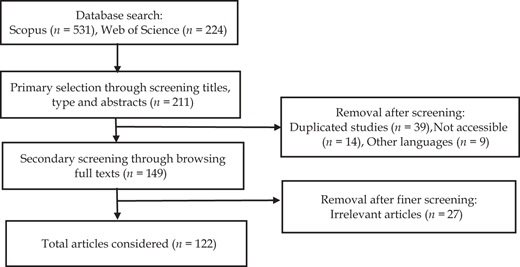
This study conducted a review and analysis of scholarship that treats the topics of IK and food security in SSA. It used the framework of food security provided by FAO (2012) (i.e. availability, access, stability and utilization) to categorize the indigenous based practices according to the reviewed literature. We used two electronic databases (Web of Science and Scopus) to search for the literature prior to conducting content analysis of the identified sources. Prior to the literature search, an analysis of studies on the topics of IK and food security had shown multiple terminologies existing as “indigenous knowledge,” “local knowledge,” traditional knowledge,” “farmer knowledge,” “rural people’s knowledge,” “local people’s knowledge,” “indigenous knowledge systems” and “indigenous and local knowledge.” Accordingly, our search used these terms as key words. The terms “food security” and “Africa” were included in the search criteria. The search results were limited to a date range from 2000 to 2021 and the database searches were completed on the 5th May, 2021. The screening criteria considered the following: articles linking IK practices and food security; freely available full text articles and/or those accessible via the University of Johannesburg; English peer-reviewed journals; and articles reporting about IK practices in Africa only. A total of 122 articles were considered for subsequent analysis after screening for relevance and removing duplicates from the two databases (Figure 1).
Data analysis was guided by themes emerging from the broad range of IK applications in food collection and harvesting, food preservation and storage and food preparation and processing. The analysis method looked for content of these themes and how they related to food security in each of the considered article. These themes were also used to present the results. We first classified each article according to the area that the study covered and the sources of the indigenous foods being reported. The results were subsequently discussed within the framework of food security dimensions provided by FAO (2012) (Table 1). The discussion also used the broad utility of IK applications in the food system to reveal the prospects and challenges associated with IK and food security.
3. Results
3.1 Distribution of indigenous knowledge and food security research in sub-Saharan Africa
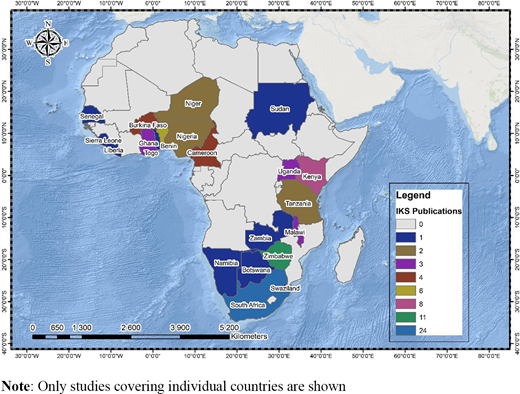
There is a wide coverage of research that examines indigenous ways of food management for food security in SSA. South Africa dominated in the number of research with 24 articles, followed by Zimbabwe (11), Kenya (8), Benin (6), Cameroon (4) and Burkina Faso (4). In the rest of the countries, the articles ranged between one and three (Figure 2). However, other studies, particularly review articles, documented indigenous ways of food management practices at a broader level: 32 articles reported about practices in the whole of SSA region; four studies covered West Africa; two studies were on Southern Africa; and two reports combined West and Central Africa sub-regions. Only two studies compared the indigenous food security practices in two countries.
3.2 Sources of indigenous foods
Indigenous food sources range from edible insects to indigenous fruit trees; traditional herbs, crops and leafy vegetables; bulbs and tubers; traditional bean varieties; mushrooms; and pteridophytes (Table 2). The terms “indigenous fruits” or “traditional fruits” and “indigenous vegetables” or “traditional vegetables” have been deployed interchangeably in many studies. Indigenous fruits or indigenous vegetables refer to traditional sources of foods commonly obtained from the wild or growing naturally from cultivated lands, which have originated in SSA and have a long history of consumption in many African communities. Most of these food sources are from indigenous wild fruits, leafy vegetables and traditional crops. Entomophagy, the human consumption of insects, is also regarded as an important practice in many countries (Illgner and Nel, 2000; Dzerefos and Witkowski, 2014; Kelemu et al., 2015; Niassy et al., 2016). Kelemu et al. (2015) reported that over 470 species of insects are eaten in SSA countries. These insects include termites, crickets, caterpillars and locusts.
3.3 Indigenous knowledge practices related to food collection and harvesting
Most indigenous fruits are harvested from the wild (Mithofer and Waibel, 2003; Kiptot et al., 2014) together with insects collected for entomophagy (Kelemu et al., 2015; Niassy et al., 2016). Some indigenous vegetables are either collected from the wild (Vorster et al., 2009) or have been cultivated (Mncwango et al., 2020) alongside most traditional crops such as millet, sorghum, cassava and yam (Oniang'o et al., 2004; Shava et al., 2009; van der Merwe et al., 2016). Studies in Zimbabwe, Zambia and Malawi revealed that most households collect indigenous fruits as a coping strategy to deal with drought-induced hunger (Kiptot et al., 2014). Similarly, the collection of indigenous fruit products in West and Central Africa, reported by Kengni et al. (2004) and Vall et al. (2011) was seen as a strategy to cope with food insecurity especially during lean seasons in semi-arid areas. Most of the insects consumed are collected using traditional methods (Niassy et al., 2016). Saka et al. (2007) and Dhliwayo-Chiunzi et al. (2014) gave detailed descriptions of the methods used in collecting Uapaca kirkiana fruits in Southern Africa.
3.4 Indigenous knowledge practices related to food preparation and processing
Indigenous practices used in the preparation and processing of vegetables, fruits, crops and milk products are well documented. Depending on the food type being processed, these techniques include boiling and drying of vegetables and grains (Masarirambi et al., 2010; Ibnouf, 2012); sun-drying, frying, boiling and roasting of insects (Niassy et al., 2016); and fermentation of milk, fruits and vegetables (Oguntoyinb et al., 2016; Agyei et al., 2020). The processing of vegetables through a combination of boiling and sun-drying is a prevalent practice reported in Swaziland (Masarirambi et al., 2010), South Africa (Masekoameng and Molotja, 2019), Sudan (Ibnouf, 2012), Kenya (Ayua et al., 2016; Gogo et al., 2016), Tanzania (Weinberger and Swai, 2006), Benin (Madode et al., 2011) and in most African countries (Shayanowako et al., 2021). The methods used for processing of wild fruit trees are also widely documented. Chadare et al. (2008) wrote about the processing of baobab (Adansonia digitata) into various food products such as: drinks and gruel from pulp; dough from fruits; potash from roots; and soups and flavoring agents from leaves, seeds and kernels. Studies by Hiwilepo-van Hal et al. (2014), Pouliot (2012); van der Stege et al. (2011); and Nyanga et al. (2008) covered the indigenous processing methods of marula (Sclerocarya birrea), shea (Vitellaria paradoxa), tamarind (Tamarindus indica) and Ziziphus mauritiana, respectively.
In Benin, Madode et al. (2011) described indigenous preparation for cowpea, which involves steeping, dehulling, milling, whipping and cooking. Similar food processing practices were reported in Zimbabwe by Shava et al. (2009), Togo (Adoukonou-Sagbadja et al., 2006) and the entire West African sub-region (Azam-Ali, 2007). Masarirambi et al. (2010) stated that unavailability of freezing and chemical processing methods for preservation has enabled the indigenous communities to stick to their own trusted techniques. From the findings of Niassy et al. (2016), boiling technique does not only reduce the amounts of toxic phytochemicals found in insects but also eliminates pathogens. Nyanga et al. (2008) provided detailed description of the procedure for processing Z. mauritiana fruits in Zimbabwe, whereas Pouliot (2012) described the method for processing V. paradoxa fruits in West Africa.
3.5 Indigenous knowledge practices related to food preservation and storage
Food needs to be preserved to control spoilage and foodborne diseases (Oguntoyinb et al., 2016). Sun-drying of raw or boiled vegetables was reported by Vorster Ineke et al. (2007) and Garutsa and Nekhwevha (2018) in South Africa; Masarirambi et al. (2010) in Swaziland; and Ibnouf (2012) in Sudan. Oniang'o et al. (2004) observed that the solar-drying technique is extensively applied for fruits, vegetables, mushrooms and tubers in many countries in Africa. Ayua et al. (2016) reported about the sun-drying of fruits and vegetables in Kenya. In addition, root crops and tubers (yams, cocoyams and cassava) are stored in underground pits after harvesting. These can be left in the ground for up to two years to act as a food reserve and used as the main source of food during lean times (Oniang’o et al., 2004). The shelf life of dried insects can be extended by applying certain additives such as salt, palm oil or pure honey (Niassy et al., 2016).
One of the common practices widely used for seed and yield preservation involves heat treatment and smoking. In South Africa, for example, Modi (2004) documented the practice as involving storage of maize cobs over a fireplace where the seeds are subjected to smoke and heat. The scholar also observed that Taro (Colocasia esculenta) propagules are maintained in dry pits for one month, in layers separated by grass straw and water is prevented from entering. In Ghana, Aniah et al. (2019) emphasized the importance of these traditional practices in managing post-harvest food losses. The authors indicated that farmers use plant extract (dabokoka) when preserving and storing grains. In Zimbabwe, groundnuts and Bambara nuts are also dried with outer covers to keep them safe from infections (Matsa and Mukoni, 2013). The use of ash as a food preservative is widespread among many indigenous communities in SSA as revealed by Gadzirayi et al. (2006) and Matsa and Mukoni (2013) in Zimbabwe, Kamwendo and Kamwendo (2014) in Malawi and Ibnouf (2012) in Sudan. Gadzirayi et al. (2006) revealed high efficacy of maize cob ash in controlling weevils that are common in stored grains. Ebregt et al. (2004) and Dougoud et al. (2019) gave detailed descriptions on the use of insecticidal plants to preserve seed grains by communities in East Africa.
4. Discussion
4.1 Indigenous knowledge and food security pillars
Indigenous food management practices involve people’s specialized knowledge about what is edible and safe for consumption from the various fruits, wild herbs and vegetables and insects. The maintenance of food sources is enabled by a system of knowledge, norms, regulations, enforcement and taboos that regulates and restricts unsanctioned behavior against natural resources depletion. The idea is to make sure that the food is available when needed. One of the main challenges of food security in SSA is to make food available and accessible. Where communities have managed to adhere to indigenous food sources as alternatives, there is evidence of mitigating hunger and starvation through exploiting their traditional food mechanisms. Collection of indigenous foods enables communities to obtain food in different times of the year (Maroyi, 2013). This aids in food availability and accessibility.
The purpose of food storage, as explained by Modi (2004) and Ibnouf (2012), is to keep food in a preserved form so that it is not attacked by pests or diseases, thereby keeping it in good quality for later use. As such, the practice ensures food security in that it allows the food to be available and accessible when required. Preservation techniques of fruits and vegetables increase nutritional value and improve safety of food products (Gogo et al., 2016). Wild fruits and vegetables are nutritionally rich and high in phytochemicals, which are important in promoting a healthy and balanced diet (Bvenura and Sivakumar, 2017; Chawafambira et al., 2020). Similarly, consumption of insects enables communities to get a protein supplement that boost people’s diet (Illgner and Nel, 2000; Kelemu et al., 2015). A balanced diet addresses the food utilization component of food security.
Diversity of local foods in meeting dietary needs can contribute to achieving year-round household food security, offering sustainable food security and solving malnutrition (van Rensburg et al., 2004; Ng’endo et al., 2018; Kirigia et al., 2019). Most indigenous fruit trees are accessible, readily available and affordable, with valuable health benefits (Omotayo et al., 2020a, 2020b) and are capable of addressing micronutrient deficiency (Krause et al., 2019a; Aderibigbe et al., 2020). Products such as juices and jams from processed indigenous fruits are rich sources of zinc, copper and phosphorus (Saka et al., 2007). Many indigenous herbs are believed to be effective in curing diarrhea and other ailments (Bisi-Johnson et al., 2010). Given that conventional medicines are costly and inaccessible amongst most rural people in SSA, indigenous herbs and medicines are a reliable alternative (Shackleton, 2003; Bisi-Johnson et al., 2010). This aspect covers the utilization element of food security.
Bharucha and Pretty (2010) stressed that wild food sources are a “hidden harvest” that provides communities with food during critical times. Particularly important is that these foods supplement cultivated food crops during periods of drought (Kabore et al., 2011; Chivinge et al., 2015; Shilenge, 2016). Access to traditional foods is crucial during times of food shortage as some indigenous fruits are consumed seasonally at a time when people run out of food (Stadlmayr et al., 2013; Agundez et al., 2016; Mwadzingeni et al., 2021). Traditional leafy vegetables are important for food security in rural areas throughout the year. The dried vegetables extend their shelf life and can be a safety food source used to ensure food availability off season (Maranz et al., 2004; Vorster Ineke et al., 2007). Food processing and preservation techniques such as drying and fermentation are carried out during times of abundance for times of scarcity (Ibnouf, 2012). These mechanisms ensure that food would be available and stable throughout the year.
The critical role of women in stabilizing indigenous food systems feature prominently in IK-food security studies. Women’s roles are predominant in all aspects, from food production (Carney and Elias, 2006; Ebhuoma and Simatele, 2017), to food gathering (Mithofer and Waibel, 2003), food processing (Ibnouf, 2012; Nyadanu et al., 2017), food preservation and storage (Ibnouf, 2012; Garutsa and Nekhwevha, 2018) and trading of indigenous foods (Maroyi, 2011; Kiptot et al., 2014). Although this can be viewed as a burden (Garutsa and Nekhwevha, 2016; Boakye et al., 2018), other scholars argue that the comprehensive involvement of women enhances the stability of food at household level (Mithofer and Waibel, 2003; Ebhuoma and Simatele, 2017).
4.2 Prospects and challenges in indigenous knowledge use
The use of IK in food security has mixed views. Traditional practices through maintaining, cultivating and processing traditional food crops sustain their culture and livelihoods, thereby providing community resilience in a changing climate (Shava et al., 2009). Indigenous plants adapt well to marginal conditions, a situation that is essential for resilient agriculture and sustainable food systems (Omotayo and Aremu, 2020a). The recurrent drought experienced in most semi-arid areas compels the people to switch to lean indigenous crops as food sources (Vall et al., 2011). For instance, drought tolerant crops such as traditional grains of sorghum and pearl millet and crops like cassava are increasingly being preferred in many rural areas of SSA (van der Merwe et al., 2016; Omotayo and Aremu, 2020a). Similarly, Azam-Ali (2007) indicated that the adoption of multi-cropping systems with indigenous crops is critical in combating climatic risks. Indigenous people are important in agroforestry programs of indigenous fruit trees (Jusu and Cuni-Sanchez, 2017; Meinhold and Darr, 2020). Agroforestry can be an opportunity for implementing afforestation and reforestation projects that are important in addressing deforestation and desertification threats in SSA. Afforestation would target planting of indigenous fruit trees mixed with other drought tolerant crops. Reforestation projects would involve growing indigenous fruit tree species that face extinction, particularly in lands degraded by overgrazing and land abandoned owing to overcultivation. Wynberg et al. (2003) also expressed that indigenous fruit trees constitute an essential part of the livelihoods, culture and spirituality of rural communities. Indigenous spirituality can promote sustainable management of trees and ecosystems under climate change (Nalau et al., 2018; Chanza and Musakwa, 2021). This suggests that there are high prospects of embracing climate smart agricultural programs such as agroforestry when working with indigenous communities. However, loss of biodiversity and the associated IK may limit these initiatives (Vorster et al., 2009).
There are also adaptation prospects emerging from indigenous food management practices. Motivation of indigenous people to conserve or grow wild edible trees have been linked to food security and their use in traditional medicine and cultural events (Assogbadjo et al., 2012). Makondo and Thomas (2018) indicated that indigenous communities have been able to adapt, build resilience and solidarity against food shortages in the face of climate change through household interdependence and spirit of resource sharing. Briggs and Moyo (2012) stated that the resilience of indigenous farming practices is influenced by food security interests and the desire to maintain soil fertility. Indigenous methods applied by women to sustain household food supplies are said to be culturally acceptable, economically practicabl and more appropriate for the local environment than modern techniques and solutions suggested by external experts (Ibnouf, 2012). These insights suggest greater potential to leverage the existing indigenous practices and systems for successful adaptation to climate change.
Nonetheless, adoption of some of the foods tends to have some challenges. Madode et al. (2011) and Nnamani et al. (2017) cited long time is required for processing and cooking certain crops such as cowpeas and Bambara groundnuts. These crops are underutilized because of a “hard-to-cook” phenomenon combined with inadequate processing techniques (Mubaiwa et al., 2017). Mooketsi and Gestring (2011) noted diminished use of indigenous leaf vegetables and limited preference by young people in some communities where they are regarded as poor people’s food. Similarly, Nyadanu et al. (2017) cited bad odor, limited market access, lack of elite genotypes, bush fires and tiresome labor operations as constraints. Although the indigenous methods of food storage have a long history necessary for maintaining landraces, there is concern that the methods are being abandoned with no modern technology replacements (Modi, 2004). Some knowledge of food processing techniques that have been used from time immemorial are being lost because of urbanization and rural–urban migration of younger people (Mooketsi and Gestring, 2011; Masarirambi et al., 2010; Mubaiwa et al., 2017). Other threats relate to the combined effects of climate change and human and wildlife pressure on the environment. For example, encroachment of human settlements and cultivated lands into woodlands and forests can lead to extermination of wild fruits. However, Shayanowako et al. (2021) revealed that traditional food processing methods are still prominent in many African societies. The fears about the erosion of IK-based foods are likely to be addressed by the increasing consciousness of the health benefits that are associated with indigenous foods. This suggests that use and preference of indigenous foods may still be maintained despite these threats.
Mainstreaming indigenous and traditional crops into the food system can contribute to a sustainable and healthy food system, while creating opportunities for local employment and environmental sustainability (Mabhaudhi et al., 2019; Akinola et al., 2020; Omotayo and Aremu, 2020a). This can also serve as safeguarding against the loss of IK. It may also be important to provide incentives and encourage the domestication, commercialization and agro-processing of indigenous fruit trees (Omotayo and Aremu, 2020b). Similar calls for interventions to unlock the potential of indigenous and traditional foods are made by Cloete and Idsardi (2013). More efforts toward value addition and marketing to realize the full benefits of such foods need to be considered (Dovie et al., 2007; Meinhold and Darr, 2020). Overall, individual countries need to formulate and strengthen policies that promote the continued use of IK in food systems.
4.3 Limitations and opportunities for future research
In an endeavor to analyze and synthesize the most authoritative and reliable literature available on the topic, this study only focused on selected English peer reviewed journal articles and did not include grey literature or books and book chapters. This focus may also be considered a limitation, given the possibility that this scoping may have missed some valuable accounts of other IK-based food systems documented elsewhere and thus omitted from the analysis. Even so, given a total of 122 articles considered in this review, it is reasonable to deduce that the studies reported here have offered comprehensive – albeit non-exhaustive – perspectives on important issues relating to indigenous food cultures and practices in the face of climate change. Future research may look at safeguarding the knowledge of indigenous foods in the context of important global mega-trends such as urbanization and globalization. There is also an opportunity to examine the extent to which indigenous food systems can be affected by exogenous adaptation practices that are driven by food security fears in the face of climate change. Finally, there are fertile opportunities for research on gendered perspectives in relation to IK, both historical, contemporary, prospective and comparative.
5. Conclusion
The surge in attention to focus on IK in food security studies tends to keep pace with the growing threat of climate change on food security. Given combined greater recognition and the worsening climate-induced threat on food security, it can be concluded that indigenous ways of food management need to be revived. This study has demonstrated that the indigenous knowledge practices adopted for food collection, preparation, processing, preservation and storage are capable of addressing all the four food security pillars. The synthesis provided has revealed that despite IK practices being treated as existing in unique settings, there are many aspects of commonalities in the ways that the communities collect, process, preserve or store food. Notwithstanding the observed challenges in adherence to indigenous food management practices, there is evidence that the IK practices are still considered relevant among many countries in SSA. The lack of access to modern technologies reported by some scholars appears to have limited influence when understood within the cultural settings that shape food systems in many parts of indigenous African communities and the widespread anticipated health benefits that they get from resorting to traditional foods. The main motivation behind the continued use of IK-based ways relate largely to the interest to be food secure against climatic shocks, and partly to the desire to maintain their food cultures and food sovereignty. Traditional foods provide inexpensive, safe, nutritious foods throughout the year and are easily accessible to the poor. Most of the indigenous foods discussed here are adapted to dry areas, making them useful in a context of a drier climate that SSA continues to face.
Funding: The research of this article was supported by DAAD within the framework of the climapAfrica programme with funds of the Federal Ministry of Education and Research.
Conflicts of Interest: The authors declare no conflict of interest. The funders had no role in the design of the study; in the collection, analyses or interpretation of data; in the writing of the manuscript or in the decision to publish the results.